Opisthographic inscriptions have not received much attention from scholars. One particular practice, the reuse of an inscribed stone for a new inscription, has been studied well,Footnote 1 but opisthographic inscriptions that cannot be explained as reuse remain understudied. In this article a case study of the double-sided inscriptions in one collection, the epigraphy holdings of the New York University Classics Department, will demonstrate that the existing explanations for opisthographic inscriptions showing no evidence of reuse are unsatisfactory.
Ivan Di Stefano Manzella, to the best of my knowledge the only scholar to date who has systematically studied opisthographic inscriptions, lists three possible circumstances (other than recycling) that would lead to a stone being inscribed on both sides. One possibility is that the customer is dissatisfied with the initial inscription because of an error or an omission and orders the stonecutter to use the other side of the stone for an improved version. Alternatively, the stonecutter himself is dissatisfied and decides to use the other side of the stone for a second try, or, thirdly, he might have used one side of the stone to cut a draft version.Footnote 2 Regarding this last possibility, it is worth noting that it would be much easier for a stonecutter to produce a draft on papyrus, a wax tablet or an ostrakon. If he were to use the back of the stone for a draft version, it seems that he would continuously have to flip the stone to check the draft and the final version against each other. The first two explanations offered by Di Stefano Manzella likewise fall short in accounting for non-reused double-sided inscriptions, as the detailed study of just a small number of opisthographic epitaphs will show.
The New York University (= NYU) Classics Department houses over forty Roman epitaphs. Most of them probably come from the Porta Salaria necropolis north of Rome. The collection was published in 2014.Footnote 3 Of these epitaphs four are inscribed on both sides of the stone, even though they would have been fixed against a wall in situ, thus hiding one of the inscribed surfaces from view. Three of the NYU opisthographs (nos. 4, 28 and 29) are inscribed for the same person on both sides. One of them, no. 33, may have been reused for a different person, since the inscription in the back is too fragmentary to determine who its dedicatee was.Footnote 4 In what follows I will test the existing explanations for opisthography by taking a closer look at the three NYU epitaphs that were inscribed twice for the same individual.
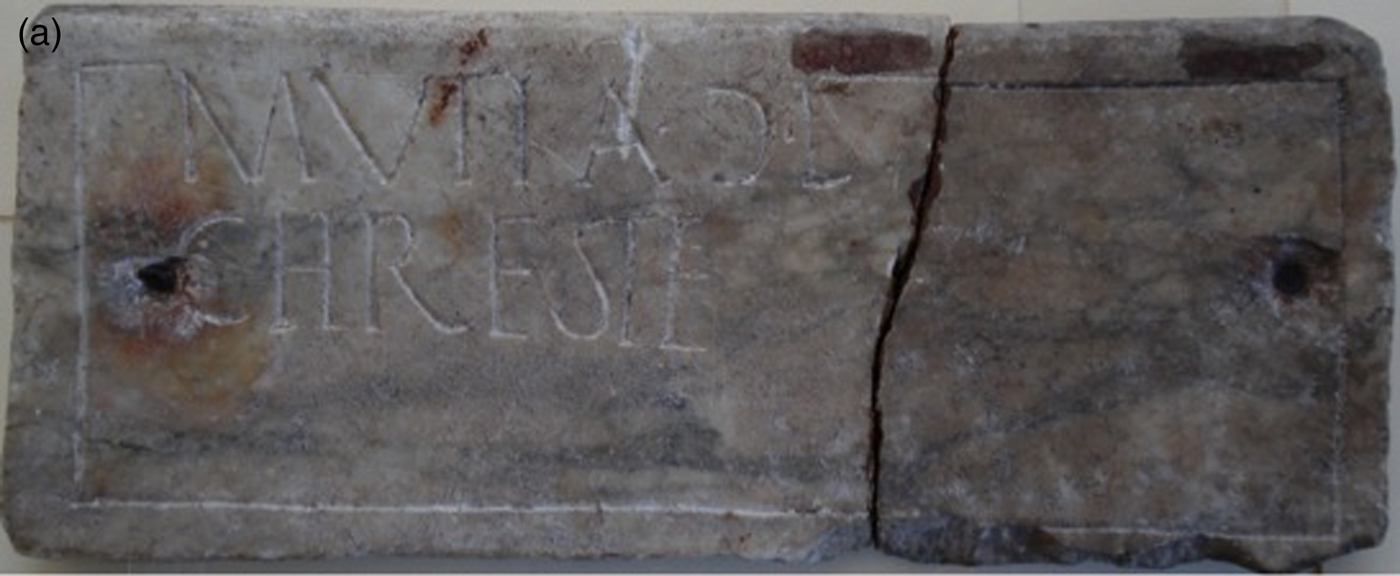
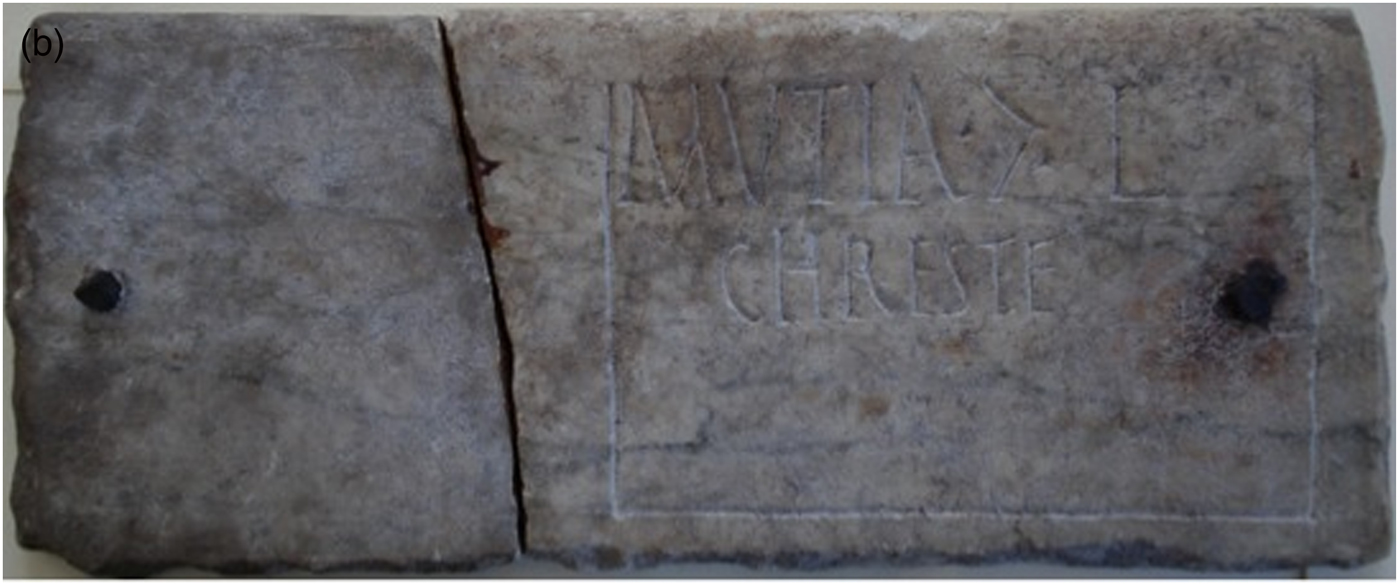
NYU inscription no. 28 is a gravestone for a freedwoman named Mutia Chreste. The small rectangular shape of the stone (14.5 cm × 35.5 cm) strongly suggests that it was used as a columbarium marker. The text of the inscription is the same on both sides:
(This monument is for) Mutia Chreste, the freedwoman of a woman.Footnote 5
This inscription has been dated to the second century c.e., based on the style of the lettering and the popularity of the name Chreste in that period.Footnote 6 Columbarium markers such as this are typically attached to the wall of the columbarium, under the niche for the urn, hiding the back from view.Footnote 7 This is confirmed in this case by the presence of nails, which also seem to indicate which was intended as the front side of the stone, and which as the back (see figs. 1a and 1b).Footnote 8
Epitaph for Mutia Chreste, recto.

Epitaph for Mutia Chreste, verso.

On Mutia's stone no omission or error in either version of the text could have caused the customer to desire a second inscription. Although the reverse ‘c’ is round on the recto and has a sharp wedge shape on the verso, this would seem to be too slight an imperfection to justify the trouble and expense of an entire new inscription. The writing on both sides of Mutia's stone is comparable in style and quality, with a simple border framing both inscriptions. In sum, the Mutia inscription cannot easily be explained by Di Stefano Manzella's account.
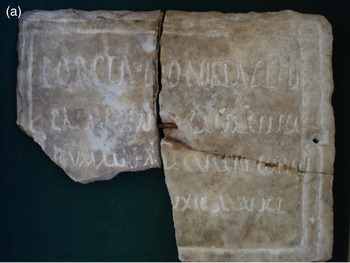
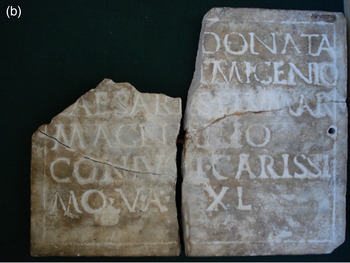
On NYU epitaph no. 4 the inscriptions both on the front and on the back are practically identical in content but quite different in appearance (figs. 2a and 2b):
front: Porcia Donata fecit
Primigen[io] Caesaris ser(uo)
plumario magnario, coniu(gi)
[carissimo. u]ixit ann(os) XL.
back: [Porcia] Donata
[fecit Pr]imigenio
Caesaris plumario
magnario
5 coniugi carissi-
mo. u(ixit) a(nnos) XL.
Porcia Donata dedicated this for Primigenius, a slave of the emperor, (chief?) embroiderer, her dearest husband. He lived for forty years.
Epitaph for Primigenius, recto.

Epitaph for Primigenius, verso.

The inscription has been dated to the first or second century c.e.Footnote 9 The small size of the stone (33 cm × 27 cm) suggests that this is another columbarium marker, and from the nail holes we can tell that the stone was indeed fixed to a wall, as one would expect. The side that, judging by the nail holes, probably faced out was cut with cursive letters, a practice fairly rare for Latin tombstones.Footnote 10 The other side was cut with capital letters. A single ornamental border frames the text in the back, and the front has a double ornamental border. Lastly, the text on the back is upside down with respect to the front-side text.
Aside from the different styles of writing, the word ser(uo) is missing from the inscription on the back. This may be explained by the fact that capitals take up more space; the omission does not affect the meaning. There is a possibility that Primigenius’ wife had the stone inscribed in cursives initially, and that after some time it was decided that a regular inscription with capital letters would be better. If the inscription was taken down, re-inscribed and turned around at this point, on account of dissatisfaction with the initial inscription, it would fit with the first explanation for opisthography offered by Di Stefano Manzella. The appearance of the nail holes, however, does not support this scenario: there is no sign of the inscription with regular capitals ever having faced out (see n. 10). It seems, then, more likely that Porcia Donata, like Mutia, had the epitaph inscribed on both sides intentionally, and that Primigenius’ stone is another example of unexplained opisthography.
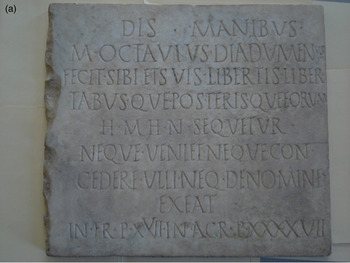
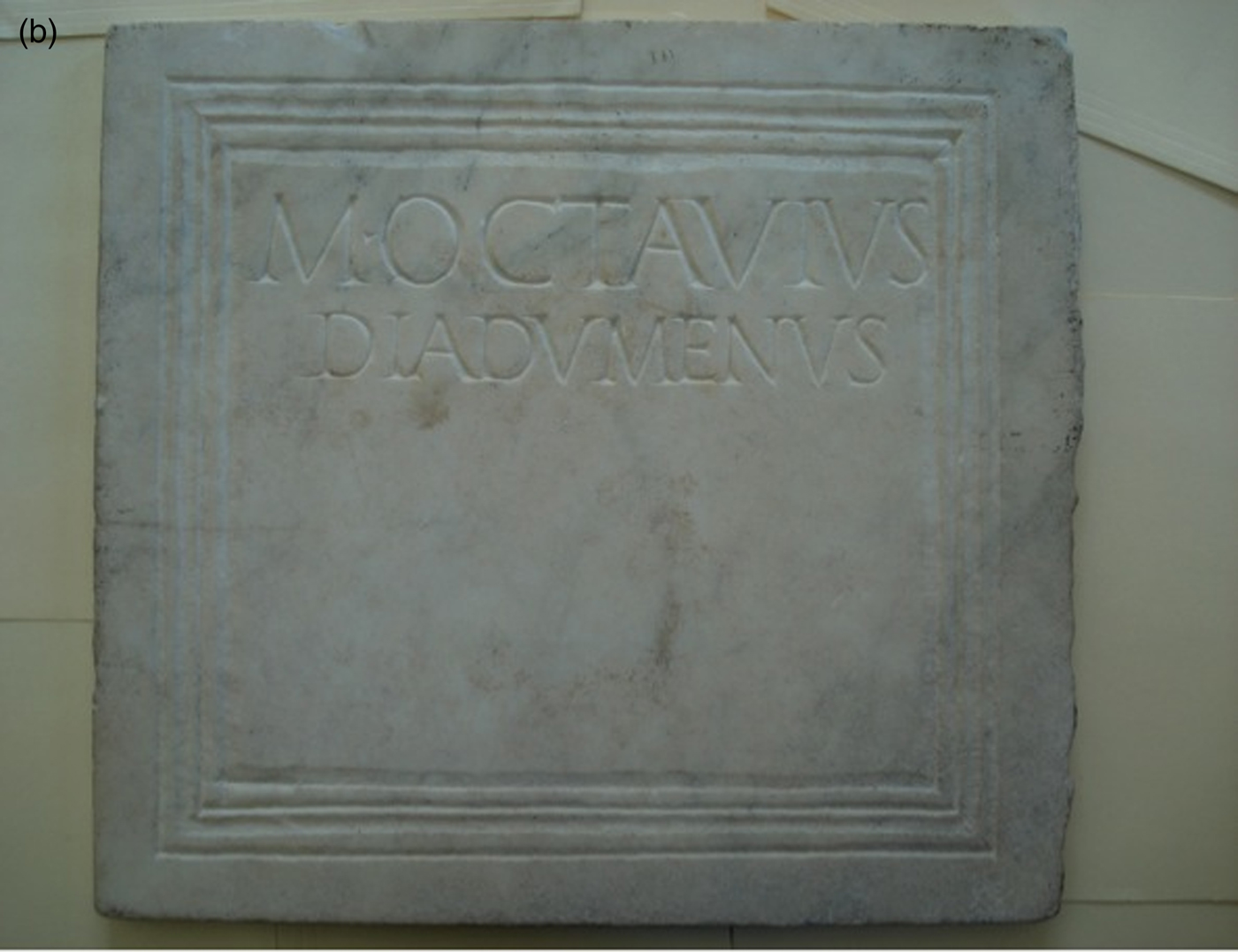
On stone no. 29, in contrast to our examples so far, the texts inscribed on the two sides are quite different in content (figs. 3a and 3b). One side contains the full epitaph, while the other side, which for reasons I explain below was probably the back, holds only the name of the deceased, written in full just as on the front. The front reads:
To the divine shades. Marcus Octavius Diadumenus dedicated (this monument) for himself and his (family), for his freedmen and his freedwomen, and for their descendants. This monument shall not go over to an heir, nor shall it be sold nor turned over to anyone,Footnote 11 nor shall it pass from the family name. (The plot is) 17 feet wide, 47 feet deep.
Epitaph for M. Octauius Diadumenus, recto.

Epitaph for M. Octauius Diadumenus, verso.

This epitaph of moderate size (47 cm × 42.5 cm) was likely attached to the wall above the entrance either of a mausoleum or of a walled burial site, or to a standing base in the centre of a burial site marked off by cippi. Clear indications for this are the specification of the plot size, and the stipulations on who may be included in the burial complex.Footnote 12 Because the inscription provides this information, this side was probably the front. However, in the absence of nail holes (the stone was perhaps fastened with clamps), it is difficult to determine for certain which side faced out. The epitaph has been dated to the second half of the first century c.e., based on the use of Dis Manibus and on the letter style.Footnote 13
Just as with Primigenius’ and Mutia's stones, the inscription on the back of stone no. 29 cannot be considered ‘wrong’. Rather, it reiterates the dedication in the front by repeating the dedicatee's name in large letters. The shorter inscription did not serve as a draft: the quality of the writing is high and there is an elaborate border framing the text. One might perhaps suggest that the stonecutter started out with large letters on the back and, once he realized the inscription would not fit, started over on the other side; or, alternatively, that Diadumenus first wanted only his name but then changed his mind and had the longer inscription cut. In my view neither scenario is very likely. The former requires a level of incompetency on the part of the stonecutter incongruous with the quality of the inscriptions. The latter requires that Diadumenus altered his plans for his burial completely in a short time span, which seems improbable too. Instead, it seems quite possible that Diadumenus, also, had his epitaph inscribed on two sides intentionally.Footnote 14
The collection of inscriptions at NYU, then, contains three opisthographs that cannot easily be explained by Di Stefano Manzella's account. Rather, it seems likely that those who ordered the opisthographic epitaphs did so intentionally. What, though, were their intentions? I suggest that the dedicators of these epitaphs wanted to protect the inscribed record of their beloved by having it inscribed twice. Romans were often concerned about the possibility of their graves being tampered with, either through physical damage or through a transfer of the burial site to someone else's ownership.Footnote 15 Physical damage to the inscription could occur through reuse,Footnote 16 vandalism,Footnote 17 natural decayFootnote 18 or targeted mutilation.Footnote 19 Dedicators tried to ward off these various risks by inscribing the common formula huic (or hoc) monumento dolus malus abesto, abbreviated as HMDMA.Footnote 20 The dedicator of NYU stone no. 29 specifically tried to prevent the second type of interference, the transfer of a burial site to someone else's ownership, as is evident from lines 5 through 8 of his epitaph. This kind of formula was probably used to prevent the plot from being sold,Footnote 21 given the evidence we have for sales, transfers, sharing and re-appropriations of burial sites.Footnote 22 It is clear, then, that Romans were quite fearful of interference with burial sites and were eager to (attempt to) counter it.
Having a two-sided epitaph could serve to protect the text: the inscription on the back reiterates the one on the front; once the stone is installed, this version of the inscription is sealed by being fixed against a wall, and protected. The hidden inscription in the back guarantees that the funerary record will be preserved even if someone, for whatever reason, scratches out the name on the front or if the inscription wears out. Additionally, inscribing the text on the back also protects the stone against reuse, by making it exceedingly unattractive: to re-appropriate an opisthograph one would have to scratch out one of the two inscriptions completely and make the surface smooth again before inscribing the new dedication.
The strategy of doubling the funerary inscription in order to protect it is reminiscent of two types of non-funerary Latin documents. Military diplomas, made available to (auxiliary) troops after they had fulfilled their service, consist of pairs of hinged bronze folding tablets. They served as proof of the rewards of service. The text was inscribed on the two inner sides, as well as on the outside of the upper tablet, and the two tablets were sealed together.Footnote 23 Secondly, on double documents used for legal acts in the Roman East the text was written twice on one side of a papryus. The first text was rolled up and fastened with string; the second text remained visible, and the names of the sealers were written perpendicularly on the back.Footnote 24 In both cases a text is written twice, one of the texts being hidden from view and sealed. If someone tampers with the first text, the second text can easily be unsealed, and the information may thus be verified.
Unlike in the case of double documents or military diplomas, opisthographic funerary monuments would have to be violated, and significantly so, for the second text to become legible. This raises several questions. Once an epitaph is dislodged, and a potential reuser has abandoned the idea of using it because it is opisthographic, can it still serve as a funerary monument? The disappointed potential reuser might reinstal the stone, especially since they could well be related to the dedicatee,Footnote 25 but what if this did not happen? Though dedicators and dedicatees of course prefer the epitaph to be in place, it could perhaps still partly fulfil its function: the record of the deceased is preserved, and re-appropriation has been prevented. Alternatively, what if the inscription in the front is damaged or wears out? The second inscription on the back would be there, but it would not be visible. We might ask, then, if there could be any value for a Roman in an unharmed but unseen funerary inscription; and if so, why?
I suggest that this question should be answered affirmatively, if only because the dedicators undertook the trouble and expense of ordering a second inscription, knowing that it would be invisible once installed. The question of why an unseen inscription could still be meaningful is more difficult. Part of the answer may lie in the phenomenon of ‘symbolic epigraphy’. This is inscribed writing of which the primary function is not transmitting information, precisely because it could not be read or was not read. Mary Beard has used the term ‘symbolic epigraphy’ in her interpretation of the Arval Acta inscribed by the Arval Brotherhood, which, she argues, were likely not used or read at all: the activity of the writing was part of the ritual, not a record of it.Footnote 26 Beard later also analysed individual votive inscriptions deposited at temples as symbolic writing,Footnote 27 while other scholars have applied the concept to realms as varied as Athenian decrees,Footnote 28 Delian temple inventories,Footnote 29 an Ephesian foundationFootnote 30 and Roman legal documents.Footnote 31 Unseen texts that (were thought to) perform actions in an even stronger sense are defixiones, or curse tablets: pieces of lead that were inscribed with a curse, rolled up and (often) fastened with a nail.Footnote 32 The force of a curse was thought to increase by repetition.Footnote 33
Funerary inscriptions are of course a different kind of document from the religious, legal and magical inscriptions that have been interpreted using the notion of symbolic writing. None the less, the small sample of the opisthographic funerary inscriptions at NYU does show affinity with these examples of symbolic epigraphy in a few respects. First, the symbolic texts were unseen or unread, just as the double-sided funerary inscriptions (if the rectos had become illegible). Second, both groups of texts were inscribed with some purpose in mind. Third, just as in the case of curse tablets, those who ordered the columbarium markers of Primigenius and Mutia repeated the inscriptions and fastened them with nails; Diadumenus’ HMHNS formula, like a curse, tries to bring about what it prescribes.Footnote 34 Romans could attribute a certain power to the inscribed word beyond its informational value, and I suggest that stones 4, 28 and 29 were inscribed on both sides partly because even an unseen funerary inscription was thought to exert some function in the world. Remains of the palace of Sargon II at Dur-Sharrukin show that in antiquity this attitude to inscriptions was not the prerogative of the Romans alone: the back of a wall slab carries a text praising the gods and celebrating the foundation of the city.Footnote 35 The text was clearly not meant for human eyes but carefully inscribed none the less.
My study of a small and almost random set of double-sided non-reused epitaphs shows that funerary opisthography was more complex than the existing literature suggests. By comparing the NYU opisthographs to examples of symbolic epigraphy I have attempted to sketch one possible avenue for further research. However, in order to formulate an alternative explanation of funerary opisthography as such, a large-scale survey of double-sided epitaphs will be required.Footnote 36 I hope that the present contribution might stimulate such research in the future.