In late October 1966 reader John Moore wrote to Michael Walter, editor at Collins publishers, offering his thoughts on the manuscript of a book that he had been sent to consider. The manuscript was for a book called The Peregrine by the first-time author J. A. Baker (1926–87).
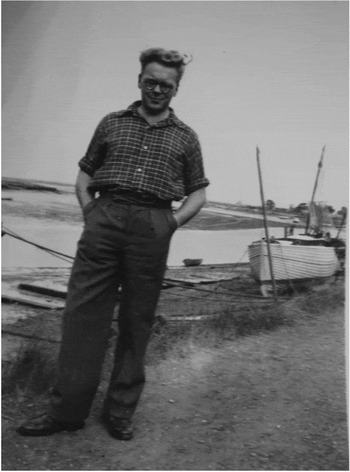
J. A. Baker on the Essex coast, c. 1956 (Courtesy of The Albert Sloman Library, University of Essex).

The book described Baker's ten-year obsessive pursuit of wintering peregrine falcons in the farmland, valleys and coastal marshes of Essex. John Moore was effusive in his praise:
I count myself lucky to have read this book in typescript and I think you are very lucky to have got the chance of publishing it. It is something quite exceptional in the way of nature writing and Gilbert White himself would have admired it . . . There are some moments of close observation which moved me as much as anything in this line that I have read. Again and again I found myself saying ‘Yes, it is exactly like this’ . . . T. H. White would have loved this book [and] so would Hemingway.Footnote 1
John Moore's comments were at once acute and prescient. When The Peregrine was published in 1967 it was awarded the Duff Cooper Memorial Prize. The panel of judges for the Prize, among them the great Trinidadian novelist V. S. Naipaul, were unanimous in their praise for the book. As Viscount Norwich, chair of the panel confessed in his congratulatory letter to Baker, ‘none of us are particularly keen or knowledgeable naturalists, but this in no way lessened our enthusiasm for the evocative power and sheer beauty in your writing’.Footnote 2
Later commentators have deepened and extended this praise for the book. For a younger generation of nature writers, The Peregrine and its enigmatic author have become the touchstone for a new wave of nature writing. Robert Macfarlane, author of The Wild Places, described The Peregrine as ‘unmistakably a masterpiece of twentieth-century non-fiction’. For Mark Cocker, author of Crow Country, Baker's account of his encounters with wild birds had ‘few rivals in the entire English speaking world’.Footnote 3 Amid this praise for the book supporters have repeatedly returned to the intense, highly concentrated poetic prose of The Peregrine. As Cocker noted, Baker played with the function of words converting nouns into verbs, adjectives into nouns or made nouns out of verbs.Footnote 4 Macfarlane also emphasised the inventive, imaginative power of Baker's prose. He suggested that in his attempts to capture how peregrine falcons perceived the landscape over which they hunted, Baker offered the reader, in one of the most startling passages in the book, a description of ‘planes and shapes which slant abstractly towards one-another’ as if peregrines’ saw ‘like a Cubist painter’.Footnote 5
These and other commentators have seen in Baker's close attention to nature, in his monocular focus and concentrated style parallels with landscape studies like Barry Lopez's Arctic Dreams (1986) and W. G. Sebald's The Rings of Saturn (1995), as well as with the poetry of Ted Hughes.Footnote 6 Others, like John Moore, as we have seen, saw the influence of the eighteenth-century naturalist Gilbert White, author of The Natural History of Selbourne (1789), in Baker's writings, together with connections with literary figures like Hemingway and T. H. White. And as Baker's own wife recognised, there was the connection with Melville's monumental account of one man's obsessive pursuit of an animal in Moby Dick.Footnote 7
J. A. Baker's The Peregrine, however, might also be looked at in another way. We might profitably locate it in a broader, less elevated field of postwar writing and observation that worked to shape new ways of understanding, apprehending and taking pleasure from the natural environment. This wider field of writing and representation included the recording practices and publications of the national and county naturalist and birdwatching societies that flourished in these years. It was also evident in the ambitious, scientifically informed popular natural history writing of the ‘New Naturalist’ series, published by Collins.Footnote 8 Baker's book, The Peregrine, in fact, even has a title that sounds like a New Naturalist monograph. In this regard, The Peregrine and Baker's other book, The Hill of Summer (1969), is as much the product of recreational birdwatching and organised amateur natural history as they were of the world of high literature. These more prosaic influences deserve greater attention in any attempt to understand The Peregrine and its articulation of the geography of natural relations in postwar Britain.
Commentaries upon Baker's work have alluded to these influences upon his writing. John Fanshawe has been the most emphatic noting the ‘clear links between [Baker's] fieldwork and the reappearance of these observations in the final text [of The Peregrine]’. This fieldwork was recorded in the birdwatching diaries that Baker kept and Fanshawe has suggested that they ‘bridge [Baker's] close watching, his quiet writing at home and his perfect distillation of these same moments in The Peregrine’.Footnote 9
Despite this acknowledgement of Baker's relationship to the field craft of amateur naturalism, however, there is much more to say about the distinctive forms of observation and recording that Baker practiced. His fieldwork was the product of a history of ‘new ornithology’ and ‘new naturalism’ pioneered in the interwar years and extended and elaborated upon within the increasingly mass participation culture of postwar birdwatching and natural history. This article sets out to reconstruct the wider, collective culture of birdwatching that Baker, the aspiring writer and apparent lone observer, was a part of and to show how his engagement with the natural world cannot be fully understood outside of this recreational culture of nature and its forms of observing and recording.
The organised birdwatching that shaped Baker's writing of The Peregrine was strongly imbued during the years of his peregrinations with a deep sense of crisis about the rapid changes unfolding in the British countryside and among its bird, animal and plant populations. Peregrine falcons were powerful symbols of this countryside crisis, with their numbers crashing through the 1950s and 1960s as a result of contamination from agricultural chemicals. The ‘vanishing peregrines’ of the British Isles stimulated new conservation effort and were central to the reorientation of the Royal Society for the Protection of Birds (RSPB), the largest bird protection organisation, towards a stronger research-based campaigning style of conservation. For many associated not just with the RSPB, but also the county naturalist trusts and societies that mushroomed in these years, the cause of conservation and a new heightened sense of the value of the natural world was driven by an awareness of the pace of environmental change and the increasing fragility and vulnerability of the natural environment.Footnote 10 This was a crisis of the countryside and coast produced by a distinctive concatenation of forces peculiar to the immediate postwar decades. They included not just the effects of agrichemicals upon the environment but the wider intensification of agriculture, increased development pressure from industry, housing, tourism and transport and the impact of oil pollution upon Britain's inshore waters and coastline. The scale of the latter phenomenon was brought home dramatically by the sinking of the oil tanker SS Torrey Canyon off the Scilly Isles in 1967, one of Britain's worst maritime pollution disasters.Footnote 11 These developments underpinned the sense of profound change and loss in the British countryside and coast that was central to the culture of birdwatching that Baker was a part of and which infused the narrative of The Peregrine at every level.
The crisis of the countryside and coast and the plight of birds of prey not only shaped the priorities of organised birdwatching, but also helped to harden the boundaries between it and other bird-centred activities. This was evident in relation to the field sport of falconry. Falconry witnessed a renewed popular interest after the Second World War and peregrine falcons were the most prized falconers’ birds.Footnote 12 Young birds were typically taken from traditional nest sites or eyries around Britain's coasts, with many sites having been used for generations. The dramatic decline of Britain's peregrines created a situation in which the interests of conservationist-birdwatchers and falconers were brought sharply into conflict over the best way to manage the remaining population of breeding peregrines. Birdwatchers and their organisations came more and more to see falconers as a threat to the survival of peregrines and in so doing opened up an ethical distance between the two bird-centred pastimes. This shift formed part of a wider remaking of birdwatching in the postwar period as increasingly separate from and indeed incommensurable with established bird-centred field sports and traditional rural activities like egg collecting.Footnote 13 Organised birdwatching sought to establish moral authority over them in its understanding of natural relations, casting field sports and many countryside practices as atavistic and archaic relics of older cultures of nature. The sportsman-naturalist became an increasingly problematic identity within the culture of modern birdwatching.Footnote 14 Yet the relationship between organised birdwatching and falconry in this period repays attention. Baker's The Peregrine is illuminating in this regard. It suggests that there were commonalities that linked how the two pastimes imagined and lived out human-falcon relations. Baker's account of what he repeatedly refers to as the hunting of the hawk allows us to see the way a close attention to birds of prey and an intimacy with them was shared by birdwatchers like Baker and falconers, even as Baker's narrative also sheds light on the differences between the two practices.
In developing these arguments about Baker's writing and his place within wider postwar bird-centred cultures of nature, the article draws on and seeks to extend recent environmental histories and cultural geographies of the British countryside and nature conservation. David Matless's path-breaking work on ‘cultures of landscape’ and ‘animal landscapes’ is a central point of reference. In both Landscape and Englishness and In the Nature of Landscape, as well as in a series of co-authored essays, Matless places countryside recreation within a broader cultural field, drawing out the tensions between different cultures of landscape, their distinctive ‘animal landscapes’ and the forms of human conduct forged within these spaces.Footnote 15
One strand of Matless's work seeks to show how nature conservation and amateur natural history were caught up in the cultivation of a self-consciously modern naturalism that promoted not only the ‘reserving of nature’, but also ‘reserved’ forms of conduct. This new natural history sought to constitute a progressive idea of the modern citizen-naturalist who was part of a collective network of observation and record keeping. Articulated by the ‘new naturalism’ of the 1930s and 1940s, this promoted a (social) democratic ideal of the citizen-scientist and a new ‘mass observational’ culture of nature.Footnote 16
Matless's arguments have been developed by historians like Helen Macdonald and Mark Toogood in order to explore how these forms of citizen science and recreational natural history developed in the 1930s and 1940s.Footnote 17 All these authors, however, tend to stop their analysis soon after the Second World War and have much less to say as a consequence about the 1950s, 1960s and 1970s. In what follows, I look at how the ‘new ornithology’ of the interwar years took distinctive directions in the changed conditions of Britain from the mid-1950s to the early 1970s and how it was expressed within a popular culture of birdwatching of which J. A. Baker was a part.Footnote 18 In doing so, I draw out how organised birdwatching increasingly rubbed up against other countryside practices and their distinctive configuring of human-animal relations and styles of human conduct. The article explores the increasingly fraught relations between organised birdwatching and the established bird-centred field sport of falconry. Baker's book, The Peregrine, offer suggestive insights into both the differences between what were seen as increasingly incompatible recreational relationships with birds of prey and the convergences that continued to link how both pastimes shaped and lived human/falcon relationships.
The article draws not just from Baker's published writings, but also from the evidence of his private papers, including his birdwatching diaries, private correspondence, records of the books in his personal library and the material artefacts that shaped his birdwatching in the Essex countryside, including his annotated ordinance surveys maps.Footnote 19 The account developed also makes use of the records of the Essex Birdwatching Society (EBwS) of which Baker was an active member and the popular styles of birdwatching promoted in this period. In the first section I describe the development of the ‘new ornithology’ and ‘new naturalism’ in the first half of the twentieth century, moving onto show how it became institutionalised within birdwatching societies and organisations after the war. I link J. A. Baker's recreational birdwatching as recorded in his diaries to the postwar culture of birdwatching and further show how this informed the writing of The Peregrine.
In the second section of the article I consider how concerns about environmental change and its effects on birds of prey in particular helped to shift conservation practice in the late 1950s and 1960s and the consequences this had for the relationship between the bird-centred hobbies of birdwatching and falconry. If conservation-led birdwatching increasingly sought to separate itself from countryside practices like falconry as ethically incommensurable pastimes, then Baker's book offers a view and attention to peregrines that shows the difficulty of such a rigid division between the two practices in their understanding of natural relations.
A new observational culture of nature
In 1932 Max Nicholson published The Art of Bird-Watching, subtitled ‘a practical guide to field observation’. It was the 29-year-old Nicholson's third book and a statement of intent. Nicholson was a young journalist but emerging as a key protagonist in the shaping of the ideas of a ‘planned countryside’. He would later play a key role in postwar conservation as the director of Nature Conservancy, the editor of the influential journal British Birds and President of the RSPB.Footnote 20
The Art of Bird-Watching set out a manifesto for a new kind of birdwatching and a new kind of birdwatcher. At its core was a plea for a more organised and scientific approach. The book offered a vision of how new technologies and devices could transform birdwatching. These included the use of telescopes and binoculars, especially the new lighter tourist field glasses, for field observation, as well as the use of hides and observation posts. These devices brought the bird closer to the observer without the need to shoot them for identification or collecting purposes.Footnote 21 Nicholson was also enthusiastic about the emerging technology of sound recording and the use of call and song to help keep track of migrating birds.Footnote 22 There was, however, one piece of more humdrum equipment that was central to the art of the new birdwatching. This was the notebook and the associated art of note taking. While conceding that ‘any kind of notebook will do for bird watching’, Nicholson argued that it was imperative to record observations of bird behaviour as soon as they were seen in a notebook, with the full field record noting times and weather conditions. Diagrams, sketches and rough maps should also be used and field notes later written up and placed in a loose-leaf book or a card index for more permanent record.Footnote 23
To be of greater value these observations should also form part of a larger collective effort. Bird census work was a key vehicle for this coordination of the records of single observers. It was central to the scientific ambitions of the ‘new ornithology’ promoted by Nicholson. Census work, such as that pioneered at Oxford University, counted usually breeding birds within a specific geographical area. A map was essential for every census and Nicholson recommended the Ordinance Survey six inches to one-mile maps of England and Wales. The census area was produced by dividing up a given geographical location into a grid of equal squares and then counting the birds – breeding pairs, nest or singing males – within this square.Footnote 24 Chapter Four of The Art of Bird-Watching offered a manifesto for how these close observations of birds could be moulded into a ‘National Society of Birdwatchers’.Footnote 25 As Nicholson argued, ‘whether he liked it or not, the birdwatcher is engaged in a cooperative undertaking . . . There is no such thing as an independent bird watcher . . . there are only organised . . . or disorganised ones’.Footnote 26
Nicholson's vision of the ‘new ornithology’ set the new birdwatcher apart from the tradition of museum study and the collection and display of bird skins.Footnote 27 In doing so, it deepened and sought to give national significance to the established tradition of local field study. It was a vision developed and given institutional direction by the organisation that Nicholson helped to found in 1932, the British Trust for Ornithology (BTO). The BTO was conceived of by Nicholson and others as an ‘independent clearing house and directive centre for all kinds of ornithological fieldwork in the UK’. A national council would help to coordinate ‘a chain of organised bird watchers throughout the British isles, with correspondences in the Empire and abroad’.Footnote 28 As both Helen Macdonald and Mark Toogood have argued, the recruitment and coordination of amateur observers by the BTO shared much with other networks of amateur observation in the interwar and wartime years, most notably Mass-Observation (M-O).Footnote 29 There were even strong personal connections between the two forms of ‘mass observing’. Tom Harrison, the key founder of M-O, had been inspired by Julian Huxley's surveys of breeding great crested grebes in the 1930s and had participated in bird surveys before turning his attention to the observation of the behaviour and social rituals of the British population in M-O.Footnote 30
More importantly, however, there were strong links between the ‘new ornithology’ of the 1930s and 1940s and the ‘new naturalism’ that developed during and after the war. Both were the product of the growing influence of the new science of ecology and the related field of ethology, the study of animal behaviour in natural settings. Ecology and the concept of the ecosystem were concerned with the study of the relationships between living things and their environments.Footnote 31 Ecological thinking became increasingly influential through the 1940s and its advocates were able to exert a growing influence within official conservation circles through their involvement in postwar planning for nature reserves.Footnote 32 Nicholson saw the ‘new ornithology’ as built upon the science of bird ecology, the study of the relationships between birds and the communities of plants and other animals of which they formed a part.Footnote 33
Nicholson's close associate Julian Huxley, former chair of the Department of Zoology at King's College London, shared this vision. Not only was Huxley a founder member of the BTO, but was also part of a small group who persuaded the publishers Collins to produce a new popular series of natural history books that showcased the insights of ecology and ethnology. This was the New Naturalist series. Like Nicholson, Huxley and Huxley's protégé, James Fisher, saw the series as self-consciously forward-looking, part of the making of British natural history modern in the 1940s. They, and the books published within the New Naturalist series, embraced not just the new observational sciences but also developments in photography, including colour photography, to record and show bird, insect and plant life as it occurred in its ‘natural habitat’.Footnote 34 Supported by Collins, the New Naturalist series affirmed its modernity by the choice of striking lithographic cover designs. Produced by the graphic artists Clifford and Rosemary Ellis they gave a strong visual identity to the new books and signalled the series mission to promote a new, self-consciously modern naturalism in Britain.Footnote 35
Matless, Macdonald and Toogood have all noted how in their concern to enthuse and constitute a ‘national chain’ of amateur observers and the revitalising of a pride among the British in their national flora and fauna, the ‘new ornithology’ and the ‘new naturalism’ worked to produce a stronger notion of British wildlife (including British birds) as well as the unique environmental history of the British Isles.Footnote 36 This was made explicit in the frontispiece to every New Naturalist book that stated the aim of the series to foster the ‘natural pride of the British public in the native flora and fauna’. The legacy of wartime anxieties and threats of invasion undoubtedly had a bearing on this focus. In 1940 James Fisher had noted in his introduction to his Pelican book Watching Birds that birds were ‘part of the heritage we are fighting for’.Footnote 37 Certainly the focus on British birds, plants, animals and landscapes in the 1940s contributed to the association of the ‘new naturalism’ and the ‘new ornithology’ with the tighter imagining of Britain as ‘an island again’ in the wartime and immediate postwar years.Footnote 38
Fuelled partly by books like James Fisher's Watching Birds that came complete with a membership form on its back cover, wartime interest in birdwatching helped the BTO to grow. By 1951, it had over 2,000 members and had formalised its field investigations.Footnote 39 The BTO's census and survey work expanded in the postwar years, with a major new phase being inaugurated by the launch of the common bird census in the late 1960s and the subsequent publication of the first national breeding bird atlas.Footnote 40 This immense body of ‘citizen-science’ coordinated by the BTO was supported by the county birdwatching societies that flourished in the postwar years. Baker was part of this army of committed county-based observers and recorders and he submitted records to the EBwS. Because of its rarity as a bird in Essex in the 1950s and 1960s his records of wintering peregrines appeared with his initials next to them in the annual Essex Bird Reports.Footnote 41
EBwS had been formed in July 1949 to document the bird life in the county. Behind its formation lay a desire to understand the changing distribution and status of birds in Essex when set against the historical records from the nineteenth and early twentieth centuries. These historical reports had drawn upon field observation but were also heavily reliant upon records of birds shot and collected in Essex. Miller Christy's The Birds of Essex, published in 1890, gives a sense of this older tradition of recording. While the report claimed to document ‘general observations on the habits and distribution of birds’, the evidence on which it drew was heavily reliant upon records of birds shot.Footnote 42 Christy's entry on the peregrine is illuminating in this regard. Described as ‘now only an uncommon or irregular winter visitor to Essex’, the species account lists many records of birds shot. One entry was from December 1879. Citing details from the Chelmsford Chronicles, it noted a peregrine was observed at Bradwell ‘in pursuit of a flock of wigeon. Singling out one of them it struck it down and was in the act of devouring it when he was shot by a man named Linnet.’Footnote 43 There is a nice historical irony to this record. Not only was Bradwell, on the Dengie Penninsular, one of the sites visited by Baker, but the Linnets, a family of wildfowlers or marshmen, lived in the old signalman's cottage that became the home of Bradwell bird observatory when it was formed in 1954 with the support of EBwS.Footnote 44
The postwar establishment of EBwS had a strong conservation impulse. As its first annual report from 1949/1950 noted, Essex was under particular pressure from the intensification of agriculture in its rural areas and from demand for land for housing. A. E. Hollman, the chairman of the society, expressed it starkly noting that ‘there is a real danger that many interesting birds may be lost to us, and it is only by organised efforts and the establishment of sanctuaries that we can hope to prevent their disappearance’.Footnote 45
The accumulation of data was used by the Society to support its conservation efforts and the protection of important bird habitats. In the 1950s and 1960s, figures with close ties to the BTO played a leading role within the society. They included Robert Hudson, co-author of the new county avifauna published in 1968, A Guide to the Birds of Essex. Hudson was a senior staff member at the BTO. Another key figure was Robert Spencer. Spencer was former head of the BTO's ringing scheme and Vice-President of the Society. Looking back on the growth of the EBwS from the 1950s to the 1980s, he drew attention to the extensive use made of BTO enquiries within the recording practices of the EBwS. This included participation in such BTO-sponsored schemes as the common bird census and the waterways bird survey.Footnote 46 Much of this activity had been fuelled by the fieldwork for the BTO's Atlas of Breeding Birds that was conducted between 1968 and 1972 and was based upon surveys of 10 km-square grids across the UK. As Simon Cox, author of A New Guide to the Birds of Essex, noted, ‘the period since 1968 has been an important one in the context of organised fieldwork in Essex and emphasises the tremendous potential usefulness of . . . the amateur bird watcher working with some direction’.Footnote 47
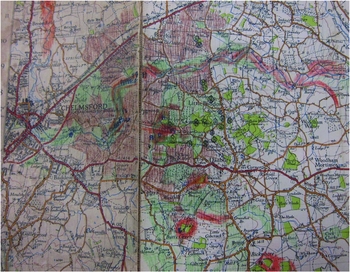
On the publication of The Peregrine in 1967, J. A. Baker was invited by the editors of EBR to write a short essay summarising his peregrine observations.Footnote 48 Baker noted how the book drew on his sightings of peregrines over ten winters between 1953 and 1965, with more than half the records relating to the three winters of 1960/1, 1962/3 and 1963/4. Baker stated, in a concern for the quantification of records central to the ‘new ornithology’, that he had seen one or more peregrines on some 220 dates.Footnote 49 Although he submitted his records to EBR, Baker generally birdwatched alone, cycling into the Essex countryside from his home in Chelmsford. Evidence derived from the ordnance survey maps that he owned and which he heavily annotated gives a sense of the roads, lanes, footpaths and fields that he explored. The maps show a marking in either black pen or red pencil of the areas of mid-Essex that Baker returned to again and again on his birdwatching excursions. These included the bleak, flat marshes of the Dengie penninsular, the coastal areas around Goldhanger and Gore saltings on the north side of the River Blackwater and the marshes of Tollesbury Wick and Old Hall, the latter famous as a wildfowling area since the eighteenth century.Footnote 50 Some of the most intense annotations on Baker's maps, however, are of the fields, lanes and woodland west of Chelmsford around Writtle and east of Chelmsford in the triangle of land marked out by Great and Little Baddow and the chalk escarpment at Danbury. Baker's red pencil marks on one of his maps highlight a tight set of contour lines around the low hills of Danbury and another set follow the valley of the River Chelmer east towards the port of Maldon. Distances are sometimes marked and the initials of birds seen have been added.
Ordnance Survey Map annotated by J. A. Baker (Courtesy of The Albert Sloman Library, University of Essex).

Taken together the maps record the movements of Baker across these Essex landscapes, preserving as a documentary trace his deep familiarity with these locales and routes. These are landscapes memorably described in The Peregrine and invoked in its early passages as ‘a land as profuse and glorious as Africa’.Footnote 51 This assertion of the enchanted qualities of the local and provincial lands of rural Essex and the way in which Baker describes the Essex coast and its inland valleys throughout the book is all the more striking because this is Essex, that most reviled of counties, that Baker is talking about. This is the county, as Country Life infamously argued, that did not have a landscape worthy of the name when viewed through the aesthetic lens that has ranked Britain's most beautiful and quintessential landscapes. For more than two centuries these have favoured the rugged coasts and open moorlands of the North and the West over the flatlands and estuaries of Essex, the most subaltern part of that most subaltern of landscape regions, East Anglia.Footnote 52
Baker's sympathy for the landscapes of mid-Essex is evident in his birdwatching diaries along with his annotated maps. In a visit on a Saturday at the end of August 1958 to Goldhanger near Maldon, the number of other people on the seawall initially disturbed his connection with the landscape. As his diary records: ‘there were a disconcerting number of people there . . . noise, litter, sailing boats close-in; all loathsome’.Footnote 53 By the end of the day, however, with the place now devoid of its ‘noisy hordes’, Baker could again find solace in the landscape and a deep connection with it: ‘My last view of the estuary, of the calling birds, the dark earth, bright water, romantically still trees, was beautiful. The loveliest place on earth, great beauty and rich sadness. A wonderful day.’Footnote 54
Other entries reveal his close observation of the animals, particularly birds, which helped to enchant the landscape for him. These observations and the way he recorded them in his diaries drew upon the observational and recording practices of the ‘new ornithology’. They record date, times, weather conditions and a listing of birds and eventful behaviour. As such the diary entries show how the concentrated observation expressed in the The Peregrine was build up from the ‘descriptive ordering’ of this way of seeing nature recorded in their pages. There is more going on in the diaries, however, than a close form of scientific observation. In them Baker also begins to develop and test out a poetic rendering of this way of apprehending nature. As such they reveal a form of writing that mixes the aesthetic and the scientific-observational. This is most evident in his embellishment of his bird records.
In a diary entry from 21st May 1954, for example, Baker describes the way Old Hall marshes were suddenly transformed ‘in a sudden gash of brilliant sunshine’. This ‘sunburst’ illuminated a group of shelduck that Baker described as being ‘like huge decorated vases with ducks heads stuck on’. Moving onto the nearby Abberton Reservoir, he vividly recorded seeing a great crested grebe swimming on the water. It ‘seemed hardly a bird, more like a Lewis Carroll character, like the Mock turtle’.Footnote 55
In December 1955, Baker visited North Farnbridge and encountered a flock of black-tailed godwit. The birds had flown in, wheeled around and flown off again. He recorded:
They seemed to fly straight onto this planet and straight off it again. To hear that clamorous gobbling call is thrilling – it is an unbelievable sound, a heathen laughter from dry-looking, reedy, big-eyed, long-nosed, cackling, crackly, bony, lanky, loose-limbed, Mad-Hatterish birds, sweeping past each on a broomstick that sticks out behind.Footnote 56
Two years later in January 1957, Baker recorded a visit to Hanningfield reservoir near Chelmsford. He saw two groups of a scarce wintering duck, smew. The drakes, he noted, ‘were beautifully streamlined, arctic creamy-white and striped deep black; the black like a vein of liquorice running through icing’.Footnote 57
These diary entries all resurfaced transformed in the final version of The Peregrine. The encounter with the godwits is set earlier in the year on 12th November in the fictional year that Baker distilled from his ten years of observation into the diary-like structure of The Peregrine. In the revised version the encounter with the godwits introduced a new metaphor for the birds while retaining the ‘heathen’ reference. Thus:
they lanced the air with long swordfish bills, their legs stretched out behind. They were calling as they flew – a hard clamorous gobbling, a heathen laugh, like curlew crossed with mallard.Footnote 58
The encounter with smew is also refined. The entry for 1st December describes a cold, frosty day at an unnamed reservoir. Amid the waterbirds spread out on the water, the narrative describes the smew:
Drake smew, their phantom arctic whiteness piped and curled about with thin black lines, sank deep like ice-floes or dazzled up the sky like flying snow.Footnote 59
Baker's vivid diary description of shelduck surfaces towards the end of The Peregrine. As the narrator searches for one of the falcons, suddenly compelled by a feeling that he will find it by the coast, he comes across a dead shelduck:
A shelduck lay on the mud, shining like a broken vase; green-black and white, chestnut-bronze, vermillion.Footnote 60
Baker removed the records of his observations of peregrines from his diaries when writing the manuscript of The Peregrine. In the process his first hand documenting of watching and recording them has been lost. Nevertheless, his descriptions of peregrines in the narrative of The Peregrine are evidently drawn from close field observation enriched by Baker's intense poetic imagination.
The countryside in crisis
Few peregrines are left, there will be fewer, they may not survive. Many die on their backs, clutching insanely at the sky in their last convulsions, withered and burnt away by the filthy, insidious pollen of farm chemicals.Footnote 61
In 1960, Nature Conservancy, the government agency responsible for conservation and headed by Max Nicholson, commissioned the BTO to report on the status of peregrine falcons as a breeding bird. The study had been prompted by complaints from racing pigeon interests that the falcons were taking an unacceptable toll on their birds. The newspaper The Racing Pigeon was particularly vociferous, urging the government to remove peregrines from the legal protection guaranteed by the 1954 Protection of Birds Act.Footnote 62 This made it illegal to kill or take the eggs of almost all British birds, save for named species of wildfowl during the regulated shooting season and certain species deemed pests.
The BTO begin its research in the breeding season of 1961 with a further survey in 1962. The preliminary findings were startling. Far from being a common breeding bird, as The Racing Pigeon had suggested, the research found that a catastrophic decline had occurred in the occupancy of peregrine territories since the first postwar survey conducted between 1947 and 1950. The decline was particularly dramatic in southern England, with 69 per cent of the total of prewar territories deserted and only two breeding pairs.Footnote 63
In his report, Derek Ratcliffe, the BTO's lead researcher, speculated on the likely causes of this decline. Excluding a decrease in food supply, disease or direct persecution by shooting, trapping or poisoning, he suggested that the most likely explanation was that peregrines were the ‘secondary victims of agricultural toxic chemicals through repeatedly taking prey which carried sub-lethal doses and so building up poison in the body’.Footnote 64 Ratcliffe showed a strong correlation in time and space between the pattern of the decline of peregrines and the application of toxic pesticides across Britain's main arable and fruit growing areas. While Ratcliffe conceded that the link between the peregrine's decline and the use of toxic chemicals was largely circumstantial, he did cite one crucial piece of direct evidence. It concerned the analysis of a peregrine's eggshell broken by one of the parent birds from an eyrie in Perthshire. Analysis of the shell fragments found that they contained significant traces of pp-DDE, a metabolite of DDT and smaller traces of Dieldrin and Heptachlor.Footnote 65 These were chemicals used in the spraying of crops or as seed dressings. The damaging effects of these chemicals upon wildlife had begun to be suspected in Britain and the US from the late 1950s. During 1959, reports of an unidentified illness effecting foxes in the UK was detected and 1,300 foxes were found dead with many showing symptoms of poisoning.Footnote 66 In the US in 1960 even more alarming evidence emerged of bird deaths caused by the spraying of DDT.
This emerging evidence prompted the RSPB to establish a joint-committee with the BTO in the autumn of 1960 to collect records of bird deaths caused by toxic chemicals.Footnote 67 As the scale of bird deaths emerged the RSPB and BTO, together with the Game Research Association, pressed the government to restrict the use of these toxic chemicals. Their lobbying was partly successful and in July 1961, Christopher Soames, the Minister for Agriculture, Farming and Fisheries proposed a voluntary ban on the use of seed dressings on winter sown grain, while allowing their continued use for autumn sowing. DDT was excluded from the ban.Footnote 68
The incidents of mass animal and bird poisonings in Britain and the UK government's response to them was noted by an especially acute and influential observer in the US, where the evidence of birds deaths from toxic chemicals was, as we have seen, even more dramatic. The observer was Rachel Carson. Silent Spring, Carson's careful analysis of the effects of toxic chemicals on bird populations and their potential threat to human health was published in the autumn of 1962 to much ‘public disquiet and fierce controversy’, as Stanley Cramp, President of the RSPB, noted in a special review of the book in the spring of 1963 when the book was published in the UK.Footnote 69 With its scrupulous evidencing of the harmful effects of the new postwar generation of agricultural chemicals, Carson's book crystallised the emerging concerns of conservationists on both sides of the Atlantic, presenting a startling and dystopian image of American landscapes, including suburban gardens, denuded of the colour, beauty and song of birds.Footnote 70
In an impassioned introduction to the British edition of Silent Spring, Lord Shackleton, the labour peer who had initiated a House of Lords discussion of the book in March 1963, praised the power of Carson's argument. He noted that what the book made clear was not just the dangers of toxic chemicals on wildlife, but also the larger fact that human beings were part of the environment and dependent upon ‘the entire living world’ for their health and well-being.Footnote 71 He was also alert to the likely resistance from what he called the ‘agricultural establishment’ to the claims of the book given the commitment to increased productivity within agricultural production.Footnote 72 Shackleton was right to warn of resistance to Carson's arguments. For all its power and capacity to dramatise the threats posed by toxic chemicals to wildlife, Silent Spring was met by the vested interests of the farming lobby, which slowed the final banning of the most harmful chemicals in the UK. A series of voluntary restrictions were introduced in 1964, 1969 and 1976.Footnote 73 Because the scale of the use of toxic chemicals was far greater in the US, Carson's findings did have more rapid effects, with most of the chemicals, including DDT, banned by the early 1970s and the Nixon administration establishing the Environment Protection Agency in the same year. The restrictions imposed in the UK from the mid-1960s combined with the lower levels of use of the most toxic agrichemicals, however, did make a difference to the populations of birds of prey and their decline was halted by the late 1960s and began to recover from this low base through the 1970s.
As the crisis caused by toxic chemicals was unfolding, conservation organisations like the BTO and RSPB sought to find common cause with countryside organisations and other bird-centred pastimes. Perhaps the most significant move came in March 1963 when the RSPB and BTO convened a conference on birds of prey in Cambridge. The conference, which as one participant noted, took place in the shadow of Carson's book, aimed to present the evidence collected by the RSPB and BTO on the decline of birds of prey and to work with landowners, gamekeepers, sportsmen and falconers to press for more restrictions on the use of toxic chemicals and for better observance and enforcement of the Protection of Birds Act. A common enemy was identified in the form of the agri-chemical industry and sections of the farming industry who were the guilty partners in the ‘slaughter’ of birds of prey that was unfolding.Footnote 74 The conference resolution emphasised the ‘great value’ of birds of prey on ‘scientific and environmental grounds’ and as part of ‘our national heritage’ and thus the urgent need to aid their preservation.Footnote 75 Lord Hurcombe, Chairman of the RSPB's Council, took great hope from the presence of such diverse countryside groups at the conference seeing parallels with the way his organisation had established fruitful relations with the wildfowling groups.Footnote 76
This alliance between organised birdwatching and other countryside pursuits, however, did not hold. Through the 1960s and early 1970s licences granted by the Home Office to take birds of prey for falconry were restricted because of the low ebb of these birds. The restrictions begin to unravel the alliance between birdwatchers and falconers. The RSPB in particular was drawn into an increasingly conflicted relationship with the supporters of falconry as it challenged what it saw as an increase in the persecution of birds of prey. ‘Would-be falconers’ were seen as part of the problem given that the demand for falcons greatly outstripped the number of licences granted. With the bird protection laws difficult to enforce and the penalties for committing bird crime weak, falconers, together with gamekeepers and landowners, shifted from being allies in the cause of conservation to being culpable through their activities with the threats to birds of prey.
A comment piece by the RSPB's Director Peter Conder in the winter 1970 edition of Birds, the RSPB's members’ magazine, signalled this new, critical line of attack. While he conceded that the RSPB was not against ‘legitimate’ falconers, he warned that a growing interest in falconry was drawing in those without proper training in the ‘ancient art’ who were unable to look after the birds properly. Conder was also scathing of commercial falconry displays. These displays not only encouraged the untutored to seek out hawks thus putting pressure on the wild populations, but were also undignified in their display of hawks ‘turning up at show grounds in exotic costumes’ and transforming these wild birds into a circus exhibit.Footnote 77 Even more so than legitimate falconers, they destroyed the ‘elemental ethos’ of these birds, birds that had, he argued, ‘a fierce, free quality like the wind itself’.Footnote 78 For Conder, then, the falconry displays distorted the natural modes of life of the birds.Footnote 79
The RSPB continued to open up a greater distance from falconry through the 1970s. In a campaign launched in April 1973 reminding the public that all birds of prey were protected by law, the organisation focused on ‘egg thieves and would-be falconers’ as the main culprits in the persistence of bird crime effecting birds of prey.Footnote 80 This hardening of the division between the bird-centred pastimes of conservation-led birdwatching and falconry led to them being increasingly in tension. The distance between the two pastimes was reinforced by differing ways in which each sought to establish their legitimacy. If, through the 1950s, 1960s and 1970s, the RSPB and bird atching societies like EBwS saw themselves as the inheritors of the forward-looking vision of the ‘new ornithology’ and the ‘new naturalism’ pioneered in the interwar years, then falconry repeatedly emphasised not its modernity but its long historical pedigree in making a different claim to legitimacy. Postwar falconry certainly drew upon the revivalist tendencies and proto-medievalism of its own interwar promoters. They presented their pastime as an antidote to modern life, ‘a romantic, pastoral, anti-modern pursuit’.Footnote 81 Certainly for falconer W. Kenneth Richmond, the post-war revival of falconry was a reaction to technological change: ‘In a push-button age, bemused with supersonic bangs’ the simpler pleasures of hawking had ‘an intense appeal’.Footnote 82 Peregrine falcons in particular embodied a ‘natural beauty’ and ‘wild nature’ placing them at the margins of urban modernity. The aristocratic image of the bird and their status as a top predator was also important to falconers. For Kenneth Richmond there was much joy to be had in possessing ‘one of the princes of the air’. He also talked, invoking Blake, about ‘their fearful symmetry’.Footnote 83 This ‘fearful symmetry’ was born of the way the birds were perfectly designed for the business of killing and surviving in wild landscapes and was embodied in the hooked bill and the aerodynamic form. Again and again, in fact, falconers summoned a distinctive range of attributes that they associated with these birds. This included their fierceness, power and aerial prowess. Peregrines were notably celebrated for the speed at which they pursued prey and the sight of a ‘stooping’ peregrine aroused excitement in the falconer. As falconer Ian McNeill put it, ‘There is not, and never has been, anything quite so spectacular as the stooping falcon, our native peregrine.’Footnote 84 This hunting technique was at its most enjoyable when peregrines were hunting with the falconer. Waiting for the captive bird to stoop generated intense anticipation of the drama of the chase and the kill. As Geoffrey Armitage suggested, ‘A moment of real excitement comes when a falcon is waiting on high above a pointing dog and the dog is given the order to flush the game concealed in front of it.’Footnote 85
It is not just the hunt or pursuit that is celebrated by falconers. There is also the moment of the kill. Falconer's accounts are candid in the 1950s and 1960s about the visceral violence of this moment. In an article on ‘Grouse Hunting in Caithness’ from Country Life from 1963, John Stevenson was matter-of-fact about the ‘killing power’ of peregrines. Describing a grouse hunt, he spelt out the moment of the kill:
The spaniel goes in, the grouse are flushed, and the falcon, folding her wings, stoops at her chosen victim. The force of the peregrine stoop has to be seen to be believed. On one occasion a grouse was bisected in mid-air, the head and body falling some yards from each other in the heather.Footnote 86
There was no public complaint about these bloodthirsty dimensions of falconry from organised birdwatchers in the 1960s and early 1970s. Indeed, there was a shared fascination with the aerial prowess of the peregrine, the speed of the stoop and the way the birds embody a sense of wildness and power. As Peter Conder put it in his editorial piece in Birds, cited above, peregrines had a ‘fierce, free-quality like the wind itself’. In countryside and bird books aimed at birdwatchers there was a foregrounding of the peregrine's aerial skills and power as a predator. As the AA's Book of the British Countryside, published in 1973, put it, ‘A peregrine can dive at speeds . . . up to 180 mph, striking its prey with instant death and swirling upwards again on sickle shaped wings.’Footnote 87 In British Birds: Lifestyles and Habitats (1982), Ian Prestt, Peter Conder's successor as RSPB director and a trained biologist who had worked for Nature Conservancy and studied the effects of pesticides on birds, was also drawn into a description of the peregrine's hunting technique that emphasised the drama of its prowess: ‘Its powers of flight are most dramatically demonstrated in its hunting technique. A peregrine will tower aloft over flying prey before stooping onto it in mid-air, striking or grabbing with its talons before the victim has time to dive for cover.’Footnote 88
J. A. Baker's observations and writings fit into this tradition of imagining peregrines, though he gives these projections of the wild, raw power of these birds his own intense poetic rendering. Central to this is the metaphor of the ‘hawk-hunt’ that drives the narrative of The Peregrine. In the first section of the book, titled ‘Beginnings’, the narrator explains the quest for wintering peregrines on which he has set out. ‘Autumn’, he notes, ‘begins my hawk-hunting, spring ends it, winter glitters between like the arch of Orion.’Footnote 89 The idea of hawk hunting is an odd phrase for a birdwatcher to use. Baker talks in these framing pages less of watching, seeing or recording peregrines than of hunting them as if he were engaged in a non-lethal version of field sports. While he is not using peregrines to hunt other birds, he shares with the falconer the pleasures of the pursuit and the chase. This gives an intensity of focus to the encounters with wild birds, heightening the senses of the ‘hunter’. ‘Hawk-hunting sharpens vision’, the narrator suggests on the fourth page of the book: ‘Pouring away behind the moving bird, the land flows out from the eye in deltas of piercing colour.’Footnote 90
The heightened sensorium of the ‘hawk-hunter’ draws together the world of the hunter and the hunted. The ‘hawk-hunter's’ senses are attuned to the presence of the hawk in the world:
As soon as the hawk-hunter steps from the door he knows the way of the wind, he feels the weight of the air. Far within himself he seems to see the hawk's day growing steadily toward the light of their first encounter.Footnote 91
In framing the diary-like account of his pursuit of peregrines in this way, Baker defines his quest for the birds as a process in which he seeks to enter into the lifeworld of his prey, to start to see the landscapes which bind him to the birds in the same way the peregrine does, to become one with the bird, to become himself a hawk. In this sense, the narrative of The Peregrine is not so much a testing of the narrator's self, but an act of shamanic transformation. This is most evident in the entry for 30th November in Baker's fictional year. Coming across the body of a wood pigeon killed by a peregrine, the narrator mimics the predator's behaviour, taking on its form: ‘I found myself crouching over the kill, like a mantling hawk. My eyes turned quickly about, alert for the walking heads of men. Unconsciously I was imitating the movement of the hawk, as in some primitive ritual: the hunter becomes the thing he hunts.’Footnote 92 Elsewhere in the book, the narrator picks up a dead gull, smelling the freshly killed flesh as if to experience how the hawk would sense it.
The recording and documenting of peregrine kills forms a central theme in the narrative of The Peregrine. Early on in the book, Baker, drawing on the quantifying practices of the ‘new ornithology’, lists the total number of peregrine kills he encountered and the relative percentages of different kinds of prey.Footnote 93 It is the more emotive, sustained descriptions of killing, however, that are central to the visceral identification with the lifeworld of the bird that is rendered so strongly in the book. These descriptions also bring Baker's narrative close to the fascination with and pleasure in kills evident within the culture of falconry. In ‘Beginnings’, the narrator prepares the reader for what is to come: ‘I shall try to make plain the bloodiness of killing’, he warns.Footnote 94 The section titled ‘Peregrine’ explains how the physiogamy of the bird is adapted to the ‘pursuit and killing of birds in flight’.Footnote 95 The narrator explains at some length and in detail the peregrine's stoop: ‘the stoop is a means of increasing the speed at which the hawk makes contact with the prey. The momentum of the stoop . . . enables him to kill birds twice as heavy as himself.’Footnote 96 The power of the stoop and its effects upon the peregrine's prey are conjured most powerfully in the description of a killing of a partridge from 10th February:
his speed increased and he dropped vertically down . . . he fell sheer . . . heart-shaped, like a heart in flames . . . The partridge in the snow beneath looked up at the black heart dilating down upon him . . . And for the partridge there was the sun suddenly shut out, the foul flailing blackness spreading wings above, the roar ceasing, the blazing knives driving in, the terrible white face descending – hooked and masked and horned and staring-eyed. And then the back-breaking agony beginning . . . till the merciful needle of the hawk's beak notched in the straining neck and jerked the shuddering life away. And for the hawk . . . there was the rip and tear of choking feathers and the hot blood dripping from the beak and the rage dying slowly to a small hard core within.Footnote 97
The narrator confesses to the vicarious pleasure of watching this kill, the ‘memory of that sabring fall from the sky’ etched in his mind, the ‘guiltless hunter who kills only through his familiar’.Footnote 98 Baker's The Peregrine shares not only the bloody fascination with the peregrine's hunting life with falconers, it also links the aerial prowess of the birds to the sense of wildness and freedom that they embody. Much of the narrative of the book is absorbed by the narrator's desire to merge with the umwelt, the lifeworld, of the peregrine, to see the world as he does and to break free from human constraints. As the narrator puts it at one point, ‘imprisoned by horizons, I envied the hawk the boundless prospect of the sky’.
Conclusion
Many of the readers of J. A. Baker's The Peregrine who were moved to write to him confessed to the intense emotional impact that his book had had on them. Dominic Cooper from Edinburgh revealed that the book ‘has so filled my mind [that] I shall have no peace until I have written to thank you’. Since the moment of first opening the book, he suggested that he had ‘lived in a state of quiet elation’.Footnote 99 Mrs Whitfield Vye, from Connecticut in the United States, wanted to communicate the ‘sheer joy’ she had experienced from the book to Baker. The Peregrine had moved her so much that she wanted ‘to give it to my dearest friends, in the way one wants to share a perfect day or a remarkable person’.Footnote 100
Much of the pleasure these readers experienced came from the careful observations described in the book and its intense poetic language. But readers were also moved by how the book enabled them to see the natural world in new ways. ‘You've broken the traditional concept of birdwatching’, Ron Berry from Glamorgan suggested, and ‘given us a new vision of what it means.’Footnote 101 Mrs Morrison of Berkshire was more precise: ‘I have always watched and loved wild birds, but your book has opened my eyes and added perception and pleasure to my country walks.’Footnote 102
This article has attempted to delineate how J. A. Baker's way of looking at and apprehending natural relations was the product not just of his creative imagination and a set of literary influences, but was also shaped by a broader collective culture of observation forged by the ‘new ornithology’ of the interwar years and elaborated within postwar organised birdwatching. In charting Baker's indebtedness to this history, my aim has been to root his literary style within this wider field of writing and representation and to show how it provided an important underpinning for his writing, in particular his first and most successful book The Peregrine. In choosing to follow the diary form in how he structured the narrative of The Peregrine, Baker was perhaps unconsciously signalling the way his book drew upon this tradition of observation and record keeping established by the ‘new ornithology’. If, as correspondents noted, he rose above ‘scientific ornithology’ to bring an emotional intensity to the exploration of the lifeworld of the peregrine and to human-falcon relations, it was also a book that burned brightly because of the way Baker ‘watched with such care’ and was so ‘carefully observant’, as Nigel Wheale of Cambridge put it in a letter to Baker.Footnote 103
Baker's correspondents were also moved by the plight of the peregrines described in the book and by the wider crisis of the countryside that it recorded. Many had never seen peregrines and feared they never would because of the long residual life of toxic chemicals. Many spoke of a feeling of loss, of ‘a new heartbreak’ at the decline of peregrines, of ‘man's onslaught upon the countryside and wildlife’.Footnote 104 Letters written from the US and Western Europe shared their common experiences of the decline of birds of prey and the widespread effects of changing agricultural practices. This narrative of loss and the new heightened threats to the natural world galvanised conservation organisations in the UK, as well as in the US, imbuing the postwar culture of birdwatching with a strong moral mission to record and protect bird populations. It meant that looking at birds as a recreational pastime was not an innocent activity or untainted simple pleasure. It was a form of observation shadowed by crisis and loss. To look was to see, for many, including Baker, ‘a dying world’. Enjoying the natural world brought with it a moral imperative to help conserve it. This was birdwatching remade in an emergent age of environmentalism.
As the article has shown, this re-imagining of organised birdwatching brought it into increasing conflict with other outdoor pursuits, most especially field sports. Organisations like the RSPB distanced themselves from falconry in particular. This was even as falconry sought to modernise its image by aligning itself with conservation. The distinctive configuring of natural relations within each of these postwar cultures of nature, however, and the way in which human-falcon relationships were imagined belied the apparent incommensurability of the two activities. Baker's The Peregrine captured the difficulty of finally separating the human-animal relations of organised birdwatching and organised falconry in this period. Both pastimes were similarly preoccupied with the fierce independence of birds of prey, their aerial prowess and the visceral quality of their predatory behaviour. Both hobbies could also claim an interest in the preservation and protection of these birds.
All of this suggests that it is not just to the discrete practices of different outdoor recreations, their styles of human conduct and the social relations through which human-animal relations are lived that is important, but so too are the emotional dimensions of different natural relations. Bringing out these dimensions of different cultures of nature is a challenge for historians of conservation and cultural geographers of the landscape, but one that promises to add much to our understanding of the structuring of these key natural relations. J. A. Baker's The Peregrine powerfully articulates the centrality of these emotional dimensions to postwar cultures of nature.
Acknowledgements
I am grateful to Michael Roper, Ted Benton, Michael Lane, Jeremy Mynott, Jules Pretty and James Canton for their thoughtful comments on the article and to audiences at the ‘J. A. Baker, Life and Legacy Conference’, University of Essex, July 2016 and ‘Understanding Material Loss in Time and Space’, University of Birmingham, February 2017.