

If nationalism is a discourse that defines who belongs (to a nation, ethnicity, or citizenship group) and has a rightful claim on the resources that come with membership, migrants represent a stress on the boundaries of belonging and distribution of resources (e.g., jobs or public goods). Nationalism is also a discourse that seeks to legitimize political elites … and in this sense it works towards the same goals as anti-migrant populism.
1.1 Introduction
The tremendous expansion of international migration and the increasing precariousness of employment and social rights for nationals in recent decades have transformed welfare provision across Europe and Russia. Conventional studies of welfare within the confines of national states and formal economies no longer fit contemporary realities. Burgeoning numbers of international labor migrants work in countries where they have few if any labor or social rights. For asylum seekers and refugees, rights are varied and uncertain despite protections mandated by the 1951 Geneva Convention Relating to the Status of Refugees as well as other United Nations (UN) conventions.1 Both groups face high risks of exclusion in receiving states. Meanwhile, nationals in Europe and Russia increasingly work in temporary or informal jobs that provide declining levels of economic stability and social security. Welfare states, which for decades after World War II (WWII) provided broadening social protections, have been shrinking since the 1980s. These three developments – large-scale international migration, deteriorating labor markets, and shrinking of social protections for citizens in mature welfare states that receive migrants – are key drivers of welfare nationalism, “the observed reluctance of those belonging to a national state to share welfare benefits with immigrants.”2
My study explains the politics of labor migrants’ and refugees’ exclusion and inclusion by receiving European and Russia states since 2000. In comparison with their counterparts who came in previous decades, recent migrants and refugees have been met more often with policies of social and sometimes physical exclusion. Social inclusion and exclusion here refer to migrants’ social, labor, and civil rights in receiving states, whether or not they have access to health care, education, social assistance, housing, legal employment, and residence status. Such access is generally available to nationals on the basis of citizenship or employment. Policies toward contemporary migrants’ inclusion or exclusion are related to what Diane Sainsbury called “incorporation regimes,” “the rules and norms that govern immigrants’ possibilities to participate in economic, cultural and political life” (Sainsbury Reference Sainsbury2012, 16). Sainsbury, whose work covers an earlier period, includes not only social and labor rights but also rights to permanent residence, family reunification, and citizenship. My thinner set of rights better fits 21st century migrants’ possibilities. Increasingly, those who live and work in Europe and Russia are denied any path to legal employment or citizenship through which they could become eligible for social inclusion.
The right to enter and remain in a receiving state comes prior to issues of social inclusion or exclusion. Physical exclusion, blocking of entry to states by sea or land borders and deportation of those who do arrive, is also increasingly common. Both social and physical exclusion block access to social rights. Bommes and Geddes (Reference Banting, Bommes and Geddes2000 Loc374 of 7293 Kindle) explain that policies blocking entry of asylum seekers, for example, “seek to prevent access to the territory of the country in which the claim for asylum is being made as a way of preventing access to welfare entitlements … immigration control guards the frontiers of the national welfare state.” I use the terms exclusion and inclusion in both social and physical meanings, as fits the various contexts throughout the study.
The growth and politicization of welfare nationalism is a major factor driving European and Russian migration policies in exclusionary directions. In response to large-scale immigration, nationals “guard the frontiers of the welfare state” because they have experienced long-term declines in social security and welfare provision. Growing numbers see most outsiders as “coming to take what is ours.” When a critical mass of the electorate in European democracies comes to view migrants and refugees as undeserving, they shift their support to anti-immigrant political parties. These parties, usually populist, further mobilize grievances in election campaigns that characterize their states as “welfare magnets” and denigrate migrants as “welfare tourists” who come to abuse social services that are financed by nationals’ taxes. As these parties gain support and vote share, their influence over national policy increases. In Russia, regional and local politicians mobilize similar welfare nationalist attitudes in society to increase their authority with constituents. In both polities, mobilization empowers anti-immigrant, often xenophobic elites to deploy exclusionary policies. My study includes three exclusionary migrations: of asylum seekers and others to Europe from the Middle East and North Africa (MENA) after 2011; of labor migrants from Central and Eastern European (CEE) states to Britain and other EU15 states after the CEE’s 2004 EU accession; and the less-known labor migration from formerly Soviet Central Asian states to Russia after 2000.
Significance of Study
Exclusionary migration policies matter because they have become sources of ongoing political and humanitarian crises. Asylum seekers and migrants from MENA and most other regions cannot enter Europe legally or safely because its borders have been tightened by strict vias rules, carrier sanctions,3 and other controls that were put in place during the 1990s. Since 2015 borders have been closed and militarized, asylum seekers and other migrants excluded indiscriminately, their boats sometimes pushed back into the sea. Media reports of mass drownings in the Mediterranean have become familiar. Many who reach Europe are detained in camps on Europe’s offshore islands or deported. The EU has further “externalized” its borders by subsidizing Turkey, Libya, and other MENA states to prevent would-be asylum-seekers and migrants from leaving their shores. Some of these subsidies strengthen the policing capacities of authoritarian states. The Geneva Convention asylum process fails even those who manage to reach Europe and apply. Most successful applicants are now granted precarious subsidiary categories of protection that have largely replaced longer-term and more secure “Convention” refugee status. Those who remain in Europe are often marginalized. States in the Middle East that are much poorer than Europe have for more than a decade housed millions of those who fled wars in Syria and Afghanistan.
The situation is complicated by the reality that those with asylum claims often cannot be distinguished from the still larger numbers of irregular migrants who come to Europe for jobs and better lives but do not meet asylum criteria. Most are poorly educated young men from the Middle East and North and sub-Saharan Africa who are driven by poverty, conflict, repression, political instability and worsening environmental degradation in home states. Militarized borders and externalization agreements are supposed to physically block their entry. Nevertheless, for more than a decade, tens of thousands have come every year, while European states have forced back and deported many. The harshest exclusionary measures have reduced numbers arriving but not stopped new attempts and arrivals. National borders in the “borderless” Schengen zone are regularly closed and walls and fences erected against crossing by migrants. Migrants’ efforts to enter Britain through the Chunnel from France, for example, confront tunnel crossings that were, according to Maggs (Reference Maggs2019, 81), “heavily fortified by walls, razor wire and a panoply of sophisticated surveillance technologies. Standing sentinel over this militarized apparatus are state border officials and public and private security guards.” In sum, the desperation of the migrants and asylum seekers is in a standoff against Europe’s powers of enforcement and surveillance.
Migrants who come to Europe and Russia more or less legally to meet labor market needs also face social exclusion. Intra-EU labor migration as well as that in the post-Soviet space are driven by the large inequalities that separate sending and receiving states within both regions. European and Russian economies need migrant labor because of aging populations, contracting domestic labor forces and resulting shortages of workers. Migrant flows have increased dramatically since 2000. In Russia, labor migrants are mostly confined to irregular status, cut off from social, labor, and residence rights and subject to abuse by state authorities. Intra-EU labor migrants’ conditions are much better but the EU failed to extend its promise of an egalitarian, socially inclusive Union-wide citizenship eastward. After the accession of Central and East European states, Britain and EU members returned to practices that discriminate among labor migrants based on skill level and ethnicity. Only the highly skilled are assured citizen-like social rights, including legal residence, employment in formal labor markets, and access to social services. In sum, since the massive increase in international migration beginning in 2000, most categories of migrants have found receiving states’ policies to be harsher and more exclusionary.
1.2 Defining Concepts
Exclusionary and Inclusionary Migrations
While exclusion is the dominant trend in European and Russian migration politics, my study also covers recent inclusionary migrations. In these cases, migrants and refugees are given access to welfare states and formal labor markets as soon as they arrive in receiving states. Inclusionary migrations include compatriot resettlement programs in Poland and Russia from 2014, and the Ukrainian refugee migration to EU states after Russia’s brutal invasion of their country in February 2022. They took place during the same time periods, and under the same economic and political conditions, as the exclusionary migrations. Why have these migrants been treated so differently? An obvious part of the answer is ethnicity. I define ethnicity as including both racial and cultural components.4 It is “based on a collective consciousness of both shared racial descent and commonalities in cultural heritage that differentiate a particular social group from others” (Tsuda Reference Tsuda and Tsuda2009, 6, following Weber Reference Weber, Parsons, Shils, Naegele and Pitts1961). With the partial exception of intra-EU CEE labor migrants, those in the exclusionary migrations differ ethnically – culturally and often racially – from dominant populations in receiving states. Most are Muslim, many are black, and few are viewed as “European.” Majorities in the inclusionary migrations are white, Christian, and viewed as co-ethnics. Shared ethnicity creates permissive societal attitudes for inclusion.
Still, ethnically similar immigrants compete for social goods and employment, and they are not provided with jobs and welfare purely on the basis of ethnicity. In earlier years, most of those from Ukraine and other post-Soviet sending states could enter EU and Russian receiving states only informally, or with temporary work visas. To be offered full inclusion on arrival, they must be deserving, expected to contribute to the receiving country, in additional ways. In practice, at least for the cases studied, resettlers served political, economic, and/or security interests of receiving states’ political elites, while their ethnic closeness to majority populations created a permissive societal environment. Russian and Polish leaders – Putin and Poland’s Law and Justice (PiS) governments – initiated, organized, and financed resettlement programs. All member states of the European Union voted to provide collective protection and social inclusion to Ukrainian refugees.
My study will show that political elites play major roles in pushing migrations in inclusionary or exclusionary directions, while mass media generally follow their lead. It is important to note that the inclusionary migrations are limited, in either scale or length, in contrast to the exclusionary. Compatriot programs are small relative to other migrations, involving several hundred thousand people in Russia and tens of thousands in Poland. The 2022 Ukrainians refugees’ migration is the largest and most condensed in Europe since WWII, far larger than the MENA migration at its peak, but it is explicitly limited in time. Ukrainian refugees were accepted not under Geneva Rules but by an EU directive providing temporary collective protection and social rights. This directive, which was used for the first time in early 2022, set a three-year limit on Ukrainian citizens’ refugee status in EU states. The trend toward exclusion of all other asylum seekers and migrants has continued to dominate European policy.
Welfare Nationalism
Welfare nationalism involves nationals and their governments identifying which outsiders deserve to be included in the “community of legitimate welfare receivers” and which do not (Bommes and Geddes 2020b; van Oorschot Reference Oorschot2000; Bay, Finseraas, and Pedersen Reference Bay, Finseraas and West Pedersen2016). In earlier post-WWII decades, most of the states studied here were more inclusive. Britain as well as France and other (though not all) European countries had inclusive post-colonial citizenship regimes that granted full social and citizenship rights to Asian, African, and Caribbean immigrants from former colonies who came to help rebuild postwar economies (Kalicki, Murakami, and Fraser Reference Kalicki, Murakami and Fraser2013). In the early 2000s, Germany, Britain, and Sweden ranked among states hosting the largest number of refugees relative to population in the developed world (Hatton Reference Hatton2012, 6). The postwar Soviet Union, while autocratic, was a multinational federation with broad citizenship and social rights (Chandler Reference Chandler2011).5 These policies created states with both multiethnic citizenries and socioeconomies that were stratified by ethnicity. In each case, the titular nationality formed a dominant ethnic group that was privileged in economic status, social rights, and political influence. Still immigrants from other ethnic groups were often granted citizenship and included in social provision (Keskinen Reference Keskinen2016; Bay, Finseraas, and Pedersen Reference Bay, Finseraas and West Pedersen2016; Larsen, Frederiksen, and Nielsen 2018). It matters that in these decades, numbers of immigrants remained limited and their entry was largely controlled by governments.
The willingness of these countries to include outsiders gradually diminished in the last decades of the twentieth century. Popular conceptions of who deserved to be included in welfare deservingness shrunk. European states progressively curtailed citizenship rights, and often entry, of new immigrants from their former colonies (Sainsbury Reference Sainsbury2012). During the 1990s, policy toward asylum seekers also tightened. Responding to large-scale immigration from former Communist states including Bosnian refugees from the wars in Yugoslavia, the EU imposed a series of restrictive measures for entry to Europe. Besides stricter visa regulations, and carrier sanctions, they included agreements with governments outside Europe to return migrants to “safe” home states (Collinson Reference Collinson1996, 85). These measures made it extremely difficult for asylum seekers to reach the continent. For those who succeeded, asylum rules in Europe were progressively tightened (Hatton Reference Hatton2012).
The Soviet and successor Russian states very rarely granted asylum, only occasionally providing temporary international protection. After 2000, the Russian Federation also tightened its citizenship regime. For more than a decade after the Soviet collapse in 1989, all entrants who had held Soviet citizenship were eligible for Russian citizenship regardless of ethnicity. In 2002, the government adopted much more ethnically restrictive citizenship criteria (Shevel Reference Shevel2012). While each of these changes responded to specific circumstances, they formed part of a long-term trend toward restricting migration and socially or physically excluding those who came to Europe and Russia as either workers or asylum seekers.
Drivers of Welfare Nationalism: Rising Immigration, Declining Welfare
The scale and speed of international migration to Europe and Russia increased dramatically with the end of the Cold War and the collapse of communism. Postcommunist states stopped restricting population movement in CEE and Eurasia. Most of the post-Soviet states maintained visa-free regimes with one another, allowing extensive migration, mainly from poorer states on the former periphery to Russia. At the same time, the European Union expanded eastward, bringing in ten new member states between 2004 and 20106 whose citizens had visa-free rights to travel and work (free movement of labor) throughout the Union. Visa-free travel across much of the post-Soviet space and the EU combined with radical disparities in living standards and wages within each region to produce unprecedented levels of labor migration. In 2011, migration from the MENA, long present at lower levels, surged as wars in Syria, Iraq, and Afghanistan produced an inflow of asylum seekers to Europe and Russia. Mixed with the asylum seekers were migrants from a dozen or more additional MENA states, most of whom were considered irregular migrants seeking work. The increased scale of migration, and the inability of governments to control or limit it, together constitute one structural driver of welfare nationalism in Europe and Russia.
Well before the post-2000 mass migrations, Europeans and Russians were experiencing growing economic and social insecurity and welfare losses. In Europe, the WWII corporatist class compromise that brought rising living standards, nearly full employment and expanding welfare provision had ended. Stable long-term jobs in formal labor markets were giving way to more precarious employment – short-term and temporary contracts, part-time and self-employment, and other insecure forms of work (Karabchuk Reference Karabchuk2010; Eurofound 2018). Informal and temporary jobs provided many fewer benefits and helped undermine social security systems. The pattern was broadly similar in communist Central and Eastern Europe and the Soviet Union: For several postwar decades, living standards, though remaining well below Western levels, had improved steadily. By the 1980s, they had begun to decline (Bialer Reference Bialer1980, Reference Bialer1981). The collapse of communism brought deep economic recessions throughout the region (Ghodsee and Orenstein Reference Ghodsee and Orenstein2021). Even when economies grew, labor markets continued to deteriorate. Growing employment precarity and declining social security were the common experience of many citizens.
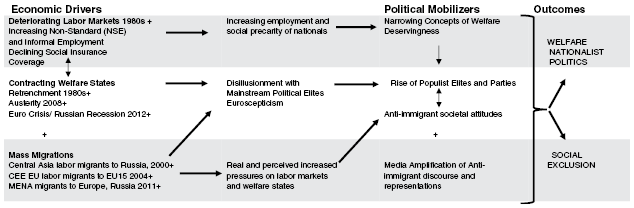
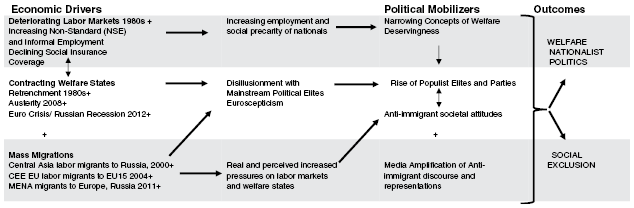
Retrenchment of welfare states began during the 1980s. European and Russian governments had accumulated extensive social expenditure commitments to nationals during the postwar decades, including universal health care, comprehensive social security, and many types of social benefits. From the 1980s, social security systems came under strain as societies aged. Welfare programs were progressively cut and benefits reduced. The 2008 financial crisis produced a sharp economic downturn that ushered in a period of austerity in both Europe and Russia. Because welfare was often deprioritized by liberalizing financial and political elites, social spending was especially affected. Deteriorating labor markets and welfare state retrenchment together constitute the second structural driver of welfare nationalism (Figure 1.1).
Economic drivers and political mobilizers of welfare nationalism (see p. 32 for an enlargement of Figure 1.1)
Elite Mobilizers of Exclusion and Inclusion
Political elites have played major roles in each migration, promoting anti-immigrant, exclusionary policies in the first three cases and inclusionary policies in the last two. In the exclusionary cases, European populist parties had been largely confined to the margins of national political systems before the migration surged. During this period, electorates became increasingly disillusioned with mainstream political parties that seemed unable or unwilling to manage economies or maintain welfare, helping to open the way for populist challengers. Populists gained support by mobilizing welfare nationalist grievances. Some analysts speculate about the direction of influence, that is, whether societal attitudes drove support for populists or populist elites generated these attitudes. Here I agree with Larsen et al. (Reference Larsen, Frederiksen, Nielson, Taylor-Gooby and Leruth2018, 98) that popular attitudes and elites’ mobilization are mutually reinforcing: “Whether populist right parties are the cause or the product of public welfare nationalism is virtually impossible to determine; the most plausible answer is that causality goes in both directions.” Grievances must be present, real, and felt in society sufficiently so that entrepreneurial politicians are motivated to respond to them and can do so effectively. Mass media further amplified populist discourses. Although varying over time, place, and type, on balance media represented migrants in pejorative and sensationalist ways that fanned the flames of nationals’ hostility and fear.
Populists cast migrants as threats to jobs and as welfare abusers. These appeals are compelling to nationals because their welfare and labor market opportunities have in fact deteriorated, mainly because of structural factors and governments’ decisions about labor market liberalization and welfare retrenchment. Populist appeals proved effective for directing popular grievances against migrants. In fact, the bulk of research finds that labor migrants on balance contribute to fiscal coffers while all migrants, including refugees, in the end have modest costs in overall spending. A significant part of welfare nationalist politics involves populist elites scapegoating migrants to gain political advantage. They blame migrants for social hardships and blame mainstream parties for both migration and austerity, a strategy that has brought populist parties increasing representation and power in European states. Mainstream parties in turn adopt less extreme scapegoating appeals to compete with populist challengers, blaming migrants for declines in nationals’ welfare that often result from cuts they themselves have made.
Anti-migrant politics takes different forms in Russia’s electoral-authoritarian system, though popular grievances related to migration are similar to those in Europe. Welfare nationalist demands to restrict immigration and limit Central Asian migrants’ access to labor markets and social services have been voiced strongly, especially by governors and mayors in places with concentrations of migrants but also by the public and in the media. Electoral politics has played a much smaller role than in Europe, though local and regional elections, some competitive and featuring anti-migrant grievances, were held during the years of mass migration. Subnational elites in Russia had other motives to respond to societal grievances, including the need to maintain social stability and to demonstrate control and authority to both those they governed and to Moscow (Gandhi and Przeworski Reference Gandhi and Przeworski2007; Gandhi Reference Gandhi2008). Russian politicians also used migrants as scapegoats for accumulating social problems, falling wages, and worsening conditions, especially during the long period of economic decline and stagnation that began in 2008. Russia’s media contributed to blaming and denigrating CA migrants.
In the inclusionary cases, compatriot resettlement programs7 in Poland and Russia and collective inclusion of Ukrainian refugees in EU states – national leaders and governing political parties took the lead in welcoming migrants. While societies are receptive to co-ethnic refugees and migrants, national leaders acted to reinforce receptiveness, showcasing migrants as highly sympathetic and deserving people who would contribute to economies or national security of receiving states. Media generally provided favorable coverage. Because they can work in formal markets and have legal residence and in some cases citizenship, these migrants are less vulnerable to welfare nationalist challenges. Nevertheless, societal resentments against their social rights and privileges, not unlike resentments seen in exclusionary migrations, do emerge. Political elites in inclusionary migrations act to manage such resentments and avoid contention, for example, by making resettlers less visible or moderately reducing refugees’ social benefits. Their behavior stands in stark contrast with that of elites in exclusionary cases, who politicize and exploit anti-migrant grievances and scapegoat migrants in order to increase their political and electoral support.
Deservingness
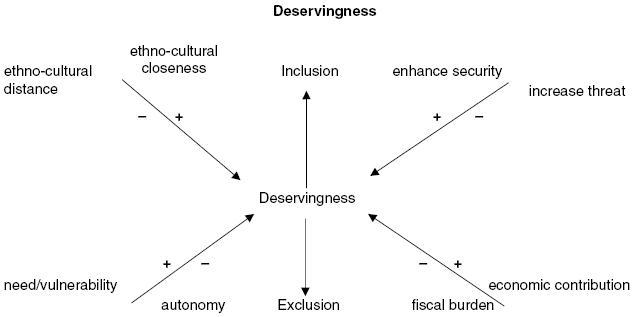
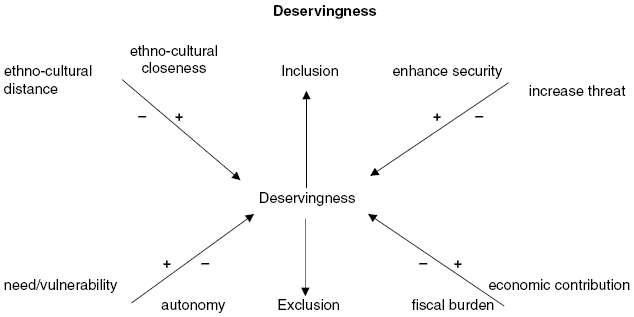
“Deservingness” is a normative judgment about which outsiders should be accepted and socially included and which should not. The literature on migration identifies four key factors that account for judgments of outsiders’ deservingness: ethnic (i.e., cultural and racial) closeness to the dominant population; need and vulnerability; economic contribution to the receiving state’s economy; and effects on its national security. Judgments on some of these factors can shift or increase in salience during migrations, as results of major economic and political changes as well as influence of elites and to some degree media. I review claims for the significance of each factor and explain how it contributes to the book’s arguments in the forthcoming paragraphs.
Many contemporary analysts see deservingness as based mainly or exclusively on the ethnic identity of immigrants, a judgment that only outsiders who share the culture and race of the state’s dominant population have the right to be included. Those who are distant ethnically are viewed as undeserving outsiders. Use of ethnicity as the sole criterion for inclusion/exclusion is referred to as welfare chauvinism (Reeskens and van Oorschot Reference Reeskens and van Oorschot2012, Van Der Waal, De Koster, and Van Oorschot Reference Van Der Waal, De Koster and Oorschot2013; Kymlicka Reference Kymlicka2015; Keskinen Reference Keskinen2016; Kingsbury Reference Kingsbury2019; Enggist Reference Enggist2019). My study confirms that ethnic proximity to the dominant population of receiving states is the most important determinant of perceived deservingness and so inclusion. This factor best explains inclusion and exclusion across the book’s cases. Ethnically distant migrants from MENA and CA are generally excluded, ethnically close groups from Europe usually included. But ethnic closeness is seldom the sole criterion for inclusion. It does not necessarily confer deservingness, as the progressive exclusion of CEE labor migrants in Britain shows. Nor does ethnic difference always lead to exclusion; early in the MENA migration some European governments welcomed refugees from war-torn countries. Rather, ethnicity has to be considered in combination with the other bases of deservingness: need, contribution, and security. Because I argue that ethnicity is not the sole criterion for exclusion, I use the term “welfare nationalism” rather than chauvinism.
A second factor, the need or vulnerability of a migrant group, weighs in judgments of deservingness, especially if migrants have no control over their situations (Reeskens and van der Meer Reference Reeskens and van der Meer2019; Smith and Waite Reference Smith and Waite2019; von Hermanni and Neuman Reference Hermanni and Neumann2019; Fraser and Murakami Reference Fraser and Murakami2022). Those fleeing war-torn home countries, especially women and children, are most often seen as deserving, regardless of their ethnicity. During the early years of the MENA migration, from 2011–2015, asylum was most often granted to those from countries at war – most from Syria or Afghanistan. Even after 2015, when Europeans’ responses to MENA migrants had become overwhelmingly exclusionary, Syrian families were seen as deserving. Some were given limited but still exceptional access to international protection. In the early stages of the Central Asian migration to Russia, women and children were provided with some social services despite their cultural distance. Need and vulnerability also play roles in the deservingness of compatriot re-settlers and Ukrainian refugees. Re-settlers to Poland were viewed as people who had been historically wronged, separated from their homeland by deportations and other traumas, at risk of losing their national identity. The refugees from Ukraine since 2022, over ninety percent of whom are women and children, easily meet the vulnerability criterion. (It should be noted that, by contrast, economic migrants, even those fleeing extreme poverty and generalized repression, are not viewed as vulnerable or deserving.)
A third criterion for deservingness is the expected economic contributions or fiscal costs that result from including migrants (Newman and Malhotra Reference Newman and Malhotra2019; Greve Reference Greve2019). Contributions usually take the form of participation in the labor force and payment of taxes. Costs include public expenditures and fears that migrants will compete with nationals for scarce resources. This socio-economic dimension of deservingness is central, and somewhat ambiguous, for labor migrants. On the one hand, they face demands to work and contribute; on the other hand, they are charged with taking nationals’ jobs. CA and CEE labor migrants were progressively excluded during the 2008 financial crisis, because the value of their labor contribution was seen to diminish and threats to nationals’ jobs to increase. In compatriot programs, the expected economic contribution is a central motive for sponsoring governments. For refugees, the initial fiscal costs of inclusion have to be balanced by ethnicity, need, and/or contributions to security.
The fourth factor of deservingness, the expected or actual effects of a migration for national security, has received much less attention than the others in the migration literature, especially before 9/11. Such effects long predated the current age of terrorism (Weiner Reference Weiner1992–1993; Rudolph Reference Rudolph2003; Kalicki, Murakami, and Fraser Reference Kalicki, Murakami and Fraser2013; Fraser and Murkami Reference Barnard, Fraser-Butlin and Costello2022). In an article in International Security, Myron Weiner (Reference Weiner1992–1993: 94–95) proposed “the need for a security/stability framework for the study of international migration that focuses on state policies toward emigration and immigration as shaped by concerns over internal stability and international security.” He saw a security framework as complementary to then-dominant political economy frameworks. Available research shows that both realistic and symbolic threats associated with migrants increase exclusionary attitudes. These include threats to the receiving state’s borders or autonomy, fears of political violence or of migrants’ links to hostile political groups or states and, especially after 2001, migration as a conduit for terrorists (Adamson Reference Adamson2006).
If migrants are perceived as threatening the national security of a state or the physical or existential security of its population, this factor can outweigh any others (Cowling, Anderson, and Ferguson Reference Cowling, Anderson and Ferguson2019). Rudolph (Reference Rudolph2003, 604) argues about the relationship between security and migration, “examining levels of threat to security at a given point in time can largely explain variation in policy.” The cases of CEE and MENA migrations clearly illustrate this argument. The Brexit movement cast CEE labor migrants in Britain as threats to border security and sovereignty and ultimately ended their rights to free entry. When the MENA migrants became associated with Islamic terrorist attacks in European cities in 2015–16, the previous willingness of some governments to admit those from countries at war ended. Though in fact European citizens with Muslim heritage and ties to international terrorist networks dominated among the planners and perpetrators of those attacks, fear and apprehension turned Europe to policies of nearly indiscriminate exclusion of MENA migrants (Pinto Arena Reference Pinto Arena2017).
While recent literature has focused on threats, migrations can also contribute to or enhance security (Weiner Reference Weiner1992–1993; Adamson Reference Adamson2006). Migrants may provide opportunities for receiving states’ elites to pursue economic and political interests. They may, for example, cement profitable connections with sending states or provide political leverage by making those states financially dependent on migrants’ remittances. Migrants may increase a state’s human capital. Compatriot re-settlement programs in Russia and Poland were explicitly designed to address demographic losses and replenish labor forces with resident native speakers, making receiving states less dependent on mobile foreign workers. Giving Ukraine’s vulnerable citizens refuge in Europe supports the Ukrainian government and military in their fight against Russia, a common enemy.
These four factors constitute a matrix of perceived deservingness (see Figure 1.2). Judgments are determined by a mix of factors. Their weights vary over the course of each migration and shift, sometimes abruptly, because of events such as economic crises or terrorist attacks. Politicians and media can influence the salience of these factors in directions either favorable or unfavorable to inclusion. Shifting collective judgments of deservingness among electorates and elites in turn drive migration policy in exclusionary or inclusionary directions. I conceptualize welfare inclusion and exclusion not as static features of states’ approach to migration, but as processes that change over time and are contingent on specific economic and political factors.
Deservingness: four determining factors
1.3 The Relationship between Immigration and Welfare
Comparative politics literature on immigration and welfare contributes to the framing of my study. Most early research focused on how migration impacted nationals’ support for welfare states (see Morissens and Sainsbury Reference Morissens and Sainsbury2005). A seminal book by Diane Sainsbury, Welfare States and Immigrant Rights: The Politics of Inclusion and Exclusion (2012), shifted the focus to states’ provision of welfare to migrants. Hers was the first study that looked comparatively at migrants’ social rights in Europe from the post-WWII period to the beginning of the twenty-first century. Sainsbury’s analysis covered all immigrant entry categories, including international and intra-EU labor migrants; refugees and asylum seekers; documented and undocumented; and ex-colonials and co-ethnic immigrants who came through earlier compatriot resettlement programs. She found that both entry regimes – the rules for entry – and incorporation regimes – the rules for inclusion, determined and stratified immigrants’ rights (Sainsbury Reference Sainsbury2012, 16).
My research builds on Sainsbury’s work, extending her questions in time and regional coverage. Focusing on the period after 2000, I cover six cases – Britain, Germany, Sweden, Italy, Poland, and Russia – that range across Western Europe, Central and Eastern Europe, and Eurasia. I follow Sainsbury in looking at the politics of inclusion and exclusion for several migrant entry categories: international and intra-EU labor migrants, refugees and asylum seekers, and co-ethnic immigrants. To preview, my study finds that entry categories have become much more difficult to differentiate and matter less in immigrants’ treatment, a conclusion already reached by Joppke (Reference Joppke2021). Incorporation regimes have become more fragmented and provide fewer and more precarious rights, and the security dimension has become more central to migration policy. I also find that there are significant similarities in welfare nationalist grievances and appeals across European democracies and authoritarian Russia.
Welfare State Institutions and Immigrants
Sainsbury grounds her study in Esping-Andersen’s (Reference Esping-Andersen1990) famous welfare regime typologies – liberal, conservative-corporatist, and social democratic – and asks how these different “types” shaped migrants’ welfare rights across Europe. Many scholars have followed the research path she laid out, developing hypotheses from the three typologies and using them to frame studies of comparative welfare generosity toward migrants. Some scholars hypothesize that corporatist and especially social-democratic regimes will be more inclusive of immigrants because they are more inclusive of citizens – the “generosity hypothesis.” They expect that liberal regimes will be less generous to both nationals and immigrants (Banting Reference Banting, Bommes and Geddes2000; Sainsbury Reference Sainsbury2012; Boräng 2015). Van Der Wall et al. (2013) group conservative-corporatist with liberal regimes, finding only the social-democratic type to be more generous to immigrants. Gschwind (Reference Gschwind2018, 1), by contrast, finds, at least in some cases, “a negative relationship between welfare state generosity and migrants’ social protection.” In sum, analysts’ findings vary and reach no consensus.
The central question of these studies – how to explain comparative inclusion and generosity toward migrants – is similar to the question that motivates my research, but the welfare regime approach has limitations. Even if we accept a regime-based “generosity” argument, migrants cannot be automatically subsumed into the national population in terms of welfare provision. They often do not meet criteria – what Gschwin calls “welfare conditionality” – that make nationals eligible for social benefits. As Gschwind (Reference Gschwind2018, 1) argues, “A sound conceptualization of migrants’ social protection needs to include the actual receipt of benefits…. [I]mmigrants can be systematically excluded from social protection in the shadows of seemingly inclusive and generous welfare states.” Even those who enter with strong social rights confront various obstacles and conditionalities, sometimes including administrative manipulations purposely designed to raise the bar and exclude them, as the British case will show (Corrigan Reference Corrigan2014). Nor, as Sainsbury (Reference Sainsbury2012) emphasized, can migrants be treated as a single or unitary group. Some – EU labor migrants and compatriot re-settlers – entered with the promise of full social rights. Others – asylum seekers and unregistered labor migrants – came with no or at best precarious rights. Finally, the models implicitly assume that a state’s welfare regime remains relatively stable, but in recent decades, governments across the region have confronted shared new risks and made major changes affecting both nationals and immigrants (Cook and Titterton Reference Cook and Titterton2023).
More significantly, the growing role of the European Union has gone some way toward standardizing European states’ responses to migration. The EU initially dictated strong social rights for its migrant citizens working in member countries. After Brexit, it backed down and loosened those rights for all remaining members (see Chapter 5). The Union made efforts to set common standards for the treatment and rights of asylum seekers through the Common European Asylum System (CEAS). Though the system largely failed, the European Council very effectively coordinated the harsh exclusionary policies that ended the 2015 surge of MENA migration (see Chapter 6). The EU has coordinated all aspects of the response to the Ukrainian refugee migration through the passage of the Temporary Protection Directive, which homogenizes member states’ responsibilities for refugees’ protection and broad social inclusion (see Chapter 8). In sum, while there remain differences in the treatment of migrants by individual European states, my study will show that it has become less relevant to look for systematic divergences based on national welfare regimes or other state-level characteristics as the EU’s role in immigration policy has expanded.
Multiculturalism
A substantial body of literature explains welfare nationalism as a result of growing ethno-cultural diversity or multiculturalism within European societies (Bommes and Geddes Reference Banting, Bommes and Geddes2000; Larsen Reference Larsen2011; Bay et al. Reference Bay, Finseraas and West Pedersen2016, Larsen, et al. Reference Larsen, Frederiksen, Nielson, Taylor-Gooby and Leruth2018). The premise here is that shared culture forms the basis for social solidarity, which in turn makes people willing to redistribute within their national community but less or not willing to share with cultural others. It is, they argue difficult or impossible to build social solidarity across cultural lines. This argument is supported by numerous surveys showing that many respondents see ethnic others generally as less deserving than co-ethnics, other conditions being equal, and see immigrants as least deserving. Ford’s (Reference Ford2016, 630) survey experiments in Britain found that the majority of respondents favored co-ethnic welfare claimants, while “both race and migrant status trigger discrimination and the impact of these is cumulative.” Other scholars have found similar results. These authors argue that exclusion of immigrants extends from hostility to ethnically or racially different groups within societies and that increased multi-culturalism in European societies is a major cause for the growth of migrants’ exclusion.
Other scholars challenge the claim that increasing ethnic or cultural diversity alone undermines support for redistributive social spending. Banting (Reference Banting, Bommes and Geddes2000) argues that, while cultural heterogeneity or homogeneity may be related to welfare provision, the relationship is mediated by political institutions and other factors. Mewes and Mau (Reference Mewes, Mau and Svalfors2012) find that the proportion of immigrants in a country has no effect on welfare chauvinism. Kymlicka (Reference Kymlicka2015, 9) generalizes the argument:
[T]here is no inherent or universal tendency for multiculturalism to drive down solidarity. Cross-national studies show that countries which have gone farther down the road of embracing multiculturalism policies have on average fared as well as other countries in maintaining social spending, in maintaining public support for redistributive programs, and in maintaining attitudes of inclusive solidarity…. Whatever the relationship between multiculturalism and solidarity, it is not a simple hydraulic one, in which one goes down when the other goes up.
(At a more general level, Kymlicka does argue that cultural factors matter much more than economic or welfare competition in explaining anti-immigrant attitudes.)
Reeskens and van Oorschot (Reference Reeskens and van Oorschot2012, 122) propose a more nuanced argument that most Europeans oppose giving migrants immediate access to welfare benefits but do favor later, conditional access:
One’s perception of immigrants as less deserving does not necessarily imply a desire to categorically exclude them from social welfare provisions…. A larger proportion of Europeans favors granting immigrants social welfare rights, but only after they acquire citizenship or after they made significant tax contributions.
My analysis is close to their line of argument, with the major caveat that many contemporary migrants have no possibility to either acquire citizenship or work and pay taxes in the legal economy. Chapter 3 provides further discussion of the issue.
Economic Explanations
Some researchers attribute welfare nationalism to real economic effects of migration, including nationals’ competition with migrants for employment and social benefits. Mewes and Mau (Reference Mewes, Mau and Svalfors2012, 149) argue that economic and cultural threats both matter and are complementary. Their research found a “robust and strong effect of perceived material risk on welfare chauvinism.” Claims that immigrants not only steal jobs but also push down wages are legion in the rhetoric of anti-immigrant politics. European trade unions opposed the opening of labor markets to CEE migrants because union leaders feared EU migrants would lower national wage levels. Russia’s labor unions have also pressed for exclusion of labor migrants, though they have little independent influence. There is in fact evidence that migrants compete with and may displace nationals and push down wages at the lower rungs of labor markets, in low-skilled work. In some cases, they displace workers in particular economic sectors. Affected groups of nationals bear real costs. Generally, though, in both Europe and Russia, migrants are concentrated in job sectors that have labor shortages because low wages and the absence of mobility opportunities make them unattractive to most nationals. Migrants commonly work in construction, agriculture, and other seasonal occupations, as well as in personal services and caring for elderly. Most developed economies face labor shortages in these sectors.
Anti-immigrant movements also charge that migrants compete with nationals for scarce social resources and overburden and exploit welfare states. No doubt there have been such cases. However, field research shows that most labor migrants know little about welfare in receiving states and, for a variety of reasons, including poor language competence and lack of cultural knowledge, avoid or make limited use of most public services (Osipovič Reference Osipovič2010; Rocheva Reference Rocheva2014). Experts’ estimates of the fiscal impact of immigration differ and there is cross-country variation. However, a 2013 study of costs of cumulative migration of all types over fifty years in OECD member states concluded that on average the impact was close to zero (Liebig and Mo Reference Liebig and Mo2013). Labor migrants in particular are overall younger and more economically active than nationals and generally have a positive fiscal impact. According to an OECD study (2014, 2), “Immigrants are thus neither a burden to the public purse nor are they a panacea for addressing fiscal challenges. In most countries, except in those with a large share of older migrants, migrants contribute more in taxes and social contributions than they receive in individual benefits.” There are of course costs to providing for newly arrived refugees and asylum seekers. But these costs constitute a relatively small part of overall welfare spending. According to Enggist (Reference Enggist2019, 5), citing the OECD Social Expenditure Database, “Germany in 2015 – when the number of asylum seekers famously peaked, spent about 0.5 percent of its GDP on measures to integrate immigrants and refugees.” He argues convincingly, as do others, that the political salience of costs for migrants’ social rights far outweighs their limited financial significance.
In sum, none of these explanations– welfare state regime types, degree of multiculturalism or significant competition in most sectors of labor markets, can account well for the levels and decline of welfare provision to migrants. The overall declining employment and welfare security of nationals provide a better explanation for the rise of welfare nationalism.
Migration Cycles
My study shows that there are exclusionary (vicious) and inclusionary (virtuous) migration cycles. Exclusionary migrations involve a ‘vicious’ cycle of hostile public opinion toward more-or-less ethnically-distant migrants that is reinforced and exploited by politicians for political advantage, amplified by mass media and produces policies of exclusion. By contrast, inclusionary migrations involve a ‘virtuous cycle’ of relatively receptive public opinion toward ethnically close migrants, high-level political support, elites’ management of tensions with nationals and positive treatment in mass media, producing policies of inclusion. While ethnicity is key, the other elements of deservingness matter. Politicians have a great deal of influence over the political salience and degree of anti-migrant mobilization, and exploitation or management of grievances in both types of cycles. But elites cannot manufacture grievances, empathy or societal perceptions of deservingness. Responses to migrations involve interactions of elites and their societies.
The remainder of the chapter considers the comparative method, country cases and populist parties that feature in the book, and provides a synopsis of the chapters.
1.4 Cases and Method
My study focuses on five major post-2000 migrations to Europe and Russia, the first three exclusionary and the last two inclusionary. The first brought several million labor migrants from Central Asian (CA) countries in the former Soviet periphery to work in Russia’s booming economy beginning in 2000. The second followed the accession to the European Union (EU) of ten Central and East European (CEE) states in 2004 (EU8) and 2007 (EU2). Hundreds of thousands of intra-EU labor migrants from Poland, Hungary, and other new member states migrated to work in EU15 economies. Beginning in 2004, CEE states sent the largest-ever migration to modern Britain, and later substantial numbers to other EU15 states. The third migration, beginning in 2011 and overlapping with the first two, brought hundreds of thousands of asylum seekers and others from the MENA region to Europe and thousands to Russia. The MENA migration reached a peak of more than one million during 2015. The fourth, an inclusionary migration, which was smaller than the first three, began in 2014. It brought several hundred thousand migrants to Russia and tens of thousands to Poland. Most came seeking asylum from the war in Donbass. Instead of becoming refugees, many became Russian compatriot re-settlers or holders of the Pole’s Card (Karta Polaka). The fifth migration brought several million Ukrainian refugees to Europe after Russia’s brutal invasion of their country in February 2022 (see Table 1.1).
The study focuses on six states, each of which was affected by at least two of the migrations. I chose states that vary as much as possible on potentially relevant explanatory factors. Welfare regime types have been identified as explaining differences in states’ treatment of migrants; my cases represent social-democratic (Sweden), conservative (Germany), and liberal (Britain) regime types as well as two post-communist states that differ in welfare structures – Poland and Russia. Political regime types potentially influence migration policy, with democratic governments expected to be more responsive to popular grievances than authoritarian, so I have varied regimes: four are democratic, Poland is a democratic backslider, and Russia is electoral-authoritarian. I added the European Union as a separate actor because of its large role in member states’ migration policy. The scale of migration has been identified as influencing responses. My cases vary in the scale of inflow for each migration.
In terms of method, I constructed comparisons of responses by all studied states affected by each migration, beginning with the three exclusionary cases. Russia and Britain both received large labor migrations. Because Russia alone was affected by the CA labor migration, I compare it with Britain, the most similar in that it received the largest and most condensed CEE migration. All six states received MENA migrants. I compare their responses from the beginning of the migration surge in 2011 to 2016, when it was brought under control. I also track the major role of the European Union in shaping and coordinating Europe’s strategies for managing the MENA migration. The last section of the book covers the two inclusionary migrations. Compatriot resettlement programs in Poland and Russia, while not identical, are shown to have many common features. The final case, the extraordinarily welcoming responses of European governments and societies to the Ukrainian refugees, is compared with responses to the MENA refugees. The deservingness lens is used throughout to frame perceptions of migrants and explain their inclusion/exclusion.
Populist parties played major roles in all the European cases. They are typically nationalistic, anti-elite, anti-immigration, Euroskeptic, and focused on economic grievances. (For an extended discussion of the concept and practices of populism, see Chapter 3.) My study focuses on one populist party for each of the European cases, two for Italy (see Table 1.1, furthest right column): Alternative for Germany (AfD), the United Kingdom Independence Party (UKIP), Italy’s League and Five-Star Movement (M5S), the Sweden Democrats, and Poland’s Law and Justice Party (PiS). All are right or far right ethno-nationalists on issues of identity politics. All use the core welfare nationalist appeal that, as the rules of exclusion against immigrants are strengthened, the social and economic rights of those within the national community will be enhanced. On domestic distributive and welfare policy they divide into right and left, some favoring more expansive policies, others pro-market. While anti-immigrant appeals are most important to their success, economic appeals also draw support. As Mudde and Kaltwasser (Reference Mudde and Kaltwasser2018, 1670) explain, “By combining populism with other sets of ideas, populists are able to politicize grievances that are relevant in their own context.” My study analyzes the roles of the major populist party in the five European states through comparative case studies that track their rise in influence and effects on migration policy in each state. It shows the entrenchment of most by 2018 and tracks their progression to the present. I explain why, despite their anti-immigrant and ethno-nationalist orthodoxies, European populists have not tried to mobilize against the Ukrainian refugees.
In Russia, my research shows that governors and mayors played a major role in anti-migrant politics. Those governing regions and cities with large concentrations of migrants responded to and mobilized welfare nationalist grievances among their populations, as will be shown in their public speeches and election platforms. Until 2014, some did compete in local and regional elections, where immigration was a major issue. They scapegoated migrants both to compete in elections and to demonstrate their authority, control, and responsiveness to constituents. Sub-national politicians in Russia did not influence migration policy as much as populist parties in Europe did, because the executive and policy processes in Russia are far more insulated. They did, however, push Russia’s policy in exclusionary directions.
1.5 Synopses of Chapters
Part I
Chapter 2 expands on economic drivers of welfare nationalism, the longer-term structural trends that produced the ‘toxic mix of immigration and austerity,’ which in turn drove the exclusion of migrants in Europe and Russia after 2000. It identifies causes for the explosion of international migration: collapse of communist governments, rapid expansion of the European Union, and multiple crises in the MENA region. The scale and speed of the three major migrations are covered: from Central Asia to Russia; from Central and Eastern Europe to the EU15; and from the MENA region to Europe and Russia. The chapter then turns to structural economic decline and austerity. Effects on labor markets – increase in non-standard and informal employment and growing exclusion from social security systems – are documented. The 2008 global financial crisis, 2011 Euro Crisis, and recession in Russia from 2012, which further drove austerity, are discussed. Finally, the chapter shows retrenchment in social provision across the cases, declining real value of major benefits, and dissatisfaction with health care. Declines in welfare affected politics, alienating European electorates from mainstream parties and leaving postcommunist societies disillusioned with their liberal political leaders.
Chapter 3 focuses on political mobilizers of welfare nationalism, the attitudes and agents that produced anti-immigrant politics and exclusionary policies in Europe and Russia. It elaborates on deservingness criteria: ethnic closeness, need, contributions to domestic economies, and national security, and explains their role in my cases. Tracking the rise of the six populist parties that play the major roles in my cases – UKIP in Britain, AfD in Germany, M5S and Region in Italy, Sweden Democrats and PiS in Poland, I show how each gained vote share and national influence during the CEE and MENA migrations. I argue that welfare nationalist attitudes in society and populist parties’ appeals were mutually reinforcing, amplifying societal grievances and channeling them into electoral success for the parties and exclusionary migration policies. In Russia, popular grievances against Central Asian labor migrants were similar to those against labor migrants in Europe. In the near absence of elections, welfare nationalism was mobilized by regional elites, governors, and mayors. Drawing on arguments about authoritarian regimes’ stability and persistence, I show that sub-national leaders used anti-immigrant mobilization to demonstrate control and generate popular support, and pressed the autocrat for exclusionary policies.
Part II
Chapter 4 focuses on labor migration from Central Asia to Russia after 2000, which made Russia one of the world’s major migrant-receiving states. It explains why Putin retained a visa-free regime with the much poorer former Soviet states of CA, allowing millions of their citizens free entry to Russia. Most stayed and worked with undocumented status. As the number of the ethnically distant Muslim migrants rose, welfare nationalist grievances emerged in the cities and regions where they were concentrated. Citing public opinion surveys, speeches by mayors and governors, election and party platforms, the chapter shows how politicians framed and used societal grievances to placate citizens and scapegoat migrants for declines in popular welfare. It highlights the role of sub-national officials in mobilizing anti-immigrant politics and channeling pressures for exclusionary policies to Putin. These pressures are shown to cause legislative and normative changes that progressively excluded migrants from social sectors and labor markets, and subjected them to increasing abuses and deportations. I explain why, despite his autocratic power and instrumental support for migration, Putin responded to pressures from below by adopting limited exclusionary policies toward CA labor migrants.
Chapter 5 turns to westward labor migration from the EU’s newly acceded Central and East European (CEE) states to the EU15 from 2004. Focusing on Britain, the country first and most affected by immigration from CEE, the chapter shows how migrants’ EU-mandated free entry and social rights provoked a welfare nationalist backlash that was reflected in opinion polls and in growing support for the populist, anti-immigrant United Kingdom Independence Party (UKIP). Relying on government documents, I show how Britian’s social security bureaucracy rescinded CEE labor migrants’ social rights. Exclusionary legislative reforms, culminating in the 2016 Brexit vote, ended their entry rights. The Brexit Settlement Scheme extended residence rights for some on ethnically and economically discriminatory bases. Comparative case studies of CEE migration to EU members Germany, Sweden, and Italy show that each followed the British model “part of the way,” adopting weaker, more selective exclusionary policies that discriminated against young and low-skilled workers and the less ‘European.’ The conclusion explains why the EU failed to extend its egalitarian, inclusionary, post-national citizenship project eastward.
Chapter 6 looks at political responses to the MENA migration, which mixed refugees fleeing wars in Syria, Iraq, and Afghanistan, with labor migrants from many other MENA states. The chapter tracks Europe’s progression from initially cautious receptiveness of asylum seekers to the nearly total exclusion of MENA migrants from the continent. I show that the growing numbers and migrant “mix,” populist parties, and terrorist attacks by Islamic extremists in Europe combined to mobilize anti-immigrant sentiments and pressured centrist governments toward harshly exclusionary policies. Europe’s turn to militarized securitization and ‘externalization of borders’ to Turkey and Libya ended the migration surge, effectively abandoning those with legitimate asylum claims under the Geneva Convention. MENA migrants’ only claim to deservingness was need, and it was undermined by the mixing in of labor migrants and overwhelmed by the perceived security threat from terrorism. Comparative studies of the six cases show that governments responded differently in the course of the migration, but in the end, the EU managed a homogenized policy intended to physically exclude all those from the MENA region.
Part III
Chapter 7 discusses the resettlement of co-ethnics in Poland through the Karta Polaka and in Russia through the Compatriot Resettlement Program. In both cases the receiving states’ elites sponsored the migrations for their own political purposes, while societies were receptive. Migrants and refugees in these cases entered ‘virtuous cycles’ of relatively tolerant public opinion toward ethnically-close migrants, support by high-level political elites, and positive treatment in mass media, resulting in inclusionary policies. Political elites and media showcased migrants’ contributions to economy and security, key elements of deservingness. Welfare nationalist grievances did arise among receiving societies, but political elites managed and mitigated these grievances rather than mobilizing them for political gain. Resettlers were given privileged access to citizenship and economic support, though restrictions of the program in Russia and limited language competence of many in Poland disadvantaged them.
Chapter 8 concludes the book with a study of Ukrainian refugees’ migration to Europe since February 2022. It explains the EU members’ decision to activate for the first time the Temporary Protection Directive (TPD), which provided Ukrainian citizens with immediate and collective international protection and full social rights in all member states. I show that public opinion and elites across Europe’s political spectrum sustained support for inclusion despite worsening economic conditions, and explain the refugees’ multiple sources of deservingness. EU states are protecting and including Europe’s largest immigration since WWII. Chapter 8 deploys the book’s analytical framework to explain why, and compares the Ukrainian and MENA refugee migrations.