Introduction
Frailty is a complex clinical syndrome associated with failing health. At its root is multi-system dysregulation leading to a reduction in the ability to withstand stressors.1–Reference Rockwood3 This renders individuals more susceptible to all adverse health outcomes: disability, falls, morbidity, hospitalization, institutionalization and mortality.Reference Fried, Tangen, Walston, Newman, Hirsch, Gottdiener, Seeman, Tracy, Kop, Burke and McBurnie4, Reference Rockwood and Mitnitski5 Wide individual variation reflects a frailty spectrum ranging from relatively fit individuals to those at the final stage who are profoundly disabled and dependent. Despite much research, consensus on a standardized definition, and hence standardized criteria for identifying and measuring frailty, is still lacking. This relates to the ongoing debate over whether it should be defined as a physiological entity, with focus on the physical components, or viewed more holistically to encompass cognitive and psychosocial elements.
The proportion of older people becoming frail is due to increase with the expanding older population. A greater burden will be placed on the resources of health and social care providers. Interventions that prevent or ameliorate the severity of frailty could have far-reaching health and socioeconomic implications. One of the major components of frailty is sarcopenia, i.e. loss of muscle mass, strength and/or physical performance.Reference Cruz-Jentoft, Baeyens, Bauer, Boirie, Cederholm, Landi, Martin, Michel, Rolland, Schneider, Topinková, Vandewoude and Zamboni6 Exercise interventions have been found to improve some of these physical deficits and potentially reduce dependency levels. A previous systematic review of this topic by Chin A Paw and colleagues in 20087 found no evidence of exercise being beneficial in highly frail individuals and, although exercise was beneficial in less frail individuals, conclusions could not be drawn about which type of exercise intervention was most favourable.
The aims of this systematic review are to synthesize and evaluate randomized controlled trials (RCTs) investigating the effects of exercise interventions on physical performance and muscle strength in frail older people, to ascertain sustainability of any benefits and identify adverse events. This seeks to extend the work of the previous review by Chin A Paw et al.Reference Chin A Paw, van Uffelen, Riphagen and van Mechelen7 and consequently only new studies published since their review in 2008, or found in databases not searched by them, will be examined.
Methods
Guidelines for conducting systematic reviews set out in the PRISMA statementReference Liberati, Altman, Tetzlaff, Mulrow, Gøtzsche, Ioannidis, Clarke, Devereaux, Kleijnen and Moher8 and Cochrane Handbook for Systematic Reviews of Interventions (version 5.0.2, 2009)Reference Higgins and Green9 were followed. Assessment of methodological quality was done qualitatively with reference to the Cochrane Handbook's ‘Risk of bias assessment tool’ (Table 8.5.c)Reference Higgins and Green9 and the PEDro scale.10
Literature search
This review updates a previous review by Chin A Paw et al.Reference Chin A Paw, van Uffelen, Riphagen and van Mechelen7 Searches for the previous review were conducted in August 2007 and included the following databases: PubMed, Embase and CENTRAL (in Cochrane Library); publication years were from 1995. Duplication is not intended, hence only new studies published since then (i.e. from September 2007 to September 2010) in those databases, or from other databases (date limits 1995–2010), have been reviewed. The following databases were searched in September 2010: Medline, Embase, AMED, PEDro, The Cochrane Library (Cochrane Register of Controlled Trials and Cochrane Database of Systemic Reviews), British Nursing Index and PsychINFO. Search terms used were as follows: exercise or terms synonymous with exercise (e.g. exercise movement techniques, exercise therapy, kinesiotherapy), and terms associated with frailty and old age (e.g. frail elderly, aged 80 and over, ageing, nursing homes, homes for the aged). The search strategy was limited to RCTs and English language.
Inclusion/exclusion criteria
Studies met the following criteria: (1) study participants were described as ‘frail’ in the title or abstract or deemed frail by virtue of their advanced age and/or need for institutional care; (2) the intervention group received a programme of exercise/physical activity designed to improve strength and/or function, individually or in a group, home-based or at a gymnasium/clinic; (3) the control group was non-exercising and received either a placebo intervention, e.g. health education, social visits etc., or no intervention; (4) a minimum of one valid measure of physical function was reported as an outcome. Studies were excluded if they met any of the following criteria: (1) multi-component interventions where the effects of exercise could not be isolated; (2) disease-specific studies, e.g. frail older people with Parkinson's disease, stroke, chronic obstructive pulmonary disease, cognitive deficits or mood disorders; (3) frail hospitalized patients; (4) falls prevention studies.
Data collection and analysis
The title and abstracts of identified studies were screened from all literature searches. Unless there was a clear reason for exclusion, full texts of potentially relevant studies were obtained to determine eligibility. Once confirmed, the following data were extracted from each trial: (1) rationale for describing the study participants as frail; (2) details of the study population (number, setting, age, sex, functional status, number of drop-outs with reasons); (3) study location; (4) characteristics of the exercise intervention (group/individual, type, frequency, intensity, repetitions, duration of exercise sessions and intervention period); (6) adherence rate; (7) outcome measures; (8) results: estimate of the size of the treatment effect; (9) adverse events. Studies were assessed for methodological quality using the following criteria: randomization method, allocation concealment, clearly defined inclusion and exclusion criteria, baseline comparability (age, co-morbidities, physical function/activities of daily living (ADL) dependency level, cognitive status), clearly defined intervention and outcome measures, blinding of outcome assessor, more than 80% follow-up for a minimum of one key outcome, intention-to-treat analysis for participants who withdrew from the study and other risks of bias during the trial, e.g. unblinding of assessors. Blinding of participants and personnel administering ‘therapy’ is impossible to achieve in physical activity/exercise intervention trials and was therefore excluded.
Results
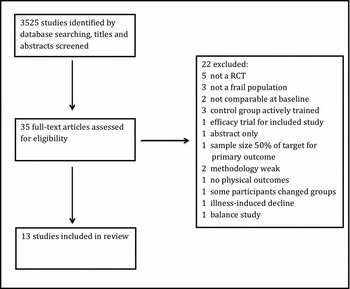
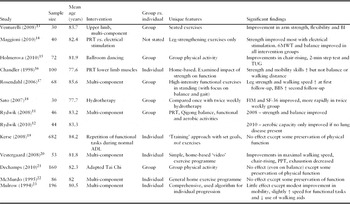
The search strategy retrieved 3523 references. All titles and/or abstracts were screened and 35 potentially relevant full-text papers were obtained for more detailed screening. Of these, 13 studies met the inclusion criteria and 22 studies did not. Figure 1 summarizes the review process using the PRISMA guidelines. Two of the included studiesReference Rydwik, Lammes, Frandlin and Akner11, Reference Rydwik, Gustafsson, Frandin and Akner12 used the same intervention to investigate different effects of exercise. They were essentially the same trial, but because of different objectives, outcome measures and other disparities (e.g. different drop-out numbers) they have been treated separately unless stated. Table 1 summarizes the main characteristics of the studies.
PRISMA flow diagram

Study characteristics (the nutritional arms of the Rydwik (2008, 2010) and Rosendahl studies were disregarded)

Study populations
The trials were conducted in different countries: three in Sweden,Reference Rydwik, Lammes, Frandlin and Akner11, Reference Rydwik, Gustafsson, Frandin and Akner12, Reference Rosendahl, Lindelöf, Littbrand, Yifter-Lindgren, Lundin-Olsson, Håglin, Gustafson and Nyberg17 one in Denmark,Reference Vestergaard, Kronborg and Pugaard20 one in the Czech Republic,Reference Holmerová, Machácová, Vanková, Veleta, Jurasková, Hrnciariková, Volicer and Andel15 two in the USA,Reference Chandler, Duncan, Kochersberger and Studenski16, Reference Mulrow, Gerety, Kanten, Cornell, DeNino, Chiodo, Aguilar, O'Neil, Rosenberg and Solis23 one in Japan,Reference Sato, Kaneda, Wakabayashi and Nomura18 one in New Zealand,Reference Kerse, Peri, Robinson, Wilkinson, von Randow, Kiata, Parsons, Latham, Parsons, Willingale, Brown and Arroll19 one in France,Reference Dechamps, Diolez, Thiaudière, Tulon, Onifade, Vuong, Helmer and Bourdel-Marchasson21 one in Scotland,Reference McMurdo and Johnstone22 and two in Italy.Reference Venturelli, Lanza, Muit and Schena13, Reference Maggioni, Cè, Rampichini, Ferrario, Giordano, Veicsteinas and Merati14 A total of 1652 individuals were included in the trials. Two studies included women only,Reference Maggioni, Cè, Rampichini, Ferrario, Giordano, Veicsteinas and Merati14, Reference Vestergaard, Kronborg and Pugaard20 one study did not specify genderReference Sato, Kaneda, Wakabayashi and Nomura18 and of the remaining studies, most (73.7%) were women. Participants were either community dwelling,Reference Rydwik, Lammes, Frandlin and Akner11, Reference Rydwik, Gustafsson, Frandin and Akner12, Reference Chandler, Duncan, Kochersberger and Studenski16, Reference Sato, Kaneda, Wakabayashi and Nomura18, Reference Vestergaard, Kronborg and Pugaard20, Reference McMurdo and Johnstone22 living in residential care,Reference Holmerová, Machácová, Vanková, Veleta, Jurasková, Hrnciariková, Volicer and Andel15, Reference Rosendahl, Lindelöf, Littbrand, Yifter-Lindgren, Lundin-Olsson, Håglin, Gustafson and Nyberg17, Reference Kerse, Peri, Robinson, Wilkinson, von Randow, Kiata, Parsons, Latham, Parsons, Willingale, Brown and Arroll19 a nursing home,Reference Venturelli, Lanza, Muit and Schena13, Reference Dechamps, Diolez, Thiaudière, Tulon, Onifade, Vuong, Helmer and Bourdel-Marchasson21, Reference Mulrow, Gerety, Kanten, Cornell, DeNino, Chiodo, Aguilar, O'Neil, Rosenberg and Solis23 or in a long-stay hospital.Reference Maggioni, Cè, Rampichini, Ferrario, Giordano, Veicsteinas and Merati14 All participants were medically stable and free of acute illness.
Studies varied in terms of baseline ambulatory, functional and cognitive capacity, reflecting the wide heterogeneity of study participants’ capabilities between studies. However, each intervention was targeted towards individuals with similar deficits. Participants in the Holmerova studyReference Holmerová, Machácová, Vanková, Veleta, Jurasková, Hrnciariková, Volicer and Andel15 were the most mobile, enabling them to cope with the demands of the intervention (ballroom dancing). Conversely, one study,Reference Venturelli, Lanza, Muit and Schena13 evaluating upper body training when sitting, required participants to have severe mobility limitations and a poor Barthel Index (BI), i.e. 20/100 (high score best). Participants’ performance in ADL varied from independence in transferring from bed to chairReference Vestergaard, Kronborg and Pugaard20 to needing assistance with transfersReference Sato, Kaneda, Wakabayashi and Nomura18 and from dependence in ≥ one personal activity of daily living (PADL)Reference Venturelli, Lanza, Muit and Schena13, Reference Rosendahl, Lindelöf, Littbrand, Yifter-Lindgren, Lundin-Olsson, Håglin, Gustafson and Nyberg17, Reference McMurdo and Johnstone22 to dependence in ≥ two PADL.Reference Kerse, Peri, Robinson, Wilkinson, von Randow, Kiata, Parsons, Latham, Parsons, Willingale, Brown and Arroll19, Reference Mulrow, Gerety, Kanten, Cornell, DeNino, Chiodo, Aguilar, O'Neil, Rosenberg and Solis23 To ensure effective engagement with the intervention, most studies specified either functional cognitive measures or a mini-mental state score above which participants were enrolled.Reference Rydwik, Lammes, Frandlin and Akner11–Reference Maggioni, Cè, Rampichini, Ferrario, Giordano, Veicsteinas and Merati14, Reference Chandler, Duncan, Kochersberger and Studenski16–Reference Dechamps, Diolez, Thiaudière, Tulon, Onifade, Vuong, Helmer and Bourdel-Marchasson21, Reference Mulrow, Gerety, Kanten, Cornell, DeNino, Chiodo, Aguilar, O'Neil, Rosenberg and Solis23
There was no specific assessment of frailty in the majority of studies. Three studiesReference Rydwik, Lammes, Frandlin and Akner11, Reference Rydwik, Gustafsson, Frandin and Akner12, Reference Vestergaard, Kronborg and Pugaard20 used markers of frailty based on Fried's phenotypeReference Fried, Tangen, Walston, Newman, Hirsch, Gottdiener, Seeman, Tracy, Kop, Burke and McBurnie4 to define frailty and/or as inclusion criteria: low physical activity and unintentional weight lossReference Rydwik, Lammes, Frandlin and Akner11, Reference Rydwik, Gustafsson, Frandin and Akner12 and exhaustion.Reference Vestergaard, Kronborg and Pugaard20 Three other studies used proxy indicators of muscle strength: chair-rising abilityReference Rosendahl, Lindelöf, Littbrand, Yifter-Lindgren, Lundin-Olsson, Håglin, Gustafson and Nyberg17, Reference Dechamps, Diolez, Thiaudière, Tulon, Onifade, Vuong, Helmer and Bourdel-Marchasson21 and inability to walk downstairs one leg after the other without holding a rail.Reference Chandler, Duncan, Kochersberger and Studenski16
Quality assessment
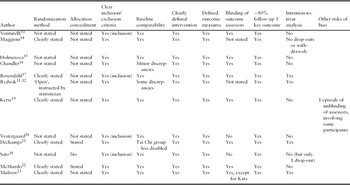
Studies were of relatively high quality, but there were a few areas of concern. The method of randomization, if reported, varied and allocation concealment was unclear in most cases. There was a possibility of systematic bias in three studies because the method of randomization was not ‘closed’.Reference Rydwik, Lammes, Frandlin and Akner11, Reference Rydwik, Gustafsson, Frandin and Akner12, Reference Sato, Kaneda, Wakabayashi and Nomura18 Other areas of concern were a lack of blinding of outcome assessors in two cases,Reference Sato, Kaneda, Wakabayashi and Nomura18, Reference Vestergaard, Kronborg and Pugaard20 not stated in three others,Reference Rydwik, Lammes, Frandlin and Akner11, Reference Rydwik, Gustafsson, Frandin and Akner12, Reference Maggioni, Cè, Rampichini, Ferrario, Giordano, Veicsteinas and Merati14 and no intention-to-treat analysis in seven cases.Reference Venturelli, Lanza, Muit and Schena13, Reference Holmerová, Machácová, Vanková, Veleta, Jurasková, Hrnciariková, Volicer and Andel15, Reference Chandler, Duncan, Kochersberger and Studenski16–Reference Vestergaard, Kronborg and Pugaard20, Reference McMurdo and Johnstone22 There were a few other minor discrepancies as shown in Table 2.
Methodological strengths and weaknesses

Intervention characteristics
There was considerable diversity in content, frequency, duration, intensity, setting, level of supervision and outcomes assessed. The interventions included: seven studies examining multi-component exercise programmes,Reference Rydwik, Lammes, Frandlin and Akner11–Reference Venturelli, Lanza, Muit and Schena13, Reference Rosendahl, Lindelöf, Littbrand, Yifter-Lindgren, Lundin-Olsson, Håglin, Gustafson and Nyberg17, Reference Vestergaard, Kronborg and Pugaard20, Reference McMurdo and Johnstone22, Reference Mulrow, Gerety, Kanten, Cornell, DeNino, Chiodo, Aguilar, O'Neil, Rosenberg and Solis23 combining e.g. resistance, flexibility, aerobic, functional training, some with a specific focus, e.g. balance and gait,Reference Rosendahl, Lindelöf, Littbrand, Yifter-Lindgren, Lundin-Olsson, Håglin, Gustafson and Nyberg17 aerobic capacityReference Rydwik, Gustafsson, Frandin and Akner12 or solely upper limb exercises;Reference Venturelli, Lanza, Muit and Schena13 two studies were physical activity programmes: ballroom dancingReference Holmerová, Machácová, Vanková, Veleta, Jurasková, Hrnciariková, Volicer and Andel15 and Tai Chi;Reference Dechamps, Diolez, Thiaudière, Tulon, Onifade, Vuong, Helmer and Bourdel-Marchasson21 one study was a functional training programme,Reference Kerse, Peri, Robinson, Wilkinson, von Randow, Kiata, Parsons, Latham, Parsons, Willingale, Brown and Arroll19 i.e. practising normal functional tasks (sitting-to-standing, transfers) several times during normal performance and increasing walking distance according to mutually agreed functional goals; two studies were progressive resistance training (PRT) programmes for lower limb muscles: one studyReference Maggioni, Cè, Rampichini, Ferrario, Giordano, Veicsteinas and Merati14 compared the effects of electrically induced quadriceps muscle contractions with PRT of leg extensor muscles (alone and in combination), the other studyReference Chandler, Duncan, Kochersberger and Studenski16 examined the effects of conventional leg strengthening exercises of all lower limb muscles, and one study was a hydrotherapy programme featuring multi-component activitiesReference Sato, Kaneda, Wakabayashi and Nomura18 that compared frequency of the intervention (once or twice a week).
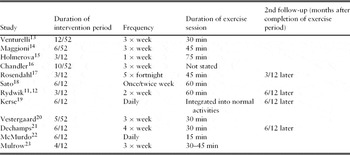
Three interventionsReference Rydwik, Lammes, Frandlin and Akner11, Reference Rydwik, Gustafsson, Frandin and Akner12, Reference Rosendahl, Lindelöf, Littbrand, Yifter-Lindgren, Lundin-Olsson, Håglin, Gustafson and Nyberg17 were high intensity. One of these comprised only of exercises in standing.Reference Rosendahl, Lindelöf, Littbrand, Yifter-Lindgren, Lundin-Olsson, Håglin, Gustafson and Nyberg17 In the dance-therapy programme,Reference Holmerová, Machácová, Vanková, Veleta, Jurasková, Hrnciariková, Volicer and Andel15 several of the dances (e.g. polka, cancan, cha-cha-cha) could be classified as ‘vigorous’, as defined by Peterson et al.Reference Peterson, Giuliani, Morey, Pieper, Evenson, Mercer, Cohen, Visser, Brach, Kritchevsky, Goodpaster, Rubin, Satterfield, Newman and Simonsick24 One home-exercise studyReference McMurdo and Johnstone22 seemed low intensity and minimally challenging with few repetitions in a short exercise session. Three studiesReference Rosendahl, Lindelöf, Littbrand, Yifter-Lindgren, Lundin-Olsson, Håglin, Gustafson and Nyberg17, Reference Kerse, Peri, Robinson, Wilkinson, von Randow, Kiata, Parsons, Latham, Parsons, Willingale, Brown and Arroll19, Reference Mulrow, Gerety, Kanten, Cornell, DeNino, Chiodo, Aguilar, O'Neil, Rosenberg and Solis23 specifically addressed individual impairments. There was a progressive element in nine studiesReference Rydwik, Lammes, Frandlin and Akner11–Reference Rosendahl, Lindelöf, Littbrand, Yifter-Lindgren, Lundin-Olsson, Håglin, Gustafson and Nyberg17, Reference Dechamps, Diolez, Thiaudière, Tulon, Onifade, Vuong, Helmer and Bourdel-Marchasson21, Reference Mulrow, Gerety, Kanten, Cornell, DeNino, Chiodo, Aguilar, O'Neil, Rosenberg and Solis23 either with increases in ‘load’ or percentage of one-repetition maximum, or by participants being encouraged to perform more demanding movements.Reference Holmerová, Machácová, Vanková, Veleta, Jurasková, Hrnciariková, Volicer and Andel15, Reference Dechamps, Diolez, Thiaudière, Tulon, Onifade, Vuong, Helmer and Bourdel-Marchasson21 With a few exceptionsReference Rydwik, Lammes, Frandlin and Akner11, Reference Rydwik, Gustafsson, Frandin and Akner12, Reference Holmerová, Machácová, Vanková, Veleta, Jurasková, Hrnciariková, Volicer and Andel15, Reference Rosendahl, Lindelöf, Littbrand, Yifter-Lindgren, Lundin-Olsson, Håglin, Gustafson and Nyberg17 older people with frail characteristics would presumably manage these interventions. The duration of the intervention period, duration and frequency of the exercise sessions, and timing of second follow-up varied considerably between studies, as illustrated in Table 3.
Duration of exercise period, duration and frequency of each exercise session, and timing of 2nd follow-up

Outcome measures
Outcome measures also varied widely. Performance-based tests included the Physical Performance Test (PPT),Reference Venturelli, Lanza, Muit and Schena13 Senior fitness test,Reference Maggioni, Cè, Rampichini, Ferrario, Giordano, Veicsteinas and Merati14 Elderly Mobility scale,Reference Kerse, Peri, Robinson, Wilkinson, von Randow, Kiata, Parsons, Latham, Parsons, Willingale, Brown and Arroll19 Physical Disability IndexReference Mulrow, Gerety, Kanten, Cornell, DeNino, Chiodo, Aguilar, O'Neil, Rosenberg and Solis23 and Tinetti performance-orientated mobility assessment.Reference Maggioni, Cè, Rampichini, Ferrario, Giordano, Veicsteinas and Merati14 Muscle strength of upper limb muscles was measured in two studiesReference Venturelli, Lanza, Muit and Schena13, Reference Vestergaard, Kronborg and Pugaard20 and of lower limb muscles in six studies.Reference Rydwik, Lammes, Frandlin and Akner11, Reference Rydwik, Gustafsson, Frandin and Akner12, Reference Maggioni, Cè, Rampichini, Ferrario, Giordano, Veicsteinas and Merati14, Reference Chandler, Duncan, Kochersberger and Studenski16, Reference Rosendahl, Lindelöf, Littbrand, Yifter-Lindgren, Lundin-Olsson, Håglin, Gustafson and Nyberg17, Reference Vestergaard, Kronborg and Pugaard20 Various tests of balance and mobility were undertaken: timed up and go;Reference Rydwik, Lammes, Frandlin and Akner11, Reference Holmerová, Machácová, Vanková, Veleta, Jurasková, Hrnciariková, Volicer and Andel15, Reference Kerse, Peri, Robinson, Wilkinson, von Randow, Kiata, Parsons, Latham, Parsons, Willingale, Brown and Arroll19, Reference Dechamps, Diolez, Thiaudière, Tulon, Onifade, Vuong, Helmer and Bourdel-Marchasson21, Reference McMurdo and Johnstone22 6 minute walk test;Reference Maggioni, Cè, Rampichini, Ferrario, Giordano, Veicsteinas and Merati14, Reference Chandler, Duncan, Kochersberger and Studenski16 gait speed (over different distances and at different speeds)Reference Rydwik, Lammes, Frandlin and Akner11, Reference Chandler, Duncan, Kochersberger and Studenski16, Reference Rosendahl, Lindelöf, Littbrand, Yifter-Lindgren, Lundin-Olsson, Håglin, Gustafson and Nyberg17, Reference Vestergaard, Kronborg and Pugaard20, Reference Dechamps, Diolez, Thiaudière, Tulon, Onifade, Vuong, Helmer and Bourdel-Marchasson21 and balance, measured in seven studies with single item testsReference Rydwik, Lammes, Frandlin and Akner11, Reference Chandler, Duncan, Kochersberger and Studenski16, Reference Kerse, Peri, Robinson, Wilkinson, von Randow, Kiata, Parsons, Latham, Parsons, Willingale, Brown and Arroll19–Reference McMurdo and Johnstone22 or by the Berg balance scale (BBS).Reference Rosendahl, Lindelöf, Littbrand, Yifter-Lindgren, Lundin-Olsson, Håglin, Gustafson and Nyberg17 ADL was measured in six studies either by the BI,Reference Venturelli, Lanza, Muit and Schena13, Reference McMurdo and Johnstone22 Katz Activities of Daily Living ScaleReference Dechamps, Diolez, Thiaudière, Tulon, Onifade, Vuong, Helmer and Bourdel-Marchasson21, Reference Mulrow, Gerety, Kanten, Cornell, DeNino, Chiodo, Aguilar, O'Neil, Rosenberg and Solis23 or Functional Independence Measure (FIM).Reference Rydwik, Lammes, Frandlin and Akner11, Reference Sato, Kaneda, Wakabayashi and Nomura18 Chair-rising ability was tested by various means in seven studies.Reference Rydwik, Lammes, Frandlin and Akner11, Reference Holmerová, Machácová, Vanková, Veleta, Jurasková, Hrnciariková, Volicer and Andel15–Reference Rosendahl, Lindelöf, Littbrand, Yifter-Lindgren, Lundin-Olsson, Håglin, Gustafson and Nyberg17, Reference Vestergaard, Kronborg and Pugaard20–Reference McMurdo and Johnstone22 Aerobic capacity was the primary outcome measure in one study.Reference Rydwik, Gustafsson, Frandin and Akner12
Treatment effects
Synthesis of treatment effects was difficult because of the eclectic nature of the interventions and multitude of outcome measures used. Three studiesReference Kerse, Peri, Robinson, Wilkinson, von Randow, Kiata, Parsons, Latham, Parsons, Willingale, Brown and Arroll19, Reference Dechamps, Diolez, Thiaudière, Tulon, Onifade, Vuong, Helmer and Bourdel-Marchasson21, Reference McMurdo and Johnstone22 failed to demonstrate significant improvements in any balance, gait, physical performance-based or ADL test. However, the deterioration in almost all outcomes in all control groups implied preservation of aspects of physical performance in the intervention groups. One studyReference Mulrow, Gerety, Kanten, Cornell, DeNino, Chiodo, Aguilar, O'Neil, Rosenberg and Solis23 demonstrated a modest but significant improvement in only one component of the main outcome in the intervention group, the mobility subscale, which increased by 15.5% (95% CI, 6.4–24.7) compared with a 10.5% reduction in controls. Of note, participants in all four studies were older (mean age 82.9 years), the specificity of the exercises and/or intensity may not have been adequate for improvements to occur and adherence was poor (Mulrow studyReference Mulrow, Gerety, Kanten, Cornell, DeNino, Chiodo, Aguilar, O'Neil, Rosenberg and Solis23 excepted).
Three studies showed significant improvements in all outcomes assessed.Reference Venturelli, Lanza, Muit and Schena13, Reference Holmerová, Machácová, Vanková, Veleta, Jurasková, Hrnciariková, Volicer and Andel15, Reference Sato, Kaneda, Wakabayashi and Nomura18 In the Venturelli study,Reference Venturelli, Lanza, Muit and Schena13 arm strength increased by 26% (P < 0.05), shoulder flexibility by 29% (P < 0.05) and the BI by 77% (P < 0.05). Both hydrotherapy intervention groupsReference Sato, Kaneda, Wakabayashi and Nomura18 made significant improvements in FIM scores, increasing by 13.5% (once weekly) and 23.6% (twice weekly), which implied a dose–response relationship. In the dance-therapy intervention,Reference Holmerová, Machácová, Vanková, Veleta, Jurasková, Hrnciariková, Volicer and Andel15 chair-stands increased by 38.3% (P < 0.001), the 2-minute step test by 9.6% (P = 0.009) and TUG by 7.8% (P = 0.014). These were group exercise programmes with good adherence rates (75–95%). Participants in another studyReference Vestergaard, Kronborg and Pugaard20 also showed significant (within group) improvements in maximal walking speed (8.2% increase), chair-rises (26.9% increase), PPT (11% increase) and in the Mob-T score, a measure of activity-related tiredness (34.6% increase); no changes occurred in controls, except gait speed increased significantly by 7.4%.
Outcomes varied in the two PRT intervention studies.Reference Holmerová, Machácová, Vanková, Veleta, Jurasková, Hrnciariková, Volicer and Andel15, Reference Chandler, Duncan, Kochersberger and Studenski16 In the Chandler study,Reference Chandler, Duncan, Kochersberger and Studenski16 strength for all leg muscle groups increased by 9–16% (P = 0.06 to 0.001). In the Maggioni study,Reference Maggioni, Cè, Rampichini, Ferrario, Giordano, Veicsteinas and Merati14 leg extensor muscle strength increased significantly only in the electrical-stimulation group and in the ‘combined’ group, by 25% (P < 0.05) and 16% (P < 0.05), respectively. Improvements in functional tests were mixed. The 6MWT increased by 9.6–14.9% (P < 0.05) in all intervention groups in the Maggioni study;Reference Maggioni, Cè, Rampichini, Ferrario, Giordano, Veicsteinas and Merati14 no change occurred in this test in the Chandler study.Reference Chandler, Duncan, Kochersberger and Studenski16 Tinetti balance scores increased between 9.4 and 11.3% (P < 0.05) in all intervention groups in the Maggioni study,Reference Maggioni, Cè, Rampichini, Ferrario, Giordano, Veicsteinas and Merati14 but alternative measures of balance did not improve in the Chandler study.Reference Chandler, Duncan, Kochersberger and Studenski16 However, gait scores improved significantly in the Chandler studyReference Chandler, Duncan, Kochersberger and Studenski16 (‘mobility skills protocol’) but not in the Maggioni studyReference Maggioni, Cè, Rampichini, Ferrario, Giordano, Veicsteinas and Merati14 (Tinetti gait score).
In the three Swedish studiesReference Rydwik, Lammes, Frandlin and Akner11, Reference Rydwik, Gustafsson, Frandin and Akner12, Reference Rosendahl, Lindelöf, Littbrand, Yifter-Lindgren, Lundin-Olsson, Håglin, Gustafson and Nyberg17 where a high-intensity, multi-component programme was followed, there were significant improvements in leg strength of between 13 and 22%, but mixed results in gait and balance outcomes. These were measured with different tools and it could not be determined which was the most successful intervention at the end of the exercise period. No significant changes occurred in maximal walking speed in two studies.Reference Rydwik, Lammes, Frandlin and Akner11, Reference Rydwik, Gustafsson, Frandin and Akner12 Self-paced gait speed improved significantly in the Rosendahl study,Reference Rosendahl, Lindelöf, Littbrand, Yifter-Lindgren, Lundin-Olsson, Håglin, Gustafson and Nyberg17 with a mean difference of 0.04 m/s (P = 0.02). BBS improved significantly, but only at second follow-up (13.8% increase) in the Rosendahl study;Reference Rosendahl, Lindelöf, Littbrand, Yifter-Lindgren, Lundin-Olsson, Håglin, Gustafson and Nyberg17 some single-item measures of balance improved significantly at first follow-up in the Rydwik (2008) study.Reference Rydwik, Lammes, Frandlin and Akner11 ADL was only assessed in the Rydwik (2008) studyReference Rydwik, Lammes, Frandlin and Akner11 but no change occurred in FIM score. Aerobic capacity was assessed in the Rydwik (2010) study.Reference Rydwik, Gustafsson, Frandin and Akner12 No significant differences were found except in participants without lung disease where aerobic capacity, specifically ‘work time’, increased significantly.
Adherence rates
Adherence rates varied widely in the eleven studies which reported this. Seven studies had adherence rates between 70 and 100%.Reference Venturelli, Lanza, Muit and Schena13–Reference Holmerová, Machácová, Vanková, Veleta, Jurasková, Hrnciariková, Volicer and Andel15, Reference Rosendahl, Lindelöf, Littbrand, Yifter-Lindgren, Lundin-Olsson, Håglin, Gustafson and Nyberg17, Reference Sato, Kaneda, Wakabayashi and Nomura18, Reference Vestergaard, Kronborg and Pugaard20, Reference Mulrow, Gerety, Kanten, Cornell, DeNino, Chiodo, Aguilar, O'Neil, Rosenberg and Solis23 Four studies had adherence rates between 49 and 65%.Reference Rydwik, Lammes, Frandlin and Akner11, Reference Rydwik, Gustafsson, Frandin and Akner12, Reference Kerse, Peri, Robinson, Wilkinson, von Randow, Kiata, Parsons, Latham, Parsons, Willingale, Brown and Arroll19, Reference Dechamps, Diolez, Thiaudière, Tulon, Onifade, Vuong, Helmer and Bourdel-Marchasson21
Loss to follow-up
In three studies the attrition rate was under 10%.Reference Maggioni, Cè, Rampichini, Ferrario, Giordano, Veicsteinas and Merati14, Reference Holmerová, Machácová, Vanková, Veleta, Jurasková, Hrnciariková, Volicer and Andel15, Reference Sato, Kaneda, Wakabayashi and Nomura18 In seven studies it was between 10 and 20%Reference Venturelli, Lanza, Muit and Schena13, Reference Chandler, Duncan, Kochersberger and Studenski16, Reference Rosendahl, Lindelöf, Littbrand, Yifter-Lindgren, Lundin-Olsson, Håglin, Gustafson and Nyberg17, Reference Vestergaard, Kronborg and Pugaard20–Reference Mulrow, Gerety, Kanten, Cornell, DeNino, Chiodo, Aguilar, O'Neil, Rosenberg and Solis23 and in three it was between 20 and 33%.Reference Rydwik, Lammes, Frandlin and Akner11, Reference Rydwik, Gustafsson, Frandin and Akner12, Reference Kerse, Peri, Robinson, Wilkinson, von Randow, Kiata, Parsons, Latham, Parsons, Willingale, Brown and Arroll19
Adverse events
Few adverse events were reported to have occurred in the six studies that provided this information. One studyReference Chandler, Duncan, Kochersberger and Studenski16 reported hip pain in one participant and their subsequent withdrawal. Another studyReference Kerse, Peri, Robinson, Wilkinson, von Randow, Kiata, Parsons, Latham, Parsons, Willingale, Brown and Arroll19 reported muscle aches/pain and fatigue in both the intervention and control group. Some participants experienced muscle soreness, fatigue and bruising in one study.Reference Mulrow, Gerety, Kanten, Cornell, DeNino, Chiodo, Aguilar, O'Neil, Rosenberg and Solis23 Two studies reported falls outcomes:Reference Kerse, Peri, Robinson, Wilkinson, von Randow, Kiata, Parsons, Latham, Parsons, Willingale, Brown and Arroll19, Reference Mulrow, Gerety, Kanten, Cornell, DeNino, Chiodo, Aguilar, O'Neil, Rosenberg and Solis23 one studyReference Mulrow, Gerety, Kanten, Cornell, DeNino, Chiodo, Aguilar, O'Neil, Rosenberg and Solis23 had a higher number of falls (some with serious injuries) in the intervention group compared with the control group (79 vs. 44) while no change in falls rate was reported in the other study.Reference Kerse, Peri, Robinson, Wilkinson, von Randow, Kiata, Parsons, Latham, Parsons, Willingale, Brown and Arroll19 Of note, one death occurred 1 week after the end of the intervention period in one study (ruptured aortic-abdominal aneurysm) and a link could not be excluded.Reference Rosendahl, Lindelöf, Littbrand, Yifter-Lindgren, Lundin-Olsson, Håglin, Gustafson and Nyberg17
Function post-intervention
Functional improvements only have clinical value if accompanied by enhanced functional independence and/or higher levels of physical activity in the context of normal daily activities. Observing performance of daily activities is the best indicator of improvements being put into practice; long-term sustainability of effects needs assessing by second follow-up.
Five studies undertook a second follow-up. One study,Reference Rosendahl, Lindelöf, Littbrand, Yifter-Lindgren, Lundin-Olsson, Håglin, Gustafson and Nyberg17 with follow-up at 3 months, demonstrated maintenance of improvements in gait and balance outcomes. In two other studies, at 6 months none of the improvements had been maintained except for some strength gains.Reference Rydwik, Lammes, Frandlin and Akner11, Reference Rydwik, Gustafsson, Frandin and Akner12 Attenuation in the rate of functional decline was maintained at second follow-up 6 months later in one study,Reference Dechamps, Diolez, Thiaudière, Tulon, Onifade, Vuong, Helmer and Bourdel-Marchasson21 but not in another study.Reference Kerse, Peri, Robinson, Wilkinson, von Randow, Kiata, Parsons, Latham, Parsons, Willingale, Brown and Arroll19
Discussion
The evidence from this systematic review suggests that moderately challenging, multi-component exercise interventions are more advantageous than progressive strengthening-only programmes in improving strength and mobility-related functions in frail older people. Alternative programmes of physical activity such as dance-therapy, with an element of progression, also have potential. Attempting to improve independence simply by increasing the number of times a functional task is performed is not an effective way of improving functional level. Benefits are limited in individuals at the extreme end of the frailty spectrum. Sustainability could not be determined and transfer of functional gains into real-life situations, which could serve as the stimulus for maintaining improvements, cannot be assured. Overall, exercise seems to be a safe intervention, even when relatively vigorous, in frail older people.
A previous systematic reviewReference Chin A Paw, van Uffelen, Riphagen and van Mechelen7 of the same topic found no evidence of exercise being of benefit in highly frail individuals and conclusions could not be drawn with respect to the type of exercise intervention most favourable to less frail individuals. It should be noted that the ‘functional effects’ in the title referred only to balance and mobility functions, not ADL.
There was a lack of clarity over the degree of frailty of participants in most studies in this review, preventing classification of studies into pre-frail or frail categories and hence elucidation of which intervention(s) and mode of delivery had potential to produce the best outcome according to level of frailty. Participants in one studyReference Mulrow, Gerety, Kanten, Cornell, DeNino, Chiodo, Aguilar, O'Neil, Rosenberg and Solis23 stood out as having the most frail characteristics. They followed an individualized, individually supervised, multi-component programme which, despite good adherence, failed to deliver any improvements other than modest benefits in mobility. These findings do not support those from the Cochrane Review of Rehabilitation for Older People in Long-term Care,Reference Forster, Lambley, Hardy, Young, Smith, Green and Burns25 which found that frailer participants benefited more from an individualized intervention on a frequent basis. The fact that participants in the study examined here did not show major benefit may have been due to their greater degree of frailty and more limited physiological scope for improvement. Three other trials had participants who were also probably frail, although perhaps not as severelyReference Venturelli, Lanza, Muit and Schena13, Reference Rosendahl, Lindelöf, Littbrand, Yifter-Lindgren, Lundin-Olsson, Håglin, Gustafson and Nyberg17, Reference Sato, Kaneda, Wakabayashi and Nomura18 and good improvements occurred in aspects of gait, balance and quality of life. All were group exercise interventions with high adherence rates. The social stimulation and element of competition provided by the group setting could have boosted participants’ motivation. An additional advantage of group exercises is the more efficient use of staff time.
Improvements in muscle strength of between 8 and 29% occurred in five multi-component programmes and two leg-strengthening programmes. The remarkable strength gains (174% increase) achieved by frail nonagenarians in the seminal study by Fiatarone et al.Reference Fiatarone, Marks, Ryan, Meredith, Lipsitz and Evans26 have never been replicated. In general, strength gains were as good, if not better, in some of the multi-component programmes than in the strengthening-only programmes. Strengthening-only programmes were associated with some functional task improvements. This somewhat inconsistent effect on functional performance following a strengthening-only programme has been found in other studies.Reference De Vreede, Samson, van Meeteren, Durrsma and Verhaar27 This contrasts with the universal, but not always significant, improvements in balance and mobility outcomes measured in the multi-component studies reviewed here. In the nine multi-component studies included in the previous systematic review,Reference Chin A Paw, van Uffelen, Riphagen and van Mechelen7 balance and gait outcomes also improved. In conclusion, multi-component interventions consistently produce wide-ranging benefits on gait, balance and muscle strength.
Data on the effects of exercise on aerobic capacity were limited in the included studies, as in the previous review.Reference Chin A Paw, van Uffelen, Riphagen and van Mechelen7 Only one studyReference Rydwik, Gustafsson, Frandin and Akner12 focused on this, a multi-component intervention with low adherence rates, where no effect was found except for increased endurance in participants without lung disease. However, the aerobic component in the programme was minor and subjects may not have been sufficiently trained. In three other studiesReference Maggioni, Cè, Rampichini, Ferrario, Giordano, Veicsteinas and Merati14–Reference Chandler, Duncan, Kochersberger and Studenski16 where tests of cardiorespiratory fitness were included in the battery of outcome measures, results were inconsistent.
The evidence from this review suggests that home-based exercises, although more convenient for some frail older people, are only likely to reap benefits if adequate and regular support is available to counteract the risk of poor adherence. These findings conflict with those of the two home-based interventions in the previous systematic review,Reference Chin A Paw, van Uffelen, Riphagen and van Mechelen7 where despite good supervision and good adherence rates, there were no significant beneficial effects of PRT programmes in the home setting.
The positive mobility-related outcomes in the dance-therapy intervention provide evidence that other forms of physical activity, if encompassing a range of functional components, can be better than standard exercises in improving physical performance. Participants were residents in long-term care and the effects achieved following once-weekly dance sessions for 3 months were substantial.
Discounting the predominantly unsuccessful trials, only two other studies evaluated ADL. Both observed significant improvements, but no reference was made regarding transfer of the improvements into day-to-day functional activities. This has implications from a resource and service provision perspective: unless there is evidence that an exercise intervention has enhanced the functional level of the frail older person in real-life and/or reduced dependency levels beyond the study period, it is questionable whether such interventions are justifiable in the first place.
It could not be ascertained how long improvements were sustained for after the exercise period because so few studies reviewed participants beyond duration of the intervention. The improvements in gait and balance observed at second follow-up in one study may have been facilitated by staff encouraging participants to remain active. Only one study in the previous systematic reviewReference Chin A Paw, van Uffelen, Riphagen and van Mechelen7 evaluated long-term outcome (2 years later). In this study,Reference Hauer, Pfisterer, Schuler, Bartsch and Oster28 strength improvements were sustained but physical performance decreased substantially, although not to baseline levels, and subjects resumed their previously sedentary lifestyle. Exercise should ideally be continued to ensure maintenance of initial benefits and prevent detraining.
Features identified from the interventions associated with higher adherence and better outcomes were:
• Multi-component, but simple, exercise programmes to include aerobic, balance, co-ordination, ‘speed’ activities and strengthening exercises, but not necessarily all in one session;
• Sufficiently challenging and progressive exercise, but within capability limits;
• Mainly moderate intensity exercises, some high intensity acceptable;
• Sessions lasting between 30 and 45 minutes, once or twice a week;
• Group classes;
• Educational component reinforcing benefits of exercise;
• Encouragement from institutional care staff, with carry-over of functional-task gains into real-life situations;
• Exercise/physical activities with personal relevance, incorporating any previously enjoyed physical pursuit;
• Targeted to individuals who are motivated and willing to fully engage with the intervention;
• Frequent support in home-based interventions, e.g. once/twice weekly phone calls, regular visits.
Limitations
This systematic review has several limitations. The main one was that the trials were so dissimilar and interventions so multifarious that comparisons were difficult to make. The multiplicity of outcome measures used made interpreting data problematic. This was a particular problem in relation to evaluating effects of the interventions on gait ability, e.g. five studies measured gait speed, but the speed/distance was different in all cases (self-paced/comfortable/rapid/maximum, not stated). It was therefore impossible to determine which intervention made the most impact on gait. The lack of standardized frailty criteria meant that participants were probably more heterogeneous and their presumed frailty status may even have been erroneous. There may have been selection bias in the included studies: a large number of participants were eligible, but many were reported as ‘refusing’ or ‘declining to participate’. The mean response rate of 63% may therefore represent individuals more committed to exercise. The small sample size of some of the trials may have prevented statistically significant differences between groups for some outcomes. Methodological weaknesses were present in some trials, notably omission to conduct intention-to-treat analysis and lack of blinding of outcome assessors, both potentially exaggerating treatment effect.Reference Strauss, Richardson, Glasziou and Haynes29, Reference Schulz, Chalmers, Hayes and Altman30
Recommendations for improving future trials
Standardization of outcomes, particularly those measuring balance and gait ability, would help synthesis and interpretation of the results and allow meta-analysis to be undertaken. As a reflection of the function and integration of multiple physiological systems and measure of frailty (see below), gait speed (self-paced and rapid) should be included as one outcome in exercise trials involving frail older people who are mobile.
That so few studies used Fried's criteria implied a lack of acceptability of this frailty model. In their longitudinal cohort study (N = 2964; mean age 73.6 years) examining the effects of physical activity as a factor preventing frailty, Peterson et al.Reference Peterson, Giuliani, Morey, Pieper, Evenson, Mercer, Cohen, Visser, Brach, Kritchevsky, Goodpaster, Rubin, Satterfield, Newman and Simonsick24 used a frailty model devised by Gill et al.Reference Gill, Baker, Gottschalk, Peduzzi, Allore and Byers31, Reference Gill, Williams and Tinetti32 Criteria were gait speed of less than 0.6 m/s and inability to rise from a chair once with arms folded. Participants fulfilling both criteria were deemed ‘severely frail’, and with only one criterion, ‘moderately frail’. Many studies support these criteria as predictive of adverse health outcomes: ADL dependency; institutionalization and mortality.Reference Gill, Williams and Tinetti32–Reference Studenski, Perera, Patel, Rosano, Faulkner, Inzitari, Brach, Chandler, Cawthon, Connor, Nevitt, Visser, Kritchevsky, Badinelli, Harris, Newman, Cauley, Ferrucci and Guralnik34 They are reliable and simple tests to administer and could be incorporated into exercise trials as measures of physical frailty and, in addition, could be used as tools to evaluate treatment effects.
It remains to be seen at what time-point improvements plateau, but evidence from this review suggests it is about 6 months. Trials should therefore be designed for this time period, or incorporate serial testing to assess trajectory and/or ascertain when maximum level of improvement has been attained.
Future trials should include a second follow-up between 2 and 6 months after completion to evaluate sustained effects. A short ‘top-up’ of structured exercises to reinforce and motivate participants to maintain physical activity levels might then be indicated. Qualitative research might be of value to investigate the best ways to encourage this, and also to explore the barriers to transferring functional gains into real-life situations.
Conclusions
This systematic review corroborates many of the findings from the previous systematic review that exercise is safe and beneficial in improving strength, aspects of gait and balance and some basic functional tasks in the majority of frail older people. However, in highly frail individuals with multiple co-morbidities, exercise is not only less effective but individuals may be subjecting themselves to harm through increased risk of musculoskeletal injuries and falls.
The focus on identifying the ‘optimal’ exercise programme could be a futile pursuit given that different exercise programmes, particularly multi-component, can be effective if undertaken with a degree of commitment, once or twice a week, progressing the level of intensity as improvements in physical condition and exercise tolerance allow. The sensible course of action would be to introduce structured exercise/physical activity programmes for older people at an early pre-frail stage, in an effort to prevent some of the inevitable loss of strength and physical performance which, if unchecked, could precipitate onset of frailty.
Acknowledgement
This study formed part of the MSc course in Ageing, Health and Disease undertaken at Cardiff University. The author would like to thank Dr Sinead O'Mahony for her generous help in the preparation of this article.
Conflicts of interest
The author had no conflict of interest directly relevant to the content of this paper.