


1. Introduction
One of the least studied aspects in the Portuguese economic evolution over the last 50 years is related to the business and industrial structure between 1968 and 1973 – that is, in the so-called Primavera Marcelista, the eve of the April 1974 Carnation Revolution.
On one side, some authors have justified the pace of nationalizations in the years after 1974 as a measure of economic policy that combined the ideological objectives of the forces in the revolutionary executive with an attempt to balance the industrial structure that already existed. This structure has been identified as an oligopoly, with clear marks of industrial concentration. On the other side, some authors have acknowledged that it is necessary to understand the business connections of the world of Portuguese companies and holdings during the period in question, as these structures had a unique influence on the business structure seen in Portugal in the subsequent decades, with its consequent geography of concentrated entrepreneurship, job structuring, and the country’s modernization.
This work focuses on this topic. It uses specific network analysis methods to evaluate how the structure of the business world in Portugal was configured on the eve of the April Revolution, and it tests a number of specific hypotheses related to the vertical or horizontal integration processes that Portuguese companies later configured.
As this work will highlight, the structure of Portuguese business had unique characteristics within the European context of that period. The network of business connections also highlights how such characteristics, while linked to an oligopolistic configuration, maintained a predominant structure of intra-sectoral dependency among the different companies.
The remainder of this work is structured as follows. Section 2 is the literature review, both on the economic and entrepreneurial characterization of Portugal in the 1970s, as well as on the main network analysis resources most appropriate for this focus. Section 3 discusses the three relevant aspects of the 1970 business structure in Portugal: the centrality of the different business companies, the probability of each company’s participation in the capital of the others, and the identification of the main attributes (like financial variables) behind these corporate networks. These dimensions will also be the subject of relevant discussion. Finally, Section 4 completes the work.
2. Literature Review – Historical Contextualization and Network Analysis as a Method of Business Analysis
2.1. The Business and Industrial Structure in Portugal at the Dawn of the April 25 Revolution
As Lains (Reference Lains2008) and Amaral (Reference Amaral1998) explain, Portugal’s economic-industrial structure on the eve of the April Revolution offers many potentialities for analysis. The three main promising dimensions stimulate the study of this context.
First, the few published works have not been particularly concerned with this focus, preferring to analyse the patterns of economic development in the period in question, the pressure of various efforts on the public purse (from the War in Africa to the modifications in public expenditure), and specific production units or business groups.
Second, the relevant available financial and accounting information is not particularly abundant, which understandably limits the production of relevant works.
Third, studying this period and its economic actors undoubtedly leads to improvement of the research, as it enables a more detailed understanding of the structures in place by the April Revolution, in terms of national production, income distribution, and savings, as well as explaining why some of the holdings fractured under the revolutionary action while other groups survived and developed instead (Lopes, Reference Lopes1996).
The structure of the business groups observed in this work in the years 1970–1974 coincides with a specific period of the country’s economic history. Lopes (Reference Lopes1996) notes that the average GDP growth rate in Portugal between 1960 and 1973 was 6.9%. Sectors that Oliveira Martins (Reference Martins1957) identified as the engines of the country’s economy a hundred years earlier – agriculture, vineyards, and wine – had lost more than 500,000 workers in the decade before 1974 and were seeing a reduction in their importance to Portuguese GDP of around 10 percentage points. In contrast, the secondary sectors increased by 6 percentage points in this period in terms of their contributions to the country’s production, and the tertiary sectors increased by 4 percentage points (values corroborated by Guerra, Reference Guerra1967). As the work of Angelopoulos (1973) shows, it is not surprising that the main economic groups in such an economy were associated with the sectors and subsectors with the greatest dynamism.
Authors such as Abel Mateus (Reference Mateus1998) point out that the 1970s started with the growth of indicators linked to the Portuguese economy’s higher trade openness. The relevance of imports and exports to Portuguese GDP grew around 5 percentage points between 1970 and 1973, as a result of the sharp growth in external demand and the reduction of customs duties (Macedo et al., Reference Macedo, Corado and Porto1988).
Another significant influx occurred in the evolution of Foreign Direct Investment (FDI); as a result of several double taxation agreements, it stimulated sectors such as commerce and tourism along with industries such as machinery, transport material, and electric material. Investors came primarily from Germany (26% in 1969–1974), the USA (22%), and the United Kingdom (14%), according to Mateus (Reference Mateus1998). This inflow represented 3.6% of the gross fixed capital formation in the decade between 1965 and 1974 (Salgado de Matos, Reference Salgado de Matos1973). The average annual growth rate of investment in Portugal between 1965 and 1974 was around 14% (Mateus, Reference Mateus1998). Rolo (Reference Rolo1976, in Mateus, Reference Mateus1998, 98) also points out that the period between 1970 and 1974 saw an expansion of the profit rate, and 326 imported technology contracts were identified in the various forms of transfer of ‘technical knowledge’, patents, trademarks, personnel training, researches and studies, or equipment maintenance services.
As a result, powerful economic groups established a dominant position in the Portuguese economy. Mateus (Reference Mateus1998, 207), citing Belmira Martins (Reference Martins1973), lists the following economic-industrial groups as the main producing conglomerates in the country: CUF, State Business Sector (properly detailed in Martins and Rosa, Reference Martins and Rosa1979), Champalimaud, Espírito Santo, Banco Nacional Ultramarino, Banco Português do Atlântico, Banco Borges and Irmão, and Banco Fonsecas & Burnay.
Lopes (Reference Lopes1996) states that the period between 1960 and 1973 – which was identified as the ‘golden phase of industrial development’ – coincided with a period of economic convergence that Portugal shared with its European neighbours. Gross value added at constant prices for manufacturing industries grew at a rate of 9.2% per year (one of the highest among OECD countries). In the manufacturing industry, the areas then assessed as ‘new’ (Lopes, Reference Lopes1996) – such as those in chemistry and plastics, basic metal industries, and traditional industries (such as textiles and footwear) – were the areas that most contributed to this evolution.
The reasons already presented as growth factors for most of the economies were also influential here: the generalized growth of European economies, stimuli from effective economic policies, expansion of international demand and constraints of the integration space then frequented by Portugal – the EFTA (Lopes, Reference Lopes1996). Note here the role of industrial conditioning adopted by the Executive, which in one way led to the accumulation of high profit rates in many supported industries but also contributed to some sectors adopting a certain relaxation after growth phases. It is also worth noting that 20% of capital formation in commercial companies based in Portugal in the 1960s came from abroad (Lopes, Reference Lopes1996, 169).
Authors such as Lopes (Reference Lopes1996) clearly state that the financial sector (including banking, insurance, and stock market institutions) benefited the most during the period between 1960 and 1973. The volume of deposits reported by this sector’s institutions increased 10% per year; in 1973, banking assets represented 93% of Portuguese GDP. In fact, Lopes (Reference Lopes1996) writes: ‘Banking […] was the main nucleus of the concentration of economic power in the early 1970s. Around it or in integration with it, the largest business groups that dominated the economy solidified and magnified.’
In terms of significant changes observed in the period after the Carnation Revolution, we can draw on sources such as Lopes (Reference Lopes1996) or Rosa (Reference Rosa1976). We will focus on the most relevant dimensions for understanding this work, namely in terms of the evolution of investment numbers.
Thus, investment in the period following the Carnation Revolution (1974 and 1975) experienced a significant stagnation. According to Rosa (Reference Rosa1976, 24), investment intentions in the Manufacturing Industry rose from 17.2 billion escudos to just 2.9 billion escudos. The same source (Rosa, Reference Rosa1976, 25) identifies the sharp drop observed between 1973 and 1975 in the capital of incorporated companies compared with the capital of dissolved companies. This balance evolved from PTE 7.1 billion to PTE 1.8 billion, with special registration in the share capital of large companies (Rosa, Reference Rosa1976, 25). On the other hand, expenditure on economic development (included in the state budget) rose from PTE 5.8 billion (in 1973) to PTE 28 billion (in 1976). The increase in these development expenditures also reflected the gross formation of fixed capital of public origin, which increased from PTE 6.4 billion (in 1973) to PTE 14.6 billion (in 1975).
2.2. From Network Theory to Networks of Influence, Power, and Businesses
The analysis of the business and industrial structure of any economy is easily justified. Knowing the concentration of sources of added value in a productive system is an elementary step in generating economic growth and in fostering the accompanying economic development. Thus, realizing which sectors of economic activity generate more economic growth for the community – or which sectors contribute more significantly to the growth of the region or country – is a fundamental prerequisite for establishing the economic capacity to sustain such vigour and for perceiving the capacity of the most dynamic sectors to collaborate in the leverage of other sectors.
Additionally, detailing the structure of a given sector of economic activity (for example, the internal structure of a country’s industrial sector) provides other advantages as well. This is particularly true in terms of the ability to analyse the multiplier effects derived from generating flows of both monetary and other resources among the units that make up a given economic conglomeration, along with the ability to scrutinize the main sources of most significant contributions to the dynamic sector, locating them in a specific subsector or in specific production units.
As Navidi (Reference Navidi2018) points out, certain sectors (e.g. the financial sectors) play a transformative role in today’s societies, based on the fluidity of exchanges and agile payment methods. Thus, it is not surprising that these sectors are responsible for both the generation and the destruction of jobs, value, and markets. In addition, the centrality of such sectors has a direct impact on interest income, the country’s savings rate, the price of housing loans and retirement plans.
Navidi (Reference Navidi2018) confirms that even large productive units/companies worldwide are controlled by a small number of companies. In an intricate design reminiscent of a neurological system, the relations of power or dependence and the flows of the various qualities of resources or various forms of capital, established between the units of one or more economic sectors, tend to form a network. These networks are the subject of an intense scientific analysis: an object of attention of those working in the network sciences.
According to the law of preferential attachment, a node always prefers to be linked to the nodes with the most connections, because a greater number of connections increases one’s chances of individual survival (Navidi, Reference Navidi2018). The most central nodes are known as ‘superhubs’. Studies on the power of ‘superhubs’ also rely on certain assumptions, such as the one that no node controls all other nodes. However, given the interconnectivity between the units of a network, we can expect that no individual node is exempt from receiving effects – whether direct or indirect – from the flows passed or emitted by the other nodes. Therefore, what happens to a company in the system influences, to some extent, the entire system.
Several studies (Barabasi, Reference Barabasi2018) have proved that network analysis is the appropriate methodology for analysing the structural concentrations of a given market, whether in terms of socioeconomic power (e.g. Chivangue, Reference Chivangue2015; Algan et al., Reference Algan, Fourcade and Ollion2015), imperfect competition (Pegoretti et al., Reference Pegoretti, Rentocchini and Marzetti2009), or business structure (Bailey et al., Reference Bailey, Kuchler, Russel, State and Stroebel2020; Schell et al., Reference Schell, Hiepler and Moog2018; Lakshmanasamy, Reference Lakshmanasamy2015). Additionally, studies on networks allow us to identify nodes, to characterize them, and to determine which dimensions or attributes make a network something that is not random but rather a system that works along certain well-defined vectors (Barabasi, Reference Barabasi2018). As a result, the investigation of networks in business relations has increased in recent decades. Identifying networks in this way leads to certain positive consequences: it helps us understand the decisions made by the industrial units in the network; it fosters analysis of the flows of data and information among these units; and it helps to construct optimized decision processes for the network (e.g., for a sector) and for each actor/company in the network.
Additionally, the study of market concentration in the fields of industry and business has already contributed to an extensive list of publications linking such concentration to certain socioeconomic imbalances (Merton, Reference Merton1968; Mourao, Reference Mourao2020). These imbalances have been found in the existing infrastructures, in the influence of political regimes dominated by pressure groups or under dictatorial figures, and in market externalities in some economic sectors. However, until now, there has not been any attempt to study the industrial concentration in Portugal in 1973 (the eve of Carnation revolution). Therefore, the following section will reflect on these issues by considering a business network that was responsible for the economic structure of the Portuguese economy: the network of companies existing since 1973, just before the Carnation Revolution of 1974.
2.3. Was the Portuguese Companies’ Structure a Hub in 1973? Descriptive Analysis of Business Networks and the Central Hypothesis of this Work
As our primary source for testing the existence of a hub of Portuguese companies in 1973, we refer to Belmira Martins (Reference Martins1973). This source has already been identified by Lopes (Reference Lopes1996) as the most authoritative source on the topic, not only because of the relevant details but also because of the comprehensiveness of the analysis. Figure 1 shows a representation of the network consisting of the major Portuguese companies in 1973. It has been constructed using data from Martins’ (Reference Martins1973) book.
Relations of share capitals in Portuguese companies, 1973 (For the legend to the figure, detailing which companies correspond to which numbers, please see the Appendix)

Belmira Martins’ (Reference Martins1973) book, starting on page 119, presents the list of companies in question. Starting on page 139, it presents the societies in special detail. Thus, each company is identified with the name (column 2), with the main branch of activity (column 3), with the value of the share capital (column 3, in monetary unit of ‘contos’, equivalent to current values of €4.99) the business connections (column 4), as well as the financial group to which each company belonged (column 5).
In the depicted network, a node represents a company, and an edge represents a business connection considering column 4 of Martins (Reference Martins1973, 139–180). This network has 677 nodes and 1836 edges; it is composed of 125 connected components, with a giant component accounting for 534 nodes (78.9% of the total) and 18.3% of edges. These numbers already enable us to anticipate that many of these observed companies were interconnected in terms of investment flows.
The average clustering coefficient – i.e. the mean value of the degree to which the observed companies tended to cluster together – is 0.337 for the whole network, which is significantly higher than what would be expected for random networks with the same number of nodes and edges. Although we observed a low value (0.004) of the network density, the clustering coefficient is significantly higher (almost 100 times greater), which indicates that the observed companies tended to be highly connected in the network.
Thus, our central hypothesis is that the Portuguese business structure was already a hub in 1973, concentrated around a limited number of companies that occupied central and strategic positions. This hypothesis is, until now, unprecedented in the literature on the Portuguese economy and on the Portuguese business economy.
In line with Berlingerio et al. (Reference Berlingerio, Coscia, Giannotti, Monreale and Pedreschi2011), a hub is characterized by the following four characteristics:
-
the hub can be identified as a ‘small world’, in which the parent companies are relatively close to a large number of other companies;
-
there is a significant modular structure, indicating that a high number of companies are associated with a high number of other companies;
-
the central companies of the hub demonstrate a high flow (investing in other companies and being invested in by other companies);
-
relationships between similar companies dominate (so-called homophily), which means that the observed links are explained by proximity to certain characteristics (namely by close values of share capital).
Hubs are an increasing source of fascination in scientific research. Both the frequency with which they are observable and the dependence that most citizens have on ‘hubs’ – be they groups of friends, political parties, or economic structures – justifies the study of these networks. What causes a hub to survive or disintegrate and the direct or indirect consequences it has on the lives of millions of citizens, workers or consumers, are issues that have motivated recent scientific research on the matter.
Specifically, for the period studied here, our central hypothesis is that the economic business structure observed in 1973 was already a good example of a hub and that the 1974 revolution functioned as a ‘meteorite shock’ that caused significant changes in the structure of this hub, leading to profound changes in the economic and business development processes that the country has since experienced. The next section will empirically test this hypothesis concerning the Portuguese economy on the eve of the April Revolution.
3. Empirical Analysis
3.1 Discussing ‘Small Worlds’ for the Portuguese Companies in 1973
Following Berlingerio et al. (Reference Berlingerio, Coscia, Giannotti, Monreale and Pedreschi2011) and Borgatti et al. (Reference Borgatti, Everett and Johnson2013), we seek to analyse the properties of ‘small worlds’ in the observed network, a network described by Watts and Strogatz (Reference Watts and Strogatz1998) as characterized by the following characteristics:
-
large – tested at subsection 3.1.1;
-
sparse (actors are connected to a small fraction of the total network) – tested at subsection 3.1.2;
-
highly clustered and decentralized – tested at subsection 3.1.3.
Therefore, we observe and discuss the following indicators for our network: the Small World Index and the average path length, the different levels of centrality of each observed company, the homophily pattern, and the coreness of the network.
3.1.1. Size of a Network
To evaluate the existence of a small world, according to Borgatti et al. (Reference Borgatti, Everett and Johnson2013), we have to refer to the Small World Index. This index is a ratio between the extent to which a network is more clustered than a random network and the extent to which the given network has short paths compared with a random network. If the ratio is significantly greater than 1, then the network is said to be a small world network. The network in this work has a small-world property under the Small World Index of 33.86.
3.1.2. Sparseness of a Network
To observe the sparseness of the network, we discuss its average path length. In the current case, it is 5.46, which is significantly higher than the average path length for a randomly-generated Erdos-Renyi graph, whose average path length is 2.7. This leads us to conclude that in spite of the nodes being relatively close to each other, Portuguese companies in this period still tried to increase their distance as the network matured.
3.1.3. Clusters and Centrality
For analysis of the extension of the influence/centrality of each company, social network analysis suggests the use of the following indicators for each observed case (Mourao, Reference Mourao2020):
-
‘Out Degree’ measures the number of ties (in this case, investment flows) starting in each company in the observed network.
-
‘In Degree’ measures the number of ties arriving at each company in the observed network.
-
‘Out ARD’ refers to the Outgoing Average Reciprocal Distance of the nodes. Average reciprocal distance is a measure that provides the sums and averages of the reciprocal distances between all companies; thus, this measures how many flows are initiated in company i and go to company j while keeping in mind that there will also be flows going from j to i.
-
‘In ARD’ refers to the Incoming Average Reciprocal Distance of nodes; in this case, this is a measure of how many flows go to company i and come from company j while keeping in mind that there will also be flows going from i to j.
-
‘Out Closeness’ attributes a value to each node based on its ‘closeness’ to all other nodes within the network. This value corresponds to the shortest paths connecting all nodes reached by the flows starting in the highlighted node (in this case, each company), assigning each node a score based on the sum of its shortest paths.
-
‘In Closeness’ attributes a value to each node based on its ‘closeness’ to all other nodes within the network. This value corresponds to the shortest paths connecting all nodes reached by the flows going to the highlighted node (in this case, each company), assigning each node a score based on the sum of its shortest paths.
-
‘Betweenness Centrality’ measures the number of times a node (in this case, a company) is located on the shortest path between other observed companies.
-
‘2-Step Betweenness’ is commonly described as ‘the number of times an actor connects two other pairs of nodes, but only through a maximum of two links’: a company with a high score in this indicator is a relevant ‘bridge’, especially for the most isolated actors.
Table 1 displays these indicators for the top 20 Portuguese companies in 1973 (ranked considering the Betweenness Centrality).
Centrality indicators for the top 20 Portuguese companies in 1973

Legend: A: OutDeg; B: InDeg; C: OutARD; D: InARD; E: OutClose; F: InClose; G: Betweeness Centrality
Table 1 shows that the companies that occupied positions of centrality in the Portuguese business structure of 1973 were concentrated mainly in the banking sector. According to the Betweenness Indicator, Banco Português de Atlântico is the most central entity. Within the top 20, other banks also appear: Banco Espírito Santo and Comercial de Lisboa, Banco Pinto & Sottomayor, Banco Fonsecas and Burnay, Banco Borges & Irmão, Banco Nacional Ultramarino, Banco da Agricultura, Banco Totta and Açores, and Banco Pinto de Magalhães. Other entities linked to the financial sector, such as insurance companies, also appear here: Companhia de Seguros Império, Companhia Nacional de Navegação, and Companhia de Seguros Tranquilidades. As expected, the country’s main industrial unit – CUF – appears on the list of the most central entities in the country’s business world in 1973.
This result supports the hypothesis of market concentration, already suggested by authors such as Mateus (Reference Mateus1977) and Lopes (Reference Lopes1996) to describe the Portuguese companies’ network of this period, in which the evolution of markets is assumed to enhance the control of some central companies over other companies.
Additionally, we analyse the property of homophily – i.e. the trend of Portuguese companies to establish business links with other companies of similar characteristics. This is especially relevant for our study because it allows us to observe whether a strong tendency existed for companies to connect with similar companies, a common feature of many social networks but also of some business networks (Barabasi, Reference Barabasi2018).
For the network of Portuguese companies under analysis, the homophily coefficient is 0.92. This value indicates a strong tendency for nodes to connect with nodes of a similar nature (especially with similar share capital, as explained in the following subsection).
Similar to other social networks, this network must be studied in terms of the presence of a modular structure. To test this possibility, we studied the k-coreness of each company. As defined in IBM (2019), K-Core is a measure that can help identify small interlinked core subsets on a network. To be included in the K-Core, an entity must be linked to at least k other entities in the group. For instance, a group has a ‘three-core’ if it contains all entities that are linked to at least three other entities within the group. Table 2 exhibits the companies with the highest coreness in 1973.
Portuguese companies (1973) and their coreness
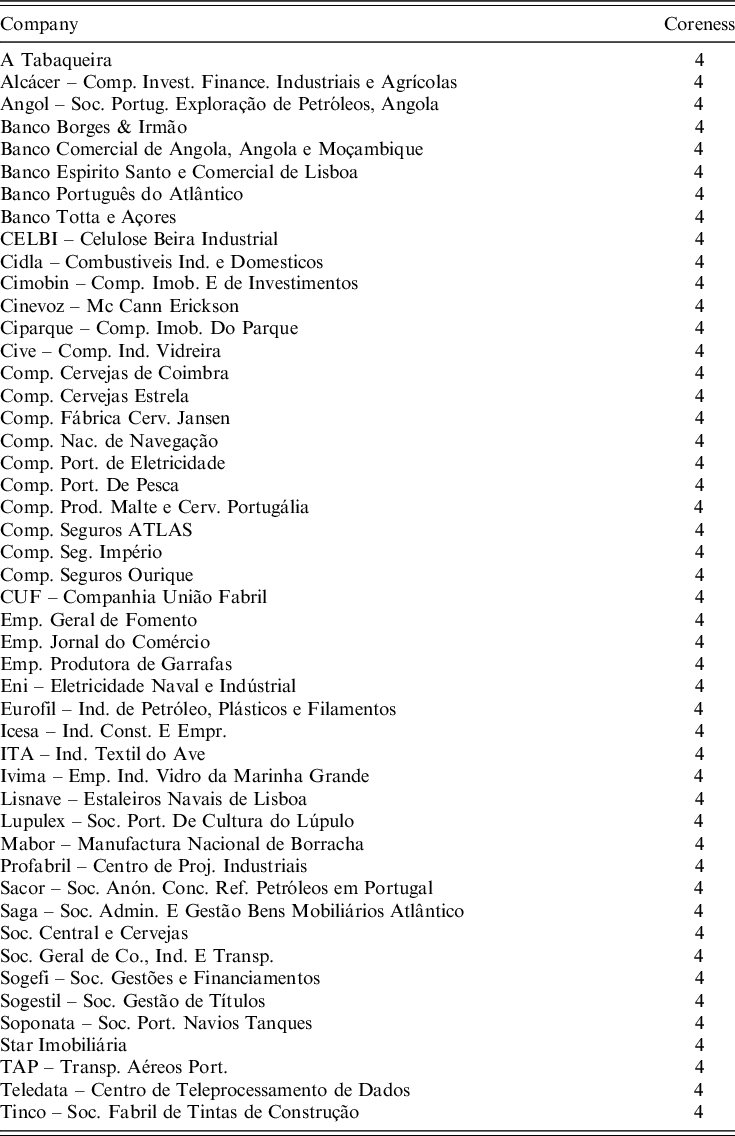
As seen in Table 2, we can confirm that all these 48 companies were linked to a minimum of four other companies in the database. Besides the banking sector, the highest coreness values in the network were recorded in the sectors of air transportation, chemical transformation, energy, food industry, and wine and breweries companies. These 48 companies represent 71% of the entire number of nodes – a highly significant percentage, proving the high coreness of this network and supporting our previous comments on the giant component of this case.
Using the Louvain algorithm (Blondel et al., Reference Blondel, Guillaume, Lambiotte and Lefebvre2008), we identified 130 modules. The significance of these modules was tested by comparing the observed network modularity with the modularity observed in a random network. The significance of our modules was tested by comparing network modularity M (the fraction of within-module edges minus the fraction expected for random connections) with the average modularity of randomized versions of the original network (M_Rand). The resulting values were M = 0.538 and M_Rand = 0.677 (± 0.002). According to Newman (Reference Newman2006), ‘Modularity is the extent to which a network contains groups of nodes that are densely interconnected with each other but sparsely connected to nodes outside the group’. Therefore, the modularity in our network is lower than that expected for a randomly-composed network, suggesting a higher interdependence between the observed companies that is independent of being in the core or not.
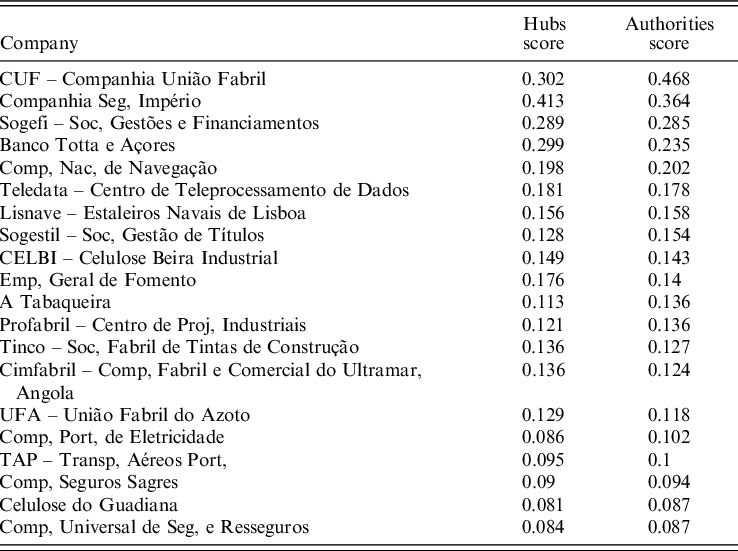
Finally, for synthesis purposes, network analysis also allows the possibility of classifying each Portuguese company based on their location in the Hubs–Authorities plane. In this classification, nodes are categorized into ‘Hubs’ (capacity to send significant investments to other companies) and ‘Authorities’ (capacity to receive relevant flows from other companies). Usually, companies without these characteristics are positioned in the set of ‘non-hubs’.
Table 3 shows the top 20 Portuguese companies in terms of their positions in the Hubs–Authorities plane.
Hubs and Authorities scores for Portuguese companies, 1973
3.2. Bigs on Bigs? Discussing the Determinants for Share Capitals of Portuguese Companies of 1973
If the previous findings are useful for indicating the structure of linkages among Portuguese companies in 1973, we seek to explain this structure in detail. According to Lopes (Reference Lopes1996) and Mateus (Reference Mateus1977), the structure of Portuguese companies in the 1970s was characterized by a high level of industrial concentration, the centrality of the banking system, and a certain vertical integration. This means that it is more likely that we will see powerful companies owning smaller companies from the same economic sector than central companies owning companies from different economic sectors. To properly analyse these claims, we must refer to exponential random graph models (ERGM).
As Holland and Leinhardt (Reference Holland and Leinhardt1981) found, ERGM ‘can easily accommodate other relations, attributes, and structural estimates as predictors of a given network’ (Snijders et al., Reference Snijders, Pattison, Robins and Handcock2006). Additionally, to quote Shumate and Palazzolo (2020), ERGM can differentiate ‘the senders of relations, the receiver of relations, or that actors with the greatest differences in valued attributes are likely to have relations.’ Following the notations of Shumate and Palazzolo (Reference Shumate and Palazzolo2010) and Mourao (Reference Mourao2020), we introduce the following ERGM model:
 $$P\left( {X = x} \right) = {{{\rm{exp}}\left\{ {\theta 'z\left( x \right)} \right\}} \over {k\left( \theta \right)}}$$
According to equation (1), we model the probability of a given network P(x) depending on the estimation of a vector of model parameters θ. z(x) refers to a vector of network statistics, and k is a normalizing function, the role of which is to define a certain probability distribution across the random networks.
For the estimation of equation (1), we have to refer to maximum pseudo-likelihood estimations. This method fits a logistic regression for the vector of network statistics; therefore, we will work with the following maximum pseudo-likelihood estimation (Mourao, Reference Mourao2020):
 $$PL\left( \theta \right) = \prod\nolimits_{i \ne j} {} \prod\nolimits_{m = 1}^r P {({X_{ijm}} = 1|X_{ijm}^C)^{{X_{ijm}}}}P{({X_{ijm}} = 0|X_{ijm}^C)^{1 - {X_{ijm}}}}$$
In line with Shumate and Palazzolo (Reference Shumate and Palazzolo2010) and Mourao (Reference Mourao2020), the maximum pseudo-likelihood estimation for each parameter is computed as a product of the log-odds ratio of two probabilities: the probability for each observed tie, P(X=1), and the probability of not observing that tie in the network, P(X=0). Additional features, such as the use of pseudo-likelihood ratio statistics, discussion of the independence assumptions, and robustness in small samples, are discussed by other authors, including Shumate and Palazzolo (Reference Shumate and Palazzolo2010) and Robins et al. (Reference Robins, Pattison and Wasserman1999).
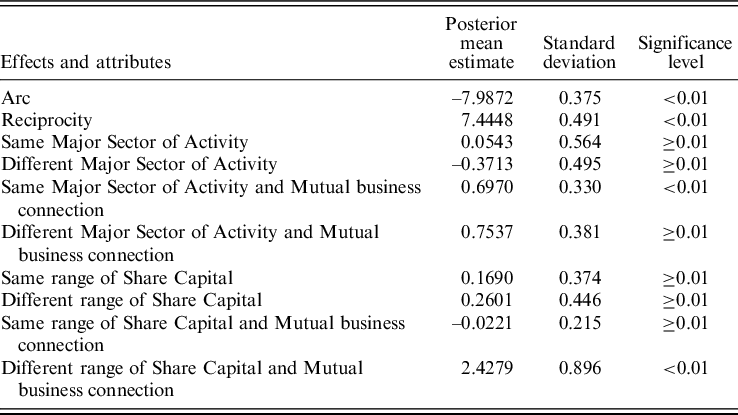
Table 4 displays the estimates we obtained for the ERGM.
ERGM estimation results
Acceptance rate: 0.54
As seen in Table 3, we chose an acceptance rate of 0.54, which is a high and significant acceptance rate. ERGM allow for three different models: only arcs, only structural parameters (like arcs or reciprocal relations), and a combination of structural parameters and attributes (variables).
The attributes studied here are those seen in Labys (Reference Labys1999), Wolfe (Reference Wolfe1955), and Djauhari and Gan (Reference Djauhari and Gan2016). Specifically, we studied the sector of activity of each company as well as its value of (share) capital. Our source is Martins (Reference Martins1973), and the descriptive statistics are available upon request. Each of these attributes allow several constructed dimensions: whether the investment relationship is established between matching/close values or not, or whether flows of capital between the companies (business connections, considering Martins’ (Reference Martins1973, 139–180) Column 4) are simultaneous or only univocal.
To avoid unnecessary waste of available space, we omit the estimates for the two first models (only arcs and only structural parameters) and focus our discussion on the estimates for the third model (structural parameters and attributes simultaneously). The omitted estimates are available upon request.
As shown in Table 3, we observed negative estimated values for the arc parameters. We interpreted these following Frank and Strauss (Reference Frank and Strauss1986), which indicates that ties are less likely to be observed in the Portuguese companies’ network of 1973 than would be seen by chance, revealing that there are significant attributes explaining the discovered relationships.
The maximum likelihood (ML) estimates for the reciprocity parameter are positive, revealing the presence of a positive propensity for these parameters in the network. In empirical terms, this means that a trend existed of a given company A investing in or participating in the share capital of another company B, which had also invested in company A (Martins, Reference Martins1973, 127–135).
Finally, in Table 3, we also see the attributes’ parameters. Given the full set of evaluated attributes, we found significant estimated coefficients for two attributes: Same Major Sector of Activity and Mutual business connection, and Different Level of Share Capital and Mutual business connection. This finding suggests that Portuguese companies tended to establish investment flows with other companies of the same activity sector, which supports Lopes (Reference Lopes1996). Additionally, these companies tended to establish investment flows with companies whose (share) capital was significantly different from theirs. This is typical of vertical integration (Avenel, Reference Avenel2003; Tenold, Reference Tenold2009), in which highly-capitalized companies tended to acquire relevant shares of less-capitalized ones. Our findings did not support the claims of Mateus (Reference Mateus1977) that the wealthiest companies preferred to establish relations of investment with other huge companies.
4. Conclusions
This work focused on the analysis of the business network in Portugal on the eve of the Carnation Revolution. To date, the object of this analysis has not been the target of the detail it deserved. Understanding the structure of the business network in Portugal is a vital piece to the puzzle that is the economic and business structure of Portugal in the 1970s as well as to the puzzle that is the business structure that the country showed in the following decades, characterized by the advance of the service sector and the intensification of openness to the outside world.
Based on a detailed contextualization of the economic and business context, we conducted an analysis of networks to test our main hypothesis that the observed Portuguese business structure was already a hub in 1973. We tested this hypothesis in three methodological steps: specifying the centrality of each company in the hub, identifying the probabilities of association between companies (in this case, probability of participation in the share capital), and identifying the characteristic attributes that can explain the observed network.
As seen in previous literature on hubs, we found that the Portuguese business network on the eve of the April 1974 Revolution had the characteristics of a business hub. We proved that this network was a ‘small world’, in which the controlling companies were relatively close to a large number of other companies. We also found a significant modular structure, indicating that a high number of companies was associated with a high number of other companies. Furthermore, we found that the hub’s central companies had a dynamic flow, indicating participation in other companies as well as being invested in by an equal number of companies. Finally, relations of homophily among companies predominated, meaning that the observed links were explained by the possession of similar characteristics (namely by close values of share capital).
To describe these characteristics in detail, we determined the following: Portuguese companies tended to acquire positions of social participation in other companies within the same sector and whose share capitals significantly differed from the share capitals of the investor companies.
With such a collection of empirical evidence, we were able to test both the existence of a corporate structure that configured a hub as well as the existence of a predominance of vertical integration, in which the acquiring companies generated a structure of participation in the capital of the acquired companies, densifying the observed flow. This business network in Portugal was reached under the economic policy guidelines laid out by the governments that followed the April 25 Revolution; moreover, given the observed density, this network contributed to the oscillation of economic activity and employment seen in the country in subsequent years.
This work researched Portuguese companies on the eve of the Carnation Revolution of 1974 in an original way, using network analysis. It also creates a number of promising research challenges. The first is the opportunity to detail more attributes of the observed companies through an exhaustive effort, in order to reinforce the analysis of the dimensions capable of explaining the corporate network and the subnets. Second, future research can carry out a comparative analysis of the world of the business network after 1974 compared with the world of the business network in the period before 1974. Finally, this work provides the possibility of further describing the companies observed here – companies of international activity – and the configuration of their respective networks of sector profiles or of headquarters in view of the regional location.
Acknowledgement
The author acknowledges the contributions provided by two anonymous referees and the discussion of a previous version of this research in the 2021 conference of the ‘Associação Portuguese de História Económica e Social’. Any remaining limitations are author’s exclusive ones.
This paper is financed by National Funds of the FCT – Portuguese Foundation for Science and Technology, within the project ‘UIDB/03182/2020’.
About the Author
Paulo Reis Mourao was born in Vila Real (Portugal). He is the author of several scientific articles indexed by ISI Thompson and of some books. His works are focused on Economics, Public Finance, Social Economics and Sports Economics. He appears often in national and international media commenting on social and economic issues. Paulo Mourao has been awarded several times for his scientific works.
Appendix
Legend to Figure 1: 1.A. M. Almeida – Com. Industria; 2.A Tabaqueira; 3.Abrigada – Comp. Nac. Refract.; 4.Acil – Administ. Imóveis, Angola; 5.Actimesa – Actvidade de Importação e Exportação; 6.Açucareira de Moçambique, Moçambique; 7.Adegas Camilo Alves; 8.Adimagri – Admin. Iob. Agrico.; 9.Aeromar – Soc. Abast. Navios, Aeronaves e Estaleiros; 10.Africados – África Supermercados, Angola; 11.Agran – Agroquímica de Angola, Angola; 12.Agloma – Soc. Indust. Madeira Aglomerada; 13.Albar – Soc. Imob. Barlaveto; 14.Albel – Comp. Com. e Turist. De Portugal; 15.Alcácer – Comp. Invest. Finance. Industriais e Agrícolas; 16.Algodoeira Agricola de Angola, Angola; 17.Aluemba – Embalagens e Artigos Metálicos; 18.Amoníaco Português; 19.Anglopor – Comp. Imob. Anglo-Portuguesa; 20.Angol – Soc. Portug. Exploração de Petróleos, Angola; 21.Aquazul – Inv. Turísticos e Financeiros; 22.Argibetão – Soc. Novos Prod. De Argila e Betão; 23.Argilex – Soc. Argilas Exp; 24.Asbiton Portuguesa; 25.Autodril – Soc. Do Autódromo do Estoril; 26.Banco da Agricultura; 27.Banco do Alentejo; 28.Banco do Algarve; 29.Banco Borges & Irmão; 30.Banco Comercial de Angola, Angola e Moçambique; 31.Banco Crédito Comercial e Industrial, Angola e Moçambique; 32.Banco Espirito Santo e Comercial de Lisboa; 33.Banco Fernandes de Magalhães; 34.Banco Fonsecas e Burnay; 35.Banco Intercontinental Português; 36.Banco Interunido, Angola; 37.Banco Nacional Ultramarino; 38.Banco Pinto de Magalhães; 39.Banco Pinto & Sotto Mayor; 40.Banco Português do Atlântico; 41.Banco Standard-Totta Moçambique, Moçambique; 42.Banco Totta e Açores; 43.Banco Totta-Standard de Angola, Angola; 44.Batiponte – Const. e Pontes de Portugal; 45.Belagri – Comp. Com. e Agric. de Portugal; 46.Biomar – Soc. Ind. De Algas Marinhas; 47.Borges & Irmão Comercial; 48.Bresfor; 49.Brisa – Auto Estrada de Portugal; 50.Cada – Comp. Angolana de Agricultura, Angola; 51.Caia – Comp. Alent. Ind. Alim.; 52.Calves – Comp. Inv. e Gestão Bens Imobiliários; 53.Carmarsousa – Soc. Civil Imobiliária do Pombal; 54.Capor – Comp. Algodões de Portugal; 55.Capsul – Cápsulas Metálicas do Ultramar, Angola; 56.Carbion Portuguesa – Cartão Bi-Ondulado; 57.Casa Hipólito; 58.CELBI – Celulose Beira Industrial; 59.Cel-Cat; 60.Celnorte – Celulose do Norte; 61.Celtrans – Soc. Trasnp. Internacionais; 62.Celulose do Guadiana; 63.Celulose do Tejo; 64.Cemarinha – Ceramicas da Marinha Grande; 65.Cembaltec – Centro Técnico e Com. de Embalagens; 66.Cemil – Celulose do Minho; 67.Centurial – Comp. Empreendimentos Turisticos; 68.Ceramica do Centro; 69.Cergal – Cervejas de Portugal; 70.Chenop – Companhia Hidroelectr. Do Norte de Portugal; 71.Cicomo – Comp. Ind. De Cordoarias de Moçamb, Moçambique; 72.Cidla – Combustiveis Ind. e Domesticos; 73.Cimertex – Socied. Máquinas e Equipamentos; 74.Cimianto de Angola, Angola; 75.Cimobin – Comp. Imob. E de Investimentos; 76.Cinevoz – Mc Cann Erickson; 77.Cinorte – Comp. Cimentos do Norte; 78.Cip – Comp. Ind. Portuguesa; 79.Cipa – Comp. Imob. Porto-Atlântico; 80.Cipan – Comp. Ind. Prod. Antibióticos; 81.Ciparque – Comp. Imob. Do Parque; 82.Cipro – Consultores Int. em Projetos de Desenvolvimento; 83.Cires – Comp. Ind. Resinas Sintéticas; 84.Cisa – Comp. Invest. Indust.; 85.Cisu – Comp. Ind. Cimentos do Sul; 86.Citroen Lusitana; 87.Cive – Comp. Ind. Vidreira; 88.Cocinor – Emp. Const. Civil; 89.Codexa – Soc. Expl. Propried; 90.Comoin – Comp. Inv. Mob. Imob.; 91.Cometna – Comp. Met. Nacional; 92.Cimfabril – Comp. Fabril e Comercial do Ultramar, Angola; 93.Confatex – Comp. Fabril de Texteis do Ultramar, Angola; 94.Compal – Comp. Produto. De Conservas Alimentares; 95.Comp. Agrícola Quinta do Duque; 96.Comp. Agrícola Ultramarina; 97.Comp. Alent. Seg. A Pátria; 98.Comp. Algodões de Moçambique, Moçambique; 99.Comp. Animat. Restauradores; 100.Companhia do Boror, Moçambique; 101.Comp. Do Buzi, Moçambique; 102.Comp. Caju do Monapo, Moçambique; 103.Comp. Carbonífera de Moçambique, Moçambique; 104.Comp. Carris de Ferro de Lisboa; 105.Comp. Carvões e Cimentos Cabo Mondego; 106.Comp. Cervejas de Coimbra; 107.Comp. Cervejas Estrela; 108.Comp. Cerv. e Refrig. MacMahon, Moçambique; 109.Comp. Cimentos de Angola, Angola; 110.Comp. Cimentos de Moçambique, Moçambique; 111.Comp. Cimentos Tejo; 112.Comp. Colonial de Navegação; 113.Comp. Constr. Moçambique, Moçambique; 114.Comp. Diamantes de Angola, Angola; 115.Comp. Elétrica do Alentejo e Algarve; 116.Comp. Elétrica das Beiras; 117.Comp. Fábrica Cerv. Jansen; 118.Comp. Ilha do Principe, São Tomé e Principe; 119.Comp. Ind. Portugal e Col.; 120.Comp. Industrial de Vidros; 121.Comp. Lezírias do Tejo e Sado; 122.Comp. Lusitana do Alumínio da Guiné e Angola; 123.Comp. Moçambicana de Naveg., Moçambique; 124.Comp. de Moçambique, Moçambique; 125.Comp. Nac. Algodoeira, Moçambique; 126.Comp. Nac. Fiação e Tecidos Torres Novas; 127.Comp. Nac. de Navegação; 128.Comp. Nac. De Petroquimica; 129.Comp. Nac. Seguros A Seguradora Industrial; 130.Comp. Do Papel do Prado; 131.Comp. Pesquisas Mineiras de Angola, Angola; 132.Comp. Do Pipe-Line Moçambique Rodésia, Moçambique; 133.Comp. Port. Das Águas Salus (Vidago); 134.Comp. Port. De Celulose; 135.Comp. Port. Do Cobre; 136.Comp. Port. de Eletricidade; 137.Comp. Port. Fornos Eletricos; 138.Comp. Port. Motores e Camiões; 139.Comp. Port. De Pesca; 140.Comp. Portuguesa de Petróleos BP; 141.Comp. Port. Rádio Marconi; 142.Comp. Port. Trefilaria; 143.Comp. Previdente; 144.Comp. Prod. Malte e Cerv. Portugália; 145.Comp. Pulverizações Aéreas Textavex; 146.Comp. Do Quanza Sul, Angla; 147.Comp. Química Geral de Moçambique, Moçambique; 148.Comp. Das Roças Plateau e Milagrosa, São Tomé; 149.Comp. Seguros A Mundial; 150.Comp. Seguros A Nacional; 151.Comp. Seguros A Nacional de Angola, Angola; 152.Comp. Seg. Aliança Madeirense; 153.Comp. Seguros de Angola, Angola; 154.Comp. Seguros ATLAS; 155.Comp. Seguros Bonança; 156.Comp. Seguros Confiança; 157.Comp. Seguros Confiança e Mundial de Angola, Angola; 158.Comp. Seguros Douro; 159.Comp. Seguros Fidelidade; 160.Comp. Seguros Fidelidade Atlantica, Angola; 161.Comp. Seg. Império; 162.Comp. Seguros Lusitania, Moçambique; 163.Comp. Seguros Mundiasl e Confiança de Moçambique; 164.Comp. Seguros Mutualidade; 165.Comp. Seguros Nauticus, Moçambique; 166.Comp. Seguros Ourique; 167.Comp. Seguros O Trabalho; 168.Comp. Seguros Previsão; 169.Comp. Seguros Sagres; 170.Comp. Seguros Soberana; 171.Companhia Seguros Tagus; 172.Comp. Seguros Tranquilidade; 173.Comp. Seguros Tranquilidade de Moçambique; 174.Companhia de Seguros Ultramarina; 175.Comp. Seguros União; 176.Comp. Dos Tabacos Port.; 177.Comp. Têxtil do Pungué, Moçambique; 178.Comp. Universal de Seg. e Resseguros; 179.Comp. Urânio de Moçambique; 180.Comp. Vidreira de Moçambique; 181.Comp. Vinícola de Moçambique; 182.Compave – Soc. Compra e Venda de Propriedades; 183.Compete – Empresa Promotora de Empreend. Turisticos; 184.Comportel de Angola; 185.Comportel – Comp. Port. De Elevadores; 186.Comportur – Comp. Port. Urbanização e Turismo; 187.Comundo – Consórcio Mundial de Exportação; 188.Conselho – Gestão e Investimentos; 189.Conservas Brandão; 190.Construções Vila Moura; 191.Construmarina – Const. Metrop. e Ultramarina; 192.Construtora Moderna; 193.Continental de Resseguros; 194.Copeja – Comp. Portuguesa de Cerveja; 195.Coper – Ind. De Perfumes; 196.Copeve – Comp. Prop. Estabelec. Vários; 197.Copta – Comp. Tur do Algarve; 198.Cota – Comp. Tur. Do Algarve; 199.Cotonang – Comp. Geral dos Algodões de Angola; 200.Covina – Comp. Vidr. Nacional; 201.Crédito Predial Português; 202.CRGE – Comp. Reunidas de Gás e Eletricidade; 203.Crisal – Cristais de Alcobaça; 204.C. Santos – Comércio e Ind.; 205.Cuca, Angola; 206.CUF – Companhia União Fabril; 207.CUFP – Comp. União Fabril Portuense; 208.Cuf-Sanders; 209.Deflório – Comp. Europeia de Investimentos; 210.Desil – Ind. Prod. Agrícolas Desidratados; 211.Diner’s Club; 212.Distribuidora Central de Tapetes de Beiriz; 213.E. Pinto Basto; 214.Ecce – Estab. De Comissões, Consignações e Empreendimentos; 215.Econar – Emp. Com. Do Ultramar; 216.Ectil – Emp. Const. E Turist.; 217.Edec. – Edificações Econom.; 218.Edificios Atlântico; 219.Editorial Verbo; 220.Efacec – Emp. Fabril de Máquinas Electricas; 221.Egi – Emp. Gestão e Investimentos; 222.Eival – Soc. Empreend. Invest. E Armazenagem de Gases; 223.Electro-Arco; 224.Emaco – Emp. Admin. E Const.; 225.EM-DI-MA – Emp. Distrib. De Máquinas; 226.Eminco – Empreendimentos industriais e Comerciais; 227.Emp. Africana de Cargas e Descargas; 228.Emp. António da Silva Gouveia, Guiné; 229.Emp. Ceramica do Fojo; 230.Emp. Cimentos de Leiria; 231.Emp. Cobre de Angola; 232.Emp. Concentrados de Alvalade; 233.Emp. Electrocerâmica; 234.Emp. Fabril do Norte; 235.Emp. Geral de Fomento; 236.Emp. Hifroelétrica da Serra da Estrela; 237.Emp. Hotel Astória de Monfortinho; 238.Emp. Ind do Freixo; 239.Emp. Insulana de Navegação; 240.Emp. Jornal do Comércio; 241.Emp. Metl. De Moçambique; 242.Emp. Mineira do Cercal; 243.Emp. Moçambicana de Malhas; 244.Emp. Nac. Aparelhagem Electr.; 245.Emp. de Pesca de Viana; 246.Emp. de O Primeiro de Janeiro; 247.Emp. Produtora de Garrafas; 248.Emp. Prod. Asfálticos (E.P.A.); 249.Empresa de Viação Algarve; 250.Emulsa – Fábrica de Dispersões; 251.Eni – Eletricidade Naval e Indústrial; 252.Entreposto de Automóveis de Angola; 253.Entreposto Comercial de Angola (Entrauto); 254.Entreposto Comercial de Moçambique; 255.Entreposto Comercial (Niassa), Moçambique; 256.Entreposto Comercial (Zambézia), Moçambique; 257.Entreposto Indústrial de Automóveis; 258.Esli – Parque de Estacionamento de Lisboa; 259.Estab. Com. Vitorino Moreira Rodrigues; 260.Estaleiros Navais de Viana do Castelo; 261.Estamparia de Braço de Prata; 262.Estoril; 263.ETC – Emp. T. Contentor; 264.Eurocerâmica – Soc. Empreend. Industriais; 265.Eurofil – Ind. de Petróleo, Plásticos e Filamentos; 266.Eurofina – Invest. e Estudos Técnicos; 267.Europac – Comp. Port. Embal.; 268.Explotel – Comp. Exploração de Hóteis; 269.Fapobol – Comp. Portuense de Borracha; 270.Fábrica das Antas; 271.Fábrica Lusandesa de Redes; 272.Fábrica Nacional de Margarina; 273.Fábrica de Plástico de Ruy d’Orey; 274.Fábrica de Porcelanas Vista Alegre; 275.Fábrica Portuguesa de Fermentos Holandeses; 276.Fábrica Portugal; 277.Fábrica Textil Riopele; 278.Fab. Tintas de Sacavém (Dyrup); 279.Fáb. Vidros da Boavista – Guilherme Pereira Rodão; 280.Facel – Fabricação de Conjuntos Electrónicos; 281.Faianças e Porcelanas Sado-Internacional; 282.Fapae – Fáb. Port. Art. Eléct.; 283.Feriatur – Empreendm. Turist. Internacionais; 284.Ferrominas; 285.Ficape – Soc. Finan. Administ. De Capitais; 286.Figueiredo e Sousa; 287.Filmes Lusomundo; 288.Fima – Fáb. Imperial de Marg.; 289.Finalgarve – Investimentos Financeiros; 290.Finalgarve – Soc. Promoção Imobiliária e Turística; 291.Findal – Comp. Com e Turist. de Portugal; 292.Finicisa – Fibras Sintéticas; 293.Firestone Portuguesa; 294.Floral – Soc. Perfumaria e Produtos Químicos; 295.Fopra – Fin. Prediais e Agr.; 296.Frinil – Frio Naval e Ind.; 297.Fundus – Admin. E Participações Financeiras; 298.Cargar – Garrafas de Port.; 299.Gás-Âncora, Moçambique; 300.Gaslimpo – Soc. De Desgasificação de Navios; 301.Gefel – Gabinetes de Estudos e Empreendimentos Técnicos; 302.General Electric Portuguesa; 303.Geobra – Gabiente de Estudos e Decoração de Obras; 304.Geogás – Soc. Port. Estudos e Aprov. De Comb. Gasosos; 305.Gertal – Comp. Geral de Restaurantes e Alimentação; 306.Gestor; 307.Getur – Gab. Estudos Téc. Do Ultramar; 308.Graham – Indústria de Papel da Abelheira; 309.Gris Impressores; 310.H. Parry e Son; 311.Hidroelétrica do Alto Alentejo; 312.Hidroelétrica do Alto Catumbela, Angola; 313.Hoechst Portuguesa; 314.Hotal – Soc. Ind. Hoteleira do Sul de Portugal; 315.Hoteis Sheraton; 316.Hotelcar – Investimentos Hoteleiros e Transp. Tur.; 317.Hulla-Hulla; 318.Icesa – Ind. Const. E Empr.; 319.ICI Portuguesa; 320.Icosal – Soc. Investimento e Const.; 321.Idal – Ind. De Alimentação; 322.Ifa – Ind. Fosforeira de Angola; 323.Ilta – Urbaniz. Da Ilha de Tavira; 324.Ima – Ind. Mont. Automóveis; 325.Imobex; 326.Imobiliária da Avenida; 327.Imobiliária Construtora Grão Pará; 328.Imobur – Imobiliz. Urbanas; 329.IMP – Ind. Metálico Previdente; 330.Imprimarte – Editora; 331.Indala; 332.Indemoto – Motores e Equipamentos Industriais; 333.Ind. Lever Portuguesa; 334.Ind. Metálicas Dine; 335.Induve – Indústrias Angolanas de Óleos; 336.Inel – Ind. Electr. Associad.; 337.Inica – Iniciativas Ind. E Mineiras; 338.Instituto Luso-Fármaco; 339.Intar – Emp. Ind. Tabaco; 340.Intebis – Ind. Texteis de Beiriz; 341.Interacid; 342.Intercal – Comp. Nac. Constr.; 343.Interhotel – Soc. Int. Hoteis; 344.International Factors; 345.Interox Portuguesa – Prod. Quimicos; 346.Interplan – Inst. Planificação Financeira; 347.Interpneus – Soc. Int. Pneus; 348.Inversora – Invest. Organiz. E Admin. Empresas; 349.Investa – Soc. Investimentos; 350.Invictos – Supermercados do Norte; 351.Invima – Imobiliária Viana Machado; 352.Ipetex – Ind. Pesadas Texteis; 353.Isu – Estabelecimentos de Saúde; 354.ITA – Ind. Textil do Ave; 355.Ivima – Emp. Ind. Vidro da Marinha Grande; 356.J.J. Gonçalves; 357.Jomar – Cabos Eletricos e Telefónicos; 358.Júpiter – Ind. Hoteleira; 359.L. D’Argent; 360.Laboratório Atral; 361.Laboratórios Vitória; 362.Latina – Agencia de Publicidade; 363.Lecabetão – P´re-fabricados em Argila Expandida; 364.Licar; 365.Lisfina – Comp. Inv. Nd. De Lisboa; 366.Lisinur – Comp. Invest. Urbanos de Lisboa; 367.Lisnave – Estaleiros Navais de Lisboa; 368.Lisnico – Serviço Martit. Internacional; 369.Lupral – Lusalite e Previdentes de Angola; 370.Lupulex – Soc. Port. De Cultura do Lúpulo; 371.Lusalite – Soc. Port. De Fibrocimento; 372.Lusofane; 373.Lusotur – Soc. Financeira de Turismo; 374.Mabor – Manufactura Angolana de Borracha; 375.Mabor – Manufactura Nacional de Borracha; 376.Mabor – Moçambique; 377.Macedo e Coelho; 378.Madeiper – Org. Cent. De Abastecimento de Madeiras; 379.Maioril; 380.Mandarim – Soc. Ibérica de Prod. Alimentares; 381.Matur – Soc. Empreendimentos Turísticos da Madeira; 382.Medical – Casa de Repouso; 383.Medicamenta; 384.Menko-Raione Textil; 385.Mercauto – Metalomecanica de Constr. E Repar. Auto; 386.Messa – Máquinas de Escrever; 387.Metalofabril – Fabricação de Equipamento Metalomec; 388.Metalurigia Duarte Ferreira; 389.Metripul – Inv. Particip. De Cap. E Gestões Metrop. E Ultramar; 390.Micofabril – Soc. Ind. De Bioquimica; 391.Mobil Oil Portuguesa; 392.Moçacor – Distribuição de Combustiveis, Moçambique; 393.Moçambique Comercial; 394.Moçambique Industrial; 395.Mompor – Comp. Por. Mont. Industriais; 396.Motra – Equipamentos Eletricos; 397.Movauto – Montagem de Veículos Automóveis; 398.Movierecord Portuguesa; 399.Multicater – Gestão de Restaurantes, Messes e Cantinas; 400.Mycofarm – Brocades Farmaceutica Portuguesa; 401.Navang – Comp. Naveg. Angolana; 402.Navemar – Agência de Naceg. Marítima e Aérea; 403.Navetur – Agências de Turismo e Transportes de Angola; 404.Navetur – Agências de Turismo e Transportes de Moçambique; 405.Nelson – Emp. Turist. da Praia Redonda; 406.Neostano – Nova Empresa Estanífera de Mangyalde; 407.Nipotix – Textil Luso-Jap; 408.Nitratos de Portugal; 409.Nocal – Nova Emp. Cerveja de Angola; 410.Noética – Consultores Int. em Economia e Gestão; 411.Norma – Soc. Estudos para o Desenvolvimento de Empre.; 412.Nortemar – Agência Maritima do Norte; 413.Novopam – Emp. Prod. De Aglomerados de Madeira; 414.Nucel – Núcleo Eletrotécnico; 415.Nutrigeste – Comp. Port. De Alimentação; 416.Nutripol – Soc. Port. De Supermercados; 417.Obreira – Soc. Imob. Ds Amoreiras; 418.Oliva de Angola; 419.Oliva Comercial; 420.Oliva Industrias Met.; 421.Oliva de Moçambique; 422.Orbis – Edições Ilustradas; 423.Orbitur – Ind. Turismo; 424.Orfina – Soc. Ind. Quim. Org.; 425.Orplan – Organização e Planeamentos Tec. E Constr.; 426.Palmares – Comp. Empreendim. Tur´sit. De Lagos; 427.Paulo Cocco; 428.Penta Publicidade; 429.Petrangol – Comp. Petróleos de Angola; 430.Petróleo Mecânica Alfa; 431.Petrosul – Soc. Port. Refinação de Petróleos; 432.Philips Portuguesa; 433.Pirâmide – Soc. Ind. Const; 434.Planope – Planos e Projetos; 435.Plásticos Sintex; 436.Plessey Automática Eletrónica Portuguesa; 437.Plessey Eletrónica Portuguesa; 438.Praial – Comp. Port. Turismo; 439.Praialonga – Soc. Inv. Tur. E Imobiliários; 440.Previnil – Emp. Preparadora de Compostos Vínicolos; 441.Printe – Promotora Int. de Financiamentos; 442.Procope – Prom. E Estudos de Mercado Publicitário; 443.Profabril – Centro de Proj. Industriais; 444.Progredior – Soc. Empreend. Urbanos e Rústicos; 445.Promarinha – Gabinete de Estudos e Projetos; 446.Promática – Soc. Informática e Organização de Empresas; 447.Prodelecte – Soc. Promotora e Selec. Produtos p/ Lavoura; 448.Protextil – Promoção e Ind. Textil; 449.Purfina – Comp. Combustiveis do Lobito, Angola; 450.Quinta do Grajal; 451.Rabor – Const. Eletricas; 452.Realimo – Estudos e Realizações Imobiliárias; 453.Reeves Port. – Revestimentos; 454.Refrigerantes Vidago; 455.Refriplás – Ind. Reunidas de Refrigerantes e Plásticos; 456.Regimprensa; 457.Renascença Gráfica; 458.Represent. Automóvel Chrysler; 459.Representações Lancal; 460.Repropel – Soc. Repar. Hélic.; 461.Resiquimica; 462.Restaubar – Bares e Restaur.; 463.Retur – Residências Turísticas; 464.Ribalonga – Empreendimentos Urbanísticos; 465.Ricardo dos Santos Galo; 466.Riguadiana – Soc. Expl. Edificios Guadiana; 467.Rilnor – Soc. Rilsanização de Metais do Norte; 468.Robbialac Portuguesa; 469.Rochazul – Soc. Inv. Imobil. e Turísticos; 470.Rodes – Estudos e Projetos; 471.Rol – Rolamentos Portugueses; 472.Rota do Atlântico – Agência de Viagens e Turismo; 473.Saaga – Soc. Açoreana de Armazenagem de Gás; 474.Sacor – Soc. Anón. Conc. Ref. Petróleos em Portugal; 475.Sacor Marítima; 476.Saema – Empreend. Fin. E Com.; 477.Safilco – Soc. Desenv. Prod. Químicos; 478.Saga – Soc. Admin. E Gestão Bens Mobiliários Atlântico; 479.Saipol – Soc. Agro-Pecuária do Ponsul; 480.Salvador – Soc. Inv. Hoteleiro; 481.Samar – Soc. Agências Marít; 482.Santos Barosa; 483.São Ciro – Admin. E Iniciat. Financeiras; 484.Seama – Soc. Expl. Aeródromos e Manutenção de Aeronaves; 485.Secil – Comp. Cimentos do Ultramar, Angola; 486.Secil – Comp. Geral de Cal e Cimento; 487.Seeicla; 488.Selecções Reader’s Digest; 489.Sema – Soc. Electrónica Marít. e Aeronáutica; 490.Sepsa – Soc. Const. Electrom.; 491.Servisan – Produtos de Higiene; 492.Seta – Soc. Exportadora de Tabacos de Angola; 493.Setal – Soc. Estudos e Tratamento de Águas de Setubal; 494.Setenave – Estaleiros Navais; 495.Shell Portuguesa; 496.Sher – Soc. Hidroelétr. Do Revué, Moçambique; 497.Sicel – Soc. Ind. Cereais; 498.Sicomol – Soc. Ind. Coloides do Mondego; 499.Sicope – Soc. Com. E Ind de Plásticos; 500.Siderurgia Nacional; 501.Sidul – Soc. Ind. Ultamar; 502.Siemens; 503.Siga – Soc. Ind. Grossarias de Angola; 504.Silo Auto – Comp. Port. De Estacionamentos; 505.Silva e Gouveia; 506.Simopre – Soc. Inv. Mobiliários e Prediais; 507.Simotra – Soc. Inv. E Trans.; 508.Sinagra – Soc. Ind. Agric. Açor.; 509.Siol – Soc. Import. Óleos; 510.Sitenor – Soc. Ind. Texteis do Norte; 511.Snapa – Soc. Nac. De Pesca de Arrasto; 512.Socaju – Soc. Ind. E Com. De Caju, Moçambique; 513.Socarmar – Soc. Cargas e Descargas Marítimas; 514.Socel – Soc. Ind. Celuloses; 515.Socer – Soc. Central Resin; 516.Soc. Agrícola da Alorna; 517.Soc. Agrícola Arneiro Grande; 518.Soc. Agríc. Do Cassequel, Angola; 519.Soc. Agrícola Chimoio e Manica, Moçambique; 520.Soc. Agríc. Incomati, Moçambique; 521.Soc. Agríc. Do Lucala, Angola; 522.Soc. Agríc. Vale Flor; 523.Soc. Agrícol. Vale dos Perdidos; 524.Soc. Agrícola de Vilamoura; 525.Soc. Das Águas do Luso; 526.Soc. Algodoeira do Ambriz; 527.Soc. Algodoeira de Fomento Colonial; 528.Soc. Algodoeira do Zambeze, Moçambique; 529.Soc. Azevedo, Soares e Cia; 530.Soc. British Leyland de Portugal – Automóveis; 531.Soc. Central e Cervejas; 532.Soc. Com. Gouveia; 533.Soc. Com. Guérin; 534.Soc. Com. José Domingos Barreiro; 535.Soc. Comercial Santa Justa; 536.Soc. Com. Ultramarina; 537.Soc. Const. William Graham; 538.Soc. Continental de Repres; 539.Soc. Corticeira Robinson Bros; 540.Soc. Emigração p/ São Tomé e Príncipe; 541.Soc. Empreitadas e Trabalhos Hidráulicos; 542.Soc. Fiação e Tecidos Azevedo e Ferreira; 543.Soc. Geral de Co., Ind. E Transp.; 544.Soc. Gestão Imobiliária; 545.Soc. Imob. Ribamar Estoril; 546.Soc. Imob. Torres do Tejo; 547.Soc. Ind. Camisaria Bastos & Irmão; 548.Soc. Ind. Farmaceutica; 549.Soc. Ind. Gouveia; 550.Soc. Ind. De Imprensa; 551.Soc. Ind. Vila Franca; 552.Soc. Inv. Iob. Da Praia da Rocha; 553.Soc. Inv. José Mariani; 554.Soc. De Lavandarias de Portugal – Solavar; 555.Soc. Lubrificantes Ingleses; 556.Soc. Luso-Japonesa de Pesca; 557.Soc. Lusolanda; 558.Soc. Manuel Pinto de Azevedo; 559.Soc. Mineira de Santiago; 560.Soc. Nac. Petróleos de Moçambique; 561.Soc. Nac. Sabões; 562.Soc. Nac. Tipografia; 563.Soc. Port. Automóveis; 564.Soc. Port. Lapidação de Diamantes (Dialap); 565.Soc. Port. De Petroquimica; 566.Soc. Port. De Seguros; 567.Soc. Predial Ultramarina, Moçambique; 568.Soc. Produtora de Leveduras Seleccionadas; 569.Soc. Produtos Lácteos; 570.Soc. Propriet. Hotal Universal; 571.Soc. Turismo de Moçambique; 572.Soc. Turística da Penina; 573.Soc. Turíst. Ponta do Adoxe; 574.Soc. Ultramarina de Administr., Moçambique; 575.Soc. Ultramarina de Tabacos; 576.Socitrel – Soc. Ind. Trefil; 577.Socinfra – Soc. Inv. Quinta da Francelha; 578.Soda Póvoa; 579.Sodege; 580.Sodim – Soc. Inv. Imobiliários; 581.Sofamar – Soc. Fainas do Mar e Rio; 582.Sofir – Soc. Turismo de Ofir; 583.Sogás Produtos – Soc. De Gases e Prod. Quimicos; 584.Sogefi – Soc. Gestões e Financiamentos; 585.Sogere, Moçambique; 586.Sogertal – Soc. Representações e Admonistrações; 587.Sogestil – Soc. Gestão de Títulos; 588.Sogin – Soc. Gestora de Iniciativas Financeiras; 589.Sointal – Soc. Inic. Turist. Algarvias; 590.Soja de Portugal; 591.Solnave – Comercio e Distribuição; 592.Solouro – Soc. Agrícola do Louro; 593.Soltroia – Soc. Imobiliária de Urbaniz. E Turismo de Tróia; 594.Somapre – Soc. Materiais Pré-Esforçados; 595.Somarisco – Soc. Produtora e Com. De Alimentos do Mar; 596.Sommer; 597.Somotel – Soc. Port. Móteis; 598.Sonacin – Soc. Nac. Inv. Financeiros; 599.Sonadel – Soc. Nac. Deterg.; 600.Sonae – Soc. Nac. Extratificados; 601.Sonap – Soc. Nac. Petróleos; 602.Sonarep – Soc. Nac. De Refinação de Petróleos, Moçambique; 603.Sonatra – Soc. Nac. Tráfego; 604.Sopogil – Soc. Gestão Com. e Indústrial; 605.Soponata – Soc. Port. Navios Tanques; 606.Sorefame – Soc. Reunidas de Fabricações Metálicas; 607.Sores – Soc. Refinadora de Santa Iria; 608.Sotáqua – Soc. Empreendimentos Turist. Da Quarteira; 609.Sotecna – Soc. Inv. Técnicos e Industriais; 610.Soteis – Soc. Int. Turismo; 611.Soturis – Soc. Expansão Hoteleira e Turística; 612.Sovena; 613.Sovendal – Soc. Distribuidora de Prod. Alim. E Higiene; 614.Sovial – Soc. De Viaturas de Aluguer; 615.Standard Eletrica; 616.Star Imobiliária; 617.Star – Soc. Turismo e Agências Ribamar; 618.Sulei – Soc. Ultram. Empreend. Imobiliárias; 619.Sumate – Concentrados e Sumos; 620.Supa – Comp. Port. De Supermercados; 621.Supermercados Modelo; 622.Supersumos; 623.Synres Port – Ind Quimicas; 624.TAP – Transp. Aéreos Port.; 625.Tecnifar – Ind. Técn. E Farm.; 626.Tecnitur – Técnica, Gestão e Prom. De Inv. Turist; 627.Telecine-Moro – Soc. Produtora de Filmes; 628.Teledata – Centro de Teleprocessamento de Dados; 629.Terrena – Com. De Imóveis; 630.Textáfrica Comerc, Angola; 631.Textarte – Texteis; 632.Textil Lopes da Costa; 633.The Atlantic Company (Herdade da Comporta); 634.Tinco – Soc. Fabril de Tintas de Construção; 635.Tintalusa; 636.Tofa – Torrefacção de Café; 637.Tomira – Emp. Concentrados de Tomate de Odemira; 638.Torralta – Club Intern. De Férias; 639.Touring-Club Portugal; 640.Tractores de Portugal – Comércio e Indústria; 641.Trafepor – Soc. Tráfego Portuário; 642.Transfrio – Soc. Marít. De Trasnporte de Frigoríficos; 643.Transfruta – Comp. Nacional de Navios Frigorificos; 644.Transmineira – Comp. Nac. De Navios Mineraleiros; 645.Transnavi – Soc. Port. De Navios Cisternas; 646.Transportes – Boa Viagem; 647.Tubus Vouga – Const. Met.; 648.Turidecor – Soc. Decoração Turistica e Hoteleira; 649.Turistrela – Turismo Serra da Estrela; 650.UFA – União Fabril do Azoto; 651.Unialgas – União Luso-Japonesa de Algas Marinhas; 652.União Eletrica Portuguesa; 653.União de Lima Tomé Feteira; 654.Uniclar – Ind. Cosmética; 655.Unifa – União Fabril Farm; 656.Unigeste – Comp. Port. Gestão e Financiamentos; 657.Unisol – Soc. Distribuição e Importação; 658.Urbipor – Soc. Port. De Urbanização Racional; 659.Vecom Portuguesa – Soc. Limpezas Quimicas; 660.Verbo – Publicações Periódicas; 661.Vidago, Melgaço e Pedras Salgadas; 662.Vidros de Segurança; 663.Vidrul – Vidraria do Ultramar; 664.Vifibrás – Plásticos Ref; 665.Vigola – Vidraria de Angola; 666.Vitamealo Portuguesa – Alim. Vitm. p/ animais; 667.Viturgal – Club Algarve de Viagens; 668.Vumba – Gestão de Bens Imobiliários; 669.Walter E. Heller Factoring Port.; 670.Ytong Port. – Betão Celular; 671.Zimbra – Empreend. Turísticos de Sesimbra; 672.Barbosa e Almeida; 673.BIC – Construção Portuguesa; 674.Brás, Lda; 675.Ford Lusitania; 676.General Mot



