INTRODUCTION
Anthelmintic resistance is a matter of concern for small ruminant farming, and the prevalence of resistance to the 3 main classes of anthelmintics is increasing, for a review see (Kaplan, 2004). Anthelmintic resistance seems to remain stable once it has been established (Borgsteede and Duyn, 1989; Leignel, 2000), and so replacement of an anthelmintic-resistant population by a susceptible one may offer a possible solution when nematode populations become multi-drug resistant. Four attempts have been reported: 1 study involved a benzimidazole (BZ)-resistant strain of Haemonchus contortus (Wyk and van Schalkwyk, 1990) in South-Africa, and the other 3 involved communities of nematodes displaying multi-drug resistance (Bird et al. 2001; Sissay et al. 2006). Unlike these 4 studies, where resistant nematodes were diluted with susceptible nematodes, we wanted to try replacing resistant nematodes by susceptible nematodes in a temperate area.
Van Wyk and van Schalkwyk (1990) successfully restored anthelmintic efficacy in 3 of the 5 paddocks they tested. Their study was conducted under extensive husbandry conditions: the available pastures were divided into 2 sections, and grazed alternately every second year, which is a common practice in large farms in South Africa. This practice of leaving pastures fallow is not compatible with the semi-intensive or intensive management of small ruminants in Europe, and in particular in France (Anonymous, 2005). Aumont et al. (2002) succeeded in replacing levamisole-resistant Trichostrongylus colubriformis, but failed to re-establish a fully benzimidazole-susceptible population of Haemonchus contortus. Bird et al. (2001) and Sissay et al. (2006) successfully restored the efficacy of avermectins, levamisole/tetramisole and benzimidazoles against a multi-resistant community of nematodes (Haemonchus spp., Teladorsagia spp., and Trichostrongylus spp., and Haemonchus spp., and Trichostrongylus sp., respectively). Anthelmintic efficacy was evaluated by a faecal egg count reduction test (FECRT), which is known to have poor sensitivity to low to medium levels of resistance (resistance levels of up to 25%) are not detected by the FECRT) (Martin et al. 1989), which makes this test rather unsuitable for these studies. The relationship between egg counts and worm burdens depends to a large extent on the species present in the community, and this further complicates the interpretation and sensitivity of the FECRT (Coles et al. 2006). Although the efficacy of the avermectins was re-established by Bird et al. (2001), the authors admit that levamisole resistance may still have been present in Trichostrongylus sp. Similarly, at the end of the experiment, BZ treatment was not as efficient against Trichostrongylus sp. as against the other species. In the present study, we set out to replace a BZ-resistant population of T. circumcincta by a local, BZ-susceptible strain. Unlike the previous studies, we accurately determined resistance by genotyping the BZ-resistant worms. The threshold of sensitivity when genotyping is used to assess resistance is 1% (Elard et al. 1999), whereas it can be as high as 25% when using FECRT (Martin et al. 1989). In the earlier studies, phenotypic evaluations of BZ resistance by FECRT and the egg hatch assay (EHA) were carried out on infestations involving several strongyle species (Bird et al. 2001; Sissay et al. 2006), which makes phenotypic evaluations difficult, and so we chose to evaluate resistance using infestations involving just a single species of strongyle. We tested 4 levels of initial resistance to BZ (from 20% to 89% of resistant worms determined by genotyping) to assess the feasibility of replacing resistant nematodes by susceptible nematodes when the initial resistance was moderate to severe. First, we postulated that eliminating resistant, infective larvae from pastures would depend on a late turnout of the flock onto the pastures (in July) in order to obtain uninfected pastures. The grass from the pastures was cut in June, dried and baled. These bales were then fed to worm-free lambs to check whether any infective larvae remained. Second, lambs were experimentally infected with the BZ-susceptible strain of T. circumcincta and were put out to graze and contaminate the pastures. The BZ susceptibility of the strain at the end of the grazing season was checked by individual genotyping of the worms, which is more sensitive than a phenotypic test (Elard et al. 1999).
MATERIALS AND METHODS
Experimental design
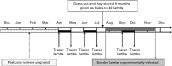
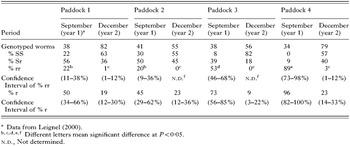
All the lambs were 5 months of age, and worm free when the experiment began. They were grazing 4 adjacent 0·7-ha. experimental paddocks that had been seeded with rye-grass and white clover 3 years previously. The paddocks all harboured the same local Teladorsagia circumcincta population, but different treatment histories over the previous 2 years (Leignel, 2000) had resulted in differing frequencies of BZ-resistant worms at the end of the preceding grazing season: 22%, 20%, 53% and 89%, in paddocks 1, 2, 3 and 4 respectively (Fig. 1). From December to July the lambs were kept off the paddocks, in order to obtain paddocks containing few or no infective larvae. In June, the grass was cut to eliminate any remaining infective larvae, and stored as bales. Forty seeder/permanent lambs were then infected experimentally (4000 larvae/lamb) with a local synthetic strain of BZ-susceptible T. circumcincta, and were allocated to the 4 paddocks until the end of the experiment. In November, the permanent lambs were brought indoors for 2 weeks: 5–6 lambs from each paddock were drenched orally with Panacur® (Fenbendazole, 10 mg/kg bodyweight, corresponding to double the ovine dose) to evaluate the BZ resistance of the worms. In December, all the lambs were necropsied at the local INRA abattoir.

Fig. 1. Experimental design.
Evaluation of the paddock infectivity at turn out
To evaluate the residual infectivity of the paddocks after the sheep had been removed for the winter, the grass cut in July was stored for 8 months as bales. Four groups of 10 uninfected experimental lambs were brought indoors and fed for 2 months with hay from these bales, originating from paddocks 1–4 respectively. These lambs were then necropsied at the INRA abattoir. In April and June, 3 worm-free tracer lambs were placed in paddock 1 for 2 weeks to evaluate the residual infectivity before the permanent lambs started grazing. In September, 3 tracer lambs were placed in each paddock for 2 weeks to evaluate the resistance status of the worm population during the course of the replacement. The lambs were brought indoors for 2 weeks after grazing to let the ingested larvae mature into adult worms before the lambs were necropsied.
Synthetic BZ-susceptible strain of T. circumcincta
The BZ-susceptible populations of T. circumcincta used for the substitution had been isolated previously from 2 local dairy goat farms, SuBou and SuLel. The SuLel population was composed of a Teladorsagia species complex (Leignel et al. 2002). The lethal dose 50% (LD50) of the SuLel population was 0·059 μg/ml thiabendazole (Elard et al. 1999). Both populations were genotyped to determine the prevalence of BZ-resistant worms (Elard et al. 1999). One worm-free lamb was experimentally infected with 2000 larvae of each strain. The resulting eggs were incubated (for 10 days at 23 °C and 70% humidity) and the infective larvae that emerged, recovered by the Baermann technique, constituted the synthetic BZ-susceptible strain.
Assessment of BZ resistance
The BZ resistance of the T. circumcincta strain at the end of the experiment was determined by a faecal egg count reduction test (FECRT), according to Mejia et al. (2003) after treatment of 5 lambs from each paddock and adult counts at necropsies. An egg hatch assay (EHA) was performed on the T. circumcincta strain from each paddock to calculate the LD50 after the strain substitution, according to Beaumont-Schwartz et al. (1987). The LD50 confidence interval was established using Probit software (Raymond, 1985). The BZ-resistance genotype of individual nematodes recovered during the necropsies was determined according to multiplex PCR protocol described by Elard et al. (1999).
Statistical analysis
A general linear model (GLM) was used to compare the success of the replacement (egg excretion, number of larvae and adults) in the different paddocks. The data did not follow a Gaussian distribution, and so were log transformed (Log x+1). GLM provides much greater flexibility than standard analysis of variance procedures as it makes it possible to freely combine quantitative and categorical factors, and to check statistically for covariates. Departure of the genotype frequencies from the Hardy-Weinberg equilibrium was tested using the χ2 test. Calculations were performed using Simstat software (Peladeau and Lacouture, 1993).
RESULTS
Paddock infectivity during the course of the substitution
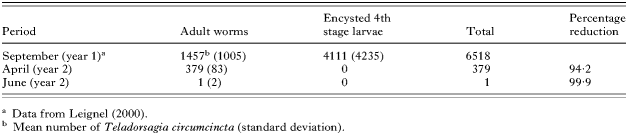
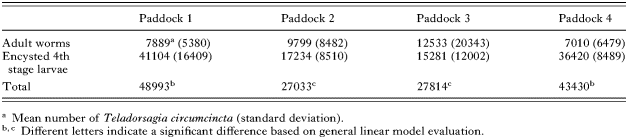
The residual infectivity of the paddocks and the impact of using the grass after the winter of year 1 were investigated using 40 lambs that were kept indoors (during year 2) and fed with hay cut from each of the paddocks that had been stored for 8 months. The worm counts were all zero. Worm counts from tracer lambs determined in April and June are summarized in Table 1. Winter eliminated 97% of the T. circumcincta infective larvae, and cutting and processing the grass in July eliminated 99·9% of the residual infective larvae. Worm counts from tracer lambs that were allowed to graze for 2 weeks in September (year 2) are summarized in Table 2. Very high numbers of worms were observed in all the paddocks: the synthetic T. circumcincta strain was successfully seeded in paddocks by seeders/permanent lambs. A large number of larvae were encysted in the mucosa.


Genotyping of T. circumcincta from susceptible parental strains
Two BZ-susceptible strains, SuBou and SuLel, were crossed to generate the synthetic BZ-susceptible strain. Genotyping of 188 SuLel T. circumcincta worms indicated that 5 individuals were heterozygotes (Sr), and the other 183 were susceptible homozygotes (SS), corresponding to an allele resistance frequency of less than 1%. Genotyping of 105 SuBou T. circumcincta worms, indicated that 100% were susceptible homozygotes (SS).
Evaluation of the BZ resistance of the T. circumcincta strain after substitution
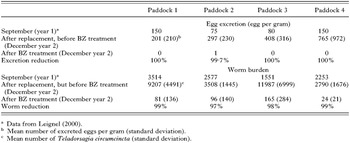
At the end of the experiment, the mean faecal egg counts of permanent lambs ranged from 201 to 765 eggs per gram of faeces (epg) depending on the paddock grazed (Table 3). After BZ treatment of 5–6 lambs in each paddock at the end of the grazing season, the faecal egg counts were reduced by 96·4–100%, indicating that the T. circumcincta populations present after the substitution were indeed susceptible to BZ (Table 3). This susceptibility was further confirmed by the reduction in the numbers of adult worms in the treated permanent lambs (Table 3).

The in vitro test for BZ susceptibility indicated that the T. circumcincta populations present in all 4 paddocks at the end of the experiment were all clearly BZ susceptible (Table 4). The phenotypic susceptibility of the population from paddock 2 was less evident. However, genotypic characterization of individual worms recovered when the permanent lambs were necropsied showed that BZ-resistant worms constituted only 1%, 0%, 0% and 3% of the population in paddocks 1, 2, 3 and 4, respectively (Table 5).


DISCUSSION
The detection of increasing numbers of nematode populations resistant to the 3 main types of anthelmintics (Kaplan, 2004), and the absence of reversion to anthelmintic susceptibility (Borgsteede and Duyn, 1989; Leignel, 2000) have suggested that it could be worthwhile trying to replace anthelmintic-resistant populations by susceptible populations. Four previous studies investigated the feasibility of replacing nematode populations or communities that are resistant to anthelmintics by substitution or dilution (Bird et al. 2001; Sissay et al. 2006; Wyk and van Schalkwyk, 1990). The main shortcoming of these studies was the poor sensitivity of the methods used to determine anthelmintic resistance after the substitution: FECRT has low sensitivity to resistance levels as low as 25%, and the relationships between egg counts and worm burdens are not reliable when highly fertile species, such as Haemonchus sp., are present in the community as was the case in these studies. In this study, we replaced a BZ-resistant population by a synthetic strain of T. circumcincta shown to be susceptible to BZ. Our strategy relied on withdrawing the ruminants from the pasture during winter, and on cutting the grass (which was then stored as bales) to eliminate any residual infectivity in the pastures. Unlike other studies carried out under tropical conditions (Bird et al. 2001; Sissay et al. 2006; Wyk and van Schalkwyk, 1990), where safe pastures could be expected after 8–10 weeks without grazing (Aumont and Gruner, 1989), in this study, the absence of pasture infectivity was ensured by delaying turnout and by a subsequent cut of the grass. The bales were used as fodder, and no infection was recorded in the lambs. The paddocks were grazed in spring by tracer lambs, and they were virtually infestation-free during the period preceding grass cutting. Ruminants are currently withdrawn from pasture in cool temperate areas: in Southern France and in the Limousin region, pastures are not grazed for 2–5 months during cooler seasons (see Hubert et al. 1978; Silvestre et al. 2000). Our proposed substitution strategy could be easily incorporated into intensive ruminant management programmes. T. circumcincta is particularly well adapted to winter conditions (Kerboeuf, 1985), and survives low temperatures better than other parasitic nematode species (Haemonchus sp. or Trichostrongylus sp.) (Rossanigo and Gruner, 1995). This means that withdrawing sheep from pasture during winter should be even more effective in reducing infestation of pastures by Haemonchus sp. and Trichostrongylus sp., the other two main genera of parasitic nematodes in temperate areas.
Phenotypic and genotypic evaluations of the BZ resistance indicated that we had successfully introduced the susceptible strain in all 4 paddocks, even when the initial level of BZ resistance had been high (89% of nematodes resistant in paddock 4). The local T. circumcincta population initially present in the paddocks was investigated (Elard et al. 1999), and the level of BZ resistance, characterized by the LD50, was consistent with the proportion of homozygous Tyr200 mutants on the β-tubulin gene. Although cytochrome P450 (Benchaoui and McKellar, 1996), P-glycoprotein (Kerboeuf et al. 2003; Kwa et al. 1998) and mutations other than that of Tyr200 on the β-tubulin gene (Silvestre and Cabaret, 2002) may have contributed to BZ resistance, the Tyr200 mutation was the main mechanism found in the local T. circumcincta population initially present in paddocks.
After substitution, we found 1% and 3% BZ-resistant T. circumcincta in paddocks 1 and 4, respectively, which corresponded to 19% and 23% frequency of resistant alleles, respectively. There are 2 possible explanations for this: either the pastures were still harbouring residual infectivity when the permanent lambs were put out to graze, or the synthetic strain introduced did in fact contain a very small number of resistant nematodes. The presence of resistant nematodes in the parental strain SuLel is very unlikely: BZ selection had been applied over 10 generations to the SuLel strain to try to select resistant nematodes without any success (the LD50 of the 10th generation was 0·05 μg/ml thiabendazole, (Elard, 1998)). Individual genotyping indicated that the parental strains, SuLel and SuBou, harboured less than 1% of the BZ-resistant allele. This proportion was considerably lower than the 19% and 23% values found after the substitution. Coles and Stafford (2000) have already voiced their suspicions that anthelmintic-resistant T. circumcincta larvae can be transmitted via hay. In the present study, hay consumption did not lead to infection of the lambs. The way the hay was processed could account for this discrepancy. The website (http://www.indre-et-loire.chambagri.fr/Agriculture/index.php, consulted in July 2006) indicated that the prevailing weather at the time of the experiment was optimal for T. circumcincta development: the mean rainfall was 72 mm/month and the mean temperature was 12 °C, suggesting that even though paddock infectivity was dramatically reduced by eliminating grazing and cutting the grass, a very small fraction of the BZ-resistant nematodes initially present had probably survived. After the substitution, the proportion of worms remaining after treatment was equal to or less than 3%, which is that commonly observed in susceptible populations. Efficacy is generally considered to be excellent if it eliminates 95% of the worms. If the seeder/permanent sheep were treated with fenbendazole, the efficacy either remained the same (no resistant allele) or fell (if even a small percentage of resistant worms was still present). Phenotypic methods could not establish the origin of the resistant alleles: had they been ‘hidden’ in the susceptible population or had they arisen from a few resistant larvae remaining on the pasture?
If substitution is to be attempted under field conditions, its feasibility will rely in part on the availability of collections of local susceptible populations, or at least of collections taken from a large number of geographical sites to ensure the greatest possible biological diversity and to limit founder effects (Hawley et al. 2006). It is not easy to introduce new nematodes onto a farm: there is a risk of introducing associated pathogens, although little information is available and what there is tends to suggest that co-infection does not in fact occur (Gruner et al. 2004). In the present study, we used a local synthetic strain of T. circumcincta. Possible differences in the fitness of nematodes in the synthetic strain could lead to a diversity of life traits, such as the establishment of infective larvae and the fertility of the females for instance. This diversity could be expected to increase the rate of successful establishment of the newly introduced strain, and so in the success of the substitution. However, long-term experiments are required before we can evaluate the stability of the species introduced, and the impact of other factors (such as anthelmintic treatment, for instance) in order to assess the response to selection.
The next step would be to monitor the kinetics of the newly-established susceptible strain, and so to find out whether anthelmintic treatments will remain effective for a long time if BZ treatments are used again. Minimal fitness costs seem to be associated with BZ resistance in T. circumcincta (Elard et al. 1998). BZ treatments should be avoided for at least 2 years after substitution, in order to favour genetic drift, and to allow the nematode population to shed any remaining resistant alleles (Gaba et al. 2006). The substitution strategy involves a rather laborious protocol, but should be considered when multi-drug resistance emerges. When double-resistant nematodes are present, worm-free lambs used as seeder lambs can be obtained after treatment with 3 groups of anthelmintic drugs (benzimidazoles, avermectins and levamisole), and carefully checking the effectiveness of the treatment. When nematodes displaying triple resistance are already present, a narrow-spectrum anthelmintic may be used (such as closantel against H. contortus), but in most cases worm-free lambs should be brought in from another farm, and treated as described above. The choice of the critical threshold of anthelmintic resistance should be based on considerations of animal welfare and loss of productivity (Wyk and Malan, 1988).
M. N. Moussavou-Boussougou was financially supported by the Gabon Ministry of Public Health. The European STREP Program, (Parasol) financed part of the worm genotyping work. The authors gratefully acknowledge information about the previous use and infection of pastures kindly provided by V. Leignel. The English text was checked by Monika Ghosh.