


Introduction
Type 1 diabetes is a condition that requires life-long, complex, and dedicated self-management (Fisher et al., Reference Fisher, Hessler, Polonsky, Masharani, Guzman, Bowyer and Wu2018). The negative emotional and psychosocial impact from living with diabetes is often referred to as diabetes distress (Balfe et al., Reference Balfe, Doyle, Smith, Sreenan, Brugha, Hevey and Conroy2013; Fisher et al., Reference Fisher, Gonzalez and Polonsky2014; Pallayova and Taheri, Reference Pallayova and Taheri2014). Forty-two per cent of adults living with type 1 diabetes have experienced diabetes distress at some point in their lives (Fisher et al., Reference Fisher, Hessler, Polonsky, Strycker, Masharani and Peters2016a, Reference Fisher, Hessler, Polonsky, Masharani, Peters, Blumer and Strycker2016b). Furthermore, it is well documented that individuals with type 1 diabetes have higher rates of co-morbid mental health conditions compared with those without diabetes (Cooper et al., Reference Cooper, Lin, Alvares, De Klerk, Jones and Davis2017; Ducat et al., Reference Ducat, Philipson and Anderson2014; Rotella and Mannucci, Reference Rotella and Mannucci2013). The co-occurrence of diabetes distress and mental health conditions exacerbates difficulties in diabetes self-management (Gonzalez et al., Reference Gonzalez, Safren, Delahanty, Cagliero, Wexler, Meigs and Grant2008), for example challenges with the management of blood glucose levels (Van Bastelaar et al., Reference Van Bastelaar, Pouwer, Geelhoed-Duijvestijn, Tack, Bazelmans, Beekman and Snoek2010; Cooper et al., Reference Cooper, Lin, Alvares, De Klerk, Jones and Davis2017). Furthermore, co-morbid diabetes and depression has been linked to increased secondary diabetes complications such as retinopathy and neuropathy (de Groot et al., Reference de Groot, Anderson, Freedland, Clouse and Lustman2001), and a greater mortality rate (Black et al., Reference Black, Markides and Ray2003). Indeed, Kinder et al. (Reference Kinder, Kamarck, Baum and Orchard2002) found that, among people who had childhood-onset type 1 diabetes, those with fewest depressive symptoms were the least likely to develop coronary heart disease over a 10-year longitudinal period.
The negative impact of co-morbid mental health problems on diabetes management increases healthcare costs (Bosmans and Adriaanse, Reference Bosmans and Adriaanse2012; Egede et al., Reference Egede, Gebregziabher, Zhao, Dismuke, Walker, Hunt and Axon2015). A meta-analysis of 27 studies demonstrated that for individuals with diabetes, those with co-morbid depression have more hospitalisations, and emergency department and out-patient visits (Hutter et al., Reference Hutter, Schnurr and Baumeister2010). Additionally, people with type 1 diabetes with a history of mental health consultations have higher rates of diabetes-related hospitalisations (Shulman et al., Reference Shulman, Luo and Shah2018).
Evidence suggests that integrating mental and physical health care can substantially improve outcomes and reduce healthcare burden related to co-morbidity (Naylor et al., Reference Naylor, Das, Ross, Honeyman, Thompson and Gilburt2016). Accordingly, the National Institute for Health and Care Excellence (NICE) guidelines for the management of type 1 diabetes recommend a referral to mental health services for the consideration of psychological wellbeing in the formulation of care plans for individuals whose psychological co-morbidities interfere with diabetes self-management (NICE guideline NG17; National Institute for Health and Care Excellence, 2022). This illustrates the importance of holistic care and co-ordination between different services in the management of type 1 diabetes. Despite this, access to appropriate psychological support for people living with type 1 diabetes has traditionally been a missing component of NHS care (All Wales Diabetes Implementation Group, 2022). This could be due to the poor identification of mental health difficulties in diabetes (Hermanns et al., Reference Hermanns, Kulzer, Krichbaum, Kubiak and Haak2006); however, we also know that support is the hardest to access when a person is experiencing mental health difficulties directly related to living with diabetes (All Wales Diabetes Implementation Group, 2022).
Psychological needs of people living with type 1 diabetes
People living with type 1 diabetes may experience a range of psychological difficulties. This may include diabetes-related distress (the experience of emotions including stress, guilt, or denial arising from living with diabetes and the burden of self-management; Kreider, Reference Kreider2017; Fisher et al., Reference Fisher, Gonzalez and Polonsky2014), difficulties relating to coping with and adjusting to a new type 1 diabetes diagnosis, fear of hypoglycaemia, hyperglycaemia aversion, concerns surrounding body image or the manipulation of insulin to manage weight, or as a self-harming behaviour. Difficulties may also include depression, anxiety, post-traumatic stress disorder, or severe and enduring mental health problems. Interventions for this range of psychological difficulties may be provided by several different services within an NHS Trust. These may consist of primary care services offering interventions focusing on depression/anxiety (e.g. NHS Talking Therapies), secondary mental health services, or a diabetes specialist psychologist, e.g. clinical health psychologist, as part of the diabetes multi-disciplinary team (MDT).
Talking Therapies for long-term conditions (LTCs)
NHS Talking Therapies for anxiety and depression services (NHS TT), formerly known as Improving Access to Psychological Therapies (IAPT) were designed to provide first-line evidence-based psychological therapies for depression and anxiety. Interventions within NHS TT services include Step 2 low-intensity interventions (e.g. guided self-help, psycho-education groups and digitally enabled therapy) and Step 3 high-intensity interventions (e.g. CBT, interpersonal psychotherapy (IPT), and counselling for depression). In line with the 5 Year Forward View for Mental Health objective to integrate physical and mental healthcare services (NHS England, 2016), IAPT-LTC guidance (National Collaborating Centre for Mental Health, 2018) focuses on the way in which pathways and interventions are adapted for people living with long-term health conditions. It is understood that the distress experienced in a primary mental health disorder such as anxiety or depression differs significantly from the distress experienced as part of a long-term health condition (Carroll et al., Reference Carroll, Moon, Hudson, Hulme and Moss-Morris2022; Hudson and Moss-Morris, Reference Hudson and Moss-Morris2019). It is therefore proposed that treatments designed predominantly for mental health do not adequately address the unique context of living with a long-term health condition (Hudson & Moss-Morris, Reference Hudson and Moss-Morris2019; Lustman and Clouse, Reference Lustman and Clouse2002). Adapting cognitive behavioural therapy (CBT) to include illness-specific beliefs and behaviours such as self-management components, as well as consideration of the bi-directional relationship between physical and mental health, can improve treatment efficacy over standard CBT protocols (Barker et al., Reference Barker, Atkins and de Lusignan2016; Cole and Vaughan, Reference Cole and Vaughan2005; Farrand and Woodford, Reference Farrand and Woodford2015; Hind et al., Reference Hind, O’Cathain, Cooper, Parry, Isaac, Rose and Sharrack2010; Nobis et al., Reference Nobis, Lehr, Ebert, Baumeister, Snoek, Riper and Berking2015; Wroe et al., Reference Wroe, Rennie, Sollesse, Chapman and Hassy2018). To facilitate such adaptations, clinicians in NHS TT services are provided with LTC ‘top-up training’ to develop the necessary competences in adapting the interventions focusing on depression and anxiety, to support people living with LTCs, such as diabetes (University College London, n.d.).
Treatment with a diabetes psychologist (as part of a diabetes MDT)
In comparison, a diabetes specialist psychologist working as part of the diabetes MDT offers psychological interventions specifically focused on living with diabetes. A psychologist working as part of a diabetes MDT is required to have specialised knowledge (e.g. understanding the aetiology and epidemiology of diabetes and the symptoms of glucose fluctuations), to work as part of a team and provide advice (e.g. participate in referral meetings), to conduct assessments (e.g. employing diabetes-specific diagnostic tools) and the ability to complete specialised psychotherapy (e.g. integrating diabetes-related issues into psychotherapeutic approaches) (Bratcher and Bello, Reference Bratcher and Bello2011; Snoek et al., Reference Snoek, Anarte-Ortiz, Anderbro, Cyranka, Hendrieckx, Hermanns, Indelicato, McGuire, Mocan, Nefs, Polonsky, Stewar and Vallis2024). It is such specialism in diabetes and their integral role within the diabetes MDT that allows for safe and effective treatment of diabetes-specific psychological issues. This may include (but is not limited to) complex diabetes distress (see Pallayova and Taheri, Reference Pallayova and Taheri2014), difficulty adjusting to diabetes diagnosis and/or secondary complications from diabetes, coping with medical regimes, concerns surrounding body image or the misuse of insulin to manage weight and negative impact of diabetes on interpersonal relationships, as well as indirect work with the MDT. Despite this, specialist diabetes psychology support is often missing within NHS Trusts, demonstrating that investment in this area is crucial (Stewart, Reference Stewart2021; Sachar et al., Reference Sachar, Breslin and Ng2023).
The current challenge
Given the range of mental health presentations, it is evident that people living with type 1 diabetes may contact and access several different services. To provide the most effective care, it is crucial that individuals are offered the most appropriate service for their clinical presentation and needs. However, this can be extremely difficult and is a very real challenge faced by disjointed NHS services. In response to this challenge, the Centre for Mental Health was commissioned by the NHS Confederation in 2022 to produce a plan of action for mental health services over the next 10 years. A key theme in this plan was of ‘No Wrong Door’, ensuring people are connected to the right type of support, no matter their starting point or what service they access first. Locally, the Community Mental Health Transformation Programme has implemented this by connecting all services into one clear mental health offer, a key part of which is making referrals and assessments more efficient. For example, a single, trusted assessment can identify the right pathway for people and build a care package around what they want and need. The goal is to improve patient experience, avoiding the need for repetition at multiple assessments and hopefully results in better outcomes.
Within the published IAPT-LTC guidance (2018), detail was given as to the role of NHS TT as part of the care pathway for people living with co-morbid depression and anxiety disorders and long-term health conditions. This highlighted the importance of linking with specialist services and in decision making regarding care pathways. This is consistent with guidance by Diabetes UK (2019), which noted the importance of making referrals to mental health services where required. However, there is currently little systematic guidance as to which is the most appropriate service for different mental health presentations seen in people with type 1 diabetes.
Scope and aims of the project
Within the local area, currently in development is a new type 1 diabetes psychology service that is located within the acute hospital and integrated within the diabetes MDT. Until this point, people living with type 1 diabetes were solely offered mental health interventions such as NHS TT. The scope of this service evaluation is to produce an evidence-based tool to be used by practising clinicians to assist in decision-making regarding treatment pathways for people living with type 1 diabetes who are presenting with co-morbid psychological difficulties. This tool could then be used collaboratively between the diabetes psychology service and NHS TT with the aim of offering the most appropriate service. The tool discussed in this paper relates to care planning between diabetes psychology and NHS TT, although it is recognised that people living with type 1 diabetes may also access other mental health services. Creating and evaluating this tool will provide a valuable contribution to the implementation of the new national ‘No Wrong Door’ initiative and trusted assessment process.
Method
Stage 1: Consultancy project
To detail the current challenge and assist in the development of the Diabetes Presentation Classification Tool, a consultancy project was completed within the local area to understand how NHS TT and diabetes specialist psychology teams work together to offer care to people with type 1 diabetes in distress. The aims of this scoping work were twofold: (1) to understand current local triage processes (including the questions currently asked by healthcare professionals), and (2) to recognise the local need (e.g. number of referrals to NHS TT with concerns related to type 1 diabetes).
The scoping project employed a mixed methods approach. Initially, six informal interviews were conducted with key stakeholders from both the local Talking Therapies (TT) service and the diabetes team. Participants included a clinical health psychologist, the LTC clinical service manager within TT, the Step 2 and Step 3 TT LTC Pathway Leads, and diabetes specialist nurses. The primary objective was to gain insight into current triage processes for individuals living with type 1 diabetes, as well as to explore the perceived need for relevant services. In addition, email enquiries were sent to other TT and Clinical Health Psychology services in neighbouring Trusts to gather further context. The subsequent phase of the consultancy project involved an audit of TT referral data to assess how many people with type 1 diabetes were accessing the service.
A prominent theme emerging from the qualitative interviews was the ambiguity surrounding the appropriateness of clinical presentations for specific services, alongside uncertainty regarding the criteria or questions required to assess referral suitability. Although participants demonstrated a general understanding of referral processes within their own services, there was markedly less clarity concerning the referral pathways between TT and specialist services. Subsequent analysis of TT audit data revealed that 209 referrals involving individuals living with type 1 diabetes were discharged in 2022. Notably, engagement levels among this cohort were low: only 13.9% were recorded by their assigned clinician as having ‘completed treatment’, while 41.2% either disengaged prior to initiating treatment or discontinued part way through.
One of the key conclusions of the consultancy project was the need to establish regular referral meetings between TT and specialist services (e.g. the diabetes psychologist). Additionally, there was a clear recommendation to develop guidance and training aimed at enhancing the identification of psychological needs and appropriate clinical presentations among individuals with type 1 diabetes. Further details of the consultancy project are provided in the Supplementary material.
Stage 2: Development of tool to classify presentation
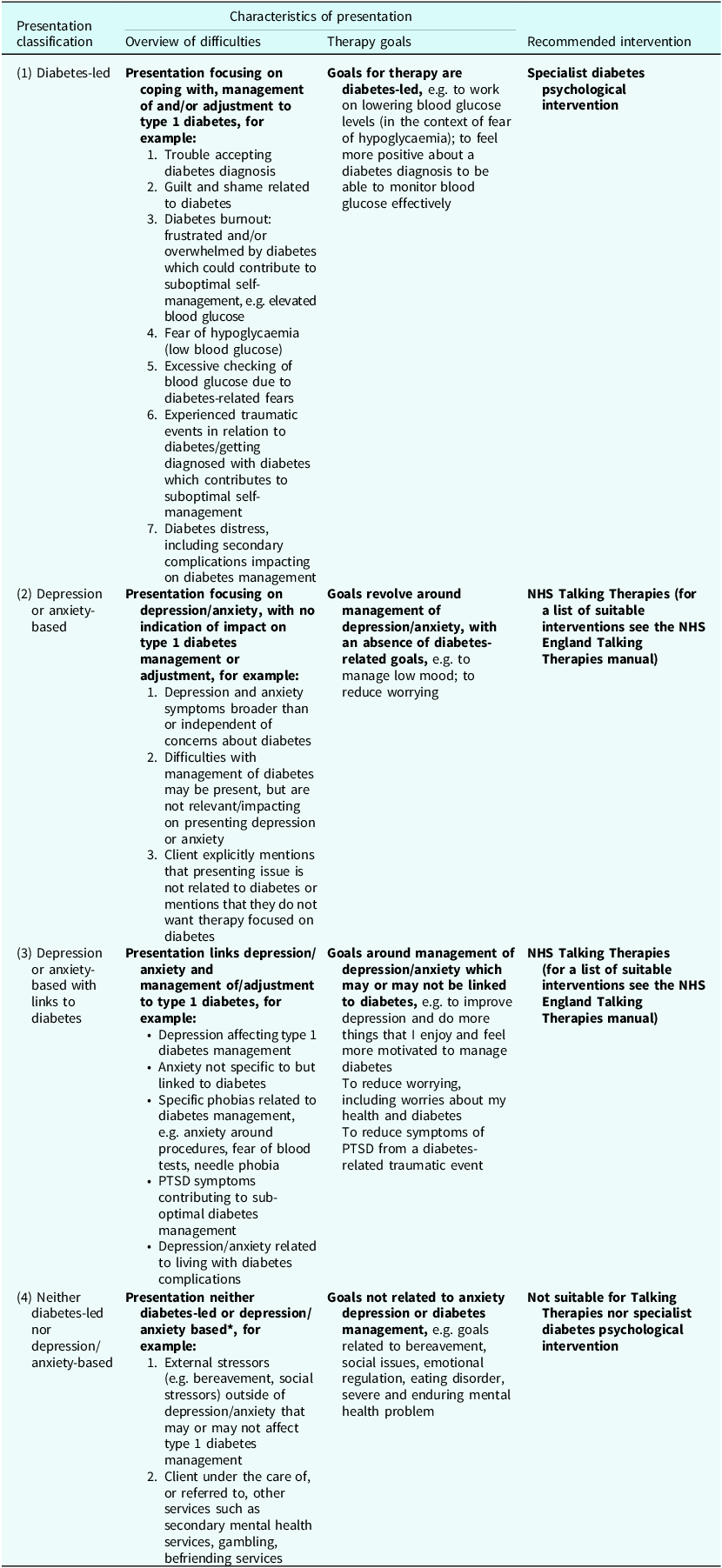
Following consultancy, the Diabetes Presentation Classification Tool (Table 1) was developed to assist in deciding the most suitable treatment pathway for people with type 1 diabetes, using information typically collected during a first clinical assessment.
Diabetes Presentation Classification Tool

Incorporating validated measures of diabetes-related distress such as the Diabetes Distress Scale (DDS; Polonsky et al., Reference Polonsky, Fisher, Earles, Dudl, Lees, Mullan and Jackson2005) or the Problem Areas in Diabetes Scale (PAID; Welch et al., Reference Welch, Jacobson and Polonsky1997) is strongly recommended as part of the assessment process. These tools include targeted questions that address key emotional and psychological challenges, such as ‘Not feeling motivated to keep up my diabetes self-management’ or rating the extent to which diabetes-specific issues, like ‘Not accepting your diabetes’, are problematic. Furthermore, in instances where social circumstances significantly impede meaningful engagement or hinder the effectiveness of psychological interventions, the services exercise caution and sensitivity when addressing ineligibility. In such cases, referrals to appropriate external support services are made, while also considering the integration of existing internal practical support services alongside psychological work.
The ‘Characteristics of Diabetes Presentation’ section within the tool is designed to guide assessors to identify whether a person with diabetes difficulties has a presentation which is: (1) diabetes-led, (2) depression or anxiety-based, (3) depression or anxiety-based with links to diabetes, or (4) neither diabetes-led nor depression/anxiety-based. The output of the classification tool is a suggestion of the most appropriate service with either an intervention with NHS TT, a diabetes psychologist as part of the diabetes MDT, or neither treatment accordingly. If the outcome is inconclusive then it is recommended for the clinician to seek further supervision, ideally in the form of an integrated referral meeting. Presentations 2 and 3 (depression or anxiety-based with or without links to diabetes) are both suited to a treatment intervention within NHS TT. However, for the purposes of this service evaluation, these presentations are separated to explore if clinical outcomes differed between these two groups.
The tool was initially drafted based on the expert consensus between a senior clinical health psychologist from NHS TT and a specialist diabetes psychologist as part of the diabetes MDT. To maximise internal reliability and clinical validity, five members of the research team, including the two clinical health psychologists, individually ascribed people presenting to the service with type 1 diabetes to one of the four presentation classifications. Disagreements were discussed by the two senior clinical health psychologists until an agreement was reached, and wording of the tool was refined accordingly. The final Fleiss’ kappa inter-rater reliability score for the coding of presentations was 75%.
Dataset
The dataset used to develop the tool was of people with self-reported type 1 diabetes who were discharged from an NHS TT service between 1 January 2022 and 31 December 2022. The dataset included sociodemographic information and clinical variables that were collected routinely for clinical use and performance reporting to NHS Digital. As such, verbal consent was provided by people accessing the NHS TT service for their data to be shared with NHS Digital, and this consent was recorded on file. Additionally, this dataset included self-reported information of each person’s therapy goals, presenting difficulties, and management of long-term condition(s), which were collected during their first assessment with NHS TT. People with type 1 diabetes were included in the dataset if they had attended at least two clinical sessions. Referrals with no first assessment recorded were excluded, as key variables of interest had not been collected. For people with more than one referral within the same defined period, only data from their most recent referral were included. This study was registered as a service evaluation project with the Clinical Audit department in the NHS Foundation Trust of the services.
Outcome measures
As is standard in NHS TT, routine outcome measures are collected and calculated to determine whether someone has entered recovery. The routine outcome measures, or the ‘Minimum Dataset’ (MDS), consist of the Patient Health Questionnaire-9 (PHQ-9; Kroenke et al., Reference Kroenke, Spitzer and Williams2001), the Generalised-Anxiety-Disorder-7 (GAD-7; Spitzer et al., Reference Spitzer, Kroenke, Williams and Löwe2006), and the Work and Social Adjustment Scale (WSAS; Mundt et al., Reference Mundt, Marks, Shear and Greist2002). NHS TT define recovery as the proportion of clients for whom their scores on the above self-report measures move from above to below clinical cut-off scores. Services work to achieve key performance indicators (KPIs) with a target of 50% of people reaching recovery, 64% reliably improved and 48% reliable recovered. Further detail of these recovery rate calculations can be found in the National TT manual (NHS, 2018). Within NHS TT the clinical cut-off score used for PHQ-9 is ≥10, and for GAD-7 is ≥8 (NHS Talking Therapies for anxiety and depression manual; NHS, 2018).
Analysis plan
Reliability of the Diabetes Presentation Classification Tool was assessed using the Fleiss’ kappa inter-rater reliability score (Fleiss et al., Reference Fleiss, Levin and Paik1981). Demographic and clinical differences between different classification groups were analysed using chi-square test for categorical variables, and one-way ANOVA for continuous variables. Recovery, reliable improvement and reliable recovery was presented as a percentage for each classification group. Data analyses were performed in R 4.2.2 and Microsoft Excel.
The Diabetes Presentation Classification Tool
See Table 1.
Results
Classification groups
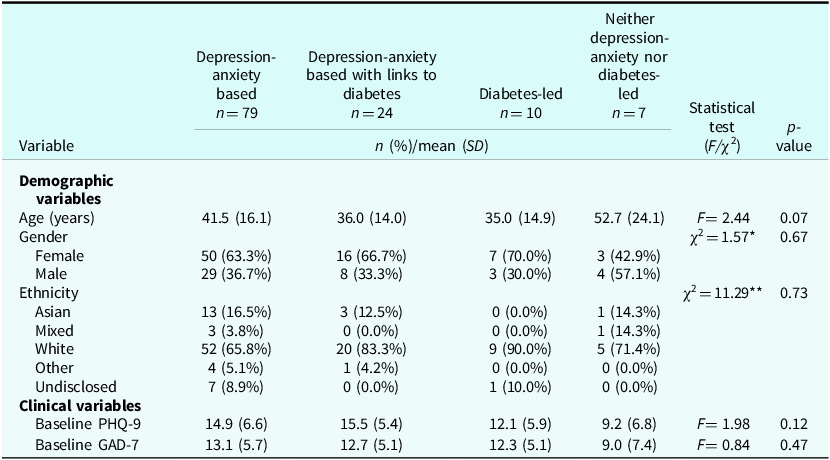
A total of 120 people living with type 1 diabetes were included in the analysis; 65.8% (n=79) were classified as ‘depression-anxiety based’, 20.0% (n=24) as ‘depression-anxiety based with links to diabetes’, 8.3% (n=10) as ‘diabetes-led’, and 5.8% (n=7) as ‘neither depression-anxiety nor diabetes-led’.
The mean age was 40.5 years (SD=16.5); 63.3% (n=76) were female, and 71.7% (n=86) were of white ethnic origin. Out of 120 people, 105 had complete baseline scores. Average pre-treatment PHQ-9 score was 14.5 (SD=6.4), and average pre-treatment GAD-7 score was 12.7 (SD=5.6); 77.1% (n=81) of the 105 people were above clinical threshold for PHQ-9 and GAD-7.
There were no other statistically significant differences across classification groups (see Table 2).
Association between demographic and clinical outcomes with type 1 diabetes presentation

Categorical variables were analysed using chi-square test, and continuous variables were analysed using one-way ANOVA. *Three cells have expected values <5. **Several cells have values of 0. The chi-square results were included for reference, but it should be noted that the sample size is too small to draw reliable interpretations on group differences in distribution of gender and ethnicity.
Differences in outcomes between classification groups
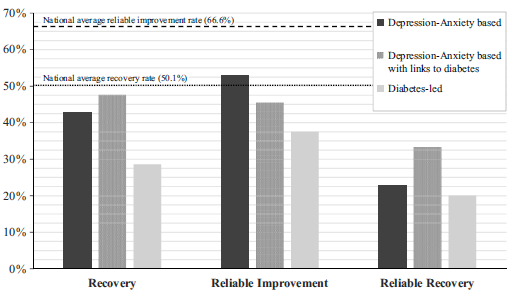
Seventy-seven people in the sample had a recovery outcome (see Fig. 1). Those in the ‘diabetes-led’ group had the lowest recovery rate out of the three groups (28.6%) and those in the ‘depression-anxiety based with links to diabetes’ group had the highest recovery rate (47.6%). All groups, regardless of classification, had a lower recovery rate compared with the NHS TT national recovery rate in 2022 of 50.1% (NHS Digital, 2022).
Outcome rates across classification groups. The ‘neither depression-anxiety nor diabetes-led’ classification group is not presented here as no patients in this group had outcome measures. In 2024–25, services are working towards achieving a target of 67% reliably improved and 48% reliable recovered.

Eighty-one people in the sample had a reliable change outcome (see Fig. 1). Those in the ‘diabetes-led’ group had the lowest reliable improvement rate out of the three groups (37.5%), whilst people in the ‘depression-anxiety based’ group showed the highest rate of reliable improvement (52.9%). Again, all groups had a lower reliable improvement rate than the NHS TT national reliable improvement rate in 2022 of 66.6% (NHS Digital, 2022).
Everyone in the sample had a reliable recovery outcome. The ‘diabetes-led’ group had the lowest reliable recovery rate (20.0%), whilst the ‘depression-anxiety based with links to diabetes’ group had the highest (33.3%).
Discussion
This study has introduced a new Diabetes Presentation Classification Tool to aid clinical decision making for people living with co-morbid type 1 diabetes and mental health difficulties.
The completion of initial consultancy work in the local area identified poor engagement for people with type 1 diabetes when accessing support for their mental health from NHS TT services. Only 13.9% of people were classified by their allocated clinician as completing treatment, highlighting high rates of unscheduled drop-out in this group. This appears to be the first published data from NHS TT services relating specifically to treatment engagement amongst people living with type 1 diabetes. However, NHS TT openly accessible data (reported monthly to NHS Digital) found that services nationally (all referrals) reached an average of 50.7% completing treatment in the last quarter of 2021–2022. Therefore, the suggested reduced engagement for people with type 1 diabetes, combined with feedback from key NHS stakeholders highlighted an urgent need to improve and develop guidance for psychology pathways for people living with type 1 diabetes.
A large majority of people (85.8%) in our sample fell within the category of a depression-anxiety based presentation (with or without a link to diabetes), with 8% determined to have a diabetes-led clinical presentation. Although to be expected within an NHS TT service, the relatively low proportion of people with a diabetes-led presentation could reflect difficulties in assessing for this presentation and the competencies required (see Snoek et al., Reference Snoek, Anarte-Ortiz, Anderbro, Cyranka, Hendrieckx, Hermanns, Indelicato, McGuire, Mocan, Nefs, Polonsky, Stewar and Vallis2024; Carroll et al., Reference Carroll, Moss-Morris, Hulme and Hudson2021). Furthermore, Naylor et al. (Reference Naylor, Das, Ross, Honeyman, Thompson and Gilburt2016) have discussed the likely barriers at play which can result in a disconnection of physical and mental health symptoms during healthcare appointments. Factors include time constraints, the skills and confidence of professionals, the language used, habitual ways of understanding roles, and services taking reactive as opposed to proactive attitudes. It is also important to consider that outcome measures specifically designed to assess diabetes distress are not routinely used during clinical assessments within NHS TT settings. Notably, Fisher et al. (Reference Fisher, Hessler, Polonsky, Masharani, Peters, Blumer and Strycker2016b) found that relying solely on the PHQ-9 in individuals with type 1 diabetes can result in a high false positive rate for depression. Therefore, it is possible that the actual prevalence of diabetes distress and diabetes-led presentations within the presenting sample was significantly higher than reported – although current primary care assessment tools and processes are not designed or delivered in a way to identify this.
This paper has examined the recovery outcomes of different clinical presentations. The poorest recovery rate was amongst people with a diabetes-led presentation (28.6%) compared with people with depression-anxiety based presentations with and without links to diabetes (47.6% and 42.9%, respectively). This supports the use of the Diabetes Presentation Classification Tool as it can be predicted that the group with a diabetes-led presentation may have benefited more from access to and support from a specialist diabetes psychological intervention. This supports Stewart (Reference Stewart2021), who recognised the unmet clinical need of people living with type 1 diabetes who require tailored, effective management of their psychological difficulties.
Interestingly, however, regardless of presentation, all people living with type 1 diabetes (depression-anxiety based and diabetes-led) had recovery rates below the national NHS TT target of 50%. This is in line with previous research suggesting poorer clinical outcomes in people with long-term conditions (Ewbank et al., Reference Ewbank, Cummins, Tablan, Bateup, Catarino, Martin and Blackwell2020; Gill, Reference Gill2017; Seaton et al., Reference Seaton, Moss-Morris, Norton, Hulme and Hudson2022; Wakefield et al., Reference Wakefield, Kellett, Simmonds-Buckley, Stockton, Bradbury and Delgadillo2021). Hence, not only is there a need to improve decision guidance following assessment and links with specialist diabetes teams, but there is suggestion of a need to further improve LTC-adapted interventions within NHS TT to better meet the needs of people living with diabetes.
In the dataset, there was a higher recovery rate for people with a depression-anxiety based presentation with links to diabetes (classification 3) than for people with a depression-anxiety based presentation (classification 2). This could be because people who have more self-awareness about the link between their physical health and mental health, are more likely to get the help they need within treatment. Furthermore, this may reflect the clinician’s ability – both during assessment and treatment – to comprehensively formulate and explore the connections between a client’s physical and mental health. This corroborates literature regarding the importance of holistic treatment and clinicians using their skills to adapt treatment interventions and formulations to draw links between someone’s long-term condition and mental health difficulties (e.g. Barker et al., Reference Barker, Atkins and de Lusignan2016; Cole and Vaughan, Reference Cole and Vaughan2005; Farrand and Woodford, Reference Farrand and Woodford2015; Hind et al., Reference Hind, O’Cathain, Cooper, Parry, Isaac, Rose and Sharrack2010; Nobis et al., Reference Nobis, Lehr, Ebert, Baumeister, Snoek, Riper and Berking2015; Wroe et al., Reference Wroe, Rennie, Sollesse, Chapman and Hassy2018). Integrated treatment approaches can be effective by improving treatment acceptability and engagement (Panchal et al., Reference Panchal, Rich, Rowland, Ryan and Watts2020) and improving illness self-management behaviours (Wroe et al., Reference Wroe, Rennie, Sollesse, Chapman and Hassy2018).
The finding that people with diabetes-led presentations recover less well in NHS TT, supports the application of the Diabetes Presentation Classification Tool within clinical settings. This tool can facilitate pathway decisions, and encourage collaboration between services, allowing people to be directed to the most appropriate and best-fitting service for their needs and improve clinical outcomes. The intention is to provide a useful contribution to the implementation of the new national ‘No Wrong Door’ initiative and trusted assessment process, which strives for services to be able to make the right decision for a person more quickly, avoiding the need for multiple assessments and retelling stories to different services. It is envisioned that this tool can be used to guide assessors in many different settings, including primary care, secondary care, specialist diabetes psychology services, or indeed by other members of the diabetes MDT (e.g. diabetes nurse).
Strengths and limitations
A particular strength of this service evaluation was the extensive scoping work carried out and mixed methodology used within this to understand the needs of services in the local area (see Supplementary material). Consultation with key stakeholders allowed for a comprehensive understanding of what tools may be required to aid assessors in their clinical decision making. Furthermore, the research team of five members (including highly experienced clinical health psychologists) allowed for substantial reliability checks when coding people within the dataset. Outcomes have been tested in a real-world NHS TT site, meaning this study is high in ecological validity.
Key limitations must also be noted. Firstly, the sample size was small as there were 120 people in total with type 1 diabetes and within this sample only 10 were classified with a diabetes-led presentation. Further evaluation of the tool using a larger sample size is recommended to allow for more robust statistical results. Another limitation is that outcomes for diabetes-led presentations have not been tested if people are subsequently referred to and receive treatment from a diabetes psychologist or specialist team. Here an assumption has been made that if they do not recover well in NHS TT there would be better outcomes upon referral to a diabetes psychologist. Therefore, there is a need to further validate this assumption by testing outcomes for clinical presentations within different services, although this is often difficult in real-world naturalistic settings as routine outcome measures may not be collected. Furthermore, there is a lack of diversity in the current study’s sample, although this is a recurrent issue across all NHS TT services. Reports and studies have shown that older people and people from ethnic minorities are less likely to access services (Baker, Reference Baker2018; British Association for Behavioural and Cognitive Psychotherapies, 2019; British Association for Behavioural and Cognitive Psychotherapies, 2024). Additionally, with the use of self-reported outcome measures we acknowledge the risk of response and recall bias within the data collected. Finally, the authors would like to acknowledge the absence of direct patient and public involvement (PPI) in the development of the classification tool. While previously gathered feedback from individuals accessing NHS TT was used to inform certain aspects of the tool – such as highlighting limited awareness around long-term conditions (LTCs) and the perception that some presentations may be better suited to a specialist diabetes psychologist – this input was indirect. The authors recognise that the lack of direct PPI represents a gap in the tool’s development process.
Recommendations
A recommended next step is to consider how to best support services and assessors to ask the right questions so that the Diabetes Presentation Classification Tool can be used appropriately. The authors highly recommend the use of a validated measure of diabetes distress (e.g. the Diabetes Distress Scale, DDS (Polonsky et al., Reference Polonsky, Fisher, Earles, Dudl, Lees, Mullan and Jackson2005) or the Problem Areas in Diabetes Scale, PAID (Welch et al., Reference Welch, Jacobson and Polonsky1997)) to be used alongside standard tools in the clinical assessment of people living with type 1 diabetes. Furthermore, a formal research trial design is required to test the efficacy of this clinical decision-making tool, reviewing recovery rates and treatment engagement in primary care and specialist diabetes services after implementation of the tool. As above, it would be important for any research trial to use outcome measures specifically relating to diabetes distress to provide deeper understanding of the tool’s content and construct validity.
Key practice points
-
(1) Type 1 diabetes is often correlated with poor mental health, which in turn contributes to challenges with diabetes self-management and secondary complications.
-
(2) NHS services are increasingly required to make pathway decisions quickly and efficiently, ensuring patients are directed to the right service for their presentation and needs. However, this can be a challenge for people living with type 1 diabetes as they present with a range of mental health symptomatology (ranging from depression-anxiety based to diabetes-led presentations).
-
(3) People with a diabetes-led presentation (e.g. difficulty accepting a diagnosis, fear of hypoglycemia, diabetes burnout) have been found to recover less well following treatment in an NHS Talking Therapies setting.
-
(4) A Diabetes Presentation Classification Tool is proposed to be used by assessors and clinicians in multiple clinical settings to encourage collaboration and aid decision making.
Supplementary material
To view supplementary material for this article, please visit https://doi.org/10.1017/S1754470X25100159
Data availability statement
The data that support the findings of this study are available on request from the corresponding author. The data are not publicly available due to restrictions from NHS Talking Therapies.
Acknowledgements
None.
Author contributions
Grace Jell: Conceptualization (equal), Data curation (equal), Formal analysis (supporting), Investigation (equal), Project administration (lead), Writing - original draft (lead), Writing - review & editing (lead); Abigail Wroe: Conceptualization (lead), Data curation (equal), Formal analysis (supporting), Investigation (equal), Writing - original draft (equal), Writing - review & editing (equal); Alisha Saadiya: Data curation (lead), Formal analysis (lead), Investigation (equal), Project administration (equal), Writing - original draft (equal), Writing - review & editing (equal); Chiara Causier: Conceptualization (equal), Data curation (equal), Writing - review & editing (supporting); Elena Palmer: Conceptualization (equal), Data curation (equal), Investigation (equal), Writing - original draft (supporting), Writing - review & editing (supporting); Louisa Dosanjh: Conceptualization (equal), Data curation (equal), Formal analysis (supporting), Investigation (equal), Project administration (supporting), Writing - original draft (supporting), Writing - review & editing (supporting); Vicky McKechnie: Conceptualization (lead), Investigation (equal), Writing - original draft (equal), Writing - review & editing (equal).
Financial support
This work received no specific grant from any funding agency, commercial or not-for-profit sector.
Competing interests
There are no competing interests.
Ethical standards
The authors assert that all procedures contributing to this work comply with the ethical standards of the relevant national and institutional committees on human experimentation and with the Helsinki Declaration of 1975, and its most recent revision. Authors have also abided by the Ethical Principles of Psychologists and Code of Conduct as set out by the BABCP and BPS. Ethical approval was not needed as the article is based on clinical insight and experience.




Comments
No Comments have been published for this article.