The English founding of Jamestown, Virginia in 1607, and the rapid growth of tobacco cultivation that ensued, created a distinct relationship between tobacco and empire, between plantation and London fashions. Although James I detested the plant, the early seventeenth century saw a prolific rise in smoking that only escalated in the decades that followed.Footnote 1 While beleaguered planters in the Chesapeake learned how to cultivate tobacco from the Algonquian-speaking Powhatans on the eastern coast of North America, smoking also fuelled the social rituals of the ‘curious, costly, and consuming gallants’ in London.Footnote 2 Despite the king's best efforts to diversify industries in Virginia to discourage tobacco production, the Virginia and Somers Isles/Bermuda companies secured a monopoly on tobacco imported into England in 1624, solidifying the relationship between tobacco and English colonial aspirations.Footnote 3
Drawing on comparative anthropology and the material conditions of tobacco, this article explores the influence of Anglo-Algonquian exchange on the sociability of London gentlemen in this early moment of colonization. The social spaces of the metropolis brought tobacco out of American ecosystems and into drastically new contexts of use. Scholars have demonstrated the ubiquity of tobacco in a range of English discourses about health, medicine, and moral regulation, where men and women of all ages adopted smoking for a variety of reasons.Footnote 4 Merchants, sailors, and smugglers served as conduits for the circulation of commodities throughout the Atlantic world and helped diffuse tobacco and other goods in Europe and further east.Footnote 5 By the 1630s, tobacco had become imbedded alongside older intoxicants like alcohol in early modern societies and political economies, providing ‘the lubricant of political patronage’ and involving displays of ‘civility, privilege, subordination, and exclusion’.Footnote 6 Examining smoking and sociability in England prior to the commodity's mass consumption offers the opportunity to investigate these elements of politics, civility, and social interaction through the intimacy of cross-cultural encounter.
As Marcy Norton pointed out in her study of the assimilation of chocolate into Europe, the adoption of American goods cannot be understood solely through economic essentialism or cultural functionalism.Footnote 7 Cultural transmission and borrowing, social networks, and innovations in material practices all contributed to the ways in which non-European goods were integrated into Europeans’ value systems and daily lives.Footnote 8 Archaeological and anthropological approaches can provide clues towards how Indigenous ‘things’ were incorporated into the social rituals and masculine rites of English gentlemen, and challenge the idea that ‘ethnographic’ perspectives should be relegated solely to the beliefs and lifeways of those ‘others’ that the English encountered through colonization and trade. Michelle O'Callaghan's study of London ‘wits’, the gentlemen participants in urban convivial societies, itself contains language that lends itself to an anthropological approach. Jacobean gentlemen, O'Callaghan noted, had ‘rituals of association’ in ‘quasi-ceremonial’ spaces of interaction that imbued individuals with the ability to store ‘knowledge of shared rituals and possession of cultural artefacts, such as . . . poems and songs’.Footnote 9
The interactions between Chesapeake Algonquians and Jacobean gentlemen exhibit a broad spectrum of exchange, but also highlight the deliberate choices made by the English to set themselves apart from those whom they sought to colonize. The first section explores how Anglo-Algonquian interactions both demonstrate and complicate the narratives of ‘improvement’ presented by colonial promoters. Archaeologists’ insights into ‘artefact recontextualization’ help to expose the imperial aspirations evident in questions of taste and appropriation.Footnote 10 In the material culture of pipes and tobacco boxes, as in literature, gentlemen celebrated the power of artifice in transforming ‘savage’ or raw material through elaborate modes of interaction that allowed them to enact the notion of improvement so fundamental to early modern socio-political thought.Footnote 11 Presenting tobacco as an artefact, produced, packaged, and consumed in different ways, implies that what the English called ‘improvement’ was often shorthand for a more complicated process of modification and acculturation. The second section discusses what such acculturation meant in practical terms, where the materiality of smoking came to reflect the beliefs and concerns of gentlemen smokers. The final part considers what happened when tobacco became integrated in wit literature and urban rituals of sociability. While gentlemen did celebrate tobacco for its role in elevating the individual to the exalted realms of convivial refinement in ways that fitted into pre-existing attitudes about intoxication, the appeal of tobacco's intoxicating powers could not be extricated from the thrill of colonizing America. The function of tobacco in wit sociability reveals how pro-colonial gentlemen consciously modified and appropriated Native American practices to perpetuate distinct ideas about their own civil refinement, one enhanced by demonstrations of colonial intervention.
I
Tobacco connected metropolitan social arenas to America and the Native American groups that had gathered knowledge about its botanical properties for millennia. ‘The people of the South-parts of Virginia esteeme [tobacco] exceedingly’, noted one English writer in 1615.Footnote 12 Archaeologists have excavated pipes in North and South America that incorporated anthropomorphic and zoomorphic carvings, particularly birds, which drew connections with drug-induced ‘flights’ and their spiritual links.Footnote 13 Though Native Americans consumed tobacco largely for religious purposes, they also did so socially and for diplomatic reasons.Footnote 14 Tobacco frequently mediated early interactions between Native groups and colonists in the Chesapeake, at a time when the English often relied on Indigenous groups for their survival.Footnote 15 It is not despite but because of these shared moments of exchange that the English likely sought to differentiate themselves from those cultures they aimed to colonize. This section explores some of the ways in which English gentlemen attempted to do this, where attitudes towards the transformation of nature, and even the production and packaging of tobacco, became a means for colonial promoters to articulate the value of ‘improvement’ and providentialism.
To Elizabethan and Jacobean gentlemen, the value of civil society lay in its artificiality. Following the writings of Aristotle and Cicero, authorities viewed social organization and the subordination of what was raw or savage as a key differentiation between humans and animals. The successful conquest of human nature and the natural world made civil society possible, a concept that informed domestic ideas of authority and justified intervention in America.Footnote 16 The English subscribed heavily to the idea of ‘improvement’, a term Paul Slack argues was a pervasive feature of elite discourse in the seventeenth century, tying land and social endeavours to plantation and socio-economic change.Footnote 17 ‘Improvement’ linked policy-makers’ hopes for territorial expansion to individual virtue and the Protestant belief in divine revelation, as scripture existed ‘to teach, to improve, to correct’.Footnote 18 In 1607, Ferdinando Gorges, captain of the harbour defences in Plymouth, wrote to James's secretary of state, Robert Cecil, complaining that the idleness of the soldiers and young gentlemen imperilled the fledgling colony in Virginia.Footnote 19 Gorges insisted on industry as the solution to the colony's current failures, for it was ‘arte, and industry, that produceth [commodities], even from the farthest places of the worlde’.Footnote 20
Sustained interaction with Algonquians had revealed fundamentally different ways of viewing the world. Virginians ‘say that God in the creation did first make a woman, then a man, thirdly great maize . . . fourthly, Tobacco’.Footnote 21 Writing about his time in the short-lived Roanoke colony in the mid-1580s, Thomas Hariot noted that Algonquians ‘make hallowed fires & cast some of the pouder therein for a sacrifice . . . all done with strange gestures, stamping, sometime dauncing, clapping of hands, holding up of hands, & staring up into the heavens, uttering therewithal and chattering strange words & noises’.Footnote 22 Concerns over degeneration through smoking went beyond rhetoric to the perceived reality of savagery as a religious and moral evil, and Protestant authorities accused smokers of seeming to ‘degenerate into the nature of the Savages, because they were carried away with the self-same thing’.Footnote 23 Adopting a practice entrenched in Indigenous socio-cosmic belief created anxieties around orthodoxy and pollution that necessitated differentiation.
At the same time, tobacco was the only colonial industry that brought any significant profit to gentlemen investors in the 1610s, and policy-makers increasingly articulated its cultivation as a marker of imperial success and economic good. The crown began receiving customs and impositions from tobacco in 1619, following the expiration of the clause in the Virginia Company's charter that exempted them from customs in the early years of plantation.Footnote 24 When the outbreak of the Thirty Years’ War in 1618 raised fears of Spanish Catholicism to a fever pitch, Protestant MPs promoted tobacco as a means of supporting Virginia while curbing Spanish expansion in the Atlantic, diminishing the reliance of English consumers on Spanish exports. Edward Bennett argued in parliament in 1620 that, once Virginia was settled and more economically diverse, planters would ‘quickely finde better Commodities’. Until then, ‘to inhabite Virginia, and to draw from thence greate benefit into this Land, is nothing but prohibiting the bringing in of Spanish Tobacco’.Footnote 25 Planting colonies and establishing a sustained, Protestant presence in America became a means of legitimizing consumption by emphasizing godly industry and improvement, though bitter disputes between merchants, courtiers, and MPs over the tobacco monopoly continued into the later 1620s and 1630s.Footnote 26 The proclamation announcing James's support of American-grown tobacco in 1624 articulated the importance of granting Virginia and the Somers Isles a monopoly for the good of ‘our Empire’ – a significant shift from the king's previous, vehemently anti-tobacco rhetoric in texts such as A counterblaste to tobacco (1604), and from earlier proclamations that had supported colonial tobacco but not used the word ‘empire’.Footnote 27
The way tobacco leaves were cultivated and packaged mattered to English imperial self-fashioning. Commodities, in the words of Arjun Appadurai, have ‘social lives’ that bond them to a ‘variety of social arenas’, ones that are linked while retaining distinct contexts of use.Footnote 28 As physical entities, tobacco plants were produced in ways that related to specific geographies. Gentlemen drew distinctions between pudding/roll tobacco and cured leaves, aware of their geographic associations with either the Spanish West Indies or English North America.Footnote 29 Some ten years after Hariot's contact with Algonquians, the London poet Anthony Chute remarked that ‘it seems that the [South American] Indians use to take this Tabacco in other maner of pipes than we . . . which the Indians make of Palme leaves and such like’.Footnote 30 These wide ‘leaves’ referred to the rolled tobacco favoured by the Spanish, which English writers related to the Spanish empire but also to the longstanding practices of Indigenous groups. Tobacco, wrote one physician, was of ‘high respect among the Indians’ of South America and the Caribbean, who ‘smoak through a Cane’.Footnote 31 Since tobacco labourers on Spanish plantations, including enslaved Africans and poorer Europeans, chewed pulverized, lime-enhanced tobacco to relieve hunger and fortify their strength, chewing tobacco could be associated with manual labour or the ‘poorer sort’.Footnote 32
While the Spanish learned to consume tobacco as Mesoamericans did, in thick rolls or with reed pipes, the Indigenous groups whom the English encountered in eastern North America smoked their tobacco through right-angled clay pipes. Pipe smoking emerged, therefore, in large part from European intervention in North America. The English were aware of the importance of pipes in the Algonquians’ highly ritualized practices, where the transformation of tobacco leaves into smoke allowed tobacco's properties to elevate a person towards spiritual realms.Footnote 33 For this reason, early endorsements of tobacco from the mid-sixteenth century often praised the medicinal properties of tobacco, such as the application of leaves to body parts or diffused into hot liquids, but described the social consumption of smoking as uncivil.Footnote 34 Physicians often recommended that leaves ‘be ashed or warmed in imbers’ rather than smoked.Footnote 35
As the English began to cultivate a distinct strand of tobacco in Virginia from the mid-1610s, one that combined seeds from potent West Indies tobacco with methods of cultivation learned from the Powhatans, gentlemen began to relate tobacco to their colonial success.Footnote 36 By the 1630s, merchants were writing to Charles I complaining of the interference of the Dutch in the trade of their ‘Virginia leaf tobacco’, which they related to ‘the growth of the King's colonies’.Footnote 37 Those who endorsed English-grown tobacco in the Chesapeake or in England argued that Iberian tobacco came corrupted with artificial dyes, the product of ‘a kinde of filthy leafe, sold by the Portugalles residing in London, the same beeing made up in rolles’.Footnote 38 English merchants and members of the gentry who pursued colonial interests in parliament framed Chesapeake tobacco as a specifically English, even patriotic endeavour.
With their matrilineal societies and use of tobacco in spiritual ceremonies, Algonquian ways of life stood at odds with the patriarchal, Protestant society that English authorities sought to establish in America, so that gentlemen searched for way to ‘improve’ and transform the objects and social practices around the commodity they appropriated. While conveying them as a ‘loving’ people, Hariot also noted that Algonquians lacked ‘skill and judgement in the knowledge and use of our things . . . howe much they upon due consideration shall finde our manner of knowledges and craftes to exceede theirs in perfection’.Footnote 39 This was evident in Edward Waterhouse's description of the colonist George Thorpe's attempts to change the Algonquian built environment. Whereas the paramount ruler Wahunsenacah (Powhatan) ‘dwelt onely in a cottage, or rather a denne or hog-style . . . covered with mats after their wyld manner’, Waterhouse wrote, ‘to civilize him, [Thorpe] first, built him a fayre house according to the English fashion, in which hee tooke such joy, especially in his locke and key, which he so admired, as locking and blocking his doore an hundred times a day’.Footnote 40
An account circulating in Wampanoag oral history may suggest that the English sought to ‘civilize’ Native Americans not only with objects ‘according to the English fashion’, but also by reforming Native American material culture with European technologies. The story draws on Algonquian ideas of boundary crossings between the spiritual and earthly realms, in a narrative that conveys a message about honouring the dead. According to the account, James I sent a Wampanoag sachem, or leader, a silver pipe as a token of amity. ‘King James of England, on hearing of the goodness and virtues of Massasoit, once sent him a present of a silver pipe. The chieftain prized it highly as a gift from his “white brother over the sea”.’Footnote 41 Despite the story's supernatural elements, in which the pipe gains animate qualities when it is not buried with its owner, Massasoit was a known historical figure who forged ties with William Bradford and other English colonists in the 1620s and who remained neutral even after the outbreak of the brutal Pequot war in 1636. Although recorded in the nineteenth century with language characteristic of the era in which it was passed down (‘white brother’, ‘chieftain’), the story drew on a much older oral tradition that is still used by Algonquians to pass down and preserve memories about significant events in the past. If James, or members of the Virginia Company, did send silver pipes to high-ranking Algonquians as gifts, it may have been with the intention of deliberately showcasing English craftsmanship. While ‘god indueth thise [sic] savage people with sufficient reason to make thinges necessarie to serve their turnes’, the English nonetheless sought to demonstrate their ability to fashion nature into art in accordance with European conceptions of value.Footnote 42 In doing so, the material conditions of craft, including metalworking, and sustained colonial intervention through plantation became a manifestation of English authority as much as purportedly ‘improving’ the lives of those in the colonies.
II
Easily broken and discarded, their brittle clay fragments unearthed by the thousands in London and other major port cities, early modern English tobacco pipes can seem numbingly quotidian. Found in back gardens, riverbanks, and archaeological sites for theatres and artisans’ workshops, extant pipe fragments overwhelmingly support the scholarly consensus that tobacco became an object of mass consumption in England by the 1630s.Footnote 43 However, assuming the commonplace nature of pipes – that they ‘naturally’ embodied the forms that were so readily adopted in Europe – risks glossing over the possibility that the English intentionally modified or appropriated Algonquian forms in the formative early years of contact. As archaeologists have long made evident, pipes, as artefacts, were consciously constructed. They were utilitarian but also used socially, existing as indicators of a society's beliefs, aspirations, and ideologies.Footnote 44 Since objects are relational and operate differently according to their social contexts, their forms should not be taken for granted.Footnote 45
While it is difficult to establish the extent to which the earliest European pipe forms were consciously modelled differently from Indigenous artefacts, Algonquian and English pipes displayed marked differences in colour, material, and form. Algonquian pipe stems were shorter and thicker than English pipe stems. English pipe bowls were very small, shaped like a bulb rather than an octagon and manufactured in a clear response to the commodity's costliness prior to the 1630s. Spanish attempts to establish a colony in the Chesapeake in the 1570s had failed, meaning that English activity in the region in ensuing decades brought colonists into direct, prolonged contact with North Americans before the Dutch and French settled in New Amsterdam and Canada.
The differences in form are especially worth considering given that English craftspeople have been credited with bringing pipe manufacturing to the Continent. The small, white, bulbous-shaped prototypes manufactured by the English became the templates for the pipes that spread to the Netherlands from the 1580s. Tightly knit communities of English merchants and artisans dominated the pipe-making industry in the Dutch Republic into the early seventeenth century, with women finishing and glazing the pipes that men moulded into their definitive shape.Footnote 46 This was a time when English soldiers and sailors were garrisoned in the Netherlands, but also when Hariot and other colonists were observing Algonquian customs first hand. As Dutch pipe specialists acknowledge, migrant English soldiers and artisans appear to have been largely responsible for introducing pipe-making techniques to Amsterdam and Gouda, which became major centres of pipe manufacture in subsequent decades.Footnote 47 Records from the chapel of the Begijnhof in Amsterdam document disputes between pipe-makers over the right to use the Tudor rose mark in the 1610s and ’20s, and in Gouda in the 1640s the wives of a large number of English soldiers and pipe-makers opposed the establishment of a domestic pipe-making guild by claiming responsibility for the prosperity of the city.Footnote 48
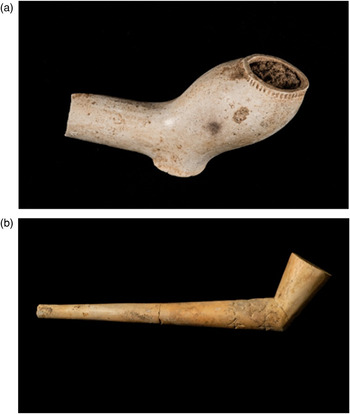
Even in Virginia, local clays and firing techniques did not contribute significantly to an American pipe-making industry at the time. Algonquian pipes (and, later, African ones) in the Chesapeake were made of local terracotta, while English pipes were manufactured in large part from the white Dorset clay brought to London to supply the monopoly held by the Tobacco Pipe Makers of London and Westminster (see Figure 1). The pipes uncovered by archaeologists in early plantation sites, such as Flowerdew Hundred or Martin's Hundred, are overwhelmingly full of European-made pipes. Only 3.9 per cent of pipe samples found at the Sandys plantation site, for example, were locally made.Footnote 49 Much later, in the 1660s, the pipe-maker Emanuel Drue consciously made two types of pipes: ones mimicking white European clay pipes, the others more angular and resembling Algonquian models, which he manufactured using red and brown clays.Footnote 50 This suggests that Drue chose to make different pipes for particular markets and consumers, supporting the idea that colonists preferred pipes that resembled English-made ones. As the archaeologist Charles Orser posited, English colonists’ insistence on smoking white pipes may complement the argument made by James Deetz in 1983, who believed that the colonists’ move from redware to white ceramics and delftwares in the eighteenth century reflected a belief in the superiority of the artificial over the natural, becoming a symbol of refinement in Anglo-America.Footnote 51
Two pipes from early colonial Jamestown, differing significantly in colour, material, and form: an English pipe bowl, made with white ball clay, early seventeenth century, Jamestown Rediscovery, 8237-JR; and an English-made pipe by Robert Cotton, manufactured in imitation of Algonquian pipes, c. 1608, Jamestown Rediscovery, 8238-JR.
Source: Courtesy of Jamestown Rediscovery Foundation (Preservation Virginia).

In the early years in Jamestown, at a time when death rates were incredibly high and colonists were forced to make material concessions to survive, local clays and ceramics were found with higher frequency, but these were only a small percentage of much larger assemblages that included Dutch pottery with painted figures, Venetian glass, and even Chinese ceramics. Moreover, archaeologists have found very few Indigenous artefacts in James Fort from after 1622. This suggests that the attack in March that year, in which an alliance of Algonquian groups killed 347 English settlers, led to the colonists’ conscious and near-complete rejection of Indigenous goods.Footnote 52 In many ways, 1622 brought the strict policies against assimilation that London councillors had advocated for years, and which were forcefully articulated in the first General Assembly of the House of Burgesses in Jamestown in 1619. Colonists were directed to cultivate ‘the better disposed of the Natives . . . thereby they may growe to a likeinge and love of Civility’, but were to abstain from living among the Powhatans, or from allowing Algonquians into their homes without permission.Footnote 53 Even as planters sought to produce tobacco for a growing English market, resisting cultural assimilation remained a prominent concern.
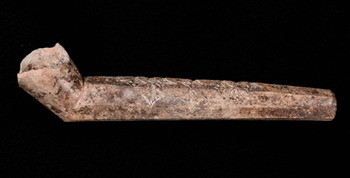
The formidable hybrid pipes made by the Englishman Robert Cotton are a seeming exception, exhibiting a remarkable engagement with Algonquian design and technique.Footnote 54 Little is known of Cotton, who arrived in Jamestown in the spring of 1608. Identified by John Smith as a pipe-maker, Cotton manufactured a series of pipes made from local clay. The pipes closely resemble Native American-made pipes from the Chesapeake, with similarities in length and form, including the shape and angle of the bowl. At the same time, the pipes were differentiated from their Native counterparts in striking ways. Many of the surviving examples were imprinted with a fleur-de-lis and/or diamond shape, using small iron stamps that archaeologists have recovered in their excavations (see Figure 2). These stamps provided the first example of print in English America, and they closely resembled those used to decorate the products of another European industry: books. The use of metals to mark pipes may have further reinforced, to the English, a sense of their advanced craftsmanship through ironwork. Hariot listed iron among those objects that ‘were so straunge unto [the Algonquians], and so farre exceeded their capacities to comprehend the reason and meanes how they should be made and done’, alongside sea compasses, mathematical instruments, guns, books, and clocks.Footnote 55 By the 1650s, the mathematician Robert Wood, an affiliate of the Hartlib circle who supported the diversification of colonial economies, voiced the belief that ‘the maine & original difference betwixt that which we call Civility of the Europeans & Barbarisme of the Americans arose chiefly from this, that the former had the use of Iron’.Footnote 56
Another Cotton pipe manufactured in imitation of Algonquian pipes, this one imprinted with a diamond-shaped metal stamp similar to those used to decorate books, c. 1608, Jamestown Rediscovery, 8238-JR.
Source: Courtesy of Jamestown Rediscovery Foundation (Preservation Virginia).

Along with stamping foliage, Cotton marked his pipes with words, inscribing them with the names of prominent supporters and investors of the Virginia Company, including Walter Ralegh, Thomas West, lord de la Warr, and Henry Wriothesley, third earl of Southampton. Although the Cotton pipes were found in Jamestown, they were likely intended to be sent to England as gifts to the investors whose names appeared on the artefacts. One such pipe contains the name of Walter Cope, an avid collector who built an extravagant ‘castle’, later known as Holland House, in Kensington in 1605. Visitors to Cope's residence, including the king and James's wife, Anne of Denmark, would have walked through a garden of trees brought from other parts of the world, and into rooms stuffed with ‘holy relics’, ‘porcelain from China’, ‘heathen coins’, ‘a [Native American] canoe’, and ‘a Madonna made of Indian feathers’.Footnote 57 Had the Cotton pipes ever left Jamestown, Cope's pipe might have found itself in this environment. Alongside relics, coins, and feathers, such objects placed the English in an alluring world of commercialization and global exchange, but one that nonetheless viewed these artefacts as curiosities to be wondered at, not incorporated into everyday use.
Far from Jamestown, the social performance of smoking in London involved an array of objects that recontextualized the meaning and purpose of smoking. Gentlemen used tobacco to set distinctions within their own carefully constructed social hierarchies. Anthony Chute's posthumous Tabacco (1595) engaged with the opinions of physicians and sought to redeem the reputation of the plant by illuminating its health benefits. But the tract, dedicated to ‘Heroicall minded Gentlemen’ and concerned with the quality of the plant and its cultivation, was deeply imbedded in the social lives of urban wits, containing an engraving of a smoking gentleman and a humorous coat of arms that juxtaposed rapiers with a similarly shaped pipe.Footnote 58 Chute dedicated his book to his fellow poet Humphrey King, playing on King's name by crowning him ‘Sovereign of Tabacco’.Footnote 59 In his conclusion, Chute invoked ‘the planter, the writer, and the reader’, relating the world of educated Londoners to those effecting plantation in America.Footnote 60
By praising tobacco for its subversive qualities while associating the commodity with political expansion through the efforts of Hariot, Ralegh, and other peers, wits differentiated their practices from Algonquian beliefs about the essential properties, function, and value of tobacco. However disposable pipes were, the elite often carried tobacco in costly accoutrements. Pipe cases, tamps, and boxes set further distinctions. Engraved with monarchs, imperial crowns, and, most often, heraldic motifs, tobacco boxes reflected the tastes of a demographic that concerned many Jacobean moralists in the early decades of consumption: the gentry who arrived in London for the fashionable ‘season’ and who had rapidly taken up smoking. The London pamphleteer Thomas Dekker wrote in 1609 that ‘our gallant’ must ‘draw out his Tobacco-box, the ladell for the cold snuffe into the nosthrill, the tongs and priming Iron: All which artillery may be of gold and silver (if he can reach the price of it)’.Footnote 61 The status of the fashionable London gentleman depended on attention to what he smoked, and where he sourced it: ‘heere you must observe to know in what state Tobacco is in towne, better then the Merchants . . . then let him shew his severall tricks in taking it . . . For these are complements that gained Gentlemen no meane respect’.Footnote 62
The rituals around smoking involved knowing the ‘state [of] tobacco’ and acknowledged global networks of exchange. The English love of tobacco, Dekker wrote, ‘make the phantastick Englishmen (above the rest) more cunning in the distinction of thy Rowle Trinidado, Leafe, and Pudding’.Footnote 63 Dekker related tobacco to preference and taste, where gentlemen knew the difference between ‘rowle’ and ‘pudding’ tobacco sourced from the West Indies and the ‘leafe’ sent from North America. As the antiquarian William Camden noted, pipe smoking among the English was popular just as much out of ‘wantonnesse, or rather fashions sake’ as for ‘healths sake’.Footnote 64 Smoking redefined patterns of sociability in London, where gentlemen evoked and simultaneously sought to differentiate their practices from the use and function of tobacco among Native Americans.
III
Unlike other Atlantic goods that gentlemen sought to regulate in parliament, such as sassafras or cod, tobacco was a potent intoxicant whose colonial associations lent themselves to the exhilarated language of possession and discovery. A glorification of empire and intoxication blossomed together in the literature of wits who penned verses intended to be shared and performed in social settings. The appeal of tobacco as an intoxicant was apparent in the opening lines of Raphael Thorius's Hymnus tabaci, first published in Latin in 1626 but composed and circulated around 1610:
Of harmlesse Bowles I mean to sing the praise,
And th'Herb which doth the Poets fancy raise
. . .
Fill me a Pipe (boy), of that lustie smoke
That I may drink the God into my brain
And so inabled, write a buskin'd strain.Footnote 65
Though presented as a native plant of the Americas, tobacco was projected by the poem as an intoxicant that belonged in the hands of Europeans. In its ludicrous scenario, Bacchus, god of wine and fervent endorser of communal debauch, conducted a war against Native Americans to claim tobacco for himself and his fellow carousers. Not only that, but the god presented wine and tobacco as a civilizing force that contained the power to transform the Indigenous peoples of America into refined beings. Deep in a cannibal bower, Bacchus told his anthropophagous companion he had but ‘play'd the man’.Footnote 66 Only by knowing how to drink and smoke – not alone, but in good company – would he ‘instil the Arts’ into ‘their gross minds’.Footnote 67 The poem presented sociability in relation to a Protestant masculinity that defined itself against Native Americans and advanced Atlantic intervention to the disadvantage of other European empires, repeatedly questioning what it meant to be a man and placing intoxication within the behavioural rites that inspired both literature and action. ‘Banish (my Friends) these unclean rites’, Bacchus's adherents coaxed the ‘savages’ who crouched before them, ‘and live / The life of men’. Then, offering the pipe: ‘here . . . your recovery lies, / Onely be willing to be cur'd’.Footnote 68 To ‘live the life of men’ was not to be bloodied in war but to spar with words and mix with friends.
In the private chambers and taverns where gentlemen met to discuss matters of state and share poetry, the materiality of tobacco lent itself to the celebration of the drug's refining qualities. The elongated stems of English pipes, which could extend to ninety centimetres, made boring holes for the smoke more difficult than the thicker, sturdier Algonquian models. This suggests that, rather than for convenience, these pipes were specifically constructed in such a way for other reasons. This likely had to do with managing the heat of the pipes after smokers lit their tobacco, but it invariably influenced the performativity of civility at dinner tables or among friends, where discourses and patterns of drinking were interrupted by the need to ‘drink’ in smoke. How did the act of smoking break up speeches and songs, and influence gesture? This is easier to reconstruct in the popular citizen comedies of the Jacobean era, which often included stage directions that involved tobacco, pipes, and exchanges in tobacco shop interiors.Footnote 69 Nonetheless, the ways in which gentlemen wrote about tobacco suggest that they may have performed their writings at dinner parties and private gatherings. Verses telling the reader to ‘Take up these lines Tabacco-like unto thy braine, / And that divinely toucht, puffe out the smoke againe’ encouraged participation, instructing gentlemen to enjoy good company, while relating tobacco to the English presence in Virginia by citing texts like Hariot's.Footnote 70 Pipes were likely used to animate, perhaps even play out, those poems like Hymnus tabaci that were specifically about the triumphs of civil intoxication in the context of masculine conviviality.
The integration of smoking into metropolitan wit coteries involved social differentiation but also a clear self-fashioning in contradistinction to Indigenous practices. Despite the thirty-four-year period separating their publications, the images in Hariot's A briefe and true report of . . . Virginia (1590) and those in John Smith's The generall historie of Virginia (1624) showed Algonquians incorporating tobacco pipes and leaves in their ‘strangest gestures’ at a time when the English colony in North America remained tenuous, and two-way assimilation continued to be seen as politically disadvantageous.Footnote 71 The religious ceremonies or small, cramped interiors in which Algonquians were shown using tobacco reinforced their remoteness from European conceptions of civil society. Conversely, woodcuts and stage directions depicted English smokers in a symbiotic relationship with their pipes, standing confidently in the tavern or sitting at a table with friends, surrounded by other markers of leisure and consumption including playing cards, plates, cutlery, and drinking vessels. The pleasure of drinking and writing poetry could be enhanced by imagining a ‘golden worlde in this our yron age’, one where intervention in America would yield ‘good Tobacco’ and submission to the English.Footnote 72
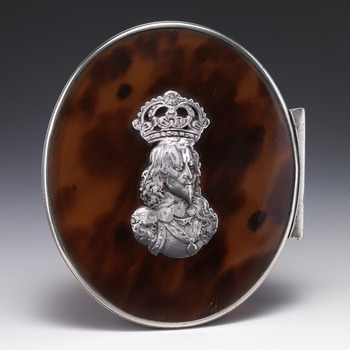
The desire to appropriate tobacco into metropolitan consumption while rejecting Indigenous ways of life sheds light on some of the consequences of English ‘improvement’. In the light of colonization, the absence of Native American-made objects in English self-fashioning is significant. Scholars have found that, on the whole, eastern goods like textiles became the commodities with global appeal in England, rather than those of the Americas.Footnote 73 Intricate patterns of Indian chintz or Chinese porcelain, like the vogue for Ottoman carpets seen in countless Tudor and Stuart portraits and interior furnishings, visually demonstrated middling and elite access to the developing trade routes of the East and its associated luxuries. Conversely, and despite some exceptions, the English elite showed scant appreciation for Native American methods of production. To have widely acknowledged the levels of craftsmanship involved in producing dyed moose-hair, or roanoke beads drilled and polished from shells – as a few colonists did, usually in unpublished letters and reports intended for select, private audiences – would have challenged commonplace English depictions of Algonquians as ‘pagans’ in need of assimilation and redemption. Nor did English motifs on tobacco boxes seek to connect tobacco to its American origins. Although tobacco boxes appear to have become curios and gifts exchanged among the elite very quickly, these boxes were overwhelmingly engraved with heraldic devices or symbols of Stuart royalty, and were inscribed with mottos and messages in English or Latin (Figure 3).Footnote 74 Pipes themselves were stamped with Tudor roses, foliage, and the initials of merchants and pipe-makers.
Silver and tortoiseshell tobacco box, British, seventeenth century, Metropolitan Museum of Art, 14.58.224.
Source: © Metropolitan Museum of Art.

In a matter of decades, English gentlemen had successfully championed the subordination of Indigenous cultures as markers of their own civility. By 1630, the witty dialogue Wine, beere, ale, and tobacco. Contending for superiority personified the figure of Tobacco not as a Native American, as typified in its earlier representations in English drama, but as ‘a swaggering gentleman’, deeply entrenched, as Phil Withington has pointed out, in the social world of urban wits.Footnote 75 Playing on the language of ‘soveraigne’ tobacco that had long informed gentlemanly discourse, Wine (a ‘gentleman’) acknowledged that ‘Tobacco is sophisticated’.Footnote 76 Tobacco's status was related to his smooth ability to persuade, evoking the wits at the Inns of Court who enthusiastically adopted smoking at the time. He could, Tobacco boasted, ‘distill eloquence and oracle upon the tongue . . . words flowing in so sweet distinction’.Footnote 77 As Ale (the ‘country man’) acknowledged, Tobacco was a ‘most excellent discourser’, possessing the rhetorical abilities that were fundamental to elite concepts of political authority.Footnote 78 Despite its foreign origins, tobacco now had an entrenched place in the world of European intoxicants. The play concluded with Wine seeking friendship with Tobacco, acknowledging his elevated status and expressing a fear of being replaced altogether unless the two formed a kinship. Tobacco's essence had been fully domesticated: there was no trace of Native America in his character at all.
IV
This investigation of the incorporation of tobacco into late Elizabethan and Jacobean metropolitan sociability offers a socially specific exploration of an intoxicant at a particular moment in time. Nonetheless, these conditions reveal several important insights into the entangled nature of colonization and the material assemblages of sociability that developed in England as a result of territorial expansion. Firstly, the fluidity of exchange between Jamestown and London provides a case study of the process whereby sought-after Indigenous goods, knowledge, and practices were integrated into English social habits, something that is often lost in studies of the longue durée. Secondly, gentlemanly attitudes towards tobacco raise attention to the impact of colonial encounters on the elite's self-conscious understanding of their own civility.Footnote 79 The ways in which gentlemen integrated tobacco into their forms of social interaction – from the poems they penned to their material assemblages – demonstrate how a Native American commodity became incorporated into elite codes of behaviour. While it is well established that men and women from a wide spectrum of social backgrounds consumed tobacco in rural and urban spaces, more research remains to be done on the extent to which they may have associated tobacco with the colonial project, and on the extent to which their social practices might have been shaped by images of Native Americans on tavern signs, tobacco packaging, and the stage.Footnote 80
What is clear is that the growing taste for a potent American intoxicant among urbane gentlemen brought imperial aspirations within the associational politics of elite London society. The archaeologist Ian Hodder wrote that ‘things show up or matter or count in terms of how they are fitting in our future-directedness – our human projects’.Footnote 81 The proliferation of tobacco, pipes, and boxes in the pockets and chambers of colonial-minded gentlemen was often related to a specific project: that of empire and the pleasures it afforded. Cultivation was nothing if not ‘a [conversion] from that most brutish condition of life, to . . . polliticke government’, and transplanting tobacco into the spaces of the political elite often explicitly celebrated this transformation.Footnote 82 Linking a previously unknown intoxicant to the virtues of plantation enabled gentlemen, as consumers, to legitimize what many Jacobean moralists considered to be a social and political ill. The glories of empire hinged on a ‘yet’ – ‘those seeds, which yet unpolisht were’ – and the English enacted what seemed like the inevitability of fruition through how and what they smoked.Footnote 83 Once grown and cured, those tobacco ‘seedes’ were put in gilt boxes stamped with coats of arms and the faces of kings, and consumed in far different environments from those of the Algonquian Chesapeake, or even the hybrid space of the plantations.
To consider the social life of things is to recognize the potency of objects in influencing the behaviour of those who use them, but also to recognize the human intent through which borrowed or appropriated things were modified in different settings. The English specifically related the success of plantation to the acquisition of a Native American intoxicant, one they learned to cultivate through the direct assistance of quiakros, revered Powhatan religious men and healers.Footnote 84 For this reason, the presence – and absence – of Indigeneity matters to scholarly assessments of how civility and social habits developed in England. More so than the French or the Spanish, the English were vehement in their rejection of overt cultural hybridity. The allure of smoking among gentlemen often depended on an awareness of the existence of Indigenous peoples while denying the value of their socio-religious practices, craftsmanship, and aesthetics. ‘[I]mbrace / My Art’, pressed Bacchus in Thorius's poem, using the sensual language of submission to conviviality to advocate control.Footnote 85 This curious meshing of moral uprightness and ‘buskin'd’ intoxication uniquely contributed to how gentlemen ‘play'd the man’.Footnote 86 Contextualizing the political aspirations of the urban gentlemen who partook in such rituals enables a better understanding of what the English were rejecting, and what they were promoting, when they cried, ‘Give him the Pipe’.Footnote 87
Acknowledgements
This article forms part of Intoxicants and early modern European globalization: spaces, practices, material culture, a special issue resulting from a workshop series, held in 2017 at the Victoria and Albert Museum and in 2018 at the Beinecke Library, Yale University.
Funding Statement
The workshop series at the Victoria and Albert Museum was funded by the ESRC ‘Intoxicants & Early Modernity Project’.