Archaeological research at the large Late Preclassic centers in the Mirador basin of Guatemala has provided support to the notion that the Lowland Maya had reached a high level of complexity centuries before the onset of the Classic period (Dahlin 1984; Demarest et al. 1984; Hammond 1992; Hansen 1990; Matheny 1986; Sharer 1992). While the existence of monumental architecture, complex iconography, large population, long-distance trade, and craft specialization in the Late Preclassic period has been documented by decades of archaeological investigation, at the time of this writing the exact nature of the institution of rulership and its ideology in the Preclassic remains elusive because of lack of direct data on Preclassic Lowland Maya “rulers,” their palaces, and their burial places.
The data I present here from the region of northern Guatemala known as the Holmul region help identify certain ritual practices, religious metaphors, and political actions that reveal the existence of an ideological charter of Lowland Maya kingship as early as in the Middle Preclassic period. These data enrich an increasingly large corpus of early monuments and architecture that helps characterize an unbroken link between Classic Maya kingship and its Preclassic Lowland Maya antecedents. Moreover, the evidence from the Holmul region adds further support to the thesis that the earliest beginnings of centralized power throughout the Maya Lowlands date to the Middle Preclassic period and followed a trajectory parallel to that of the Olmec of the Gulf Coast of Mexico and of other cultures of Formative Mesoamerica rather than derive from them (see also Hammond 1992; Hansen 1992; Sharer 1992).
Since 2000, the area of the mid-course of the Holmul River, centered on the Classic Maya city of Holmul, has been the subject of research on early Maya political institutions by the Vanderbilt University Holmul Archaeological Project (Estrada-Belli 2000, 2001, 2002, 2003a, 2005; Estrada-Belli, Bauer, Morgan, and Chavez 2003; Estrada-Belli, Grube, Wolf, Gardella, and Guerra-Librero 2003). This research project was motivated by Raymond Merwin's pioneering work in 1911, which indicated that Holmul had (1) a long cultural sequence, from the Late Preclassic to the Late Classic; (2) a “Protoclassic” complex, including elaborate burials; and (3) a renewed florescence in the Late Classic, with elaborate polychrome ceramics and palace architecture (Merwin and Vaillant 1932). Ninety years after Merwin's excavations, many basic questions about this great site remained unanswered. The size and status of Holmul within its region remained unknown. Most notably, nothing was known about any developments at Holmul prior to the Protoclassic period.
DEFINING THE HOLMUL POLITY AND ITS HINTERLAND
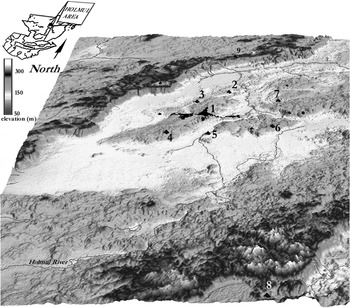
Regional GIS mapping suggested that Holmul was the center of a large polity, with a territory roughly corresponding with a broad upland ridge bounded by the Holmul tributary of the Río Hondo to the east and outlying wetlands to the south, west, and north (Figure 1). A steep escarpment encloses the low-lying basin to the west and south, providing a barrier for movement and vistas in those directions. Within this circumscribed setting, smaller centers are located within an hour's walk of Holmul: Hahakab, Hamontun, K'o, Riverona and T'ot. Stratigraphic soundings and inspection of hundreds of looters' trenches show that Holmul's East Plaza was a functional E-group since the Late Preclassic period and that Preclassic construction episodes existed within the construction fill below Late Classic Groups II and III. At the minor centers of T'ot, 4.5 km to the southwest, and at Hahakab, 4 km northeast of Holmul, E-group plazas and triadic groups were also found; part of a Preclassic stucco mask was noted in a looted 12 m high pyramid at T'ot. To the northeast, at Hamontun, four Protoclassic plates and a large shell, probably from a single looted tomb, were found on the surface. While only superficial information is so far available from these sites, it appears that in the Late Preclassic there were a number of ceremonial nuclei in the Holmul region, all comparable in size and plaza layout to Holmul.

Bird's-eye view of the Holmul region in northeastern Peten, Guatemala showing topographical features that define the Holmul region basin. The numbers identify major and minor centers: (1) Holmul; (2) Cival; (3) Hahakab; (4) T'ot; (5) Riverona; (6) K'o; (7) Hamontun; (8) Naranjo; (9) Witz Na.
THE PRECLASSIC ANTECEDENTS OF HOLMUL
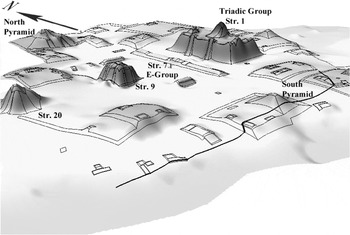
When Cival was located only 6.5 km north of Holmul and mapped, our ideas shifted dramatically. Cival was first noted as a Preclassic site of significance by Ian Graham (personal communication 1992), who mapped its center in the 1980s. We extended his map, adding several plazas and substantial residential areas with scattered peripheral temple groups; the plazas are broader and the temples larger than at Holmul itself. In 2002, we noted remains of a wall enclosing Cival's plazas (Figure 2). We surmised that the ceremonial area was abandoned after a violent attack.

Oblique perspective from the southwest of the ceremonial core of Cival. The E-group plaza is in the center; Triadic Group 1 is in the background; the North Pyramid is on the left; and the defensive wall is in the foreground. Image by the author; derived from survey data by the author, Marc Wolf, and Kristen Gardella in GRASS-GIS. Scale varies in this perspective. Group 1's width at the top is 70 m; the height of Structure 1 is 33 m above the plaza. “X” marks the location of Cache 4 and Stela 2 within plaza.
From looters' trenches and test pits we know that Cival's earliest plaza floors date to the Middle Preclassic and were last repaved circa a.d. 200. Cival's beginnings are documented by finds in the main plaza, one of the largest and oldest E-groups in the lowlands (Bauer 2005a; Estrada-Belli 2003a; Estrada-Belli, Bauer, Morgan, and Chavez 2003). The E-group is composed of a 18 m high radial pyramid and a 129 m long eastern platform (Structure 7) supporting three buildings in addition to two smaller structures to the north and south. In later versions of this eastern platform, the central building (Structure 12) was built on top of an extension (outset) to the east. A deep trench dug by looters sometime in the 1970s in Structure 7 demonstrates that the first version of this E-group's eastern platform was actually a modified bedrock knoll. All together, this platform and its central outset structure (Structure 12) were remodeled six times, the last two in the Protoclassic period, circa a.d. 150–250 (Bauer 2005a). The east–west axis connecting the western pyramid and the center of the east platform points to sunrise on the equinox.
The E-Group Plaza and Its Offerings
While numerous offerings were found along this axial location, four major features in the floor mark important stages in the history of this sacred space. The first evidence of ritual activity dates to the Middle Preclassic, sometime between 600 b.c., when five water jars, five upright celts, and 114 jade pebbles were placed in a four-level cruciform cut into the soft limestone bedrock (Bauer 2005b; Estrada-Belli, Bauer, Morgan, and Chavez 2003). The second event was the construction of an apsidal/rectangular platform in front of this eastern building, followed by burial of a large broken stela on the center line of the eastern platform, which may also date to the Middle Preclassic period. Finally, a carved stela was dedicated early in the Late Preclassic period. These four major ritual events roughly correspond with the first four (of six) major building stages of the eastern platform (Structure 7) and of its outset superstructure (Structure 12; Bauer 2005a).
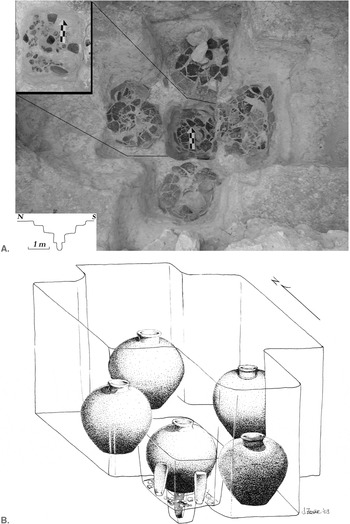
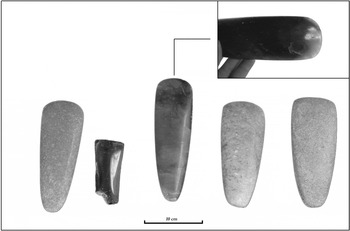
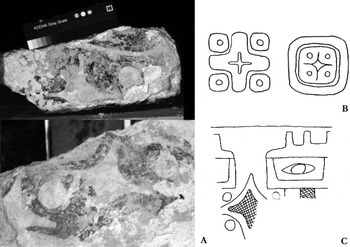
The symbolism of the offerings in this E-group plaza is testimony to the development of Preclassic Maya ideology. Cache 4 was placed in a cruciform pit measuring 2.48 m on the east–west axis and 2.48 m north–south (Figure 3). The space inside the pit was subdivided in four levels. The upper level is a shelf in the outer arms of the cross .2 m down from the original bedrock surface. Some .34 m below this was a second tier of shelves on which four jars—three black, one red (in the south)—were placed. The third level was a .44–.46 m deep squared pit in the center of the cross-shaped opening into which a fifth (black) jar was placed. Ringing this central jar, four 20–25 cm long celts were placed upright in correspondence with each of the cross arms. Three of these upright celts were of green jade while the western one was of blue-green translucent jade quality. The latter clearly showed signs of being used as a core to extract sections from it to make other implements. Underneath and surrounding the base of the jar were 30 green-blue jade pebbles and an additional 84 green jade pebbles. Finally, a central .3 m deep round hole in the center of the squared pit was the lowest level of the cruciform pit, containing a single upright green-blue jade celt, the most finely made in the assemblage (Figure 4). This jade celt was of the finest-quality material of all the jades found in this offering, being the most translucent and of the deepest blue color. Its proportions are unlike the other celts in the assemblage and suggest it may have been an heirloom or import from the Gulf Coast. In all likelihood, it was carved from a source of blue jade in the Motagua Valley recently discovered by Karl Taube, Zachary Hruby, and Luis Romero (2004; Hruby et al. 2005). A similar cruciform cache of six upright jade celts was found at Seibal by Ledyard Smith (1982:245) with five associated jars that dated to the first part of the Middle Preclassic period. Notably, in addition to celts in the Seibal cache was an “ice-pick”-shaped blue-green jade bloodletter. While this is the only other known example of an offering from the Maya Lowlands in a cruciform scheme of jade celts and ceramic vessels, several similar arrangements of upright jade celts have been found at Middle Preclassic sites outside the Maya Lowlands, including at San Isidro, Chiapas (Lowe 1981); La Venta (Drucker et al. 1959); Cerro Manatí (Ortiz and Rodríguez 2000); and La Merced, Tabasco (Rodríguez and Ortiz 2000).

(a) Cival Cache 4 during excavation of five smashed jars in cross pit. The upper insert provides a detail of jades under the central jar, and the lower insert is a north–south profile drawing. Photographs by the author and drawing by J. Bauer; (b) artist's reconstruction of Cival's Cache 4. A wooden stump was placed above the jars after the pit was filled (not shown). Drawing by Joel Zovar.

Cache 4 five jade celts. The insert shows translucence of the central celt. Photograph by the author.
The large jars were found as piles of large conjoinable pieces. A few large limestone rocks were found on top of the jar fragments, indicating that the final act included smashing them. Presumably, as the containers were broken, the liquid splashed out, filling the lower levels of the cross-shaped pit. Subsequently, the cavity was completely filled with gray marl up to the level of the bedrock surface. Finally, a post was erected in the center of the leveled pit surface.
This carefully oriented pit and its contents of various materials and shapes present an intriguing cosmological message and is clearly the result of a sumptuous ritual that involved the arranging and burying of these objects in the ground. At La Venta, the Middle Preclassic Olmec buried massive amounts of riches in the form of jade and serpentine celts. They were deposited in cruciform and layered arrangements and may have been representations of sprouting vegetation, world trees/axis mundi, or offerings to the earth and other supernaturals as a source of shamanic powers (Tate 2001). At Izapa, world trees as representations of the axis mundi sometimes were marked by a three-dimensional cruciform symbol on the trunk similar in shape to the Cival pit (Stela 27; Norman 1973:Figure 27). Similarly, the ritual practice of burying the Cival offering may have encoded multiple metaphors and meanings central to Preclassic Maya social discourse.
The Cival jars may have contained fluids, such as water, balche (mead), or other alcoholic beverage such as chicha (maize beer). According to J. Eric Thompson (1970:182), among the colonial-period Yucatec Maya it was a common practice to offer balche, made of fermented honey to which is added the bark of the balche tree (Lonchocarpus longistylus). In modern times, the Maya use alcohol or alcoholic beverages (aguardiente) as well as balche and maize gruel (saka') in ritual offerings of liquids (Freidel et al. 1993:219–221). Bruce Dahlin and William Litzinger (1986) have proposed that since the Late Preclassic period at El Mirador, Tikal, and other central Peten sites, balche and similar fermented beverages were widely brewed domestically in underground pits and cisterns known as chultuns. Thompson (1970:183) notes that Maya rituals often involved a process of purification, which was induced by drinking the purgative drink balche and by the offering of pure “virgin” water. The purest water was normally obtained from caves and was placed in bowls and poured onto idols, world trees, or the ground.
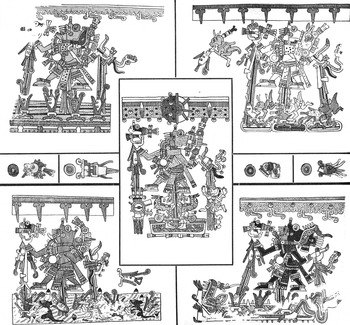
Olmec jade celts represent sprouting corn plants; their upright position in a quincunx represents cosmological order, with four maize sprouts, or four ceiba trees, plus a central one as the world tree, or axis mundi (Reilly 1994, 1995; Taube 2000). Among the Maya, as well as in central Mexico, jade axes were also associated with rain and lightning, as they are wielded by Chaak and Tlaloc storm deities. Cival's cross-shaped layout of axes recalls page 27 of the Codex Borgia (Figure 5) and page 69 of the Codex Vaticanus B, in which the four Tlalocs of the cardinal directions are represented around a central one. In the Codex Borgia representation, each corner's Tlaloc holds a Tlaloc-face object with corn/celts pendants in the right hand and a serpent fetish in the left hand and pours water onto the ground were corn/celts sprout. The four Tlalocs of the cardinal directions are also equivalent to the four “Cocijos”, the rain gods of Zapotec mythology (Karl Taube, personal communication 2004). In addition, Taube has noted that in Mesoamerica as well as in the American Southwest jade celts in cruciform patterns were associated with ears of maize as well as lightning and were imbued with supernatural power, often as symbols of the axis mundi (Taube 2000). The cardinally oriented Tlalocs in the Mexican codices' compositions represent the quadripartite divisions of the 260-day Mesoamerican calendar, each oriented to the cardinal direction, as well as the act of rain making at the four corners and center of the earth. (See also Aztec Tlaloc rituals at the cardinal directions and center of Lake Texcoco [Arnold 1999].) We thus take the placement of five vessels and of five upright jade celts to evoke the supernatural powers of water, rain, and maize deities and their arrangement in a cross layout to reflect the partition of the cosmos as well as the quadripartite divisions of the 260-day Mesoamerican calendar.

Codex Borgia, page 27 (after Seler 1963).
The layout of E-group plazas was perhaps the first architectural device created by the Maya to celebrate the four divisions of the calendar year using the shifting points of the sunrise on the eastern horizon. The main alignments used to mark these divisions were likely the days of the autumn and spring equinoxes and those in which the sun passed its zenith position (directly overhead at noon), or in some cases they coincided with a combination of the equinoxes and solstices (Aveni et al. 2003)
The jade pebbles found in the Cival cache also may symbolize river or cave pebbles and therefore the idea of pure “virgin” water often required in rituals, as well as the primordial sea at the time of creation (Thompson 1970; see also Bauer 2005b). In that sense, it is notable that the pebbles occupy the lowest level of the cache. Alternatively, their number may have divinatory significance. Michael Love reports several caches with stone pebbles in recurring numbers that may be related to the periods in the Mesoamerican calendar from El Ujuxte, in the southwestern Pacific Coast of Guatemala. At El Ujuxte, caches containing ceramic crosses aligned with the central axes of the site were also found in the same context (Guernsey and Love 2005). Furthermore, Antony Aveni and colleagues (2003) have shown that, while there is variability in the alignments of the center line and buildings of Maya E-groups, one common set of alignments may have special significance. At Uaxactun and at many other lowland sites, the days in which the sun rises behind each of three buildings on the eastern platform when observed from the western pyramid mark days that precede the passage of the sun at the zenith in multiples of 20 days (Aveni et al. 2003). In the Peten, the zenith date coincides with the May 10 date in our Gregorian calendar and the “normal” beginning of the rains. Thus, it was a pivotal moment common to the agrarian and solar year cycles. Marking those 20-day-period intervals preceding the day of the passage of the sun at the zenith position with architectural features would have helped celebrate the arrival of the rains, as well as initiate further propitiatory rituals in the plaza and in the fields. In its early version, the Cival E-group consisted of a western pyramid and an eastern bedrock knoll modified into an elongated platform. The imaginary axial line passing through them had an almost perfect equinoctial azimuth at 92°, and it is possible that it was used to mark those solar positions (equinoctial and zenith) to divide the year into four parts synchronized with the agricultural seasons in the way described by Aveni and colleagues (2003). While the passage of the sun by the zenith in the Peten coincides with the arrival of the rains, in terms of Maya ritual performance, these solar and seasonal moments coincided with the first act of creation of the world by the supreme deity “Heart of Sky,” as described in the first pages of the Popol Vuh (Edmonson 1971; Tedlock 1996:64–65; see also the later discussion of Triadic Group 1), a mythical event that among the modern-day Chortí is equated with the production of maize (Girard 1979:32–33).
At Cival, the jade cache is located on the plaza's center line immediately adjacent to the eastern platform (Structure 7, Figure 2) and appears to be centered on the equinoctial events and therefore specifically referring to the opening of the creation act. At La Venta, the largest jade and greenstone offerings are located in the center of the Complex A Plaza (Drucker et al. 1959) and in San Isidro, Chiapas, exactly on the eastern side of the plaza along the main axis (Lowe 1981), while at Seibal the alignment of the jade cache with other coeval buildings is unclear (Smith 1982). According to Clemency Coggins's (2006) and Taube's (1996:50) interpretation of the Olmec statuette from Las Limas, the four celtiform heads incised on its shoulders and knees possibly represent celts. As such, they frame the newborn baby-jaguar/Maize God at the center of a quincunx. As the centerpiece of this symbolic construct, the newborn may represent the birth of the Maize God, as well as the beginning of the new dawn, a new year, and a new agricultural cycle. In the Postclassic period, celebrations of the birth of the uinal, or the basic 20-day unit of the Mesoamerican calendar, were central to new-year ceremonies among the Yucatec Maya, and from Preclassic through Classic times the seating of a new Maya ruler was celebrated as the conjoint birth of a new uinal-based year and the rebirth of the Maize God (Coggins 2006).
In sum, Cival's cruciform cache and the quadripartite sun-oriented space of the E-group in which it is located relate not only to the quadripartite division of the Maya universe but also to the fundamental constructs of the Mesoamerican calendar and of the cycle of the Maize God. These spacio-temporal world views and the creation myth in which they are ritually enacted are deeply rooted in agrarian ways of life that the earliest Maya rulers evidently had appropriated at this time to fit a new ideology of central authority. As this cache was placed in the ground, the new ruler of Cival identified himself with the axis mundi, the reborn Maize God, and the new uinal.
The final act of the Cival Cache 4 ritual was to place a wooden post above the pit. Wooden posts, world trees, and maize plants are often equated in Olmec and Maya iconography (Reilly 1994, 1995; Taube 2003). Classic Maya and Olmec rulers often substituted as world trees (Stuart 1996) or transformed into them, as in Pacal's image on his sarcophagus lid showing a world tree emerging from his dead body (Reilly 1991), or as a centerpiece of a quincunx in ritual landscapes such as the La Milpa cosmogram, which was centered on the royal plaza (Estrada-Belli 2003b; Tourtellot et al. 2000).
Thus, at Cival, the jade celt offering embodies the most primordial agricultural and cosmological metaphors. They are metaphors central to the authority of Middle Preclassic Olmec as well as Maya rulers. At Cival, the Preclassic Maya, like their Olmec neighbors, performed public rituals that called for the burial of large amounts of jades in cruciform openings into the earth and the erection of world trees. Elaborate costumes and grand pageantry undoubtedly accompanied such exuberant displays of disposable wealth.
A piece of charcoal recovered from the floor that sealed the Cival cache produced a 1-sigma result of 790–760 and 680–550 calibrated years b.c. (2-sigma result of 800–520 cal. b.c.; sample CIV.T08.43, Beta 213528). The deposition of the cache most likely occurred sometime around 680–600 b.c., a date that is consistent with our initial ceramic seriation of the jars within the Mamom phase (Estrada-Belli, Bauer, Morgan, and Chavez 2003). Therefore, the Cival cache is a testament to the rise of a new form of individualized power in the Maya Lowlands that is largely coeval with similar developments in the Gulf Coast, Chiapas, and Pacific coast of Guatemala during the Middle Preclassic period (800–500 b.c.). The well-stratified offerings and floors that subsequently were laid onto the Cival plaza document the further development of Preclassic Maya ideology from the Middle to Late Preclassic times.
Cival Stela 2
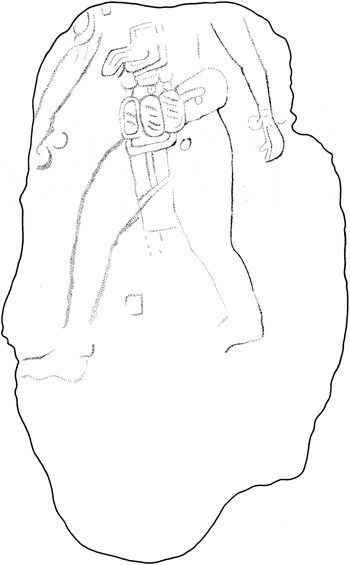
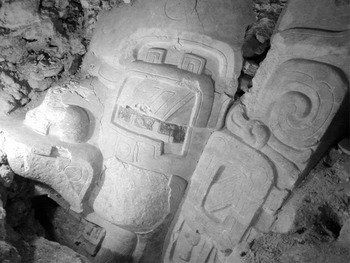
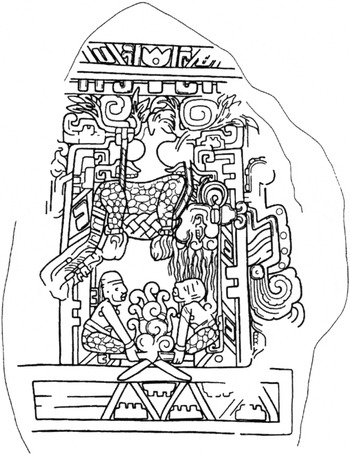
Cival Stela 2 was found laying flat on its front face inches away from the Middle Preclassic Cache 4 jade offering (Figure 6) and partially covered by the looters' rubble piles. In Nikolai Grube's analysis, its style predates the earliest monuments from Nakbe and El Mirador mainly due to the dynamic striding pose and other archaic features such as incisions, the “olmecoid” mask, and the absence of text (Estrada-Belli, Grube, Wolf, Gardella, and Guerra-Librero 2003). Molly Morgan's and Jeremy Bauer's excavations in this spot found a pit cut into a floor, which by shape and size could be the original setting of Stela 2. It was associated with a dedicatory cache and was on the center line of Structure 7, a few inches to the west of Cache 4. Its suggested date is 300–200 b.c. based on associated ceramics only ([Excavation CT08] Bauer 2005a; Estrada-Belli, Grube, Wolf, Gardella, and Guerra-Librero 2003; Estrada-Belli, Bauer, Morgan, and Chavez 2003). The carving style on Stela 2 is low-relief outline of simple forms. The figure wears a jade bird-head pectoral with three plaques, an ornament often worn by rulers on Preclassic monuments at Kaminaljuyu, Takalik Abaj, and other early sites (Parsons 1986). It is nearly identical, albeit in mirrored image, to the bird-head pectoral worn by the figure on La Mojarra Stela 1 (Winfield Capitaine 1990; Figures 7–8).

Drawing of Cival Stela 2. Drawing by Nikolai Grube, readapted from Estrada-Belli, Grube, Wolf, Gardella, and Guerra-Librero 2003.

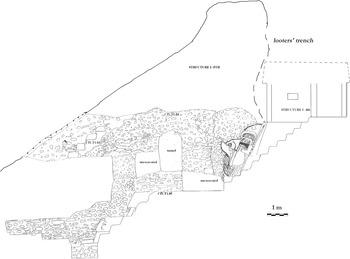
Stratigraphic profile of Structure 1 showing penultimate construction phase with stucco mask covered by last construction phase and damaged by looters' trench.

Cival Structure 1, North Mask (Mask 1).
His striding position is not unusual in Middle Preclassic Mesoamerican iconography. In the Maya calendar, the 20-day count for the uinal month was originally based on the count of fingers and toes in the human body, like all Mesoamerican vigesimal counts (Nykl 1926) and the word for 20 was the same as the word for “man” (Coggins 2006). In other words, the Maya ruler, as the personified world tree, represented the center of the four parts of space, as well as of the calendar. As the embodiment of time, he personified the first cycle of time, the uinal, through the count of his fingers and toes. His striding position reinforces the notion of the ruler as the embodiment of time in motion as the cycle of uinals (Coggins 2006), which may have been enacted by ritual dance performances probably similar that of the Classic-period Holmul Dancer. Finally, the tapered stela profile resembles upturned jade celts such as those in the cruciform cache. The celtiform shape of Olmec stelae, as well as jades and green ears of corn, reiterates the ruler/maize/world tree association (Porter 1992, 1996; Taube 2000) seen in Cache 4. It is apparent from these symbolic associations, and by the ritual erection of this stela in an E-group, that by circa 300 b.c. the ideological charter of Classic Maya kings was fully in place.
Cival's Triadic Group 1 and Its Monumental Sculpture
Possibly coinciding with the erection of Stela 2, a major construction project was carried out on the eastern side of the Cival plaza with the raising of a massive triadic temple group (Figure 2). Triadic Group 1 of Cival is a steep-sided platform rising 20 m from the plaza, 70 m wide along the front and 39 m on the sides, and supporting three temple pyramids forming a triadic group. The main temple on the eastern side is 13 m high, for a total height above the plaza of 33 m. Two stepped temples flanking it on the north and south sides of the platform are 5 m high. Attached to the eastern and southern temples are two low rises that could be the remains of low ancillary building platforms. In addition to the three main temples, there are two 4 m high pyramidal structures flanking an inset stairway on the western facade of the platform. Finally, on the northwestern and southwestern corners are two small rises that could be the remains of small, single-room ancillary buildings or shrines (5 m × 3 m wide), bringing the total number of buildings on top of this platform to seven, plus the two non-masonry ancillary structures next to the east and south temples. Because of its imposing volume, this towering group of buildings blocks the eastern horizon on the site's east–west center line. Beginning in 300 b.c., the triadic group likely became the new focus of ritual performance at Cival for the remainder of the Late Preclassic period, although three other pyramids were also enlarged at the north, west, and south ends of the main ritual core. During the span of at least 400 years from 300 b.c. to a.d. 100, Triadic Group 1 underwent at least five major remodeling episodes, the most impressive of which was the last one, initiated sometime around a.d. 100.
At first, construction of this group represented a major change in the scale and nature of ritual architecture at Cival from a wide-open plaza to a steep temple platform and from a horizontal to a vertical focus of ritual space. The Group 1 platform effectively removed the temples from the plaza and from public access, separating ritual actors from ritual observers. Nevertheless, the facade of the eastern pyramid (Structure 1) and the sides of the north and south pyramids of the triadic group would have been visible to anyone standing in the plaza below. The rituals carried out on this elevated space framed by towering temples essentially gave the impression of being situated high on the eastern horizon reaching into the sky.
The penultimate, fourth stage of the eastern temple of the triadic group consisted of a temple pyramid fully encased by the last building stage (Figure 7). Originally, its upper temple would have stood 6 m above the triadic group's top floor and 26 m above the plaza floor below the group; its pyramidal platform consisted of three terraces decorated with steeply sloping apron-moldings, inset corners, and a 2 m wide inset central stairway, all coated with a 5 cm thick layer of fine cream-painted stucco. The facade of the pyramid was decorated with two large, identical anthropomorphic stucco masks (Figures 7, 8, 9, 10, and 11). Each measured 5 m in width and 3 m in height. They decorated the sloping face of the upper (third) terrace on each side of a central 2 m wide stairway.

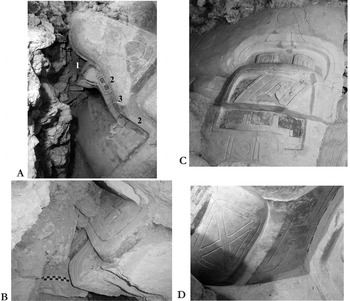
Cival Structure 1 North Mask (Mask 1), detail of identifying features. (a) mouth, teeth ([1] central incisor, [2] U-shaped molars, [3] J fangs), and palette; (b) central tooth with incised upturned U sign and J fangs; (c) recessed L-shaped eye with black paint and incisions, eyelid with incised U sign in diagonal brackets surmounted by double merlons; (d) incised crossed bands and barbs at the corner of the mouth. Photographs by the author.

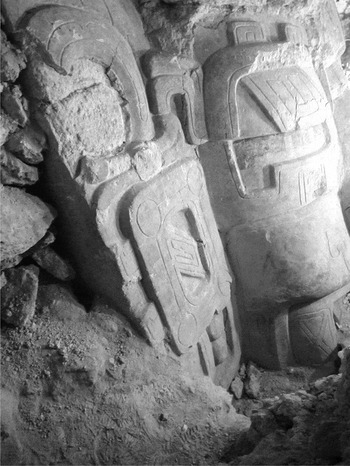
Cival Structure 1 South Mask (Mask 2), north side. Note incisions in earflare (foreground), flamed eyebrow, paw wings on cheek (right), and crossed bands (lower right)

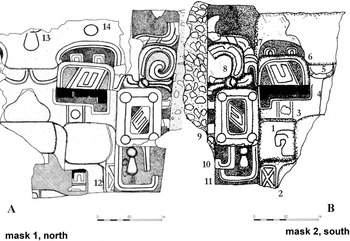
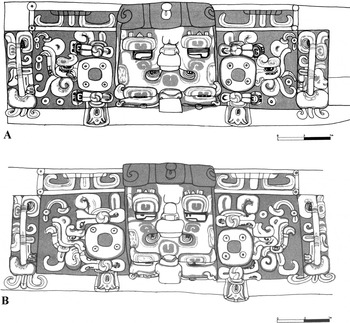
Drawings of parts of Cival Masks 1 (a) and 2 (b) side by side; central stairway not shown. Field drawing by Angel Castillo. Identifying attributes include (1) paw wing (cheek); (2) crossed-bands; (3) bracketed dot; (4) L-shaped eye; (5) frowning ridge; (6) bracketed diagonal U-sign with double merlons (eyelid); (7) paw wing (eye); (8) scrolls and knot motif; (9) four-dotted earflare with diagonal U-sign in center; (10) exclamation-point motif; (11) stylized J fangs; (12) upturned U signs alternating with J-fang motifs (mouth); (13) exclamation-point motif; and (14) incised circle (forehead).
The upper terrace itself measured 3 m in height, while the two lower terraces of the pyramid measured only about 1.3 m in height (Figure 7). The upper terrace was also much broader (4.3 m), creating a broader space in front of the mask and effectively accentuating it. A small piece of charcoal was found embedded in Mask 1's stucco layer. It returned a calibrated 1-sigma range of 260–160 b.c. (and a calibrated 2-sigma range of 360–90 b.c.; 2170 +/− 40 B.P. uncalibrated; Beta 1995–70, Oxcal v2.0), which, taken into account with the associated ceramic materials, would place the construction of the masks with good probability near 200 b.c. and almost certainly no later than 100 b.c.
The stucco masks are representations of anthropomorphic jawless faces with a mix of naturalistic and abstract motifs (Figures 8, 9, 10, and 11). These include details consistent with Maya, Olmec, and other Middle Preclassic Mesoamerican symbol systems. The most salient identifying motifs are in the eye, mouth, and earflare areas (Figures 8, 9, 10, 11, and 12a). The eye compound includes recessed and downturned L-shaped slit eye, double-merlon eyebrow motifs surmounting a bracketed diagonal U sign in the eyelid, and flame-eyebrow curls at the corner of the eyes (Figures 10, 11, and 12a). The mouth compound includes an incisor tooth ending in two bifurcated fangs (or a bifid tongue; Figure 9a–b) at the center of a squarish and elongated upper jaw, upturned U-shaped signs (Figure 9a) alternating with J-shaped fangs representing maxillary dentition (Figure 9a), incised parenthesis barbs and modeled crossed-band signs at each corner of the mouth (Figure 9d), a paw-wing motif on each cheek (Figures 10–11), and red painted gums or palate (Figure 9a). The ear compound is composed of rectangular earflares with four dots incised at the corners and a bracketed diagonal U sign in the center surmounted by spiraling and upturned scrolls, two small fangs emerging from the side, and a long J-fang and exclamation-point jewel dangling from the earflare (Figures 10–11). Finally, above its pug nose are deep wrinkles, as in a frowning expression, and on the forehead are an incised exclamation point sign in the center and incised circles on the sides (Figure 11).

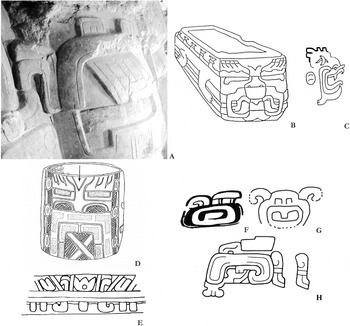
(a) Cival Mask 2's flamed eyebrow compared with Olmec Sky Dragons; (b) La Venta Monument 6; (c) were-jaguars (incision on side of Young Lord Statuette after Benson and de la Fuente 1996:213); (d) incised vase from Tlapacoya (after Joralemon 1971:Figures 12, 21a); (e) Izapan sky band (Izapa Stela 12, after Guernsey Kappelman and Reilly 2001) and Preclassic Maya ahau glyphs; (f) San Bartolo Mural 1 (after Saturno et al. 2005); (g) incised Sierra Red sherd from El Mirador (after Demarest et al. 1984); (h) detail of sky dragon from Tres Zapotes Stela D (after Taube 1995:Figure 3B).
The Cival masks most closely resemble the lower masks on Cerros Structure 5C-2d, which date to about 50 b.c. (Freidel 1986; Freidel et al. 2002; Schele and Freidel 1990:103; Figure 13). They share the L-shaped eye motif, which is often related to the Sun God and other sky deities. Other reoccurring details are the crossed-band element in place of the k'in sign, paw-wing and barbs on the face but incised instead of painted (at Cerros), double merlons, U-sign and paw-wing elements in the eyelid compound, knots and scrolls above the four-dotted earflares, stylized J-fang and teeth emerging from the side of the earflare (instead of fully depicted serpent heads emerging from the earflare at Cerros), and, finally, the exclamation-point water jewel on the forehead. In all, the Cival masks are almost identical to the Cerros masks, except for a few details, such as the presence of sky-frame serpent elements above and beside the masks and the crossed-band motif in lieu of the k'in sign at Cerros.

(a) Lower western mask; (b) lower eastern mask, Cerros, Belize (after Schele and Freidel 1990).
The Preclassic crossed-band motif is known to be associated with the sky in Maya, Izapan, and Olmec art, where it may represent the intersection of the Milky Way with the sun's elliptic (Freidel et al. 1993; Milbrath 1988; Reilly 1995:36). It could also be a precursor to the solar k'in sign with similar solar meaning. The Cerros lower masks have been interpreted as the rising and setting Jaguar Sun God (Schele and Freidel 1990:113). In a recent revision of their iconographic elements, David Freidel, Kathryn Reese-Taylor and David Mora-Marín (2002:64–65) propose that they may represent specific supernaturals such as Yax Balam and the Waterlily Jaguar known from the Popol Vuh as the children of the Maize God.
However, the combination of elements on the Cival mask may also be read to represent other celestial beings known from Preclassic contexts. On Izapan Stela 12 (Figure 14), a sky monster frames the upper part of the monument, and on the sides the artist carved the teeth of its open maw (Guernsey Kappelman and Reilly 2001). This celestial being shares with the Cival mask the motifs of sky band (flame eyebrow, bracketed U sign, and curls), which are repeated in the masks' eye compound (see also Figure 12a), the alternating J and upturned U motifs of fangs and molars along the upper and lateral views of the maw (see also Figure 9a), and the tightly curled volutes and flowering sprouts emerging from them. This volute element is believed to be associated with Middle Preclassic cloud motifs known as lazy-S signs, common at Chalcatzingo, Morelos, where they occur with images of rain-making rituals, bloodletting, and ancestral figures (Reilly 1996). The same cloud motif appears in the Classic period as part of the T632 glyph, which Andrea Stone (1996) reads as muyal and could identify a specific location in the sky associated with creation events, rain-making rituals, and a place where ancestors reside. The meanings of this type of maw and ear volutes in Preclassic and Classic iconography and epigraphy suggest that the Cival masks may represent a sky monster whose mouth is a specific celestial place or separate being that is a portal or mediator to ancestors and rain deities.

Izapa Stela 12 (after Guernsey Kappelman and Reilly 2001).
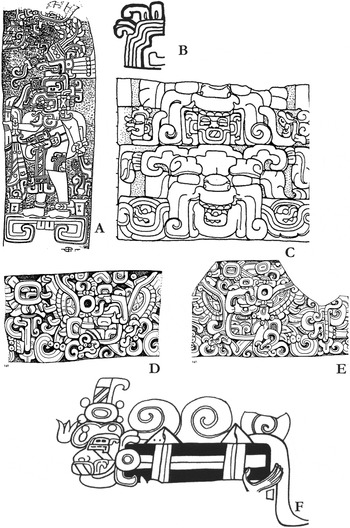
The two contemporaneous bundles carried by black figures painted in the North Wall of the San Bartolo mural (Saturno et al. 2005:Figure 5; Taube, Saturno, and Stuart 2004; Figure 15f) are virtually identical to the Cival deity, having the same L-shaped eye, eyelid, flaming-eyebrow compound, paw-wing motif, and exclamation-point sign on the forehead. William Saturno and colleagues (2005) identify these bundles as a variant of Paul Schellhas's (1904) God C sun god, also recently referred to as the Tzuc God. Freidel and colleagues (1993) identify this same being in a figure carved on the upper masks of Structure X-sub-3 of Group H at Uaxactun (Figure 15c). Its primary identifying trait is the diagonal bracket sign inside the mouth, which is read as the Yucatec word tzuk, meaning partition or mirror, and as being related with the place of creation and the world tree. In the Quiché Popol Vuh, the word tzuc is used to refer to the birth of all heavens (tzuq ronohel kah) and the four creations (u kah tzuquxik [Edmonson 1971:7]). Allen Christenson (2000:39) reads the Quiché word tzuc to mean “to germinate, sprout, bud or grow” when referring to plants, as light when referring to darkness, and as growth of fetus in a womb, and finds these meanings appropriate to the context of the story of creation. The placement of this entity on the top terrace of Structure X-sub-3, above another mask representing an earth monster identified by Freidel and colleagues (1993) as a Witz monster, suggests that Tzuc may be a celestial place of creation and possibly a birthplace of deities. The Principal Bird Deity on Late Preclassic Kaminaljuyu altars 9 and 10 wears a glyphic version of the Maya God C/Tzuc god on its belly, identifying it as “the world tree and place of creation” (Freidel et al. 1993:140; Figure 15d–e). On Kaminaljuyu Stela 11, a tzuk glyphic variant is affixed to the ruler's leg (Figure 15a–b). Both of the San Bartolo bundled Tzuc figures seem to be enveloped in red scrolls of steam or clouds. One, personage 13, has red scrolls emanating from the mouth (Saturno et al. 2005:Figure 5). In this sense, it is possible that the San Bartolo bundles and the Cival masks represent different aspects of a celestial location associated with ancestors, a place in the sky that is also related to rain gods or ancestral spirits, a concept that is most explicitly represented in the sky monster in Izapa Stela 12 (Figure 14). From the epigraphic point of view, in Classic and Postclassic texts, the “God C” (Tzuc) sign is an important component of the water group that precedes the names of other gods (Taube 1996). Saturno and colleagues (2005) point out that this association may identify it as an abstract concept for divinity or sacredness rather than a specific deity and that it may relate to the sacredness and purity of jades. In addition, in Late Preclassic texts, as I note later, parts of the eye-compound/sky-band of the Cival mask and of God C are used as suffixes for the ahau glyph, whereas in later text the k'uhul compound is used to mean holiness or divinity. From these associations we can conclude that the concepts of celestial creation, birth, divinity, and. ancestral spirits as expressed are closely related in the etymology of the word tzuk and certain epigraphic contexts.

Examples of tzuk sign/entity in Late Preclassic contexts. (a) Kaminaljuyu Stela 11; (b) detail of tzuk sign on ruler's leg (after Hansen 1992); (c) stucco masks on Uaxactun Structure X-sub-3 Group H with tzuk head carved inside mouth of upper (celestial) feathered jaguar surmounting creation flower mountain witz monster (after Freidel et al. 1993); (d–e) tzuc motif carved on belly of Principal Bird Deity on basalt alter at Kaminaljuyu (after Parsons 1986:Figures 140, 141); (f) bundled figure 14 from San Bartolo North Wall mural in Structure 1 (after Saturno et al. 2005).
Moreover, in addition to these Late Preclassic and Late Classic Maya motifs, in the corpus of Middle Preclassic Olmec and Mesoamerican art there are several examples of figures with characteristics that strongly suggest overlap in meaning with the Cival masks. These are often known as Sky Dragons or the Olmec Rain God (Joralemon 1971; Taube 1995:Figure 14). One such entity is God I in Peter Joralemon's typology of Olmec gods. Its primary identifying characteristics are “flame eyebrows, other characteristics are L- or trough-shaped eyes, pug nose, rectangular lip markings, gum brackets, and absent lower jaw” (Joralemon 1971:35). Taube (1995) argued that Joralemon's God I category may include more than one deity, a celestial Avian Serpent and the Olmec Rain God.
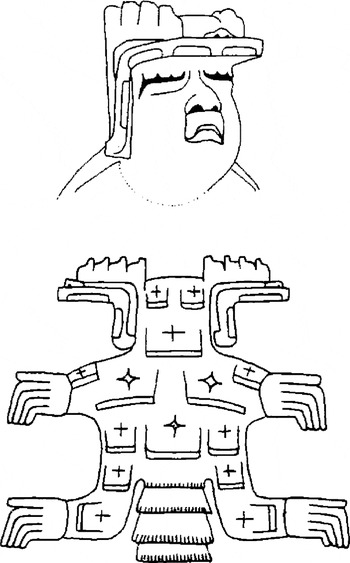
A good example of Olmec God I is Monument 6 from La Venta, which is a hollowed rectangular stone sarcophagus (Joralemon 1971:Figure 145; Figure 12b). On its sides is the full body of God I. The face has flame eyebrows, L-shaped eyes, and a flattened nose. A flashy forked tongue protrudes from a central tooth (Joralemon 1971:51). In another example, a clay figure from Atlihuayan, Morelos, represents a corpulent boy with flame eyebrows and the typical pug nose and upturned lip (Joralemon 1971:Figure 90; Figure 16). He wears on his back the full pelt of a reptilian monster with four flame eyebrows, paw wings, pug nose above a long upper jaw, and open gum brackets. Its skin is decorated with crosses and lozenges. The latter could be lamat (Venus) symbols, while the former would be solar symbols (see also the pairing of k'in and akbal signs on the wings of the Principal Bird Deity (Figure 15d–e). At Cival, lamat signs were painted on limestone blocks that were part of the temple on top of Structure 1 (see Figure 18). The Olmec God I is often represented in association with lozenge-shaped symbols such as in the Las Bocas seals as a four-legged long reptile, possibly an iguana (see also Joralemon's [1971:Figures 9, 92, 134] jaguar dragons). On a potsherd from Tlapacoya, a lamat sign made by a lozenge and four dots is incised in the place of the mouth of God I (Joralemon 1971:139; Figure 18c), in contrast to the crossed-bands sign carved in the mouth of the God I monster on the Tlapacoya vase (Figure 12d). In other cases, the crossed bands are on the eyelids or the chest (Joralemon 1971:42–43, 53; Figure 12d). When placed on heads (eyes) or the chest of figures, the crossed bands may refer to the celestial nature of those beings, but it may also have solar connotations and when paired with the lamat sign, it may indicate both day and night aspects of the sky. The crossed bands centrally positioned in the mouth of the Tlapacoya incised head emphasize a specific celestial location, the maw of the sky monster, as the center of the sky and a portal to the sky itself (Reilly 1995:36). Conceptually, this place could also be referred to in terms of the highest, most central position of the sun in the sky, which in turn may be associated with sun at the zenith.

Clay figure from Atlihuayan, Morelos (after Joralemon 1971).
The concept of the center of the sky also recalls the notion of “Heart of Sky” of the creation stories of the colonial-period Quiché and other Maya groups. It is the supreme and most often mentioned god of the creation story recorded in the Popol Vuh (Christenson 2000). It is synonymous with K'ab awil, the Quiché word for the supreme god who resides in the center of the firmament, and Hu racan, the one-legged god and idol known in the classic period as K'awil, the Maya lightning god (Christenson 2000:41; Girard 1979:31). Heart of Sky, or U K'üx Kaj in Quiché, is one and a triad of storm gods. His names are Ka Kulaha Huracan, Ch'ipi Ka Kulaha, and Raxa Ka Kulaha, which are translated as Leg Lightning, Dwarf Lightning, and Green Lightning by Edmonson (1971:14); as Thunderbolt Hurricane, New Born Thunderbolt, and Raw Hurricane by Dennis Tedlock (1996:64–65); as Thunderbolt Huracan, Small Thunderbolt, and Sudden Thunderbolt by Christenson (2000:42); and, finally, as Lightning Bolt, Brilliant Flash, and Thunder by Rafael Girard (1979:35). This is the triad of beings who initiated the moment of creation with their companions Tepeu and Kukumatz (Sovereign and Feathered Serpent) in the beginning of the Popol Vuh (Tedlock 1996:64).
In Classic Maya inscriptions at Palenque, the celestial dark center and navel of the sky at the top of the world tree is referred to as Wacha-Chan-Ki, or Raised-Sky-Heart (Freidel et al. 1993:105). This place is often associated with umbilical cords and is related to another location known as Na-Ho-Chan, from which the cords emerge from the sky, representing a metaphorical bloodline with the ancestors in the sky. Another related entity is the cloud-serpent carving above the inner doorway of Copan's Temple 22, which is named Wacha-Muyal-Chan and is associated with the Na-Ho-Chan place around which stars revolve and images of ancestors float amid its scrolls (Freidel et al. 1993:426).
In the Cival masks, the eye compound consists of the flaming eyebrow, the double merlon motifs, and the diagonally bracketed U sign over the L-shaped eye (Figure 11). These motifs often appear together on Olmec heads (next to crossed bands), such as Joralemon's God I, and most often on Izapa stelae as the Izapan sky band, which is a pars-pro-toto of the Olmec Sky Dragon or Taube's Avian Serpent (Taube 1995). This composite of elements strongly denotes association with the sky monster, or celestial forces, as it can be seen in the explicit representation of the remainder of its open maw on Izapa Stela 12, for example (Figure 14). As noted earlier, this motif was also used as a glyphic compound for ahau by the Late Preclassic Maya (Figure 11). As such, according to Freidel and colleagues (2002:Figure 3.9a–f), it probably refers to the holy nature of k'uhul ahauob holy lords. Similarly, for the Preclassic Maya, the God C variant reference in the water-group glyph may refer specifically to the heavenly nature of lords as an a priori condition of their divine essence (Taube 1992:27). Another important detail of the Cival masks is the curled motif on the cheeks, which is similar to the scrolls at the corner of the eyes (Figure 9). Taube (1995:84) identifies it as a stylized version of the Olmec “paw-wing” motif of the sky dragon. Similar examples are visible on Tres Zapotes Stela D (Figure 12h) and other Olmec zoomorphic figures that resemble four-legged serpents or saurians. These are Sky Dragons or Taube's Avian Serpents that may be precursors to later Mesoamerican feathered serpents such as Schele and Miller's (1986:192, Plate 67) Maya “vision serpent”, Teotihuacan's feathered serpents, and the Quetzalcoatls of the Postclassic period (Joralemon 1971:82–83; Taube 1995), all of which are associated with the sky. According to Taube (1992:95), the Olmec Avian Serpent is a symbol of sky and of rain-bearing wind. Long ago, J. Walter Fewkes (1894:272) noted that several features of Maya God C are those of a serpent. Consequently, and to summarize, all of the examples noted include specific features that create an overlap in meaning among the Maya gods known as God C or Sun God/Tzuc, God B or Chaak, and God GI of the Palenque Triad, the Olmec Avian Serpents, and the Olmec God I. In addition to the serpent mouth and diverging J fangs, all of these beings share the paw wing on the cheek and flamed eyebrow, the L-shaped eye, the barbel near the mouth, and water signs (i.e., exclamation points, dots, and scrolls on both Cival mask and San Bartolo bundles). Taube (1992:24) also notes that other Late Preclassic masks suggest that GI was originally identified with lightning and rain and that attributes of God GI and the Zapotec storm god Cocijo may derive from an earlier source (Figure 17). Furthermore, the earliest available representation of a Preclassic Maya rain god Chaak is on Stela 1 at Izapa of the Terminal Preclassic period (Norman 1973:Figures 86–91) and shares with the Cival mask the mouth, pug nose, flamed eyebrows, and barbs on the cheeks.

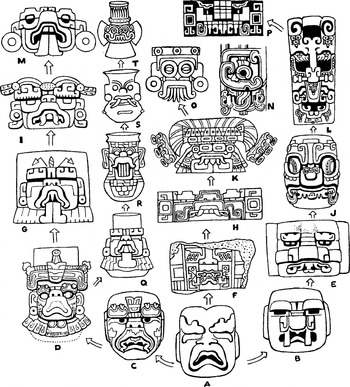
Miguel Covarrubias's diagram of the evolution of Mesoamerican rain gods (after Taube 1995).

(a) Building blocks of temple room of Cival Structure 1-sub-3 decorated with black “star” signs found in the fill covering stucco masks (infrared photograph by Gene Ware); (b) Maya signs for lamat; (c) Olmec star symbol incised on ceramic vessel (after Joralemon 1971).
It is worth noting that, linguistically, there is overlap in meaning between the Yucatec word tzuc, used by epigraphers to read the God C signs, which means partition, birth, and womb (barriga in Spanish), and the Quiché word k'üx (corazon in Spanish) and several of its cognates in other Maya languages that mean heart, belly, vital spirit, or pain. In Yucatec and several Choltian languages, however, the root k'ux is used in the verbs to bite, to eat, and to feel (pain or love) and in nouns such k'u:x for elote ‘ear of corn,’ food, ax, and metal/iron (Kaufman and Justeson 2003). The significance of these overlapping meanings is consistent with the variety of attributes possessed by the Cival masks and suggest that it may represent a celestial being that embodies a number of sacred themes including a specific place in the sky, the creator god, and the making of rain, lightning, maize, and food, which were later developed into a multitude of named deities and which the Quiché Maya referred to as U K'üx Kaj, ‘Heart of Sky.’
In the rubble covering the masks, two stucco-lined limestone blocks were found with traces of black painted signs that may add another clue to the function and meaning of this building (Figure 18). They appear to be representations of the lamat, or Venus star sign, common in Preclassic Isthmian and Maya scripts and iconography. Among the Olmec, this sign is sometimes found in association with the idea of maize as it is seen in a metate from La Venta with four legs framing a lozenge sign carved on the underside (Benson 1995:291). On another block found in the fill covering the masks, and on one from the temple terrace apron, were two profile almond-eyed faces with squared upper jaws similar to the masks, wearing an elaborate headdress. These are more readily interpreted as images of the Maize God.
The painted blocks found in the rubble covering the masks originally formed the temple walls, which were tossed down at the moment of its termination. The exterior was painted in red background with polychrome figures, and the interior was decorated with Maize God figures and black star signs. As noted earlier, Olmec sky monsters are often associated with the lamat–Venus star sign and crossed bands. Together with the masks, the painted blocks provide fragments of the cosmological theme of this Cival temple, with the gods and places of the rain-laden sky of the time of creation, perhaps subsumed under the concept of “Heart of Sky,” initiator of creation, and rain-maker deity, framing the stairway leading to a temple decorated with symbols of the night sky and of the newborn Maize God.
In summary, based on the available evidence, the Cival masks may be interpreted as the primoridial tzuk partition as well as the concept of center of sky, as a celestial place and a being at the same time. This entity appears to be the most important in Maya creation myths and rituals, as suggested by the many associations to the concept of “Heart of Sky” of the Popol Vuh, the supreme creator of the earth, storm god, and initiator of the “germination” of maize.
The masks were placed atop the highest temple on the plaza's eastern horizon, in the direction of the rising sun and of the rain-laden storm winds as seen from the plaza. Because of its prominent location on the highest spot on the Cival ridge surrounded by wetlands, this location appears to be particularly prone to lightning activity (as are most Maya pyramids). For this reason, this could have been a human-made landscape that evoked the creator gods at the celestial place of creation. In a recent review of the iconography of the Cerros masks, Freidel and colleagues (2002) propose that those masks may also represent aspects of the constellations framing the night sky during the birth of the Maize God on the day of creation, 13.0.0.0.0. (August 13, 3114 b.c.). At Cival, the beings represented on the masks and the explicit lamat star symbols decorating the upper temple specifically refer to the theme of the night sky and the moment of the first creation. According to Kathryn Reese-Taylor and Debra Walker (2002), Late Preclassic triadic pyramid complexes such as Uaxactun Group H and Cerros Group 6 mirror a place described in the Palenque texts as Wacha Chanal, Waxac-Na-Tzuc ‘the (Six) Raised-up-Sky, Eight House Partitions,’ where the three realms of the universe—sea, earth, and sky—were separated, the three hearth stones laid, and from there the world tree rose to the center of the sky. The Cival Triadic Group 1 layout, with three main temples plus two inward-facing platforms on either side of the main stairway, may coincide with the latter scheme, focusing attention on the masks on the main pyramid. However, it is equally possible that the triadic temple arrangement was dedicated to the three creator gods subsumed as Heart of Sky in the Popol Vuh (see also Christenson 2000:42). Specific examples similar to the Cival triadic-group pattern are found in the Mirador basin at Nakbe (Structure 59), El Mirador (Danta Pyramid), Yaxha (northeastern Acropolis), and Naranjo (Group C; Dahlin 1984; Graham 1975; Hansen 1992, 1998; Hellmuth 1978). In each of these cases, the high triadic group is located immediately to the east and in line with the main east–west axis of the E-group complex, which is also the site's main axis. Seen from the E-group plaza, this elevated location would occupy the eastern sky and may be identified with a celestial place on the horizon through which to observe the appearance of celestial bodies associated with the creation story (see also Freidel et al. 1993). Similarly, the Aztec Templo Mayor, at Tenochtilan, was built on the east side of the plaza and in line with Mount Tlalocan situated on the far eastern horizon to situate Tlaloc rituals in their cosmological directionality (Arnold 1999).
In retrospect, the cosmic theme expressed in the monumental sculptures of Cival's triadic group is related to the themes of water, birth of the maize god, and the raising of a cross-shaped world tree expressed by a much earlier generation of Cival rulers in Cache 4 of the E-group plaza. The elaborate jade cache was deposited sometime around 680–600 b.c., while the masks on the fourth construction phase of Triadic Group 1, described earlier, were created sometime between 200 and 160 b.c., continuing the long-standing iconographic tradition of ritual practice and cosmological ideology. This continuity in ritual themes in Cival's relatively confined space suggests that Cival's rulers were actively participating in the ideological charter of Maya kingship by Middle Preclassic times, as were their contemporary Olmec neighbors, and were direct precursors to the complex set of symbols used by their Classic-period successors. This ideology and these ritual practices were elaborated in stages that are still largely undocumented by archaeology. It evoked the most powerful agrarian symbols such as maize and rain deities to represent central authority through ritual reenactments. Cival's architectural climax, with its massive triadic building complex, marked the apical point of a centuries-long progression of ritual practice, state ideology, and central authority.
EPILOGUE
After a.d. 100, ritual activity at Cival diminished significantly. The next major temple-building project occurred in a different location, 7 km to the south, at Holmul. In Group II Building B, Raymond Merwin excavated in 1911 two elite burials with fine ceramics belonging to the complex known as Holmul I or “Protoclassic”, or the Terminal Preclassic phase dating to a.d. 150–250 (Merwin and Vaillant 1932).
After a.d. 150, Holmul rapidly became the largest center of power in this region, and in the fifth century, Building B was repeatedly enlarged and eventually used to entomb a total of 23 individuals before being buried itself under a new structure early in the sixth century (Merwin and Vaillant 1932; Neivens and Estrada-Belli 2004). Throughout this time and until their Terminal Classic collapse, the Holmul elite ruled over a territory encompassing the former domain of Preclassic Cival (Estrada-Belli 2005).
CONCLUSIONS
The initial development of centralized power and dynastic ideology in the Holmul region occurs at Cival, one of several Preclassic centers surrounding the better-known Classic-period city of Holmul. The constant remodeling of architecture and the deposition of many offerings recently recorded at Cival punctuate a steady increase in complexity and sophistication during the Middle and Late Preclassic periods. The wealth of the offerings and the scale of the architecture associated with them suggest the emergence of the Preclassic Maya state sometime in the Middle Preclassic period. The rich metaphors of the plaza offerings and the iconography of Cival's Preclassic monumental art are in many ways direct precursors of the ideology of Classic Maya kingship. The evidence from Cival neatly parallels developments in the Mirador basin demonstrating that changes in social complexity occurred in a widespread area of the lowlands contemporaneously with the development of large-scale architecture and elaborate iconography at Nakbe. Increasingly, as new archaeological finds (within and outside the Mirador basin) document the sophistication in monumental art, iconography, architecture, and even hieroglyphic writing of the Preclassic Maya (Saturno et al. 2005), any presumed disparity or organizational diversity across areas of the Maya Lowlands appears to be less significant (Sharer 1992:134).
The evidence from Cival and other recently investigated sites suggests that the development of Maya states was a long, drawn-out process that has it roots in the Maya Lowland societies of the early part of the Middle Preclassic. This was a gradual and steady process of growth in which the Maya intensified wide-ranging interactions with the contemporary Gulf Coast Olmec and other Preclassic-period cultures of Mesoamerica. Rather than a stagnant period preceding a sudden dramatic growth in the Late Preclassic and awaiting the decline of Gulf Coast Olmec, the Middle Preclassic period was a time of great changes in Maya society paralleling developments in the Olmec heartland.
The Holmul regional data also seem to challenge a widely held view that during the transition from the Preclassic to the Classic period, a “transformation of the lowland elite and the political system under their control” occurred (Sharer 1992:134), one in which the legitimization of individual rulers through genealogy and supernatural charter in public space was the prime motivation for monumental art that was not required in the Preclassic political system (Freidel and Schele 1988). The most recent additions to the corpus of Preclassic iconography and the documented ritual practices associated with it indicate that a much greater degree of unmodified continuity exists between the ideology of Preclassic hereditary rulers and their Classic Maya successors.
As in the Classic period, the life and death cycle of maize and rain-making divination were two of the most central concepts in the ideology of Preclassic Lowland Maya rulers.
In the early stages of development, a certain amount of conceptual overlap with Olmec ideology is evident. The Olmec offerings at Cerro Manatí (Ortiz and Rodríguez 2000), La Venta (Drucker et al. 1959:185), and San Isidro Chiapas (Lowe 1981:243–245), and the Maya offerings of great disposable wealth at Cival and Seibal, emphasized the precious jade celts as substitutes for sprouting maize plants and replicated the quadripartite forms of the cosmos and the calendar. As in Olmec and Classic Maya ideology, the central position in the cosmic quincunx was appropriated by the Cival ruler, as the reborn maize god, the world tree, and the new time cycle. This was expressed successively as a maize-like jade celt, as a post or tree stump above the center of Cival's jade cache, and as a celtiform stela (Stela 2) erected in this location at the onset of the Late Preclassic period. Subsequently, with a major leap in volumetric scale, the new triadic temples on the plaza's eastern horizon bore grandiose images of rain-bearing celestial deities, which clearly resemble Middle Preclassic Olmec examples on portable art. These similarities clearly demonstrate a common ideological background rooted in lowland agrarian ways of life shared by Gulf Coast Olmec and early Maya elites that continued through the Classic period with little change (see also Fields and Reents-Budet 2005). Significant idiosyncratic differences exists between the two cultures that may be due to divergent ethnic identity and this warrants further analysis. Little evidence exists for direct exchange between the Cival area and the Olmec heartland during the Middle and Late Preclassic periods, although such contacts had to be frequent. The presence of blue-green jade axes at Cival in the eastern lowlands, as well as a blue-green jade bloodletter and celts at Seibal to the southwest (Smith 1982), blue-green jade spoons at Cuello to the northeast (Hammond 1991), and at Chacsinkin in the northern lowlands (Andrews V 1990) has suggested direct trade links with the La Venta Olmecs in the Middle Preclassic. Richard Diehl (2004:151) has recently suggested that one still undiscovered Olmec “colony” had to be located at or near the jade sources in the Motagua Valley. Given the location of the source of blue-green jade at the heart of the Maya region, it will be very important to document further the production and chain of distribution of the highly prized blue-green jade objects and clarify whether they were made exclusively in the Olmec region or locally by Maya artisans before they were traded.
The still preliminary archaeological record of Cival suggests that this ceremonial center grew to be the capital of a state-level dynastic polity early in the Late Preclassic period and that it had eclipsed by a.d. 150, like several other centers in the Mirador basin and elsewhere in the Maya Lowlands. But not all centers were affected by a collapse in the Holmul region. Between a.d. 150 and 350, a local elite seem to have prospered at Holmul and left elaborate burials in Building B of Group II. The presence of a hastily built defensive wall around the Cival plazas seems to indicate a sudden and violent end of the political leadership there. The ceremonial core of Cival ceased to function, but pockets of residences were occupied through the Classic period. While still more studies are needed on the transition from the Preclassic to Classic political systems, the available evidence suggests that the changes that occurred in the Holmul region were a result of political competition among elite factions rather than systemic transformations of the political structure and of its ideological values.
RESUMEN
Las investigaciones arqueológicas recientes en la región de noreste de Peten en Holmul y sus centros menores demuestran una compleja historia de ritual público desde la época preclásica media en adelante. Los rasgos de arquitectura, escultura monumental, iconografía, ofrendas, y entierros encontrados en Holmul y Cival documentan el inicio precoz de la ideología de los gobernantes maya. La escultura monumental del preclásico tardío que adorna las pirámides proporciona metáforas complejas de los patronos de las dinastías emergentes. La arquitectura del preclásico medio y sus ofrendas están codificadas con un programa ideológico institucionalizado que incorpora temas del orden cosmológico, solares, de agua, de la deidad del maíz, de la agricultura, y del culto a los ancestros. Todas estas reliquias tempranas se encuentran en el primer espacio sagrado de Cival, la plaza del “Grupo E” y son ejemplos de una ideología de poder que sigue sin interrupción hasta fines de la época clásica.
ACKNOWLEDGMENTS
The initial season of the Holmul Archaeological Project in 2000 was a Boston University project, funded by grants to the author from the National Geographic Society and the Foundation for the Advancement of Mesoamerican Studies, Inc. (FAMSI), to the author and a special grant from Ahau Foundation to Professor Norman Hammond. This article is based on fieldwork carried out at Cival and Holmul by several dedicated individuals during the 2001–2005 seasons: Jeremy Bauer, Josué Calvo, Angel Castillo, Claudio Lozano Guerra-Librero, Dan Leonard, Molly Morgan, Niña Neivens de Estrada, and Antolin Velazquez. Their efforts are greatly appreciated. This work was made possible by generous support from the National Geographic Society, the Ahau Foundation, Boston University Department of Archaeology (2000), FAMSI., the Reinhart Foundation, ARB-USA, Warn, PIAA, Interco Tire, Toyota Motors, Yamaha Motors, an anonymous donor, and the hard work of 70 workmen from Melchor de Mencos. Permission to work in the Holmul region was kindly granted by the Instituto Nacional de Antropología e Historia of Guatemala, through the graces of Nora Lopez, Paulino Morales, and Salvador Lopez, directors of the Department of Monuments. I thank Clemency Coggins, Norman Hammond, Peter Harrison, William Saturno, David Stuart, and George Stuart for their support and advice during the research. Many thanks to Clemency Coggins, Julia Guernsey, Norman Hammond, Virginia Miller, Kathryn Reese-Taylor, and Karl Taube for their generous comments on earlier drafts of this report. Any errors or omissions are mine.