Family environment is a key influence on the course of psychosis (Cechnicki et al., Reference Cechnicki, Bielańska, Hanuszkiewicz and Daren2013). For many, family members are directly involved in the provision of care. A study of informal caregivers found that approximately 44% reported spending over 32 h per week with their family member with psychosis (Roick et al., Reference Roick, Heider, Toumi and Angermeyer2006). Family interventions (FIs) have been shown to reduce the likelihood of relapse for individuals across the spectrum of psychosis (Pharoah et al., Reference Pharoah, Mari, Rathbone and Wong2010) and are recommended in practice guidelines for psychosis internationally (NICE Clinical Guideline, 2014; Galletly et al., Reference Galletly, Castle, Dark, Humberstone, Jablensky, Killackey, Kulkarni, McGorry, Nielssen and Tran2016).
The affective attitudes and behaviours manifested within the family environment have been characterised as expressed emotion (EE; Leff and Vaughn, Reference Leff and Vaughn1984). Various tools have been developed to measure EE, the gold-standard being the Camberwell Family Interview (CFI; Leff and Vaughn, Reference Leff and Vaughn1984), which measures five dimensions: criticism, hostility, emotional over-involvement (EOI), warmth and positive remarks. Whilst the CFI provides a framework within which both negative and positive aspects of the environment can be captured, in practice the negative aspects have received far greater attention than the positive such that EE has become synonymous with a negative family atmosphere (Leff, Reference Leff1989). This focus likely reflects the fact that in early CFI studies, warmth showed a curvilinear relationship with relapse for individuals diagnosed with schizophrenia, such that medium levels of family warmth predicted the lowest relapse rates (due to a tendency for high EOI to co-occur with high warmth). The predictive value of positive remarks, meanwhile, was not reported (Brown et al., Reference Brown, Birley and Wing1972). Subsequently, the warmth and positive remarks sub-scales were excluded from calculation of the EE index, the metric most commonly derived from the CFI and used to predict outcomes. The dichotomous EE index has been used to characterise families (or individuals) as ‘high EE’ or ‘low EE’, with high EE reflecting higher levels of criticism or EOI or the presence of hostility.
A robust finding within the literature is that individuals exposed to high EE environments are at a greater risk of relapse than those in low EE environments (Butzlaff and Hooley, Reference Butzlaff and Hooley1998). Consequently, reducing high EE has become a key aim of many FIs in psychosis (Pharoah et al., Reference Pharoah, Mari, Rathbone and Wong2010). Whilst there is strong evidence for the predictive utility of the EE index in psychosis, characterising the affective environment of families using a dichotomous measure, derived solely based on negative factors, has clear limitations. The relative emphasis on caregivers as potential risk factors rather than protective factors has been argued to potentially undervalue and disempower families (López et al., Reference López, Nelson Hipke, Polo, Jenkins, Karno, Vaughn and Snyder2004; Lee et al., Reference Lee, Barrowclough and Lobban2014) and to neglect potential mechanisms of change in FIs (Claxton et al., Reference Claxton, Onwumere and Fornells-Ambrojo2017).
A growing number of studies have measured the relationship between positive EE dimensions and outcomes including more traditional relapse rates, but also domains such as social functioning and life satisfaction. An evaluation of the potential predictive value of these more positive aspects of the family environment is, therefore, timely. Given the accumulation of research relating to positive dimensions of EE, and the need to provide a balanced view of the role of EE in the context of psychosis, we sought to systematically identify, synthesise and evaluate evidence regarding their role in psychosis. Specifically, the question the review aims to answer is: are positive family factors, as reflected in warmth and positive remarks measured on the CFI, related to outcomes in psychosis?
Method
Search strategy
This study was conducted in accordance with PRISMA guidelines (Liberati et al., Reference Liberati, Altman, Tetzlaff, Mulrow, Gøtzsche, Ioannidis, Clarke, Devereaux, Kleijnen and Moher2009). Relevant papers were identified by conducting a systematic search of the electronic databases EMBASE, MEDLINE, PsycINFO, PubMed and Web of Science from inception to April 2017. Medical Subject Headings was used to maximise search results. Search terms were selected to capture papers relating to psychosis (psychosis; psychoses; psychotic; schizophreni*; ‘severe mental’; ‘serious mental’; ‘serious psychiatric’; paranoi*; delusion*; hallucination*; ‘thought disorder’) and warmth or positive remarks (warm*; ‘expressed emotion’; ‘positive remarks’). Within each search set, terms were linked using the Boolean operator ‘OR’ and the two sets of terms were linked using ‘AND’. Terms were used to search titles and abstracts (and topics in Web of Science). Results were limited to English language. Reference lists of relevant retrieved articles were searched for additional studies.
Eligibility criteria
Study inclusion criteria were: (i) participants with psychosis or those at high risk for psychosis based on a validated measure of prodromal symptoms; (ii) measurement of warmth and/or positive remarks of a relative or other informal caregiver on the CFI; (iii) measurement of a relevant outcome for the individual with (or at risk of) psychosis (including relapse, symptom severity, hospital admission, social functioning and quality of life-related outcomes); (iv) a test of the relationship between warmth or positive remarks and the outcome measure and (v) an adult or adolescent sample. Exclusion criteria were: (i) grey literature; (ii) qualitative studies, (iii) single-case studies; (iv) psychosis secondary to organic pathology; (v) heterogeneous samples and (ix) positive EE measured in caregivers/staff. Two studies were excluded based on all relevant data being reported within other included studies.
Camberwell family interview
For inclusion, studies needed to use the CFI to measure warmth or positive remarks. Alternative measures of family environment [e.g. Family Environment Scale (Moos and Moos, Reference Moos and Moos1994); Family Assessment Device (Epstein et al., Reference Epstein, Baldwin and Bishop1983); Parental Bonding Instrument (Parker et al., Reference Parker, Tupling and Brown1979)] were considered. However, we decided to exclude these because combining findings from studies using alternative predictor measures would have increased the heterogeneity of included studies, obfuscating interpretation of results. We also excluded self-report measures of warmth as perceived EE and CFI-rated EE have been found to measure slightly different constructs and are more subjective than the third-party rated CFI. For example, studies included in the current review that measured perceived and CFI-rated warmth found only a moderate correlation between the two (Schlosser et al., Reference Schlosser, Zinberg, Loewy, Casey-Cannon, O'Brien, Bearden, Vinogradov and Cannon2010; Lee et al., Reference Lee, Barrowclough and Lobban2014). Furthermore, self-report measures of parental warmth, such as the EMBU (Perris et al., Reference Perris, Arrindell, Perris, Eisemann, Van der Ende and von Knorring1986), are often rated retrospectively, referring to parental warmth during the person's upbringing.
Warmth is measured on the CFI using a six-point global rating (0 = no warmth, 5 = high warmth) reflecting tone of voice, spontaneity, sympathy, concern or empathy and interest in the person. Positive remarks are measured as a frequency count, based on the number of positive remarks made during the interview. Positive remarks are primarily defined by content that expresses praise, appreciation or approval, but tone of voice is also taken into account in its scoring.
Study selection and data extraction
The article selection process is illustrated in Fig. 1. The search produced 4689 results. Duplicate results were removed using Endnote reference manager before titles and abstracts were screened for inclusion. Full text articles were obtained for all potentially eligible studies, which were then reviewed according to eligibility criteria. RB assessed study eligibility with queries resolved through discussion with the research team. An independent rater assessed reliability of the selection process by reviewing 10% of titles and full-text articles. Estimates of inter-rater reliability showed good agreement at screening (κ = 0.73, p < 0.001) and full-text stages (κ = 0.70, p < 0.001; Landis and Koch, Reference Landis and Koch1977). Data were extracted from included studies using a standardised form capturing details of the study sample, design, measures, analyses, results and strengths and limitations. Where sufficient data were available, effect sizes were calculated (Table 1). Eligible studies were assessed for risk of bias and study quality to inform the critical evaluation of their findings using an adapted version of the Effective Public Health Practice Project tool (EPHPP; Thomas et al., Reference Thomas, Ciliska, Dobbins and Micucci2004). A proportion of included studies were second rated for quality, with 100% agreement reached across all domain ratings.
Flowchart of study selection process.

Study effect sizes

PR, positive remarks; f-u, follow-up; mt, months; RCT, randomised controlled trial.
a Not possible to calculate effect size d from data reported.
b Range of significant effects as data only provided for significant results.
Data analysis
Extracted data were tabulated and synthesised into a narrative review. There was a degree of heterogeneity across outcome measures utilised, as well as the study designs, follow-up periods and sample populations (in terms of culture and stage of psychosis). Study heterogeneity, as well as variable study quality, could have rendered a meta-analysis of included studies misleading. A narrative review of results was, therefore, deemed most appropriate. However, individual study effect sizes were included to aid assessment of the magnitude of relationships found and aid cross-study comparisons. Study findings were reviewed primarily according to outcome measures used. Where inconsistencies were observed, factors such as study culture and stage of psychosis were considered alongside quality assessment to inform interpretation.
Results
Overview of included studies
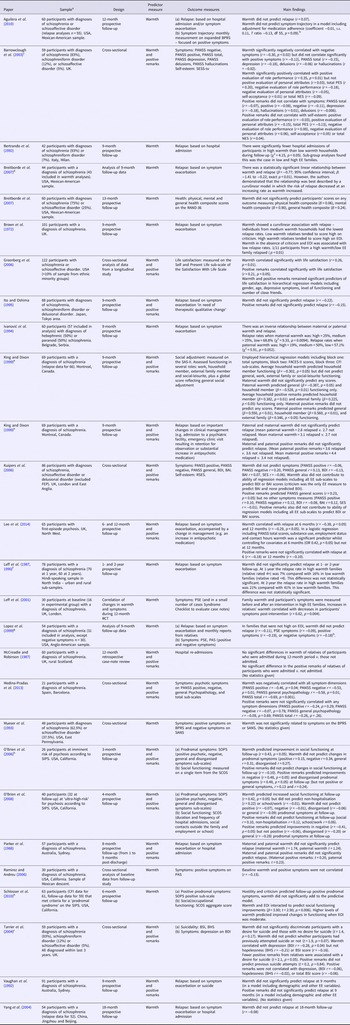
A summary of relevant findings of the 27 studies included is presented in Table 2.
Summary of main review findings

BAI, Beck Anxiety Inventory (Beck et al., Reference Beck, Epstein, Brown and Steer1988); BDI, Beck Depression Inventory (Beck et al., Reference Beck, Ward, Mendelson, Mock and Erbaugh1961); BPRS, Brief Psychiatric Rating Scale (Overall and Gorham, Reference Overall and Gorham1962); BHS, Beck Hopelessness Scale (Beck and Steer, Reference Beck and Steer1978); BSI, Beck Suicidal Ideation Scale (Beck and Steer, Reference Beck and Steer1991); NES, Negative Evaluation of Self; FACES II, Family Adaptability and Cohesion Evaluation Scale (Olson et al., Reference Olson, Portner and Lavee1985); PANSS, Positive and Negative Symptoms Scale (Kay et al., Reference Kay, Fiszbein and Opler1987); PAS, Psychiatric Assessment Scale (Krawiecka et al., Reference Krawiecka, Goldberg and Vaughan1977); PES, Positive Evaluation of Self; PSE, Present State Examination (Wing et al., Reference Wing, Cooper and Sartorius1974); RAND-36, RAND 36-Item Health Inventory (Hays et al., Reference Hays, Prince-Embury and Chen1998); RSES, Rosenberg Self-Esteem Scale (Rosenberg, Reference Rosenberg1965); SANS, Scale for the Assessment of Negative Symptoms (Andreasen, Reference Andreasen1982); SAS-II, Social Adjustment Scale; Satisfaction With Life Scale (Test et al., Reference Test, Greenberg, Long, Brekke and Burke2005); SCOS, Strauss-Carpenter Outcome Scales (Strauss and Carpenter, Reference Strauss and Carpenter1972); SESS-sv, Self-Evaluation and Social Support Interview (Humphreys et al., Reference Humphreys, Barrowclough and Andrews2001); SIPS, Structured Interview for Prodromal Symptoms (Miller et al., Reference Miller, McGlashan, Rosen, Somjee, Markovich, Stein and Woods2002); SOPS, Scale of Prodromal Symptoms (Miller et al., Reference Miller, McGlashan, Rosen, Somjee, Markovich, Stein and Woods2002).
a Study samples included both the person with (or at risk of) psychosis and their caregiver(s). Numbers represent the number of people with (or at risk of) psychosis included in the sample.
b Symptom scores contributed to evaluation of relapse.
c Barrowclough et al. (Reference Barrowclough, Tarrier, Humphreys, Ward, Gregg and Andrews2003) and Tarrier et al. (Reference Tarrier, Barrowclough, Andrews and Gregg2004) report data from the same sample.
d Breitborde et al. (Reference Breitborde, López, Wickens, Jenkins and Karno2007) analysed data from Karno et al. (Reference Karno, Jenkins, De la Selva, Santana, Telles, Lopez and Mintz1987).
e King and Dixon (Reference King and Dixon1999) report data from the same sample.
f Leff et al. (Reference Leff, Wig, Menon, Bedi, Kuipers, Ghosh, Korten, Ernberg, Day and Sartorius1987) and (Reference Leff, Wig, Bedi, Menon, Kuipers, Korten, Ernberg, Day, Sartorius and Jablensky1990) report 1-year and 2-year data, respectively, from the same sample.
g Lopez et al. (Reference Lopez, Nelson, Snyder and Mintz1999) report data collected by Vaughn et al. (Reference Vaughn, Snyder, Jones, Freeman and Falloon1984).
h 24/63 participants in Schlosser et al. (Reference Schlosser, Zinberg, Loewy, Casey-Cannon, O'Brien, Bearden, Vinogradov and Cannon2010) also took part in O'Brien et al. (Reference O'Brien, Gordon, Bearden, Lopez, Kopelowicz and Cannon2006).
All 27 studies tested the relationship between warmth and outcomes; 14 studies also measured positive remarks as a predictor. Most studies employed cohort designs (n = 19); the remaining were cross-sectional. Most studies were conducted in the USA (n = 10); four of these focused on Mexican-American participants. In a number of instances, data are reported for the same sample in more than one paper. However, these report findings using different outcome measures in all cases (relevant cases are noted in Table 2). Most participants had a schizophrenia-spectrum disorder diagnosis (n = 23). The most widely used measure of outcome was relapse rate (n = 14), defined according to symptom exacerbation and/or a change in clinical management (including hospital admission). Levels of symptoms, both psychotic and non-psychotic, were used in nine studies, and three studies measured prodromal symptoms. Other outcomes included social functioning (n = 4), life satisfaction (n = 1) and health (n = 1). Quality assessment scores are shown in online Supplementary Table S1. No study was deemed ‘strong’ across all domains assessed on the EPHPP. This was largely due to studies being cross-sectional in design and limitations in sample representativeness.
Relapse
Of the 15 studies that tested the relationship between relapse and warmth, five reported a statistically significant association (Brown et al., Reference Brown, Birley and Wing1972; Bertrando et al., Reference Bertrando, Beltz, Bressi, Clerici, Farma, Invernizzi and Cazzullo1992; Ivanović et al., Reference Ivanović, Vuletić and Bebbington1994; Breitborde et al., Reference Breitborde, López, Wickens, Jenkins and Karno2007; Lee et al., Reference Lee, Barrowclough and Lobban2014) and ten did not (Leff et al., Reference Leff, Wig, Menon, Bedi, Kuipers, Ghosh, Korten, Ernberg, Day and Sartorius1987, Reference Leff, Wig, Bedi, Menon, Kuipers, Korten, Ernberg, Day, Sartorius and Jablensky1990;Footnote 1Footnote † McCreadie and Robinson, Reference McCreadie and Robinson1987; Parker et al., Reference Parker, Johnston and Hayward1988; Vaughan et al., Reference Vaughan, Doyle, McConaghy, Blaszczynski, Fox and Tarrier1992; Ito and Oshima, Reference Ito and Oshima1995; King and Dixon, Reference King and Dixon1999; Lopez et al., Reference Lopez, Nelson, Snyder and Mintz1999; Yang et al., Reference Yang, Phillips, Licht and Hooley2004; Aguilera et al., Reference Aguilera, López, Breitborde, Kopelowicz and Zarate2010). Where a relationship was found, lower rates of caregiver warmth was associated with higher participant relapse rates across cultures and phase of psychosis, even when controlling for potential confounds (Bertrando et al., Reference Bertrando, Beltz, Bressi, Clerici, Farma, Invernizzi and Cazzullo1992; Lee et al., Reference Lee, Barrowclough and Lobban2014). One of the strongest quality rated papers included in the review found an association with relapse in first-episode psychosis (Lee et al., Reference Lee, Barrowclough and Lobban2014). Differences in stage of psychosis do not appear to explain the inconsistency of findings across other studies, which were all in samples with a schizophrenia-spectrum diagnosis. Studies that failed to find an association between warmth and relapse were largely comparable with those that did in terms of quality assessment profiles. Control for EE dimensions such as EOI was variable between studies reviewed, with no evidence of a systematic relationship between controlling for EE dimensions and positive or negative findings. Definition of relapse also failed to effect relationships with outcomes. Some studies argued that the relationship between warmth and relapse was best characterised as curvilinear; although, there was disagreement between these as to whether protective effects were most likely at moderate (Brown et al., Reference Brown, Birley and Wing1972) or high levels of warmth (Breitborde et al., Reference Breitborde, López, Wickens, Jenkins and Karno2007).
All but one (McCreadie and Robinson, Reference McCreadie and Robinson1987) of the relapse studies employed prospective follow-up designs. At 9-month follow-up, four studies found an association (Brown et al., Reference Brown, Birley and Wing1972; Bertrando et al., Reference Bertrando, Beltz, Bressi, Clerici, Farma, Invernizzi and Cazzullo1992; Ivanović et al., Reference Ivanović, Vuletić and Bebbington1994; Breitborde et al., Reference Breitborde, López, Wickens, Jenkins and Karno2007) and four did not (Vaughan et al., Reference Vaughan, Doyle, McConaghy, Blaszczynski, Fox and Tarrier1992; Ito and Oshima, Reference Ito and Oshima1995; King and Dixon, Reference King and Dixon1999; Lopez et al., Reference Lopez, Nelson, Snyder and Mintz1999). Studies with follow-up greater than 9 months failed to find an association (Leff et al., Reference Leff, Wig, Menon, Bedi, Kuipers, Ghosh, Korten, Ernberg, Day and Sartorius1987, Reference Leff, Wig, Bedi, Menon, Kuipers, Korten, Ernberg, Day, Sartorius and Jablensky1990; McCreadie and Robinson, Reference McCreadie and Robinson1987; Yang et al., Reference Yang, Phillips, Licht and Hooley2004; Aguilera et al., Reference Aguilera, López, Breitborde, Kopelowicz and Zarate2010), apart from Lee et al. (Reference Lee, Barrowclough and Lobban2014) who found significant correlations between warmth and relapse at 6 (large effect size) and 12 months (medium effect size); although, the 12-month relationship was no longer significant when total symptoms on the Positive and Negative Syndrome Scale (PANSS), substance use, employment and contact time with relative were controlled for. Differences in study culture do not appear to explain discrepancies found. However, studies outside of the USA/Europe reported null findings (Leff et al., Reference Leff, Wig, Menon, Bedi, Kuipers, Ghosh, Korten, Ernberg, Day and Sartorius1987, Reference Leff, Wig, Bedi, Menon, Kuipers, Korten, Ernberg, Day, Sartorius and Jablensky1990; Parker et al., Reference Parker, Johnston and Hayward1988; Vaughan et al., Reference Vaughan, Doyle, McConaghy, Blaszczynski, Fox and Tarrier1992; Ito and Oshima, Reference Ito and Oshima1995; King and Dixon, Reference King and Dixon1999; Yang et al., Reference Yang, Phillips, Licht and Hooley2004).
Six studies tested the relationship between positive remarks and relapse, none of which found a significant association (McCreadie and Robinson, Reference McCreadie and Robinson1987; Parker et al., Reference Parker, Johnston and Hayward1988; Vaughan et al., Reference Vaughan, Doyle, McConaghy, Blaszczynski, Fox and Tarrier1992; Ito and Oshima, Reference Ito and Oshima1995; King and Dixon, Reference King and Dixon1999; Lee et al., Reference Lee, Barrowclough and Lobban2014).
Symptom severity
Composite symptom scores
Four studies examined associations between warmth and overall symptom scores (Lopez et al., Reference Lopez, Nelson, Snyder and Mintz1999; Leff et al., Reference Leff, Sharpley, Chisholm, Bell and Gamble2001; Medina-Pradas et al., Reference Medina-Pradas, Navarro, Pousa, Montero and Obiols2013). Two longitudinal studies examined whether warmth predicted changes in scores on the Present State Examination (Wing et al., Reference Wing, Cooper and Sartorius2012), with one finding a significant association [large effect size (Leff et al., Reference Leff, Sharpley, Chisholm, Bell and Gamble2001)] and the other finding no association [trivial effect size (Lopez et al., Reference Lopez, Nelson, Snyder and Mintz1999)]. The contradictory findings may reflect differences in study design. Lopez et al. (Reference Lopez, Nelson, Snyder and Mintz1999) employed an observational longitudinal design, where baseline warmth was used to predict symptoms during a follow-up period. Leff et al. (Reference Leff, Sharpley, Chisholm, Bell and Gamble2001) reported findings from a FI trial, with increases in relatives’ warmth found to correlate significantly with reductions in individuals with psychosis’ symptoms when pre- and post-intervention scores were compared. Two cross-sectional studies examined whether warmth related to PANSS total symptoms; one study found a strong negative association (Medina-Pradas et al., Reference Medina-Pradas, Navarro, Pousa, Montero and Obiols2013) while the other found a small, non-significant, association (Barrowclough et al., Reference Barrowclough, Tarrier, Humphreys, Ward, Gregg and Andrews2003). Although limited, there is some evidence that warmth may be associated with better outcomes in terms of overall symptom measures. Both studies did not find a significant association between positive remarks and PANSS total scores.
Positive psychotic symptoms
Of the seven studies that examined warmth and positive symptoms (Mueser et al., Reference Mueser, Bellack, Wade, Sayers, Tierney and Haas1993; Lopez et al., Reference Lopez, Nelson, Snyder and Mintz1999; Barrowclough et al., Reference Barrowclough, Tarrier, Humphreys, Ward, Gregg and Andrews2003; Kuipers et al., Reference Kuipers, Bebbington, Dunn, Fowler, Freeman, Watson, Hardy and Garety2006; Ramirez and Andreu, Reference Ramirez and Andreu2006; Aguilera et al., Reference Aguilera, López, Breitborde, Kopelowicz and Zarate2010; Medina-Pradas et al., Reference Medina-Pradas, Navarro, Pousa, Montero and Obiols2013), only one found a significant and large association (Medina-Pradas et al., Reference Medina-Pradas, Navarro, Pousa, Montero and Obiols2013; this was one of the weakest rated studies). Three studies examined whether positive remarks related to positive symptom levels (Barrowclough et al., Reference Barrowclough, Tarrier, Humphreys, Ward, Gregg and Andrews2003; Kuipers et al., Reference Kuipers, Bebbington, Dunn, Fowler, Freeman, Watson, Hardy and Garety2006; Medina-Pradas et al., Reference Medina-Pradas, Navarro, Pousa, Montero and Obiols2013); no significant relationships were evident.
Negative psychotic symptoms
Five studies tested for a relationship between warmth and negative symptoms; two found a significant association (Barrowclough et al., Reference Barrowclough, Tarrier, Humphreys, Ward, Gregg and Andrews2003; Medina-Pradas et al., Reference Medina-Pradas, Navarro, Pousa, Montero and Obiols2013) and three did not (Mueser et al., Reference Mueser, Bellack, Wade, Sayers, Tierney and Haas1993; Lopez et al., Reference Lopez, Nelson, Snyder and Mintz1999; Kuipers et al., Reference Kuipers, Bebbington, Dunn, Fowler, Freeman, Watson, Hardy and Garety2006). The studies were largely comparable across quality domains, with the exception of confounders. The studies that did not find an association made strong attempts to control for potential confounding variables (e.g. history of illness; other EE dimensions); the medium to large associations found by Barrowclough et al. (Reference Barrowclough, Tarrier, Humphreys, Ward, Gregg and Andrews2003) and Medina-Pradas et al. (Reference Medina-Pradas, Navarro, Pousa, Montero and Obiols2013) might reflect other, uncontrolled variables. Findings regarding positive remarks and negative symptoms (Barrowclough et al., Reference Barrowclough, Tarrier, Humphreys, Ward, Gregg and Andrews2003; Kuipers et al., Reference Kuipers, Bebbington, Dunn, Fowler, Freeman, Watson, Hardy and Garety2006; Medina-Pradas et al., Reference Medina-Pradas, Navarro, Pousa, Montero and Obiols2013) were not significant.
Affective symptoms and general psychopathology
Three cross-sectional UK studies examined whether family warmth was associated with depression in psychosis (Barrowclough et al., Reference Barrowclough, Tarrier, Humphreys, Ward, Gregg and Andrews2003; Tarrier et al., Reference Tarrier, Barrowclough, Andrews and Gregg2004; Kuipers et al., Reference Kuipers, Bebbington, Dunn, Fowler, Freeman, Watson, Hardy and Garety2006). Tarrier et al. (Reference Tarrier, Barrowclough, Andrews and Gregg2004) found that greater warmth was significantly correlated with lower scores on the Beck Depression Inventory (BDI). In the same sample, Barrowclough et al. (Reference Barrowclough, Tarrier, Humphreys, Ward, Gregg and Andrews2003) did not find an association between warmth and depression measured on the depression sub-scale of the Positive and Negative Syndrome Scale (PANSS-D; Kay et al., Reference Kay, Fiszbein and Opler1987). A systematic review found the BDI and PANSS-D to be valid and reliable for measuring depression in schizophrenia, with the BDI having slightly lower sensitivity and specificity than the PANSS-D (Lako et al., Reference Lako, Bruggeman, Knegtering, Wiersma, Schoevers, Slooff and Taxis2012). Therefore, the difference in findings does not appear to reflect lower sensitivity of the PANSS-D to depressive symptoms, but it could potentially reflect the reduced specificity of the BDI. The third study failed to find an association with depression measured on the BDI (Kuipers et al., Reference Kuipers, Bebbington, Dunn, Fowler, Freeman, Watson, Hardy and Garety2006). One potential contributor to the disparity between the two studies that employed the BDI is the clinical characteristics of the samples. Participants in the Tarrier et al. (Reference Tarrier, Barrowclough, Andrews and Gregg2004) study reported an illness duration of <3 years, most in the first year post-diagnosis, whilst Kuipers et al.’s (Reference Kuipers, Bebbington, Dunn, Fowler, Freeman, Watson, Hardy and Garety2006) sample reported a mean illness duration of 11.2 years. As suggested by Lee et al.’s (Reference Lee, Barrowclough and Lobban2014) findings, it might be that family warmth may be more strongly related to psychological outcomes in the early course of psychosis. At longer illness durations, factors such as social isolation and medication effects may be more chronic and pervasive. Further work is required to investigate such possibilities. The same three studies also examined the relationship of positive remarks to depression (Barrowclough et al., Reference Barrowclough, Tarrier, Humphreys, Ward, Gregg and Andrews2003; Tarrier et al., Reference Tarrier, Barrowclough, Andrews and Gregg2004; Kuipers et al., Reference Kuipers, Bebbington, Dunn, Fowler, Freeman, Watson, Hardy and Garety2006). No significant associations were found.
Kuipers et al. (Reference Kuipers, Bebbington, Dunn, Fowler, Freeman, Watson, Hardy and Garety2006) also examined associations between warmth and positive remarks and participants’ scores on the Beck Anxiety Inventory, with neither positive EE sub-scales found to significantly predict anxiety.
Two cross-sectional studies examined associations with PANSS general psychopathology scores (Kuipers et al., Reference Kuipers, Bebbington, Dunn, Fowler, Freeman, Watson, Hardy and Garety2006; Medina-Pradas et al., Reference Medina-Pradas, Navarro, Pousa, Montero and Obiols2013). Medina-Pradas et al. (Reference Medina-Pradas, Navarro, Pousa, Montero and Obiols2013) found a strong negative correlation with warmth; Kuipers et al. (Reference Kuipers, Bebbington, Dunn, Fowler, Freeman, Watson, Hardy and Garety2006) found no significant correlation. With regards to positive remarks and PANSS general psychopathology scores, Medina-Pradas et al. (Reference Medina-Pradas, Navarro, Pousa, Montero and Obiols2013) found no significant association but Kuipers et al. (Reference Kuipers, Bebbington, Dunn, Fowler, Freeman, Watson, Hardy and Garety2006) found a small positive correlation. Both samples reported similar illness duration and showed similar profiles across the domains of study quality assessed. However, Kuipers et al. (Reference Kuipers, Bebbington, Dunn, Fowler, Freeman, Watson, Hardy and Garety2006) demonstrated greater control of confounding variables with a much larger sample, 86 dyads v. 21 dyads. Therefore, differences in study quality may potentially contribute to the discrepancies in their findings. A further potential differentiating factor is sample culture; the Medina-Pradas et al. (Reference Medina-Pradas, Navarro, Pousa, Montero and Obiols2013) study was conducted in Spain whilst the Kuipers et al. (Reference Kuipers, Bebbington, Dunn, Fowler, Freeman, Watson, Hardy and Garety2006) study was conducted in the UK. As differences in relationships between EE and outcomes have been reported between Mexican-American and Anglo-American samples, this inconsistency raises the question of whether this also applies to other Spanish-speaking samples.
Prodromal symptoms
Three longitudinal studies of ultra-high-risk for psychosis samples examined relationships between warmth and changes in prodromal symptom levels (O'Brien et al., Reference O'Brien, Gordon, Bearden, Lopez, Kopelowicz and Cannon2006, Reference O'Brien, Zinberg, Bearden, Lopez, Kopelowicz, Daley and Cannon2008; Schlosser et al., Reference Schlosser, Zinberg, Loewy, Casey-Cannon, O'Brien, Bearden, Vinogradov and Cannon2010). Warmth was not found to be a significant predictor of changes in scores on the positive, negative, general psychopathology or disorganised sub-scales of the Scale of Prodromal Symptoms (Miller et al., Reference Miller, McGlashan, Rosen, Somjee, Markovich, Stein and Woods2002; Schlosser et al., Reference Schlosser, Zinberg, Loewy, Casey-Cannon, O'Brien, Bearden, Vinogradov and Cannon2010 only looked at the positive symptoms sub-scale). Effect sizes ranged from trivial to medium. These studies benefitted from longitudinal designs, good control of confounders (with the exception of O'Brien et al., Reference O'Brien, Gordon, Bearden, Lopez, Kopelowicz and Cannon2006), and appropriate statistical analyses. However, the reliability of relevant outcome measures was not consistently reported and it is worth noting that 38% of participants in Schlosser et al. (Reference Schlosser, Zinberg, Loewy, Casey-Cannon, O'Brien, Bearden, Vinogradov and Cannon2010) also took part in O'Brien et al. (Reference O'Brien, Gordon, Bearden, Lopez, Kopelowicz and Cannon2006). Two of these studies (O'Brien et al. Reference O'Brien, Gordon, Bearden, Lopez, Kopelowicz and Cannon2006, Reference O'Brien, Zinberg, Bearden, Lopez, Kopelowicz, Daley and Cannon2008) also examined associations between positive remarks and prodromal symptoms. Neither found an association with positive prodromal symptom or general psychopathology changes. However, both studies found that higher levels of baseline positive remarks predicted greater reductions in negative prodromal symptoms at follow-up, with large effect sizes. Positive remarks correlated significantly with disorganised prodromal symptoms in the 2006 study, but this was not replicated in the 2008 study.
Suicidality
A single study, Tarrier et al. (Reference Tarrier, Barrowclough, Andrews and Gregg2004) examined the relationship between warmth and scores on the Beck Scale for Suicide Ideation (BSI; Beck and Steer, Reference Beck and Steer1991) and Beck Hopelessness Scale (BHS; Beck and Steer, Reference Beck and Steer2006), neither of which was significant. Warmth did not relate to whether participants had previously attempted, or expressed desire for, suicide. Furthermore, positive remarks were not associated with overall scores on the BSI or BHS, and it did not discriminate between those with/without previous suicide attempts. However, relatives’ rates of positive remarks were significantly higher amongst participants with no desire for suicide, compared with those who reported some desire for suicide. Positive remarks were the only EE dimension associated with suicidal ideation. Replication of this finding using stronger study designs is needed.
Self-esteem
Two cross-sectional studies examined participants’ self-esteem and warmth (Barrowclough et al., Reference Barrowclough, Tarrier, Humphreys, Ward, Gregg and Andrews2003; Kuipers et al., Reference Kuipers, Bebbington, Dunn, Fowler, Freeman, Watson, Hardy and Garety2006). Kuipers et al. (Reference Kuipers, Bebbington, Dunn, Fowler, Freeman, Watson, Hardy and Garety2006) found no association. Barrowclough et al. (Reference Barrowclough, Tarrier, Humphreys, Ward, Gregg and Andrews2003) used a scale capturing positive and negative evaluations of self and found no significant associations between warmth and negative/positive self-evaluation. However, greater warmth was associated with higher positive evaluation of role performance, suggesting that aspects of self-esteem may be related to warmth. Barrowclough et al. (Reference Barrowclough, Tarrier, Humphreys, Ward, Gregg and Andrews2003) and Kuipers et al. (Reference Kuipers, Bebbington, Dunn, Fowler, Freeman, Watson, Hardy and Garety2006) did not find associations between positive remarks and self-esteem.
Social functioning
Four studies examined the relationship between warmth and social functioning; three studies were conducted in at-risk groups (O'Brien et al., Reference O'Brien, Gordon, Bearden, Lopez, Kopelowicz and Cannon2006, Reference O'Brien, Zinberg, Bearden, Lopez, Kopelowicz, Daley and Cannon2008; Schlosser et al., Reference Schlosser, Zinberg, Loewy, Casey-Cannon, O'Brien, Bearden, Vinogradov and Cannon2010) and one in schizophrenia (King and Dixon, Reference King and Dixon1999). The at-risk studies all found an association between greater warmth and better social functioning; although, Schlosser et al. (Reference Schlosser, Zinberg, Loewy, Casey-Cannon, O'Brien, Bearden, Vinogradov and Cannon2010) found that warmth interacted with EOI such that improvements in social functioning were predicted by greater warmth when EOI was moderate. The relationship between warmth and improvements in functioning found by O'Brien et al. (Reference O'Brien, Zinberg, Bearden, Lopez, Kopelowicz, Daley and Cannon2008) was specific to functioning in the social domain and replicated an earlier finding (O'Brien et al., Reference O'Brien, Gordon, Bearden, Lopez, Kopelowicz and Cannon2006) in a slightly larger sample. Large effects were found in both studies.
The one study in a sample diagnosed with schizophrenia provided the only evidence within this review of higher warmth predicting poorer outcomes. King and Dixon (Reference King and Dixon1999) measured participants’ functioning across a variety of domains. In analyses controlling for participants’ level of symptoms, maternal warmth was not predictive of any outcome measures. Paternal warmth was significantly related to general social adjustment and household member functioning, which was also predicted by average household warmth levels. In each instance, higher levels of warmth predicted worse functioning. Higher warmth might reflect greater tolerance of the unwell relative's difficulties and a concurrent lowering of expectations. Three of the studies that examined social functioning also included positive remarks as a predictor (King and Dixon, Reference King and Dixon1999; O'Brien et al., Reference O'Brien, Gordon, Bearden, Lopez, Kopelowicz and Cannon2006, Reference O'Brien, Zinberg, Bearden, Lopez, Kopelowicz, Daley and Cannon2008). The two studies in at-risk groups found no significant associations (O'Brien et al., Reference O'Brien, Gordon, Bearden, Lopez, Kopelowicz and Cannon2006, Reference O'Brien, Zinberg, Bearden, Lopez, Kopelowicz, Daley and Cannon2008). However, King and Dixon (Reference King and Dixon1999) found that paternal positive remarks predicted functioning in several domains. These associations were positive, unlike findings for warmth, with higher paternal positive remarks predicting better general social functioning and functioning as a household and external family functioning. The relationship with household and external family functioning was also significant when average household positive remarks were used as a predictor. Maternal positive remarks did not significantly predict any areas of functioning.
Health and life satisfaction
One study examined the relationship between warmth and physical, mental and general health at 13-month follow-up (Breitborde et al., Reference Breitborde, López, Wickens, Jenkins and Karno2007) in Mexican-American participants. No significant associations with warmth were found; although, findings may have been influenced by the relatively high dropout rates. The study with the largest sample in the review was the single study that employed life satisfaction as an outcome measure (Greenberg et al., Reference Greenberg, Knudsen and Aschbrenner2006). Greenberg et al. (Reference Greenberg, Knudsen and Aschbrenner2006) found that warmth was a significant predictor of life satisfaction, even when participants’ gender, age, level of depressive symptoms, level of functioning and number of close friends was taken into account. Positive remarks also significantly predicted life satisfaction, even with the aforementioned potential confounders accounted for. The association with life satisfaction was larger for warmth (medium effect) than positive remarks (small effect).
Discussion
This review aims to summarise and evaluate research examining the relationship between warmth and positive remarks and outcomes in psychosis. The 27 studies included in the review incorporated a range of outcome measures, but most commonly relapse. The only study in first-episode psychosis provided relatively strong evidence that higher warmth was associated with lower relapse at follow-up; although, this finding requires replication. In samples with chronic psychosis, there is some evidence that within Mexican-American and European samples, warmth may predict relapse. However, there is no evidence for an association beyond 9-month follow-up and even up to 9 months some studies did not find an association. Although linear relationships emerged in some studies, the possibility of whether the relationship between warmth and relapse may be better characterised as curvilinear has been suggested, with none of the studies with null findings investigating this possibility. The relationship between positive remarks and relapse has only been explored in a small subset of studies, with no studies finding evidence of an association to date. Studies assessing outcomes in terms of symptomatology have shown inconsistent findings in relation to both warmth and positive remarks. Where evidence for associations does exist, there is a lack of corroboration across studies. In cases where relationships with symptoms have been found, this has tended to emerge on overall and negative symptom measures, with no evidence at this stage for an association with positive symptoms. Evidence for associations between positive EE dimensions and social functioning has emerged, primarily in at-risk groups. There is also evidence that warmth and positive remarks predict life satisfaction but, again, this finding requires replication.
Theoretical and clinical implications
Some of the included prospective studies yielded tentative evidence for protective effects of positive EE dimensions. This does not preclude the possibility that warmth or positive remarks may interact with factors such as symptomatology and functioning over time. Indeed, a bidirectional relationship seems likely and is widely accepted in the case of negative aspects of EE (Hooley, Reference Hooley2007). Whether such a reciprocal relationship with positive EE dimensions exists requires further study. A stronger relationship between improved outcomes and positive EE dimensions is evident in the early course of psychosis. Factors likely to predict poor outcomes (e.g. diminishing social networks; reduced occupational functioning), together with reduced chronicity of comorbid difficulties such as social anxiety, low mood and substance use (McGorry and Yung, Reference McGorry and Yung2003), may mean that there is greater potential for protective effects of positive family environments earlier in psychosis.
Differences in relationships between positive EE dimensions and outcomes across different stages of psychosis also emerged when examining social functioning. Warmth predicted improved social functioning at follow-up in at-risk samples (O'Brien et al., Reference O'Brien, Gordon, Bearden, Lopez, Kopelowicz and Cannon2006; Reference O'Brien, Zinberg, Bearden, Lopez, Kopelowicz, Daley and Cannon2008; Schlosser et al., Reference Schlosser, Zinberg, Loewy, Casey-Cannon, O'Brien, Bearden, Vinogradov and Cannon2010), but poorer social functioning at follow-up in schizophrenia (King and Dixon, Reference King and Dixon1999). This could reflect a lowering of expectations in families where greater warmth was expressed (King and Dixon, Reference King and Dixon1999). Although the latter study did not only differ from the at-risk studies in terms of sample characteristics, it is possible that, whilst the family attitudes and behaviours captured on the CFI warmth sub-scale may be conducive to better social functioning in early psychosis, the same affective attitudes and behaviours may have inadvertent negative effects in some domains when difficulties are more chronic.
Very few studies considered which relative was rated on the CFI. Three studies of relapse analysed maternal and paternal scores with outcome separately, with no differences based on which parent's scores were used (Parker et al., Reference Parker, Johnston and Hayward1988; Ivanović et al., Reference Ivanović, Vuletić and Bebbington1994; King and Dixon, Reference King and Dixon1999). It may be that the parental differences in predicting outcome are specific to social functioning, but this requires further investigation. The majority of relatives included in studies were parents, but spouses, siblings and other informal caregivers were also represented. Given that higher levels of warmth have been identified in caregivers who are not parents of the person with psychosis (Bentsen et al., Reference Bentsen, Munkvold, Notland, Boye, Oskarsson, Uren, Lersbryggen, Bjørge, Berg-Larsen and Lingjaerde1998), future studies may wish to the nature of the relationship measured into account.
Higher levels of warmth and positive remarks are not synonymous with low EE. Some included studies found protective effects of warmth, even within the context of high EE (Bertrando et al., Reference Bertrando, Beltz, Bressi, Clerici, Farma, Invernizzi and Cazzullo1992). Others have suggested that protective effects may be most likely in the context of high warmth and moderate EOI (Breitborde et al., Reference Breitborde, López, Wickens, Jenkins and Karno2007). Whilst studies of FIs have less commonly stated increased positive EE as an explicit aim (compared with say, reduced criticism), it often constitutes an important element of such interventions. For example, problem-solving and emotion regulation FI components focus heavily on increasing warmth (e.g. Kuipers, Leff, and Lam, Reference Kuipers, Leff and Lam2002). The current results support continued emphasis on fostering positive aspects of EE within FIs.
Limitations
Firstly, the observational nature of the evidence-base prohibits strong conclusions regarding causal relationships. Secondly, the reliability of the warmth and positive remarks sub-scales has previously been questioned, with claims that this may lead to an underestimation of relationships with outcome (Bentsen et al., Reference Bentsen, Boye, Munkvold, Uren, Lersbryggen, Oskarsson, Berg-Larsen, Lingjaerde and Malt1996). However, reported reliabilities always exceeded an acceptable rate, apart from a study using the CFI (Japanese version; Ito and Oshima, Reference Ito and Oshima1995), which found acceptable inter-rater reliabilities for warmth but not positive remarks (neither scale related to relapse). In studies that did not report inter-rater reliabilities, there was no systematic relationship with whether study findings. Therefore, reliability of the predictor measures does not seem to have been a major limitation of included studies. Thirdly, EE dimensions have been shown to vary cross-culturally (Swaran Kymalainen and Weisman de Mamani, Reference Kymalainen and Weisman de Mamani2008; Singh, Reference Singh2011). Most studies reviewed were conducted within the UK or USA. Whilst cross-cultural differences do not appear to explain the inconsistencies of findings within the current review, further investigation is required to draw firmer conclusions about broader cultural relationships. Fourthly, the mechanisms by which warmth and positive remarks may potentially exert protective effects have yet to be addressed. There are also some limitations to the current review itself. We did not review the grey literature and included only English language articles; findings might therefore be susceptible to language and publication bias. Also, warmth and positive remarks as measured on the CFI are unlikely to wholly capture the many potential positive aspects of family environments. Furthermore, despite being the gold standard EE measure, the CFI has been criticised for being labour-intensive and questions have been raised as to the underlying constructs the CFI taps (Hooley and Parker, Reference Hooley and Parker2006). We did not analyse results based on ethnicity of participants within samples. This is a limitation of the review, as the impact of warmth has been shown to vary cross-culturally (e.g. López et al., Reference López, Nelson Hipke, Polo, Jenkins, Karno, Vaughn and Snyder2004) and therefore this may have provided further insights into relationships between EE and different outcomes. Intervention trials that saw an increase in warmth and concomitant decrease in symptomatology but did not test for a relationship between the two were excluded from the current study. This was necessary as a presumption of a direct relationship between such changes on our part would potentially be unfounded. However, there is evidence to suggest that positive EE dimensions may be predictive of outcomes, not only in individuals with psychosis, but also their caregivers (Breitborde et al., Reference Breitborde, López, Wickens, Jenkins and Karno2007). Consideration of outcomes in caregivers was beyond the scope of the current review but is needed. Improving the lives of people with psychosis clearly goes beyond solely minimising relapse rates. It was on this basis that we employed broad inclusion criteria in terms of what constituted an eligible outcome. The breadth of studies included is a strength of the review in this regard. However, the heterogeneity of included studies in terms of outcome measures, sample clinical and demographic variables, study quality and designs confounded potential meta-analysis of the data.
Future research
Inclusion of the positive EE dimensions in further well-controlled prospective cohort studies with multiple follow-up points measuring both symptomatology and functioning will help researchers draw firmer conclusions about their relationship with outcomes. For example, studies in at-risk samples could assess whether the predictive relationship found between baseline warmth and follow-up social functioning provides further protective effects in terms of symptomatology at later follow-up. Knowledge of the potential mechanisms underlying protective effects using experience sampling, for example, could help provide information regarding temporal relationships between positive EE dimensions, functioning and symptomatology. Single-symptom approaches and controlled experimental studies in non-clinical samples can also contribute to furthering understanding of relationships between positive EE factors and psychosis outcomes.
Supplementary material
The supplementary material for this article can be found at https://doi.org/10.1017/S0033291718003768.
Author ORCID
Sandra Bucci 0000-0002-6197-5333