Background
Loneliness is highly prevalent in western communities. Chronic loneliness affects 15–30% of the population, whereas as much as 60–80% experience occasional feeling of loneliness (Hawkley & Cacioppo, Reference Hawkley and Cacioppo2010). The definition of loneliness is the distressing feeling that accompanies discrepancies between one's desired and actual social relationships (Peplau & Perlman, Reference Peplau and Perlman1982). Loneliness is a subjective feeling and separates from the more objective term called social isolation, where number of friends and social contacts are considered. Loneliness is a problem for the individual as well as a serious social problem, and may have severe health consequences (Luanaigh & Lawlor, Reference Luanaigh and Lawlor2008). Studies suggest that the feeling of loneliness affects both the mortality and physical health (Patterson & Veenstra, Reference Patterson and Veenstra2010; Shiovitz-Ezra & Ayalon, Reference Shiovitz-Ezra and Ayalon2010; Holwerda et al. Reference Holwerda, Beekman, Deeg, Stek, van Tilburg, Visser, Schmand, Jonker and Schoevers2012; Luo et al. Reference Luo, Hawkley, Waite and Cacioppo2012; Perissinotto et al. Reference Perissinotto, Stijacic Cenzer and Covinsky2012; Drageset et al. Reference Drageset, Eide, Kirkevold and Ranhoff2013; Newall et al. Reference Newall, Chipperfield, Bailis and Stewart2013; Luo & Waite, Reference Luo and Waite2014). In a meta-analysis from 2015, Holt-Lunstad et al. found an increased mortality risk of 26% for individuals feeling lonely (Holt-Lunstad et al. Reference Holt-Lunstad, Smith, Baker, Harris and Stephenson2015). Previous studies reported loneliness to be associated with high blood pressure (Hawkley et al. Reference Hawkley, Masi, Berry and Cacioppo2006, Reference Hawkley, Thisted, Masi and Cacioppo2010; Momtaz et al. Reference Momtaz, Hamid, Yusoff, Ibrahim, Chai, Yahaya and Abdullah2012), coronary heart disease (Thurston & Kubzansky, Reference Thurston and Kubzansky2009) and metabolic syndrome (Whisman, Reference Whisman2010).
The prevalence of loneliness is not equal for males and females. As so, many studies demonstrate a higher prevalence of loneliness among females (Pinquart & Sorensen, Reference Pinquart and Sorensen2003). Despite the difference in incidence, gender differences are not investigated much in the literature concerning mortality.
Research in loneliness and its influence on health and mortality is incomplete due to indefinite results and a number of methodological shortcomings, such as use of retrospective design, small sample sizes and short follow-up (Tilvis et al. Reference Tilvis, Laitala, Routasalo and Pitkala2011; Luo et al. Reference Luo, Hawkley, Waite and Cacioppo2012; Perissinotto et al. Reference Perissinotto, Stijacic Cenzer and Covinsky2012; Drageset et al. Reference Drageset, Eide, Kirkevold and Ranhoff2013; Newall et al. Reference Newall, Chipperfield, Bailis and Stewart2013). Thus, to extend previous findings, we conducted a prospective study that assessed the association between loneliness and mortality during 14 years of follow-up while using a large community-based cohort in Sweden. Specifically, the aims of this study were (1) to investigate the association between lonely individuals and mortality compared with non-lonely individuals, (2) to examine difference in risk of mortality for lonely males and females compared with non-lonely individuals, while adjusting for relevant risk factors for poor physical health.
Methods
Design
A longitudinal community-based cohort study with 14 years follow-up of death from 1997 to 2011.
Sample and setting
This study used data from the Lundby Study, which was established in 1947 to examine mental health in Sweden. It consists of all the inhabitants of all ages who lived in two parishes in southern Sweden in 1947, and newborns and newcomers to the area were added in 1957. The Lundby Study comprises 3563 individuals in total, who were followed for up to 50 years. In 1997, questions on loneliness were included in the semi-structured interview protocol. The selection in 1947 and 1957, respectively, means that all subjects are above 40 years of age at baseline in 1997. The sample is originally selected in a rural area where the main occupation was farming. During the years, the area has gone through structural changes in society, and was a suburban area in 1997. Of the individuals, 66% had moved out of the original area. Mattisson et al. provide a detailed description of the Lundby Study (Mattisson et al. Reference Mattisson, Bogren, Bradvik and Horstmann2015).
Inclusion and exclusion criteria
The source population in 1997 was 1797 individuals and 1363 were interviewed and answered the question about loneliness and were eligible for inclusion. Only individuals who did not answer the question about loneliness were excluded.
Measures
Baseline demographic data and information on physical and psychological health were collected by psychiatrists upon household visits in 1997. Semi-structured interviews were utilised and consisted of a structured part to generate factual information, and an unstructured part to gather information about a topic perceived relevant (Mattisson et al. Reference Mattisson, Bogren and Horstmann2013). Information on loneliness was obtained during the face-to-face interviews with a single measure independent question, asking if the individual felt lonely. The response possibilities were ‘frequently’, ‘sometimes’, ‘rarely’ and ‘never’. This single-question measure has been used in several similar studies (Thurston & Kubzansky, Reference Thurston and Kubzansky2009; Patterson & Veenstra, Reference Patterson and Veenstra2010; Stessman et al. Reference Stessman, Jacobs and Iecovich2011; Tilvis et al. Reference Tilvis, Laitala, Routasalo and Pitkala2011; Luo & Waite, Reference Luo and Waite2014; Stessman et al. Reference Stessman, Rottenberg, Shimshilashvili, Ein-Mor and Jacobs2014), and reported to have a good validity (de Jong-Gierveld, Reference de Jong-Gierveld1987). We defined loneliness as a dichotomised variable ‘lonely’ (often and sometimes) and ‘non-lonely’ (rarely and never). The pooling of ‘often’ and ‘sometimes’ was done because we believe sometimes feeling lonely is as relevant as often feeling lonely, and because the definition of ‘sometimes’ is vague. We obtained information of death through linkage to the Swedish National Death Register. The date of death comprised as the study outcome. Data were available up until 31 December 2011 (The Cause of Death Register, 2004). Information on marital status, employment as well as social status, children and tobacco use was obtained through the interview. Social status was classified according to the principles in the Swedish Socio-Economic Classification (1982). The three levels were: (1) blue-collar workers, which included unskilled and skilled workers; (2) white-collar workers who were assistant non-manual employees, professionals, high civil servants and executives; and (3) self-employed. Diagnoses of diabetes, hypertension and heart disease were obtained in 1997 from general practitioners and official registers such as hospital case notes and inpatient registers and computed in the dataset in accordance to the International Classification of Diseases 10 (ICD-10). Psychiatric diagnoses were registered from 1947 up until 1997 by trained psychiatrists at the face-to-face interview at the household visits when collecting data. The diagnoses were evaluated according to the ICD-10 and the Diagnostic and Statistical Manual of Mental Disorders, Fourth Edition (DSM-IV) in 1997, and the previous diagnoses were re-evaluated to the updated diagnostic criteria. This variable covers all psychiatric diseases in the classification systems (Mattisson et al. Reference Mattisson, Bogren, Bradvik and Horstmann2015).
Statistics
Descriptive statistics were performed using the cross-sectional baseline data from 1997. Differences between lonely and non-lonely were compared using two-tailed Z-test. Follow-up started on the date of interview in 1997 (index date), and ended on the date of either death or end of study period (31 December 2011). To address aim 1, mortality was assessed using survival analysis calculated incidence rates (IR) and Cox proportional hazards models with hazard ratios (HR) with corresponding 95% confidence intervals (CI). To address aim 2, the cohort was stratified according to gender. The Cox regression controlled for confounders in three models: model 1 adjusting for age; model 2 adjusting for age, marital status, being childless and tobacco use; and model 3 adjusting for age, marital status, childlessness, tobacco use, hypertension, heart disease, diabetes and psychiatric disease. These possible confounders were chosen since marital status and childlessness are thought to relate to social contacts. Hypertension, heart disease and diabetes are generally highly prevalent, and were chosen because they are diseases both related to lifestyle and mortality. Psychiatric diseases were chosen as a possible confounder because of the possible association between loneliness and depression, and the known elevated mortality for mentally ill patients. Results were considered statistically significant when p < 0.05. All statistical analyses were performed using Stata 13.1.
Results
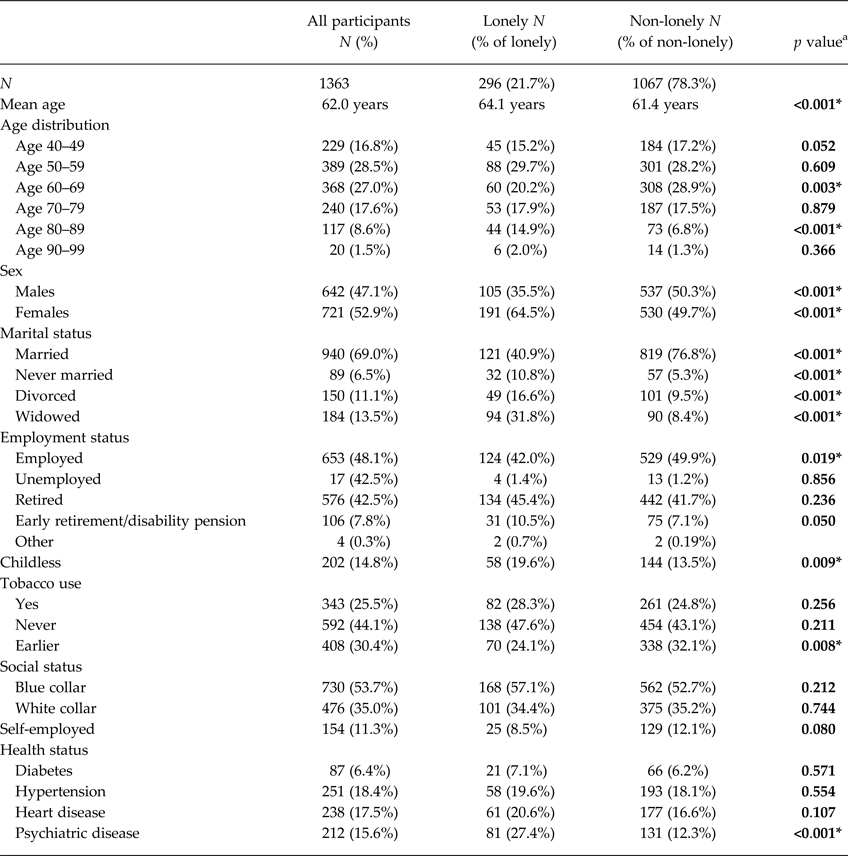
Table 1 presents the baseline characteristics of the population. Of the total 1363 respondents, 296 individuals (22%) were reported as lonely and 1067 (78%) individuals as non-lonely. Lonely individuals had a mean age of 64.1 compared with a mean age of 61.4 for non-lonely individuals, and 64.5% of the lonely individuals were females. Loneliness was associated with being childless, never married, divorced or widowed. Compared with the non-lonely cohort, lonely individuals were more likely to have a tobacco use, diabetes, hypertension and heart disease, but the differences were statistically insignificant.
Baseline characteristics for all participants and according to reporting of loneliness

a p value based on two-tailed Z-test.
*Significant difference with significance level 0.05.
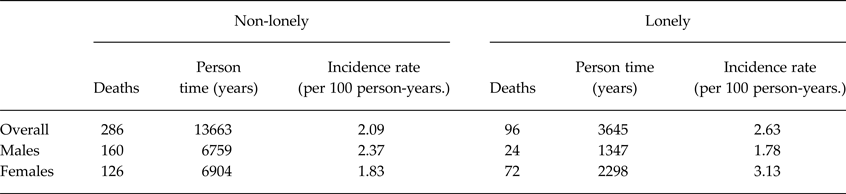
From 1997 to 2011, 26.7% of non-lonely individuals died compared with 32.2% of lonely individuals. Table 2 shows the IR for mortality as well as stratified by gender. Overall, non-lonely individuals had a mortality IR of 2.09 per 100 person-years compared with 2.63 per 100 person-years for lonely individuals. When stratified by gender, lonely males had a mortality IR of 1.78 per 100 person-years compared with 2.37 per 100 person-years for non-lonely males. Lonely females had a mortality IR of 3.13 per 100 person-years compared with 1.83 per 100 person-years for non-lonely females.
Events and incidence rates of death for the non-lonely and lonely cohorts

Table 3 presents the association between loneliness and the risk of death. Loneliness was associated with a significant increased mortality risk of 27% (HR 1.27; 95% CI 1.01–1.60), compared with non-lonely individuals (unadjusted model). When adjusting for age, the HR decreased to 0.91 (95% CI 0.72–1.16). Other covariates of models 2 and 3 did not affect the association substantially as well as when stratified by gender. The unadjusted and fully adjusted HR for lonely males compared with non-lonely males were HR 0.74 (95% CI 0.49–1.15) and HR 0.50 (95% CI 0.32–0.80), respectively. Unadjusted HR was 1.76 (95% CI 1.31–2.34) for lonely females, and when adjusted for age, the HR was 1.29 (95% CI 0.96–1.73), compared with non-lonely females.
Cox proportional regression mortality analysis

a From Cox regression.
Model 1: age. Model 2: age, marital status, childlessness and tobacco use. Model 3: age, marital status, childlessness, tobacco use, hypertension, heart disease, diabetes and psychiatric disease.
Discussion
This study was based on a Swedish community population followed from 1997 up until 2011. This study has three main findings. First, this study supports the notion that loneliness affects mortality in adults, though the association for overall findings was influenced by covariates. Second, the increased mortality risk associated with loneliness indicated to differ in gender. Third, our results did not suggest physical health risk factors to be influencing the association between loneliness and mortality risk. Below we provide a discussion of these main findings in the context of existing literature while highlighting opportunities for future research.
This study found an overall 27% increased risk of dying for individuals feeling lonely compared with non-lonely individuals in the unadjusted analyses, which is comparable with previous findings (Holt-Lunstad et al. Reference Holt-Lunstad, Smith, Baker, Harris and Stephenson2015). Moreover, likewise existing literature, age influenced the association between loneliness and mortality risk in our population (Holt-Lunstad et al. Reference Holt-Lunstad, Smith, Baker, Harris and Stephenson2015). In addition, fully adjusted model did not support an overall association between loneliness and mortality, which is likely to be due to the found differences in the association according to gender. Previous studies on loneliness and mortality find no difference in gender (Holt-Lunstad et al. Reference Holt-Lunstad, Smith, Baker, Harris and Stephenson2015). However, present results may be affected by bias, and of note, only few events of death were reported in the group of lonely men and thus results must be interpreted with caution. For example, a misclassification, where males with poor health under-report their loneliness, and consequently appear in the group of non-lonely individuals could skew the association. However, to support the results concerning gender differences, other studies report health differences between genders, in individuals suffering from loneliness. Christiansen et al. found that loneliness in females is more associated with poor health, such as diabetes, than in lonely men, and that the mediators for cardiovascular disease are different in males and females (Christiansen et al. Reference Christiansen, Larsen and Lasgaard2016). Therefore, a difference in mortality between males and females is possible as well. In addition, the baseline characteristics of this study likewise indicated a less healthy lifestyle for the cohort of lonely individuals which is in accordance with similar previous studies (Hawkley et al. Reference Hawkley, Masi, Berry and Cacioppo2006; Thurston & Kubzansky, Reference Thurston and Kubzansky2009; Hawkley et al. Reference Hawkley, Thisted, Masi and Cacioppo2010; Momtaz et al. Reference Momtaz, Hamid, Yusoff, Ibrahim, Chai, Yahaya and Abdullah2012; Christiansen et al. Reference Christiansen, Larsen and Lasgaard2016) as well as a higher proportion of hypertension, heart disease and diabetes. To further elucidate the potential gender differences in mortality for lonely individuals, findings need to be replicated using other cohorts. Although the proportion of poor healthy life style and physical risk factors was higher in the lonely cohort, no substantial difference in the effect size was found in models 2 and 3, suggesting these risk factors to have little influence on the association between loneliness and mortality risk. Though, little is known about the pathogenetic pathways of loneliness’ influence on mortality, several theories have been acknowledged throughout the literature such as altered health behaviours, stress reactivity because of social malaise, and decreased repair and maintenance processes (Hawkley & Cacioppo, Reference Hawkley and Cacioppo2002).
This study had a long follow-up of 14 years, compared with a mean length of follow-up of 7.1 years for studies on social isolation (Holt-Lunstad et al. Reference Holt-Lunstad, Smith, Baker, Harris and Stephenson2015). The cohort of the Lundby Study is an unselected and homogenous population, because it originally included all inhabitants in two parishes in southern Sweden. However, at the 1997 survey, only 1363 of the 1797 individuals alive were reachable, agreed to participate and answered the question about loneliness; the dropout could potentially have introduced selection bias. In addition, individuals may have agreed to participate because they felt lonely and wanted the visit; dropout may have altered health. Furthermore, the selection of our population back in 1947 could give rise to a selection bias due to censoring of death. Unhealthiest could have died, meaning that our 1997 population contains the healthiest survivors. Such a bias would lead to an underestimation of the effect between loneliness and mortality. Loneliness was measured during the interview with a single-item question and may have led to an underestimation of loneliness. However, the single-item question was the standard which the two most used rating scales were validated with, as so, it correlates both with the De Jong Gierwield loneliness scale (de Jong-Gierveld, Reference de Jong-Gierveld1987) and the UCLA Loneliness scale (Russell et al. Reference Russell, Peplau and Ferguson1978). To be able to differentiate between chronic and situational loneliness, it is preferred with more than one measurement of loneliness. Only a few studies have used this method, with more than one registration of loneliness over time, and it could possibly be a more reliable measurement for future studies to utilise it (Shiovitz-Ezra & Ayalon, Reference Shiovitz-Ezra and Ayalon2010). An interesting aspect of loneliness is the relation to social isolation, such as network contacts and quality of social relationships. Such data would aid in the investigation of the two phenomena, loneliness and social isolation, and are an area for future research.
Conclusion
In conclusion, an association between loneliness and increased risk of mortality may exist, though age seems to influence the association. Findings suggest an increased mortality for lonely females, and a decreased mortality for lonely men compared with non-lonely females and males, respectively. If replicated, our results indicate that loneliness may not have physical implications for all subgroups. Our results do not support physical health risk factors to influence the relationship between loneliness and mortality risk, but findings need to be replicated in future studies using other cohorts.
Acknowledgements
None.
Financial support
None.
Conflict of interest
None.
Ethical standard
The authors assert that all procedures contributing to this work comply with the ethical standards of the relevant national and institutional committees on human experimentation and with the Helsinki Declaration of 1975, as revised in 2008, and with the ethical standards of the relevant national and institutional guides on the care and use of laboratory animals.
Availability of data and materials
Data will not be public due to the anonymity of the individuals included.