Over the past decade, substantial scientific evidence has accumulated that contamination of environmental surfaces in hospital rooms plays an important role in the transmission of several key healthcare-associated pathogens, including methicillin-resistant Staphylococcus aureus (MRSA), vancomycin-resistant Enterococcus spp. (VRE), Clostridium difficile, Acinetobacter spp., and norovirus.Reference Boyce 1 – Reference Weber, Anderson and Rutala 5 All of these pathogens have been demonstrated to persist in the environment for hours to days (and in some cases months), to frequently contaminate environmental surfaces and medical equipment in the rooms of colonized/infected patients, to transiently colonize the hands of healthcare personnel (HCP), to be associated with person-to-person transmission, and to cause outbreaks in which environmental transmission was deemed to play a role. Furthermore, hospitalization in a room in which the previous patient had been colonized/infected with MRSA, VRE, Clostridium difficile, multidrug-resistant Acinetobacter spp., or multidrug-resistant Pseudomonas has been shown to be a risk factor for colonization/infection with the same pathogen for the next patient admitted to the room.Reference Otter, Yezli, Salkeld and French 4 , Reference Weber, Anderson and Rutala 5
Multidrug-resistant (MDR) Gram-negative pathogens have been a growing problem in acute care medical facilities including MDR-Pseudomonas aeruginosa and MDR-Acinetobacter baumannii. In addition, Enterobacteriaceae (principally Klebsiella pneumoniae, Escherichia coli, and Enterobacter spp.) which produce extended spectrum β-lactamases, have been of concern. More recently, carbapenem-resistant Enterobacteriaceae (CRE) have been reported in the United States. The National Healthcare Safety Network reported that, in 2009–2010, the following frequencies of carbapenem resistance occurred in central-line–associated bloodstream infections: K. pneumoniae, 12.8%; Enterobacter spp., 4.0%; and E. coli, 1.9%.Reference Sievert, Ricks and Edwards 6 For catheter-associated urinary tract infections, the frequencies of carbapenem resistance were as follows: K. pneumoniae, 12.5%; Enterobacter spp., 4.6%; and E. coli, 2.3%.Reference Sievert, Ricks and Edwards 6 Importantly, CRE infections are difficult to treat and have been associated with mortality rates as high as 40%–50%.Reference Patel, Huprikar, Factor, Jenkins and Calfee 7 Given recent evidence that the contaminated hospital environment is an important risk for transmission of several pathogens and that CRE poses a public health threat, we undertook the following study, which had 2 aims. First, we aimed to describe the frequency and location of CRE contamination of hospital surfaces in the rooms of patients with CRE. Second, we aimed to assess the survival of a clinically relevant level of CRE inoculated onto a variety of different surfaces.
METHODS
In pursuit of aim 1, we sampled surfaces in 15 rooms that housed a patient with CRE as defined by the Centers for Disease Control and Prevention. 8 We attempted to culture the following 8 surfaces in each room: bed rail, overbed table, chair #1 arm, sink, toilet, bathroom floor, supply/medicine cart, and top of linen hamper. If a site was not available, we chose from the following sites: mobile computer, chair #2 arm, bedside table, toilet cabinet, floor outside toilet cabinet, and ventilator counter. A total of 5 Rodac plates containing DE Neutralizing Agar were collected from each environmental surface, but the sampling sites were nonoverlapping. Once all samples had been obtained, they were incubated at 35°C for 48 hours. After 48 hours, the number of colony-forming units (CFU) was estimated for each plate and each plate was evaluated for CRE. All pathogens were identified using standard microbiological techniques.
To accomplish aim 2, we inoculated test surfaces with a clinically derived carbapenem-resistant strain of K. pneumoniae, E. coli, or Enterobacter sp. suspended in TSB. Test surfaces included an overbed table, vinyl, stainless steel, Formica, and cloth. Rodac templates were drawn on all hard surfaces and inoculated with 15 µl of a 104 dilution, giving us an estimated inoculum of ~102 of our test organism. After inoculation, each surface was allowed to air dry for 10 minutes. Once dry, duplicate samples were once again collected with Rodac plates containing DE Neutralizing Agar at times 0, 1 hour, 3 hours, 6 hours, 24 hours, 48 hours, and 72 hours. Each template area was only sampled once. Surfaces were maintained at ambient room temperature and relative humidity. Plates were incubated at 35°C for 48 hours, after which colony-forming units were enumerated for each plate. To test cloth, a clean privacy curtain was cut into 3×3-inch pieces and a Rodac template was drawn on each piece. Then, using a special inoculating tool consisting of a round disk with many tiny spikes, each curtain piece was inoculated by placing this tool in a fresh 0.5 McFarland suspension of our test organism, then removing it and touching it to the surface of the cloth. This process was performed for each piece of cloth. Then, after air drying for 10 minutes, duplicate samples were collected and processed as described above.
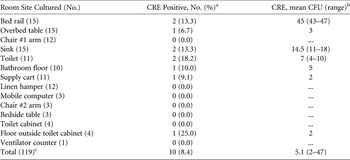
RESULTS
Overall, 15 sets of surface cultures were performed in the rooms of 7 patients who were colonized or infected with CRE (Table 1). One patient’s room was sampled 5 times, 4 patient’s rooms were sampled twice, and 2 patient’s rooms were sampled only once. Pathogens included 6 different strains of Enterobacter spp. and 1 strain of Klebsiella pneumoniae. Overall, 8.4% of surfaces were contaminated; contamination was found more than once only on the bed rail, sink, and toilet (Table 1). The mean level of CRE for contaminated surfaces was only 5.1 CFU per surface (120 cm2).
Contamination on Surfaces in Rooms Housing a Patient with CRE

CFU, colony forming units; CRE, carbapenem-resistant Enterobacteriaceae.
a Considered positive if ≥1 of the 5 Rodac plates had positive growth (ie, area sampled=120 cm2).
b Mean and range calculated only for CRE culture positive sites.
c For one site cultured, technical difficulties prevented assessing growth. Thus total was 119 sites instead of 120 sites.
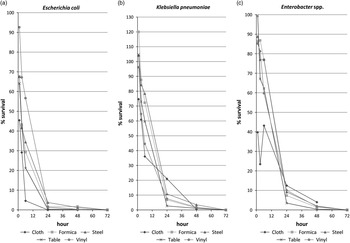
With only a single exception (K. pneumoniae on Formica), all three pathogens demonstrated <15% survival at 24 hours on the 5 test surfaces (Figure 1a–c). All pathogens demonstrated <5% survival at 48 hours and all cultures at 72 hours were negative. E. coli appeared to survive more poorly than K. pneumoniae or Enterobacter spp. on environmental surfaces. At 6 hours, E. coli levels were significantly less on cloth than on vinyl surfaces (P=.0116). No other clear relationships between survival and specific environmental surfaces were apparent.
a. Survival of Carbapenem-Resistant Escherichia coli on 5 Different Environmental Surfaces. b. Survival of Carbapenem-Resistant Klebsiella pneumoniae on 5 Different Environmental Surfaces. c. Survival of Carbapenem-Resistant Enterobacter spp. on 5 Different Environmental Surfaces

DISCUSSION
Contamination of the hospital environment has been linked to patient-to-patient transmission with MRSA, VRE, C. difficile, Acinetobacter spp., and norovirus.Reference Boyce 1 – Reference Weber, Anderson and Rutala 5 These pathogens have been shown to survive for prolonged periods of time in the environment and to frequently contaminate environmental surfaces in rooms housing a colonized/infected patient. CRE strains have been a growing concern. 8 These pathogens have caused outbreaks in the United States 9 and infection is associated with high mortality.Reference Patel, Huprikar, Factor, Jenkins and Calfee 7
Our data demonstrate that CRE can only infrequently be isolated from environmental surfaces in the rooms of infected patients and that when isolated, only relatively small numbers are cultured. Our data are similar to those of Cochard et al,Reference Cochard, Aubier, Quentin and van der Mee-Marquet 10 who reported that only 0.8% of 1,160 environmental surfaces tested by culture were contaminated in French nursing homes that housed patients colonized with extended-spectrum β-lactamase–producing Enterobacteriaceae.
Our results differ from those of Havill et al,Reference Havill, Boyce and Otter 11 who reported that CRE survived on inoculated stainless steel discs for multiple days. However, this difference is likely explained by their high inoculum (ie, >5–7 log10), whereas we used ~2 log10. Given the low number of CRE found on environmental surfaces in rooms occupied by a patient colonized/infected with CRE, our challenge may be more realistic for actual patient rooms.
In conclusion, our data demonstrated that CRE are infrequently cultured from environmental surfaces in the rooms occupied by a colonized/infected patient, and when isolated, they are cultured in only small numbers. CRE survives poorly compared to other important healthcare-associated pathogens on a variety of surfaces including cloth, Formica, vinyl, and steel. Our data suggest that the environment will likely play a less important role in the transmission of these pathogens compared with more common healthcare-associated pathogens, although this hypothesis will need to be confirmed by more detailed study of transmission dynamics.
Acknowledgments
Financial support: No financial support was received for this research.
Potential conflicts of interest: DJW has served as a consultant for Johnson & Johnson and Clorox; WAR has served as a consultant for Advanced Sterilization Products and Clorox. All other authors report no conflicts of interest relevant to this article.