For the 2013 issue of this journal, Jeremy Taylor provided a thought-provoking discussion of the diversity of response to Romanitas among Britain's agricultural communities.Footnote 136 To over-simplify the argument, the response of those who lived in some parts of the East Midlands was markedly different from that exhibited (at least in the archaeological record) by communities living in the area that was later to become Shropshire and the Welsh Marches; specifically, in the Wroxeter hinterland.
The former region saw, by the middle of the second century, ‘a significant and growing network of modest villas’ along with ‘a far larger number of materially more modest settlements … all of which came to use a wide range of material culture associated with the Roman world’.Footnote 137 In the hinterland of Wroxeter, on the other hand, the take-up of such material culture seems to have been very limited. For example, the quantities of Roman ceramics recovered from rural settlements is small: ‘known rural sites of the Roman period are almost aceramic’,Footnote 138 an impression which is strengthened by the very low levels of coin loss when compared with the East Midlands.Footnote 139
It may well be the case, as Taylor suggests, that the extent to which rural communities were receptive to Roman material culture was a reflection of their diverse social organisation and the values they used to construct their identities; but he also notes other differences — economic ones. In the East Midlands, he sees ‘evidence for investment in corn-driers, barns and even mills to process and transport agricultural surpluses to the towns of the region and probably beyond’,Footnote 140 whereas he infers in the Wroxeter hinterland a more pastoral economy, with an emphasis on cattle.Footnote 141
What is particularly striking about these economic contrasts is that they also applied over a thousand years later. In the twelfth to fifteenth centuries, ‘open-field’ arable farming predominated in the East Midlands, whereas the West Midlands, including Shropshire and the Welsh Marches, were characterised by a much greater emphasis on pastoral farming in a more extensively wooded environment. These contrasting regions were merely components of broader patterns of settlement and agricultural practice which were mapped across the whole of England by Brian Roberts and the present writer in a volume entitled Region and Place.Footnote 142
What emerged from that mapping exercise was a central zone of ‘open land’, relatively free from woodland, where communities usually inhabited nucleated settlements — villages — and focused on extensive arable farming; whereas to either side, to the north and west and to the south-east, were zones which retained more extensive tracts of woodland, and where there was greater emphasis on pastoral farming in communities which occupied more dispersed settlements. In the context of Roman studies, it is distinctly unhelpful that the authors decided to name these three zones the Central Province, the Northern and Western Province and the South-eastern Province.Footnote 143
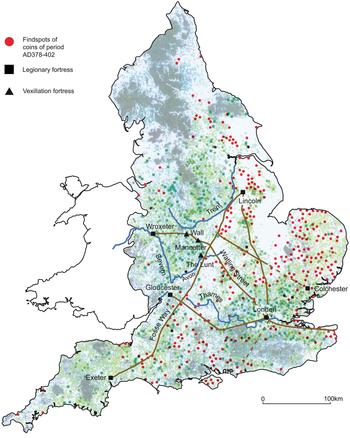
Many of the distributions plotted against these three Provinces — nucleated and dispersed settlements, extensive former open field-systems, particular place-name elements — have no relevance, at least in any direct sense, to Roman studies. Others, however, have potentially greater relevance, particularly the distribution of woodland recorded in a.d. 1086, in Domesday Book. Analysis of the Domesday record is not an easy matter: the data are inconsistently presented and incomplete (omitting some northern counties of England entirely), while many aspects of their interpretation continue to be debated. Nevertheless, the broad pattern of woodland recorded in Domesday correlates well with, for example, Anglo-Saxon place-names containing the element -lēah, which are thought to indicate clearings in wooded environments.Footnote 144 The Domesday records and place-name evidence have been combined to create the green symbols on fig. 15.
Woodland recorded in Anglo-Saxon place-names and in Domesday Book (green symbols: after Roberts and Wrathmell Reference Roberts and Wrathmell2002, fig. 1.13), and findspots of coins of the period a.d. 378‒402 (red dots: after Moorhead Reference Moorhead2011, map 2), with the main early road alignments and legionary and vexillation fortresses of Claudio-Neronian date (after Jones and Mattingly Reference Jones and Mattingly2002, maps 4.23 and 4.24).

Fundamental shifts in the size, composition and layout of settlements can occur over relatively short periods of time, in response to the policies of those in whom power resides, or in response to changing economic circumstances. Woodland is a different matter. The felling of extensive tracts of mature woodland required, until recent centuries, a huge investment of labour that might instead be required for more immediate and routine agrarian tasks; and the generation of mature woodland is a long-term process.
Key questions raised by the results of this mapping exercise were: how had this pattern of woodland and open land developed; and how long had it been part of the landscape of what is now England? There seemed to be three hypotheses which might be explored in an attempt to answer these questions:
(1) The broad pattern of woodland inferred from the Domesday records, and from Anglo-Saxon place-names coined in earlier centuries, may already have been long established by a.d. 1086.
(2) The inferred pattern of late eleventh-century woodland may alternatively have been a relatively recent phenomenon, replacing a very different, unknown and perhaps unknowable pattern.
(3) The inferred pattern of late eleventh-century woodland may have been generated in a landscape previously devoid of extensive woodland.Footnote 145
We felt that the first of these was the most credible and we were particularly intrigued by the way in which, across extensive parts of the countryside, distribution plots of early Anglo-Saxon material culture broadly correlated with the zone in which open land rather than woodland predominated. The same was largely true for the distribution of sites producing characteristically Roman building materials,Footnote 146 reinforcing some of Taylor's contrasts summarised above.
It is important to acknowledge that the match is by no means perfect. In the South-East, in particular, Romanised buildings frequently coincide with Domesday woodland records. There are two likely reasons for this. In the first place, Domesday sometimes — most notably in the Weald — lists the woodland resource not where it was actually located, but under the names of the surrounding estate centres to which that woodland was attributed and which were themselves set in open land. Secondly, the extent of woodland and its perceived boundaries were not immutable and in post-Roman times there may have been significant regeneration of woodland in some areas, for example north of London, on the Chilterns.Footnote 147
It should also be noted at this point that our preferred hypothesis elicited a sceptical response from a number of leading landscape and settlement historians: they were (and probably remain) unconvinced of the idea that Domesday woodland patterning was relevant to the early Anglo-Saxon and Roman periods.Footnote 148 In an early review, Christopher Dyer concluded that, ‘On the present evidence, the central province took shape sometime after a.d. 600’.Footnote 149 More recently, John Blair's extensive research into English settlement and landscape has led him to suggest that the origins of the Central Province of open land might well lie in what he defines as an ‘Anglo-Saxon building culture province’, dating to the period c. a.d. 650–850, despite the two zones overlapping rather than coinciding.Footnote 150
Another recent research project, on the other hand, appears to lend some support to the idea of much earlier origins for parts of the Domesday patterning of woodland and open land. The ‘Fields of Britannia’ project, led by Stephen Rippon, involved the identification and analysis of almost 200 dated pollen sequences straddling the Roman and early medieval periods (a.d. 43–1066). Essentially, the site sequences from the ‘central zone’ — broadly that part of the Central Province of open land lying south of the Humber — had far lower percentages of tree pollen than the adjacent ‘western lowlands’ (part of the Northern and Western Province); and this disparity can be seen in the Roman period, as well as in the fifth century and onwards.Footnote 151
There is far more of interest in Rippon's data, including the relatively high percentage of tree pollen in his south-east zone (part of the South-eastern Province), and its noticeable increase in the fifth century,Footnote 152 but for present purposes, the most important aspect of his work is its support for the existence of the central zone of largely open land, with a more extensively (and intensively) wooded zone on its western edge. It provides a measure of support for the hypothesis that the green ‘woodland’ symbols on fig. 15 are, at least in the western lowlands — the West Midlands and counties adjoining Wales — a continuing reflection of a woodland zone that had endured since Roman times and before.
In addition to the green ‘woodland’ symbols and grey areas marking extensive commons, moorland and mountains, fig. 15 also includes a scatter of red dots; these are the findspots of coins dating to the period a.d. 378–402, as recorded by the Portable Antiquities Scheme. It is based on one of Philippa Walton's invaluable distribution maps,Footnote 153 selected because it shows well a characteristic noted by Taylor and referred to above: the relatively low levels of coin-loss in the West Midlands as opposed to the East Midlands.
The broader distribution of coin finds in late Roman Britain is, as Sam Moorhead and Walton have argued, a consistent one, with ‘the majority of finds coming from the “lowland” zone to the east of the Fosse Way …’; there are few from Devon and Cornwall, Wales, the West Midlands, the North-West and the North-East.Footnote 154 It is worth adding that a significant proportion of the red dots that do occur in the latter regions could be the result of coastal transportation. Furthermore, Moorhead and Walton conclude that ‘this distribution pattern is very similar to that of coin-loss in the first and second centuries’.Footnote 155
Also included in fig. 15 are the ‘main early road alignments’ along with some of the main military installations of Claudio-Neronian date, derived from Barri Jones and David Mattingly's Atlas of Roman Britain.Footnote 156 Among the roads, the position and alignment of the Fosse Way is particularly striking, as it follows the main axis of the zone of open land close to its north-western, woodland edge. The Fosse Way was not, however, on the edge, and its probable function has been convincingly argued by Jones and Mattingly as a strategic road, a rearward communication route, rather than a front line.Footnote 157
It is not the Fosse Way itself, but the boundary between open land and woodland that appears to have informed Roman military strategy; for it coincides, south of the Humber estuary and north of the Severn estuary, with the south-eastern limit of military installations occupied during the Flavian period.Footnote 158 It would be easy enough to regard this northern and western military zone as ‘upland’ rather than ‘lowland’ Britain; but not all ‘upland’ Britain is upland. As noted above, the West Midlands were, for the ‘Fields of Britannia’ project, part of the western lowland region. It is, in this part of the country, not the hills and mountains but the woodland that seems to define military strategy in the Flavian period.
This should not, perhaps, be surprising given the earlier history of Rome's imperial expansion in northern Europe, which in a.d. 9 saw the infamous destruction of Varius’ three legions in the Teutoburger Wald of north-west Germany. When Germanicus subsequently campaigned against the German nations who had mustered in silvam Herculi sacram,Footnote 159 he felt the need to exhort his troops that open land was not the only battle ground favourable to Roman troops; so, too, were woods and glades, if accompanied by a strategy: ‘Non campos modo … sed si ratio adsit, silvas et saltus’.Footnote 160 The subtext is, presumably, that there were many in his audience who might have doubted this.
In terms of the green woodland symbols on fig. 15, one striking aspect is their apparent density in the gap between the rivers Avon and Trent to the north-west of the Fosse Way and south-west of Watling Street. This is where, in the period around a.d. 60, at the time of the Boudican revolt or shortly afterwards, a small number of forts may have been (re-)garrisoned. They include Mancetter, Wall, the Lunt near Coventry, and Metchley: the first three on the edge of this distinct concentration of woodland symbols; the last in its centre (omitted from fig. 15 for the sake of clarity).Footnote 161
This military activity has caused some puzzlement among scholars: Gil Gambash has noted that ‘such activity can hardly be interpreted as relevant to the enforcement of peace at the focal points of the revolt, much further to the east’,Footnote 162 while Paul Booth has commented that ‘the assignment of the phase I fort at the Lunt to this period is also hard to understand in strategic terms … there seems little justification in this period for an extensive establishment, possibly analogous in character to the earlier phases at Mancetter, away from important lines of communication [my Italics]’.Footnote 163
Such activity might well, however, have related not to the main centres of the Boudican revolt further east, nor to the planning of campaigns further west, but to the local control of an area dominated by woodland which perhaps offered sanctuary for resistance to authority (as woodland often has). In this context it would be wrong to ignore Graham Webster's suggestion that the historically attested battle which ended the Boudican revolt took place in the vicinity of the fort at Mancetter: ‘The description suggests a sudden change … from open plain to thick woodland’.Footnote 164 On this occasion, though, it was the Roman line that was protected from the rear by woodland (which Paullinus had first established was free of enemy troops) and it was the rebels who approached from the plain without the benefit of cover.Footnote 165
Part of this particular stretch of woodland is, of course, the medieval woodland of Arden, located in what became north-west Warwickshire and contrasting with the Feldon region of largely open land in the south and east of that county.Footnote 166 The present writer is by no means the first to suggest that Arden's woodland may already have been in existence by the Roman period. Booth, for example, has noted the distribution of Mancetter-Hartshill pottery and tile kilns ‘which appear to lie mainly in an arc which loosely reflects the edge of the later Forest of Arden …’, and has suggested that this woodland may already have been an important source of fuel for these industries.Footnote 167 Comparative local distributions such as these, combined with the national distributions outlined above, offer a measure of support for the hypothesis that Arden, and perhaps many other stretches of woodland later recorded to the north-west of the Fosse Way, were in existence in the first century.
How might this hypothesis inform our perception of societies and economies in Britain at that time? In the first place, it is important to emphasise that in the later Middle Ages, the ‘western lowlands’ were not dominated by tracts of dense, closed-canopy woodland; Arden and similar areas were managed as ‘wood-pasture’, grazed woodland, interspersed with coppices which would have been protected from grazing when necessary.Footnote 168 Current thinking on the significance of wood-pasture regimes in Europe, recently reviewed by Tom Williamson, has emphasised ‘the connection they provide with the deep past’.Footnote 169
In England's western lowlands, it has been argued that the wood-pasture regimes of the later Middle Ages had been operating in earlier centuries: that the numerous records of silva in Domesday Book also refer to wood-pasture rather than closed-canopy woodland.Footnote 170 Moving further back in time, settlements associated with wood-pasture management could well have generated the Anglo-Saxon place-names containing the element -lēah. It is then only a relatively short step to argue that wood-pasture management was probably operating also in Roman times.
Secondly, even if, in Roman times wood-pasture management predominated in the western lowlands and the Northern and Western Province more widely, these areas will still have contained many communities that needed at least some cultivated land, even though the extent of cultivation will on the whole have been more restricted when compared with their equivalents in the open land of the Central Province. These categoric differences relate to comparative, predominant character, not to sets of mutually exclusive characteristics.
Similarly, in medieval times the Central Province was not completely open land, as can be seen from fig. 15 which shows noticeable and sometimes extended patches of woodland within it. The same was no doubt true in Roman times. Some of the patches of woodland shown on fig. 15 coincide with areas of Roman iron and ceramics production,Footnote 171 both of which will have required, like the Mancetter-Hartshill industries, large areas of coppiced woodland for fuel; woodland which presumably ceased to be managed after the closure of these industries. The same is no doubt true of the numerous villas located in the Central Province:Footnote 172 these will also have required significant amounts of coppiced woodland which could be cropped regularly to provide fuel for hypocausts.
Thirdly, though there is a marked ‘thinning’ in the distribution of many elements of recorded ‘Roman’ material culture in the Northern and Western Province as compared with the regions to the south and east, this does not necessarily mean that the inhabitants of the wood-pastures, or of cleared arable zones within them, were impoverished. It may be, instead, that their material cultural repertoire relied more heavily on locally manufactured objects of wood or basketry, such as those recorded for these and other woodland areas in the sixteenth century;Footnote 173 though it has to be admitted that evidence for wooden tablewares, for example, in the Roman period seems to be very limited.Footnote 174
The fourth point is that it would also be wrong to assume that the boundary between open land and woodland (wherever it is drawn) will inevitably have marked a political and administrative divide in Roman times. In later centuries there is evidence, in the Midlands, of close administrative and economic relationships between the two contrasting environments, with estates centred in the open land having distant areas of woodland attached to them. In Warwickshire this led to transhumance practices linking the open land, the Feldon, with the woodland of Arden.Footnote 175 It is possible that, in Roman times, distinct tribal polities occupied the open land and the woodland; but this need not have been the case and should not become a preconception.
This last point is well made in a more recently published survey of Roman rural settlement,Footnote 176 part of the series entitled ‘New Visions of the Countryside of Roman Britain’ which offers the exciting prospect of populating some of these hypothetical landscapes with large quantities of data. For example, in ‘The Central West’ zone (incorporating Rippon's ‘western lowlands’), Tom Brindle has identified small, dispersed, enclosed settlements as the dominant form.Footnote 177 Some of these could well be wood-pasture settlements, ditched to prevent incursion by freely grazing animals — and perhaps also to provide protection in countrysides which were less amenable to supervision than open land. This could be particularly relevant to settlements in curvilinear enclosures, which seem unlikely to have been established within pre-existing rectilinear field-systems.
In contrast, among the settlements of ‘The Central Belt’, part of the Central Province, Alexander Smith has shown that ‘complex farmsteads’ become much more frequent in the Roman period than enclosed farmsteads; and villas are also concentrated in this zone.Footnote 178 Ignoring the zones themselves, which in ‘New Visions’ and in all other studies cited here are merely tools used for comparative analysis, the overall distribution of corn-driers (perhaps better described as crop-processing kilns) appears to confirm that the areas where open-field cultivation predominated in the Middle Ages were also open land, under extensive cultivation, before the end of the Roman period, constituting ‘the “bread basket” of late Roman Britain’.Footnote 179
ACKNOWLEDGEMENTS
I am very grateful to H.E.M. Cool for reading and commenting on an early version of this article; to the anonymous referee for suggesting several improvements; to Jon Prudhoe for preparing the accompanying illustration and to Kevin Moon for making final amendments to it.