Introduction
With the greater emphasis on recovery, users of mental health services require opportunities to collaborate in their own care and in the development, delivery and evaluation of mental health services [Department of Health and Children, 2006, 2008; World Health Organization, 2010; Health Service Executive (HSE), 2017a, 2017b]. Co-production of interventions and services is one way in which meaningful service user involvement may be operationalised (HSE, 2018). Co-production involves a partnership approach to the development and delivery of services and is underpinned by the principle that all partners are equally valuable (Bradley, Reference Bradley2016; HSE, 2018).
Coinciding with the focus on co-production is recognition of the importance of education and information as tools to support service users’ efforts towards self-efficacy and recovery (Slade et al. Reference Slade, Amering, Farkas, Hamilton, O’Hagan, Panther, Perkins, Shepherd, Tse and Whitley2014). Users of mental health services require access to information in order to make informed and empowered decisions regarding their care (Swarbrick, Reference Swarbrick2013), as well as develop the range of skills and competencies to maintain wellness and assume full citizenship (Davidson & Roe, Reference Davidson and Roe2007; Keogh et al. Reference Keogh, Morrissey, Higgins, Callaghan, deVries, Nash, Ryan and Gijbels2014). Within the education and psychoeducation literature, two models exist: peer- or user-led education and clinician-led education. Evaluations of user-led psychoeducation programmes show increases in hopefulness (Pickett et al. Reference Pickett, Diehl, Steigman, Prater, Fox and Cook2010) and knowledge of mental health issues, improvements in self-efficacy (Cook et al. Reference Cook, Copeland, Corey, Buffington, Jonikas, Curtis, Grey and Nichols2010), self-advocacy, empowerment and recovery (Barber et al. Reference Barber, Rosenheck, Armstrong and Resnick2008; Resnick & Rosenheck, Reference Resnick and Rosenheck2008; Druss et al. Reference Druss, Zhao, von Esenwein, Boma, Fricks, Jenkins-Tucker, Sterling, DiClemente and Lorig2010). Service users’ inclusion in the design and delivery of educational interventions ensures that the knowledge provided is relevant and appropriate to users (Bradley, Reference Bradley2016) and incorporates recovery-focused content (McNeil, Reference McNeil2013). Although clinician-delivered education has been criticised for conforming to a ‘traditional disease-oriented model’ and reinforcing powerlessness by rendering participants’ passive recipients of information (Jormfeldt et al. Reference Jormfeldt, Rask, Brunt, Bengtsson and Svedberg2012), clinicians’ skills and expertise are also valuable assets (Lefley, Reference Lefley2009). This paper reports on the outcomes and experiences of an information and learning programme for users of mental health services that was jointly developed and co-facilitated by users and clinicians – the EOLAS programme. Although the initial pilot evaluation of the EOLAS programme demonstrated some positive outcomes for users of services, the small number of participants restricted the statistical power of the analyses and limited generalisability of the findings (Higgins et al. Reference Higgins, Hevey, Gibbons, O’Connor, Boyd, McBennett and Monahan2017b).
EOLAS mental health information project
The EOLAS programme is part of a recovery project comprising service users, family members, clinicians and academics who co-produced, co-delivered and co-managed two mental health information programmes (one for people who have been diagnosed with schizophrenia spectrum or bipolar disorders and a parallel programme for their family members and supporters). The service user programme consists of eight weekly sessions, each of 90 minutes duration. While the programme content is constantly under review, it mainly addresses information on mental health service provision, diagnosis, treatment, medication and care, proactive engagement with mental health services, strategies to maintain recovery and minimise relapse, sources of self-help information, support groups and agencies, personal stories, statutory rights and entitlements, and the Mental Health Act. While not privileging any one theoretical perspective, the information is framed within a recovery ethos and emphasises the right of people to participate meaningfully in decisions about their health and well-being (HSE, 2018). To facilitate consistent programme delivery, two handbooks with information pertaining to each session were produced (one for facilitators delivering the programme and one for participants). Further details on the participatory approach taken to co-designing the programmes (Higgins et al. Reference Higgins, Hevey, Gibbons, O’Connor, Boyd, McBennett and Monahan2017a, Reference Higgins, Hevey, Gibbons, O’Connor, Boyd, McBennett and Monahan2017b), the outcomes of the family programme (Higgins et al. Reference Higgins, Hevey, Boyd, Cusack, Downes, Monahan and Gibbonsin press) as well as the outcomes of the training provided to facilitators (Higgins et al. Reference Higgins, Hevey, Boyd, Cusack, Downes, Monahan, McBennett and Gibbons2018) are published elsewhere.
Aim of evaluation
The evaluation assessed the impact of the service user programme on participants’ knowledge, confidence, recovery attitudes, advocacy and hope and explored their experience of participating in the programme.
Methods
A sequential design was used involving the collection of quantitative and qualitative data. First, quantitative data were collected to evaluate programme outcomes, while service users’ experience of the programme was subsequently obtained through qualitative methods. The approach taken to the qualitative design was independent insofar as the results of the quantitative phase did not inform the focus of the qualitative phase.
Data collection
A pre–post design was used to collect quantitative data, with questionnaires completed before and immediately after programme participation. The pre-programme questionnaire collected demographic data on participants (including age, gender and psychiatric diagnosis). In conjunction with some members of the EOLAS steering group (clinical and service users), members of the team (A.H., D.H., M.M., P.G.) designed a number of questions to measure the programme’s main learning outcomes. A 14-item knowledge scale ascertained participants’ knowledge of mental health issues including the meaning of the term psychosis, stress management techniques, reasons for taking medication, legal rights, symptoms of relapse and the role of each member in their mental health team. This was scored using a 5-point Likert scale ranging from 1 (poor) to 5 (excellent). Participants’ confidence in their ability to cope with their mental illness was assessed using a 13-item scale ranging from 1 (not at all confident) to 4 (very confident). Confidence items examined included speaking to medical practitioners about treatment options, accessing services in the community, recognising relapse triggers, dealing with family interactions and dealing with voices or distressing thoughts. The Recovery Attitudes Questionnaire 7 (RAQ-7) (Borkin et al. Reference Borkin, Steffan, Krzton, Wishnick, Wilder and Yangarber2000) measured attitudes towards recovery. Self-advocacy was evaluated using a 9-item scale ranging from 1 (strongly disagree) to 5 (strongly agree). This scale was informed by Brashers et al.’s (Reference Brashers, Haas and Neidig1999) Patient Self-Advocacy Scale. Hope was assessed by asking the participants to rate their agreement to the statements ‘I am hopeful for my future’ (Q1), and ‘I see possibilities for myself amidst difficulties’ (Q2), with responses ranging from 1 (Not at all hopeful) to 10 (Very hopeful).
The same measures were repeated in the post-programme questionnaire. It also included new questions, which gathered information on the number of sessions attended, satisfaction with the programme, perceived impact of the programme on personal well-being, perceived usefulness of programme and whether participants would recommend the programme to others. Two open-ended questions gathered participants’ views on the most and least helpful aspects of the programme.
For the qualitative component, semi-structured interviews were conducted with participants using a topic guide developed by the research team in conjunction with members of the steering group. The guide explored participants’ experience of various aspects of the programme, including its impact on their lives and on those around them, and their experience of co-facilitation (Table 1). All interviews were audio-recorded and carried out by one member of the team (M.M.) at a time and location suitable to the participants.
Interview topic guide

Recruitment
Potential participants were given an information sheet about the evaluation when they were being recruited to attend the EOLAS programme. To avoid people feeling pressurised to participate, they were informed that they could opt to participate in the programme without obligation to participate in the evaluation. At the first EOLAS session, an envelope containing a questionnaire and an information sheet was distributed and participants were instructed to complete and return the questionnaire in the envelope provided they consented to participation in the evaluation. Participants who did not wish to participate were informed that they could return an uncompleted questionnaire in order to facilitate anonymity and ensure that no one felt obliged to participate. The post-programme questionnaire was distributed at the end of the final EOLAS session. It included an opt-in form for the semi-structured interviews, which participants could complete immediately or return at a later time to researchers in the stamped addressed envelope provided. Researchers then contacted individuals who completed the opt-in form to discuss participation and scheduled interviews with those consenting to participate. Individual interviews were conducted 2–4 weeks post-programme.
Ethical considerations
Ethical approval to conduct the study was granted by the Research Ethics Committee (name will be inserted after review) of the university and ethics committees of the participating mental health services. Informed voluntary consent was ensured by providing written and verbal information outlining the voluntary nature of participation: the right to participate in the programme without participating in the evaluation and the right to stop the interview at any time and withdraw without any consequences. Written consent was also obtained for the interview and the audio recording.
Data analyses
Quantitative data were analysed using SPSS version 22 (IBM Corp, Armonk, NY) (C.D., D.H.). Categorical data are summarised using frequencies (n) and percentages (%), and the continuous data are summarised using means (M) and standard deviations (s.d.). The mean scores on scales were calculated, with higher scores on each of these scales representing more positive outcomes. Independent samples t-tests and chi-square analyses assessed whether there were any differences in the profile of those who completed the survey at Time1 (T1) only and those who completed the survey at both time points (T1 & T2). A series of paired sample t-tests were conducted to examine the changes in knowledge, confidence, advocacy, recovery attitudes and hope for the participants from T1 to T2. Due to the non-normal distribution of change scores, Spearman’s rho correlations examined the relationships between the changes (pre–post scores) in the programme outcomes. For all inferential analyses, statistical significance was set at 0.05.
Once the interviews were transcribed verbatim and entered into the software package NVivo version 8 (QSR International, http://www.qsrinternational.com), they were analysed by the members of the team (A.H. and M.M.). Thematic analysis, guided by the constant comparative process (Glaser & Strauss, Reference Glaser and Strauss1967), was performed. Interviews were read and reread, following which they were open-coded. This involved systematically naming units of data using a concept or code. Following this, codes were compared for similarity and differences and merged into higher themes. To enhance the rigour of this process, data analysis was carried out by more than one person.
Validity and reliability
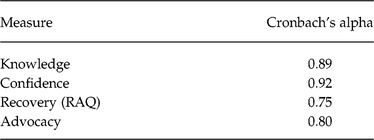
Feedback from piloting of the surveys with a group of service users indicated that the surveys were user-friendly. All scale measures used were internally consistent, with Cronbach’s alpha values above 0.75 (Table 2).
Reliability of measures

Results Participant profile
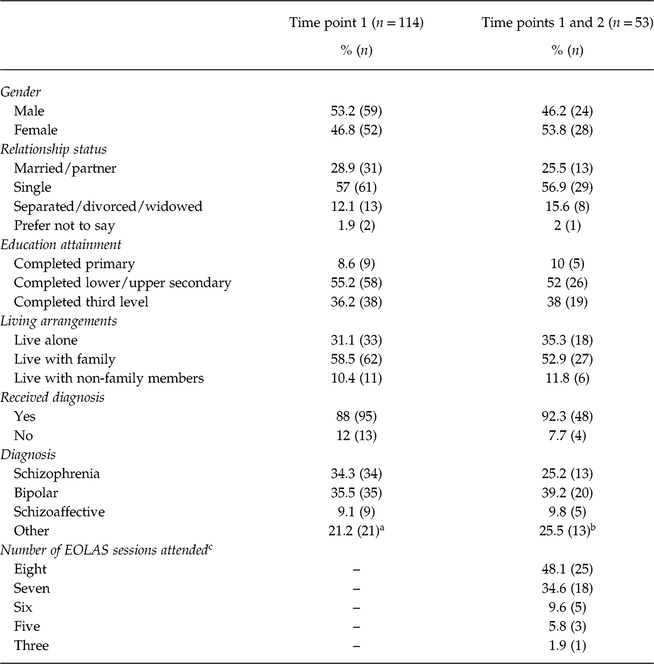
In total, 114 participants completed surveys at T1, with 53 completing both pre- and post-questionnaires. Table 3 presents the profile of participants who completed surveys at T1 and those who completed both pre- and post-surveys. Just over half of the sample who completed both surveys was female (53.8%, n = 28), single (56.9%, n = 29), educated to lower/upper second level (52%, n = 26) and living with family members (52.9%, n = 27). Participants’ mean age was 43.3 years (s.d. = 13, range 20–77). The vast majority (92.3%, n = 48) reported that they had received a formal diagnosis, with bipolar affective disorder being the most common diagnosis. Four-fifths of participants (82.7%, n = 43) reported that they attended seven or eight sessions, with the remainder attending either five or six sessions (15.4%, n = 8) and one participant attending three sessions (1.9%). There were no significant differences between those who provided data at T1 only and those who completed both T1 and T2 questionnaires in relation to demographic factors (gender, age, marital status, and educational level), clinical factors (received a diagnosis, diagnostic category) or baseline psychological factors (pre-course knowledge, confidence, advocacy, recovery and hope).
Profile of participants who completed surveys

a Other: depression/anxiety (n = 6); multiple disorders (n = 5); psychosis (n = 2); No diagnosis (n = 2); symptoms described (n = 2); borderline personality disorder (n = 1); nervous disorder (n = 1); manic hyper (n = 1); body dysmorphic disorder (n = 1).
b Other: depression (n = 5); psychosis (n = 3); multiple disorders (n = 2).
c Only asked at time point 2.
In total, 12 participants, 5 male and 7 female, were interviewed. Participants’ ages ranged from 25 to 62 years (mean = 44.6 years). Five were single, six were married/partnered and one was divorced. Eight participants lived with family, three lived alone and one lived in a supported residential setting. Five participants held a third-level degree, four were educated to diploma/certificate level and two educated to second level. Six participants were employed (full time = 4; part time = 2), three were unemployed and one was a student. Self-identified mental health diagnoses included bipolar disorder (n = 5), psychosis\schizophrenia (n = 5) and depression (n = 2), with 17.9 years being the average duration of illness (range = 8–40 years). All participants were still in contact with services, with contact ranging from daily to 12-week intervals (mean = 4.8 weeks). Participants reported having the most frequent contact in the services with nurses (n = 7), followed by their psychiatrist (n = 3), social worker (n = 1) and occupational therapist (n = 1). All participants had attended six or more EOLAS sessions.
Results from the pre–post surveys
Statistically significant higher levels of overall knowledge in relation to mental health issues, confidence and advocacy scores were found post-programme. Positive recovery attitudes were evident at pre-programme stage and although they increased slightly, this was not statistically significant. Sense of hope increased from pre to post; however, this increase was only statistically significant for one of the hope items: ‘I see possibilities amidst difficulties’ (Table 4).
Impact of programme on outcomes

ns, Not significant.
*p<0.05, ***p<0.001.
Relationship between changes in programme outcomes
To further examine the changes in the programme outcomes, a correlation analysis was conducted on the change scores (See Table 5). A number of statistically significant relationships were found: increases in Knowledge were associated with increases in Confidence, Advocacy, Recovery Attitude and Hope scores; increases in Confidence were associated with increases in Advocacy and Hope; increases in Advocacy were correlated with increases in Hope; and increases in Recovery Attitudes were associated with increases in Hope.
Relationships between the changes in programme outcomes

ns, Not significant.
*p<0.05, **p<0.01, ***p<.001.
Satisfaction with and usefulness of the programme
The majority of participants reported that the programme was ‘satisfactory’/‘very satisfactory’ (96.2%, n = 51) and ‘useful’/‘very useful’ (98.1%, n = 51). The majority also perceived that their well-being had improved as a result of the programme (‘Improved’: 69.2%, n = 36; ‘greatly improved’: 19.2%, n = 10). Most (84.6% n = 44) reported that they would definitely recommend the programme to others. The findings from the open-ended questions on the surveys supported the quantitative findings, with many participants stressing the need for such a programme and expressing gratitude for getting the opportunity to participate in it. Positive descriptions of the programme included ‘open’, ‘inclusive’, ‘participant orientated’ and ‘designed for needs’.
Results from the interviews
The findings from the interviews resulted in the development of the following four themes: enhancing knowledge and awareness of distress and wellness; normalising experiences and challenging stigma; nurturing hope and reducing hierarchy and increasing collaboration.
Enhancing knowledge and awareness of distress and wellness
Despite prior encounters with mental health services, participants reported receiving a wide range of helpful information that they had not received previously, including information about diagnoses, side effects of medication and self-help strategies. In addition, some participants reported gaining a greater awareness of the mental health system, its services, structures and personnel; knowledge which imbued participants with a sense of comfort that help was available as well as knowledge on how to access help if required.
I would say now having done the EOLAS course the real difference is I know if that’s (relapse) going to happen again, I know that there are services in place that can help me …now I’m motivated to engage and realise there is a light at the end of the tunnel and I can do something about it. (SU04)
In addition to knowledge of the services, the programme fostered a greater awareness of triggers to relapse, as well as feelings and actions that might point to increasing distress.
…I thought the information on the signs of getting back into ill health, what to look out for … also how to keep yourself well… that was very good. (SU01)
Things like say not putting your makeup on, not washing your hair, not having showers, before the EOLAS programme I wouldn’t have thought about them things, now I know that they’re a sign to me, as it’s different for everyone. (SU11)
In keeping with the recovery ethos of the programme, the participants valued the time spent on discussing strategies for maintaining well-being and responding to their distress.
I remember one quote from the book that this guy heard voices…and the way he was coping was talking back to his voices and telling them to be quiet now or that he’d return to them again…and I thought it was very powerful…he hears voices and he can manage them. (SU08)
…they told us what to do in a crisis…told us to ring up a certain person as well like turn on your favourite music and lie on the bed… (SU02)
Participants also reported gaining a greater understanding of the importance of communication with family during periods of wellness as well as distress.
…I realise now that I have to, I communicate with my family a lot more in general but also a lot more in times of calm or respite…as well as in times of pressure… (SU10)
…It was talking about family members like don’t shut them out totally, even though you don’t want them all the time to be worried about you… (SU11)
Normalising experiences and challenging stigma
Participants reported that the stigma of mental illness was challenged, not only through its inclusion as a topic within the programme, but also through the process of sharing and discussing issues related to mental illness in an open manner. While some participants noted difficulties and challenges listening to other people’s stories of distress and consequently feared for their own relapse, overall the style of sharing and learning from others was valued. Participants reported coming to the realisation that they shared common experiences, which normalised their own experience while they derived solace and comfort from mutual understanding.
I actually think the EOLAS has helped me [with stigma], become more open about it [mental health problem]… actually going there every week and being a part of it and connecting with other people that encounter difficulties like myself, that was vital because it makes it more normal, this is what people go through and here’s a programme designed to talk about these things. (SU03)
It’s nice to talk about things to people who understand. Schizophrenia is a thought in your head and it [thoughts] can seem very true to you, and just to meet people who have the same thing is kind of comforting. (SU12)
In some instances, participants reported a greater openness about their mental health, and a greater desire and ability to self-advocate as a result of talking about stigma.
Stigma, the whole discussion on stigma…I think was good… even though in an ideal world you tell your brother-in-law that you are schizophrenic you haven’t…and for me to go and say ‘right it’s time’, I picked the phone up and told my brother-in-law, ‘by the way you know the reason I’m odd sometimes, this is why’…it’s a new realisation…I can self-advocate much better than I have been. (SU04)
Nurturing hope
The unique aspect of EOLAS is that it recognises that service users’ experience and expertise are as valuable as clinicians’ contributions. Hope for recovery was nurtured through hearing other participants’ stories of recovery and seeing a peer co-facilitate the sessions. Peers acted as a point of comparison and served as evidence that recovery was achievable.
You do feel ‘God I’m not the only one that goes through this’ and you see someone doing well and you think ‘well there is a light there, she is doing well. (SU11)
…well I thought wow she’s [peer facilitator] doing this, she’s great isn’t she, like she is able to recover to the point that she’s so useful to the service and she’s able to facilitate, you know I really admired that she was doing it. (SU08)
As well as providing beacons of hope, peer facilitators were deemed valuable due to their experiential knowledge and the fact that the peer ‘wasn’t just taking it from a book you know’ (SU01).
Reducing hierarchy and increasing collaboration
Delivery of the programme via facilitation rather than in a didactic format gave participants a sense of equality of participation with facilitators; this appeared to cultivate an open, safe environment, which enabled service users to ask questions and engage in discussion.
…that’s where I think the program succeeded, in that it didn’t feel like a teacher standing in front of a class, it felt like everybody was on the same level. (SU10)
I don’t ever recall ever an opportunity where people could sit around and discuss issues…so that was a great opportunity. (SU09)
Many participants mentioned how the programme gave them the opportunity to engage with professionals in a way which mental health system interactions rarely facilitate due to time constraints, and hierarchy and paternalism within the system.
…the facilitators who were nurses…it was great to get to work with them in a different way where it’s not just you’re sitting down telling them all your problems …I got to ask her questions (laugh), put her on the spot rather than the other way around…. (SU03)
It was great, great to see him [psychiatrist]… he was more open, he talked more and he showed a different side to himself, so that was a little bit of an eye-opener. (SU06)
In addition to humanising practitioners and engendering trust, the opportunity to engage with practitioners in a more open, non-hierarchical manner also reinforced the importance of engaging positively with mental health professionals.
…for me it’s understanding that sometimes the psychiatrist or the psychiatric nurse is only as good as what you tell them…but sometimes you’ve got to realise that you need to communicate these things about how you are unwell and why you are distressed. (SU04)
Discussion
Although co-facilitation as a model of user engagement has not been fully evaluated (Grundy et al. Reference Grundy, Walker, Meade, Fraser, Cree, Bee, Lovell and Callaghan2017), our findings add to a nascent evidence base on the effectiveness of this medium of delivery on multiple outcomes, which are core to the recovery process. The EOLAS co-facilitated information and learning programme is acceptable to service users and capable of producing positive outcomes in terms of enhanced knowledge, confidence, advocacy and hope, with some evidence of improvement in recovery attitudes. The increase in knowledge is an important finding given the fact that users of Irish mental health services continue to report a lack of information on mental health issues and mental health services (O’Féich et al. Reference O’Féich, Mitchell, Pérez and McDaid2019). The association between the knowledge and the increases in confidence is also significant given that the relationship between the knowledge of early warning signs/triggers and the confidence to self-manage, use wellness tools and self-advocate (Cook et al. Reference Cook, Copeland, Corey, Buffington, Jonikas, Curtis, Grey and Nichols2010, Reference Cook, Copeland, Jonikas, Hamilton, Razzano, Grey, Floyd, Hudson, Macfarlane, Carter and Boyd2011; Jonikas et al. Reference Jonikas, Grey, Copeland, Razzano, Hamilton, Floyd, Hudson and Cook2013). While an upward shift in recovery attitudes was achieved, the failure to find significant change may reflect a ceiling effect: the mean scores for the pre-programme assessment were quite close to the scale maximum value of 5 and consequently, there was minimal opportunity to increase the scores significantly.
Few programmes are modelled on the EOLAS co-facilitated approach but where they do exist, service users respond positively. Similar to the findings of other co-facilitated (service user and clinician) programmes for people experiencing mental distress (Green et al. Reference Green, Janoff, Yarborough and Paulson2013; Turner et al. Reference Turner, Realpe, Wallace and Kosmala-Anderson2015), participants in this study valued the contribution of both peers and clinicians. The experiential knowledge of the peer facilitator gave their education on treatments and coping strategies greater credibility (Salzer & Mental Health Association of Southeastern Pennsylvania Best Practices Team, Reference Salzer2002). As well as being knowledgeable and credible sources of information and advice, peer also served as role models in terms of providing hope and inspiration. Peer facilitators provided the participants with living proof of the attainability of recovery. Although only one item on the Hope scale was statistically significant (‘I see possibilities amidst difficulties’), given the centrality of hope to recovery (Leamy et al. Reference Leamy, Bird, Le Boutillier, Williams and Slade2011; Tse et al. Reference Tse, Tsoi and Wong2014; Watts & Higgins, Reference Watts and Higgins2017), the qualitative data on the importance of peers in nurturing hope are encouraging.
Within the literature, there is unanimous agreement that recovery requires a different relationship between practitioners and services users, one where there is less of ‘them and us’ and more of a collaborative approach to interactions and problem-solving (HSE, 2017a, 2017b). Contact between service users and professionals on an equal footing is regarded as essential to challenging power differentials, building trust and enhancing service users’ ability to collaborate in mental health care (Repper & Perkins Reference Repper and Perkins2003; Salkeld et al. Reference Salkeld, Wagstaff and Tew2013; Bee et al. Reference Bee, Price, Baker and Lovell2015). The findings from this evaluation suggest that the co-facilitation model created a space for interaction where the traditional boundaries of the service user–professional relationship were absent. This in turn had the effect of humanising clinicians to the extent that the participants perceived a greater confidence and willingness to engage with practitioners. This is an important finding in terms of developing recovery-oriented services as studies indicate that service users who are comfortable engaging with providers learn more and are better able to contribute to decision-making (Jonikas et al. Reference Jonikas, Grey, Copeland, Razzano, Hamilton, Floyd, Hudson and Cook2013).
Often, people experiencing mental health difficulties rely on family for care and support. As such family members can play a pivotal role in supporting the person’s recovery, not only though providing practical supports such as housing or finance but also through engaging in positive relationships and interactions with the person (Topor et al. Reference Topor, Borg, Mezzina, Sells, Marin and Davidson2006; Wyder & Bland, Reference Wyder and Bland2014; Reupert et al. Reference Reupert, Maybery, Cox and Scott Stokes2015; Watts & Higgins, Reference Watts and Higgins2017). Despite this, service users rarely receive information on how to communicate with family, and they express a desire for information on how to communicate and maintain positive relationships with those around them (Jormfeldt et al. Reference Jormfeldt, Rask, Brunt, Bengtsson and Svedberg2012). In the context of managing their distress, participants in this study reported learning ways in which to communicate effectively with family members and involve them in their recovery. In addition, given the manner in which stigma can impede the recovery process through reducing self-esteem, self-imposed social isolation and societal discrimination (Lakeman et al. Reference Lakeman, McGowan, MacGabhann, Parkinson, Redmond, Sibitz, Stevenson and Walsh2012), the findings that the programme increased participants’ advocacy skills, enhanced capacity to disclose and be open about mental health problems are also encouraging outcomes.
Limitations
Self-selection of participants into the study may have introduced bias into the sample, with those more positive about a recovery-based programme and with more positive experiences of the programme electing to participate in the survey or interviews. Therefore, the results may not reflect the views and experiences of all those who took part. Furthermore, while the study demonstrated the positive impact of the programme in the short term, it is not clear if the changes evident are sustained in the medium or long term. While the findings are positive, further research exploring the long-term impact using a control or comparison group is required.
Conclusion
Despite recovery being a central theme within mental health policy and academic writing, there still appears to be a gap between the promotion of recovery-oriented care and practitioners’ ability and confidence to engage with recovery-oriented practice. The evaluation highlights the potential strengths of a service user and clinician co-facilitated education programme. Education that is co-produced and co-facilitated by service users and clinicians has the potential to offer an effective model that incorporates recovery perspectives, in a manner that acknowledges and respects both the knowledge gained through self-experience and the knowledge gained through formal learning.
Conflict of interest
The authors have no conflict of interest to report.
Ethical standards
The authors assert that all procedures contributing to the work comply with the ethical standards of the relevant institutional committee on human experimentation with the Helsinki Declaration of 1975, as revised in 2008. The study protocol was approved by the institutional review board of each participating institution. Written informed consent was obtained for all interviews.
Financial support
The study was funded by a grant from GENIO and Health Service Executive Ireland.