Aaron Kesselheim serves as the editor for Health Policy Portal. Dr. Kesselheim is the JLME editor-in-chief and director of the Program On Regulation, Therapeutics, And Law at Brigham and Women's Hospital/Harvard Medical School. This column features timely analyses and perspectives on issues at the intersection of medicine, law, and health policy that are directly relevant to patient care. If you would like to submit to this section of JLME, please contact Dr. Kesselheim at akesselheim@bwh.harvard.edu.
The arrival of the first generic version of a brand-name drug to the US market is an important moment for numerous stakeholders.Reference Kaplan1 For patients, entrance of the first generic heralds a time when greater competition will lead to lower drug prices, which can reduce out-of-pocket drug costs and improve medication adherence and clinical outcomes.Reference Bender and Rand2 Since drug prices account for 17% or more of health care costs, payors also benefit from the initiation of generic competition, particularly government payors like Medicaid with limited budgets that can then be allocated for other uses.Reference Kesselheim, Avorn and Sarpatwari3 Brand-name drug manufacturers also develop strategies in advance of generic entry to minimize revenue loss,Reference Hering, Loretz, Friedli, Lehr and Stieneker4 such as taking steps to delay generic entry and introducing new products to buoy income and meet investor expectations.Reference Vokinger, Kesselheim, Avorn and Sarpatwari5
When does generic entry occur? A brand-name drug's market exclusivity term is primarily determined by its patents.6 The patent on a drug's active ingredient is often filed early in development, long before clinical trials and FDA review begin. Patents expire 20 years after filing, but due to the development time leading up to FDA approval, top-selling brand-name small-molecule drugs enjoy an average of 12-14 years of patent-protected exclusivity before generic entry.Reference Beall, Darrow and Kesselheim7 Still, approximating future generic entry is not straightforward.Reference Hemphill and Sampat8 Physicians and patients are often surprised when it eventually does happen. In one national survey of internal medicine physicians, about half reported that they were often unaware of the date when generic versions of brand-name medications that they commonly prescribed became available, and one-fifth reported learning this information from a brand-name drug sales representative.Reference Kesselheim, Gagne and Eddings9
In a recent study, we developed a methodology for estimating first generic entry based on the expiration dates of manufacturers' drug patents and two special exclusivity extensions made available to drug manufacturers under current law: “patent term restoration” and pediatric exclusivity.Reference Beall, Darrow and Kesselheim10 For approved drugs, the 1984 Hatch-Waxman Act authorized brand-name manufacturers to receive patent term restoration on one patent equal to the length of FDA review plus half the time spent in clinical trials, up to a maximum of 5 years (but in no event more than 14 years from the date of approval).Reference Dunn11 Starting in 1997, in a program later formalized by the Best Pharmaceuticals for Children Act of 2002, manufacturers have been able to seek an additional 6 months of exclusivity by responding to a written request from the FDA to conduct trials in children.12
When we applied this methodology to a cohort of 170 top-selling older drugs for which generic drugs entered in the last decade, we found that for innovative drugs (defined as those for which the active ingredient was a new chemical entity [NCE], i.e., not previously been approved by the FDA), generic entry occurred within one calendar quarter of the time predicted by our method more than half the time (59%).13 In the majority of remaining cases, generic entry was delayed due to strategies employed by brand-name manufacturers to prevent FDA approval of generic drugs, such as the later filing of additional patents on other aspects of the products' formulations or delivery devices (also known as “secondary” or “tertiary” patents).Reference Beall and Kesselheim14
To extend this previous research, we applied our methodology for determining the predicted date of generic entry to a more recent cohort of brand-name drugs to help policymakers and patients assess when potentially wasteful delays might be occurring. Using the Drugs@ FDA database,15 we identified all NCEs approved between 2000-2012 that were currently available with a prescription and not discontinued or available over-the-counter. This timeframe (products approved 5-17 years ago) was chosen to allow enough time for some products' key patents and exclusivities to expire while still capturing many instances in which generic entry was expected in the near future.
To determine whether generic entry had already occurred for the NCE cohorts approved in 2000-2012, we first consulted the FDA's Orange Book16 to identify generic products with the same active ingredient, route of adminstration, and strength. To ensure the generic products had actually entered the market, we then verified that the FDA-approved generic drug had a “start marketing date” listed in the National Drug Code directory.17
For all remaining NCEs without available generics, the process for key patent identification was described in more detail previously.18 For the identification of a product's key patent, we consulted the US Patent and Trademark Office's list of patents (and associated products) that were granted patent term restoration.19 For products without such a patent, we used the first-expiring patent listed in the Orange Book,20 since previous research had shown that these patents nearly always pertain primarily to that product's active ingredient for small molecule drugs21 and since active ingredient patents have been shown to be particularly effective at blocking generic compentition.22
As previously described,23 we also considered 5-year NCE exclusivity, which is available for all NCEs that do not have Orange Book-listed patents, as well as 7-year exclusivity available for new rare disease treatments (i.e., Orphan Drug Act exclusivity [ODE]).24 These exclusivities run in parallel with patent protection and bar the FDA from receiving or approving generic drug applications under most circumstances.25 Thus, even products with no patent protection or patent protection that expired prior to FDA approval generally have a mimimum period without competition.
In accordance with our methodology,26 we considered the last-expiring key patent or exclusivity period (NCE or ODE) to be the primary expiration of interest. We then determined whether the product in question appeared in the FDA's list of granted pediatric extensions.27 These extensions reflect another incentive program authorized by Congress to encourage testing drugs in children, if and when the FDA requests such studies in writing. The 6-month periods are added to the end of patent periods and other exclusivities.28
The expected generic entry date was determined by applying any relevant 6-month extensions to the last-expiring key patent or exclusivity expiration date — in other words, the time when the initial set of government-granted market protections on the first version of the product had expired and when policymakers should begin to expect that generic entry will occur, especially in high volume markets that attract multiple competitors (even if other peripheral protections exist specific to certain formulations of the drug or specific indications). We report here on drugs with expected generic entry dates within the next five years (2019-2023).
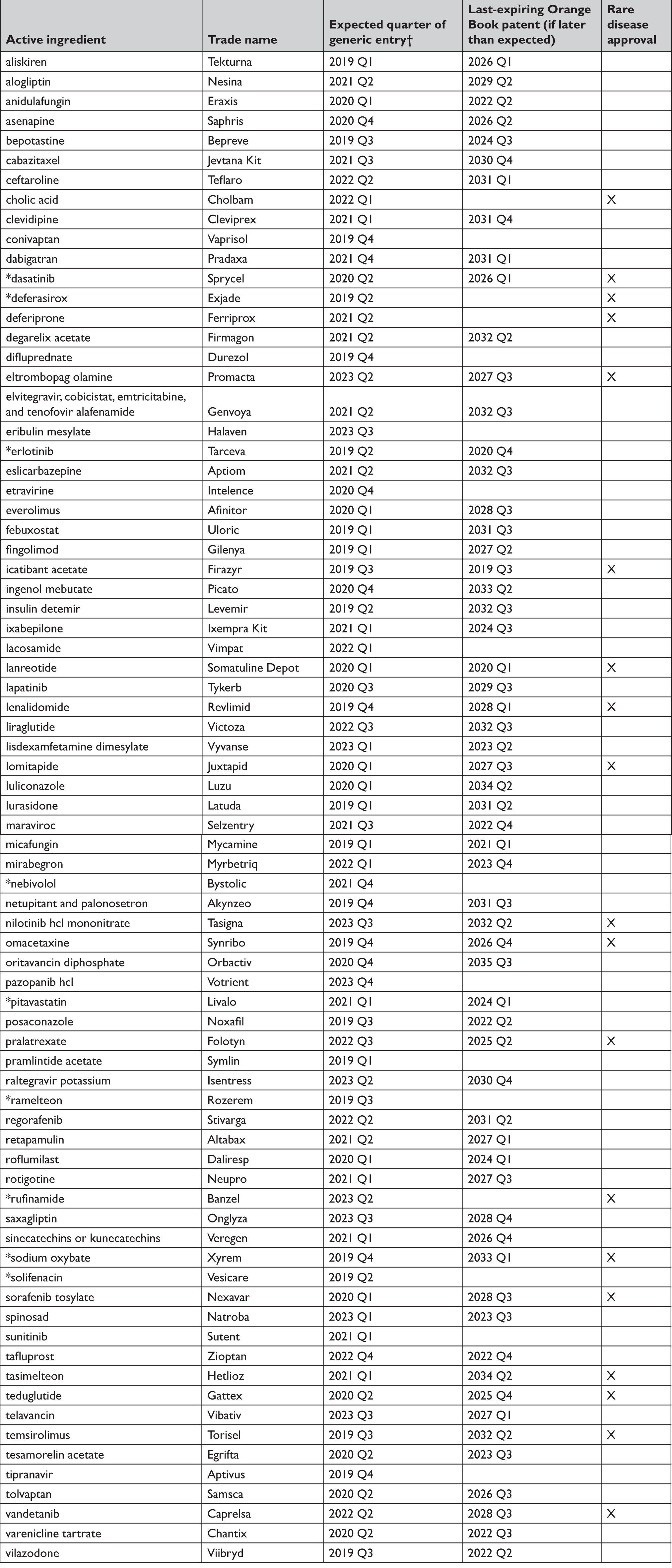
Based on this methodology, Table 1 provides a list of the calendar quarters when generic entry might be expected for 76 brand-name drugs approved by the FDA between 2000 and 2012 and still in widespread use as of June 2018. The list does not include every new drug approved during that period because some more recently-approved drugs may still have their patent term restoration applications pending. It is also subject to subsequent adjustments, for example, if written requests for pediatric studies occur in the future or if other patents with later expiration dates are subsequently added to the Orange Book. Table 1 also indicates the year and quarter of the last patent expiration in for those drugs having other patents listed in the Orange Book with expiration dates extending beyond the drug's patent term restoration period. Finally, Table 1 indicates whether the drug was approved for treating a rare disease, which might reduce the likelihood of generic entry immediately after patent expiration.Reference Sarpatwari, Beall, Abdurrob, He and Kesselheim29

* As of July 2018, the FDA had approved a generic application for this drug; however, no code was available for that product in the National Drug Code Registry, implying that marketing for that generic product has not yet begun.
† Prediction based on Beall-Darrow-Kesselheim model described in Reference 10.
It should be noted that our methodology was not designed for use with biologic drugs, which have longer 12-year non-patent exclusivity periods and tend to address niche markets with relatively fewer patients. Applying our methodology to biologic drugs is also more challenging because patents covering those drugs are not required by statute to be listed in the Orange Book, nor are such patents listed in the Purple Book, the analogous FDA publication for biologic products — a lack of transparency that could be remedied by Congress. The economic significance of biosimilar entry is also less well-understood as compared to generic entry of small-molecule drugs.Reference Mulcahy, Predmore and Mattke30
Despite these limitations, we used an innovative methodology to predict the date of generic entry for a cohort of widely-used brand-name drugs approved in the last two decades. These data can help patients taking chronic disease medications inquire regarding generic drug availability at the earliest opportunity. Physicians can apply their expertise to identify therapeutically equivalent alternatives that may become generically available sooner, thereby using these data to plan future drug treatment options with their patients. Finally, the data can help payors and pharmacy benefit managers avoid entering into unfavorable contractual arrangements for slightly modified new versions of products shortly before low-cost generic versions of the older product become available.
Approximating future generic entry is also important because it can provide a signal that something may be amiss when generic entry does not happen in the quarter expected. When generic entry is later than anticipated, it may be because the manufacturer has engaged in “life-cycle management,” such as attempting to switch the market to a higher-priced and newly patented version that contains the same active ingredient but offers a different formulation, dose, or route of delivery.31 Our model will be most reliable when the drug's last patent to expire was also the one that received patent term restoration, but later-issued patents on peripheral features of the drug or its uses may also be listed with the FDA. These or the patent term-extended patents may be the subject of legal challenges under the Hatch-Waxman Act, initiating a 30-month stay that can extend the 5-year NCE exclusivity period to up to 7.5 years, unless the litigation ends first. When generic entry is delayed beyond the date predicted using our method, it can also mean that a brand-name manufacturer has used other tactics to delay generic entry, such as by restricting generic manufacturers' access to samples needed to conduct testing for FDA approval. In these cases, intervention by antitrust authorities may be needed.32
When generic drugs enter around the time of key patent expiration it is often because challenges from generic manufacturers have invalidated any additional patents. However, generic manufacturers may also settle these lawsuits with brand-name manufacturers, leaving secondary patents in place.Reference Kesselheim, Murtagh and Mello33 If generic entry occurs after the original predicted date in Table 1, it can signal that such agreements might have happened. Public interest groups and large payors such as Medicare and Medicaid should routinely review such patents to ensure that they were properly granted, challenging them when necessary via the US Patent and Trademark Office's administrative review process, or else they may delay generic entry.Reference Darrow, Beall and Kesselheim34
As the US health care system works to contain costs and improve patient outcomes, it is essential to ensure the efficient transition from brand-name to generic drugs at the end of market exclusivity periods. A publicly available, continually updated list of brand-name drugs and their expected generic entry dates can help that process
Of course, lack of generic competition does not always relate to patents or anticompetitive behavior,35 and we are currently conducting additional research to identify factors that predict early or late generic appearance. For example, our methodology will be most accurate when generic manufacturers are incentivized to enter a market as soon as possible, such as when a drug is a top-seller and not a complex molecule. If generic entry does not happen within the predicted time frame and prices remain elevated even after patents and exclusivities have expired, the US government might authorize importation of generic drugs from other countries, invest in purchasing contracts with lower-cost suppliers willing to undergo the generic drug approval process, or engage in generic drug manufacturing itself to ensure reliable supplies and reasonable prices.
As the US health care system works to contain costs and improve patient outcomes, it is essential to ensure the efficient transition from brand-name to generic drugs at the end of market exclusivity periods. A publicly available, continually updated list of brand-name drugs and their expected generic entry dates can help that process for policymakers who are evaluating the extent to which the current system is bringing exclusivity periods to a close after the expiration of government programs that extend competition-free periods and also work to provide some clarity to patients, physicians, and payors about how much they should expect drugs to cost.
Acknowledgements
Dr. Kesselheim and Dr. Darrow's work is supported by the Laura and John Arnold Foundation, the Harvard-MIT Center for Regulatory Science, and the Engelberg Foundation.