Introduction
Little information exists on the relationships between floral insects and many plant species in Cameroon. It is well known that anthophilous insects, including bees, usually increase the fruit and seed yields of many plant species through pollination (Keller and Waller, Reference Keller and Waller2002; Fluri and Frick, Reference Fluri and Frick2005; Sabbahi et al., Reference Sabbahi, De Oliveira and Marceau2005; Klein et al., Reference Klein, Vaissière, Cane, Steffan-Dewenter, Cunningham, Kremen and Tscharntke2007; Gallai et al., Reference Gallai, Salles, Settele and Vaissière2009; Tchuenguem Fohouo et al., Reference Tchuenguem, Djonwangwe, Messi and Brückner2009a; Mensah and Kudom, Reference Mensah and Kudom2010, Reference Mensah and Kudom2011). Phaseolus coccineus L. (Fabaceae) is an annual plant that originated in Mexico and Central America (Kaplan, Reference Kaplan1965; Oscar and Stephenson, Reference Oscar and Stephenson1991). The flower is white, but can vary in colour from pink to red, depending on the variety (Ibrahim and Coyne, Reference Ibrahim and Coyne1975), and produces nectar and pollen that attract insects (Schneider and Hall, Reference Schneider and Hall1997; Pando et al., Reference Pando, Tchuenguem Fohouo and Tamesse2011a). In Cameroon, P. coccineus is cultivated as a vegetable and can be consumed raw or cooked. Its pods are sold fresh (green beans) or converted into flour; the stems and leaves are used to feed livestock (Gupta et al., Reference Gupta, Parab, Mehta and Goyal2001). The plant is allogamous and autogamous (Ibrahim and Coyne, Reference Ibrahim and Coyne1975; Williams and Free, Reference Williams and Free1975; Maréchal et al., Reference Maréchal, Mascherpa and Stainier1978; Pando et al., Reference Pando, Tchuenguem Fohouo and Tamesse2011a), and cross-pollination is carried out by insects (Free, Reference Free1970; Heslop-Harrison and Heslop-Harrison, Reference Heslop-Harrison, Heslop-Harrison and Reimann-Phillips1983; Pando et al., Reference Pando, Tchuenguem Fohouo and Tamesse2011a). Bumblebees have been reported to be the most effective pollinators of beans when visiting blossoms to collect nectar and pollen (Blackwall, Reference Blackwall1971). Phaseolus coccineus flowers have been reported to produce fewer seeds/pod in the absence of efficient pollinators in Great Britain (Kendal and Smith, Reference Kendal and Smith1976), Colombia (Vanderborght and Rasmont, Reference Vanderborght and Rasmont1987) and Poland (Koltowski, Reference Koltowski2004). In an earlier study, the importance of Xylocopa calens to the pollination of P. coccineus was demonstrated (Pando et al., Reference Pando, Tchuenguem Fohouo and Tamesse2011a). No fruits were formed when flowers were bagged to exclude visits by bees (Mensah and Kudom, Reference Mensah and Kudom2010, Reference Mensah and Kudom2011; Pando et al., Reference Pando, Tchuenguem Fohouo and Tamesse2011a). Prior to these studies, no previous research has been reported on the relationships between P. coccineus and its anthophilous insects in the Adamaoua Region of Cameroon, although the activity and diversity of floral insects of a plant species vary with regions (Roubik, Reference Roubik2000). Xylocopa olivacea is one of the common carpenter bees in Cameroon. During preliminary investigations on flower–insect relationships in Ngaoundéré before 2010 (F.-N. Tchuenguem Fohouo, unpublished observation), X. olivacea had been seen intensively visiting flowers of P. coccineus.
The main objective of this study was to gather more data on the relationships between P. coccineus and flower-visiting insects in Ngaoundéré for the optimal management of pollination in Cameroon. Specific objectives were to observe X. olivacea activity on P. coccineus flowers, estimate its pollination efficiency and evaluate the effect of visiting insects on the pollination and pod and seed yields of this Fabaceae plant.
Materials and methods
Study site, experimental plot and biological material
Experiments were conducted from June to August 2010 and from July to September 2011 at Dang Village (latitude 7°25.372′N, longitude 13°32.566′E, and altitude 1092 masl), Ngaoundéré, in the Adamaoua Region of Cameroon, within the University campus. This region belongs to the high-altitude Guinea savanna agroecological zone (Tchuenguem Fohouo et al., Reference Tchuenguem Fohouo, Djonwangwe, Messi and Brückner2007). The climate is characterized by two seasons: a rainy season (April–October) and a dry season (November–March). The annual rainfall is about 1500 mm. The mean annual temperature is 22 °C; the mean annual relative humidity is 70% (Tchuenguem Fohouo et al., Reference Tchuenguem Fohouo, Djonwangwe, Messi and Brückner2007). Small white seeds of P. coccineus were purchased from the local market and sown in the experimental plot measuring 437 m2. During the study period, 31 to 51 colonies of Apis mellifera adansonii Latreille (Hymenoptera: Apidae) were located in an area 3 km in diameter around the experimental plot. The vegetation was represented by crops, ornamental plants, hedge plants and native plants of savanna and gallery forests. The vegetation near the P. coccineus field had various unmanaged and managed insect species including. Xylocopa olivacea, which nests in tree trunks and branches under natural conditions.
Sowing and weeding
On 20 May 2010 and 21 June 2011, the experimental plot was prepared and divided into eight subplots each year, each measuring 8 × 4.5 m. Two seeds were sown in six lines/subplot, each of which had 16 holes/line. The holes were separated from one another by 50 cm; lines were 75 cm apart. Weeding was performed manually as necessary to maintain weed-free plots.
Determination of the reproduction system of Phaseolus coccineus
On 4 July 2010, in each subplot, 120 P. coccineus flowers at the bud stage were labelled, giving a total of 240 flowers. Of the total flowers, 120 were allowed to be open-pollinated (treatment 1); the remaining 120 were placed in gauze bags (mesh size of 1 mm2 in diameter; bag size 20 cm × 50 cm) to prevent access by visitors or external pollinating agents (treatment 2). On 4 August 2011, the experiment was repeated, in which 120 flowers were left open for unlimited visits (treatment 3) and 120 were bagged (treatment 4). The number of pods was determined in flowers subjected to each treatment 12 days after the shedding of the last flowers. The podding index (P i) was then calculated as described by Tchuenguem Fohouo et al. (Reference Tchuenguem Fohouo, Messi and Pauly2001):
 $$\begin{eqnarray} \end{eqnarray}$$
where F 2 is the number of pods formed and F 1 the number of viable flowers that initially set fruit. The allogamy rate (Alr) from which the autogamy rate (Atr) was derived was expressed as the difference in podding indices between unprotected flowers (treatment 1) and protected flowers (treatment 2) as follows (Demarly, Reference Demarly1977):
 $$\begin{eqnarray} \end{eqnarray}$$
where P i1 and P i2 are the podding average indices of flowers subjected to treatments 1 and 2. Then,
 $$\begin{eqnarray} \end{eqnarray}$$
Assessment of the foraging activity of Xylocopa olivacea on Phaseolus coccineus flowers
Observations were recorded for the 120 individual open-pollinated flowers subjected to treatment 1 from 5 to 21 July 2010 and those subjected to treatment 3 from 5 to 17 August 2011 each day at 1-h intervals from 07.00 to 16.00 h. During slow walks along the plots, the identity of all insects that visited all the labelled P. coccineus flowers subjected to treatments 1 and 3 was recorded. On unlabelled flowers, three to five specimens of all insect taxa were caught with an insect net. These specimens were preserved in 70% ethanol (except butterflies, which were preserved dry) for subsequent taxonomic identification. All insects encountered on flowers were recorded, and the cumulated results were expressed as the number of floral visits to determine the relative visit frequency of X. olivacea among the anthophilous entomofauna of P. coccineus.
In addition to the determination of floral insect visit frequency, direct observations of the foraging activity of the insect pollinator fauna on flowers in the experimental plot were recorded. The floral products (nectar or pollen) harvested by X. olivacea during each floral visit were recorded, based on its foraging behaviour. Nectar foragers were expected to extend their proboscis to the base of the corolla and the stigma; pollen gatherers were expected to scratch the anthers with their mandibles or legs (Jean-Prost, Reference Jean-Prost1987).
The number of open flowers was counted in the morning of each sampling day. On the same day, the duration of individual floral visits was recorded (using a stopwatch) at least three times at hourly intervals between 08.00 and 17.00 h. In addition, the number of pollinating visits, defined as contact between the bee and the stigma during a visit (Jacob-Remacle, Reference Jacob-Remacle1989; Freitas, Reference Freitas1997; Tchuenguem Fohouo, Reference Tchuenguem Fohouo2005), the abundance of foragers, defined as the highest number of insects simultaneously foraging a flower or 1000 flowers (A 1000) (Tchuenguem Fohouo et al., Reference Tchuenguem Fohouo, Messi, Brückner, Bouba, Mbofung and Hentchoya Hemo2004), and the foraging speed, which is the number/min of flowers visited by a bee (Jacob-Remacle, Reference Jacob-Remacle1989), were determined. The abundance of insects/flower was recorded by direct counting on the same dates and during the same time periods as for the recording of the duration of floral visits. The foraging speed was calculated according to the method of Tchuenguem Fohouo et al. (Reference Tchuenguem Fohouo, Messi, Brückner, Bouba, Mbofung and Hentchoya Hemo2004). The disruption of the activity of foragers by competitors or predators and the influence exerted by other plant species on X. olivacea were assessed by direct observation. Temperature and relative humidity at the station were also recorded every 30 min during the entire sampling period using a portable thermo-hygrometer (techno WS-7018, Germany).
Evaluation of the effect of Xylocopa olivacea and other insects on Phaseolus coccineus yields
The evaluation of the effect of X. olivacea and other insects on P. coccineus yields was based on the effect of visiting insects on pollination, the effect of pollination on the fructification of P. coccineus, and the comparison of yields (fruiting rate, mean number of seeds/pod and percentage of normal or well-developed seeds) of flowers subjected to treatments Z and Y (open-pollinated and bagged pollinated). The fruiting rate due to the influence of foraging insects (Fri) was calculated using the following formula:
 $$\begin{eqnarray} \end{eqnarray}$$
where FrZ and FrY are the fruiting rates of flowers subjected to treatments Z and Y. The fruiting rate (Fr) was calculated as follows:
 $$\begin{eqnarray} \end{eqnarray}$$
where F 2 is the number of pods formed and F 1 the number of open flowers that initially set fruit. At maturity, pods were harvested from flowers subjected to each treatment and the number of seeds/pod was determined. The mean number of seeds/pod and the percentage of normal seeds were then calculated for flowers subjected to each treatment. The effect of flower-visiting insects on seed yields was evaluated using the method used for evaluating the fruiting rate.
Assessment of the pollination efficiency of Xylocopa olivacea on Phaseolus coccineus
To evaluate the pollination efficiency of X. olivacea, 100 flowers were isolated (treatment 5) in 2010 and 100 flowers were bagged (treatment 6) in 2011. Between 09.00 and 11.00 h of each observation day, the gauze bag was carefully removed from each open flower and the flower observed for up to 10 min. The flowers visited by X. olivacea were labelled after this manipulation. The contribution (Frx) of X. olivacea to fruiting was calculated using the following formula:
 $$\begin{eqnarray} \end{eqnarray}$$
where FrZ and FrY are the fruiting rates of flowers subjected to treatment Z (protected flowers exclusively visited by X. olivacea) and treatment Y (protected flowers). At maturity, pods were harvested from flowers subjected to treatments 5 and 6 and the number of seeds/pod was counted. The mean number of seeds/pod and the percentages of normal or well-developed seeds were then calculated for flowers subjected to each treatment.
Data analysis
Data were analysed using descriptive statistics, Student's t test was used for the comparison of means of two samples, correlation coefficient (r) was used for the study of the association between two variables, and χ2 test was used for the comparison of percentages with Microsoft Excel 2007.
Results
Reproduction system of Phaseolus coccineus
In 2010, the P i was 0.95 for flowers subjected to treatment 1 and 0.55 for those subjected to treatment 2; in 2011, it was 0.97 for flowers subjected to treatment 3 and 0.33 for those subjected to treatment 4. Thus, the Alr was 41.22% in 2010 and 65.81% in 2011. The (Atr) was 58.79% in 2010 and 34.18% in 2011. During the two study years the Alr was 53.51% and the Atr was 46.48%. The variety of P. coccineus examined in this study had a mixed reproduction mechanism, i.e. allogamous–autogamous, with a predominance of allogamy over autogamy.
Activity of Xylocopa olivacea on Phaseolus coccineus flowers
In 2010, the highest mean numbers of X. olivacea insects that were simultaneously active were 1/flower (n= 118; s= 0) and 162.56/1000 flowers (n= 106; s= 28.16; maximum = 200). In 2011, the corresponding values were 1/flower (n= 85; s= 0) and 164.50/1000 flowers (n= 85; s= 32.48; maximum = 250). The difference between the mean number of foragers/1000 flowers in 2010 and that in 2011 was not significant (t= − 0.43; P>0.05).
Frequency of floral entomofauna of Phaseolus coccineus
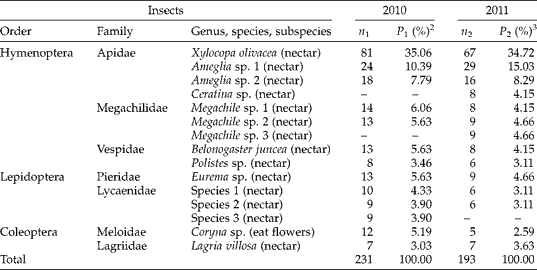
Among the 231 visits by 13 insect species in 2010 and 193 visits by 14 insect species in 2011 that were recorded for P. coccineus flowers, those by X. olivacea were more: 81 visits (35.06%) in 2010 and 67 visits (34.72%) in 2011 (Table 1). The difference between the percentage of floral visits in 2010 and that in 2011 was not significant (χ2= 0.01; df = 1; P>0.05).
Diversity of floral insects visiting Phaseolus coccineus flowers in 2010 and 2011 and number and percentage of visits by different insects1

n 1, Number of visits on 120 flowers over 17 days; n 2, number of visits on 120 flowers over 13 days; P 1 and P 2, percentages of floral visits.
1 Comparison of the percentages of X. olivacea visits in the two study years: χ2= 0.01 (P>0.05; NS).
2 P 1= (n/231) × 100.
3 P 2= (n/193) × 100.
Floral products harvested
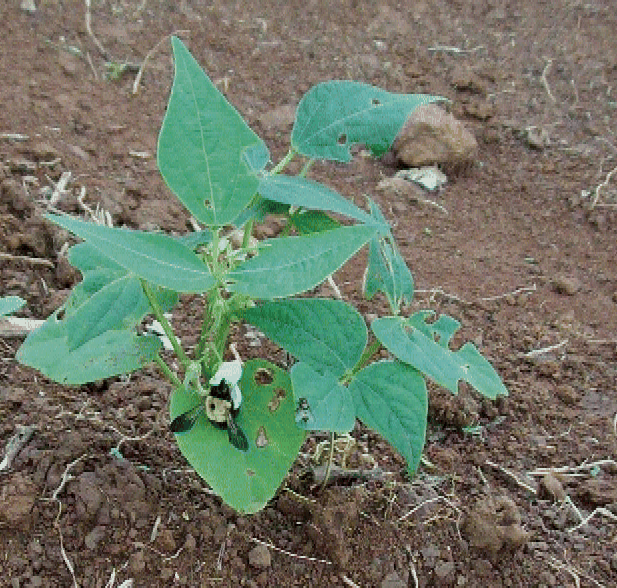
During each of the two flowering periods, X. olivacea was found to intensively and regularly collect nectar from P. coccineus flowers, but no pollen collection was observed (Fig. 1).
(colour online) Phaseolus coccineus plant showing Xylocopa olivacea collecting nectar from an open flower
Relationship between visits and flowering stages
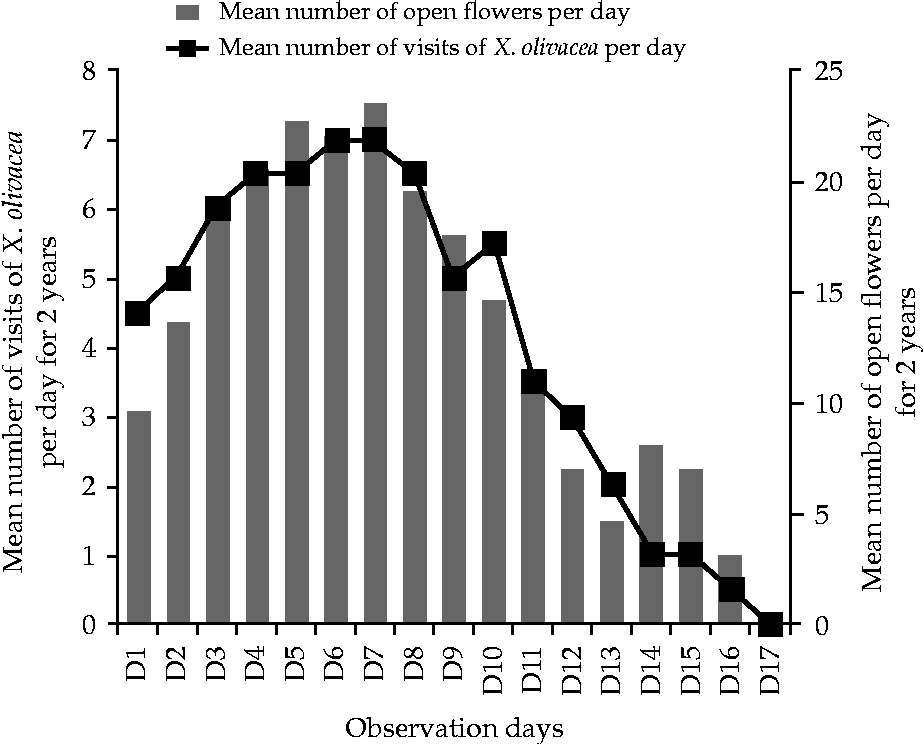
A positive and highly significant correlation (Fig. 2) was found between the number of P. coccineus open flowers and the number of floral visits by X. olivacea in 2010 (r= +0.89; df = 15; P< 0.01) as well as in 2011 (r= +0.95; df = 11; P< 0.01).
Seasonal distribution of the number of Phaseolus coccineus open flowers and the number of Xylocopa olivacea visits in 2010 and 2011
Diurnal floral visits
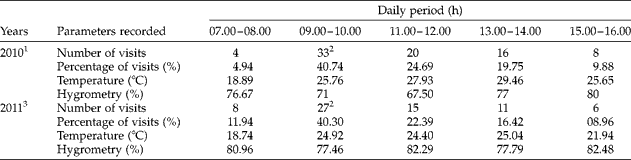
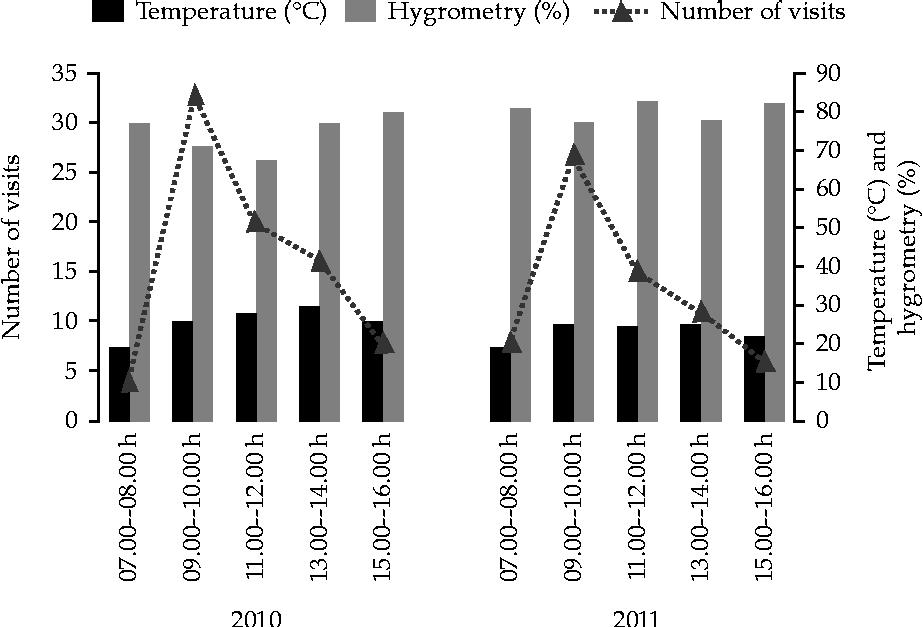
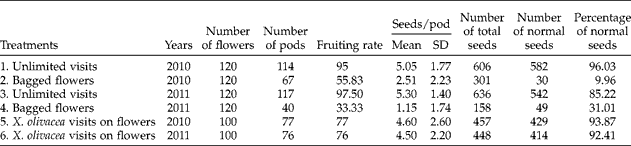
Xylocopa olivacea foraged P. coccineus flowers throughout the day, with peak activity being observed between 09.00 and 10.00 h daily (Table 2). Climatic conditions influenced the activity of X. olivacea (Fig. 3). In 2010, the correlation between the number of floral visits and temperature was positive and significant (r =+0.50; df = 15; P< 0.05) and that between the number of floral visits and relative humidity was negative and highly significant (r= − 0.69; df = 15; P< 0.01). In 2011, the correlation between the number of floral visits and temperature was positive and significant (r= +0.60; df = 11; P< 0.05) and that between the number of floral visits and relative humidity was negative and significant (r= − 0.61; df = 11; P< 0.05).
Daily distribution of Xylocopa olivacea visits on 120 Phaseolus coccineus flowers over 17 days in 2010 and over 13 days in 2011 and mean temperature and humidity of the study site
1 For temperature and hygrometry, each value represents the means of 56 observations.
2 Daily peak in visits.
3 For temperature and hygrometry, each value represents the means of 52 observations.
Daily distribution of Xylocopa olivacea visits on 120 Phaseolus coccineus flowers over 17 days in 2010 and over 13 days in 2011 and mean temperature and mean humidity of the study site
Abundance of Xylocopa olivacea
In 2010, the highest mean numbers of X. olivacea insects that were simultaneously active were 1/flower (n= 117; s= 0) and 162.56/1000 flowers (n= 106; s= 28.16; maximum = 200). In 2011, the corresponding values were 1/flower (n= 85; s= 0) and 164.50/1000 flowers (n= 85; s= 32.48; maximum = 250). The difference between the mean number of foragers/1000 flowers in 2010 and that in 2011 was not significant (t= 0.43; P>0.05).
Duration of visits/flower
In 2010, the mean duration of X. olivacea visits was 2.84 s (n= 131; s= 0.83; maximum = 5 s); in 2011, the corresponding value was 3.12 s (n= 105; s= 0.91; maximum = 5 s). The difference between the two study years was significant (t= − 2.44; P <0.05). The mean duration of a floral visit was 2.96 s in the two study years.
Foraging speed of Xylocopa olivacea on Phaseolus coccineus flowers
Xylocopa olivacea visited between 3 and 18 P. coccineus flowers/min in 2010 and between 3 and 17 flowers/min in 2011. The mean foraging speed was 9.48 flowers/min (n= 129; s= 3.13) in 2010 and 9.04 flowers/min (n= 108; s= 3.17) in 2011. These mean values were not significantly different (t= 1.07; P>0.05).
Influence of neighbouring flora
During the observation period, flowers of many other plant species growing in the study area were visited by X. olivacea for nectar (ne) and/or pollen (po). Among these plants were Phaseolus vulgaris (Fabaceae; ne), Cajanus cajan (Fabaceae; ne and po), Vigna unguiculata (Fabaceae; ne and po), Voacanga africana (Apocynaceae; ne) and Gossypium hirsutum (Malvaceae; po). During the entire observation period, individual bees foraging P. coccineus flowers were not observed moving to a neighbouring plant of a different species and vice versa.
Impact of anthophilous insects on the pollination, pod/set formation and seed yields of Phaseolus coccineus
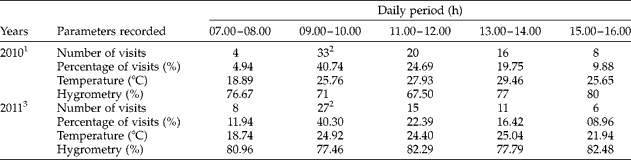
During nectar and/or pollen harvest from P. coccineus, some foraging insects were always ‘buzzing’ near the flowers with contact on anthers and stigma, thus increasing the possibility of cross- and self-pollination of P. coccineus. Comparison of the fruiting rates is given in Table 3.
(1) The differences observed between free open flowers and bagged flowers were highly significant in 2010 (χ2= 49.65; df = 1; P< 0.001) and in 2011 (χ2= 109.20; df = 1; P< 0.001). The difference between the 2 years with respect to exposed flowers was not significant (χ2= 1.04; df = 1; P>0.05). Consequently, the fruiting rate of the unprotected flowers (treatments 1 and 3) was higher than that of the protected flowers (treatments 2 and 4). The fruiting rate due to the activity of flower-visiting insects was 41.23% in 2010 and 65.81% in 2011. For all the flowers studied, 53.52% of the fruiting rate was attributed to the influence of insects.
(2) The comparison of the mean numbers of seeds/pod (Table 3) indicated that the differences observed were highly significant between flowers subjected to treatment 1 and those subjected to treatment 2 (t= 7.96; P< 0.001) and flowers subjected to treatment 3 and those subjected to treatment 4 (t= 13.65; P< 0.001). The difference between the two study years with respect to exposed flowers was not significant (t= 1.19; P>0.05). Consequently, the mean number of seeds/pod of open flowers (treatments 1 and 3) was higher than that of the bagged flowers (treatments 2 and 4). The percentage of seeds/pod attributed to the activity of flower-visiting insects was 50.29 in 2010 and 78.30 in 2011, giving a total mean of 64.29%.
(3) The comparison of the percentages of normal or well-developed seeds (Table 3) indicated that there were highly significant differences between free open flowers (treatments 1 and 3) and bagged flowers (treatments 2 and 4) in 2010 (χ2= 678.90; df = 1; P <0.001) and in 2011 (χ2= 195.42; df = 1; P <0.001). The difference between the two study years with respect to exposed flowers was highly significant (χ2= 42.25; df = 1; P< 0.001). Thus, the percentage of normal or well-developed seeds of exposed flowers was higher than that of the protected flowers in 2010 and 2011. The percentage of normal or well-developed seeds due to the activity of insects was 89.62 in 2010 and 63.61 in 2011. For all the flowers studied, the percentage of normal or well-developed seeds due to the activity of flower-visiting insects was 76.62.
Phaseolus coccineus yields under different pollination treatments
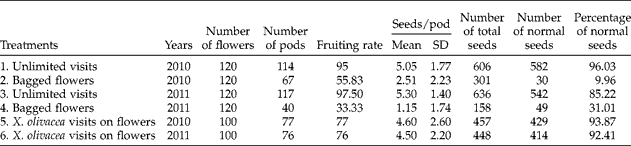
SD, standard deviation.
Pollination efficiency of Xylocopa olivacea on Phaseolus coccineus
During nectar harvest from flowers, foragers were always in contact with the stigma and anthers. The total number of floral visits expressed as a percentage during which worker bees came into contact with anthers and stigma was 100% during nectar harvest. Thus, X. olivacea significantly increased the pollination of P. coccineus flowers.
(1) The comparison of the fruiting rates (Table 3) indicated that the differences observed were highly significant between flowers subjected to treatment 2 and those subjected to treatment 5 (χ2= 10.81; df = 1; P< 0.01) in 2010 and between flowers subjected to treatment 4 and those subjected to treatment 6 (χ2= 39.84; df = 1; P< 0.001) in 2011 and not significant between flowers exclusively visited by X. olivacea (treatments 5 and 6) in the two study years (χ2= 0.03; df = 1; P>0.05). Consequently, in 2010 and 2011, the fruiting rate of flowers that were bagged and exclusively visited by X. olivacea (treatments 5 and 6) was higher than that of flowers that were bagged during their flowering period (treatments 2 and 4). The fruiting rate due to the activity of X. olivacea was 27.49% in 2010 and 56.14% in 2011. For all the flowers studied, the fruiting rate attributed to the influence of X. olivacea was 41.82%.
(2) The comparison of the mean numbers of seeds/pod (Table 3) revealed that the differences observed were highly significant between flowers subjected to treatment 2 and those subjected to treatment 5 (t= 5.19; P< 0.001) and flowers subjected to treatment 4 and those subjected to treatment 6 (t= 8.97; P< 0.001). Consequently, in 2010 and 2011, the yields of seeds/pod of flowers that were bagged and exclusively visited by X. olivacea (treatments 5 and 6) were higher than those of flowers that were bagged during their flowering period (treatments 2 and 4). The percentage of seeds/pod attributed to the influence of X. olivacea was 45.43 in 2010 and 74.44 in 2011. For all the flowers studied, the percentage of seeds/pod attributed to the influence of X. olivacea was 59.94.
(3) The comparison of the percentages of normal or well-developed seeds (Table 3) indicated that the differences observed were highly significant between bagged flowers and flowers exclusively visited by X. olivacea in 2010 (χ2= 534.88; df = 1; P< 0.001) and in 2011 (χ2= 115.96; df = 1; P< 0.001) and not significant between flowers exclusively visited by X. olivacea in the two study years (χ2= 0.03; df = 1; P>0.05). The percentages of normal or well-developed seeds of bagged flowers and those exclusively visited by X. olivacea were higher than those of the protected flowers in 2010 and 2011. The percentage of normal (or well-developed) seeds attributed to the influence of X. olivacea was 89.38 in 2010 and 66.44 in 2011. For all the flowers studied, the percentage of seeds/pod attributed to the influence of X. olivacea was 74.91.
Discussion
Xylocopa olivacea was the main floral visitor of P. coccineus observed during the study period. The results of the present study confirm those reported by Pando et al. (Reference Pando, Tchuenguem Fohouo and Tamesse2011a), who revealed that X. olivacea is the most frequent floral visitor of P. coccineus. However, in other parts of the world, such as South Africa (Palmer, Reference Palmer1967), Great Britain (Kendal and Smith, Reference Kendal and Smith1976), Colombia (Vanderborght and Rasmont, Reference Vanderborght and Rasmont1987), Poland (Koltowski, Reference Koltowski2004) and Kenya (Kasina et al., Reference Kasina, Kraemer, Martius and Wittmann2009), other bees, including Bombus terrestris, Xylocopa bariwal and A. mellifera adansonii, have been reported as the main floral visitors of this crop. This could be due to the absence or lower abundance of X. olivacea in these areas, though the abundance and diversity of floral insects to a plant vary depending on the region (Roubik, Reference Roubik2000).
The non-significant difference between the percentages of floral visits by X. olivacea during the two study years could be explained by the presence of several natural nests of this insect near the experimental plot.
According to Kasper et al. (Reference Kasper, Reeson, Mackay and Austin2008), foragers prefer warm or sunny days for good floral activity. During the study period, the ambient temperature was low at Dang Village, with a mean of 25.64 °C (n= 56; SD = 1.60) in 2010 and 23.12 °C in 2011 (n= 52; SD = 1.79), and humidity was high, with a mean of 72.03% (n= 56; SD = 5.24) in 2010 and 79.37 (n= 52; SD = 7.70) in 2011 (Table 2). These conditions probably negatively affected the activity of workers. This could explain the lowest number of X. olivacea visits on P. coccineus flowers between 07.00 and 08.00 h (Table 2). In fact, Kasper et al. (Reference Kasper, Reeson, Mackay and Austin2008) and Tuell and Isaacs (Reference Tuell and Isaacs2010) reported that the weather during blooming affects the abundance and foraging activity of insect pollinators. Similar results were obtained for A. mellifera adansonii workers foraging the flowers of Abelmoschus esculentus (Azo'o et al., Reference Azo'o, Tchuenguem Fohouo and Messi2011) and Callistemon rigidus (Myrtaceae) (Fameni Tope et al., Reference Fameni Tope, Tchuenguem Fohouo and Brückner2012). Between 09.00 and 10.00 h, temperature and humidity were probably more favourable for X. olivacea activity. This activity correlates with the period of highest availability of nectar in P. coccineus flowers as reported by Koltowski (Reference Koltowski2004) and Pando et al. (Reference Pando, Tchuenguem Fohouo and Tamesse2011a). In 2010 and 2011, we found a positive and significant correlation between the number of floral visits and temperature (r= +0.50; df = 15; P< 0.05; r= +0.60; df = 11; P< 0.05), but a negative and significant correlation between the number of floral visits and humidity (r= − 0.69; df = 15; P< 0.05; r= − 0.61; df = 11; P< 0.05) (Table 2).
The high abundance of carpenter bees/1000 flowers and the positive and significant correlation between the number of P. coccineus flowers blooming and solitary bee visits underscore the attraction of P. coccineus nectar for X. olivacea. This could be partially explained by the concentration of total sugar (35–45%: Koltowski, Reference Koltowski2004) P. coccineus nectar compared with 15–75%, the range in which the nectar concentrations of most plant species fall (Proctor et al., Reference Proctor, Yeo, Lack, Corbet, Walters, Richard, Streeter and Ratcliffe1996). According to Vanderborght and Rasmont (Reference Vanderborght and Rasmont1987) and Koltowski (Reference Koltowski2004), nectar produced by P. coccineus flowers attracts various insects in natural conditions.
The significant difference between the duration of floral visits in 2010 and 2011 could be attributed to the availability of floral products or the variation in the diversity of floral insects from 1 year to another. During each of the two flowering periods of P. coccineus, X. olivacea intensely and regularly harvested nectar. This could be attributed to the needs of insects during the flowering period. The disruptions of visits by other insects reduced the time frame of floral visits of certain individuals of X. olivacea. This obliged some carpenter bees to visit more flowers for a foraging trip to maximize their nectar loads. Similar observations were made for A. mellifera adansonii workers foraging the flowers of Entada africana (Mimosaceae), Psidium guajava (Myrtaceae) (Tchuenguem Fohouo et al., Reference Tchuenguem Fohouo, Djonwangwe, Messi and Brückner2007), Croton macrostachyus (Euphorbiaceae), Syzygium guineense var. guineense (Myrtaceae) (Tchuenguem Fohouo et al., Reference Tchuenguem Fohouo, Djonwangwe, Messi and Brückner2008a), Persea americana (Lauraceae), Vitellaria paradoxa (Sapotaceae) (Tchuenguem Fohouo et al., Reference Tchuenguem Fohouo, Djonwangwe and Brückner2008b), V. unguiculata (L.) (Fabaceae) (Tchuenguem Fohouo et al., Reference Tchuenguem Fohouo, Ngakou and Kengni2009b), Combretum nigricans, Erythrina sigmoidea, Lannea kerstingii, Vernonia amygdalina (Tchuenguem Fohouo et al., Reference Tchuenguem Fohouo, Fameni Tope, Mbianda Pharaon, Messi and Brückner2010), and C. rigidus (Fameni Tope et al., Reference Fameni Tope, Tchuenguem Fohouo and Brückner2012) and Chalicodoma cincta (Hymenoptera: Megachilidae) foraging the flowers of C. cajan (Fabaceae) (Pando et al., Reference Pando, Tchuenguem Fohouo and Tamesse2011b), P. vulgaris (Douka and Tchuenguem Fohouo, Reference Douka and Tchuenguem Fohouo2013) and G. hirsutum (Dounia and Tchuenguem Fohouo, Reference Dounia and Tchuenguem Fohouo2013; Mazi et al., Reference Mazi, Tchuenguem and Brückner2013).
The carpenter bee foragers had a higher affinity for P. coccineus than for the neighbouring plant species, indicating their faithfulness to this Fabaceae plant, a phenomenon known as ‘floral constancy’ (Louveaux, Reference Louveaux, Pesson and Louveaux1984; Backhaus, Reference Backhaus1993; Basualdo et al., Reference Basualdo, Bedascarrasbure and De Jong2000). Floral constancy is an important aspect in the management of pollination. From this study, it can be concluded that X. olivacea is beneficial for the pollination management of P. coccineus.
While feeding on nectar, X. olivacea foragers regularly come into contact with the stigma. They are also able to carry pollen with their hair, legs and mouth accessories from a flower of one plant to the stigma of another flower of the same plant (geitonogamy), to the same flower (autogamy) or to that of another plant (xenogamy).
The significant contribution of X. olivacea to the pod and seed yields of P. coccineus is in agreement with similar findings in Britain (Kendal and Smith, Reference Kendal and Smith1976) and the USA (Ibarra-Perez et al., Reference Ibarra-Perez, Barnhart, Ehdaie, Knio and Waines1999), which revealed that P. coccineus flowers produce fewer seeds/pod in the absence of efficient pollinators.
The contribution of X. olivacea to P. coccineus production through its pollination efficiency was significantly higher than that of all insects visiting the exposed flowers. The weight of X. olivacea played a positive role during nectar collection. Xylocopa olivacea shook flowers, facilitating the liberation of pollen by the anthers for optimal occupation of the stigma. The results of the present study confirm those reported by Mensah and Kudom (Reference Mensah and Kudom2011), who revealed that fruits developing from Luffa aegyptiaca flowers that had been visited by X. olivacea once had a mean weight of 428.7 g, which was 1.5 times greater than that of fruits developing from flowers visited by A. mellifera (286.76 g). This phenomenon was also reported by Vanderborght and Rasmont (Reference Vanderborght and Rasmont1987) for X. bariwal, an efficient pollinator of P. coccineus.
The higher yield of pods and seeds during unlimited visits when compared with that of bagged flowers revealed that insect visits were effective at increasing cross-pollination. The results of the present study confirm those reported by Webster et al. (Reference Webster, Ross and Evans1982), Wells et al. (Reference Wells, Isom and Waines1988) and Ibarra-Perez et al. (1997), who demonstrated that P. coccineus flowers set few pods in the absence of insect pollinators. Similar experiments carried out in England (Free, Reference Free1966) and in Brazil (Free, Reference Free1993) have shown that pollination by insects is not always required. Darwin (Reference Darwin1876) demonstrated that the self-pollinated flowers of P. coccineus produced as many pods and seeds as exposed plants. Thus, pollination requirements may differ between plant varieties.
Conclusion
This study has revealed that P. coccineus is a highly nectariferous plant that derives benefits from pollination by insects, among which X. olivacea is of greater importance. The comparison of the pod and seed sets of unprotected flowers with those of flowers exclusively visited by X. olivacea underscores the value of this bee in increasing pod and seed yields as well as improving seed quality. The installation of X. olivacea nests in the proximity of P. coccineus seed fields is recommended for increasing the pod and seed yields of this valuable crop.
Acknowledgements
The authors thank the International Foundation for Sciences (Stockholm, Sweden) for providing financial support and the UN University (Tokyo, Japan) (research grant to F.-N.T.F.; 3181-1) for providing some equipment and contributing to the installation of honeybee colonies within the University campus.