INTRODUCTION
This essay explores Greek social practice and imagination in the context of what is globally defined as the Greek debt crisis. I strategically avoid entering into a formal discussion of the etiology and definition of the crisis,Footnote 1 which anyway remain contested, particularly among economists. For the purposes of this paper the crisis is assumed to be a period of wider financial meltdown, which is accompanied by a renewed set of relations between Greece and its lenders and also by drastic political reforms and austerity policies. I will analyze the crisis from a perspective that is rarely considered in dominant depictions of financial crises. My focus is on the Greek self-image and its multiple corporeal subjectifications (embodied in imagery, sexualized jokes, and other realms) in the face of what is increasingly recognized as national and personal subjugation. I am interested in Greek responses to these conditions, which, even though they differ along class and gender lines, generate widely shared (and widely contested) understandings of what life is like in a contemporary state that is progressively defined as subordinate and in need of tutelage from more powerful regimes to the north. Among my arguments is that the perceived sense of subordination reveals the common lure of motifs of transgression for people of different backgrounds.
Given that the crisis conditions under discussion have produced in me strong feelings of identification and discontent, this essay is also an effort to use my own intimate lifeworld as a means of producing analysis, which explains the persistent theorization of anecdotes and other ethnographic moments involving friends, colleagues, and bystanders.Footnote 2 My larger goal, however, is to make sense of the anxiety about Greece's role as a global entity, how tutelage is conceived in an idiom of surveillance, and how it is negotiated through fantasies of nativism. I will pursue these questions across multiple social fields, complicating them through an investigation of ruptures and disputes. The role of sexualization and joking in Greek responses to the crisis will be central to my analysis, as will an examination of how visual and material culture are instrumental to Greek perceptions and practices.
EVERYDAY INTERNATIONAL DRAMAS
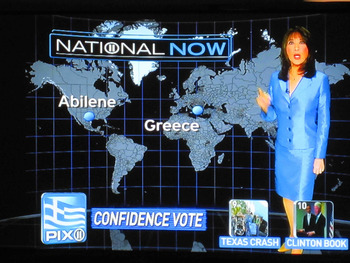
I will begin with scenes from the winter of 2011–2012 in an eastern U.S. university town, a place seemingly unrelated to the representational motifs surrounding the Greek crisis. One morning I spotted a television news story that featured extensive footage from the “Greek riots” in Athens, taken during a protest against the austerity measures imposed by the Greek government as part of the International Monetary Fund (IMF) and European Union (EU) financial bailout and monitoring of the country. I was intrigued by the sudden appearance of Greece on the landscape of U.S. news. The images shown focused mostly on Molotov cocktails fierily crashing on empty pavement. I was taken aback by the story's switch from the smokiness of the protest landscape to a didactic placement of Greece in a global map of representable events (figure 1). This rioting iconography, which has come to stand for the Greek crisis around the globe, plays an instrumental role as a shock tactic that “justifies” austerity policies. It helps motivate political shifts in the more powerful northern European countries (Knight Reference Knight2013a: 153, 147, 148) and, as it is displayed here, in the United States. The same iconography can be an object of fascination in other spheres, including photojournalistic blogs where photographers claim an aura of self-heroizing empiricism by involving themselves in the clashes, or in those (both Greek and international) domains of leftist aestheticsFootnote 3 in which the display of rioting scenes is enmeshed in desires for revolutionary warfare and in the endorsement of the view—increasingly heard outside of leftist debates—that holds destruction to be the only form of rejecting complicity with the current, subjugating state of affairs.
Still Image from Pix11 News, November 2011. Placement of Greece in a global map of events. Copyright WPIX-TV. Author's photo.

Some hours later, I accidentally met a middle-aged member of the (non-academic) university staff who jokingly commented on a Greek colleague's bodily injury by saying, “Not only the country is falling apart but you are as well.” Another kind of placement was at play here. “We,” the injured man and myself, were ascribed a Greek national identity and, even more, our own bodies were seen as the metaphor and place where a national injury was sustained. The realm of abstract economics was now conceived to be as tangible as my Greek colleague's broken limb, and the nation-state itself was condensable in the nationalized subject's body. I pondered all this as I sat with three Greek colleagues at the university café a few hours later. One of them recounted a scene in which he tried to chat with a young German woman while waiting for the night bus in a German city. The woman's allegedly scornful response was fixated on the man's Greek descent, which reminded her of “where our (German) taxes go” (her words). This comment invokes a popular motif in certain public German and Greek discourses according to which German taxpayers are called upon to repair the mismanagement of Greek finances, which, in this view, caused the Greek debt crisis. The man's portrayal of sexuality as a field of international negotiations immediately reminded me of another scene. A young Greek man, in his early days of “flirting” with a German woman, claimed to have received a text message in which she playfully invited him to “fix the corrupt Greek tax system,” only later to note that this “of course” was “a joke.”
About a week later, first a medical doctor and then an employee at a supermarket remarked emphatically that I must be “happy” to have “escaped” what was happening in Greece. These men referred to the allegedly destructive protests that, in the iconography disseminated in U.S. media representations, form the landscape of the Greek crisis. I originally thought that these remarks reflected a certain triumphant portrayal of America as an entity that rescues people from supposedly unsafe (non-Western, non-democratic) regimes. In my past experience of studying in the UK, where national origin was resonant for some Greek students due to their expatriate status, I had seen them act out different subject positions. These included a self-proclaimed, empowering alliance among southern Europeans on the grounds of cultural and sensory affinity. As if articulating a kind of European negritude, these Greeks proposed elements such as body posture and open-air socializing as a means of asserting cultural superiority. Of course, despite its glorious tone, one cannot preclude that other groups may use this same essentialization to exclude these “southerners” from various social spheres or to attribute potential shortcomings to this identity (Carrier Reference Carrier and Carrier1995: 23; Herzfeld Reference Herzfeld and Harris2005: 52, 62). In any case, the designation of Greece as the place to happily escape from, which I encountered in the United States, was rather novel to me.
The scenes I have just described correspond to narratives I began to hear from other young, middle-class Greek émigrés during the same period. Their stories featured motifs of performative ascription of nationality to Greek subjects, the (Greek) anxiety about non-participation in a Euro-American Enlightenment cosmos, a sense of being surveyed and demeaningly gazed at, and the signification of sexuality as an arena of power struggle. It is the drama of these everyday international scenes—Bhabha originally called them “‘everyday’ colonial scenes” (Reference Bhabha and Bhabha2004: 109)—that drew me into this project, tempting me to sublimate my own ambivalence and even bitterness about the crisis into analysis. This endeavor differs significantly from other ethnographies I have pursued. I ask no questions of my informants, for instance. Instead this project entails my constant immersion in scenes, imagery, and other people's questions that forcefully demanded my response. A certain personal tone is unavoidable and necessary, even if its ultimate aim is not a reflexive exposition of ethics and representation (e.g., Clifford and Marcus Reference Clifford and Marcus1986). Subjective reflection, with its potential “lament,” “may in the end fulfill … the law of the word's course” (Adorno Reference Adorno and Jephcott2005: 16), reproducing the very power relations it sought to scrutinize. Still, an analysis of my own positionality is important in illuminating the questions of pleasure, aversion, and desire that my text addresses.
The widespread notion that Greece is symbolically dominated within the current context of IMF/EU monitoring and sponsorship is not simply an abstract claim. As I will argue, it is deeply embodied; felt at a visceral level. This is why my essay privileges material and visual culture, not only from the scope of semiotics, but through a consideration of corporeality, including the embodiment that takes place in performing and uttering national narratives, or viewing public photographs. My use of the term materiality signals my interest in “the figural”; that is, the “libidinally charged domain” “where intensities are felt,” which philosopher Jean-François Lyotard opposed to discourse, the field associated with what can be read and be given meaning within a closed system (Pinney Reference Pinney and Buchli2002: 85; Reference Pinney, Tilley, Keane, Kuechler and Rowlands2006: 135). My approach complements the emphasis placed on rhetoric and discourse (and consequently on the semiotic study of meaning and strategies of discursive communication) in recent analyses of the Greek crisis (e.g., Theodossopoulos Reference Theodossopoulos2013).
The essay traverses different registers and terrains, but it will focus less on marginal subalterns (e.g., poor farmers, which is the common anthropological motif) and more on young, middle-class Greek men (see also Faubion Reference Faubion1993). Of course, from a certain perspective, all middle-class Greeks constitute a specific form of subalternity in that they were forced to accede to various Eurocentric constructs, while reproducing them against weaker internal classes (Herzfeld Reference Herzfeld2002; Reference Herzfeld2003: 294; Argyrou Reference Argyrou2002; but see Kalantzis Reference Kalantzis2014). Nonetheless, middle-class aesthetics and sensibilities are embodied in ways that affect their positioning vis-à-vis other groups in Greek society within the crisis.
This essay builds on problematics and approaches developed in recent work on the geographies, representations, historicities, discourses, and economies of the Greek crisis (Herzfeld Reference Herzfeld2011; Yiakoumaki Reference Yiakoumaki2011; Panourgiá Reference Panourgiá2011; Papailias Reference Papailias2011; Athanasiou Reference Athanasiou2012; Dalakoglou Reference Dalakoglou2012; Hirschon Reference Hirschon2012; Kalantzis Reference Kalantzis2012; Knight, Reference Knight2012; Reference Knight2013a; Reference Knight2013b; Theodossopoulos Reference Theodossopoulos2013; Rakopoulos Reference Rakopoulos2014; see also Cabot Reference Cabot2014). I also turn to questions of desire and pleasure (Kulick Reference Kulick2006: 933) that may account for the “affectively ambivalent complexities” (Ortner Reference Ortner1995: 179) of responses to the crisis. I treat the ambivalence of Greek engagements not as a discursive strategy for acquitting oneself, blaming others, or rhetorically rendering socioeconomic conditions more legible and “less threatening” (but see Theodossopoulos Reference Theodossopoulos2013: 202, 208). In other words, I am not interested here in evaluating responses to the crisis for their capacity to develop “resistance” or to semantically control a felt threat. Instead, I am exploring the kinds of experiences and embodied subjectifications that emerge in people's conflictual reactions to Greece's putative subjugation, by writing in various spheres of disavowalFootnote 4 including jokes, which tend to be underrepresented in analyses of the Greek crisis and Greek social practice more broadly (but see Orso Reference Orso1979; see also Knight Reference Knight2015). Such disavowals may be inconsistent with the actors’ self-image, yet they do various things for them. Jokes and ambivalent subjectifications temporarily destabilize the actors’ expressed aspirations of the self, exposing the precarity and even fluidity of middle-class self-images in the face of the crisis. As social performances, they have a contextual character (see also Herzfeld Reference Herzfeld1985) that escapes the sphere of strategies and semantic tactics, momentarily exceeding the limits of official political positioning. They operate at the level of pleasure and desire, producing (even unwanted) commonalities among groups and agents who might be formally opposed.
Doing research among middle-class subjects whose experiences I relate to the lives of people in other spheres, including my two earlier rural fieldsites in highland Crete and Thessaly, involves interesting complications of method. For instance, turning my own peers and friends into informants produced heightened resentment of my decision to entangle them in my analysis. Of course, the dynamic of people “pushing back” as “we push” them “into the molds of our texts” (Ortner Reference Ortner1995: 189) does not uniquely pertain to fieldwork among middle-class subjects. I am reminded of Petros (a pseudonym), a tricenarian shepherd in the Sphakia region of western highland Crete, who once remarked that I would never be able to write about and understand him with “my little pencil,” derisively pointing at my field notebook. My peers, however, some of them pursuing academic careers in the social sciences, departed slightly from Petros’ disdainful remark in that they used a near-to-anthropology vocabulary that speaks of alienating objectification in describing their disapproval of my employing their experiences. Their objections more closely mirrored self-reproachful anthropological reflections on ethics (e.g., Schepher-Hughes Reference Schepher-Hughes1995).
REINFORCED ANXIETIES
Following the 2010 commencement of the IMF/EU financial sponsorship of Greece, which is accompanied by the obligation of the Greek government to implement structural reforms as outlined in a series of memoranda agreed upon by Greece and its lenders, there has been an outburst of public utterances that represent Greece as an entity dominated by mechanisms of financial and political control. The term memorandum itself is now synonymous with national subjugation to the interests of foreign agents. In many ways, both the increased electoral support to SYRIZA (Coalition of the Radical Left) and the public expressions of exhilaration following its victory in the January 2015 Greek elections are related to that party's anti-memorandum and anti-austerity claims, as well as its disdain for the lenders’ demands. International monitoring and sponsorship have heightened and partly shifted preexisting anxieties about Greek belonging and suspicion of (Western) tutelage. Briefly, what is happening today builds on the widespread Greek sense, present certainly in the second half of the twentieth century, that powerful Western nation-states have insidiously shaped the history of Greece in ways that have damaged and mocked Greek interests (Herzfeld Reference Herzfeld2003: 293, 298; Sutton Reference Sutton, Brown and Hamilakis2003). It is this “felt and lived national history” that triggers empathy for other global populations, even those that are otherwise rejected for their un-European backwardness (Kirtsoglou and Theodossopoulos Reference Kirtsoglou, Theodossopoulos, Theodossopoulos and Kirtsoglou2009: 86, 93). Often phrased in anti-colonial languageFootnote 5 (see also Knight Reference Knight2013b: 112), and marking the disgorging of terminology from more marginal discursive spheres (e.g., Papamanousakis Reference Papamanousakis1979) into the mainstream media, this sensibility is nevertheless evocative for people of diverse political self-images, even though they may perform/utter it in different ways.
Along these lines, there is currently a re-contextualization of older anxieties about Greece's political and cultural position in the “West,” as an “imaginary entity” (Chakrabarty Reference Chakrabarty1992: 21). A Greek friend in his early thirties, who holds a well-paid job as a digital-media analyst in London, pointed out to me how he was appalled when during a 2011 job interview he was asked whether he possessed the mandatory work visa. He interpreted the question as ignoring or even challenging the fact that Greeks, as citizens of an-EU member state, are not required to hold a special permit in order to work in the UK. This fear of the non-recognition of Greece as a respectable Western nation-state is familiar to any anthropologist who has ever worked in Greece, but such worry is now greatly enhanced. My informant understood his interviewer's question as pinpointing how Greece is what Chakrabarty calls, in reference to the always-yet-to-be-modernized Indian peasantry, “a figure of lack” (ibid.: 6, 18).
His story resonates with other narratives I collected from people of roughly the same age and background working in other Western European countries. Indicatively, one informant claimed to have received jocular notes from his academic colleagues warning him that unless he works they “will notify the troika” (i.e., officials from the European Commission, IMF, and European Central Bank who are monitoring Greece's progress). We are again in the realm of everyday scenes occurring outside Greece, in which Western spectators identify Greeks as national representatives and demand responses on the crisis. My informants often experience such demands as a callous gaze that, as we will see, provokes identifications with the Greek national entity that are more complex and more intense than expected.
Another story by the informant whose friends threatened to report him to “the troika” illustrates how the European gaze is experienced. He told me that he once guiltily revealed his Greek identity to a bartender who was asking whether the money he had placed on the table was enough to cover the bill. He felt he had to disclose his nationality, inviting the bartender to count the banknotes, as a verification that Greeks are not to be trusted around money. Although this man was subjected to unwelcome jokes about the need to surveil Greekness, he was now reproducing the image of Greeks as cheaters to an interlocutor who, as a European citizen, was endowed with the capacity to survey/evaluate the Greek subject. An interesting complication arises from the fact that similar stories of Greeks being ridiculed abroad are often aired in Greek media outlets, making it hard to chart the flow of ideology between personal experience and public enunciations. This issue demands closer attention, and I will briefly return to it in my discussion of how Greeks envision the public sector.
NATIVISM AND SURVEILLANCE
Popular in contemporary media spheres and other social domains is the concept of a Greek native cosmos resisting past invasion and, by extension, contemporary tutelage. I have previously argued that the notion of locality in Greece (par excellence ascribed to Crete today) brings together diverse political investments made by a wide range of agents. These include anarchists who attribute community egalitarianism and anti-statist revolutionary spirit to gun-bearing Cretan shepherds, and nationalists who are lured to Crete as the last enclave that can protect the nation from its enemies (Kalantzis Reference Kalantzis2012). Similarly, invocations of nineteenth-century Greek brigands as forces that could purify the corrupt internal bureaucracy and resist external tutelage were recently made by the young Thessalonikiot artist Christos Stamboulis in his comic-strip Mavri Foustanela (“Black kilt”), which casts a poor, nineteenth-century brigand and shepherd as the hero who opposes corrupt Greek and Ottoman elites. I recently also witnessed a middle-aged man in an exuberant moment at a restaurant that evokes vernacular aesthetics, calling out Kolokotronis (heroized figure of the nineteenth-century Greek war of independence) as a historical figure who could purge the nation-state of its traitors. He used the term “Nenekos” to describe this treason, referring to the nineteenth-century Greek chieftain Dimitrios Nenekos, who was reportedly bribed into joining Ottoman forces against his fellow Greeks. In this way, a global problem was “filtered through” a more “local-level understanding” (Sutton Reference Sutton1997: 415), but also the present moment was understood in light of past events (Knight Reference Knight2012), as registered in historical figures who are national icons. The man's performative call was related to Greek anger against politicians for leading the country to its current debt crisis and further destabilizing the reciprocities that once defined the relationship between voters and the parties.Footnote 6
Such expressions of wrath against politicians often cast contemporary Cretans in the role of purging force. Take the users’ comments below a YouTube video that features folk singing by members of a Cretan cultural association. The performers, who are dressed up in “traditional” attire, are touring Mani, another part of Greece that is mythologized for its rugged culture. A popular comment, which has received many positive votes by other viewers, warns politicians of the devastating wrath of Cretans and Maniates should they decide to act against them. The idea of agnatic feuding is deployed as a punishing counter to the opulent corruption of urbanite politicians.
The restaurant patron who summoned Kolokotronis as a comparable cleansing force ended his speech by exclaiming, “If only Juncker (then president of the Eurogroup) could see us now!” That is, having fun and spending money even though we are in a state of austerity. This reference to surveillance has become a popular trope in Greece. It points to a certain kind of experience emerging within tutelage. In other recreational contexts, I have witnessed middle-class friends pointing at the materiality of recreation (plates of food, drinks, crowds of bodies dancing) as something that would enrage the European lenders, who are presented as invisible spectators. A young friend in his thirties, dining out in a restaurant, recently shouted, oscillating between guilt and amusement, “What if Schäuble (then German minister of finance) could see this?” Similarly, a woman standing on the boat escalator dressed in colorful summer attire and holding shopping bags wondered aloud, “What would the Germans and the IMF say if they saw us returning from vacation like this?” (Kalantzis Reference Kalantzis2013: 213). These utterances, often addressed to a wider audience of bystanders in hopes of obtaining their agreement, represent tutelage, not merely as an abstract notion pertaining to economics but as a deeply embodied, internalized gaze.
I am reminded here of a certain middle-aged Sphakian man who told me in 2007 that the image of local bearded men shooting with their guns at a feast would regrettably remind “those who are watching” of images of warfare in the third world. Who are “those who are watching”? I take the man to be referring to the sense of constant monitoring and evaluation of local idioms by mechanisms that place things in hierarchies of value (see also Herzfeld Reference Herzfeld2004). Besides, Sphakia has been evaluated by European travelers, photographers, folklorists, musicologists, and botanists since at least the eighteenth century (Kalantzis Reference Kalantzis, Carabott, Hamilakis and Papargyriou2015, Reference Kalantzis2014). Locals resort to these “external” representations today in statements about the self. I originally interpreted the Sphakian man's utterance as an attempt to distance himself from the alleged excesses of Cretan traditionalism, which are a theme of constant contestation among Sphakians and are often presented by people as an embarrassment for the region. I later witnessed him enthusiastically endorsing the sorts of gun-shooting performances he was criticizing and, moreover, affectionately calling himself and other shooters “Taliban.” The self-ascription of what is otherwise condemned as warlike backwardness is comparable to the jocular disavowals of tutelage made by members of the Greek middle class. In both cases, there is ambivalent pleasure in embodying the figure of the transgressive native.
NATIONALIZATIONS
Closely related to the surfacing of common cultural reflexes is the increasingly nationalized perception of things. How events that would normally be classified as personal experience are nationalized is evident in the interactions of two close friends from Athens in their early thirties. One had begun a relationship with a younger German woman that coincided with the commencement of the memorandum. This had already placed him in an ambiguous position vis-à-vis his friends and peers, who often labeled the woman “Merkel” (after the German chancellor) and spoke about his desire as a form of victimizing self-colonization. Following a break-up, one of his peers said, “She colonized us, didn't she?” Among young Greek men jokes about the potentially castrating power of women are common, with women portrayed as forces that steal men away and break the bonds of “homosocial” interaction (Sedgwick in Giannakopoulos Reference Giannakopoulos2005: 59), finally disempowering and rendering them obedient subjects who merely fulfill women's desires. Such jokes are often performed in spheres where men claim exclusionary social space away from the presence of women, such as the spectatorship of football matches (ibid.).
I want to stress here how this man's affair was read in a nationalized light. When he spoke of a clash with the German woman in which she maintained an allegedly tough stance, his friend immediately asked, “But will you, in response, become Aris or Tsolakoglou?” Aris Velouchiotis was the chief of communist guerrillas. He was active in mainland Greece from 1942–1945, and his death—possibly a suicide; he was being pursued by Greek rightwing paramilitaries—was followed by his decapitation. Aris is a heroic figure mostly for leftists, though he stands for combative resistance even among people who do not identify with the left. His appearance, as captured in archival photographs, invokes the iconography of nineteenth-century brigand warriors, a matter of great interest that exceeds the scope of this essay. Georgios Tsolakoglou, by contrast, was one of the prime ministers of Greece during the German occupation. As with the chieftain Nenekos mentioned earlier, he is often used in Greek public discourse as a synonym for complicity and treason.
The man's jocular question manifests a complex intertwining of sexuality with nationhood, staged against a backdrop of comparative historical imagery. In the dilemma “Aris or Tsolakoglou,” Germany is again portrayed as a scornful female who prompts either resistance or complicity (recall the Greek man in the U.S. university town narrating his night-bus experience with a German woman). This same envisioning is at play in the jokes another male, middle-class interlocutor directed at his friend with a German partner. He compared his friend's relationship-negotiation skills to the “doomed-to-fail,” “maximalist” threats Alexis Tsipras has allegedly made against Angela Merkel's efficacious and cold determination. (Tsipras is head of the Coalition of the Radical Left and since January 2015 prime minister of Greece, but at the time he was leader of the opposition party.) In each case, figures from the Second World War and the contemporary political scene are used to classify and metaphorize daily experience. Furthermore, both men subordinate personal experiences to the national realm. Both were self-proclaimed metropolitan leftists who opposed the national(ist) project, yet they used national(ist) schemata to interpret events near to them. In some ways, this tendency is the reverse of what Sutton has noted with reference to the employment of Greek local-level practices to signify international politics (Reference Sutton1997). In what I am describing, the personal level is resignified and re-experienced through resort to the national ideological level. Intriguingly, this is observable among subjects who are otherwise disdainful of nationalism and its prescriptions.
The employment of figures from the Second World War through what Knight calls “cultural proximity” (Reference Knight2012) is further enhanced by the fact that the two friends just described had experienced their grandfathers’ embodied narratives of the German occupation. The man with the German partner recalled his enthusiasm as a child for hearing his grandfathers’ stories about the bodily toil, hunger, and numbing cold in the winter of 1941, and the ruthlessness of the German forces. The embodied element extends beyond the narrative level (i.e., the described bodily sensations of the Occupation itself), since these stories were also a means for the grandchild to associate and affectively connect with his grandfathers. The war stories were accompanied by the sensory experience of eating his favorite pasta dish at his grandparents’ home (see also Sutton Reference Sutton2001; Panourgiá Reference Panourgiá2005: 63), remembering the texture of those particular velvety couches, and smelling the attractively obsolete lemonesque cologne worn by his grandfather. The man's friend who posed the question about Aris and Tsolakoglou recalled his own grandfather's oft-repeated story of a German atrocity involving the killing of a child after luring it with breadcrumbs. The old man told this tale in protest against his grandson's choice to do German as a third language at school. There is a certain overlap between the school-level teaching of history and these grandfathers’ narratives, which endow the official ones with feeling. Despite potential divergences between official and personal narratives, the national level becomes embodied through its enmeshment in the sensorial sphere of grandfather-grandson affection. As with the question of the media, it is difficult to assess the exact effect of national history, but the contemporary emergence of nationalized reflexes does point to the amplification of national history through its inclusion in affective spheres, and to the fact that the sense of subordination entailed in the crisis triggers responses at the interface of the national and the familial.
RUPTURES
I have so far presented a somewhat unitary story that leaps between different spheres, revealing homogenizations that are emerging in the present context. These homogenizations break down in moments of dissonance, such as that I observed during the 2011 Syntagma Square protests, when leftist protesters dancing to a Cretan lyre player's Cretan tunes booed him for switching to the national anthem (Kalantzis Reference Kalantzis2012: 10). Another, more structural dissonance emerges in reference to the civil sector, and builds on past outcries against public sector employees as lazy, corrupt, and allegedly reliant on political contacts to acquire their posts.
In one of many arguments between bystanders I have recently witnessed, a woman criticized civil servants for striking despite their supposedly high salaries, and for blocking the train services she needed to commute to her private sector job, which she described as low-paying. Upon hearing these angry utterances, another middle-aged woman in that same train countered that instead of turning against each other there should be a unanimous Greek response to the disempowering tutelage imposed by the troika. I have heard similar criticisms of the civil sector in rural Greece, both in Thessaly and Crete. Farmers and shepherds mock co-villagers who work in the public sector as lazy. They also stigmatize EU subsidies as a force that pollutes local cultural and bodily idioms. Theodossopoulos argues that this anti-civil sector discourse emanates from a Greek agonistic work ethos that is autonomous from ideas about capital and labor produced in Western Europe (Reference Theodossopoulos2013: 204). Even if such autonomy exists, we ought to study it in light of the fact that various popular media sources express views powerfully critical of the public sector. Without assuming that the media exercise total control over ideology, the case in contemporary Greece is clearly one of “articulation between fractured hegemonic discourses and the situated interpretations of … subjects,” as Gupta put it in his account of Indian farmers’ perceptions of the state (Reference Gupta1995: 391).
The anti-civil sector discourse predates the crisis and may be partly based on a sense that others have used unofficial relationships with political parties to secure privileged positions that bypass class criteria and educational qualifications. In fact, spending time in Greek public services in Athens (before and during the crisis), consistently provides the observer with instances in which some customers, embodying an “aesthetics of exasperation” (Kalantzis Reference Kalantzis2012: 7) vocally attribute any inability to successfully complete their transactions to the services’ structural inefficiency, or even to the laziness and caprice of employees. These sentiments are currently being reshaped and rearticulated by specific commentators who represent the civil sector as a morally corrupt, homogeneous entity, prefiguring political measures that include layoffs. On the same day that I witnessed the heated exchange on the train, I saw a segment of a popular news show on SKAI (a private television channel) in which the host insisted that Greek politicians avoid the “necessary regulation” of the public sector for fear of losing support from their corrupt voters. Programming of this kind airs “preexisting grievances,” but it also “creates subjects” by systematically directing the form and etiology of exasperation (Gupta Reference Gupta1995: 388).
Both the critics and the defenders of the civil sector ascribe to their opponents something akin to a Marxist concept of false consciousness. For instance, a fifty-something, upper-middle-class private physician I know often describes non-civil sector workers who join the public strikes as misguided individuals who fail to see that the interests of civil sector employees do not coincide with their own. On the other hand, various friends who support the Coalition of the Radical Left portray those who turn against the civil sector as naively internalizing the agendas of conservative commentators, who have an interest in dividing workers.
The very concept of a common anti-memorandum front is questioned by commentators who consider themselves representatives of a sober, centrist, and bourgeois aesthetic. Resorting to an occidentalist self-image (Carrier Reference Carrier and Carrier1995), these interlocutors publicly advocate for accountability, audit culture, and the need to repay the debt to Greece's lenders. In media outlets that claim to represent such an aesthetic (e.g., the Kathimerini newspaper), one often encounters the idea that Greeks today are politically divided into those who (naively) ascribe blame to cryptically external forces and those who (maturely) seek responsibility among Greeks themselves. In the former category, people of both leftwing and rightwing background are bundled together under the anti-memorandum rubric. The other category is supposed to be made up of pro-memorandum political forces. Forms of Orientalism (Said Reference Said1978) and distinction (Bourdieu Reference Bourdieu1984) play into this binary classification. This is evident, for instance, in the intellectual commentaries offered by the philosopher Stelios Ramfos (Reference Ramfos2012) and the psychoanalyst M. Yosafat, who have argued, from their distinct perspectives, that Greeks are locked in culturally specific pathological structures that hinder their participation in an Enlightenment cosmos of accountability, responsibility, and maturity. In public disputes, many agents who vocally oppose Greece's austerity measures increasingly tend to identify this centrist rhetoric with treasonous complicity with the lenders’ interests. Greece is not unique, of course, in exhibiting internal Orientalisms. The Italian nation-state is also characterized by such dynamics, although the Italian variety combines class divisions with regional and racialized claims to superiority (Schneider Reference Schneider1998), factors related to “centrifugal forces” less prevalent in Greece (Herzfeld Reference Herzfeld2003: 286).
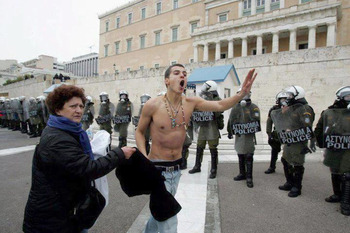
Consider also the analysis offered by a middle-aged, middle-class Lacanian interlocutor about an image that circulated in numerous Greek blogs and in international outlets (figure 2). It portrays a mother complicitly handing a shirt to her protester son, who appears in a tense moment of performative communication, though we cannot tell if he is addressing other protesters or the police. The subject position of a son in complicity with a mother who both endorses his transgression and subordinates it through her overprotectiveness is certainly familiar to Greeks, from various cultural registers. This familiarity is probably what triggered the blog responses that jokingly idolized the mother. My Lacanian interlocutor claimed, nevertheless, that what triumphs in the image is the absence of the father (and, by extension, the actor's identification with the father's domain—the law). Supposedly, the father figure would impose a certain order on the pathological synergy between mother and son. I am struck by the similarity between this analysis and the approach of the filmmaker Michael Haneke in his 2001 film The Piano Teacher. During a key scene, the mother places a jacket over the shoulder of her middle-aged daughter, distracting her from her engagements with men and keeping her confined within the sexualized dynamics of their morbidly dyadic relationship. The piece of clothing in both cases is the metaphor and vehicle of the mother's tender domination, an image also evoked in the final scene of August Strindberg's play, The Father, when the old nurse places a straitjacket on the male protagonist following his exhausting defeat by his wife. In my Lacanian interlocutor's analysis, the protesting body is represented as an adolescent boy (misguidedly) revolting with the (infantilizing) assistance of the mother. In this view, the ambiguous love of the mother lies behind Greek protesting practices.
Protestor and his mother outside the Greek Parliament in the February 2012 demonstrations against the austerity measures. Copyright and photograph by Simela Pantzartzi, Athens News Agency (ANA-MPA).

A Saidian reading (Reference Said1978) of this analysis would certainly point to the attempt to construct a generic category of “protesters” that is immediately rejected as perverse. From a similar perspective, the views of the allegedly sober center take us back to the theme of Greek reproductions of Eurocentric ideas at the expense of other social groups within Greek society (e.g., Herzfeld Reference Herzfeld2003: 294). Class certainly plays a role here. Those who claim to represent this bourgeois aesthetic may invoke the importance of university studies in the West, refer to terms (drawn from a neoliberal vocabulary) such as “innovation” or “entrepreneurship,” and express a certain antipathy toward the public sector, sympathizing instead with private sector employers and idealizing Greek industrialists of the past. In the face of the crisis, however, this same bourgeois aesthetic is intriguingly destabilized, particularly in jocular spheres, by the same actors who would otherwise endorse it.
SEXUALIZATION: ECHOES (AGAIN) ACROSS DIFFERENT FIELDS
A few months before figure 2 was taken, protesters raised a banner in the same square that compared Greece to the hotel maid allegedly raped by the then head of the IMF, Dominique Strauss-Kahn. This imagery stirred a heated debate at the general assembly that took place in the lower square (mostly frequented by leftists) in which a young woman critiqued the banner for its aggressive androcentric aesthetics. Despite these feminist misgivings, the notion that Greece is subjected to a castrating form of sexual domination is widely expressed by Greeks, often in the guise of jokes. The identification of Greece as male and Germany as female emerges in a variety of spheres, far exceeding the registers of self-ascribed virility that play out in, say, the relationships between Greek men and Western female tourists.
This broader casting of gendered roles includes, for instance, the short film A Very European Breakup (2012) by Bob Denham, which concerns the political relationship between Greece and Germany as metaphorized through the relationship of a Greek-German couple. Following a report about the film on the private TV channel Alpha, a Greek journalist asked an instructive question to the male actor: “So did she succeed in dominating us? Us as Greeks and as men?” The clash here is conceived as occurring on both a sexual and a national plain, with Greece being synonymous to manhood. Similarly, in the context of the U.S. university town, my male academic informants actually called their German female friend “Germany.” This nickname cunningly employed the Greek grammar convention whereby Germany and “a German woman” are both feminine nouns, differentiated only by the consonant delta (Ghermania vs. Ghermanidha).
My rural Greek informants, in conversations about tourism, also tended to identify the West as a female entity, contrasting it with Greekness. For them, Greekness ran the risk of becoming passively feminine by catering to tourists and abandoning the idealized spheres of shepherding and farming. This view is reflected in ethnographies of tourism in Greece (e.g., Buck-Morss Reference Buck-Morss, Raskin and Bernstein1987: 216, 217; Zinovieff Reference Zinovieff, Papataxhiarchis and Paradellis2006) that explore sexual affairs between Greek men and non-Greek, mostly Western European women. Such affairs are treated as a strategy for appropriating foreign women, subordinating the symbolic threat they pose as representatives of powerful political forces that clash with the men to whom these women putatively belong (Buck-Morss Reference Buck-Morss, Raskin and Bernstein1987: 216, 217; Zinovieff Reference Zinovieff, Papataxhiarchis and Paradellis2006). This is comparable to Bowman's analysis of Palestinian vendors’ sexualization of female tourists as compensation for political and economic damages and the precarities of mercantile exchange in the Old City of Jerusalem (Reference Bowman1989).
But what does the sexualization of Germany do for middle-class Greeks? The threat of Western-cum-female power, metaphorized further by the fact that the prime minister of Germany is a woman, is currently signified in multiple spheres as threatening the sovereignty of an imagined male national self. The tendency to express this relationship as a joke rather than as an agonistic narrative downplays the certainty and positivity of what is uttered, making it possible for middle-class actors to both affirm its content and deny it on the grounds that it is simply a joke. “Germany fucked us,” said an academic peer in the United States, referring to a German woman who recently broke up with a Greek man. His utterance curiously echoed a Sphakian shepherd's utterance, “they want to castrate us” (referring to the European lenders), in which the man used the local word for removing the testicles of a ram or billy goat (munuchizo). This echo reverberates further in a pictorial montage portraying a cow labeled IMF humping a horse, labeled Greece, which I received in a humorous chain email concerning the crisis.
Even more, I was recently sent a picture of what appears to be a sticker (or perhaps stencil-graffiti) inside a public lavatory in Athens, which portrays Angela Merkel in an expression of disgust, indicating with her fingers the size of the lavatory user's penis (figure 3). The design can be seen as a witty meditation on economic measurements and the corporeality of financial policies. This picture, too, has echoes in other domains, as in the circulated Greek web news about a German research project on European penis sizes, according to which Greeks scored low. A comparable expression of aversion in Merkel's face is reproduced in the masks I photographed during a protest against her visit to Athens in October 2012. It is as if the procession mirrors the repugnance people attribute to her political stance, a moral interpretation of German politics (see Herzfeld Reference Herzfeld2011: 24) that embodies the disavowed opponent as a means of rejecting her.
Picture of German Chancellor Angela Merkel in a public lavatory. Unknown artist. Taken from “Η χολή.”

Dozens of users’ comments on Facebook below the sticker picture (figure 3) attribute the penis's shrinkage to Merkel's visual presence and particularly her putative unattractiveness. Here we arrive at current Greek engagements with Angela Merkel as a gendered subject. I recall the indignant question of a middle-class Greek-American businessman in New Jersey: “What is this woman?” A comparable puzzlement over Merkel's gendered identity is expressed by another Greek émigré, the hip-hop artist Alitiz, who fashions himself as a gangster from the lower class of urban Germany. The artist's own career, starting supposedly as a joke and acquiring enthused veneration by people who enjoy but also mock his excess, illustrates the character of the jocular trope I am analyzing. His moniker is a slightly modified transliteration of the noun alitis, which could be roughly translated as “rogue” or “bum,” with connotations of transgression and misconduct. In his song about Angela Merkel, which is replete with sexist and sexualized insults, Alitiz emphatically asks, “What are you exactly, a man or a woman?”
Another overlap between the hip-hop artist and the businessman is the way they conceive of kinship, which reflects an émigré preoccupation with blood and national belonging that has been cultivated by the Greek state itself (Stewart Reference Stewart2006: 66, 68, 82). The Greek-American entrepreneur told me that he had heard that Merkel is related to Hitler, while Alitiz sings about her supposed use of a Hitler poster as home decoration. For both men, Merkel, as a contemporary German national leader, belongs to an aesthetic and blood lineage of German-ness that includes Nazism as an inherent trait and depicts Hitler as an archetypical agnate. A striking parallel to this politics of kinship was provided four decades ago in Peter Loizos's ethnography of Greek Cypriot villagers before the island's division. In the heated 1970 elections, supporters of the Progressive Front (a populist, nationalist party that appealed especially to young rural men) questioned the legitimacy of the United Party, which was lead by an English-trained barrister and seen as a party of the privileged urban bourgeoisie. Backers of the Progressive Front accused this leader of having a picture of the Queen of England in his study; they also claimed he was not a proper Christian Greek and associated his wife with the Turks because of her non-Greek descent (Loizos Reference Loizos1975: 237, 238, 254, 259). These accusations linked the United Party to Cyprus's recently overthrown British colonial regime and thus with treason, a linkage that, as we have seen, is central in contemporary Greek criticisms of the politicians who agreed to the memorandum and to austerity policies more broadly. In both Alitiz's song and the Progressive Front's claims, the ownership and display of an image is seen as an absolute sign of allegiance to the depicted figure, a pattern that highlights the primacy of the visual in establishing and proving social bonds. The Progressive Front's claims were particularly resonant because both Cypriot parties competed to control the same national space, but the Progressive Front emphasized its leader's role in the anti-colonial struggle against the British. The Progressive Front also professed an uncompromising desire for union with Greece, which was fashioned as antithetical to the supposedly corrupt, middle-class position on that issue (ibid.: 279). Again, in contemporary Greece it is exactly the notion of an uncompromising, pure stance that the fantasy of nativism entertains. This pure stance is juxtaposed to the alleged duplicity of the governing political system.Footnote 7
The idea that Merkel is not a proper female subject, that she steps over desired gender boundaries, is poignantly expressed in prosthetic visual montages that circulate on the web in the guise of the joke. The picture editors add predictable traits (e.g., oversized breasts), re-sexualizing Merkel in order to make her the object of aggressive masculine sexuality. Elsewhere, she is shown as a female tourist, which places her in the role of the foreign visitor who is subjugate-able through sexual affairs established with local men. In a picture that circulated following the 2012 defeat of the Greek national football team by “Germany,” Chancellor Merkel was portrayed as naked, in a bent over pose, being penetrated by the black Italian football player Mario Balotelli, an allusion to Italy's victory over “Germany” in the same cup. The jocular comments below this image (some mocked the ridiculousness of the montage itself, but also celebrated the chancellor's submission) could be read as signs of a complex identification. The racist stereotype of black men as “licentious”—which itself enacts an ambivalent oscillation between veneration and repugnance (Bhabha Reference Bhabha and Bhabha2004: 108)—is used to equate Greekness with potent sexuality. This “black Greek” is a fantasy of revenge allowed within the photographic frame. Such cultural investments do not contradict the Orientalist stance the same Greek commentators might otherwise take towards blacks, especially black migrants in Greece. Two things are happening politically in the deployment of Balotelli's image. First, the black male is seen as representative of a subaltern class with whom the commentators establish empathetic affinities in contrast to Western political powers (see Kirtsoglou and Theodossopoulos Reference Kirtsoglou, Theodossopoulos, Theodossopoulos and Kirtsoglou2009: 98). Second, the same stereotype that stigmatizes black men for their supposed underdevelopment, their animality, leaves space for the veneration of potent sexuality (Bhabha Reference Bhabha and Bhabha2004), a quality that is attractive for its avenging capacity against the (feminine) West.
Pictures like these realize certain possibilities of photography that preexisted digital technology, such as the representation of sitters in multiple roles and postures through collage, as well as the use of props and backdrops in Indian studio photography (Pinney Reference Pinney1997), or the reassembly in a single frame of deceased kin in photo-montages, which are often used in the mortuary practices I recorded in western highland Crete. These doctored images encapsulate a certain cultural investment in photography; they call upon photography's capacity to induce effects beyond the realm of physical actuality. In other words, they approach photography as being akin to magic (see Pinney Reference Pinney2011: 12, 76–78). The web images I discuss here ought, therefore, to be approached through questions of efficacy rather than meaning alone. What kind of “work is expected of them?” (Edwards Reference Edwards2012: 222).
The hint at how this question should be answered comes from a popular comment on YouTube under a picture of Alitiz giving the Greek version of the middle finger to Angela Merkel (figure 4). YouTube user “Andreas19ist” invites other viewers to admire how Angela “the whore” is standing to attention in front of Alitiz and “does not talk back.” The photographic frame is the space wherein a power reversal is possible. Here, Angela Merkel is subjugated to the potency of the male national subject (note the flag in the background). Given the intensity of people's engagements with this iconography, the power reversal is arguably effective at a visceral level, where it is “animated” in one's own body (Belting Reference Belting2009: 307). I borrow the term “animation” from Hans Belting, who makes the body central in assessing how images “work on us” (ibid.: 319). Viewing imagery is, in this sense, more than a passive reception of signs, and entails reviving an image in one's own body, summoning and producing the image and filling it with personal experience (ibid.: 305–7, 315). Viewers temporarily become the black penetrators or the mischievous “rogues” who control Merkel's movements; their gestures are enacted and enjoyed (or rejected and found repulsive) at the bodily level.
Hip-hop artist Alitiz's YouTube image.

Not surprisingly, approaches to Merkel, and to Germany as a whole, are far from stable. Merkel's androgynous image, for instance, can also produce awe. “Merkel has balls,” noted a retired civil servant in Thessaly, celebrating her prosecution of tax evaders in Germany, against the interests of Swiss banks. Another informant in the same village, a middle-aged farmer, recalled how his migration to Germany “made him a human being,” meaning a law-abiding, hard-working citizen. His claim was identical to that of my London-residing friend (of quite different background, given his urbanite middle-class descent), who said he knew a Greek man who “became a human being” as a result of dating a German woman for five years. Germany is the ambivalent object par excellence, venerated by Greeks of different background for its political efficacy, technology, socialist policies, or even its gender politics. Germany can also inspire aversion among these same venerators for what they see as its dehumanizing instrumentality and intrusive spirit. In ways comparable to colonial stereotyping, Greeks attempt to box Germany into fixed categories yet end up in a vacillating dynamic in which veneration and aversion constantly shift (Bhabha Reference Bhabha and Bhabha2004).Footnote 8
The Twitter and Facebook pages of members of the “Independent Greeks” party, known in Greece for its aesthetics of patriotic carnivalesque, often endow the motif of aggressive male sexuality that subordinates Western tutelage with a certain official status. The head of the party, Panos Kammenos (appointed Minister of Defense in January 2015), who inaugurated his campaign in Crete and marked the island as an inspiration for themes of resistance, tweeted, in response to a Swedish minister's allegedly demeaning 2013 statements, that Swedish women spend the summer as tourists with Cypriot lovers on Cypriot beaches. The tourist sphere emerges once again as a space of potential revenge, reversal, and transgression. As if to prove this point, before Angela Merkel's visit to Athens in October 2012 the actor and politician Pavlos Haikalis (appointed Deputy Minister of Social Security in July 2015) posted an image of a tied-up statue with an immense erection, captioned “Is she coming on Tuesday?? Untie me!!!!!!!!!”
This nationalized portrayal of tourist encounters as a field of power and sensuality corresponds to the jokes made by my colleague's German girlfriend. She often affectionately labeled her partner a Greek fisherman or shepherd, humorously comparing their relationship to that between an awkward female German tourist (with references to the supposedly revolting aesthetics of white socks and sandals) and a sensually sunburned southern manual laborer. The girlfriend thus participated in the casting of Greece as male, Germany as female, within a paradigm of reverse negritude. Her investment in alterity—Said would have called it “latent Orientalism”—entails fantasy, enthusiasm, dreams, and desire for a world that is attractively different (Bhabha Reference Bhabha and Bhabha2004: 102).
THE JOCULAR MODALITY
Disavowals of the lenders’ power through the idiom of aggressive masculinity are judged at both the national and international levels as signs of ridiculous, intransigent nationalism. This assessment, made by advocates of a “sober” and “serious” politics, reflects only one side of things, and the mechanisms of “sober” political engagement often themselves reproduce, as a joke, sexist, aggressive responses to tutelage, giving them another life. For instance, Lifo, a free, image-heavy periodical and online platform that cultivates the self-image of a bourgeois aesthetic opposed to nationalism, occasionally reproduces hostile, sexualized reactions to the West for the purpose of mocking them. Despite the reality of critique at the discursive level, the visual representation of criticized arguments and performative images allows for their reappearance, revival, and reproduction. I draw here on Bernadette Bucher's analysis of early European representations of the Americas (Reference Bucher1981). She argues that there can be no negation in the visual, since anything represented occupies the positivity of appearance, including what is being otherwise (verbally) diminished or despised (Pinney Reference Pinney, Tilley, Keane, Kuechler and Rowlands2006: 136). W.J.T. Mitchell similarly argues, in relation to Malek Alloula's (Reference Alloula1987) reproduction of colonial postcards depicting Algerian women as a means of “exorcising” their “ideological spell,” that such reappearance hardly eschews the original, objectifying dynamic involved in the viewing of this material (Reference Mitchell1994: 310, 309).
Questions of visual ontology aside, I have repeatedly observed friends and informants verbally criticizing a long list of what they consider stereotypically Greek responses to the crisis, such as the frenzy against Merkel, the conspiratorial analyses of the “crisis” and its causes, and the ridiculousness of carnivalesque protests against Merkel's visit. The same people, however, engage in the exchange of messages, mostly through the Internet, in which they enthusiastically reproduce and transmit imagery taken from the discourses they otherwise mock and critique.
When discussing, for example, the Greek football fans who supposedly wrote in 2012, “We don't pay, you cunts!” on the German parliament building, my friends and interlocutors often call them “gods,” while simultaneously ridiculing them for a series of deficiencies such as their incorrect English. The other side of the cult of these “gods” is their placement in the cosmos of illiteracy, even lunacy, a common designation for one's political opponents in Western contexts (Sontag Reference Sontag1991: 37, 77).
An image circulated recently on the web in which a semi-naked man displayed aggressively sexual, but also incoherent banners during the 2012 protests against Merkel's visit. Partly due to his appearance, this man was described as “crazy” by one of my interlocutors, a diagnosis that denied the man's critical credibility. Yet insanity, in the Greek context, also evokes desirable attributes. It stands for a kind of bestial deliverance that carries “the threat of absolute freedom” (Foucault Reference Foucault and Howard2002: 78). The Greek terms for “madness” (trela) and “illness” (arrostia) are typically used in the context of sports spectatorship to designate embodied frenzy and satisfaction. This frenzy is especially associated with combative male sociality played out through sexual tropes of domination (see also Giannakopoulos Reference Giannakopoulos2005). It is hardly accidental that one of my émigré friends, in discussing the embarrassing effects the Greek protests against Merkel produce when screened globally, jokingly admitted his desire to light up a flare and sing protest rhymes at his university so as to shock “the Harvard professor.” “The Harvard professor,” a visiting (non-Greek) scholar at his institute, was, in my friend's eyes, a personification of high authority. Flares, commonly used in football matches, mostly among young male fans, were a means by which my friend could transgress against an authority he strongly respected. His expressed desire was funny exactly because it reworked his vehement admiration for the professor and was in flagrant contrast to the daily etiquette of civility at the institution, which excludes the possibility of entering the office with a flare.
At one level, the circulation of material that glorifies the aggressive responses to tutelage is indicative of a cultural dynamic enabled through the Internet. Here, one may send material to others, justified by the sheer abundance of available information, while oscillating between endorsement and derision. Such information forwarding can employ the alibi that the sent material is based on a collecting habit and focused on bizarre and amusing curios, even if these are simultaneously reanimated and reengaged in the act of resending. Such reproductions are not confined to the web-world, however. My interlocutors often jokingly stated their pleasure in seeing Western spectators shocked by aggressive Greek reactions to tutelage, especially when these spectators have offered critiques of Greece for its laziness or corruption. The same informant who ridiculed the rhymes sung by football fans against a German team in 2012—a close translation, appropriately ungrammatical in English, would be: “This is how those who owe to you, fuck you”—enthusiastically narrated the embodied shock produced in a café in a Northern European capital when he performatively broke a glass during the Germany-Greece football game. I was struck by how similar this story was to another friend's account of producing surprise in a café in an East Asian capital during the same football match because of his sustained screams, which obviously contrasted with local social etiquette.
There is, at present, a certain idiom of joking in which pleasure at and rejection of aggressive national performances coexist. This idiom is expressed by male, middle-class subjects who would reject such performances in formal contexts of self-representation. Greeks who are seen as the authentic originators of such performances (e.g., football fans) are not unproblematically accepted; they are subject to rejection on the basis of things such as linguistic ability. They are comparable to the social groups who, according to Kathleen Stewart, become objects of nostalgia. These groups are glorified for their ability to speak authentically, yet they are dismissed as speaking “incorrectly” (Reference Stewart1988: 228). Jokes about “incorrect” linguistic utterances (e.g., those of Alitiz) are prefigured in Greek television shows and book editions, mostly addressed to middle-class audiences, that feature malapropisms and blunders (especially those uttered in rural and poor urban settings) (e.g., Markopoulos Reference Markopoulos1995).
Mixed feelings of derision and desire are particularly intense among middle-class informants who face criticisms of Greek laziness and corruption while living abroad. Often, these informants privately celebrate the idiom of violent counter-response (e.g., of bringing up the Nazi past to a German), but they rarely enact it. In the form of social fantasy, they momentarily ally with actors they would normally reject for their lack of seriousness. I vividly recall a friend, who criticized my decision to do fieldwork in highland Crete, “Orientalizing” Cretan shepherds as macho bullies who mismanage EU funds. He recently described in guilt-cum-delight how he wanted to embarrass a German acquaintance by insinuating the latter's connection with Nazism following an uncomfortable conversation about Greek tax corruption. His story reminded me of a shepherd friend in highland Crete who told me that when he is faced with demeaning expectations from German tourists he responds by saying the word “Nazi,” which allegedly embarrasses the Germans and stops the conversation abruptly. It is as if the Cretan shepherd (who is otherwise rejected) fulfills my friend's fantasy, which is hindered by certain conventions (politeness, sophistication, reserve).
The performed transgressions of “incorrect” subjects offer a liberating response to Orientalist assumptions about Greek backwardness, which reinforce European public opinion about the precarious position of Greece within Western hierarchies of value. This Orientalism is particularly damaging to middle-class Greeks who identify with a bourgeois European style, but now more than ever find themselves in the position of the (globally) mocked subject. The embodied satisfaction that comes with aggressive disavowals of German tutelage is due partly to their sharp contrast with the public self-image that middle-class Greeks aspire to. This same satisfaction produces temporary alliances and feelings of commonality with subjects (e.g., rural Greeks) who are excluded from the bourgeois aesthetic, yet who become viscerally compelling in the face of imposed austerity and financial monitoring.
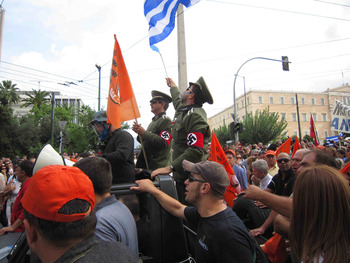
I was especially troubled, for instance, by my own and a friend's sudden laughter upon seeing a self-consciously preposterous “Nazi” vehicle in the protests against Merkel's visit (figure 5). This vehicle totally opposed our aesthetic and ideological understanding of politics, yet it seemed to produce a certain ill-mannered enjoyment. I was reminded of Adorno and Horkheimer's idea that to “be entertained means to give one's consent” (Claussen Reference Claussen and Livingstone2008: 161). What entertainment was offered by such a performance, and what kind of consent were we giving? The reflections of Stallybrass and White on the European carnival and “the dialectics of social classification” (Reference Stallybrass and White1986: 26) are relevant here. I interpret our laughter as a temporary embodiment of that which is excluded at the official level yet is immensely alluring precisely for its vulgar lowness (ibid.: 4, 5, 191). Officially expelled from the middle-class self-image but providing fuel for fascination and longing, Greek aggressive performances create subject positions that are nearly impossible to inhabit (ibid.). Relevant here is the question of “desire in negativity,” apparent in other historical contexts, as in the nineteenth-century destruction of police stations by Indian peasants in Andhra Pradesh described by David Arnold (in O'Hanlon Reference O'Hanlon1988: 206). Indian protestors’ actions were incapable of offering structural change, manifesting the partial failure contained in any form of dissent (see also Prakash Reference Prakash1994: 1480). Though we are far from the world of nineteenth-century Indian peasants, it is important to remember that not all political practices in the Greek crisis are to be understood as consistent forms of critique and interpretation. Carnivalesque destruction and self-Orientalist explosions may in fact inform the responses of people who usually affect stable political positions (like my friend who laughed at the vehicle, a consistent critic of austerity from a communist perspective). This pattern might even account for the behavior of protestors who embrace appeals “to go bankrupt,” appeals that Theodossopoulos reads mostly as discursive tactics and interpretative strategies (Reference Theodossopoulos2013: 206). In other words, the negotiation of the crisis entails not just calculated tactics and “discursive weapons” of “empowerment” that subsume threats, pursue accountability, or rationalize events through interpretation and blame-negotiation (per ibid.: 202, 208, 209; Reference Theodossopoulos2014: 500). It also involves visceral eruptions and unpredictable performances that are deeply conflictual and ambivalent, offering mostly (non-strategic) temporary pleasure at a level that engages the body.
The “Nazi vehicle” during the protests against Angela Merkel's 2012 visit. October 2012. Author's photo.

Another picture that recently circulated on the web, both widely ridiculed and widely reproduced, shows a poster ad for a private language school in Athens on which someone has written with a marker, “Germany is being fucked” (ghamietai i Ghermania), and crossed out “German” from the list of course offerings (figure 6). The man who sent me the image was the one whose grandfather had deterred him from studying German in school by referring to the atrocities he had witnessed during the occupation of Athens (1941–1944). As if realizing his grandfather's aversion, my friend claims that he has never been able to learn German, and he told me about the aggression he and his classmates exhibited against the German language teachers in school.
Image of a language school poster with graffiti. Unknown photographer. Currently found online at: http://athensville.blogspot.gr/2011_11_01_archive.html. The caption in the blog reads: “That's a form of resistance too….”

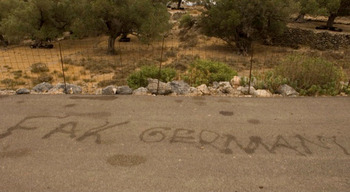
This example reminded me of graffiti I encountered in 2007 on the asphalt road of an abandoned village in western Crete, where German visitors had bought extensive property (figure 7). Despite the shock they are likely to produce, both inscriptions are conditioned by a set of limitations. The Cretan one, with its bad English (“Fak Germani” instead of “Fuck Germany”), will possibly cause the spectators’ amusement. Written in an oily substance that will be quickly eroded by rain, it reflects the inability of its maker to reverse the resented phenomenon (the passing of local property into “foreign” hands) because they do not possess the cultural and financial capital necessary for efficacious resistance (see Kalantzis Reference Kalantzis2014: 67). The Cretan inscription is part of wider negotiations over the power dynamics inherent to tourism. Negativity is only one aspect of this process, since Germans are frequently included and accepted in areas of local social life (see also Papataxiarchis Reference Papataxiarchis and Papataxiarchis2006: 455). The fear of losing property to Germans and other outsiders is played out today on the national level through media stories about the potential purchase of islands and archaeological monuments, particularly the Acropolis, by the lenders (see also Yalouri Reference Yalouri2001).
Oily inscription on tarmac in western rural Crete. Photo by Giorgos Patroudakis and the author, October 2007.

The “Fak” element resonates with the jocular salute that was dominant during the October 2012 protests against the German chancellor's visit to Athens: “[I] fuck Merkel” (Ghamo ti Merkel). There was a unifying power to this salute, apparent in two scenes that I witnessed. In the first, a middle-aged leftist with a history of antipathy toward the police amicably called out “fuck Merkel” to a patrol officer, who responded with a slight smile. Second, a middle-aged woman whose bag was snatched by a motorcyclist broke the silence that ensued by shouting, “[I] fuck Merkel,” which produced intense laughter among the café patrons and bystanders in that corner of Athens. Her statement was funny for several reasons. It was incongruous, given that one might have expected her to accuse the thieves rather than Angela Merkel (although there is an element of indirect blame in the innuendo claim that Merkel's imposed austerity makes people steal for survival). Her statement allowed for a release of the audience's tension, given the intensity and danger of the moment. Her reaction also brings to mind the old Hobbesian idea that laughter arises “from a sudden conception of some eminency in ourselves by comparison with the infirmity of others” (in Oring Reference Oring1982: 63), an observation that is applicable here to the extent that the audience potentially mocked the woman, while enjoying its exemption from her plight. Finally, a dynamic of powerful veneration is possibly at play in the laughter, idealizing the woman's ability to adhere defiantly to her critique of wider political forces despite a damaging attack by individuals. In any case, her utterance acted as a punchline, which drew the spectators’ attention back to the day's main event, from which the theft digressed, and further condensed the day's message to one of sexualized domination over the German chancellor. It was a woman assuming the role of sexual domination over another woman (perhaps another reason for the spectators’ laughter), a move enabled by her identification with the nation, which is envisioned in such contexts as a male aggressor.Footnote 9
I finish with the “Fak Germani” inscription because it condenses many of this essay's points. The graffiti was located on the Greek periphery, in a region associated with notions of resistance. It manifests a reaction that tends to stigmatize the graffiti authors themselves, yet offers pleasure to middle-class spectators within a jocular idiom (two friends enthusiastically pointed to this sign while walking with me in the village). It thus echoes in realms far beyond the rural Cretan context. The inscription is currently in dialogue with the national media and nationalized anxieties as it encapsulates fears regarding foreign house buying. It envisions tutelage not as an abstract notion but as the visceral penetration of the (national) body itself.
CONCLUSION
This essay has traversed various cultural fields in exploring Greek responses to the financial crisis. These entail anxiety about the position of the nation-state globally, fantasies of nativism, resort to historical figures in classifying the present, the dynamics of internal Orientalism, the perception of Germany as a threatening female force, and the practice of sexualized joking. I have emphasized embodiment and materiality, the perspective of ambivalence, and questions of desire and pleasure. By comparing different registers and spheres, I have revealed strong convergences between people of different social backgrounds. Greeks become imaginarily black, urbanite Athenians endorse Cretan shepherds’ anti-German utterances, and metropolitan leftists employ categories fundamental to national identification. All of this is part of the emerging “erotics of nationhood,” to redeploy terminology Appadurai invented to describe Indian cricket spectatorship (Reference Appadurai1996: 111).
My point about these convergences is not that Sphakian shepherds and London-residing Athenians belong structurally to the same cultural universe, even though the Greek class system is arguably not as consolidated in cultural terms as in other European cases, such as France as described by Bourdieu (Reference Bourdieu1984). My argument is that the financial crisis, and the sense of domination it creates, disgorges certain cultural materials, particularly among middle-class Greeks. These materials exceed the self-image of middle-class individuals, dragging them closer, in terms of identification and desire, to positions occupied by or ascribed to other groups, such as rural Greeks. The context of the crisis, therefore, produces shifts in the experience of nationhood, revealing the irresistible lure, for different Greeks, of unruly (yet fundamental) “stuff” that inhabits the national imaginary. The latter include motifs of an avenging male sexuality directed against the (feminine) West, ideas of transgressive natives fighting against treason, and playful rogues undermining Westernized civility. Of course, these shifts in patterns of national identification do not eliminate ruptures and class-cultural cleavages, which reemerge in other moments and contexts. It is useful to remember that middle-class anti-tutelage performances resort to the modality of joking in order to justify the transcending of boundaries that are in fact integral to middle-class self-images. The joke as a form is what allows this (temporary) recasting of boundaries, while the endorsement of elements classified as “low” triggers guilt and derision as well as delight and pleasure, especially when Western observers are imagined as the audience for these performative transgressions.
This ill-mannered delight, which includes elements of segmentary organization whereby clashing social groups harmonize in the face of an external threat (see Herzfeld Reference Herzfeld2003), is in my account a question neither of “resistance” nor of the reproduction of power relations. Jokes and humor are often seen in anthropology as either a sign of subaltern subversive resourcefulness (e.g., Jackson Reference Jackson2005: 189) or complicit reproduction “that leaves power relations intact” (Faris Reference Faris1997: 211). I have moved away from this dilemma, focusing instead on the embodied experiences, the explosive conflictual reflexes and pleasures, which make middle-class actors uneasy even as, at the visceral level, they do things for them.
Across the Greek public sphere different constituencies and interest groups promote fixed political positions, for and against the memorandum. Yet a part of the middle-class, composed largely of young adults, is caught between Orientalisms and disappointment about Greece's problems of governability, between bitterness about the nation-state's subjection to surveillance and difficulty in trusting specific models of escaping the crisis. As with most Greeks, these subjects are experiencing an “evaporation of the near future” that is perhaps an inherent result of IMF structural adjustment policies (Guyer Reference Guyer2007: 410). Furthermore, they face the threat of (re)encountering modernity as loss of property and the means of production (Buck-Morss Reference Buck-Morss, Raskin and Bernstein1987: 227), as pervasive changes in taxation, labor laws, and income that are affecting patterns of inheritance, social care, and employment. For these embattled subjects, the jocular embodiment of a debased form of anti-colonial aggression is what allows the suturing of sober self-images to a dreadfully delightful sense of incorrect disavowal.Footnote 10