Introduction
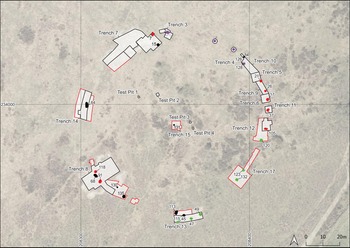
In responding to our Antiquity article, ‘The original Stonehenge?’ (Parker Pearson et al. Reference Parker Pearson2021b), Timothy Darvill (Reference Darvill2022) questions both the interpretation of Waun Mawn as an unfinished stone circle and the suggestion that elements of the site were subsequently removed to Stonehenge. His argument that the plan of the known features at Waun Mawn should be understood as a series of linear monuments suffers, however, from a major error: it is based on a partial plan, published in 2021, which has been superseded by a much more detailed plan published following the 2021 excavations (Parker Pearson et al. Reference Parker Pearson2021a; Parker Pearson Reference Parker Pearson2022; see Figure 1). His argument therefore omits many of the excavated features that make up this stone circle. As such, the reader should ignore Darvill's Figure 1 and refer only to our plan to understand the site. How do we know that Waun Mawn is an unfinished circle? Because it has an entrance, convincing arcs of stoneholes, and—most significantly—a centre. Amongst other features discovered during investigations in summer 2021, we identified a hearth located at the exact centre of the 110m-diameter Waun Mawn circle.
Plan of the unfinished and dismantled stone circle of Waun Mawn, Pembrokeshire. Remaining stones, standing and recumbent (purple), are shown, with stoneholes of dismantled standing stones (red), pits dug for standing stones but never used (green) and other features (black). Viewed from the hearth (131) at the centre of the circle, the midsummer solstice sun rose within the entrance formed by stoneholes 128 and 21 (figure by C. Casswell).

Building the unfinished stone circle of Waun Mawn
The bowl-shaped hearth at the centre of the circle was partially covered by deposits from the base of a large, long-vanished tree. While we await radiocarbon dates on samples of the wood charcoal from the hearth and the layers immediately above, we can consider the context of both the hearth and the tree. These features were uncovered within a 5 × 5m trench located in the centre of the unfinished circle (Figure 1). Not only does the hearth lie at the exact centre of the circle, but it is also the only hearth so far detected within a total excavated area of more than 1200m2 at Waun Mawn. Given that it could only have been so precisely positioned during the laying out of the circle, or at least while the stones were extant, the hearth is likely to be contemporaneous with the construction and/or use of the circle.
The hearth was covered by the upcast from a fallen tree, indicating that it was originally set at the foot of a large standing tree. A number of tree roots and tree holes have been found at various locations during the excavations at Waun Mawn, which, on the basis of radiocarbon dates on wood charcoal, potentially date to anywhere between the Early Mesolithic (8000–6000 BC) and the Roman period of AD 43–410 (Parker Pearson et al. Reference Parker Pearson2021b). Yet none of these other tree features are as large as the remains of the 3m-diameter base of the tree at the centre of Waun Mawn. It is possible that an unusually large and ancient tree was chosen as the centre from which to lay out the stone circle. We cannot say what species this tree was, but oak is a reasonable guess, given its size and the ubiquity of Quercus charcoal in the immediate context and more widely around Waun Mawn.
Excavations in 2021 also uncovered a further three stoneholes and five pits around the circle's circumference (Figure 1). These five pits (and another excavated in 2018) all lie along the southern arc of the circle's circumference, but never held standing stones. Continuing a line south-westward from the last stonehole in the east (stonehole 105 in Trench 12), they provide evidence that this circle was abandoned mid-construction. One of the pits (pit 120) lies at the end of an arc of stoneholes, with which it shares similar spacing, suggesting that this hole was dug to receive a stone that was never erected. The other pits in this south-eastern arc are similar, and are probably also to be interpreted as preparation pits for stones that were never erected. On the Waun Mawn stoneholes generally, we note that the fills of these features were clearly distinguishable and carefully recorded by a very experienced team; Darvill's (Reference Darvill2022) observation that he personally believes that the photograph of one of these stone sockets (Parker Pearson et al. Reference Parker Pearson2021b: fig. 6) resembles a field clearance scar is therefore unconvincing.
Although at least 140m of the circle's 345m circumference remains unexcavated (parts of it are protected as a Scheduled Ancient Monument and as a Site of Special Scientific Interest [SSSI], limiting the scale and extent of excavations), it is evident that there are significant gaps along the western and southern arcs. This suggests that probably no more than 30 per cent of the circle was ever completed.
In 2021, we also re-investigated the entrance of the circle, which is orientated on the midsummer solstice. This work revealed that, what had been thought in 2018 to be the stonehole for the entrance's lefthand stone (now recumbent), was, in fact, a robbing hole. Charcoal samples from this hole and the low mound accumulated around it provide a possible date for the stone's toppling of sometime around or after 2000 BP. More importantly, the actual stonehole (128) for the lefthand stone was positioned within 0.10m of a large stakehole (discovered in 2021) and both of these features lie on an alignment from the position of the central tree towards the midsummer solstice sunrise. The stonehole forming the righthand side of the entrance (21), 15m to the east, also had a stakehole in the bottom of its fill. Notably, these are the only two stoneholes out of the 10 so far excavated that have associated stakeholes.
As an incomplete stone circle, Waun Mawn offers an unparalleled insight into the likely sequence of construction of such monuments:
1. Light a fire in a bowl-shaped hearth at the foot of an ancient tree chosen as the centre of the circle;
2. erect a post along the circumference on an alignment from the tree towards the midsummer solstice sunrise;
3. erect a second post 15m from the first to mark the other side of an entrance to the intended circle;
4. erect standing stones (in stoneholes 128 and 21) beside each post to form this north-east-facing entrance;
5. erect two standing stones (stoneholes 91 and 118) at the opposite (south-west) side of the circle to the entrance;
6. erect standing stones in two arcs, one 30m long in the east and one 60m long in the north; and
7. dig preparation pits (45, 47, 49, 120, 123, 132) to hold standing stones in a 70m-long arc in the south and south-east.
At this point, construction of the circle was abandoned, leaving two long arcs incomplete—one on the south and south-east side and the other on the west and north-west. These could effectively be considered the ‘sides’ of the monument, since the frontal façade and entrance had already been erected, as had the two stones marking the rear (south-west side).
Dismantling the stone circle of Waun Mawn
Whilst four stones remain at Waun Mawn, eight empty stoneholes reveal that other stones have been taken away. Our hypothesis is that these stones were removed when the incomplete stone circle was dismantled. We await further radiocarbon dates on wood charcoal from fills of the holes left by removal of these eight stones. A set of optically stimulated luminescence (OSL) determinations, however, allows refinement of the probable date before which the stones were removed. Drawing on results from samples taken in both the 2018 and 2021 field seasons, it is likely that the monoliths were removed before or during 3490–2870 BC (3180±310 BC).
OSL dating of the packing fills of the stoneholes excavated in 2021 has also refined the likely date of the circle's construction. The OSL dataset comprises 302 field measurements, of which 239 were progressed to laboratory characterisation, fully contextualising the 31 discrete dating samples. The OSL technical report will be published in due course, alongside the monograph describing the full excavation results. We can report here, however, that the monoliths were erected in the mid to late fourth millennium BC, potentially as late as 3520–2940 BC (3230±290 BC). The depositional age for the packing fill of one stone socket (118) has returned a combined age of 3710–3350 BC. Our estimate is that the circle was constructed c. 3400 BC (Parker Pearson et al. Reference Parker Pearson2021b).
Based on the OSL, a date of 3490–2870 BC for the removal of the stones is consistent with the construction dates for Stonehenge Stage 1, both for the enclosing ditch (2995–2900 cal BC) and for Aubrey Hole 32 (3080–2890 cal BC; Parker Pearson et al. Reference Parker Pearson2020: 166–68). This raises the possibility that Waun Mawn's dismantled stones were among the Bluestones taken to Stonehenge. Yet geological analysis of the extant stones at Waun Mawn and of chippings from one of the empty stoneholes (91) reveals that these materials probably derive from unspotted dolerite outcrops at Cerrig Lladron, west of the two locations identified as sources of Stonehenge's unspotted dolerites (Bevins et al. Reference Bevins, Pearce, Pearson and Ixer2022). On the balance of probability, few, if any, of the stones taken from Waun Mawn ever ended up at Stonehenge.
Even if Waun Mawn was not the source of any of Stonehenge's Bluestones, however, it must still be considered as a place of significance in the Stonehenge story. The abandonment of the Waun Mawn circle before its completion suggests either some form of breakdown in community/cooperation or external disruption of what was intended to be a major monument. The stones of the Preseli Hills are integral to Stonehenge and understanding the local use of Bluestones near to their quarries and prior to their use at Stonehenge widens our knowledge of the Neolithic of southern Britain, particularly the relationship between Wales and Wessex.
So when did the Bluestones arrive at Stonehenge?
The ring of Aubrey Holes at Stonehenge belongs to Stage 1 of its construction, starting 3080–2950 cal BC and ending 2865–2755 cal BC at 95% probability (Marshall in Parker Pearson et al. Reference Parker Pearson2020: table 11.7 [the date ranges used by Darvill have been revised]). Various arguments have been rehearsed over the last 100 years about whether or not the Aubrey Holes contained Bluestones (Parker Pearson et al. Reference Parker Pearson2020: 164–69). Our Stonehenge Riverside Project team have been fortunate to not only re-excavate an Aubrey Hole but also to excavate numerous other Neolithic stoneholes and postholes in the surrounding chalk landscape (e.g. Parker Pearson et al. Reference Parker Pearson2020: 215–300). As a result, telling the difference between these two types of cut feature is now relatively easy. Of course, the standards of early twentieth-century excavations make this task more difficult for the Aubrey Holes, but there is a statistical means of discrimination between postholes and Bluestone holes.
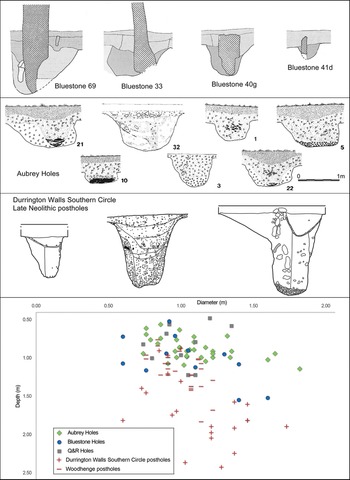
At Stonehenge and Durrington Walls, postholes tend to have a width:depth ratio of ≥1:1.10, whereas Bluestone holes have a ratio of ≤1:1.10 (Parker Pearson et al. Reference Parker Pearson2009: fig. 8, Reference Parker Pearson2020: fig. 4.5). In other words, postholes are deeper than stoneholes. The Aubrey Holes are shallow—clearly shallower than postholes of similar diameter (Figure 2). Even though three Aubrey Holes are greater than 1.5m in diameter, they are all less than 1.3m in depth. The maximum depth range of the Bluestone holes, including the Q and R Holes, is just over 1.5m. Thus, as postholes are deeper than stoneholes, it is unlikely that the Aubrey Holes held anything other than stone.
The relative sizes and shapes of a selection of Aubrey Holes (in profile) compared with holes for Bluestones 69, 33, 41d and 40g from Stonehenge and with holes for posts at Durrington Walls (after Wainwright, with Longworth Reference Wainwright and Longworth1971; Cleal et al. Reference Cleal, Walker and Montague1995; figure by the authors, with re-drawings by permission of Historic England [© Historic England; reuse not permitted] and the Society of Antiquaries of London).

Darvill argues that the Aubrey Holes held posts rather than stones on the basis of the absence of Bluestone chips in their basal deposits (as opposed to their secondary deposits, in which such chips are plentiful). Such chips are supposedly the result of breakage during a monolith's erection, so why are they absent from the bases of the Aubrey Holes if they once held stones? Chalk is a soft rock, whereas most of the Bluestones are of hard, igneous rock; therefore, it would always have been unusual for fragments to become detached from a monolith (whether dressed or unworked) while inserting or removing it from its surrounding chalk. Most of the Aubrey Hole basal layers are likely to have been packing deposits inserted around a raised monolith. If the Bluestones inserted into the Aubrey Holes were undressed, no chippings would have been present in the area to be incorporated into these basal packing deposits (note that 27 Bluestones present at Stonehenge today are undressed). Our excavation of seven stoneholes at nearby Bluestonehenge failed to find a single chip (Parker Pearson et al. Reference Parker Pearson2020: 215–300). The likely origin of the chips found in the Aubrey Holes’ secondary deposits is from several possible events: removal of (and consequent damage to) Bluestones at the end of Stage 1; dressing of Bluestones (which may have occurred in Stage 2); and/or their working-down and intentional breakage (probably in Stage 5).
Turning to the origins of the Bluestones in the Preseli Hills, there is further evidence that they belong with the start of Stonehenge Stage 1. Radiocarbon dates of 3020–2920 cal BC and 3270–2910 cal BC for the end of quarrying at the two Preseli outcrops from which the Stonehenge Bluestones were extracted are unusually close to the start dates for Stonehenge (Parker Pearson et al. Reference Parker Pearson2019). In such a scenario, some or even all of the Bluestones could have come direct to Stonehenge from their quarries. The hypothesis that we consider to be most plausible, however, is that some or even all of the quarried Bluestones were first erected in one or more stone circles that were dismantled and then moved from south-west Wales to Stonehenge and Bluestonehenge in the thirtieth century BC. Within the varied mix of Bluestone sizes and types—spotted dolerite, unspotted dolerite, sandstone, andesite, three types of dacite and three types of rhyolite—the strongly cleaved andesite, for example, would have been a poor initial choice for long-distance transport direct from a quarry. So why were those stones selected? It may have been the monument(s) rather than the individual stones per se that were selected for transport to Salisbury Plain.
Conclusions
In light of Bevins et al.'s (Reference Bevins, Pearce, Pearson and Ixer2022) new analysis, which reveals that the stones at Waun Mawn have no geological match to the 43 surviving Bluestones at Stonehenge, it may be that none of Waun Mawn's stones ever reached the Wessex monument. Waun Mawn, however, was most certainly a stone circle, albeit unfinished and partially dismantled. Intriguingly, its plan is similar to the Bluestones’ arrangement in the Q and R Holes of Stonehenge Stage 2, a circle that was probably also unfinished, being left similarly incomplete along its west side (Atkinson Reference Atkinson1979: 205–206; Cleal et al. Reference Cleal, Walker and Montague1995: 180, fig. 80; Parker Pearson et al. Reference Parker Pearson2022: 82–83, fig. 3.1). We suggest that this similarity of plan is because both circles were built in the same sequence of stages, with the Q and R Hole circle abandoned at a slightly later stage to that of Waun Mawn. Based on the dimensions of the Aubrey Holes as consistent with holding Bluestones rather than timber posts, and the radiocarbon dates from the Preseli quarries, the case for the Bluestones arriving at Stonehenge during Stage 1 is very strong.
The abandonment and later dismantling of Waun Mawn provides insight into the process of stone circle construction and raises intriguing new questions about the background to the creation of Stonehenge. We now know that monuments were erected close to the quarries and subsequently dismantled, at around the same time as the unparalleled transporting of approximately 80 Bluestone monoliths to form two Neolithic stone circles 170 miles away on Salisbury Plain. Hypothesising as to why this happened is beyond the scope of this brief reply.