Introduction
Arthropods perform many important tasks in Arctic ecosystems, including pollination, herbivory, and decomposition (Leborgne et al. Reference Leborgne, Ernst and Buddle2011). They are also an important food source for highly valued vertebrates. Tulp and Schekkerman (Reference Tulp and Schekkerman2008) demonstrated that the seasonal availability of arthropod prey is critical to the growth and survival of many Arctic shorebirds. As the major food source for some 50 species of Arctic birds (Meltofte et al. Reference Meltofte, Hoye, Schmidt and Forchhammer2007) and a component of mammalian diets including those of Mustelidae (Mammalia) and Arctic fox (Vulpes lagopus (Linnaeus); Mammalia: Canidae) (Elmhagen et al. Reference Elmhagen, Tannerfeldt, Verucci and Angerbjörn2000; Hoekstra et al. Reference Hoekstra, Braune, Elkin, Armstrong and Muir2003), it is critical to understand the seasonal availability of energetically significant epigeic macroarthropods.
The phenology patterns of some individual Arctic arthropod species have been well studied (e.g., Danks Reference Danks1978; Danks Reference Danks1999; Sovik et al. Reference Sovik, Leinaas, Ims and Solhoy2003; Mjaaseth et al. Reference Mjaaseth, Hagen, Yoccoz and Ims2005) but we know relatively little about how entire assemblages vary seasonally (but see Høye and Forchhammer Reference Høye and Forchhammer2008a, Reference Høye and Forchhammer2008b; Tulp and Schekkerman Reference Tulp and Schekkerman2008). It is important to recognise that relationships between species often lead to community responses that contradict predictions generated from single-species models (e.g., Davis et al. Reference Davis, Lawton, Shorrocks and Jenkinson1998; Tylianakis et al. Reference Tylianakis, Didham, Bascompte and Wardle2008; Van der Putten et al. Reference Van der Putten, Macel and Visser2010). In other words, patterns of assemblage structure can be strongly influenced by interactions (de Ruiter et al. Reference de Ruiter, Wolters and Moore2005). It is therefore important to consider phenological changes in entire assemblages.
The phenology of an entire assemblage can be estimated using capture rates (e.g., the number of individuals or biomass per sampling period). These rates may change throughout the active season in response to weather-mediated effects on activity levels (Briers et al. Reference Briers, Cariss and Gee2003). Although arthropods in northern regions have developed physiological, morphological, and behavioural adaptations to cope with harsh Arctic weather conditions (see reviews in Downes Reference Downes1965; Ring and Tesar Reference Ring and Tesar1981; Strathdee and Bale Reference Strathdee and Bale1998; Danks Reference Danks2004), they are still responsive to the inherent variability of seasonal weather patterns. While temperature seems to be a critical influence on seasonal arthropod activity in the far north (e.g., Høye and Forchhammer Reference Høye and Forchhammer2008a, Reference Høye and Forchhammer2008b; Tulp and Schekkerman Reference Tulp and Schekkerman2008) the responses of ground-dwelling northern arthropod assemblages to seasonal weather patterns requires further study.
In addition to revealing changes in taxonomic assemblage structure, arthropod capture rates can act as a proxy for the effects of environmental variation on the functional contributions of arthropods to an ecosystem. Although guilds (Root Reference Root1967; Root Reference Root1973) are often used to describe assemblages on the basis of competitive resource use, the parallel term “functional group” (FG) (Cummins Reference Cummins1974) is more accurately used to describe animals that are equivalent in terms of their ecological roles or processes (Blondel Reference Blondel2003). The functional structure of an assemblage can be defined by the relative contributions (e.g., abundance and/or biomass) of individuals in specific FGs. FGs based on feeding behaviours, food types, or feeding relationships can be particularly useful for describing dynamic insect communities and their responses to environmental variation, as has been demonstrated recently in the literature (e.g., Lassau et al. Reference Lassau, Hochuli, Cassis and Reid2005; Noriega et al. Reference Noriega, Botero, Viola and Fagua2007; Choi et al. Reference Choi, Choi, Lyu, Lee, Lim and Lee2010).
We examine changes in the taxonomic and functional assemblage structure of epigeic insects collected in Kugluktuk, Nunavut, over the course of the active season. Beetles are used as the model ground-dwelling insect taxon in this study, because they are diverse, abundant, have diverse ecological functions, and respond rapidly to environmental change (Nelson Reference Nelson2001). The data are used to test four hypotheses: (1) the taxonomic structure of beetle assemblages will vary during the active season, (2) the functional structure of beetle assemblages will vary during the active season, (3) seasonal patterns in beetle assemblage structure will differ between habitats, and (4) weather variables will explain seasonal variations in the assemblage structure of beetles.
Methods
Experimental design
Beetles were collected in Kugluktuk, Nunavut, Canada (67.82°N, 115.09°W). The landscape beyond the limits of the town centre is open, largely undisturbed tundra, interspersed with occasional rocky outcrops of Canadian Shield. The region falls within the southern bounds of the subarctic ecoclimatic zone (Strong et al. Reference Strong and Zoltai1989) and has a semi-arid climate, receiving ∼250 mm of precipitation per year. Winters are long and cold, with an average temperature of −16.9 °C between September and May, while summers are short and cool, averaging 8.2 °C between the months of June–August (i.e., the active period for most terrestrial arthropods).
Two broadly delimited but ecologically distinct habitat types were investigated in this study. “Mesic” habitats were characterised by elevated topography and well-drained soils. The dominant vegetation was dwarf woody shrubs, especially willows (Salix reticulata Linnaeus and other Salix Linnaeus species (Salicaceae)), birch (Betula glandulosa Michaux (Betulaceae)), Arctic heather (Cassiope tetragona (Linnaeus) Don (Ericaceae)), mountain avens (Dryas integrifolia Vahl (Rosaceae)), Labrador tea (Ledum decumbens Small (Ericaceae)), and various berries (Vaccinium Linnaeus species (Ericaceae)), and perennial forbs (e.g., Lupinus arcticus Watson (Fabaceae)), as well as moss and lichen cover, with occasional bare patches. “Wet” habitats were located in adjacent low-lying regions and had saturated or very poorly drained soils. The vegetation in the wet habitats consisted primarily of sedges (Carex Linnaeus species and Eriophorum Linnaeus species (Cyperaceae)), some grass, and mosses.
Sampling and specimen processing
Between 21 and 22 June 2010, sampling sites were established at three different locations within 8 km of each other. Each site consisted of one wet and one mesic habitat. Within each habitat, three 75 m trap lines were set, spaced 15 m apart. Three pitfall traps and three pan traps were placed in a random sequence at 15 m intervals along each trap line, creating a 15 × 75 m grid with a total of 18 traps (nine of each type) per habitat (108 traps in total, for all habitats and sites). Pitfall traps consisted of a plastic cup 10 cm in diameter and 7 cm deep, nested in a second cup of the same diameter that was 15 cm deep, and into which drainage holes had been punched. Pitfall traps were covered by a 12 × 12 cm2 piece of corrugated plastic positioned 3 cm above each trap. Pan trap were bright yellow, 20 cm in diameter and 3 cm deep. Traps were dug into the soil or vegetation so that the top edge of the trap was flush with the ground surface. Propylene glycol (diluted 2:1 with water) and a drop of surfactant were placed in each trap to capture and preserve arthropods.
Traps were serviced once per week, for a total of eight collection periods between 22 June and 13 August 2010. Samples were subsequently placed in 95% ethanol and returned to the laboratory. Adults were pinned and identified to species or morphospecies, and data were pooled by habitat type and sampling period. Based on information available in the literature regarding feeding preferences (of the species if available; if not, then of the lowest possible taxonomic resolution), each beetle was assigned to one of seven FGs (see Appendix 1). Voucher specimens of all species are deposited in the Lyman Entomological Museum (Ste-Anne-de-Bellevue, Québec, Canada) and/or at the Canadian National Collection of Insects, Arachnids and Nematodes (Ottawa, Ontario, Canada).
Weather data
Weather data were obtained online from the Canadian National Climate Data and Information Archive (http://climate.weatheroffice.gc.ca, climate station ID no. 2300902). Since this was a short-term study and because there was some variability in the length of the sampling periods, it was determined that daily weather data would be used to generate mean weather values for each sampling period. Mean values were determined for the following variables: mean daily temperature (°C), mean daily wind speed (km/hour), atmospheric pressure (kPa), and total precipitation (mm rain or snow). These variables were selected based on previous seasonal studies that supported their effects on insect activity in the Arctic (e.g., Høye and Forchhammer Reference Høye and Forchhammer2008a, Reference Høye and Forchhammer2008b). Maximum and minimum daily temperatures were also considered, but both were found to be highly correlated with the mean daily temperature; they were thus excluded to prevent difficulties associated with autocorrelation. Given their proximity to each other (within 8 km), all sampling sites were considered to have about the same weather conditions.
Data analyses
The biomass of each beetle was estimated by measuring the specimen length and using length:biomass regressions for Coleoptera (Jarosik Reference Jarosik1989; Hodar Reference Hodar1996). To account for slight variations in the length of sampling periods and disturbed traps, abundance and biomass data were standardised to the number of active traps per day per sampling period. To compensate for zero counts and large differences in abundance and biomass between samples, data were log + 1 transformed prior to analyses.
The total beetle biomass and abundance for each sampling period in each habitat was determined. We tested whether sample period and/or habitat had an effect on the total biomass and the total abundance of beetles via repeated measures analysis of variance (ANOVA). The dependent variable was either total biomass or total abundance (adjusted values, pooled by replicate, sample period, and habitat); sample period was treated as the within-subjects factor; and habitat was treated as the between-subject factor. The ANOVA was conducted using the ezANOVA function in the ez package (Lawrence Reference Lawrence2011) in R version 2.10.0 (R Development Core Team 2009).
Species richness in each habitat was determined. However, species richness tends to increase as more individuals are added to a sample. Larger samples can be standardised to smaller samples via random sampling (Sanders Reference Sanders1968), so that the species richness of all samples is based on a constant number of individuals (i.e., rarefaction). Rarefaction was therefore used to generate an unbiased estimate of the expected number of species (rarefied species richness [S]) (Forbes et al. Reference Forbes, Schauwecker and Weiher2001) in each habitat at each sampling period using the rarefy function in the vegan package (Oksanen et al. Reference Oksanen, Blanchet, Kindt, Legendre, O'Hara and Simpson2010) of R version 2.10.0 (R Development Core Team 2009).
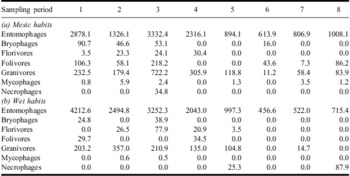
To test the hypotheses that (1) taxonomic and (2) functional beetle assemblages changed over time, assemblages from each sampling period in each habitat were visualised with nonmetric multidimensional scaling (NMDS), using the rich (Rossi Reference Rossi2011) and vegan (Oksanen et al. Reference Oksanen, Blanchet, Kindt, Legendre, O'Hara and Simpson2010) libraries of R version 2.10.0 (R Development Core Team 2009). NMDS is an indirect ordination approach maximising the rank order correlation between distances in a distance matrix. Assemblages that are more similar to each other are arranged more closely in ordination space. In this case, the ordinations were conducted using Bray–Curtis distance matrices generated from the species (42 species, standardised and log + 1 transformed abundances) and functional (eight feeding groups, standardised and log ± 1 transformed biomass) matrices. Since biomass integrates functional characteristics of assemblages (e.g., energy and nutrient flow) (Saint-Germain et al. Reference Saint-Germain, Buddle, Larrivee, Mercado, Motchula and Reichert2007; Wang et al. Reference Wang, Morrison, Singh and Weiss2009), it was used as the metric to describe the functional assemblage (i.e., rather than abundance). Changes in the functional assemblage over time were additionally visualised using stacked bar graphs showing the total biomass of beetles in each feeding group. Due to great differences in biomass between FGs, the data were log + 1 transformed and displayed on a nonlogarithmic scale. Untransformed values are presented in Appendix 2. To test the hypothesis that beetle assemblages changed over time in response to seasonal weather patterns, weather variables were overlaid on the NMDS plots as vectors, using the envfit function in the vegan (Oksanen et al. Reference Oksanen, Blanchet, Kindt, Legendre, O'Hara and Simpson2010) library in R version 2.10.0 (R Development Core Team 2009). The direction of each vector indicates the direction of the gradient (that of the most rapid change), and the length of the vector is proportional to the strength of the correlation between the variable and the ordination. This function allows a more objective interpretation of the results of unconstrained ordination analyses and generates a measure of fit as well as a significance value based on a permutation test (1000 permutations). Using this function, the significance of the relationship between each weather variable and the assemblages at each sampling period was tested.
Results
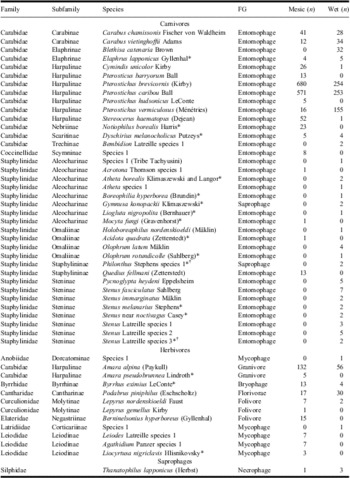
A total of 2638 terrestrial adult beetles were captured between 23 June and 13 August 2010. These represented 50 species or morphospecies in 11 families (Appendix 1). The dominant taxon was the ground beetles (Carabidae), with 2466 individuals and 16 species. More species of rove beetles (Staphylinidae) were found (22 species), but they were much less abundant (58 individuals). All other families were represented by three or fewer species, and <50 individuals (Appendix 1). The beetles collected in this study include 17 new species records for the territory of Nunavut, and probably two species unknown to science (Appendix 1).
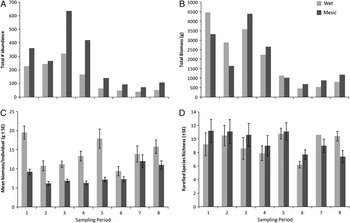
In both habitats, the number of beetles is greatest during the first three sampling periods (albeit with a pronounced “dip” in abundance during sampling period 2); abundance exhibits a steep decline in sampling period 4 that continues for the remainder of the active season. More beetles were collected from mesic habitats than from wet habitats during each sampling period (Fig. 1A) and overall (1693 and 945, respectively). Wet habitats supported more total beetle biomass than mesic habitats over the course of the season (Fig. 1B). The total beetle abundance and biomass from the pooled samples were found to differ significantly by sampling period (P < 0.001) (Table 1), but not by habitat type. Although fewer beetles were trapped in the wet habitats, they tended to be larger (range of mean beetle biomass/sampling period = 9.4 ± 1.2 to 19.5 ± 1.7 mg) than those caught more abundantly in dry habitats (range of mean beetle biomass/sampling period = 6.2 ± 0.5 to 12.0 ± 1.7 mg) (Fig. 1C).
Changes in (A) total abundance; (B) total biomass (g); (C) average biomass (g); and (D) rarefied species richness of beetles collected from wet (grey) and mesic (black) habitats across sampling periods from June to August 2010.

Summary of repeated measures ANOVA testing for the influence of habitat type (wet or mesic) and sample period (1–8) on total biomass and total abundance (adjusted, pooled values).

Notes: df for the numerator and denominator (n and d, respectively), F- and P-values.
P-values with an asterisk (*) indicate significance.
ANOVA, analysis of variance; df, degrees of freedom.
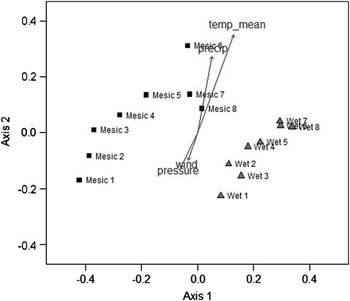
Overall capture rates for individual species (Appendix 1) indicate that, while some species can be found in either habitat, most display either a strong preference for one habitat type (e.g., Cymindis unicolor Kirby (Carabidae), Pterostichus haematopus Dejean (Carabidae) – mesic; Carabus vietinghoffi Adams (Carabidae), Pterostichus vermiculosis Ménétries (Carabidae) – wet) or are found exclusively in one habitat (e.g., Notiophilus borealis Harris (Carabidae), Quedius fellmani Zetterstedt (Staphylinidae), all Leiodidae, Coccinelidae, and Elateridae – mesic; Blethisa catenaria Brown (Carabidae) and most other Staphylinidae – wet). The NMDS ordination of the taxonomic beetle assemblages (Fig. 2, stress = 6.199, solution found after two iterations) indicates a difference in the overall species composition of beetles in the wet habitat compared with those in the mesic habitat. The arrangement of assemblages from each sampling period within habitats suggests a rapid turnover in species composition throughout the season. Despite the apparent turnover, rarefied species richness within and between habitats remained nearly consistent throughout the season (Fig. 1C). The only exception to this occurred in week 6, when rarefied estimates of species richness decreased in both habitats.
Nonmetric multidimensional scaling of 50 beetle species (log + 1 abundance) collected in wet (triangles) and mesic (circles) habitats across sampling periods (denoted by numbers) from June to August 2010. Overlaid on the figure are the weather variables, visualised as vectors.

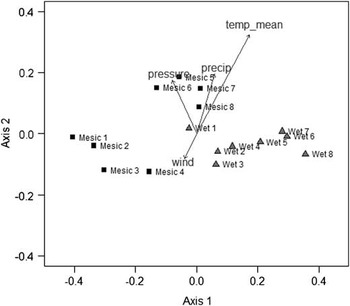
The NMDS based on FGs (Fig. 3, stress = 8.98141, solution found after three iterations) confirms that the beetle assemblages in the two habitats were functionally distinct throughout the active season. Similar to the taxonomic NMDS, the functional ordination also indicates a seasonal functional turnover in both habitat types, although this pattern is more evenly gradual in the wet habitats; there is a pronounced change in the functional assemblages between sampling periods 4 and 5 in the mesic habitats.
Nonmetric multidimensional scaling of seven beetle functional groups (log + 1 biomass) collected in wet (triangles) and mesic (circles) habitats across eight sampling periods (denoted by numbers) from June to August 2010. Overlaid on the figure are the weather variables, visualised as vectors.

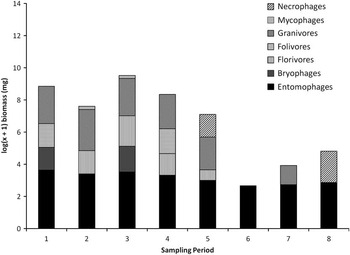
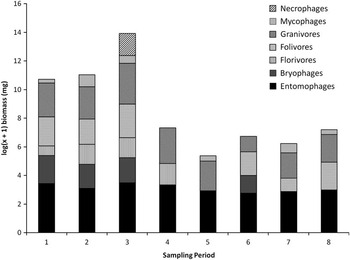
The beetle biomass in both wet (Fig. 4, Appendix 2) and mesic (Fig. 5, Appendix 2) habitats was dominated by entomophagous fauna throughout the active season. Among the noncarnivorous FGs, florivores are relatively well represented in both habitats from the beginning of the season to approximately sampling period 5, whereas bryophages are more commonly collected early in the season. Folivores are generally scarce in wet habitats (Fig. 4), but in mesic habitats display two peaks of activity in the first three and final three sampling periods (Fig. 5). Granivore biomass is consistent throughout the season in mesic habitats (Fig. 5), but becomes almost negligible after sampling period 5 in wet habitats (Fig. 4). Necrophages were infrequently represented in traps.
Stacked bar graph showing the total biomass (log + 1 transformed) of beetles from each functional group collected eat each sampling periods from June to August 2010, in mesic habitats. Note that the y-axis is not a logarithmic scale.

Stacked bar graph showing the biomasses (log + 1 transformed) of all feeding groups collected across sampling periods from June to August 2010, in wet habitats. Note that the y-axis is not a logarithmic scale.

Vectors of the weather data were plotted on the taxonomic (Fig. 2) and functional (Fig. 3) NMDS ordination space. Mean temperature was the only variable found to be significantly related to the taxonomic (r 2 = 0.616, P = 0.002) and functional (r 2 = 0.435, P = 0.020) assemblage structures throughout the sampling periods.
Discussion
In this study, ground-dwelling beetles were quantitatively sampled for eight weeks in two habitat types in a subarctic region, to determine how their taxonomic and functional assemblage structures changed over time and in response to seasonal weather patterns. Our results show that, while some species were found in both habitats sampled, many displayed strong preferences for one particular habitat. As a result, the hypothesis (3) that the beetle assemblages in the two habitats would be taxonomically distinct throughout the active season was supported. This could be attributed largely to differences in the diversity and structure of the vegetation in each habitat. Assemblages of other ground-dwelling arthropods in the far north have been shown to be best explained by associated plant communities (e.g., spiders; see Bowden and Buddle Reference Bowden and Buddle2010) or by structural vegetational boundaries (e.g., Carabid beetles, see Nelson Reference Nelson2001).
Species in both habitats exhibited rapid seasonal turnover, supporting our first hypothesis, which was that the taxonomic assemblage structure would change throughout the active season. This is to be expected given the very brief summers of the subarctic region: northern species have adapted to the short summers, cold temperatures, and unpredictable food supplies by displaying short periods of seasonal activity, resulting in an extension of their lifespan and development (compared with southern species) (Danks Reference Danks1992; Lovei and Sunderland Reference Lovei and Sunderland1996). Although the species composition changed throughout the season, rarefied species richness remained relatively stable, and there was little difference in richness between the two habitats. In light of this stability, and given the inherent paucity of resources in the far north (Danks Reference Danks2004), the assumption might be made that temporal resource partitioning is taking place. It has been surmised that in some ground beetle assemblages, interspecific competition between individuals relying on similar resources or prey items (i.e., FGs) can be reduced by their minimally overlapping or nonoverlapping periods of emergence and activity (Niemelä Reference Niemelä1993). Although comprehensive studies of the life cycles of northern species are scarce, some generalisations may be made. For example, while some Arctic arthropods respond to the brief availability of resources and favourable weather by emerging as early as possible in spring and completing their development in a single season, others display greater flexibility in terms of the timing of their emergence and the duration of their development (Danks Reference Danks1999). These different strategies, and the resulting variability in faunal composition at any given time, may permit a temporal “staggering” of resource exploitation by species reliant on similar resources.
Functionally, the beetle assemblage demonstrated a seasonal turnover, supporting our second hypothesis that the functional assemblage structure would change throughout the active season. Generally, the seasonal turnover effect was more pronounced in the mesic sites, due to the fact that the diversity of FGs was generally lower in the wet sites. The two habitats were functionally distinct throughout the active season (supporting our third hypothesis). Both the mesic and the wet sites were overwhelmingly dominated by entomophagous beetles throughout the active season. However, mesic sites consistently had greater biomass and greater diversity of herbivorous FGs; this was especially pronounced by sampling period 6, when herbivores were all but absent from wet sites. With the exception of sporadic appearances of necrophagous scavengers, saprophages were absent from the samples.
The vegetation in the two habitats may be the most likely factor explaining these results. The wet habitats in this study were dominated by graminoids, while the mesic sites supported a variety of shrubs and forbs. In a feeding preference study involving 42 common Arctic plants, MacLean and Jensen (Reference MacLean and Jensen1985) found that herbivorous insects (Lepidoptera and Hymenoptera larvae) consistently selected deciduous shrubs while rejecting evergreen and graminoid species. Deciduous shrubs tend to grow on more nutrient-rich soil, and therefore exhibit rapid growth, high leaf turnover, and little investment in chemical or physical defence; conversely, graminoids grow in nutrient-poor soils, grow more slowly, have low leaf turnover, and tend to favour more investment in defence (MacLean and Jensen Reference MacLean and Jensen1985). It is likely that the vegetation in mesic sites provided more favourable food sources for herbivorous beetles. While reduced leaf senescence in the wet habitats might explain why few saprophages were collected there, the apparent absence (or paucity, at least) of generalist saprophages from the mesic sites is interesting given the abundance of senesced deciduous leaves from the previous season. In addition to senescence, other plant phenology patterns may explain other functional trends. For example, plant communities in the far north exhibit a single, compressed flowering season, as opposed to plants in temperate or tropical regions that display periodic or ongoing flowering (Thórhallsdóttir Reference Thórhallsdóttir1998). The florivorous beetles in this study similarly display a short, intense period of activity in the early summer.
The foraging and activity levels of certain insect species can be reduced by high wind speeds in exposed habitats such as open tundra (Downes Reference Downes1969; Service Reference Service1980; Totland Reference Totland1994). Wind speed can also be a factor in habitat selection by some ground beetles, which generally prefer lower wind speeds (e.g., Penney Reference Penney1966). Atmospheric pressure can also alter flight and foraging activities in some insects (Lanier and Burns Reference Lanier and Burns1978; Drake and Farrow Reference Drake and Farrow1988). In our study, seasonal changes in the structure of the entire beetle assemblage were not significantly related to wind speed, precipitation, or atmospheric pressure. Epigeic fauna may be less affected by wind and atmospheric pressure – which are closely related – due to shelter afforded from vegetation, or because of their flightlessness (many species of beetles above the tree line are apterous). There was little total accumulation of precipitation across the season (68.7 mm total) and rain events were frequent (21 days) but not significant (mean = 1.4 mm; the largest single rain event deposited only 15.6 mm). While flash floods or periods of heavy rain might affect the availability of food or the suitability of habitats, the minimal rainfall in this semi-arid region is not likely to affect short-term changes in the activity of ground-dwelling fauna.
We did uncover a significant seasonal relationship between the beetle assemblages and mean daily temperature. We can therefore partially accept hypothesis four: mean daily temperature appears to play an important role in the taxonomic and functional assemblage structure of insects. This is consistent with other work from northern regions. For example, seasonal ground-dwelling arthropod activity in Taimy, Sibera, Russia was found to increase most strongly in response to increased temperatures, and secondarily to lower precipitation and wind (Tulp and Schekkerman Reference Tulp and Schekkerman2008). Ground-dwelling arthropod activity in Zackenberg, Greenland, was most strongly influenced by solar radiation levels and secondarily by temperature (Høye and Forchhammer Reference Høye and Forchhammer2008a). Solar radiation data were not available for this study. The influences of temperature on the species composition and functions of epigeic assemblages in Kugluktuk indicate that changes in weather (or, by proxy, longer-term changes in climate) could affect the biodiversity and ecological function of insects in this system (and other similar systems). Given the significance of insects in the north (Leborgne et al. Reference Leborgne, Ernst and Buddle2011), such changes could result in important modifications to northern ecology.
A final point of interest is the carnivore-heavy trophic structure evident in this study system: an apparent “inverted trophic pyramid” (Odum Reference Odum1971). One possible explanation is that beetle predators are supported by something other than noncarnivore beetle prey. Mites (Acari), Collembola, Hemiptera, Orthoptera, and Lepidoptera larvae were also present in traps, but in low numbers and minimal biomass. Alternate explanations are intratrophic predation or cannibalism, or it could be that beetles are consuming “aerial plankton”; wind-dispersing arthropods may provide important influxes of food in the Arctic (Coulson et al. Reference Coulson, Hodkinson and Webb2003). Future work will seek to uncover which of these trophic interactions (if any) support carnivorous arthropods in the far north. Uncovering the mechanisms behind the trophic structure may prove to be important: since carnivores represent the greatest biomass in the assemblage, their functional role and availability as a food source for other animals may be affected if weather and long-term climate patterns continue to change.
Acknowledgements
The authors acknowledge the collection and processing efforts of other members of the Northern Biodiversity Program (T. Wheeler, D. Currie, S. Loboda, K. Sim, L. Timms, M. Blair, A. Solecki, P. Schaeffer), as well as their comments on earlier versions of the paper. The authors thank R. Anderson, Y. Bousquet, A. Davies, H. Douglas, H. Goulet, J. Klimaszewski, C. Maier, S. Peck, and A. Smetana for their expertise and help with identifications. Kugluktuk residents A. Pedersen, K. Kuodluak, and A. Niptanatiak were of great help in the field, as were the students of Kugluktuk High School. Statistical assistance was provided by S. Hamblin. This work was supported by a National Science and Engineering Research Council of Canada (NCERC) Strategic Project Grant (Ecological Structure of Northern Arthropods: Adaptation to a Changing Environment) awarded to C. Buddle, T. Wheeler, and D. Currie (University of Toronto), its supporting partners and collaborators, and a Natural Sciences and Engineering Research Council – Canada Graduate Scholarship (Doctoral) awarded to C. Ernst.
Summary of the beetle species collected in this study.

Canges in the total biomass (g) of beetles in seven FGs over eight sampling periods in (a) mesic and (b) wet habitats.