Introduction
As pivotal micro-economic entities, manufacturing firms, characterized by high-pollution and high-energy-consumption growth models, exacerbate environmental pollution and pose severe threats to sustainable development (Lena, Pasurka, & Cucculelli, Reference Lena, Pasurka and Cucculelli2022). As a result, the issue of green transformation within these manufacturing firms has attracted increasing attention from industry professionals and academic researchers. Green transformation, defined as the gradual shift towards enhanced energy efficiency, reduced environmental harm, improved labor productivity, and strengthened capabilities for sustainable development (Deng, Zhang, & Guo, Reference Deng, Zhang and Guo2024), manifests in both strategic approaches and actual eco-friendly practices. Firms leading in green transformation efforts can gain competitive advantages by leveraging advanced environmental insights, innovative technologies, and pioneering products (Chen, Lai, & Wen, Reference Chen, Lai and Wen2006). Extensive research has shown that internal factors, such as green entrepreneurial acumen (Brandt & Svendsen, Reference Brandt and Svendsen2016) and lean management practices (Dey, Malesios, De, Chowdhury, & Abdelaziz, Reference Dey, Malesios, De, Chowdhury and Abdelaziz2020), as well as external factors, like the financial environment (Lu, Gao, Zhang, & Wang, Reference Lu, Gao, Zhang and Wang2022) and environmental regulations (Chen, Li, & Liu, Reference Chen, Li and Liu2024), influence firms’ green transformation. Among these, environmental regulations not only directly impact firms’ operational strategies but also shape their long-term development trajectories (Shi, Li, & Gao, Reference Shi, Li and Gao2022). However, the literature on how market-oriented environmental regulations specifically affect firms’ green transformation remains incomplete.
Previous research on market-oriented environmental regulations mainly focuses on their impact on regional and industry-level green transformations (Feng, Zhao, & Yan, Reference Feng, Zhao and Yan2024), or on firms’ green innovation and pollution emissions (Lu et al., Reference Lu, Gao, Zhang and Wang2022). Few studies examine the multidimensional effects of environmental regulations on green transformation. Green transformation goes beyond single-dimensional measurements, representing a firm’s comprehensive shift in both strategy and practice. It embodies not only environmental responsibility but also serves as a strategic foundation for enhancing long-term competitiveness, making it a critical component of sustainable governance (Eccles, Ioannou, & Serafeim, Reference Eccles, Ioannou and Serafeim2014). As environmental requirements tighten, understanding whether market-oriented environmental regulations can drive firms to align their strategies with sustainable actions becomes crucial. These regulations not only help firms gain a competitive edge but also provide valuable insights for policymakers to design more effective regulatory policies (Hu, Wu, & Ying, Reference Hu, Wu and Ying2022). These policies encourage firms to continuously improve their environmental practices, fostering a sustainable balance between economic growth and ecological preservation, and promoting long-term progress in green transformation (Chen, Chen, & Zhang, Reference Chen, Chen and Zhang2024). Given the critical importance of green transformation and the increasing trend toward the marketization of environmental regulations, answering this question has become both essential and urgent, driving the motivation for this study.
Market-oriented environmental regulation uses market mechanisms to encourage eco-friendly measures, distinguishing itself from traditional direct controls (Shi et al., Reference Shi, Li and Gao2022). Specifically, market-oriented environmental regulation is characterized by the coexistence of emission reduction pressures and incentives. It limits pollution by setting emission caps and imposing emission taxes, thus increasing compliance pressure on firms (Zhang & Xu, Reference Zhang and Xu2013). Additionally, legitimacy-driven firms seek to increase profits or adhere to ethical standards through environmental activities. Market-oriented environmental regulation incentivizes firms to pursue legitimacy by offering both economic and non-economic incentives. Economic tools, such as tax preferences, subsidies, and emissions trading, allow firms to benefit from emission reduction (Hu, Fang & Wu, Reference Hu, Fang and Wu2023; Ren, Liu, Li, Wang, & Chen, Reference Ren, Liu, Li, Wang and Chen2020). These regulations also cultivate a green ethos in society, encouraging firms to enhance their social reputation by improving environmental awareness and capabilities (Sun, Bai, & Sarkis, Reference Sun, Bai and Sarkis2024). Some scholars have studied the positive impacts of market-oriented environmental regulations on firms’ environmental performance, such as sulfur dioxide emission trading policies (Dagestani, Shang, Schneider, Cifuentes-Faura, & Zhao, Reference Dagestani, Shang, Schneider, Cifuentes-Faura and Zhao2023) and green credit regulation (Zhang, Wu, He, & Hao, Reference Zhang, Wu, He and Hao2022). However, Ji, Wang, Wang, and Tang (Reference Ji, Wang, Wang and Tang2024) argued that the policy’s emission reduction incentives may be limited by the leniency of emission allowances. Moreover, when environmental costs are high, environmental regulations may harm firm performance, forcing them to relocate or exit the market (Lena et al., Reference Lena, Pasurka and Cucculelli2022). However, limited literature exists on the impact of the Carbon Emissions Trading Policy (CETP), a market-oriented environmental regulation, on firms’ green transformation. Given the lack of consensus, the effect of market-oriented environmental regulations on firms’ green transformation, as well as whether firms adopt a strategy of ‘proactively seeking change,’ are issues worth further exploration.
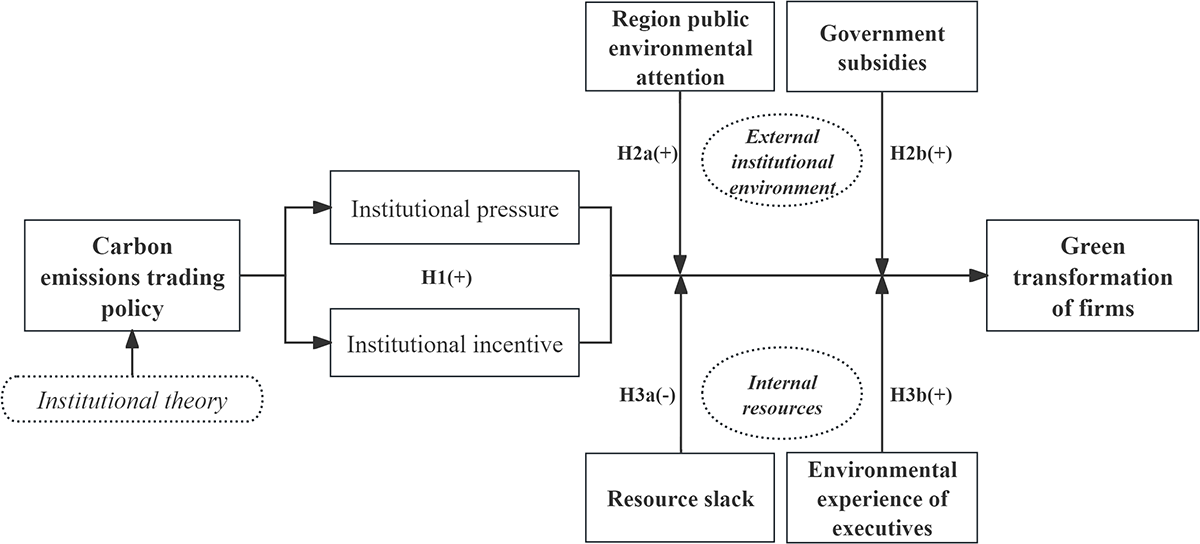
According to institutional theory, market-oriented environmental regulations introduce a new institutional force, distinct from the mandatory pressures of command-and-control regulations. This force drives firms’ green transformation through economic incentives, positioning the regulation as a form of ‘pressure-incentive’ regulation. By setting emission limits below actual emissions, firms must purchase emission rights, which compels them to adopt greener practices due to the high cost of exceeding limits. Additionally, economic incentives reduce the cost of green technology research and development, making eco-friendly behavior more viable and attractive. Firms that cultivate a ‘green image’ may benefit from favorable policies, consumer preferences, and easier access to funding and investment because of their reputation. Based on this, we hypothesize that the CETP can facilitate firms’ green transformation. Institutional theory defines the institutional environment as a broad set of social norms, cultural beliefs, political structures, and economic systems that influence organizational behavior and decision-making. Thus, external environments can affect the perceived intensity of institutional pressures and incentives. This study further proposes hypotheses 2a and 2b, suggesting that regional public environmental attention and government subsidies can reinforce the positive impact of CETP on firms’ green transformation. Furthermore, the effectiveness of policies is influenced by internal resources within firms, reflecting an organization’s strategic priorities and its responsiveness to institutional demands. Therefore, we propose hypotheses 3a and 3b: CETP may exert a weaker positive influence on green transformation in firms with resource slack, while it is more likely to incentivize green transformation in firms with executives who have environmental experience.
This study applies institutional theory to examine the relationship between market-oriented environmental regulation and firms’ green transformation under institutional pressures and incentives, and explores the influence of external institutional environments and internal resources on these pressures and incentives. In the empirical analysis, the study uses Chinese A-share manufacturing firms listed on the Shanghai and Shenzhen stock exchanges from 2010 to 2020 as the research sample and employs a propensity score matching difference-in-difference (DID) approach to investigate the impact of the CETP on firms’ green transformation. Initially, we use Python to extract data from corporate social responsibility reports and quantify the degree of green transformation leveraging structural equation modeling. Subsequently, we apply a fixed-effects panel DID model to examine the facilitating effect of CETP on firms’ green transformation in pilot areas and confirm this relationship through a series of robustness tests. The moderating effects of the external institutional environments show that regional public environmental attention and government subsidies reinforce the positive impact of CETP on firms’ green transformation. The findings related to internal resources suggest that executives’ environmental experience strengthens the positive impacts of CETP on firms’ green transformation, while higher resource slack plays an opposite role. Further analysis of regional spillover effects indicates that CETP hinders green transformation in neighboring regions. Studies on economic consequences reveal that, in the short term, green transformation may suppress firms’ economic performance.
This study makes three main contributions. First, this study contributes to the literature on market-oriented environmental regulations by revealing its dual attributes of institutional pressures and institutional incentives. Existing research typically analyzes the effects of market-oriented environmental regulations from a single perspective – either institutional pressures or incentives (Dagestani et al., Reference Dagestani, Shang, Schneider, Cifuentes-Faura and Zhao2023) – with a predominant focus on economic incentives. Unlike previous studies, we analyze the combined effects of pressures and incentives inherent in CETP, emphasizing both economic and non-economic rewards within institutional incentives. Specifically, while CETP imposes emission reduction pressures on firms, it also offers opportunities for firms to gain economic profits and enhance their social reputation through environmental actions. Our study enriches the application of institutional theory in the field of environmental management and lays a foundation for future theoretical developments.
Second, we contribute to the literature on firms’ green transformation, an important area in environmental management research. Previous studies primarily focused on the industrial or regional impacts of market-oriented environmental regulations (Dy & Yang, Reference Dy and Yang2025), often using single-dimensional indicators to represent firms’ green transformation, particularly green actions (Zhang, Yu, & Sun, Reference Zhang, Yu and Sun2022) and green innovations (Xu, Zhu, & Wang, Reference Xu, Zhu and Wang2023), without fully exploring its broader scope. This study employs Python for text mining to extract data from corporate social responsibility reports, and applies structural equation modeling to develop a comprehensive indicator. It measures firms’ green transformation from two aspects: green strategic transformation and green practice transformation, capturing the multifaceted nature of green transformation more scientifically than single-indicator measures.
Third, we contribute to research on how market-oriented environmental regulations can effectively play policy effects, which is practically significant. While prior research has widely examined the benefits of market-oriented environmental regulations (Dagestani et al., Reference Dagestani, Shang, Schneider, Cifuentes-Faura and Zhao2023) and potential issues of insufficient incentives (Xu et al., Reference Xu, Zhu and Wang2023), our study expands the focus beyond the pressures and incentives inherent in market-oriented environmental regulation. We investigate how other external pressures and incentives faced by firms influence the policy’s efficacy. Additionally, we examine how internal resources within firms coordinate with the external institution to affect policy outcomes. Furthermore, we explore the broader impacts of implementing such regulations, which include regional spillover effects of creating pollution havens in neighboring areas, and impairing the short-term economic performance of pilot firms. Our multi-perspective research provides policy recommendations for governments on how to design market-oriented environmental regulations to promote firms’ green transformation.
Literature Review
Market-Oriented Environmental Regulation and Its Impact
Market-oriented environmental regulation is a form of induced regulation that pressures organizations while providing economic and non-economic incentives for voluntary compliance with specific conditions. It does not directly dictate what firms should do or not do. The literature on the impact of market-oriented environmental regulations on firm behavior is extensive, focusing on regulatory measures such as SO2 emission trading policies (Ren et al., Reference Ren, Liu, Li, Wang and Chen2020), green credit policies (Lu et al., Reference Lu, Gao, Zhang and Wang2022), and carbon emission trading policies (Chen, Li, et al., Reference Chen, Li and Liu2024). SO2 emission trading policies not only reduce SO2 emission intensity but also incentivize polluters to engage in effective innovation (Dagestani et al., Reference Dagestani, Shang, Schneider, Cifuentes-Faura and Zhao2023), thereby enhancing firms’ total factor productivity. However, the productivity boost typically diminishes over time. Some scholars have highlighted the limitations of these policies in terms of emission reduction, primarily because lenient emission permit quotas may hinder the effective implementation of emission trading (Ji, Wang, Wang, & Tang, Reference Ji, Wang, Wang and Tang2024). Under green credit regulation, the policy exerts both punitive and incentivizing effects on high-pollution firms. It increases financing costs for high-pollution firms, while offering preferential interest rates to environmentally conscious industries (Lu et al., Reference Lu, Gao, Zhang and Wang2022). This dual effect encourages firms to enhance technological innovation and improve productivity, thus steering their development toward a green trajectory (Zhang, Wu, et al., Reference Zhang, Wu, He and Hao2022).
CETP is a system that enables firms to trade carbon allowances autonomously within an overall cap. The government allocates initial emission reduction quotas based on reduction targets, then optimizes firms’ production behaviors through carbon market prices and quota constraints. Carbon emissions trading incorporates both market and policy attributes. From a market perspective, it functions through a market-based mechanism driven by trading systems and price signals, thereby using economic incentives to guide firms to reduce greenhouse gas emissions. From a policy perspective, CETP serves as an effective tool for environmental protection. However, it inevitably pressures high-energy-consuming and high-emission firms, potentially leading to negative effects on short-term economic growth (Chen, Chen, et al., Reference Chen, Chen and Zhang2024).
Existing literature on the impact of CETP mainly focuses on areas such as pollution control, green innovation, and resource allocation. At the macro level, CETP has been found to reduce regional carbon emissions (Feng, Zhao, & Yan, Reference Feng, Zhao and Yan2024) and increase energy utilization efficiency (Zhang, Zhang, & Yu, Reference Zhang, Zhang and Yu2019) by enhancing technological capabilities. The number of firms participating in the carbon market is crucial for effective carbon emission reduction, and the longer the CETP is implemented, the greater its emission reduction effect (Shi et al., Reference Shi, Li and Gao2022). At the micro level, carbon markets have demonstrated significant emission reduction effects among firms in pilot regions (Chen, Chen, et al., Reference Chen, Chen and Zhang2024). However, the policy’s effects vary across different property rights and industries. Numerous scholars have found that CETP increases the total factor productivity of pilot firms (Bai, Liu, Zhang, & Feng, Reference Bai, Liu, Zhang and Feng2023) and promotes green innovation outputs (Chen, Li, et al., Reference Chen, Li and Liu2024), particularly in green invention patents, thereby supporting Porter’s hypothesis. Despite these findings, the conclusions of related studies remain inconsistent. For instance, Rogge, Schneider, and Hoffmann (Reference Rogge, Schneider and Hoffmann2011) found that the EU Emissions Trading System (ETS) had little substantial impact on green transformation and even had negative effects in certain industries. The above literature is summarized in Table A1.
Influencing Factors of Green Transformation
Research on the factors influencing firms’ green transformation has focused on both external and internal aspects. Externally, Zhou, Song, and Huang (Reference Zhou, Song and Huang2023) found that environmental regulation promotes firms’ green innovation, especially in regions with stricter regulatory intensity and industries with higher pollution levels. Regarding market-oriented environmental regulations, green credit policies facilitate green transformation by adjusting the size of bank loans and increasing firms’ environmental expenditures (Lu et al., Reference Lu, Gao, Zhang and Wang2022; Zhang, Wang, Li, Zhang, & Balezentis, Reference Zhang, Wang, Li, Zhang and Balezentis2024). Environmental tax policies promote green mergers and acquisitions, thereby reducing illegal emissions and encouraging shifts to green industries (Hu, Fang, & Wu, Reference Hu, Fang and Wu2023; Lu, Li, & Wang, Reference Lu, Li and Wang2023). However, when environmental costs are high, these regulations may hinder green transformation, forcing firms to exit the market or relocate (Lena et al., Reference Lena, Pasurka and Cucculelli2022). Uncertainty in the market environment can also deter firms from pursuing green development (Arena, Michelon, & Trojanowski, Reference Arena, Michelon and Trojanowski2018).
Internally, heightened awareness of carbon risk is essential for firms developing low-carbon strategies and green transformation, and it can even help reduce the carbon footprint across the supply chain (Deng et al., Reference Deng, Zhang and Guo2024). Executives, as key decision-makers, play a pivotal role in this process. Green-minded entrepreneurs can drive green transformation successfully if they effectively communicate, build trust, and generate profits (Brandt & Svendsen, Reference Brandt and Svendsen2016). Conversely, executives who prioritize short-term returns are less willing to engage in green transformation due to its high costs and risks (Flammer, Hong, & Minor, Reference Flammer, Hong and Minor2019). CEOs with overconfident personalities may overestimate the likelihood of success in green transformation (Arena et al., Reference Arena, Michelon and Trojanowski2018).
Research Gaps
Based on the analysis above, existing literature presents the following issues. First, although some studies have examined firms’ green transformation from a policy perspective, research on the multidimensional impacts of market-oriented environmental regulations remains limited. Green transformation is not merely the outcome of green practices (Deng et al., Reference Deng, Zhang and Guo2024), but a comprehensive plan from strategy to action. Current theoretical frameworks fail to fully explore the relationship between market-oriented environmental regulation and green transformation, thus hindering accurate assessments of policy effectiveness. Second, analyses of existing studies reveal that the relationship between market-oriented environmental regulations and green transformation often focuses on their impacts on green innovation and productivity, with significant differences in conclusions. Only analyzing green actions may underestimate the environmental governance effects of the CETP, leading to biased conclusions both theoretically and statistically. Third, prior studies have concentrated solely on the effects of formal market-oriented environmental regulations, such as the CETP, without considering the influence of external institutional environments and internal resources. This omission limits the understanding of the direct interactions between the regulations, external environments, and internal resources. Finally, much of the literature focuses only on the positive effects of policies, without deeply investigating their potential negative impacts.
Theoretical Background and Hypotheses Development
Institutions consist of cognitive, normative, and regulative structures and activities that provide stability and meaning to social behavior (Scott, Reference Scott1987). Institutions establish standards and norms for organizational behavior, define the conditions required for organizational behavior to be accepted, and constrain its choices. Organizations under institutional pressures select appropriate behaviors to acquire legitimacy (DiMaggio & Powell, Reference DiMaggio and Powell1983).
The institutional environment – including policies, laws, social norms, and cultural beliefs – forms the external ecosystem that influences and regulates organizational behavior (DasGupta & Roy, Reference DasGupta and Roy2023). Firms experience different degrees of institutional pressures and incentives depending on the institutional environment. According to Liu and Yin (Reference Liu and Yin2020), stakeholders such as government agencies, environmental organizations, and consumers play significant roles in influencing firms. For example, in environments with heightened environmental regulatory pressure, firms tend to perform better environmentally, although they may face difficulties in balancing environmental and economic objectives (Zhu & Sarkis, Reference Zhu and Sarkis2007). In environments with lower corruption, firms are more likely to fulfill social responsibilities (DasGupta & Roy, Reference DasGupta and Roy2023). Consequently, firms in favorable institutional environments may face stronger institutional pressures and benefit from greater institutional incentives. These firms are often more proactive in pursuing green transformation to gain competitive advantages and legitimacy (DiMaggio & Powell, Reference DiMaggio and Powell1983).
Moreover, firms can leverage internal resources like management systems and organizational culture to adapt to external institutional demands. For example, managers’ environmental ethics can elevate moral standards and foster green practices (Quan, Ke, Qian, & Zhang, Reference Quan, Ke, Qian and Zhang2023). External institutional environments and internal resources largely determine the autonomy of organizational choices (Oliver, Reference Oliver1991). Thus, firm strategy is multifaceted and driven by complementary forces, which together shape the diversity of firms’ environmental strategies.
Institutional Characteristics of Market-Oriented Environmental Regulation: Pressure and Incentive Coexist
Environmental regulations are designed to accomplish two things: reducing the adverse impact of businesses on the environment and fostering an atmosphere conducive to sustainable environmental practices (Dagestani et al., Reference Dagestani, Shang, Schneider, Cifuentes-Faura and Zhao2023). To achieve these goals, governments use command-and-control regulations or market-oriented environmental regulations that rely on economic instruments. Command-and-control environmental regulations are authoritatively enacted and enforced by the government, featuring strict penalty mechanisms (Xie, Li, Ye, & Jiang, Reference Xie, Li, Ye and Jiang2021). Due to the high costs of complying with environmental regulations, these regulatory tools are often ineffective in meeting most pollution control objectives, and they fail to provide sufficient incentives for green transformation (Dagestani et al., Reference Dagestani, Shang, Schneider, Cifuentes-Faura and Zhao2023). Therefore, many governments have turned to market-oriented alternatives to provide more economical means of addressing pollution issues. Based on market mechanisms, environmental regulations create pressures and incentives for emission reduction through cap-and-trade. Caps are primarily reflected in the government allocating initial emission quotas that are set below the total amount required for business production, thus limiting the emission rights available to regulated firms and creating pressure to reduce emissions (Shi et al., Reference Shi, Li and Gao2022). Trade means that although total emissions are controlled, firms have the autonomy to meet these targets in flexible ways, as market-oriented trading mechanisms provide economic incentives for emission reduction (Zhang & Xu, Reference Zhang and Xu2013).
The advantages of market-oriented environmental regulations over command-and-control approaches include the following: First, market-oriented environmental regulations provide economic incentives or penalties through fiscal measures such as tax preferences, subsidies, and emissions trading, encouraging firms to adopt greener behaviors. For example, the carbon trading market allows firms that meet emission reduction requirements to sell their surplus emission quotas to other emitters (Chen, Chen, et al., Reference Chen, Chen and Zhang2024). Second, they allow for greater flexibility, enabling firms to reduce costs while meeting environmental goals (Hu et al., Reference Hu, Fang and Wu2023). Third, by leveraging economic incentives, market-oriented environmental regulations can stimulate investment in new technologies aimed at reducing pollution and optimizing resource use (Lu et al., Reference Lu, Gao, Zhang and Wang2022). Fourth, these regulations can be dynamically adjusted according to market conditions and policy objectives. For instance, the government can adjust the total emissions cap in response to actual environmental improvement. Fifth, they can create a relatively fair competitive environment among different polluters. Each polluter faces the same marginal cost of reduction. These characteristics make market-oriented environmental regulations a flexible and effective tool for addressing a wide range of environmental issues.
Market-Oriented Environmental Regulation and Green Transformation
The carbon market represents a typical application of market-oriented environmental regulation in addressing environmental pollution. This system follows market dynamics of supply and demand, instead of imposing mandatory constraints on firm carbon emissions. Under cap-and-control measures, carbon emission rights become tradable commodities. This approach assigns a market price to the negative externalities of environmental pollution caused by firm activities, directly incorporating them into firms’ operating costs and investment opportunity costs. As firms continually strive for economic optimization, they need to balance rising environmental protection costs, short-term profitability, and long-term sustainability (Dey et al., Reference Dey, Malesios, De, Chowdhury and Abdelaziz2020). In this regulatory environment, firms typically have three behavioral options: one option is to maintain current production levels and purchase excess emission rights on the carbon market; another is to reduce output to meet total emission control requirements; a third option is to optimize resource allocation or innovate technologically to reduce carbon intensity per unit of output through green transformation, thereby achieving emission reduction goals. High costs of carbon emissions may also lead to factory relocation, production restrictions, or even market exit.
Based on the logic of the first two types of firm behavior, it is believed that an increase in environmental costs could undermine firms’ competitive advantage (Jorgenson & Wilcoxen, Reference Jorgenson and Wilcoxen1990). As profit-seeking organizations, firms are unlikely to comply passively and are more likely to adopt the third type of behavior. Driven by institutional pressures, firms in pilot areas evolve towards consistency in behavior (DiMaggio & Powell, Reference DiMaggio and Powell1983). Similar to command-and-control environmental regulations, firms face pressure to reduce their emissions. The CETP requires firms to follow carbon emission quotas. When a firm’s emissions exceed the quotas allocated to it, the firm must either buy additional allowances on the carbon market or face administrative penalties. Additionally, firms participating in carbon trading need to transparently record and report their carbon emissions data, which increases their operational burden (Chai, Zhou, Ji, Liu, Liu, & Chu, Reference Chai, Zhou, Ji, Liu, Liu and Chu2025). Therefore, driven by the need for legitimacy and operational pressures, firms tend to optimize resource allocation or upgrade technology, thereby fostering green transformation (Fabrizi, Guarini, & Meliciani, Reference Fabrizi, Guarini and Meliciani2018).
On the other hand, compared to command-and-control environmental regulations, the CETP’s emission reduction benefits incentivize firms to pursue green transformation. The demand for excess carbon rights in secondary markets motivates firms to pursue green transformation (Shi et al., Reference Shi, Li and Gao2022). Proactive green transformation not only helps firms meet total emission control targets but enables them to sell surplus rights for additional benefits (Clarkson, Li, Pinnuck, & Richardson, Reference Clarkson, Li, Pinnuck and Richardson2015), thus better matching the costs and benefits of emission reduction. In addition to direct economic incentives, carbon emission rights, as an asset, have given rise to various forms of green financial products, providing low-cost and diversified financing options for firms to support green transformation. Moreover, the implementation of CETP fosters a new green and low-carbon trend in society. It influences consumer preferences by sending clear signals about products. Environmentally compliant firms may be favored by eco-conscious consumers because of their ‘green image’ and better reputation (Kammerer, Reference Kammerer2009; Wang & Zhang, Reference Wang and Zhang2020). These firms are also more likely to attract financial support from green investors. Overall, the carbon emissions trading mechanism continually shifts the preferences among policymakers, consumers, and investors toward green and low-carbon firms. These economic and non-economic incentives make environmental behavior attractive. Based on the above discussions, we propose the following hypothesis:
Hypothesis 1 (H1): Carbon emissions trading policy can promote the firms’ green transformation.
Moderating Effect of External Institutional Environments
The external institutional environment, comprising policy structures, legal frameworks, and cultural elements, varies across regions, thereby influencing the effectiveness of the CETP. Tolerance for environmental pollution reflects the environmental expectations of stakeholders such as community groups and consumers. Local public attention to environmental issues can influence institutional pressures, often manifesting as public penalties for firms that fail to meet institutional requirements, such as reputational damage and reduced demand for their products. Moreover, firms are especially sensitive to stakeholders with substantial influence and power. The high costs associated with achieving institutional compliance and implementing environmental protection measures mean that green transformation is often highly dependent on government subsidies. The extent of government support is a crucial incentive for firms to pursue green transformation.
Regional public attention to environmental issues plays a significant role in shaping public environmental preferences, thereby influencing the green strategic choices of both governments and firms (Blome, Hollos, & Paulraj, Reference Blome, Hollos and Paulraj2014). It serves as a crucial source of pressure for firms. As public awareness of environmental issues rises, local firms face increased social scrutiny and public opinion pressure. Firms may encounter heightened external pressures in response to CETP. For example, the public may become less tolerant of polluting emissions or even boycott or criticize firms that fail to meet environmental standards (Chai et al., Reference Chai, Zhou, Ji, Liu, Liu and Chu2025). This social oversight compels firms to prioritize green transformation in order to mitigate public dissatisfaction and reputational risks. Furthermore, regional public attention to environmental issues acts as an important complement to government monitoring (Mao & Wang, Reference Mao and Wang2019). Increased public focus on environmental concerns can attract government attention, prompting more stringent regulatory actions against pollution. It can also generate public opinion pressure, particularly through online platforms, to prevent potential collusion between governments and firms over pollution activities (Gaganis, Papadimitri, Pasiouras, & Ventouri, Reference Gaganis, Papadimitri, Pasiouras and Ventouri2021). In response, firms are more inclined to adopt proactive measures to improve their environmental performance. Conversely, limited public attention may diminish the pressure from CETP, resulting in reduced motivation for green initiatives.
For listed firms in China, managing political costs is critical to their survival (Wang & Zhang, Reference Wang and Zhang2020). Achieving independent and proactive green transformation is challenging for firms, as it requires substantial investments, and the benefits of emission reduction are uncertain. Simply pursuing environmental goals without considering economic incentives makes it difficult for firms to achieve long-term sustainability and threatens their market competitiveness (Schaltegger & Hörisch, Reference Schaltegger and Hörisch2017). In this context, government subsidies serve as a crucial external incentive for firms. Government subsidies can offset emission costs, alleviate the financial constraints and share the risks associated with green transformation. These subsidies also play a policy-guiding role, encouraging firms to enhance their sense of social responsibility and actively engage in green practices (Wang & Zhang, Reference Wang and Zhang2020), thereby bridging the gap between the social and corporate benefits of green transformation. Additionally, government subsidies have signaling properties (Kleer, Reference Kleer2010), indicating the government’s support for green transformation. This signaling can create a ‘certification effect’ within the market and industry that highlights the investment value and market potential of firms’ green projects (Kleer, Reference Kleer2010). Receiving government subsidies signals positive messages to investors, reducing their moral hazard. This, in turn, facilitates firms in attracting external financing, which further accelerates their green transformation. Based on the above discussions, we propose the following hypotheses:
Hypothesis 2a (H2a): Regional public environmental attention may reinforce the positive correlation between CETP and firms’ green transformation.
Hypothesis 2b (H2b): Government subsidies may reinforce the positive correlation between CETP and firms’ green transformation.
Moderating Effect of Internal Resources
Internal resources such as capital, talent, and management systems are crucial for firms to meet corresponding external institutional demands. A successful green transformation depends on effective financial management and strong internal capabilities. Firms are more likely to excel in environmental performance when their internal resources align with external institutional pressures. Additionally, managers, as primary decision-makers, possess cognitive abilities and values that significantly shape their perceptions of the business environment, thereby influencing strategic decisions (Hambrick & Mason, Reference Hambrick and Mason1984). Consequently, the characteristics of executives’ work experience can affect the success of green transformation under CETP (Bamber, John, & Wang, Reference Bamber, John and Wang2010).
Resource slack refers to the excess resources that firms possess beyond what is necessary for their daily operations (Wang, Choi, Wan, & Dong, Reference Wang, Choi, Wan and Dong2016). Green transformation requires strategic allocation of resources to effectively respond to external institutional pressures. For firms with resource slack, environmental labels provide limited benefits because they are less vulnerable to legitimacy deficits (Wang, Cui, & Liang, Reference Wang, Cui and Liang2015). Despite having vast resources available to initiate green efforts, the transition towards sustainability is a prolonged process, demanding substantial investments with uncertain returns. Managers often shy away from risky investments, preferring instead to focus on initiatives that enhance their personal reputations or improve personal well-being through superficial projects (Paeleman & Vanacker, Reference Paeleman and Vanacker2015), rather than committing to sustainable development for competitive advantage. This resource management approach compromises efficiency and hinders the achievement of green transformation goals. In contrast, firms with limited resources face greater constraints due to carbon emissions costs, increasing their urgency to embrace green transformation. Scarce resources also help align the objectives of directors and managers, fostering collaboration that supports long-term sustainability through green transformation.
Organizational strategic decisions often reflect the values and beliefs of executives. Executives with long-term experience in a particular area may develop selective cognition, resulting in decisions based on cognitive biases shaped by their past experiences (Zhang, Xu, & Chen, Reference Zhang, Xu and Chen2022). Executives with experience in the environmental field are inclined to view external CETP as development opportunities for firms. They proactively assume environmental responsibilities and guide green development by fostering a green culture and reallocating resources. These actions enable firms to gain a sustainable competitive advantage. According to Martin, Muûls, de Preux, and Wagner (Reference Martin, Muûls, de Preux and Wagner2012), firms are more likely to adopt environmentally friendly technologies and equipment for production activities when executives prioritize environmental protection. Conversely, executives with limited environmental awareness may prefer to maintain stability in existing production and operation systems, adopting only minimal green measures to comply with environmental policies. They may perceive the uncertainty associated with green transformation as a threat to their managerial roles and the firm’s performance. This reduces their enthusiasm for advancing green transformation strategies. Based on the above discussions, we propose the following hypotheses:
Hypothesis 3a (H3a): Resource slack may mitigate the positive relationship between CETP and firms’ green transformation.
Hypothesis H3b (H3b): Environmental experience of executives may enforce the positive relationship between CETP and firms’ green transformation.
Figure 1 displays the theoretical framework of this study.
The theoretical framework of this study

Empirical Strategy
Data
This study utilizes data from Chinese A-share manufacturing firms listed on the Shanghai and Shenzhen Stock Exchanges, spanning the period from 2010 to 2020. After excluding firms labeled as ST and ST* states and removing entities with incomplete data, the final sample includes 346 listed manufacturing firms, yielding 1442 observations. The primary data sources include the China Juchao Information Website (http://www.cninfo.com.cn/), officially designated by the China Securities Regulatory Commission to disclose information on listed firms, which provides data related to firms’ green transformation. Data on regional public environmental attention are collected from the Baidu index website (http://index.baidu.com/), while data on executives’ environmental experience are sourced from the Sina Finance website (https://finance.sina.com.cn/). Other data are obtained from reliable databases including the China Stock Market & Accounting Research (CSMAR) database and the Chinese Research Data Services (CNRDS) platform.
Model Specification
To analyze the policy impact of the CETP on firms’ green transformation, this study employs a multi-period propensity score matching difference-in-difference (PSM-DID) model for several reasons. Since the selection of pilot areas is non-random and influenced by factors such as local economic development, pollutant emission intensity, and environmental management capacity, this approach helps mitigate sample selection and heterogeneity bias, thereby improving the robustness of the estimations. Moreover, considering the policy was gradually implemented across seven pilot regionsFootnote 1 in 2013 and 2014, and acknowledging the fluctuating number of firms affected during different observational periods, a single-period DID method is insufficient to accurately evaluate the policy’s impact. Consequently, applying a multi-period PSM-DID design is essential.
The sample is divided into two categories: a treatment group including firms situated in the seven pilot regions, and a control group constituting firms from other regions. To construct the control group, firms within the treatment group are matched annually with control samples using the Propensity Score Matching (PSM) method, which estimates propensity scores based on firms’ participation in the carbon trading market. Significant variables influencing firms’ green transformation, including firm size, firm age, independent directors, shareholding concentration, asset liability ratio, main operating income, staff numbers, executive age, female executives and executives’ R&D backgrounds (elaborated in measurements of control variables), are employed as matching variables to pair samples across the two groups. The Logit model facilitates the estimation of propensity scores, adopting a one-to-one nearest neighbor matching technique to align samples with similar scores from the control group to the treatment group, while ensuring that samples meet the common support hypothesis. Furthermore, since the policy was implemented in Beijing, Tianjin, Shanghai, Guangdong (including Shenzhen) in 2013, and Hubei and Chongqing in 2014, the explanatory variable  $Are{a_j} \times Pos{t_t}$is defined according to the actual policy implementation time. If a firm is located in Beijing, Tianjin, Shanghai or Guangdong and the year t
 $ \geqslant $2013,
 $Are{a_j} \times Pos{t_t}$ is 1; otherwise 0. If a firm is located in Hubei or Chongqing and the year t
 $ \geqslant $2014,
 $Are{a_j} \times Pos{t_t}$ is 1; otherwise 0.
We construct a two-way fixed effects panel data DID model based on the above settings, as follows:
 \begin{equation}GreenTransformatio{n_{it}} = {\beta _0} + {\beta _1}Are{a_j} \times Pos{t_{_t}} + {\beta _2}{X_{it}} + {\mu _t} + {\gamma _j} + {\varepsilon _{it}}\end{equation}
where  $GreenTransformatio{n_{it}}$ represents the green transformation of firm i in year t;
 $Are{a_j} \times Pos{t_t}$ represents whether the firm is located in a pilot region after the policy launch.
 $Are{a_j} \times Pos{t_t}$equals 1 if the firm is located in a pilot region after the policy launch and 0 otherwise. The coefficient
 ${\beta _1}$captures the net policy effect on green transformation.
 ${X_{it}}$is a series of control variables to capture other factors that may influence green transformation, including firm size, firm age, independent directors, shareholding concentration, asset liability ratio, main operating income, staff numbers, executive age, female executives and executives’ R&D backgrounds.
 ${\mu _t}$is year-fixed effects that control for aggregate time-varying shocks common to all firms, and
 ${\gamma _j}$ is industry-fixed effects that capture time-invariant industry features.
 ${\varepsilon _{it}}$denotes the random error term.
Variables and Measurements
Measurement of green transformation
Existing literature typically measures green transformation using two indicators: green innovation level (Lu, Gao, Zhang, & Wang, Reference Lu, Gao, Zhang and Wang2022) and green total factor productivity (Zhang, Yu, et al., Reference Zhang, Yu and Sun2022). A major drawback of this approach is that relying on a single indicator fails to reflect the comprehensive nature of green transformation, which involves more than just enhancements in productivity or increases in green innovation (Xu et al., Reference Xu, Zhu and Wang2023). Although green total factor productivity integrates pollutant emissions into its analysis, it primarily focuses on output changes while overlooking the impacts of green strategies and institutional directives. It also fails to identify the drivers of changes in pollutant emissions, such as renewable energy utilization or firms’ pollutant monitoring efforts. Furthermore, although green patents are the product of the application of firms’ R&D activities to production and sales, they fall short in assessing the effectiveness of green innovations, management practices, and strategies. There is also a risk that firms may acquire low-quality green patents, thereby exaggerating the extent of their green transformation (Rong, Wu, & Boeing, Reference Rong, Wu and Boeing2017).
In this study, we evaluate green transformation by combining text mining techniques with a structural equation model, leveraging word frequency analysis of corporate social responsibility reports. These reports serve as bridges between firms and external stakeholders, portraying how firms balance profit maximization and social responsibility. To build a favorable image and enhance their social reputation, firms often highlight their green transformation initiatives at both strategic and practical levels. Thus, word frequency emerges as a meaningful indicator for assessing the extent of green transformation. The structural equation model enables a more nuanced analysis of word frequency as it accounts for the interrelationships between latent variables during the estimation phase. This approach facilitates a more precise calculation of correlation coefficients for each latent variable, thereby improving the measurement of green transformation (Anderson & Gerbing, Reference Anderson and Gerbing1988). By evaluating the overall fit of the model, we can identify paths that are most closely aligned with actual firm behavior.
Guided by works such as Loeser, Recker, Brocke, Molla, and Zarnekow (Reference Loeser, Recker, Brocke, Molla and Zarnekow2017), Zhou, Shu, Jiang, and Gao (Reference Zhou, Shu, Jiang and Gao2019), and relevant policiesFootnote 2, this study categorizes green transformation into two distinct dimensions: green strategy transformation and green practice transformation. Green strategy transformation refers to firms recognizing green development as a strategic direction and developing green-oriented strategies that provide both institutional and theoretical foundations for implementing green initiatives (Chan, He, Chan, & Wang, Reference Chan, He, Chan and Wang2012). This includes green awareness, green planning, and green institutional frameworks. Conversely, green practice transformation emphasizes practical actions including cleaner production technologies, waste management, recycling, and technological advancements (Chen et al., Reference Chen, Lai and Wen2006). Therefore, pollutant management, production technology enhancements, green emissions, and green energy reforms represent the key aspects of green practical transformation. Clearly, adopting a keyword lexicon approach to assess firms’ green transformation offers a more comprehensive perspective than relying on singular indicators. Details on the calculation of the green transformation variable are described in Appendix 2. We construct the green transformation variable based on the outcomes of the structural equation model, as shown inEq. (2):
 \begin{equation}GreenTransformatio{n_{st}} = \sum\limits_s {{\omega _s}} \sum\limits_t {{\omega _{st}}} {Z_{st}}_{_{}}\end{equation}
where  ${Z_{st}}$ represents the word frequency of each indicator,
 ${\omega _{st}}$ represents the weight of the third-level indicators to the second-level indicators, and
 ${\omega _s}$ represents the weight of the second-level indicators to the first-level indicators.
Furthermore, to address the potential for greenwashing by firms, we construct our green transformation lexicon by excluding terms that lack substantive environmental efforts. To enhance the reliability of our empirical findings, we conduct several robustness checks. We narrow our focus to the relationship between CETP and green practice transformation, and use widely accepted metrics, such as green innovation outputs, as proxies for green transformation. Through these measures, we aim to validate the robustness and validity of the green transformation framework.
Measurement of moderating variables
In this section, we outline the mechanisms for measuring four moderating variables that reflect both external institutional environments and internal resources. Initially, referring to Shi and Huang (Reference Shi and Huang2025) and Wu, Wang, and Zhang (Reference Wu, Wang and Zhang2022), we use the sum of Baidu search indices for 15 keywordsFootnote 3 related to environmental protection and environmental pollution as an indicator to gauge regional public environmental attention (Attention) and reflect public pressure.Footnote 4 The data for this analysis are sourced from the official website of Baidu Index (http://index.baidu.com/). Second, given that firms of various sizes have differing motivations for pursuing the same government subsidies, we draw on relevant studies (Pan, Chen, & Qiu, Reference Pan, Chen and Qiu2024) and adopt the intensity indicator of government subsidies. This indicator is calculated as the ratio of total government subsidies received by the firm to its operating income.
Subsequently, following Chen, Yan, Jia, Wang, and Chai (Reference Chen, Yan, Jia, Wang and Chai2024), we introduce a variable, Environmental experience, to characterize the environmental experience of firm executives. The original data on environmental experience of executives comes from personal resumes published on the Sina Finance website (https://finance.sina.com.cn/). If a personal resume contains keywords such as ‘environment’, ‘environmental protection’, ‘new energy’, ‘clean energy’, ‘ecology’, ‘low carbon’, ‘sustainability’, ‘energy-saving’, or ‘green’, we classify the executive as having environmental experience. Based on this, we measure it using the ratio of executives with environmental experience to the total number of executives in the firm. Due to the low percentage of executives with environmental experience, we introduce a dummy variable to make the conclusions more robust. This variable equals 1 if the firm has executives with environmental experience, and 0 otherwise.
Furthermore, while some studies use the current ratio as a representative metric for resource slack (Yang, Jiang, & Chen, Reference Yang, Jiang and Chen2021), our study, guided by Lee (Reference Lee2015), uses the quick ratio as a more refined measurement tool. This ratio excludes inventory to avoid potential liquidity issues and provides a conservative yet accurate alternative to the current ratio. It effectively reflects a firm’s ability to meet its short-term liabilities using its most liquid assets, offering a clear measure of surplus resources available to management for greater flexibility (Lee, Reference Lee2015). The quick ratio is derived by subtracting inventory from current assets, and dividing by current liabilities.
Measurement of control variables
Referring to Zhou, Song, and Huang (Reference Zhou, Song and Huang2023) and Li and Guo (Reference Li and Guo2022), we first control for financial characteristics of firms: 1) Firm Size (Firm size): Firms with a substantial asset base typically possess greater operational and financial resources, enabling investments in green innovations and clean equipment, which support sustainable practices (Wakasugi & Koyata, Reference Wakasugi and Koyata1997). 2) Firm Age (Firm age): Established firms with extensive experience often have a broad range of capabilities and resources for innovation, which can drive green transformation (García-Quevedo, Pellegrino, & Vivarelli, Reference García-Quevedo, Pellegrino and Vivarelli2014). 3) Asset Liability Ratio (Asset liability ratio): This metric describes the structure of a firm’s assets and is a significant determinant that could constrain or facilitate green transformation (Vojislav & Sheridan, Reference Vojislav and Sheridan1991). 4) Main Operating Income (Main operating income): It significantly influences economic efficiency, shaping the financial landscape available for green transformation. Second, we control for firms’ governance structure. 5) Percentage of Independent Directors (Independent director): A board enriched with independent directors often contributes valuable insights and suggestions aligned with the firm’s long-term development trajectory, helping to integrate green transformation into the firm’s strategy (Helmers, Patnam, & Rau, Reference Helmers, Patnam and Rau2017). 6) Shareholding Concentration (Shareholder concentration): In firms with concentrated shareholdings, shareholders’ interests are closely tied to the firm’s welfare, motivating them to support decisions that promote sustainable growth (Jia, Shi, Wang, & Wang, Reference Jia, Shi, Wang and Wang2020). 7) Staff Numbers (Staff number): The variable reflects the firm’s scale in terms of human capital, implying the magnitude of resources available for steering green initiatives (Becker, Hottenrott, & Mukherjee, Reference Becker, Hottenrott and Mukherjee2022). Finally, we control for managerial characteristics. 8) Executive Age (Executive age). Older executives are more risk-averse, less likely to adopt transformative strategies, and thus inclined to avoid green transformation (Wiersema & Bantel, Reference Wiersema and Bantel1992). 9) Female Executives (Female executive). Women tend to have higher climate risk perceptions, and female executives are more committed to environmental protection (Al-Najjar & Salama, Reference Al-Najjar and Salama2022). 10) Executives’ R&D Backgrounds (R&D background). Executives with an R&D background can contribute to firms’ green transformation by providing technical knowledge and increasing investment in low-carbon technology development. The measurements of the above variables are displayed in Table A3.
Empirical Results
Baseline Results
Following Eq. (1), we utilize the multi-period PSM-DID model to examine the impact of CETP on the green transformation of manufacturing firms. Note that Models 1, 3, and 5 in Table 1 exclude control variables, while Models 2, 4, and 6 include them. All results account for both year- and industry-fixed effects. Models 1 and 2 show the overall impact of the policy on firms’ green transformation. The coefficients of Area*Post are significantly positive at the 5% level, indicating a facilitating effect on the firms’ green transformation.
Results of baseline regression

* Notes: t values are reported in parentheses; Significance: ***1%, **5% and 10%; Robust standard errors are clustered at the province level; Results are obtained by Stata 17.0.
Furthermore, Models 3 and 4 shed light on the impacts on green strategy and practical transformations respectively, revealing positive influences in both areas. A comparative analysis of the coefficients of Area*Post in columns (4) and (6) shows that CETP has a more pronounced influence on the green practical transformation than on strategy. This suggests that the policy’s facilitative effects go beyond mere strategic considerations. Indeed, implementing green practices can bring long-term substantial environmental and economic benefits to firms by adopting innovative green technologies and phasing out outdated production equipment. By articulating green practices through transparent information disclosure, firms can cultivate a positive public image and elevate their social acceptance, supporting H1.
Placebo Tests
To circumvent the potential confounding influences of simultaneous policies affecting both the treated and control groups during the study period, we conducted a series of placebo tests. Initially, we established a hypothetical policy implementation timeline. Given the staggered implementation of the policy across the seven pilot regions in 2013 and 2014, we adjusted the policy implementation timeline by advancing it by two years and then delaying it by the same duration. The results of this adjustment are depicted in Table 2, including Models 1 and 2.Footnote 5 These models present insignificant coefficients for Area*Post, suggesting that altering the policy initiation timeline does not significantly affect firms’ green transformation.
Results of placebo tests

** Notes: t values are reported in parentheses; Significance: 5%; Robust standard errors are clustered at the province level; Results are obtained by Stata 17.0.
Next, we conducted an anticipated effect analysis to determine whether firms predicted the policy before its actual enactment. We added Area*Post1 and Area*Post2 as separate variables in the baseline regression model. Here, Fore1 represents the year before the CETP launch, while Fore2 represents two years prior to the policy introduction.Footnote 6 Models 3 and 4 in Table 2 indicate that, while the coefficients for Area*Post1 and Area*Post2 remain statistically insignificant, the coefficients for Area*Post exhibit a significant positive trend. This observation rules out any anticipated effects. Overall, these placebo test results confirm that the progress in firms’ green transformation can be exclusively attributed to the policy’s implementation in 2013 and 2014, emphasizing the causal relationship between the policy and the observed green transformation.
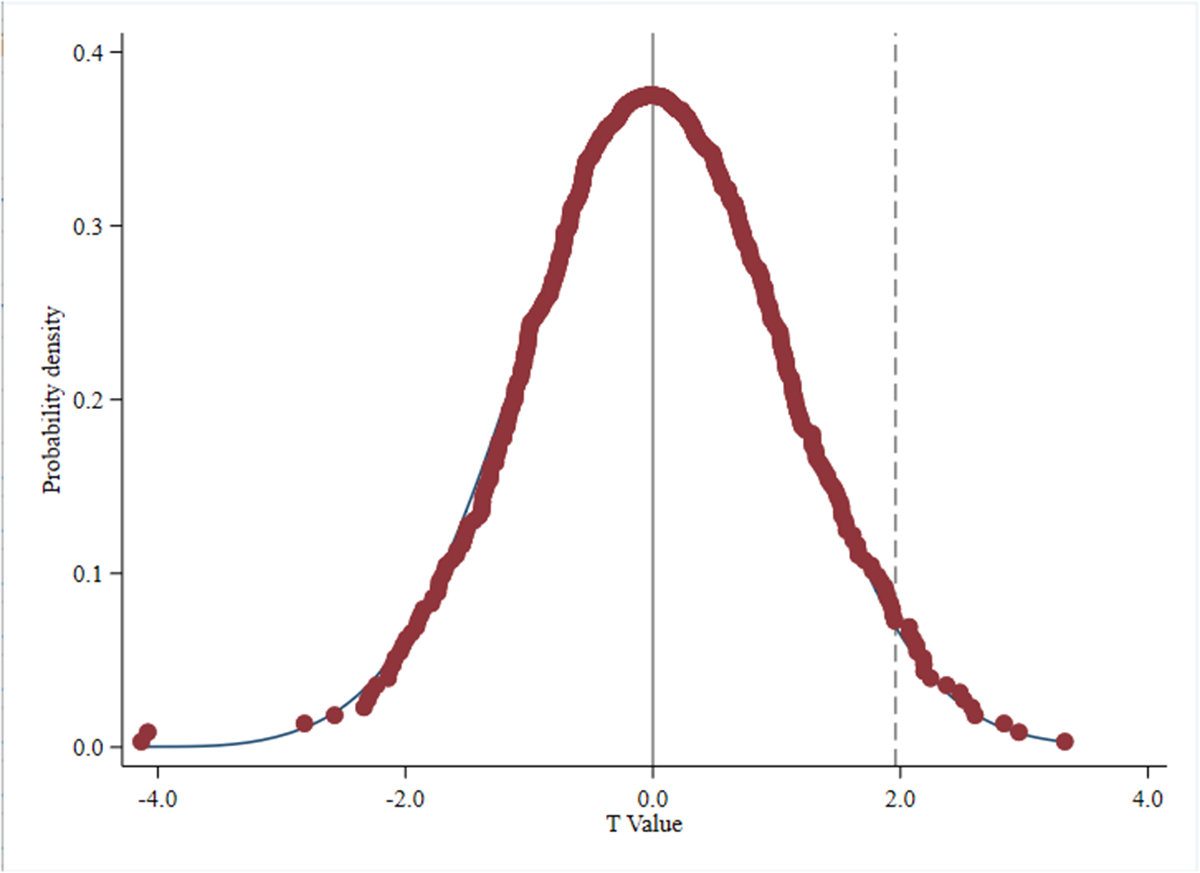
The results derived from the baseline regression may be influenced by certain latent factors. To address this, we conducted a placebo test using a randomized selection of samples. In accordance with Eq. (1), we extracted 500 estimated coefficients and t-values by simulating the equation 500 times at random. Figure 2 illustrates the probability density distribution of the obtained t-values. It is observed that the t-values predominantly cluster around 0, with only a small fraction exceeding 1.96, confirming that the facilitative effect of the policy on firms’ green transformation is not a mere coincidence.
Results of placebo tests by randomly selecting samples 500 times

Robustness Checks
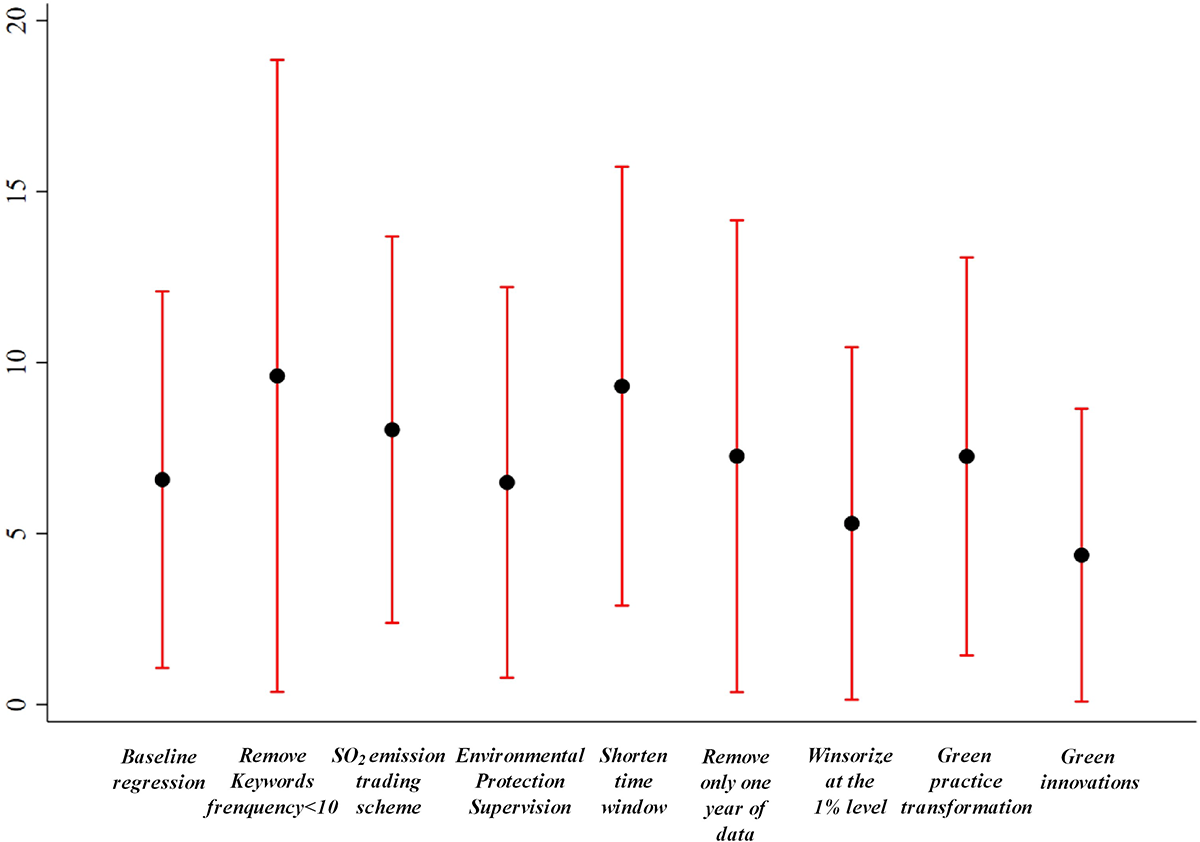
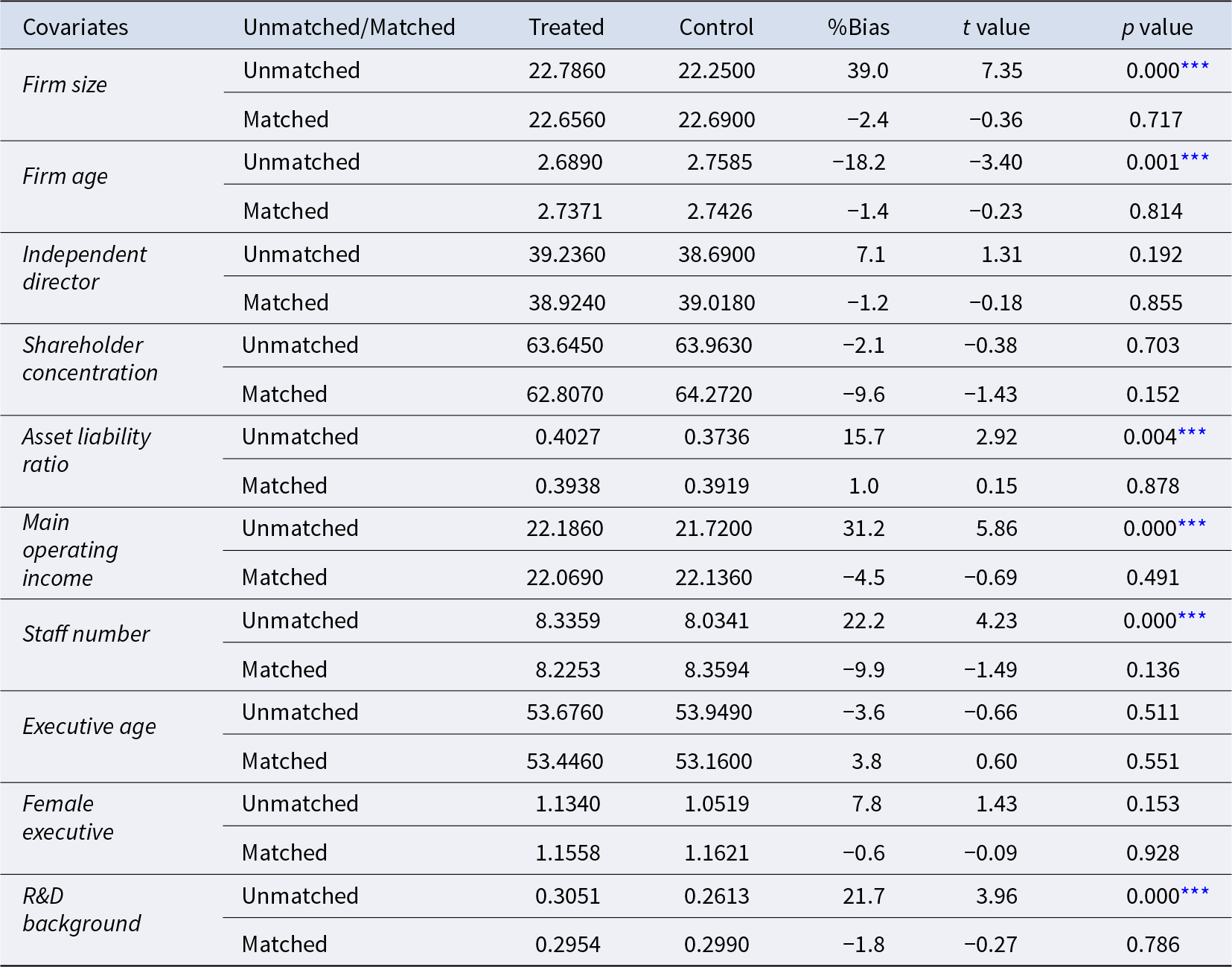
To validate the robustness of our findings, we conducted several tests, including: the balance test of Propensity Score Matching (PSM), alterations to the explanatory variable, mitigating the impact of other policies, and excluding certain samples. First, following the propensity score matching between the treated and control groups, we performed a balance test to assess the reliability of the sample pairing. Detailed results and discussions are presented in Appendix 5. Second, acknowledging the potential impact of less significant keywords of green transformation, we removed keywords with a frequency of occurrence below 10, and reformulated the structural equation model to assess the degree of green transformation.
Third, we took steps to eliminate the disturbance caused by other concurrent policies. One such policy that could introduce bias into our estimation is the SO2 emissions trading scheme launched by China in 2007, which covered 11 pilot regions, including Tianjin, Hubei, and Chongqing. These regions are also included in the CETP regions. Given the interconnected nature of carbon and SO2 emissions, the SO2 emissions trading scheme could influence green transformation. As a result, we excluded these samples. Additionally, the enforcement of the Environmental Protection Supervision Program (trial phase) in 2015, followed by the first round of environmental inspections from January 4, 2016, to September 15, 2017, promoted high-polluting firms to reduce pollution. To mitigate these impacts, we excluded data from 2015 to 2017.
Next, we excluded specific samples. We refined our sample by narrowing the baseline regression period from 2010-2020 to 2012-2019. The low-carbon pilot policy was launched in 2010, and we excluded data from 2010 and 2011 to avoid capturing pre-policy responses of firms. We also excluded data from 2020 because China launched a national carbon emissions trading market that year. Additionally, we excluded firms with only one year of data to prevent skewed results. Data are winsorized at the 1% and 99% levels.
Lastly, to eliminate the potential tactical behaviors by firms, we used green practice transformation and green innovations as dependent variables to re-estimate Eq. (1). The count of green invention patent applications is used to present the green innovations, with data sourced from the Chinese Research Data Services (CNRDS) database. The results in Figure 3 demonstrate the robustness of the main conclusions.
Robustness results (black dots represent the estimated coefficients, and red lines are confidence intervals at the 95% level)

Moderating Effects
Despite previous analyses substantiating the policy’s facilitative role in steering firms toward green transformation, it is necessary to explore whether these relationships are moderated by institutional environments and internal resources. The findings, presented in Table 3, address this concern. In Model (1), the coefficient of Area*Post*Attention is significantly positive. This suggests that heightened regional public environmental awareness can amplify the positive effects of the CETP on firms’ green transformation, affirming H2a. In these regions, the public can foster green transformation by closely monitoring firms’ environmental conduct (Mao & Wang, Reference Mao and Wang2019). Additionally, Model (2) reveals a significantly positive coefficient of Area*Post*Government subsidies, suggesting that government subsidies reinforce the favorable impact of CETP on green transformation and thus support H2b. Government subsidies incentivize firms to comply with environmental regulations and indirectly attract social investment, easing financial constraints on green transformation (Kleer, Reference Kleer2010).
Result of the moderating effects

* Notes: t values are reported in parentheses; Significance: ***1%, **5% and 10%; Robust standard errors are clustered at the province level; Results are obtained by Stata 17.0; Environmental experience in column (4) is measured as the ratio of executives with environmental experience to the total number of executives, and Environmental experience in column (5) is measured using a dummy variable.
Further, Model (3) reveals a significantly negative coefficient of Area*Post*Resource slack, indicating that resource slack can undermine the beneficial effects of the CETP on green transformation, lending support to H3a. Resource-abundant environments may lead firms to perceive fewer institutional pressures, thus hindering the momentum of green transformation. Managers may also divert surplus resources toward diversification or personal gain (Tan & Peng, Reference Tan and Peng2003), thereby sidelining green transformation goals. Finally, Model (4)-(5) reports a significantly positive coefficient of Area*Post*Environmental experience, implying that environmental experience of executives can augment the positive impact of CETP on green transformation, thus confirming H3b. Executives with environmental experience are better positioned to leverage green information and resources to reduce strategic environmental risks and green transformation costs, mitigate conflicts between environmental and financial performance, and encourage firms to pursue sustainability (Chen, Chen, et al., Reference Chen, Chen and Zhang2024).
Regional Spillover Effects
This section aims to analyze the regional spillover dynamics induced by the CETP. The policy may generate both positive and negative impacts on firms’ green transformation in neighboring regions. Positively, firms in pilot regions, required to enhance energy efficiency and reduce emissions, may foster significant green innovations. These advancements could spread to neighboring areas through industrial partnerships and economic collaborations. Negatively, increased production and pollution control costs might prompt firms to relocate high-emission operations to neighboring provinces to reduce expenses and avoid market penalties. Such actions could hinder green transformation efforts in surrounding regions.
To assess the regional spillover effects, we selected adjacent regions based on the principle of geographical proximity, including seven provinces: Hebei, Henan, Shandong, Jiangsu, Zhejiang, Hunan and Anhui. The time variable for firms in non-pilot regions was aligned with the CETP launch year in the neighboring pilot provinces. If a firm is located in Hebei, Jiangsu, Zhejiang or Anhui and time ≥ 2013, or located in Henan or Hunan and time ≥ 2014, Area*Post = 1; otherwise, Area*Post = 0. Model 1 in Table 4 reveals a significant negative coefficient of Area*Post at the 5% level. Models 2 and 3 further corroborate this trend, showing a substantial negative influence on both green strategy and practice transformations. Specifically, the CETP hinders green transformation efforts in neighboring regions, potentially turning them into havens for pollution-intensive operations and further exacerbating emission reduction challenges. This trajectory also signals a weakened drive toward green transformation among firms in non-pilot regions due to the lack of environmental regulations. These findings highlight the urgent need to expand cross-regional environmental regulations and advance a nationwide CETP to foster progressive green transformation.
Results of regional spillover effects and economic consequences

** Notes: t values are reported in parentheses; Significance: 5%; Robust standard errors are clustered at the province level; Results are obtained by Stata 17.0.
Economic Consequences
Building on the CETP’s potential to drive green practices, it is crucial to examine the subsequent impact of these transformations on economic performance. To gauge economic performance, we use firms’ profitability as an indicator, calculated as the ratio of operating profit (revenue minus cost) to operating revenue (Rahmana, Rodríguez-Serranob, & Lambkin, Reference Rahmana, Rodríguez-Serranob and Lambkin2020). The analysis presented in Model 4 of Table 4 shows a significant positive coefficient of Area*Post, suggesting that the CETP can significantly improve firms’ economic viability. It’s important to note that carbon quotas are tangible assets, as they can be monetized or transferred. Firms holding substantial carbon quotas can generate cash flows and profits by selling them or passing emission costs to consumers.
Model 5 adds an interaction between Green transformation and Area*Post, presenting a significant negative coefficient on the interaction term. This suggests that green transformation may have a short-term adverse impact on economic performance. One possible explanation is that large capital allocations toward green initiatives may reduce investment in other revenue-generating areas and lead to short-term economic slowdowns (Weche, Reference Weche2019). However, from a sustainability perspective, maximizing profit should not be the only objective. Instead, firms must embrace broader societal responsibilities. While empirical evidence highlights temporary financial pressures from green transformation, it is expected that these efforts will yield long-term benefits and pave the way for sustainable corporate growth. It is important to acknowledge that this study is limited by data availability, which restricts a more detailed exploration of the long-term policy implications.
Discussion
Theoretical Implications
First, we extend institutional theory by examining how the pressure and incentive mechanisms embedded in the CETP influence firm behavior, thereby shedding light on the effectiveness of market-oriented environmental regulation. Most existing research tends to categorize the role of environmental regulation solely as either institutional pressures or institutional incentives (Shi et al., Reference Shi, Li and Gao2022). For example, Chai et al. (Reference Chai, Zhou, Ji, Liu, Liu and Chu2025) argue that market-oriented environmental regulation increases operational pressure on firms, while Dagestani et al. (Reference Dagestani, Shang, Schneider, Cifuentes-Faura and Zhao2023) suggest that it creates economic incentives driving firms to innovate effectively. Sun et al. (Reference Sun, Bai and Sarkis2024) further find that economic incentives of environmental regulation elicit a more positive market response than non-economic incentives. Indeed, these studies view pressures and incentives as the outcomes of different institutions, ignoring their potential synergy within the same regulatory framework. In contrast, this study argues that both institutional pressures and incentives within market-oriented environmental regulation can jointly influence corporate decisions. To ensure legitimacy, firms must respond to institutional pressures on sustainability (Zhu & Sarkis, Reference Zhu and Sarkis2007), while gaining access to both economic and non-economic rewards through green transformation. The theoretical framework in this study provides a new perspective on the ongoing study of market-oriented environmental regulation.
Second, this study contributes to environmental management research by exploring how CETP, a market-oriented environmental regulation, affects firms’ green transformation. Previous research has identified environmental regulation as a catalyst for firms’ green transformation (Lu et al., Reference Lu, Gao, Zhang and Wang2022). Market-oriented environmental regulation has also been recognized as a significant driver for industry emission reduction (Dy & Yang, Reference Dy and Yang2025), energy efficiency (Zhang et al., Reference Zhang, Zhang and Yu2019), and advancements in green technologies within firms (Chen, Li, et al., Reference Chen, Li and Liu2024). Furthermore, Bai et al. (Reference Bai, Liu, Zhang and Feng2023) found that CETP increased total factor productivity among pilot firms, particularly in high-emission industries. Bartram, Hou, and Kim (Reference Bartram, Hou and Kim2022) observed that the emission reduction effect of CETP on firms varies due to financial constraints. However, the more comprehensive role of CETP in shaping firms’ green transformation remains under-explored, with questions about the moderating role of external institutional environments and internal resources largely unanswered. Given the growing importance of green transformation, further investigation is essential. This study aims to address these gaps by examining the impact of CETP on firms’ green transformation from the perspective of institutional theory. Additionally, in constructing indicators for ‘green transformation,’ unlike previous studies that relied on a single indicator such as green practice (Begum, Ashfaq, Xia, & Awan, Reference Begum, Ashfaq, Xia and Awan2022), we employ Python for text mining to extract keywords and create a dictionary from corporate social responsibility reports. We then utilize structural equation modeling to construct comprehensive indicators. Two key dimensions – green strategy transformation and green practice transformation – are identified, broadly capturing the multifaceted nature of green transformation.
Third, our study extends the conditions for the impact of market-oriented environmental regulation on firms’ green transformation, offering significant practical implications. By analyzing external institutional environmental pressures, Chen, Geng, and Liu (Reference Chen, Geng and Liu2023) found that reduced government intervention significantly enhances the positive impact of CETP on corporate green investment. Kang and He (Reference Kang and He2018) argued that firms’ internal environmental orientation and innovation capacity could amplify the effects of external institutional factors on green transformation. However, prior studies often fail to provide empirical evidence from institutional theory on how external institutional environments and internal resources influence institutional pressures and incentives, which leads to diverse pursuits of institutional coherence by organizations. We explore how additional external and internal pressures and incentives faced by firms influence the effectiveness of these policies. We introduce moderating variables such as regional public environmental attention and government subsidies in external institutional environments, along with resource slack and the environmental experience of executives as internal resource conditions. Our findings indicate that CETP has a more pronounced facilitating effect on firms’ green transformation when firms benefit from higher public environmental attention, substantial government subsidies, and environmentally experienced executives. Conversely, excessive resource slack diminishes this effect. Furthermore, our study highlights that beyond improving environmental performance, the market-oriented environmental regulation may result in regional spillovers that incentivize firms to shift highly polluting activities to neighboring regions. We also examine the policy’s economic implications, noting that the green transformation effect of CETP may temporarily inhibit pilot firms’ economic performance. This comprehensive approach allows for a better understanding of the multifaceted impacts of environmental regulation.
Managerial and Policy Implications
The findings of this study carry important managerial and policy implications. First, setting rational carbon emission caps and quotas is essential to fully leverage the institutional pressures and incentives inherent in the carbon market. This requires the development of a robust carbon emissions disclosure system that includes detailed information on carbon quotas, emission reduction strategies, and environmental performance. Enhanced transparency is necessary to avoid issuing excessive or insufficient carbon quotas. To address the short-term economic challenges that CETP may pose to firms undergoing green transformation, the government should provide targeted subsidies for green technology and financial support. Additionally, adopting a differentiated approach to developing a national carbon trading market and refining the carbon quota allocation mechanism is crucial to mitigate regional spillover effects and prevent the transfer of pollution factors due to market and industrial disparities across regions. Such strategic planning and policy adjustments are pivotal in ensuring the effectiveness and fairness of the carbon market, aligning environmental objectives with economic stability.
Second, within the external institutional environments, realizing the full potential of environmental policies requires heightened public engagement with environmental issues. Governments should foster this engagement by using digital platforms to spread green knowledge, raise public awareness and promote advocacy, thereby encouraging the public to participate in environmental monitoring. Educating consumers to prefer green products and monitor firms’ production processes can pressure firms to pursue green transformation. The role of government subsidies in reinforcing the incentives provided by CETP should be particularly emphasized. Government subsidies should be tailored to address the specific value and challenges of environmental projects, requiring thorough pre-assessment, ongoing monitoring, and post-utilization reviews of subsidy funds to ensure effective support. Firms, in turn, should build relationships with the government and the public while enhancing their resource management capabilities to better absorb external resources. By doing so, firms not only comply with regulatory expectations but also position themselves advantageously for sustainable growth in an increasingly eco-conscious market landscape.
Third, in terms of internal resources, firms with resource slack can advance green strategies by implementing training and awareness programs to educate executives and employees on the benefits of green practices, fostering organizational support for green transformation. To further encourage and facilitate this shift, these firms should also establish internal incentives, such as rewards for green technology development or for achieving energy and emission reduction targets, to stimulate active investment. The successful implementation of green transformation strategies heavily depends on professional leadership. Therefore, firms should recruit and develop executives with environmental experience and integrate green goals into performance appraisals. By aligning executive incentives with sustainable practices, firms can encourage their leaders to actively fulfill social and environmental responsibilities, thereby driving meaningful organizational change and amplifying its broader impact on society.
Limitations and Future Research
Despite the strengths inherent in our study, several limitations warrant further scholarly exploration. First, the research focuses exclusively on the influence of market-oriented environmental regulations on firms’ green transformation, overlooking potential differences in response to other policy frameworks, such as command-and-control or voluntary regulations. Future studies should explore these diverse regulatory impacts and scrutinize their underlying mechanisms to foster meaningful comparisons. Second, quantifying green transformation remains a complex endeavor. Although our method for measuring green transformation measurement transcends prior approaches that relied on questionnaires or singular indicators (Begum et al., Reference Begum, Ashfaq, Xia and Awan2022), the reliance on corporate social responsibility report keywords may not capture the entire scope of green transformation due to data limitations. Future research should aim to develop a more robust metric system for a comprehensive evaluation of green transformation.
Conclusion
This research highlights the significant potential of CETP as a market-oriented environmental regulation in driving firms toward green transformation, as supported by placebo tests and robustness checks. The findings indicate that firms are more effective at implementing green practice transformation compared to strategy transformation. For external institutional environments and internal resources, CETP has a strong effect on firms with higher regional public environmental attention, more government subsidies and executives with environmental experience. However, resource slack weakens this relationship. Supplementary analyses suggest that CETP implementation may inhibit green transformation in neighboring provinces, as well as impose short-term economic setbacks on pilot firms undergoing such transformation. Overall, this study outlines the nuanced impacts of CETP on firms’ green transformation, providing valuable insights for the formulation of market-oriented environmental regulations.
Data Availability Statement
Data available upon request from the authors.
Acknowledgements
Ma Xuejiao, Ma Xiaojun, and Zhao Yanzhicontribute equally to this work. This work is supported by Major Commissioned Project of the Liaoning Provincial Social Science Planning Fund (L23ZD053) and National Social Science Foundation of China (24&ZD050).
Appendix 1. Overview of the Literature
Summary of influencing consequences of environmental regulations

* Notes: 1) Emissions refer to CO2 emission and SO2 emission; 2) TFP means total factor productivity; 3) EE means energy efficiency; 4) GM&As means green mergers and acquisitions; 5) GT means green transformation; 6) DID means Difference-in-Differences; 7) DDD means Difference-in-Differences-in-Differences; 8) PSM-DID means Propensity Score Matching Difference-in-Differences; 9) + indicates a positive impact; 10) − indicates a negative impact; 11) denotes the innovation or total factor productivity specifically refers to green innovation or green factor productivity.
Appendix 2. Measurement of Green Transformation
Drawing on Liu, Zhou, and Li (Reference Liu, Zhou and Li2023), we first collected the social responsibility reports of A-share listed firms and extracted their textual content to construct a dataset for text mining. Next, we used Python crawler techniques to extract green transformation keywords, which are summarized in Table A2. Following this, we retrieved, matched, and counted the keywords in the lexicon to determine word frequencies that reflect various aspects of firms’ green transformation. Using these frequencies, we employed a structural equation model to objectively assign weights to each sub-indicator, thereby calculating the green transformation index, as detailed in Appendix 4. In this analysis, the primary latent variable is green transformation, and the secondary latent variables are green strategy transformation and green practice transformation. The tertiary observable variables include green consciousness, green planning, green institution, pollutant treatment, production technology advancements, green emissions, and green energy reform. By inputting the word frequencies of these observed variables into the Amos software, standardized factor load estimates between indicators can be obtained.
Keywords related to green transformation

Appendix 3. Detailed Description of All Variables
Measurement, definitions and descriptive statistics of variables

Note: Obs. denotes observation; Max. denotes maximum; Min. denotes minimum.
Appendix 4. Results of the Structural Equation Model
The structural equation model comprises two basic models: the measurement model and the structural model. To construct the structural equation, we selected AMOS 22 software due to its ability to visually represent the relationships among influencing factors through graphical tools, conduct factor analysis on the measurement model and structural model, and perform path analysis between observed and latent variables. AMOS continuously evaluates the model results and adjusts them until a satisfactory result is achieved. The modelling steps are as follows:
First, we constructed the theoretical framework of the model to analyze the determinants of firms’ green transformation. In the diagram, rectangles represent observed variables, ellipses denote latent variables, and unidirectional arrows indicate causal relationships. Second, we imported the data and analyzed the consistency between the latent variables and their respective observed variables, ensuring alignment with model settings. Third, we performed model estimation using the maximum likelihood method and output a flow chart of the structure with coefficients after completing parameter estimation. We calculated the standardized factor loadings between the seven latent variables and their respective observed variables, as well as among the latent variables. The results correspond to the coefficients on the variable paths. Finally, we evaluated and corrected the model. The results show that the model exhibits a satisfactory fit. Table A4 presents the results of the structural equation model.
Results of the structural equation model

Note: ‘→’ represents the path between two indicators.
Appendix 5. Results of the Balance Test of PSM
As shown in Table A5, except for Shareholder concentration and Executive age, the standard deviation of the remaining eight covariates decrease substantially after matching, with all absolute deviation values below 9.9%. The p-values for all ten covariates exceed 10%, supporting the null hypothesis that no significant difference exists between the treatment and control groups. This affirms the efficacy of the one-to-one nearest neighbor matching method.
Results of the balance test of PSM

*** Notes: t values are reported in parentheses; Significance: 1%; Robust standard errors are clustered at the province level; Results are obtained by Stata 17.0.
Xuejiao Ma (maxuejiao@dlut.edu.cn) is an associate professor at the School of Economics and Management, Dalian University of Technology, China. Her research interests include energy economics, economic statistics, and firm innovation. She has published papers in Annals of Tourism Research, Journal of Business Research, among other peer-reviewed journals.
Xiaojun Ma (772905437@qq.com) is a professor at the School of Statistics, Dongbei University of Finance and Economics, China. Her research interests include green and low-carbon statistics, energy-environment statistics, digital economy and global value chains. Her work has appeared in Energy Economics, Technological Forecasting and Social Change, among others.
Yanzhi Zhao (18525423037@163.com) is a professor at the School of Public Administration, Dongbei University of Finance and Economics, China. His research interests include industrial economics, and organizational structure. His work has been published in other academic journals, such as Economic Perspectives and Public Finance Research.
Wen Qin (qinwen412@163.com) is a PhD candidate at the School of Statistics, Dongbei University of Finance and Economics, China. Her research focuses on energy economics, firm strategy, and firm innovation. She has published papers in Technological Forecasting and Social Change.