Introduction
Chromosome numbers in the genus Chirita D.Don (Gesneriaceae), as defined until recently, exhibited a high level of diversity (Kiehn et al., Reference Kiehn, Hellmayr and Weber1998; Möller et al., 2002 onwards), showing a wide range of basic numbers (x = 4, 8, 9, 10, 14, 17) (Kiehn et al., Reference Kiehn, Hellmayr and Weber1998) and an even higher range of haploid numbers (n = 4, 9, 10, 14, 16, 17, 18) (Möller et al., 2002 onwards; Möller & Kiehn, Reference Möller and Kiehn2003).
The genus has long been recognised as taxonomically problematic with regard to delimitation, homogeneity and subdivision despite two traditional revisions (Wood, Reference Wood1974; Wang, Reference Wang1985a, Reference Wang1985b). Recently, Chirita has been the subject of two further studies, this time supported by molecular data and phylogenetic approaches (Wang et al., Reference Wang, Mao, Liu, Li, Dong and Li2011; Weber et al., Reference Weber, Middleton, Forrest, Kiew, Lim and Rafidah2011), to bring the taxonomy in line with evolutionary relationships. The latter work presents a complete listing of the necessary generic changes, resulting in the elimination of the genus name Chirita with all former species now sunken into synonymy in one of the five emerging genera: (i) Henckelia Spreng. with a radically altered delimitation (see Weber et al., Reference Weber, Middleton, Forrest, Kiew, Lim and Rafidah2011) and the synonymisation of most of Chirita sect. Chirita (including the type species) and the monotypic Hemiboeopsis W.T.Wang; (ii) Damrongia Kerr ex Craib which includes several species previously in Chirita sect. Chirita; (iii) Liebigia Endl. which resulted from raising Chirita sect. Liebigia (Endl.) C.B.Clarke back to generic rank; (iv) Microchirita (C.B.Clarke) Yin Z.Wang which resulted from raising Chirita sect. Microchirita C.B.Clarke to generic rank; (v) Primulina Hance, previously monotypic but now greatly expanded to include all of Chirita sect. Gibbosaccus C.B.Clarke, together with all of Chiritopsis W.T.Wang and two species of Wentsaiboea D.Fang & D.H.Qin (Weber et al., Reference Weber, Middleton, Forrest, Kiew, Lim and Rafidah2011).
These systematic rearrangements raise important issues: whether this new taxonomic framework has led to cytologically more uniform taxonomic units, and whether any of these units show a characteristic basic or somatic chromosome number. To address these issues we obtained the chromosome numbers of 21 species hitherto ascribed to Chirita and of Primulina tabacum Hance, and extracted published chromosome numbers from the RBGE WebCyte database (Möller et al., 2002 onwards) and published literature (Lu et al., Reference Lu, Sun, Zhou and Gu2002; Cao et al., Reference Cao, Cao, Tang and Wei2003) for Chirita as previously defined. We then analysed the results in the light of the new taxonomic framework and phylogenetic hypotheses for the erstwhile genus Chirita.
Materials and Methods
Material
Roots were taken from plants growing in the living research collection at the Royal Botanic Garden Edinburgh (RBGE). We sampled 23 accessions of 21 species of Chirita, as previously applied, and Primulina tabacum (Table 1). Voucher specimens are deposited at E. To maximise the cytological success rate, leaf or stem cuttings were cultivated in perlite in propagators, and roots harvested after about 6 weeks. The growing conditions were a base heat of 20°C, 24°C ambient air temperature and a high humidity between 80% and 100%. The cuttings were watered regularly, usually once every one to two days, to stimulate a rapid and continuous root growth essential for mitotic divisions.
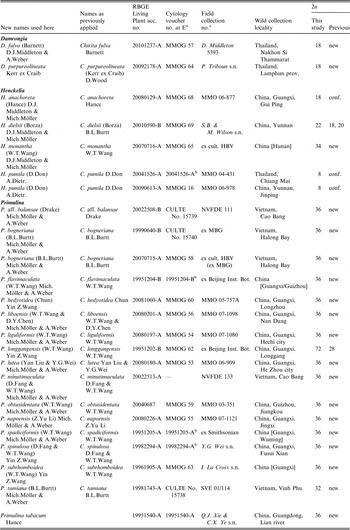
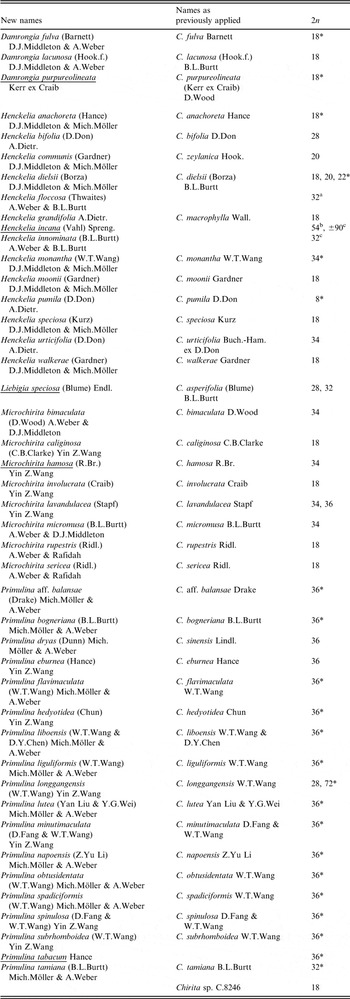
Primulina tabacum and species of Chirita investigated cytologically in the present study, with RBGE accession, voucher and collection numbers, locality information and somatic chromosome numbers. For species previously belonging to Chirita, the old and new names are given

a MMOG – Michael Möller Garden voucher, RBGE; CULTE – cultivated RBGE: MMO – Michael Möller, RBGE; NVFDE – Northern Vietnam First Darwin Expedition; SVE – Soviet-Vietnam Expedition (Liberec Botanic Garden, Czech Republic & St Petersburg Botanic Garden); HBV – Vienna University Botanic Garden; MBG – Munich Botanic Garden; conf. – confirmatory count.
b RBGE Living Plant acc. no. used as cytology voucher no.
Methods
The cytological methods followed Jong & Möller (Reference Jong and Möller2000). In brief, root tips were pre-treated either in saturated aqueous 1-bromonaphthalene or in 0.002 M 8-hydroxyquinoline in the dark for 4 hours at room temperature. The roots were then fixed in freshly prepared Farmer’s fluid (3 parts ethanol : 1 part glacial acetic acid). They were hydrolysed for 30 minutes in 5 M HCl at room temperature, then stained with fresh Feulgen reagent prepared according to Fox (Reference Fox1969) for 2 hours in the dark. The stained material was softened in an enzyme 1:1 mixture of 4% pectinase (Sigma 2401) and 4% cellulase (BDH or Calbiochem 21947) at 36°C for 30 minutes. Root tips were squashed in an acetocarmine counterstain (0.4%). Counterstaining reduces the likelihood of fading in permanent slides. These were prepared following a modified quick-freeze method (Conger & Fairchild, Reference Conger and Fairchild1953; Jong, Reference Jong1997). Chromosome lengths were determined from 3–5 metaphase cells.
Images were captured using Zeiss AxioVision rel.4.7 and AxioCam MRc5 cameras mounted on both AxioSkop and AxioPhot brightfield microscopes (Zeiss, Welwyn Garden City, UK).
Results and Discussion
In the present cytological investigation we obtained 18 new counts for species previously assigned to Chirita, confirmed two previously published counts and added new somatic chromosome numbers for two previously investigated species. We also obtained the first count for the hitherto monotypic Primulina tabacum (Table 1).
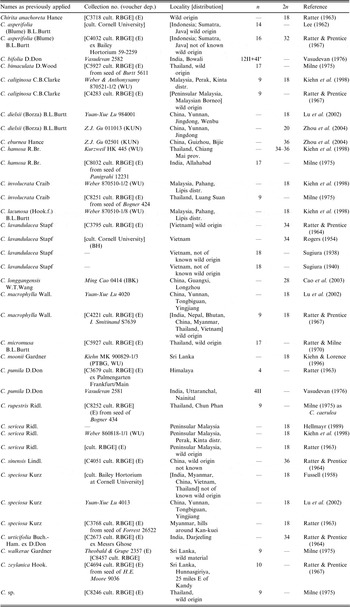
The chromosome counts obtained here revealed seven somatic numbers among the samples analysed (2n = 8, 18, 22, 32, 34, 36, 72). These covered all but three (2n = 20, 28, 54) numbers counted in previous studies for the genus Chirita as previously defined (Table 2). The results are given under their new systematic names and in alphabetic order.
Previously published chromosome counts of Chirita species with collection information, locality information, results of chromosome counts and references

* I – univalents, II – bivalents.
Damrongia
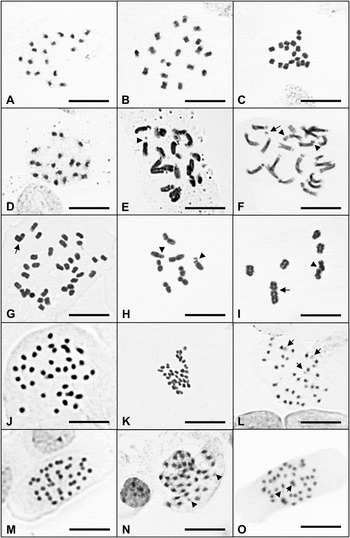
Both Damrongia fulva (Barnett) D.J.Middleton & A.Weber and D. purpureolineata Kerr ex Craib were counted with 2n = 18. These were new counts for the species. The two species had similar-sized chromosomes with 1.0 to 1.4 and 1.3 to 1.7 μm lengths, respectively, and their karyotype consisted of mostly metacentric chromosomes (Fig. 1A–C).
Somatic metaphase chromosome numbers of species of Chirita, as defined previously, cytologically investigated in the present study, arranged by current name. A: Damrongia fulva prometaphase, 2n = 18; B: D. purpureolineata prometaphase, 2n = 18; C: D. purpureolineata metaphase, 2n = 18; D: Henckelia anachoreta late prometaphase, 2n = 18; E: H. dielsii metaphase, 2n = 22, arrowhead indicates stalked satellite NOR; F: H. dielsii prometaphase, 2n = 22, arrow indicates satellite NOR, arrowheads indicate satellite NOR with short stalk; G: H. monantha metaphase, 2n = 34, arrow indicates two overlapping chromosomes; H: H. pumila from Thailand metaphase, 2n = 8, arrowheads indicate NOR chromosomes; I: H. pumila from China, late metaphase, 2n = 8, arrow indicates two touching chromosomes, arrowhead indicates two slightly overlapping chromosomes; J: Primulina aff. balansae metaphase, 2n = 36; K: P. bogneriana from Munich Botanic Garden metaphase, 2n = 36; L: P. bogneriana from Vienna University Botanic Garden metaphase, 2n = 36, arrows indicate chromosomes out of focus plane; M: P. flavimaculata metaphase, 2n = 36; N: P. hedyotidea late prometaphase, 2n = 36, arrowheads indicate satellite NORs; O: P. liboensis early metaphase, arrow indicates two touching chromosomes, arrowhead indicates satellite NOR, 2n = 36. Scale bars 10 μm.

Henckelia
For Henckelia anachoreta (Hance) D.J.Middleton & Mich.Möller we determined 2n = 18 for this accession from Guangxi, China (Fig. 1D). Its chromosomes were relatively uniform, between 1.3 and 1.4 μm in length. The same number was obtained previously by Ratter (Reference Ratter1963), as Chirita anachoreta Hance. No locality information was given for this widespread species (China: Yunnan, Guangxi, Hunan, Guangdong; Taiwan; Burma; Thailand; Laos; Vietnam).
Henckelia dielsii (Borza) D.J.Middleton & Mich.Möller was relatively unambiguously counted here with 2n = 22 (Fig. 1E,F). The chromosomes were comparatively large, 2.5 to 4.4 μm. Previously, the somatic chromosome number of this species was determined with 2n = 18 (Lu et al., Reference Lu, Sun, Zhou and Gu2002) and 2n = 20 (Zhou et al., Reference Zhou, Gu and Möller2004), for both as Chirita dielsii (Borza) B.L.Burtt. The count by Lu et al. (Reference Lu, Sun, Zhou and Gu2002) appears somewhat unconvincing, since, even considering the presence of the large satellites, the published metaphase image appears to show more than 18 chromosomes. The count by Zhou et al. (Reference Zhou, Gu and Möller2004) shows two pairs of chromosomes with satellites, in one the satellite being particularly large. In our preparations most chromosomes appear telocentric and acrocentric in late prometaphase chromosomes, with some sub-metacentric and one pair of distinctly small chromosomes. The latter show centromeres and are thus unlikely to be homologous to the large satellites in Zhou et al. (Reference Zhou, Gu and Möller2004). Furthermore, the nucleolus organiser region (NOR) chromosomes with a large and small satellite can be observed in our preparation (Fig. 1F), confirming the observations of Zhou et al. (Reference Zhou, Gu and Möller2004) in this respect. Therefore, Henckelia dielsii appears to possess a variable number of chromosomes. It occurs together with Henckelia pumila (D.Don) A.Dietr. in Jingdong, Yunnan, China, where the material of H. dielsii for both Zhou et al. (Reference Zhou, Gu and Möller2004) and the present study was collected. The two species hybridise in nature (M. Möller, pers. obs.), and this may explain the variable chromosome count in Henckelia dielsii. The two species have similar chromosome sizes, but differ not only in chromosome number but greatly in their chromosome morphology, with Henckelia pumila having mostly symmetrical (i.e. metacentric) chromosomes while H. dielsii has predominantly highly asymmetrical ones (i.e. telo- and acrocentrics) (Fig. 1E,F). To fully understand this intriguing relationship between these two species in Jingdong more analyses are needed.
For Henckelia monantha (W.T.Wang) D.J.Middleton & Mich.Möller the somatic number of chromosomes obtained was 2n = 34, a new count for this species (Fig. 1G). The chromosomes were mostly metacentric, of elongated shape, and quite large, with lengths of 1.4 to 2.4 μm. This number has been observed in several other species of Chirita, as previously applied, in section Microchirita, such as C. bimaculata D.Wood [now Microchirita bimaculata (D.Wood) A.Weber & D.J.Middleton] (Milne, Reference Milne1975), C. hamosa R.Br. [now Microchirita hamosa (R.Br.) Yin Z.Wang] (Milne, Reference Milne1975), C. lavandulacea Stapf [now Microchirita lavandulacea (Stapf) Yin Z.Wang] (Ratter & Prentice, Reference Ratter and Prentice1964) and C. micromusa B.L.Burtt [now Microchirita micromusa (B.L.Burtt) A.Weber & D.J.Middleton] (Ratter & Milne, Reference Ratter and Milne1970). This number has also been found in Chirita urticifolia Buch.-Ham. ex D.Don [now Henckelia urticifolia (Buch.-Ham. ex D.Don.) A.Dietr.] (Ratter & Prentice, Reference Ratter and Prentice1964), the type of Chirita and hence Chirita sect. Chirita to which H. monantha belonged. Thus, 2n = 34 occurs in both erstwhile sections Chirita and Microchirita (see below).
The lowest number found here was 2n = 8 for Henckelia pumila (Table 1, Fig. 1H,I), confirming earlier counts by Ratter (Reference Ratter1963) and Vasudevan (Reference Vasudevan1976), in both as Chirita pumila D.Don. The chromosomes were relatively large with lengths of 2.7 to 4.1 μm. The chromosome complement consisted of three pairs of metacentrics and one pair of sub-metacentrics; the latter possessed a subterminal NOR (Fig. 1H, arrowheads). With the new counts here, this species now has four counts from different geographic areas, the Himalayas (Ratter, Reference Ratter1963, with no further geographic details), the Himalayan foothills in NW India (Vasudevan, Reference Vasudevan1976), S Yunnan in SW China (MMO 06-978, Fig. 1H) and Chiang Mai in N Thailand (MMO 04-431, Fig. 1I). This species has a very wide distribution range (India, Nepal, Bhutan, China, Myanmar, Vietnam, Thailand), and the samples analysed cytologically span its entire geographic range. So far all counts have been 2n = 8, suggesting a highly conservative genome evolution in terms of trends in chromosome number changes, or a rapid spread of the species across its distribution range. The difference in chromosome morphology in Fig. 1H and 1I is most likely due to the latter having progressed further in mitosis and having perhaps over-condensed. To ascertain whether there exist karyotype variations between the samples more detailed analyses are required.
Primulina
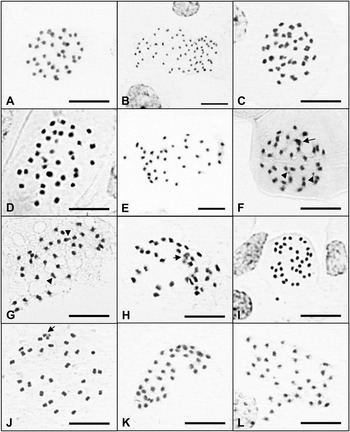
For 14 species of Primulina, previously belonging to Chirita sect. Gibbosaccus, the newly determined chromosome number was 2n = 36 (Table 1, Figs 1J–O, 2A,C–I). Their chromosomes were small, mostly between 0.7 and 1.6 μm long, except for Primulina aff. balansae (Drake) Mich.Möller & A.Weber with 1.0 to 2.0 μm, and mostly round to oval in shape. In some preparations one (Fig. 1O) or two (Figs 1N, 2F,G) terminal NORs with, sometimes short (Fig. 2G), satellite stalks were observed. A somatic number of 2n = 36 has only previously been observed for two other species, Primulina eburnea (Hance) Yin Z.Wang (Zhou et al., Reference Zhou, Gu and Möller2004), as Chirita eburnea Hance, and P. dryas (Dunn) Mich.Möller & A.Weber (Ratter & Prentice, Reference Ratter and Prentice1964), as Chirita sinensis Lindl. Both species also belonged to Chirita sect. Gibbosaccus.
Somatic metaphase chromosome numbers of species of Chirita, as defined previously, and Primulina tabacum cytologically investigated in the present study, arranged by current name. A: Primulina liguliformis prometaphase, 2n = 36; B: P. longgangensis early metaphase, 2n = 72; C: P. lutea prometaphase, 2n = 36; D: P. minutimaculata metaphase, 2n = 36; E: P. napoensis late prometaphase, 2n = 36; F: P. obtusidentata late prometaphase, 2n = 36, arrow indicates three overlapping chromosomes, arrowheads indicate satellite NORs; G: P. subrhomboidea late prometaphase, 2n = 36, arrowheads indicate NORs; H: P. spadiciformis prometaphase, 2n = 36, arrow indicates three overlapping chromosomes; I: P. spinulosa metaphase, 2n = 36; J: P. tamiana metaphase, 2n = 32, arrow indicates two overlapping chromosomes; K: P. tabacum prometaphase, 2n = 36; L: P. tabacum burst prometaphase, 2n = 36. Scale bars 10 μm.

The highest chromosome count in the present study was obtained for Primulina longgangensis (W.T.Wang) Yin Z.Wang with 2n = 72 (Fig. 2B), with chromosome sizes between 0.8 and 1.1 μm. This species was investigated previously by Cao et al. (Reference Cao, Cao, Tang and Wei2003), as Chirita longgangensis W.T.Wang, who reported 2n = 28 chromosomes. Though the plants originated from different localities, from Longgang, Guangxi in the present study and Longzhou, Guangxi in Cao et al. (Reference Cao, Cao, Tang and Wei2003), this high discrepancy is surprising, particularly the apparent difference in basic numbers, 18 and 14, respectively. Judging from the published image in Cao et al. (Reference Cao, Cao, Tang and Wei2003) it is difficult to see how the number of chromosomes was determined, since the figure shows a poorly reproduced or prepared prometaphase. A basic number of x = 14 is unusual among species previously in Chirita, and has been counted only once before, for C. bifolia D.Don (Vasudevan, Reference Vasudevan1976). Chirita bifolia, however, is now placed in Henckelia, as H. bifolia (D.Don) A.Dietr. (Table 3). Compared to other counts in the genus Primulina, 2n = 72 appears to represent a polyploid number, with a basic number of x = 9 or x = 18, and would equate to an octoploid or tetraploid condition (see below).
Summary of chromosome counts in species previously included in Chirita, with the type species of each currently recognised genus indicated (underlined)

aMilne (Reference Milne1975), bThathachar (Reference Thathachar1942), cRatter & Prentice (Reference Ratter and Prentice1967).
* Counted in the present study.
Primulina tamiana (B.L.Burtt) Mich.Möller & A.Weber has 2n = 32 chromosomes (Fig. 2J). This species mostly has metacentric chromosomes 1.1 to 1.5 μm in length which are rectangular in shape, unlike the other species in this genus. This somatic number has been counted only once before, for Liebigia speciosa (Blume) Endl. (Ratter & Prentice, Reference Ratter and Prentice1967), as Chirita asperifolia (Blume) B.L.Burtt. However, Chirita asperifolia has also been counted with 2n = 28 (Lee, Reference Lee1962).
Primulina tabacum was also counted with 2n = 36 chromosomes (Fig. 2K,L), like most species in this newly defined genus. Its chromosomes were 0.8 to 1.4 μm in length, which is as small as those of the Chirita species which previously belonged to Chirita sect. Gibbosaccus.
Diversity across Chirita as previously defined
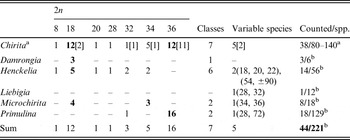
From all previous and new counts of species previously placed in Chirita, a high diversity in somatic numbers, with 2n = 8, 18, 20, 28, 32, 34, 36 at the species level and additional numbers of 2n = 22 and 72 in species with variable chromosome numbers (Tables 2 and 4), can be observed. Such a high variation in somatic numbers is not unprecedented in the Gesneriaceae and has also been observed for example in the genus Didymocarpus Wall. (2n = 20, 22, 24, 26, 28, 32, 36) (Kiehn et al., Reference Kiehn, Hellmayr and Weber1998; Möller & Kiehn, Reference Möller and Kiehn2003).
Summary of chromosome counts for Chirita, as previously applied, and for genera with species previously included in Chirita. In square brackets is the number of new species’ counts obtained in the present paper; in round brackets is chromosome variation in species with variable chromosome numbers. Predominant numbers in bold

a According to Weber (Reference Weber, Kubitzki and Kadereit2004).
b According to Weber et al. (Reference Weber, Middleton, Forrest, Kiew, Lim and Rafidah2011).
However, this was before Chirita was redefined (Wang et al., Reference Wang, Mao, Liu, Li, Dong and Li2011; Weber et al., Reference Weber, Middleton, Forrest, Kiew, Lim and Rafidah2011), and any speculation on the relationships between these numbers has to be discussed in the new taxonomic framework (Table 3).
Diversity within the new taxonomic framework
The split of Chirita into the five independent genera Damrongia, Henckelia, Liebigia, Microchirita and Primulina necessitates a new look at their genome diversity and changes in chromosome numbers (Table 3).
Of the six species listed in Damrongia (Weber et al., Reference Weber, Middleton, Forrest, Kiew, Lim and Rafidah2011), three have now been counted (D. fulva, D. lacunosa (Hook.f.) D.J.Middleton & A.Weber and D. purpureolineata), all with 2n = 18 (Table 3).
More than 50 species of Henckelia sensu Weber & Burtt (Reference Weber and Burtt1998) have been counted (Kiehn et al., Reference Kiehn, Hellmayr and Weber1998). However, only two of these belong to Henckelia sensu Weber et al. (Reference Weber, Middleton, Forrest, Kiew, Lim and Rafidah2011), the rest to species in Loxocarpus R.Br. and Codonoboea Ridl. (see Weber et al., Reference Weber, Middleton, Forrest, Kiew, Lim and Rafidah2011; Kiew & Lim, Reference Kiew and Lim2011). The species now removed from Henckelia are highly uniform in their chromosome number, with 2n = 18 (Kiehn et al., Reference Kiehn, Hellmayr and Weber1998). The newly defined genus Henckelia sensu Weber et al. (Reference Weber, Middleton, Forrest, Kiew, Lim and Rafidah2011) is, however, now extremely diverse, with nine different somatic numbers observed, though three of these, 2n = 22, 54, ±90, involve species with variable counts. This is still quite remarkably variable, given that of the 56 species now in the genus only 14 have been cytologically investigated (Table 4).
Only one chromosome count is available as yet for the 12 species of Liebigia, L. speciosa with two different counts of 2n = 28 and 32 chromosomes (Table 3). More work is required here.
In Microchirita only two somatic numbers, 2n = 18 and 34, have been observed, and in similar proportions (Table 4). However, only about half the Microchirita species have been counted, and more data are needed before a final pattern may emerge. There is some geographic pattern, with species with 2n = 18 occurring in Peninsular Malaysia and S Thailand, while species with 2n = 34 have a more northerly distribution in C and N Thailand, Vietnam and S China.
It is interesting that the newly defined genus Primulina, previously monotypic and now the largest among the five genera with about 130 species, appears to possess the most conserved chromosome number, with 16 out of 18 species analysed possessing 2n = 36 (excluding the odd count of 2n = 28 for P. longgangensis, see above). Our count of 2n = 72 for this species would fit a polyploidy based on x = 9 or 18 (see below). Only Chirita tamiana, with 2n = 32, seems to truly differ from the other Primulina species. This is an odd species that has been placed in Primulina (Weber et al., Reference Weber, Middleton, Forrest, Kiew, Lim and Rafidah2011), though preliminary molecular data suggest that the species might not belong in this genus (M. Möller, unpublished data). This would make Primulina uniformly 2n = 36 with one polyploid.
Evolution of chromosome numbers in the new taxonomic framework
Using recent comprehensive molecular phylogenetic analyses (Möller et al., Reference Möller, Pfosser, Jang, Mayer, Clark and Hollingsworth2009, Reference Möller, Forrest, Wie and Weber2011; Weber et al., Reference Weber, Middleton, Forrest, Kiew, Lim and Rafidah2011) we can infer genome evolution within the newly established genera that show variation in chromosome numbers, namely Henckelia, Microchirita and Primulina. This will then enable an investigation of putative polyploidy series (e.g. x = 9, 18, 27, 36 and 4, [8], 16) and the origin of the lowest count among Gesneriaceae with x = 4.
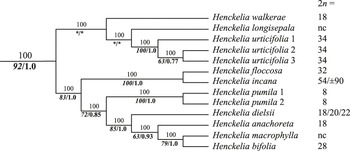
Using parts of the phylogeny in Weber et al. (Reference Weber, Middleton, Forrest, Kiew, Lim and Rafidah2011) where the topology is well supported, we can investigate the evolution of chromosome numbers of the species and genera investigated. We find that in Henckelia s.l. (Fig. 3) it would appear that 2n = 18 is ancestral, and polyploidisation in H. urticifolia is accompanied by a reduction in the number from a somatic 2n = 18 to a basic number of x = 17. However, on the whole, Henckelia s.l. is too heterogeneous and undersampled (14 out of 56 species counted) to enable definite conclusions to be drawn about the extensive genome rearrangements that must have occurred within this clade. It is interesting that the Gesneriaceae species with the lowest chromosome number, Henckelia pumila, with 2n = 8, is in this clade, with H. dielsii and H. anachoreta as sister with 2n = 18, and H. bifolia with 2n = 28. If the ancestral state in this area of the phylogeny is indeed 2n = 18, as discussed above, extensive Robertsonian fusion events (e.g. Hair & Beuzenberg, Reference Hair and Beuzenberg1958; Jones, Reference Jones1974; John & Freeman, Reference John and Freeman1975) must have occurred in this species to result in a reduction from a haploid complement of x = 9 to x = 4, while fission events or genome duplication and fusion events must have occurred to give 2n = 28 for Henckelia bifolia. Thus, no obvious ascending or descending series are seemingly present. Further cytogenetic studies in these species, perhaps involving chromatin level determinations (e.g. Gregory, Reference Gregory2005; Leitch et al., Reference Leitch, Soltis, Soltis and Bennett2005; Siljak-Yakovlev et al., Reference Siljak-Yakovlev, Stevanovic, Tomasevic, Brown and Stevanovic2008) and the use of fluorescent chromosome probes (e.g. Kasai et al., Reference Kasai, Takahashi, Koyama, Terao, Suto and Tokunaga2000) may shed light on these processes that shaped the karyotypes in this cytologically highly interesting clade.
The Henckelia clade (modified from Weber et al., Reference Weber, Middleton, Forrest, Kiew, Lim and Rafidah2011), with somatic chromosome numbers indicated. nc = not counted. Numbers above branches are majority rule consensus proportions; numbers below branches are branch support values, in italics to the left as bootstrap values, and to the right as Bayesian posterior probabilities.

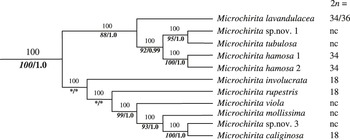
In the phylogeny in Weber et al. (Reference Weber, Middleton, Forrest, Kiew, Lim and Rafidah2011) Microchirita is divided into two sub-clades (Fig. 4), one with species possessing 2n = 34 chromosomes, the other with species having exclusively 2n = 18 for those counted and included in the phylogeny. The genome evolution in this clade has seemingly involved only one change in chromosome number, and at present it is difficult to ascertain in which direction the change occurred.
The Microchirita clade (modified from Weber et al., Reference Weber, Middleton, Forrest, Kiew, Lim and Rafidah2011), with somatic chromosome numbers indicated. nc = not counted. Numbers along branches as in Fig. 3.

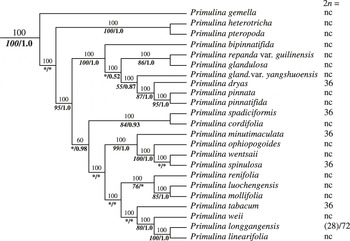
In Primulina only one basic number, x = 18, has been found (excluding the somewhat dubious count of 2n = 28 and 2n = 32 for P. tamiana, see above), with one polyploidy event. This does not enable any great inferences on chromosome evolution in the genus. Even though 18 out of the around 130 species have been counted now, only six of these are included in the phylogeny (Fig. 5). More counts are necessary to confirm whether 2n = 36 is the prevailing and ancestral number and to determine the degree of polyploidy and levels of polyploidy within this genus. Perhaps it is polyploidy that aided the high diversification and speciation of this genus and the evolution of the many species found in the limestone areas of SW China.
The Primulina clade (modified from Weber et al., Reference Weber, Middleton, Forrest, Kiew, Lim and Rafidah2011), with somatic chromosome numbers indicated. nc = not counted. Numbers along branches as in Fig. 3.

Genome evolution among genera
Given that the five genera with species previously included in Chirita are scattered widely across the Old World Gesneriaceae it is conceivable that their genome evolution, in terms of changes in chromosome number, is tightly linked to the evolution of a large portion of the advanced didymocarpoid Gesneriaceae. However, the weakly supported backbone topology of the phylogenetic tree in Weber et al. (Reference Weber, Middleton, Forrest, Kiew, Lim and Rafidah2011) currently precludes deeper discussions of evolutionary events concerning genome relationships at this level. Nonetheless, the distribution of chromosome numbers on this tree suggests that 2n = 18 has been conserved in parts of the tree involving some genera hitherto included in Chirita, namely Damrongia, Microchirita and Henckelia. The 2n = 36 count for Primulina at first seems a straightforward duplication from an ancestor with 2n = 18 chromosomes. The clade closest to this genus (with high statistical support) until recently included eight genera that have now all been synonymised into Petrocodon Hance (Weber et al., Reference Weber, Middleton, Forrest, Kiew, Lim and Rafidah2011). From this clade a count is only available for Petrocodon hancei (Hemsl.) A.Weber & Mich.Möller, as Didymocarpus hancei Hemsl., with 2n = 20 (Cao et al., Reference Cao, Cao, Tang and Wei2003). The ancestral chromosome state for Primulina or Petrocodon is, therefore, inconclusive and further cytological studies are necessary, particularly in the expanded genus Petrocodon. In the phylogeny in Weber et al. (Reference Weber, Middleton, Forrest, Kiew, Lim and Rafidah2011) members of other clades around Primulina include genera with high somatic chromosome numbers, such as Anna (2n = 34), Hemiboea C.B.Clarke (2n = 32, 36), Loxostigma C.B.Clarke (2n = 34), Lysionotus D.Don (2n = 30, 32), Petrocosmea Oliv. (mostly 2n = 34) (from Möller et al., 2002 onwards), and Pseudochirita W.T.Wang (2n = 28) (Cao et al., Reference Cao, Cao, Tang and Wei2003), and in the neighbouring clade Aeschynanthus Jack (2n = 28, 30, 32), Agalmyla Blume (2n = 32), Cyrtandra J.R.Forst. & G.Forst. (mostly 2n = 34), and Oreocharis Benth. (2n = 34) (Möller et al., 2002 onwards). Thus it seems likely that the duplication in Primulina occurred long before the differentiation of this genus. However, much more work is needed on the advanced didymocarpoid Gesneriaceae, both molecularly to obtain a stable hypothesis of genus relationships, and cytologically to allow a full discussion on the genome rearrangements over time to take place.
The systematic remodelling of the genus Chirita, while bringing the taxonomy greatly in line with molecular phylogenetic relationships, has not completely resulted in genera with uniform chromosome numbers. Henckelia is as equally heterogeneous as the erstwhile Chirita while, on the other hand, the Damrongia and Primulina species so far analysed show highly conserved numbers. Microchirita includes two numbers but more taxa need to be investigated. It appears that, although some of the genera to emerge from Chirita are fairly uniform in chromosome number, the previous diversity in Chirita has mostly simply been transferred to Henckelia in its new circumscription. Polyploid and dysploid changes seem to mark the genome evolution of Henckelia, Microchirita and Primulina. On comparison of chromosome counts to the recently published phylogenetic hypotheses, no ascending or descending chromosome number series have been observed, but rather a patchwork of evolutionary increases and decreases in chromosome numbers. Though some insight into the evolution of the genomes through changes in chromosome numbers of the genera has been gained, much more work remains to be done.
Acknowledgements
We acknowledge and greatly appreciate A. Ensoll, L. Galloway and S. Scott for their care of the Living Collections at the Royal Botanic Garden Edinburgh. We would like to thank D. J. Middleton for the collection and provision of living plant material of Damrongia species, and Prof. Y. G. Wei for supporting field collections in Guangxi. We would also like to thank the Percy Sladen Memorial Fund and the Royal Botanic Garden Edinburgh Expedition Fund for supporting the fieldwork of M.M. The Royal Botanic Garden Edinburgh is funded by the Rural and Environment Science and Analytical Services division (RESAS) in the Scottish Government.