The strong deeds of the Maccabees are read out and sung of in church services. While they fought for the laws of their fatherland, they did so also for their inheritance and their heirs. But [the crusaders] in truth set out not on their own behalf, nor on that of those close to them, but for the kingdom of heaven alone, and they fought manfully and won, for God helped them.Footnote 1
This passage from the prologue of the anonymous twelfth-century Historia Peregrinorum praises the deeds of those taking part in the Third Crusade and compares them to characters from the Old Testament, namely Judas, who held the honorary war-name ‘Maccabeus’ (‘the Hammerer’), and his brothers, Jonathan and Simeon, who were known during the Middle Ages as Jewish war heroes. Indeed, they had successfully resisted the introduction of the Hellenistic way of life under the Seleucid ruler Antiochus Epiphanes IV (reign: 175–164 bc), and his successors, as reported in the two deuterocanonical libri Macchabeorum.Footnote 2 Especially during the crusades, the Maccabean brothers were viewed as religious warriors and ideal knights, and pronouncements of the Church and crusade historiography such as the Historia Peregrinorum refer to them repeatedly.Footnote 3 Although the Maccabees were not honoured with a Christian saints' feast – such is not to be expected – their story was commemorated in one of the historiae of the summer temporale. The readings and chants of the weeks of October were taken from the Books of the Maccabees, which were performed after extracts from the Books of the (victorious) Judith and Esther had been read and sung.Footnote 4 The themes of the chants include war as an existential threat and armed resistance under the leadership of God.Footnote 5
War and violence figure importantly not just in the office chants of the October temporale, but also in many other parts of the Latin plainchant repertoire, particularly chants honouring the saints. Relatively well known are the numerous new alleluias and sequences sung at Masses on saints' feasts; less well known are the many chant-cycles for the Divine Office, or historiae, for the same occasions. It must be recalled that, in the Middle Ages, the saints functioned as figures manifesting religious and political ideals in concentrated form.Footnote 6 Saints' legends concern key positive values, but they also established boundaries, reinforced stereotypes of the enemy and legitimated them, all against a broader Christian backdrop. Based as they generally are on legends and reports of miracles, the chants of historiae helped articulate a variety of socio-political issues, including matters of war and violence.
The field of historia studies has developed considerably over the last three decades, with research concentrating mainly on editorial work, repertoire studies, analyses of melodic styles and structural questions.Footnote 7 Issues of theological and/or socio-historical meaning and function of the chant texts, and their bearing on the formation of the melodies, have only rarely been considered. Focusing on themes of war and violence, this article aims to show how historiae, in both their texts and their music, served to represent such ideas in liturgy. By examining them in ways developed here, we seek a better understanding of their original cultural-historical dimension.
The texts: war and the Old Testament
Old Testament models in the offices of the temporale
Many biblical texts describe God's presence and impact on a human history replete with violence and war,Footnote 8 such themes being especially prominent in the Old Testament.Footnote 9 The presence of the divine is perpetuated in saints' offices especially in the psalms, the recitation of which is central to the hours. Many office chants also refer to Old Testament models and contexts in their descriptions and interpretations of war. Among the most intriguing issues the books of the Old Testament raise is their characterisation of God as a God of wrath and revenge.Footnote 10 He is the highest commander, the one who grants victory but also metes out defeat.Footnote 11 These topics are central to one of the responsories from the Office of the Maccabees referred to earlier, Congregati sunt inimici (Text 1).Footnote 12 God's help is here invoked in the face of powerful enemies who represent an existential threat. Indeed, in the Old Testament the survival of whole peoples is frequently at stake, as articulated in the text of R. Miserere, Domine, populo tuo (Text 2) from the Esther historia. Text 3, the verse of the R. Judas Simoni, was also part of the Maccabean Office. It is taken from the first book of the Maccabees, an extract from the battle oration of Judas Maccabeus before the battle against Gorgias.

Old Testament models in the offices of the sanctorale
Chant texts based on the Old Testament develop, among other war-related topics, themes of the threat of merciless enemies, armed resistance and death in battle for one's people and one's faith. All three themes are also encountered in saints' offices in specifically Christian versions. The antiphon Principes et populi (Text 4) illustrates how, in a later office, the Old Testament theme of enemy threat is developed in reference to Christ.

The words ‘principes et populi … convenerunt’ are taken from Ps. 2, the theme of which is the struggle between the heathens and the anointed one, who, with God's help, emerges victorious.Footnote 18 The antiphon introduced and closed the recitation of this very psalm.Footnote 19 In such cases, the ‘liturgical vicinity’ of antiphon and psalm was frequently used to interconnect the Old Testament context of the psalm and the antiphon's Christological theme, rendering these texts especially significant from the perspective of salvation history. The text of this particular antiphon blames Christ's crucifixion on heathens and unbelievers and, with this, it articulates a boundary. This articulation gains considerable weight once we consider the antiphon's liturgical context: it was part of the Office of the Holy Lance, written at the court of Emperor Charles IV in 1355, a historia known widely across Bohemia and Germany in the late Middle Ages.Footnote 20
Metaphors of war in the New Testament
Cosmic warfare
This is another aspect of the theme of war in saints' offices, developed in a large array of war metaphors, many with New Testament backgrounds. The Apocalypse here figures prominently, as in the Office of St Michael, in which some chants refer to the famous battle between the Archangel and Satan (see Text 5).

At the very centre of the cosmic war metaphors however stands the Passion of Christ. Especially in the context of the Constantinian turn c.313, the utter defeat at Golgotha received a drastic theological and rhetorical reinterpretation as a triumphant victory over Satan.Footnote 22 Consequently, the cross, symbol of love and non-violence, experienced a remarkable transformation into a sign of victory.Footnote 23 The hymns Pange lingua … proelium and Vexilla regis, by Venantius Fortunatus (d. c.600), are surely among the most famous examples of this shift. A small selection of antiphons and responsories demonstrates the results of this transformation. The responsory, Ecce crucem Domini (Text 6), for example, celebrates Christ's passion and resurrection in military terms, that is, as a victory: the cross appears as a battle-standard.

Numerous other chant texts transpose this military imagery from a specifically Christological context to ones involving saints or relics. From the Office of St Martin (first transmitted in the tenth century) comes the antiphon, Ego signo crucis (Text 7), which identifies the cross as a symbol of protection. The cross was, however, occasionally likened to an offensive weapon, as in the responsory Armati vexillo crucis sung on feasts of the cross (Exaltatio or Inventio Crucis) (see Text 8).

While it is probable that ‘the enemy’ (acc. sing.) referred to in the responsory Armati vexillo crucis is Satan, the antiphon Per signum crucis (from the same offices) uses ‘the enemies’ (dat. plur.) (see Text 9). The cross-symbol thus transcends the confines of the spiritual or cosmic battle, and is in the antiphon invoked against one's opponents. In the fourteenth-century office in honour of St Wenceslaus, ‘the enemy’ is again taken to mean human military forces (see Text 10).

Spiritual battle: ‘milites Christi’
A side aspect of the cosmic war metaphor can be found in the idea of inner ‘spiritual battle’ already known from the Old Testament,Footnote 25 but receiving much of its later significance in the letters of St Paul, who wrote about the Christian's spiritual resistance to the Devil. Benedict of Nursia, in the prologue to his Rule, may well have had Paul's writings in mind when he described the monastic life as spiritual military service. Indeed, in the Benedict office the saint is identified as the leader of a glorious army of monks (‘dux gloriose agminis monastici Benedicte’).Footnote 26 But St Paul intended the metaphor ‘miles Christi’ to have a strictly spiritual meaning,Footnote 27 an understanding that follows from the Christian commandment to refrain from violence, as reflected in the antiphon, Beatus Martinus dixit Iuliano (Text 11), from the St Martin's Office.

It was in this particular sense that the term ‘miles Christi’ was used in the liturgies in honour of saints of various kinds, most often confessors.Footnote 29 As regards the martyrs, however, secular forces may temporarily subdue them, but in principle they remain undefeated ‘soldiers of Christ’. To give but one example, St Vincentius fights with the weapons of faith, the ‘arma spiritualia’ (Text 12).

In chants in honour of St Mauritius and the Theban Legion, some of which are based on a fifth-century passio, a slightly different attitude towards military service is encountered. The antiphon Nos pugnare adversus (Text 13) is first documented in practical sources at the end of tenth century. The text shows where the boundaries are drawn: to make war on Christians is forbidden, but war on the ‘impios’, the godless, is legitimate as ‘just’ war.Footnote 30 The antiphon Pugnavimus semper pro iustitia (Text 14) from a later office in honour of St Mauritius accentuates this point.

Fighters for faith and fatherland: sainted rulers
From the eleventh century on, several offices were written in honour of sainted rulers including Oswald of Northumbria, Edmund of East Anglia, and Olaf and Erik, the later patron saints of Norway and Sweden respectively. They are depicted as model kings, dying for their people as martyrs in the tradition of the imitatio Christi. Here, a significant shift in the attitude toward war is evident. The martyr's spiritual battle is placed in the context of resistance to attacking heathens, sometimes even to Christian tyrants: St Edmund of East Anglia, for example, died because he refused to submit himself and his kingdom to a heathen aggressor. This makes him ‘father of the fatherland’, as the fourth antiphon of First Vespers of the eleventh-century office formulates (see Text 15). In the third Matins responsory from the same office, Miles Xpisti Ædmundus, a ‘clericalised’ variant of the well-known verse from Horace (‘dulce et decorum est pro patria mori’), serves as the repetenda (see Text 16). The twelfth Matins responsory from the eleventh-century English office in honour of St Oswald, O regem et martyrem Oswaldum (Text 17), commemorates the martyrdom of an entire army.

The chants of St Oswald's Office are largely based on the Venerable Bede's Historia ecclesiastica gentis Anglorum (written c.731) which refers to Oswald as a saint but not a martyr.Footnote 35 It has been argued, not without some plausibility, that Bede did so in order to keep warfare away from religious connotations.Footnote 36 The earliest references to Oswald as a martyr come from vitae written by Ælfric (d. 1010) and Drogo of Bergues (d. 1070), the latter of whom also wrote the continental office in honour of the saint.Footnote 37 The roughly contemporary continental and English Oswald Offices seem to be the first to document the shift from the earlier stages of Oswald hagiography, in which warfare and martyrdom are kept separate, to the eleventh-century position in which both sides converge. This conforms to a broader historical development: the theme of martyrdom was increasingly developed with regard to those killed in religious war, particularly during the First Crusade.Footnote 38
In this later epoch, sainted kings such as Charlemagne and Stephen of Hungary were no longer officially venerated as martyrs, but rather as confessors who, on occasion, waged war on those with other beliefs. Some chants in their offices legitimise military action as missionary ministry. Such is the case with the responsory Fusa prece mentis bone (Text 18), from the twelfth-century Office for Charlemagne, and the responsory Gloriosus cultor Dei (Text 19), from the twelfth-century office in honour of Stephen of Hungary.

King Eric of Sweden was revered as a martyr. Examples 20-2 come down to us in a version of his office dating from c.1400 and they describe Eric's armed mission against the Finns. The first antiphon, Pugil fortis fidei (Text 20), gives the reason for Eric's embarking on war: zeal for his faith. The topic of the second antiphon, Pacem offert hostibus (Text 21), is the destruction of the king's enemies who, we assume, did not accept his offer of peace and refused to convert to Christianity. In the third antiphon, Plorat strages hostium (Text 22), the king mourns the death of his enemies: they would be eternally damned because they had not been baptised.

Despite the violent outcome, armed mission is depicted here as motivated by faith and brotherly love.Footnote 39 This seems to be based on the Augustinian idea that the use of force against heretics was legitimate if it leads to their conversion. Augustine's idea would in the Middle Ages come to be enforced by military means, and modern historians have examined such incidents under the catchword ‘compelle intrare’.Footnote 40 Texts of the kind surveyed above illustrate the presence of a medieval, Augustinian view of war in the saints' offices in addition to that encountered in the Old Testament.
Punishing saints
The chant texts discussed so far concern men who would be called saints participating in war during their lifetimes. These figures become, however, truly powerful and thus dangerous to their enemies only after their deaths, when they advance into an otherworldly source of military or punitive action.Footnote 41 The third Lauds antiphon from the thirteenth-century office in honour of St Henry, Furti reus multiplicis custos (Text 23), identifies the saint as protector of his church, the cathedral of Bamberg. Similarly, St Edmund is shown as acting on behalf of ‘his’ institution in the first two Lauds antiphons of his office (Texts 24–5).

Music
The preceding has shown how topics of war and violence were incorporated into the texts of historiae; it remains to indicate how the music of historiae participates in their articulation. An interpretative endeavour arguing in favour of an articulating function of plainchant settings must confront contradictory opinions about the relationship between music and texts. Depending on the personal experiences, methodological perspectives and aesthetic expectations of the one doing the describing, the text–music relationship may be characterised as neutral or something more specific.Footnote 43 When Ritva Jonsson and Leo Treitler combined their philological and musicological expertise in a 1983 collaborative study of this relationship, they concluded that ‘a chant melody records a reading of its text’, that it is a response to both the text's structure and meaning.Footnote 44 Approaching chants in historiae as products of conscious compositional choices and solutions to problems posed by their texts opens a path leading to a more nuanced view of the interdependence of music and meaning. With this in mind, the following section seeks to test the plausibility of such an analytical approach by examining two case studies which address two central principles of text-music relationship.
First principle: music as a declamatory tool
Plainchant is characterised by a parallelism between the text's formal syntactic structure and the phrasing of the musical setting: syntactically and semantically coherent portions of text are represented in musically coherent phrases and/or subphrases. Melodic phrase structure and musical caesurae clarify the text's declamation and thus its meaning.Footnote 45 In the later repertory of historiae, the text–music relationship was intensified as a result of developments in melodic style and tonality.
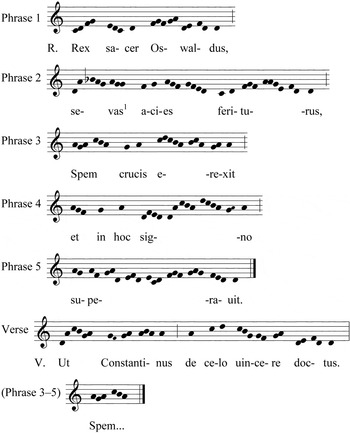
Text 26, the R. Rex sacer Oswaldus, is from the previously discussed eleventh-century English office in honour of St Oswald which relates the story of his victory over the British king Caedwalla (Cadwallon) at Heavenfield. In the hexametric text, and according to the Venerable Bede, Oswald erected a large cross on the battlefield before the troops engaged.Footnote 46 As will become evident in the analysis of this responsory, the office's melodic style differs from that of traditional Gregorian Chant (see Ex. 1).Footnote 47

R. Rex sacer Oswaldus (St Oswald's Office, England, eleventh century).

The tonal structure of Rex sacer Oswaldus is concentrated on a few central pitches: the final D, the upper fifth a and upper octave d. The final and cofinal (a) clearly mark the cadences and caesuras.Footnote 49 In contrast to the rigid tonal framework, the approach to melody is flamboyantly ornamental. Large interval leaps, leap combinations and sometimes lengthy scale passages are the most significant characteristics of this later style. The traditional melodic formulas of Gregorian Chant are lacking.
Here also the tension between tonality and melody intensifies the musical impact and contributes to a clear articulation of the text. The form of the responsory takes as its point of departure the caesuras of the Leonine hexameter, a formal-syntactical orientation not unlike the older plainchant style.Footnote 50 Initially, each half-verse corresponds to a musical phrase. A number of relatively short musical units emerge, ending with rhymes: phrases 1–2 / hexameter 1: ‘Oswaldus’ : ‘feriturus’; phrases 3–5 / hexameter 2: ‘erexit’ : ‘superauit’. The second half-verse of hexameter 2 is set so elaborately that it takes up two phrases, 4 (‘et in hoc signo’) and 5 (‘superauit’). It seems likely that this, the central message of the text, received this musical elongation intentionally.
Given the strict control of melodic space – that is, a gamut divided into a low register from D to a, and a high register from a to d – tonal contrasts in the melodic setting are of significance. The statements made in the text are obviously coordinated with the registers, and contrasts in the text correspond to contrasts in register. Phrases 1 and 2 introduce Oswald and his foes; both phrases use the lower register. At the start of hexameter 2, phrase 3, the king erects the cross as a sign of hope. One hears the high a–d register exclusively and for the first time, a clear contrast to the preceding (lower-range) phrases. The climax of the chant occurs in phrase 4, which combines both registers. The chant's ambitus is fully articulated for the first time on ‘signo’. The melisma is rather exceptionally shaped, moving quite rapidly from the lower end of the ambitus to its peak on d, first using the leap-combination D–a–c, and then, after a short return to the cofinal a, the singular leap a–d.
The text of the verse adds – almost as a punch line – a huge dimension of salvation history: Oswald's victory under the Cross of Heavenfield is compared to Constantine's victory at the Milvian Bridge.Footnote 51 The verse melody brings to mind the climactic setting of ‘signo’ in phrase 4 of the respond. At the start of the verse the D–a–c leap-combination returns, and in the second half the top-note (d) of the ambitus is touched again. The musical high points of the responsory are reached at the erection of the cross (‘erexit’, phrase 3) as a sign (‘signum’, phrase 4) for Christian hope (‘spem’, phrase 3), all concentrated in the repetendum, which is further emphasised by repetition after the verse. In the verse, Oswald's representation as an ‘alter Constantine’ receives hardly less musical attention.
It is interesting to observe how the musical realisation deals with the theme of military victory. In phrase 5 the verb ‘superavit’ appears exposed at the very end of the text. This emphasis is reflected musically through the dynamic musical setting: a melisma which rapidly traverses a major sixth a–C in a zigzag shape, employing a series of downward leaps.Footnote 52 The verb ‘superavit’ occurs in the last phrase of the respond, where tradition dictated a return to the register of the modal final. The strict tonal organisation of this piece amplifies the impact of this return: the half-cadences at the ends of phrases 3 and 4 in the second hexameter are on the cofinal a. This creates a longer arch of musical tension which resolves only with the cadence on D in phrase 5 at the end of the respond.
Considering the respond as a whole, this final phrase indeed has the function of a concluding musical relaxation. It sets the verb ‘superavit’ as the result at the end of a text–music process which starts in phrase 3 with the erection of the cross, cross and victory being associated with one another musically. Not only the words, but also the musical setting, show that the victory is the consequence of Oswald's public gesture of hope. Thus, the setting offers a ‘reading’ of the text which addresses military victory not in isolation but dependent upon unswerving faith in a situation of crisis. Linked to this is the religious idealisation of St Oswald in the verse. Musically this interpretation is achieved by way of tonal organisation, and by employing contrasts: contrasts in register and text setting, syllabic and/or melismatic.Footnote 53
Second principle: musical association
The second principle of music-text interaction, mentioned earlier, is concerned with the associative characteristics of music, that is, its capacity to connect different texts and contents. For this just one example must suffice.Footnote 54
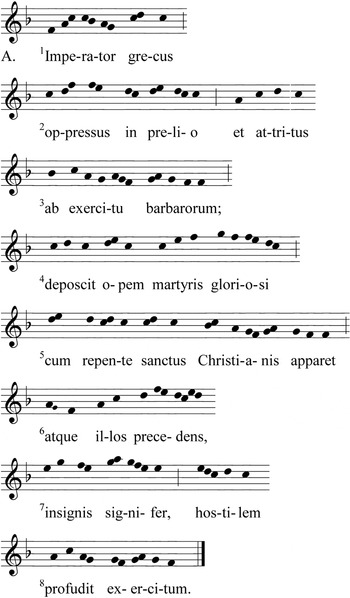
Between 1160 and 1180, the office in honour of the patron saint Olaf was written in the city known today as Trondheim, the seat of the Norwegian archdiocese of Nidaros. In the Lauds of this office, the Benedictus antiphon Imperator grecus was sung. Its text is based on one of the first reports in the Miracula sancti Olavi.Footnote 55 As shown in Text 27, its theme is the saint's assistance in battle.

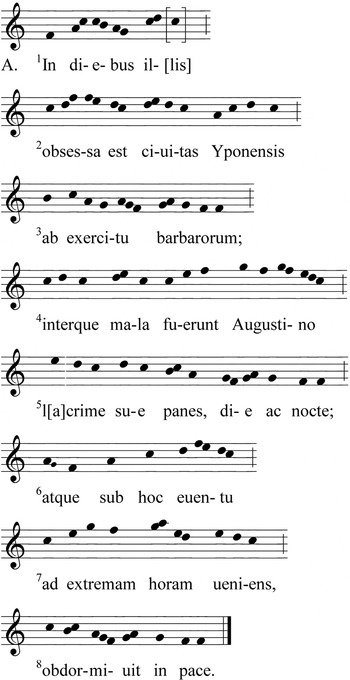
Most chant melodies in the Office of St Olaf were not newly composed, but instead were based on the office in honour of the Church Father Augustine, which was perhaps written by Walter, prior of the convent of Augustinian canons at Arrouaise near Arras before 1162.Footnote 56 The Olaf antiphon Imperator grecus is based on the Benedictus antiphon for St Augustine, In diebus illis, which stems from the end of Possidius's Vita Augustini. In diebus illis, too, describes a scene of battle (see Text 28 and Exx. 2a and 2b).

A. Imperator grecus (St Olav's Office, 1160–80).

A. In diebus illis (St Augustine's Office, twelfth century, first half).

Both texts describe the same fundamental situation, namely existential threat posed by barbarians, but the situations are resolved in opposite ways: negatively in the Augustine antiphon – the hero dies; positively in the Olaf antiphon – the Christians are liberated. There are hints, however, that the two texts were not viewed as different as might first appear. A first hint comes from the specific liturgical context in which the antiphons were performed in both offices, that is, (after the respective antiphons) in connection with the Benedictus Canticle, the song of Zacharias (Luke 1:68–79). The text mentions the theme of liberation in several of its passages.

The performative juxtaposition of the texts with the Benedictus Canticle evidently classifies not just the Olaf antiphon, but also the Augustine antiphon under the theme of ‘liberation’.
A second hint: Augustine's biographer Possidius reports that during the siege of Hippo Augustine prayed to God to free the besieged city, or grant his servants the strength to endure their misery, or if neither of these alternatives were acceptable, to ‘take [him] from this world’.Footnote 59 Possidius comments: ‘The Lord was not going to withhold from His servant the answer to his prayer. He obtained in due time what he had asked for through his tears both for himself and for his city.’Footnote 60 Possidius's Vita thus interprets Augustine's death as an act of heavenly mercy. The antiphon alludes to this positive view: in spite of the misery of war, Augustine dies ‘in peace’ (‘obdormivit in pace’).
In the twelfth century, the Norwegian editors chose to use a battle miracle of their patron Olaf as the text for a melody that described the death of Augustine. This could have happened because both texts were thought to have dealt with one and the same theme, namely liberation by God. If this hypothesis is correct, then the music serves as an indicator of the contemporary interpretation of the two antiphon texts.
Plainchant and history
The chants of saints' offices are capable of reflecting central aspects of medieval experiences and views of war, enemy stereotypes and concepts of religiously legitimate warfare. Some of these draw a strict boundary, particularly as they set up Christians and those with other beliefs in opposition. By doing so, they also establish identity – in the same vein as the idea of ‘holy’ war, which, as historians tell us, creates togetherness in defining ‘the others’.Footnote 61
The music of these chants is by no means indifferent to the content of the texts, as I have indicated, but at the same time uses only the normal stylistic vocabulary of its period. Because of this, music plays a role in integrating the theme of war into the liturgical, spiritual context. Traditional musical stylistics lead to a musical ‘normalisation’ of war, and to its legitimation within the framework of the liturgy. Within its prescribed boundaries, ecclesiastical music takes part in the articulation of our subject matter.
The war imagery of these chants, fuelled by biblical metaphors, cannot be seen as straightforward war propaganda in the medieval church service. The use of war metaphors in liturgy was, however, open to use and transposition into a real-political context.Footnote 62 In this respect, office chants are part of a larger cultural–political area where religious and secular spheres converge: liturgical celebrations were a regular part of war ritual, especially during the crusades.Footnote 63 As is well known, saints' images and relics were used as insignias of leadership and as war-standards;Footnote 64 often reported is the belief in the real presence of the saints during military operations (as described in the Olaf antiphon, Ex. 27). The passage from the Historia Peregrinorum, for example, cited at the beginning of this article, refers to the help of Saints Mercurius, Georgius and Theodorus militarily during the crusade.Footnote 65
The chants discussed above were not thematically isolated from other ecclesiastical texts, such as prayers or benediction formulas which occasionally have a public, ecclesio-political function, as for example the blessing formulae for armies, knights and standards. Historians have long considered liturgical texts of these kinds valuable evidence for the development of crusade ideology.Footnote 66 These scholars have not, however, taken thematically related chants into full consideration, even when they were part of the same services that contained these benedictions or orations.Footnote 67 Let us consider just one example of this thematical parallelism, a portion of the blessing of the banner (‘Benedictio vexilli’) from the so-called Ratold sacramentary (c.980). It refers to the cross in the real political sense, that is, as encountered in some of the chants discussed above.

There is no doubt, moreover, about the thematic and sometimes also literal parallelism of the chant texts even to medieval historiography, and not only when Old Testament passages are quoted.Footnote 69 Analysing orations which frequently can be found before battle accounts in chronicles written between 1000 and 1250, John Bliese described several topoi which functioned as motivations for war. One is the notion that one fights for a worthy cause. This implies the legitimation of war as a struggle for justice, a war for the fatherland and the Christian faith. References to the help of God and the saints are mentioned as another topos of battle orations, as well as the idea that those falling during a just battle will earn the glory of martyrdom.Footnote 70 As I have shown, all these topics can be found in the chants of historiae. Liturgical plainchant should thus be taken seriously, as a reflection of and point of reference for the political thought of the Middle Ages.Footnote 71 And yet there is another aspect which invites further reflection: medieval clerics spent their lives surrounded by and participating in the singing of ecclesiastical music, that is, mainly plainchant. We may assume that the textual and musical statements of these chants, characterised by careful concentration and musical interpretative structuring, also played a significant role in these clergymen's intellectual world. The more frequently performed chants of the annual cycle may even have functioned as musical proverbs, or shortcuts to saints' vitae or to biblical themes and passages. It is a matter of speculation whether Pope Innocent III, for example, had the V. Accingimini et estote filii potentes (CAO 6478b) in mind before quoting the Maccabees passage on which this verse is based in one of his crusade writings.Footnote 72 As the passage cited at the beginning of this study illustrates, plainchant was clearly involved in communicating messages of considerable political relevance to those capable of understanding the liturgical texts.
Appendix 1 Feasts and chants
Abbreviations:
arch=archangel. – CAO I or II+number: feast/office-number in CAO I and II. – CAO III or IV+number: number of the (normalised) text edition in the respective volumes of CAO. – conf=confessor. – Cid: Cantus Identification number. LMLO: siglum for the specific office-version in Andrew Hughes, Late Medieval Liturgical Offices: Resources for Electronic Research, Vol. 1 Texts, Vol. 2 Sources and Chants, Subsidia Mediaevalia, 23–4 (Toronto 1994, 1996). – mart=martyr.
Dates in parentheses are based on the earliest source of the office in CAO and/or the Cantus Index. For an index of the examples, see Appendix 2.
Augustinus, conf, Aug. 28.
On dating and authorship see: Berschin, Historia S. Augustini.
Ex. 28 A. In diebus twelfth century Cid 202402. Transcribed from Paris, Bibliothèque Nationale, lat. 14816, f. 262v.
Carolus magnus imperator, conf, Ian. 28. LMLO CA51.
Ex. 18 R. Fusa prece V. Leone twelfth century. Transcribed from Aachen, Domarchiv G 20, f. 28v.
Cf. Michael McGrade, Affirmations of Royalty: Liturgical Music in the Collegiate Church of St. Mary in Aachen, 1050–1350 (Chicago, 1998; UMI microfilms), 216 and fn. 57, with a divergent translation of this responsory text.
Crux
Exaltatio Crucis, Sept. 14. CAO I 110; II 922, 110.
Inventio Crucis, May 3. CAO I/II 92.
Ex. 6 R. Ecce V. Crux (eleventh century). Text ed.: CAO IV 6581, 6581a.
Ex. 8 R. Armati (eleventh century). Text ed.: CAO IV 6119.
Ex. 9 A. Per signum (ninth century). Text ed.: CAO III 4264.
Edmundus rex, mart, Nov. 20. LMLO ED61.
Probably composed at Bury Abbey during Abbot Baldwin's time, 1065–97; see Rodney M. Thomson, ‘The Music for the Office of St Edmund King and Martyr’, Music & Letters, 65 (1984), 189–93, at 189 and 190.
Ex. 15 A. Princeps before 1087. Transcribed from New York, Pierpont Morgan Library MS 736 on p. 177. Compare the transcription of this antiphon from First Vespers by Thomson, ‘The Music for the Office of St Edmund’, 192 (and fn. 25), where the preceding antiphons are also given. These Vespers antiphons are additions to the office which were written by Abbot Warner of Rebais during a visit at Bury before 1087, see ibid., 192.
Ex. 16 R. Miles Xpisti 1065–97. Oxford, Bodleian Library, Digby 109, p. 74.
Ex. 24 A. Qvidam maligne 1065–97. Cid 204169.
Ex. 25 A. Facto autem 1065–97.
Both antiphons transcribed from Oxford, Bodleian Library, Digby 109, pp. 93–4.
Ericus rex, mart, May 18. LMLO ER21.
Ex. 20 A. Pugil fortis c.1400.
Ex. 21 A. Pacem offert c.1400.
Ex. 22 A. Plorat strages c.1400.
Edition of the three antiphons in Ann-Marie Nilsson (ed.), St Eriks hystoria (Stockholm, 1999), 67–8; I have adopted her translations (pp. 141–2).
Henricus imperator, conf, July 15. LMLO HE92.
On repertory and history see Roman Hankeln, ‘“Properization” and Formal Changes in High Medieval Saints' Offices: The Offices for Saints Henry and Kunigunde of Bamberg’, Journal of the Plainsong and Medieval Music Society, 10/1 (2001), 3–21.
Ex. 23 A. Furti reus twelfth century München, Bayerische Staatsbibliothek, clm 18392 (Tegernsee, fourteenth century), f. 31r–v.
Historia de Esther, summer temporale. CAO I 975 133 135; II 1094 135.
Ex. 2 R. Miserere (ninth century). Text ed.: CAO IV 7159.
Historia Maccabeorum, summer temporale. Rep.: CAO I 977 137; II 1132 137.
Ex. 1 R. Congregati V. Disperge (ninth century). Text ed.: CAO IV 6326, 6326a.
Ex. 3 V. Accingimini (ninth century). Text ed.: CAO IV 6478b.
Lancea Domini, Second Friday after the Easter Octave. LMLO XL11.
Ex. 4 A. Principes fourteenth century Cid 203961. Ed. Franz Machilek, Karlheinz Schlager, Theodor Wohnhaas, ‘“O felix lancea”: Beiträge zum Fest der Heiligen Lanze und der Nägel’, Jahrbuch des historischen Vereins für Mittelfranken, 92 (1984/5), 43–107, at 85.
Martinus, conf, Nov. 11. CAO I 116; II 116 1172 1254.
Ex. 7 A. Ego signo ninth century Text ed.: CAO III 2587.
Ex. 11 A. Beatus ninth century Text ed.: CAO III 1644.
Music edition of both antiphons in Martha Fickett, ed., Historia Sancti Martini (Ottawa 2006), 36 and 38.
Mauritius, mart, Sept. 22. CAO I/II 111.
Ex. 13 A. Nos pugnare (tenth century). Text ed.: CAO III 3959.
According to Walter Lipphardt, the antiphon is part of Regino's tonary, but I was unable to find this item in Coussemaker's facsimile, used by Lipphardt. See Walter Lipphardt, ed., Der karolingische Tonar von Metz (Münster, 1965), 167; Edmond de Coussemaker, ed., ‘Tonarius Reginonis Prumensis’, Scriptorum de Musica Medii Aevi, vol. 2 (Paris, 1867), 1–73.
Ex. 14 A. Pugnavimus (fourteenth century). Cid 204003. Transcribed from Einsiedeln, Kloster Einsiedeln, Musikbibliothek Ms. 611, f. 224v (fourteenth century).
Michael, arch, 8 May, 29 Sept. CAO I113 II 924 113.
Ex. 5 R. Factum est (ninth century). Text ed.: CAO IV 6715.
Olavus rex, mart, Iul. 29. LMLO OL21.
Ex. 27 A. Imperator grecus twelfth century. Transcribed from the fragment of a thirteenth century noted breviary, today attached to Stockholm, Riksarkivet, Smålands handlingar, 1551: 12:2 / Räkenskap för Rälla ladugård, 2A. (=Fr 22225 in the Medeltida Pergamentomslag-catalogue; the siglum in the Catalogus codicum mutilorum is: Br 269.) The fragment uses square notation with f-, c- and b-clefs on lines. This source was not part of the latest transcription of the office by Eyolf Østrem, The Office of Saint Olav: A Study in Chant Transmission (Uppsala, 2001). Compare his transcription on pp. 382–4.
Oswaldus rex, mart, Aug. 5. LMLO OS93.
Cf. David Hiley, ‘The Office Chants for St Oswald king of Northumbria and martyr’, in A Due: Musical Essays in Honour of John D. Bergsagel & Heinrich W. Schwab, ed. Ole Kongsted, Niels Krabbe, Michael Kube, Morten Michelsen, and Lisbeth Larsen (Copenhagen, 2008), 244–59.
Ex. 17 R. O regem V. Inter eleventh century. Transcription of the main part in Hiley, ‘The Office Chants for St Oswald’, 254.
Ex. 26 R. Rex sacer V. Ut C. eleventh century.
Responsories transcribed from Cambridge, Magdalene College, F.4.10, f. 261r and 259r.
Stephanus rex, conf, Sept. 2. LMLO ST31.
Ex. 19 R. Gloriosus 1190–1270. Music edition in Laszlo Dobszay, ed., Historia sancti Stephani regis 1190–1270 (Ottawa, 2010), 4–5.
Vincentius, mart, Ian. 22. CAO I 46; II 46.
Ex. 12 A. In cuius (eleventh century). Text ed.: CAO III 3217.
Wenceslaus dux, mart, Sept. 28. LMLO WE51.
Ex. 10 A. Signo crucis fourteenth century.
Text ed. Guido Maria Dreves (ed.), Historiae rhythmicae. Liturgische Reimofficien des Mittelalters, Erste Folge, Analecta hymnica, 5 (Leipzig 1889), 261.
About dating, see Dreves, Historiae, 263, and also Machilek et al., ‘“O felix lancea”’ 53.
Appendix 2 Index of chants cited