Introduction
Many physiological functions are affected by a reduction of the intake level. It was extensively studied in adult human and positive long-term effects of a food restriction were obtained on ageing and disease (Polivy, Reference Polivy1996), or on functions such as energy metabolism, stress and immune response (Jolly, Reference Jolly2004), and recently microarrays were developed to evaluate the effects of food restriction (Han and Hickey, Reference Han and Hickey2005). In contrast, in animals the effects of feed intake level have been mainly explored in the young, not to study the impact on health but for improving the meat and carcass quality or energy metabolism (Lovatto et al., Reference Lovatto, Sauvant, Noblet, Dubois and van Milgen2006). For instance, the effects of a feed intake reduction have mainly been studied on rabbit meat quality (Ledin, Reference Ledin1984a; Perrier, Reference Perrier1998). Hence, digestive functions, such as gastric emptying and rate of passage or the digestion of nutrients, have been less described (Ledin, Reference Ledin1984b; Gidenne, Reference Gidenne1993). Furthermore, the digestive response according to a quantitative reduction of the intake was very scarcely studied in the growing rabbit (Maertens and Peeters, Reference Maertens and Peeters1988), although this feeding strategy would provide improvement in feed efficiency and potentially on health.
Therefore, we designed a two-side study. This first part aimed to analyse the effects of a quantitative linear reduction of the feed intake level (100% to 60%) on several digestive parameters of the growing rabbit, such as organ development, nutrient digestion and rate of passage, and caecal microbial activity. The second part of the study will describe the effects on growth, feed efficiency and digestive health, measured on a large number of animals in a French research network of experimental units (Gidenne et al., Reference Gidenne, Combes, Feugier, Jehl, Arveux, Boisot, Briens, Corrent, Fortune, Montessuy and Verdelhan2009).
Material and methods
Animals, feeds and experimental design
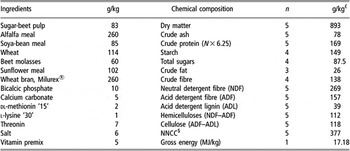
Rabbits were reared at the animal breeding unit of INRA (Castanet-Tolosan, France, UMR 1289), in compliance with national regulations for human care and use of animals in research (French Department of Agriculture). The study was organised in three experiments to measure for growing rabbits individually caged (70 × 25 cm2): the growth, the intake and feed efficiency (experiment 1), the whole tract digestive efficiency, the digestive organs’ development and the caecal microbial activity (experiment 2) and the rate of passage (experiment 3). For the three experiments, the same monofactorial experimental design was used to produce a progressive linear reduction of the feed intake level, from the ad libitum level (AL group) to 80%, 70% and 60% of AL (I80, I70 and I60, respectively), except for in experiment 3 where the I70 group was not studied. The experimental diet used for the three trials was manufactured and pelleted at one time (Euronutrition SAS, Sourches, France), using one batch of raw materials (Table 1). The diet was formulated to cover the nutritional requirements of the growing rabbit (Gidenne, Reference Gidenne2000), although the lignocellulose level was chosen slightly under recommendations (Gidenne, Reference Gidenne2003). It did not contain any drug supplementation (antibiotic or coccidiostatic).
Ingredients and chemical composition of the experimental diet

n: number of laboratories for analyses.
£As-fed basis.
$Non-nitrogenous cellular content = organic matter − NDF − crude protein.
In the three experiments, rabbits were weaned at 34 days of age and the restriction programme was applied by giving a daily meal (between 8:00 and 8:30) during 21 days after weaning. At 55 days of age, a 4-day transition period was managed where the feed intake of I70 and I60 groups was fixed at 80% of the AL group. Then all groups were fed ad libitum till 69 days of age.
Measurements of growth, intake, digestibility, rate of passage and faecal excretion pattern
In experiment 1, four groups of 30 rabbits were allotted according to the four treatments (blocked by litter), at weaning. Live weight was recorded weekly till 69 days of age, while feed intake was controlled every 2 days for adjusting the intake of restricted groups to that of the AL group.
According to the ‘European’ reference method (Perez et al., Reference Perez, Lebas, Gidenne, Maertens, Xiccato, Parigi-Bini, Dalle Zotte, Cossu, Carazzolo, Villamide, Carabaño, Fraga, Ramos, Cervera, Blas, Fernandez Carmona, Falcao, Cunha and Bengala Freire1995), faecal apparent digestibility was measured individually between 41 and 45 days of age, on four groups of 10 rabbits, housed in individual metabolism cages from 34 days of age (experiment 2). Then at 45 days, rabbits were sacrificed by sudden cervical dislocation (AVMA, 2001), for stomacal and caecal digesta sampling, 5 h after the meal distribution (between 13:00 and 14:00).
The pH of the stomach (fundus and antrum) and of the caecal digesta were taken immediately after sacrifice, with a glass electrode pH meter (pH 95; WTW, Weilherm, Germany). Portions of caecal digesta sample (5 to 10 g fresh matter) were placed in tubes containing (2%, v/v) H3PO4 or H2SO4 storage solution (1 and 2 ml/tube), respectively, for further analyses of volatile fatty acid (VFA) and ammonia (NH3), and stored at −18°C. Full and empty stomach and caecum were also weighed.
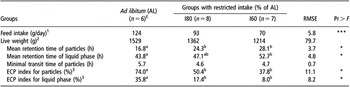
The rate of passage of liquids and fibre particles (experiment 3) was measured between 42 and 47 days of age, on nine rabbits per group (AL, I80, I60) housed in individual metabolism cages, by following the faecal excretion of a single dose of 141Cerium-labelled fibre particles freshly diluted in 51Cr-EDTA solution before administration (Gidenne, Reference Gidenne1994). The rate of passage between the mouth and the rectum was obtained by giving orally these markers simultaneously (at 09:00 h) using a modified plastic syringe of 1 ml. Then, the faecal excretion was fractionated in 36 samples during 96 h by means of an automatic faecal sampler (API, Castanet, France) adapted for use in rabbit metabolism cages. After drying, faeces were directly analysed for their marker content in a gamma spectrometer (Packard Model 5530; Packard Instrument, Downersgrove, IL, USA). The digesta mean retention time (MRT) was algebraically calculated by numerical integration of the marker quantity excreted in faeces: MRT = ∑Miti/∑Mi, where ti was the time that has elapsed between marker administration and the ith defecation and Mi was the quantity of marker excreted. MRT includes the minimal transit time ‘TT’, which was the time that has elapsed between marker administration and the first marker appearance in the faeces. TT reflects the retention time of digesta without a delay in the mixing compartments. Thus, it represents the rate of passage in the tubular segment of the tract, i.e. mainly in the small intestine and also in the distal colon (Gidenne, Reference Gidenne1994). In addition, we calculated an index ‘ECP’ (excreted before caecotrophy), which is specific of the rabbit digestive physiology. ECP is the quantity of marker (as a percentage of the total administered) excreted between dosing and the following phase of caecotrophy. This provides an estimation of the quantity of marker potentially recycled in soft faeces, and also reflected the potential effect of caecotrophy upon rate of passage.
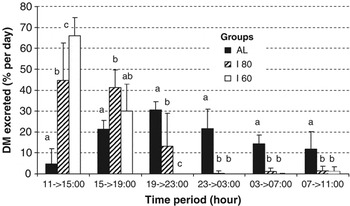
Additionally, on the same animals (experiment 3) the circadian pattern of faecal excretion was measured individually with a 4 h time interval, and for two periods of 24 h (42 and 43 days). Results were expressed as percent of dry matter (DM) excreted within a 24 h period (Figure 2).
Determination of fermentation and enzymatic activities in the caecum
Ammonia concentration was measured with the procedure of Verdouw et al. (Reference Verdouw, Van Echteld and Dekkers1978) using an auto-analyser (Technicon, Domont, France). VFA concentrations were determined by gas chromatography (CP9000; Chrompack, Middelburg, The Netherlands) according to the method of Jouany (Reference Jouany1982) adapted to a semi-capillary column. The fibrolytic activity of the cæcal flora was investigated by measuring carboxymethylcellulase, xylanase and pectinase activities as previously described (Gidenne et al., Reference Gidenne, Jehl, Segura and Michalet-Doreau2002). Cæcal digesta solutions were first submitted to an ultrasonic disintegration with an MSE Sonirep 150 disintegrator (MSE Instruments, Crawley, UK) in order to disrupt bacterial cellular membranes and to liberate enzymes (Martin and Michalet-Doreau, Reference Martin and Michalet-Doreau1995). Polysaccharidase activities were then determined by measuring the release of reducing sugars from the carboxymethylcellulose, xylan and citrus pectin. Reducing sugars were spectrophotometrically quantified at 410 nm according to the p-hydroxybenzoic acid hydrazide method (Lever, Reference Lever1977).
Chemical analyses of feeds and faeces
The following chemical analyses were carried out on feed (EGRAN, 2001): DM (24 h at 103°C), ash (5 h at 550°C), gross energy (PARR adiabatic calorimeter; PARR Instrument Co.; Moline, IL, USA), and fibres (NDF, ADF and ADL) according to the sequential method of Van Soest et al. (Reference Van Soest, Robertson and Lewis1991) with an amylolytic pre-treatment. Starch in the feed was hydrolysed enzymatically and the resulting released glucose was measured using the hexokinase glucose-6-phosphate dehydrogenase system (d-Glucose®; Boëhringer, Mannheim, Germany). The non-nitrogenous cellular content (NNCC), which includes starch and also the major part of pectins, was estimated by difference according to the relation: NNCC (%) = organic matter (%) − crude protein (%) − NDF (%). Nitrogen was determined according to the DUMAS combustion method using the Leco auto-analyser (model FP-428; Leco Corp., St Joseph, MI, USA) and converted to crude protein (N × 6.25).
Statistical analysis
The results were analysed using a monofactorial variance analyses (GLM procedure, SAS OnlineDoc®). Comparison of means among the four treatments was presented in tables as superscripts associated with means, using the test of Scheffe. In addition, the REG procedure was used to calculate the regression equations for growth according to the restriction level.
Results
Growth and feed intake
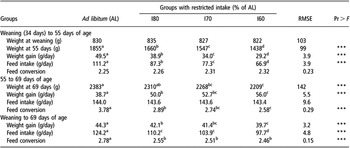
Compared to the AL group, the observed intake levels of the restricted groups conformed to those initially planned (from 34 to 55 days), with a linear reduction of the intake from 80% to 60% (Table 2). Already 4 days after weaning, the rabbits submitted to a feed restriction began to eat immediately after the feed distribution at 8:00. Thus, restricted rabbits ate totally their ration, within 6–7 h after the feed distribution for the I60 group, 7–8 h for the I70 group and 9–10 h for the I80 group; however, ad libitum-fed rabbits consumed 75% of their food between 15:00 and 8:00. Accordingly, the circadian faecal excretion pattern was deeply affected (Figure 2). Classically, 65% of the DM excretion of control rabbits was distributed over the whole night period (i.e. 12 h), with a low excretion phase in morning and early afternoon that corresponds to the excretion of soft faeces. In contrast, 65% of the faeces were excreted between 11:00 and 15:00 for I60 animals (period of feed intake), and no faecal excretion occurred from 23:00 to 11:00. An intermediate situation was observed for I80 rabbits, since their faecal excretion occurred over an 8 h period (11:00–23:00).
Growth and intake according to the feed restriction level, for growing rabbits caged individuallyFootnote £ (experiment 1)

RMSE = root mean square error.
£ Thirty replicates per group.
a,b,c,d Means having a common superscript are not different at the level P = 0.05. ***P < 0.001.
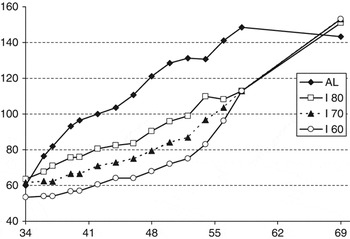
From 55 to 59 days old, rabbits of I70 and I60 groups reached the intake of the I80 group within 1 day. After this transition period, the feed intake of restricted animals increased progressively, and remained under the level of the AL group till 65 days of age (Figure 1). From 54 to 69 days old, the intake of the four groups did not differ and averaged 143.7 g/day (Table 2). However, the relative feed intake (% of metabolic weight) was significantly higher in restricted groups compared to the AL ones. Over the whole experimental period, the intake levels were 89%, 84% and 79% (for I80, I70 and I60, respectively) of the AL group.
Intake pattern of the growing rabbit individually caged, according to the feed intake level (experiment 1). AL: Rabbits fed ad libitum; I80, I70, I60: rabbits fed, respectively, at 80%, 70% and 60% of the ad libitum level.

At the end of the restriction period, the live weight and the weight gain decreased linearly with restriction level (y = −0.55x + 99.9, R 2 = 0.99, P < 0.001) for weight; y = −1.03x + 99.8; R 2 = 0.99, P < 0.001, for the weight gain, and for instance a 20% reduction of the intake led to a reduction of 11% in live weight (Table 2). In return, from 55 to 69 days, the weight gain increased linearly according to the restriction level previously applied. At 69 days, the restricted rabbits did not totally reach the weight of those fed ad libitum, but their weight was only 3%, 5% and 7% lower for I80, I70 and I60 groups, respectively.
During the restriction period, the feed conversion remained similar among the four groups, while from 55 to 69 days, it was 0.89 units lower for I80 (−23%) compared to the AL group. Furthermore, the feed conversion linearly reduced from I80 to I60. Over the whole experiment, the feed conversion of restricted groups was 10% lower compared to the AL one (P < 0.05).
Digestive parameters and microbial activity
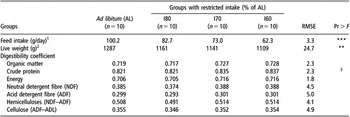
After 8 days of restriction, the whole tract digestion of most nutrients was not significantly affected by the intake level (Table 3), and the digestible energy content of the feed was meanly 12.21 MJ/kg (as-fed basis). Only crude protein presented a slightly higher (+1.5 unit) coefficient in I70 and I60 compared to AL and I80 groups (P = 0.05). Accordingly, the digestible protein content was 139 and 141 g/kg (as-fed basis), respectively.
Whole tract digestive efficiency in the young rabbit according to feed intake level (experiment 2)

RMSE = root mean square error.
1Mean feed intake during the measurement of the digestive efficiency (4 days, from 41 to 45 days old).
2Mean live weight during the measurements.
***P < 0.001; **P < 0.01.
§P-value = 0.05, for the contrast ‘AL + I80’ v. ‘I70 + I60’.
The MRT of particles increased by 50% for restricted animals (meanly 26.2 h for I80 and I60 groups) compared to AL rabbits, while the minimal transit time was not significantly affected (Table 4). This suggested that the retention time of digesta was mainly increased in the mixing compartment, such as the caeco-colic segment, since the minimal transit time corresponds to the transit in the tubular segment of the tract (i.e. the small intestine). The proportion of marker excreted in particles before the first caecotrophy phase ‘ECP’ was almost two times lower when compared to the AL and I60 groups. The MRT of the liquid phase was almost three times longer than particles for the AL group, and it was linearly and moderately increased with the reduction of intake (+20% between AL and I60). The ECP for liquids was about two times lower than particles for the AL group, and it was four times reduced between AL and I60 groups.
Rate of passage in the young rabbit according the feed intake level (experiment 3)

£Number of valid replicates (on nine rabbits) per group.
1Mean feed intake during the measurement of the rate of passage (5 days, from 42 to 47 days old).
2Mean live weight during the measurements.
3ECP, proportion of marker excreted before the first cæcotrophy phase.
a,bMeans having a common superscript are not different at the level P = 0.05.
***P < 0.001; *P < 0.05.
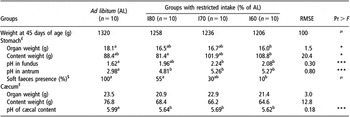
The reduction of the intake level led to a lower stomach empty weight (meanly −9%, P < 0.05; Table 5), and this effect was totally linked to the subsequent effect observed on the live weight at 69 days (result of a covariance analysis). The fresh digesta content of the stomach was higher for I60 and I70 groups compared to the AL and I80 ones (+20%, contrast: P < 0.05), and could be related to the intake pattern of these animals who almost finished their daily ration at sacrifice time (5 h after the meal distribution). In return, the content of the caecum was similar among groups. The pH in the antrum was two units higher (P < 0.001) in the restricted groups compared to the AL one, while it increased moderately in the fundus (meanly + 0.5 unit). Soft faeces in the fundus were always observed in ad libitum animals, and their frequency was sharply and linearly reduced in restricted groups.
Digestive parameters of 45 days old rabbits, according to the feed intake level (experiment 2)

£Data measured 5 h after the meal distribution for restricted groups.
$Proportion of animal having soft faeces in the fundus.
a,bMeans having a common superscript are not different at the level P = 0.05.
μApproaching significance (P < 0.10); ***P < 0.001; *P < 0.05.
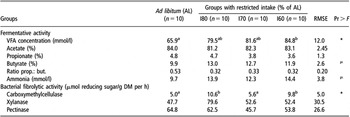
In restricted groups, the caecal pH was lower (meanly − 0.3 unit) and could be related to their higher VFA concentration (meanly +16 mmol/l compared to AL, P < 0.05; Table 6). However, the feed restriction did not significantly affect the ammonia concentration or the VFA molar proportions, except for the butyrate proportion that tended to increase. Besides, the bacterial fibrolytic activity remained unaffected by the feed intake level, although carboxymethylcellulase was higher in I80 and I60 groups.
Caecal microbial activityFootnote $ in the young rabbit, according to the feed intake level (experiment 2)

VFA = volatile fatty acid; DM = dry matter.
$ Data obtained on 45 days old rabbits, 5 h after the feed distribution (i.e. between 13:00 and 13:30).
a,b Means having a common superscript are not different at the level P = 0.05.
μ Approaching significance (P < 0.10); *P < 0.05.
Discussion
Intake pattern, growth and feed efficiency according to the restriction level
The intake and faecal excretion pattern of ad libitum rabbits was in agreement with the literature (Jilge, Reference Jilge1987; Gidenne and Lapanouse, Reference Gidenne and Lapanouse2004; Gidenne and Lebas, Reference Gidenne and Lebas2006), with a pattern adjusted to light cycle (07:00–19:00): two-third of the daily feed consumption and faecal excretion occurring in the nocturnal period. In contrast, restricted rabbits changed their intake and excretion pattern (including soft faeces intake) according to the time of the meal distribution (i.e. at 8:00), and they finished their daily ration before the nocturnal period (Figure 2). Moreover, it is acknowledged that animals submitted to a feed restriction modified their drinking behaviour. For instance, Fodor et al. (Reference Fodor, Fekete, Zoldag, Bersenyi, Gaspardy, Andrasofszky, Kulcsar and Eszes2001) observed a higher water consumption in the restricted young rabbit female (3.5 ml/g DM intake v. 1.9 ml/g DM for the AL group).
Circadian kinetic of the faecal excretion of the growing rabbit, according to the feed intake level (experiment 3). AL: Rabbits fed ad libitum; I80, I60: rabbits fed, respectively, at 80% and 60% of the ad libitum level. $Data obtained during the measurement of the rate of passage (at 42 and 43 days old), the feed distribution occurred between 8:00 and 8:30. a,bWithin a time period and among groups, means having a common superscript are not different at the level P = 0.05.

Lebas and Laplace (Reference Lebas and Laplace1982) reported that a quantitative restriction (71% of ad libitum for 21 days) did not lead to a morphological adaptation of the tract, which is in agreement with the similar stomach and caecum weight measured here for ad libitum and restricted rabbits.
A quantitative linear reduction of the intake was reached not only during the restriction period but also over the whole experiment, since we did not observe the behaviour of over-intake after restriction, in agreement with Taranto et al. (Reference Taranto, Di Meo, Stanco, Piccolo, Gazaneo and Nizza2003). This absence of compensatory intake originated probably in the digestive physiology and feeding behaviour of the rabbit, who possessed a relatively small stomach (30% of the whole gut content) and fractionates its daily intake into 30 to 40 meals (Gidenne and Lebas, Reference Gidenne and Lebas2006), thus explaining that a rabbit restricted since 3 weeks is not able to increase its intake by 20% (from 80% to 100%) within 10 days.
Although the intake increased moderately, a marked compensatory growth was observed during the two last weeks of the experiments, thus leading to a better feed conversion. The increase in daily weight gain and feed conversion was then proportional to the level of restriction, as found previously for rabbits housed individually (Perrier, Reference Perrier1998).
Digestion in the young rabbit according to the intake level
Seven days after the application of the restriction strategy, the digestive efficiency was not significantly affected, irrespective of the intake level. Similarly, Diaz Arca et al. (Reference Diaz Arca, Perez Alba and Perez Hernandez1999) measured the faecal digestibility in growing rabbits during the restriction and without a delay of adaptation, and they did not find major effect of the intake level, even when the intake was reduced to 10% of the voluntary food consumption.
However, the digestion of protein was here slightly but significantly improved for the lowest level of intake (I60 and I70). An increase in protein digestion was also found after a 2-week adaptation period to the restriction (75% of ad libitum) for growing rabbits (Xiccato et al., Reference Xiccato, Cinetto and Dalle Zotte1992) or for adult rabbits (Lebas, Reference Lebas1979; Xiccato and Cinetto, Reference Xiccato and Cinetto1988, Fodor et al., Reference Fodor, Fekete, Zoldag, Bersenyi, Gaspardy, Andrasofszky, Kulcsar and Eszes2001). Similarly, in these studies the authors found in restricted animals a better digestive efficiency for energy, but few improvements in lipid or fibre digestion. However, Ledin (Reference Ledin1984a) reported significant improvement of the digestion in rabbit fed 60% of their voluntary intake, for all major nutrients including fibre and lipids. Besides, the digestibility of nutrients seemed to be improved only during the restriction period, and in the re-feeding period there were no differences between restricted and AL-fed rabbits (Tumova et al., Reference Tumova, Skrivanova and Skrivan2003 and Reference Tumova, Zita, Skrivanova, Fucikova, Skrivan and Buresova2007). Thus, under intake restriction, an improvement of the digestive efficacy of the young rabbit became significant only after an adaptation delay of at least 8 to 10 days. Such improvement could originate in physiological changes in the intestine (enzymes secretion, mucosa absorption, etc.), and for instance in a longer retention time of digesta particles in the caeco-colic segment, as shown here (Table 4). A 40% reduction of the intake level led to a 65% increase in the retention time of particles. With similar intake levels, a similar increase in digesta retention was observed by Ledin (Reference Ledin1984b), while with more fibrous diets Gidenne et al. (Reference Gidenne, Poncet and Gomez1987) reported only a 25% increase. Longer retention time in restricted rabbits originated mainly from the first 24 h of marker excretion, as shown by the sharp decrease of the ECP index for particles as well as for liquids. For instance, in the AL group the quantity of particulate marker (141Ce) excreted within 24 h after dosing (ECP index) was meanly 74%, as found by Laplace and Lebas (Reference Laplace and Lebas1975), and fell to about 40% for the I60 group. However, the caecotrophy period was moved in restricted animals, and as previously shown (Laplace and Lebas, Reference Laplace and Lebas1975; Gidenne and Lapanouse, Reference Gidenne and Lapanouse1997) the retention time of a marker is longer when dosing occurred close to the caecotrophy period. The impact of the intake restriction would have been thus more precisely measured by choosing different dosing times according to groups, to maintain a similar delay between marker administration and caecotrophy.
Reversely, Fioramonti and Ruckebusch (Reference Fioramonti and Ruckebusch1974) observed no motricity response of the caecum in the rabbit fed ad libitum, probably because the caecum is constantly in a repletion status. Hence, when adapted to eat in one meal (and thus restricted), there is an increased frequency of caecal contractions before the mealtime. Moreover, hungry animals ate a high quantity of food in a short time, and this prolonged the motor activity of the small intestine (Ruckebusch et al., Reference Ruckebusch, Grivel and Fargeas1971). Therefore, applying a restriction strategy to rabbits probably modifies the motor activity in all segments of the tract, and between meals there is probably a period with a digestive vacuity.
The lower caecal pH observed for restricted rabbits was reliable with the higher VFA concentration. Since the transit of digesta is about 4 to 6 h from the mouth to the ileum (Gidenne, Reference Gidenne1994), a high flow of digesta enters the caecum at 13:00 for restricted animals, thus leading to a ‘peak’ of fermentation. Similarly, Gidenne and Bellier (Reference Gidenne and Bellier1992) reported a peak of fermentation in the caecum 5–7 h after a meal for adult cannulated animals. However, Maertens and Peeters (Reference Maertens and Peeters1988) or Taranto et al. (Reference Taranto, Di Meo, Stanco, Piccolo, Gazaneo and Nizza2003) observed a higher pH and a lower VFA concentration in the caecum of young restricted rabbits, since measurements were performed in the morning (9–10 h) just after meal distribution and thus before the peak of digestion in the caecum. In contrast, the fermentative activity of ad libitum-fed rabbits is relatively stable over the nycthemere (Bellier et al., Reference Bellier, Gidenne, Vernay and Colin1995), thus explaining their relatively lower VFA concentration of the AL group. Irrespective of the restriction level, the xylanasic and pectinasic activity of caecal bacteria was higher than that of the cellulase. Boulahrouf et al. (Reference Boulahrouf, Fonty and Gouet1991) corroborates this observation, as they described a prevalent xylanolytic and pectinolytic flora compared to the cellulolytic one.
Conclusions
An intake restriction sharply modifies the feeding behaviour (including the caecotrophy) of the young rabbit and led to deep changes in its digestive physiology, such as gastric parameters but more by reducing the digesta rate of passage and by modifying the caecal microbial activity pattern. In perspectives, the impact of reduced feed intake should be stated more precisely by studying the changes in the circadian cycle of microbial activity and on the microbiota biodiversity and stability. Meanwhile, the second part of this study will analyse the effects on feed intake level on the digestive health, growth and carcass characteristics of the young rabbit, using a high number of animals in a network of experimental stations (Gidenne et al., Reference Gidenne, Combes, Feugier, Jehl, Arveux, Boisot, Briens, Corrent, Fortune, Montessuy and Verdelhan2009).
Acknowledgements
The authors thank C. Bannelier, M. Segura, A. Lapanouse, P. Aymard (INRA, UMR1289 TANDEM) for their technical collaboration.