Barian trioctahedral micas
Natural Ba-rich micas have been described from different rock types including alkaline igneous rocks (Thompson, Reference Thompson1977; Wendlandt, Reference Wendlandt1977; Mansker et al., Reference Mansker, Ewing and Keil1979; Velde, Reference Velde1979; Gaspar and Wyllie, Reference Gaspar and Wyllie1982; Edgar, Reference Edgar1992; Bigi et al., Reference Bigi, Brigatti, Mazzucchelli and Rivalenti1993; Zhang et al., Reference Zhang, Suddaby, Thompson and Dungan1993; Shaw and Penczak, Reference Shaw and Penczak1996), metasomatized rocks (Pan and Fleet, Reference Pan and Fleet1991; Tracy, Reference Tracy1991; Harlow, Reference Harlow1995), marbles or calc-silicate rocks (Glassley, Reference Glassley1975; Pattiaratchi et al., Reference Pattiaratchi, Saari and Sahama1967; Rice, Reference Rice1977; Kretz, Reference Kretz1980; Bucher-Nurminen, Reference Bucher-Nurminen1982; Solie and Su Reference Solie and Su1987; Bol et al., Reference Bol, Bos, Sauter and Jansen1989), and metamorphosed ore deposits (Frondel and Ito, Reference Frondel and Ito1967; Yoshii et al., Reference Yoshii, Maeda, Kato, Watanabe, Yui, Kato and Nagashima1973a; Fleischer et al., Reference Fleischer, Chao and Kato1975; Matsubara et al., Reference Matsubara, Kato, Nagashima and Matsuo1976; Filut et al., Reference Filut, Rule and Bailey1985; Dasgupta et al., Reference Dasgupta, Chakroborti, Sengupta, Bhattacharya and Banerjee1989; Tracy, Reference Tracy1991; Frimmel et al., Reference Frimmel, Hoffmann, Watkins and Moore1995; Gnos and Armbruster, Reference Gnos and Armbruster2000).
Whereas very high Ba contents are relatively rare in dioctahedral micas (Guidotti, Reference Guidotti and Bailey1984), with exceptions that include two occurrences of ganterite Ba1(Na,K)1Al4(Si5Al3)O20(OH)4 (Hetherington, Reference Hetherington2001; Graeser et al., Reference Graeser, Hetherington and Gieré2003; Ma and Rossman, Reference Ma and Rossman2006), high BaO contents up to 25 wt.% are more common in trioctahedral micas. In both types of micas, Ba replaces Na, K and Ca in the interlayer site (Mansker et al., Reference Mansker, Ewing and Keil1979). As in biotites and phlogopites the predominant interlayer cation is K, the excess charge due to the presence of Ba has to be compensated, either by the formation of vacancies through the substitution (Ba□)(2K)–1 (Guidotti, Reference Guidotti and Bailey1984), or by the substitution of Al to Si in the tetrahedral site (BaAl)(KSi)–1 (Wendlandt, Reference Wendlandt1977).
In all reported occurrences of Ba-rich trioctahedral micas, the proposed Ba-rich end-members have an interlayer site occupied completely by Ba. The most frequently reported Ba end-member is kinoshitalite Ba2(Mg,Mn)6(Al4Si4)O20(OH,F)4 (Frimmel et al., Reference Frimmel, Hoffmann, Watkins and Moore1995; Guggenheim and Frimmel, Reference Guggenheim and Frimmel1999). Manganese-rich kinoshitalite was found at Noda-Tamagawa mine, Japan (Yoshii et al., Reference Yoshii, Maeda, Kato, Watanabe, Yui, Kato and Nagashima1973a), and also in a quite similar type of occurrence at Hokkejino (Matsubara et al., Reference Matsubara, Kato, Nagashima and Matsuo1976) where it is associated with hausmannite, celsian and tephroite or manganosite in fine layers in cherts. Yoshii et al. (Reference Yoshii, Togashi and Maeda1973b) showed that the exchange vector is (BaAl)(KSi)–1, independent of the Mn↔Mg substitution. Mn-poor kinoshitalite (Ba1.10K0.80Na0.06)1.96(Mg5.14Al0.32 ${\rm Fe}_{{\rm 0}{\rm. 46}}^{{\rm 2 +}} {\rm Fe}_{{\rm 0}{\rm. 08}}^{{\rm 3 +}} $ Ti0.02)6.02(Si4.48Al3.52)8O20(OH2.60F1.40)4 has been reported from the contact-zone of a quartz-syenite intrusion in calc-phyllites in Middle Fork complex, Alaska (Solie and Su, Reference Solie and Su1987). The natural kinoshitalite end-member (Ba1.98K0.12Na0.02)2.12(Mg5.28Mn0.62)5.90(Al4.02Si4.06)8.08O20(OH3.22F0.74Cl0.04)4 has been found occurring among a series of compositions in which the average is (Ba1.2K0.8Na0.2)2.2(Mg4.2Mn1.0Al0.4)5.6(Si4Al3.8)7.8O20(OH)4 (Gnos and Armbruster, Reference Gnos and Armbruster2000). An apparently continuous solid-solution series between phlogopite K2Mg6Al2Si6O20(OH)4 and kinoshitalite has been described (Dasgupta et al., Reference Dasgupta, Chakroborti, Sengupta, Bhattacharya and Banerjee1989; Brigatti and Poppi, Reference Brigatti and Poppi1993).
Ferrokinoshitalite BaFe3Al2Si2O10(OH,F)2, the Fe-analogue of kinoshitalite, has been defined from a banded iron formation interstratified with the Broken Hill massive sulfide deposit, with a typical composition Ba1.0K0.8 ${\rm Fe}_{\rm 4}^{{\rm 2 +}} $Mg2Si5Al3O20(OH)2.7F1.3 (Frimmel et al., Reference Frimmel, Hoffmann, Watkins and Moore1995; Guggenheim and Frimmel, Reference Guggenheim and Frimmel1999). No occurrence of the end-member has yet been found, but ferrokinoshitalite with the interlayer site entirely occupied by Ba, e.g. Ba2
 ${\rm Fe}_{{\rm 4}{\rm. 2}}^{{\rm 2 +}} $(Mg,Mn,Zn,Ti)1.8(Si4.2Al3.6
 ${\rm Fe}_{{\rm 0}{\rm. 2}}^{{\rm 3 +}} $)8O20(OH)0.94Cl2.52F0.54, has been reported from skarns associated with the Zn ore deposit of Sterling Hill, New Jersey (Tracy, Reference Tracy1991). Anandite is a S-bearing and Al-poor trioctahedral Ba mica from Sri Lanka (Pattiaratchi et al., Reference Pattiaratchi, Saari and Sahama1967), with a simplified end-member formula proposed to be Ba2
 ${\rm Fe}_{\rm 6}^{{\rm 2 +}} $Si6
 ${\rm Fe}_{\rm 2}^{{\rm 3 +}} $ O20(OH)2S2 (Giuseppetti and Tadini, Reference Giuseppetti and Tadini1972; Filut et al., Reference Filut, Rule and Bailey1985). Oxykinoshitalite, the Ti-rich end-member ideally Ba2(Mg4Ti2)6(Si4Al4)8O20O4, was described from an olivine nephelinite (Kogarko et al., Reference Kogarko, Uvarova, Sokolova, Hawthorne, Ottolini and Grice2005).
These Ba-rich trioctahedral micas can be derived from non-barian biotites through the Wendlandt substitution, occasionally combined with other substitutions not involving Ba, such as Tschermak, with no or limited participation of the vacancy-producing substitution (Ba□)(2K)–1. In contrast, the present study reports Ba-rich phlogopites in which the interlayer vacancies reach values almost as high as (K + Na), with an interlayer content approximately Ba0.8(K + Na)0.6□0.6 (Fig. 1a). The layer is practically identical (except for a small Ti content) to that of the ideal phlogopite K2Mg6Al2Si6O20(OH)4 (Table 1), i.e. the Si content is much higher than for kinoshitalite (Fig. 1b). These types of lacunar Ba-rich and Si-rich phologites have not been described elsewhere so investigation is needed into their chemical conditions of formation.
Barium contents (atoms per formula unit) vs K + Na (a) and Si (b) in phlogopites from La Creuse talc rocks, compared to other occurrences of Ba-rich phlogopites in: alkaline rocks (Wendlandt, Reference Wendlandt1977; Mansker, Reference Mansker, Ewing and Keil1979; Gaspar and Wyllie, Reference Gaspar and Wyllie1982; Edgar, Reference Edgar1992); metamorphosed ore deposits (Yoshii et al., Reference Yoshii, Maeda, Kato, Watanabe, Yui, Kato and Nagashima1973a,b; Gnos and Armbruster, Reference Gnos and Armbruster2000; Frimmel, Reference Frimmel, Hoffmann, Watkins and Moore1995; skarns and calcsilicate rocks (Solie and Su, Reference Solie and Su1987; Tracy, Reference Tracy1991). Also displayed are Ba-phlogopites from the nearby metamorphosed sulfide deposit of Chessy (Poupon, Reference Poupon1989). Phlogopites from talc-free metapelites and metarhyolites of La Creuse are compared with phlogopites from metapelites (Guidotti and Dyar, Reference Guidotti and Dyar1991).

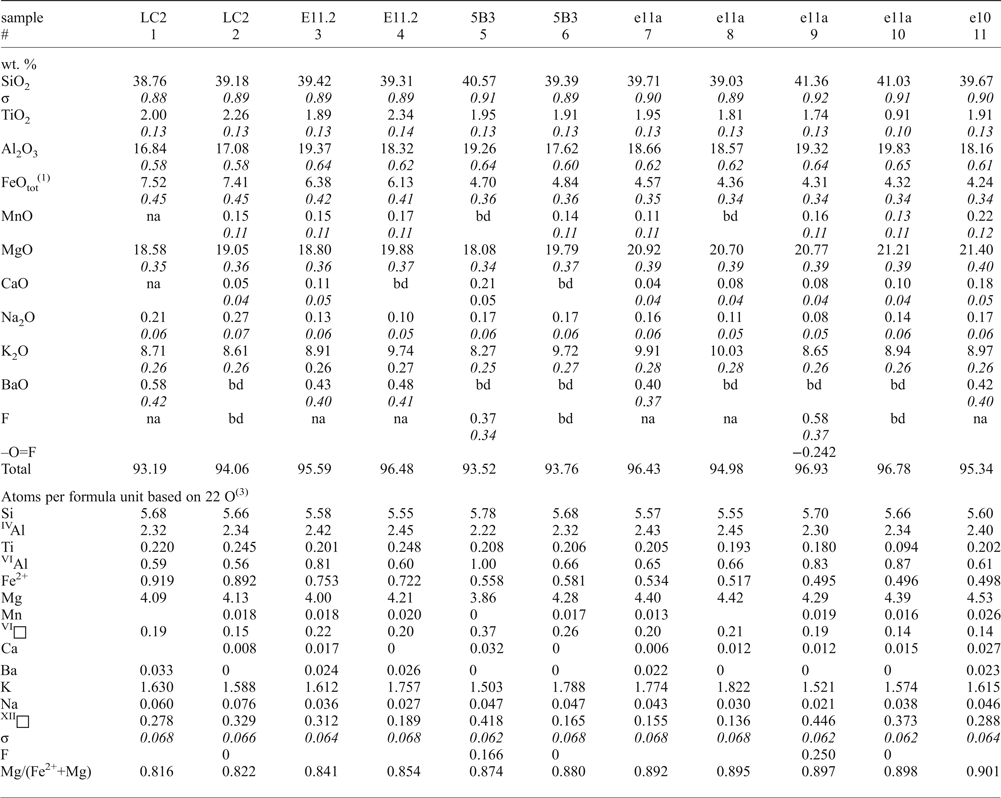
Selected EMPA results of Al-rich phlogopites from La Creuse, talc-free zone.

σ = Standard deviation in italics below each constituent; na = not analysed; bd = below detection
(1) Fe total calculated as FeO; (2) detection limit; (3) calculation after Rieder et al. (Reference Rieder, Cavazzini, D'yakonov, Frank-Kamenetskii, Gottardi, Guggenheim, Koval, Mueller, Neiva, Radoslovich, Robert, Sassi, Takeda, Weiss and Wones1998).
Geological setting
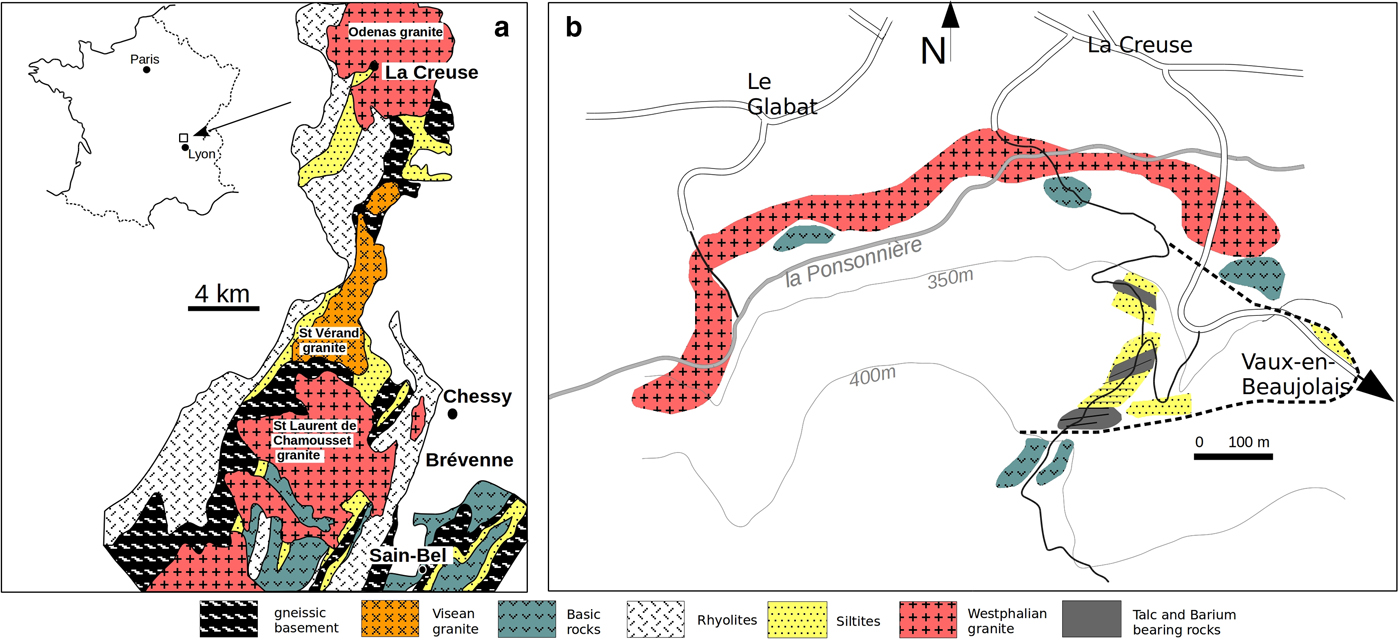
The phlogopite-bearing rocks of La Creuse occur in the southern Beaujolais region on the eastern boundary of the French Massif Central (Fig. 2a). They belong to a Palaeozoic mid-Visean metamorphic series, mainly composed of siltites, rhyolites and basic intrusive rocks, including mineralization, which overlies a gneissic basement and is overlain unconformably by upper Visean terranes (Tournis, Reference Tournis1990). This series is similar to and considered as the equivalent of the Brévenne series, such as described by Peterlongo (Reference Peterlongo1960) at 10 to 30 km south of La Creuse. Sulfide mineralization, formerly exploited, occur in the Brévenne series, at Sain Bel (exhalative type) and Chessy (massive sulfides/baryte). A sulfide ore with similar minerals (pyrite-chalcopyrite-arsenopyrite-sphalerite) to that of Sain Bel but smaller, with ~40,000 tons of ore, occurs at La Creuse (Fig. 2a). An important common feature to the Chessy and La Creuse sulfide mineralizations is the presence in both cases of phlogopitized aureoles. In southern Beaujolais as well as in the Brévenne area, Westphalian granite intrusions (granites of Odenas and of Saint-Laurent du Chamousset) have developed metamorphic aureoles in which rocks include hornfels, andalusite-biotite/phlogopite schists (Poupon, Reference Poupon1989) and cordierite-phlogopite schists (Tournis, Reference Tournis1990), as a result of a possible poorly defined regional metamorphism followed by contact metamorphism.
Location and geological sketch of the Brévenne series, Chessy and Sain-Bel sulfide deposits and La Creuse (after Peterlongo, Reference Peterlongo1960). (b). Field features of the occurrence of baryte–talc rocks at La Creuse.

The phlogopite-bearing rocks of La Creuse, mainly metasiltites and metarhyolites where identifiable (see below), have an outcrop of <100 m along a path in a vineyard (fig. 2b). Apart from this unique outcrop of phlogopite rocks, the outcrops and blocks in the vineyard are basic volcanic rocks crosscut by a network of hydrothermal veins. The relationships of the basic rocks to the phlogopite-bearing rocks are unknown, as the contact could not be observed, the important point being that both types of rocks are hydrothermalized.
Petrology of the phlogopitized terrains
Part of this hydrothermalized area is characterized by an abundant development of talc, mentioned by Lacroix (Reference Lacroix1910), partly replacing the original quartz. In the talc-absent region, the terrains are readily identified by their remnant texture and inherited (although modified) mineralogy. They are: (1) contact-metamorphosed siltites with biotite, cordierite and some muscovite; and (2) subordinate rhyolites and rhyolitic tufs, mostly in breccia-type association with the siltites. The original cordierite is completely altered to kaolinite-group minerals.
The talc-bearing region is characterized by a much deeper transformation that leaves no trace of its original state apart from breccia-type structures. The rocks are made essentially of talc, in some cases with abundant clinochlore, occasionally with celsian, and in most cases with almost entirely neo-crystallized phlogopite. Part of the talc-bearing rocks, also containing baryte and clinochlore, are devoid of phlogopite. Rutile is ubiquitous as an accessory mineral, tremolite also, but more irregularly scattered. The talc-bearing region typically contains minor oxidized sulfides either disseminated or organized in layers, occasionally associated with quartz, and very frequent lenses of baryte, monomineralic or associated with quartz, often with strong internal deformations strictly limited to the baryte crystals. Baryte is unrecrystallized, in striking contrast with the surrounding completely recrystallized silicate minerals, although it shows overall structural relations in complete harmony with the surrounding talc rocks. Such lenses in which quartz may be associated with baryte occur in rocks in which the bulk chemical compositions have Al:Si ratios that are variable but markedly lower than the metasiltites and metarhyolites (Tournis, Reference Tournis1990).
In accordance with such features, these regions are assumed to correspond to a metasomatic sequence in which the most transformed zone is the phlogopite-absent, talc-, baryte- and chlorite-bearing region, followed downstream by the talc-bearing region, itself followed by the talc-absent region. The boundary between talc-bearing and talc-absent zones, hereafter designed as the talc ‘front’, is characterized by the occurrences of talc, clinochlore or celsian and some tremolite in the upstream zone, in contrast with quartz, pseudomorphs after cordierite and muscovite (siltite type) or K-feldspar and albite (rhyolite type) in the downstream zone. Where the talc front is observed, the feldspar is hyalophane.
The most obvious chemical feature of the metasomatic changes is the addition of Mg, accompanied by loss of K, although no precise overall image of the infiltration metasomatic sequence could arise from field observations, even in the limited thickness of terrains concerned, due to the incomplete, discontinuous and altered character of the outcrops. The chemical evolution of the phlogopites is partly controlled by the metasomatic process, bearing in mind that changes in the bulk composition of the rocks between the talc-bearing and the talc-absent zones are most probably due not only to metasomatism, but also to lithological differences predating the metasomatic process, as indicated by the abundance of baryte ± quartz lenses in the talc zone. This lithologic difference seems to control the location of the talc front.
Analytical details
Chemical microanalysis
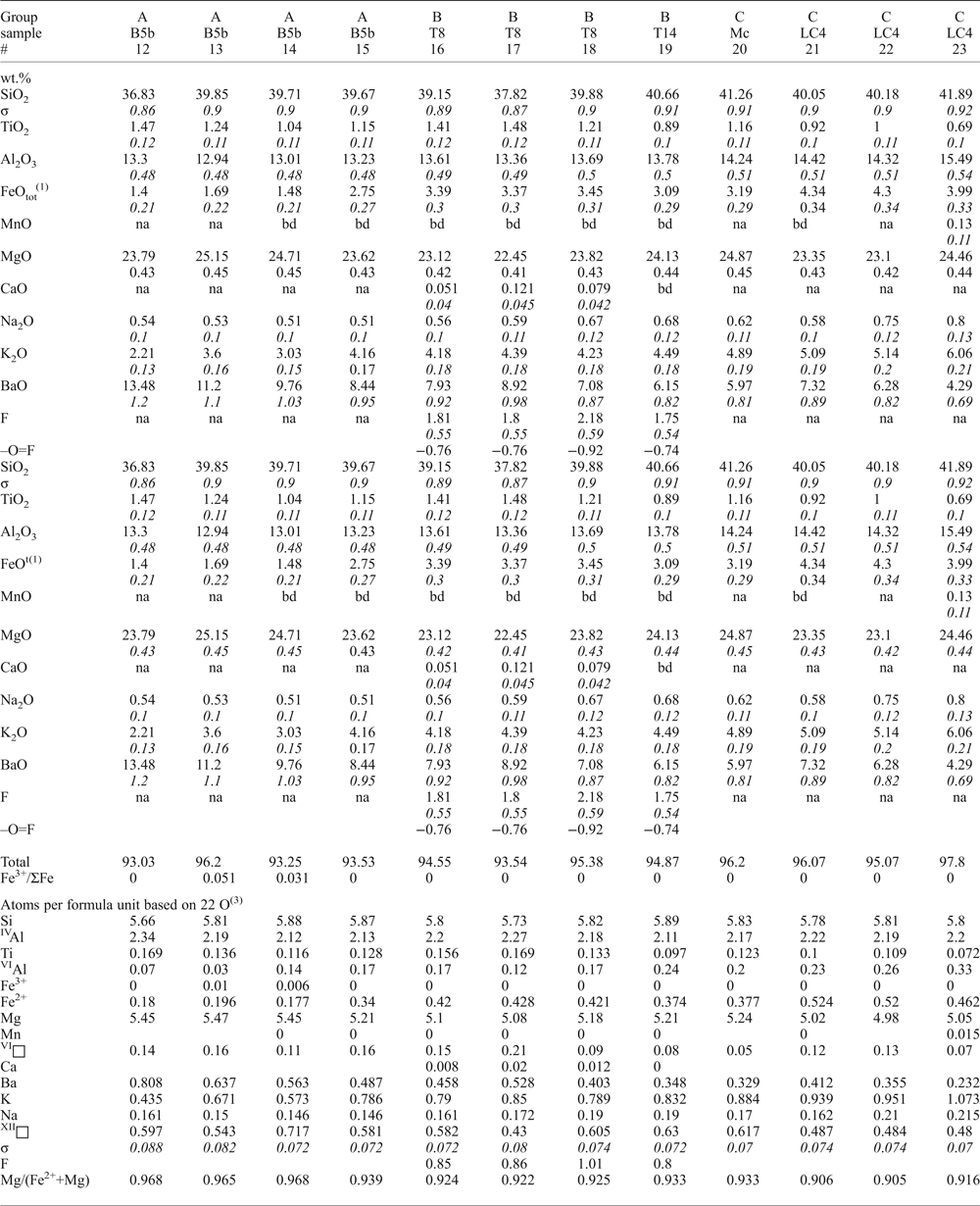
The phlogopites were analysed on MEB-FEG Zeiss Ultra 55 and Cameca SX-five microprobe with EDS Brüker, using beam conditions of 15 kV and 10 nA. Standards were albite (Na), orthoclase (K, Al), diopside (Si, Ca, Mg), hematite (Fe), pyrophanite (Ti, Mn), zircon (Zr), baryte (Ba), apatite (P), scapolite (Cl) and fluorite (F). The results in Table 1 (talc-absent zone) and Table 2 (talc-bearing zone) have been selected among 87 and 367 microanalyses, respectively. The standard deviations associated with the electron microprobe (EMPA) results are indicated in the tables, as well as the detection limits for elements at low concentration such as Mn and Ca, in both cases as weight percent of oxide. They allowed for the calculation of uncertainties on the structural formulae, mentioned in the text below, and especially the interlayer vacancy (Tables 1, 2).
Selected EMPA results of Ba-rich phlogopites from La Creuse, talc zone.

σ = Standard deviation in italics below each constituent; na = not analysed; bd = below detection.
(1) Fe total calculated as FeO; (2) detection limit; (3) calculation after Rieder et al. (Reference Rieder, Cavazzini, D'yakonov, Frank-Kamenetskii, Gottardi, Guggenheim, Koval, Mueller, Neiva, Radoslovich, Robert, Sassi, Takeda, Weiss and Wones1998).
The Fe3+/ΣFe ratio was quantified with the Cameca SX-five electron microprobe, using a peak-shift method protocol described in Fialin et al. (Reference Fialin, Wagner, Metrich, Humler, Galoisy and Bezos2001, Reference Fialin, Bezos, Wagner, Magnien and Humler2004, Reference Fialin, Wagner and Pascal2011). The Fe peak positions were determined on Ba-rich micas (sample B5b) and Ba-poor micas (sample LC2), using seven raw single crystals of mica from the Collection de minéraux de Sorbonne Université as a reference, with ten replicate measurements per spot. Fe total and Fe2+ in the reference single crystals were analysed by potentiometric titration.
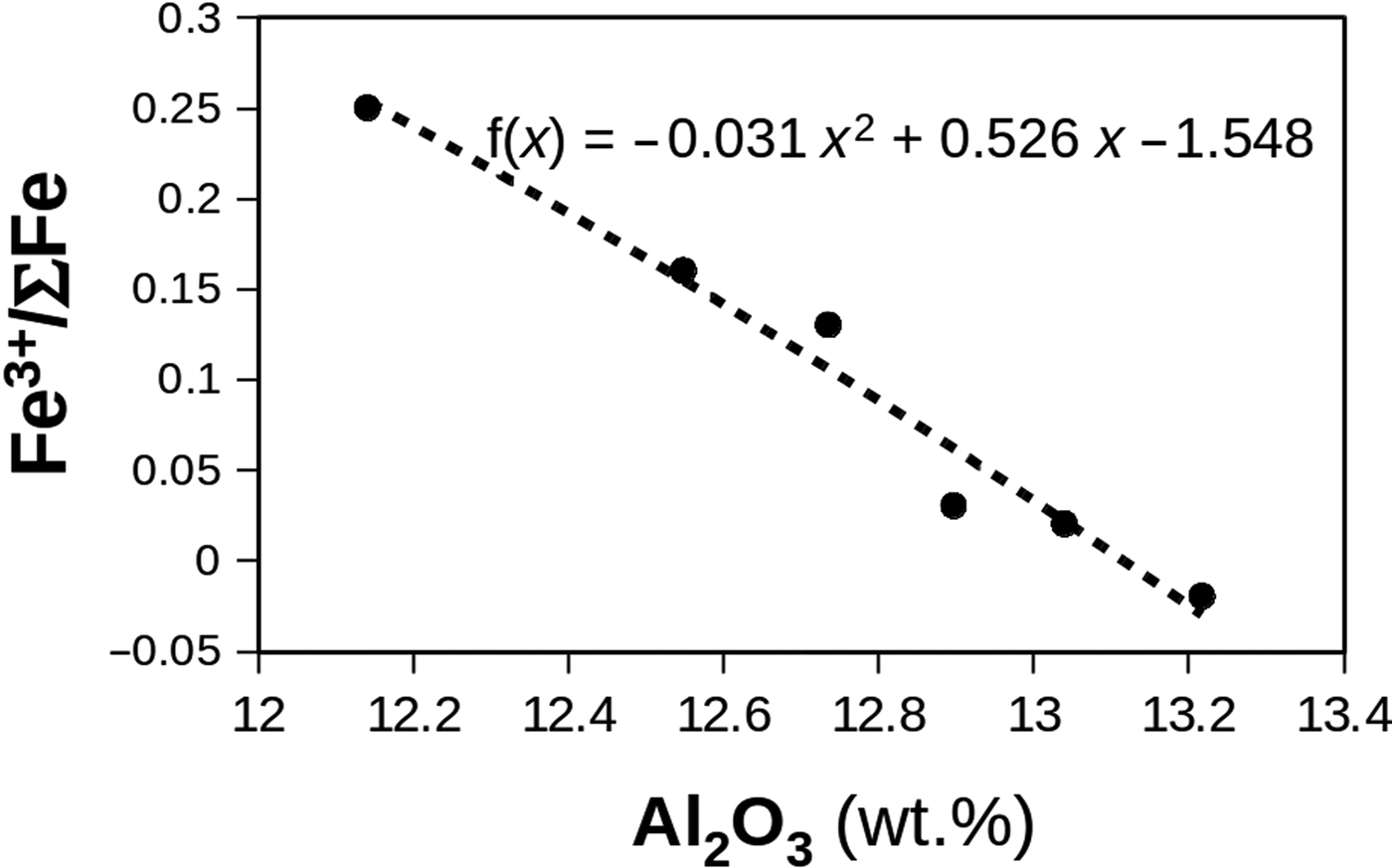
In the Ba-rich, Al-poor phlogopites, the ratio Fe3+/ΣFe shows a good inverse correlation with Al2O3 (wt.%) (Fig. 3) expressed by the relation:
 $${\rm Fe}^{3 +} /{\rm \Sigma Fe} = - 0.263{\rm Al}_2{\rm O}_3 + 3.448 \,\,\lpar {R^2 = 0.9652} \rpar $$
This correlation only corresponds to the phlogopites with <13 wt.% Al2O3. No similar correlation was observed in the Al-rich, Ba-poor phlogopites, which are virtually devoid of Fe3+.
Correlation of the ratio Fe3+/ΣFe with the Al content of the barian phlogopites from La Creuse.

X-ray diffraction analysis
X-ray diffraction (XRD) analysis was performed at the Plateforme de diffraction des rayons X, IMPMC-Sorbonne-Université. A single crystal was carefully extracted from a thin section and then mounted on a glass fibre for the XRD experiment. Diffracted intensities were collected at 293 K on an Oxford Diffraction Xcalibur S 4-circle diffractometer equipped with a Sapphire 3 CCD detector and using MoKα radiation (λ = 0.71073 Å, graphite monochromator).
CrysalisPro software (Agilent Technologies Ltd, Yarnton, England), was used for data acquisition and processing: data reduction, cell refinement, space-group determination, scaling, analytical absorption correction (Clark and Reid, Reference Clark and Reid1995). A preliminary experiment rapidly allowed us to determine the monoclinic unit cell and a strategy combining different omega scans was then automatically calculated to perform a complete measurement with an optimized redundancy. The data analysis lead to a monoclinic C2/m cell (R int = 5.31%) with refined parameters a = 5.3185(5) Å, b = 9.2136(9) Å, c = 10.1349(11) Å and β = 100.131(11)°.
After correction for Lorentz-polarization effects and absorption, the structure was then solved through the Olex2 program (Dolomanov et al., Reference Dolomanov, Bourhis, Gildea, Howard and Puschmann2009) by direct methods using SHELXT (Sheldrick, Reference Sheldrick2015) and gave rise to starting atomic coordinates consistent with previously described analogous structures (Bailey, Reference Bailey and Bailey1984).
The anisotropic structural refinement was then carried out with SHELXL2013 (Sheldrick, Reference Sheldrick2008) by full-matrix least squares minimization and difference-Fourier methods. Neutral atomic scattering factors were used. The crystallographic information files have been deposited with the Principal Editor of Mineralogical Magazine and are available as Supplementary material (see below).
Phlogopite chemical features
Talc-absent zone
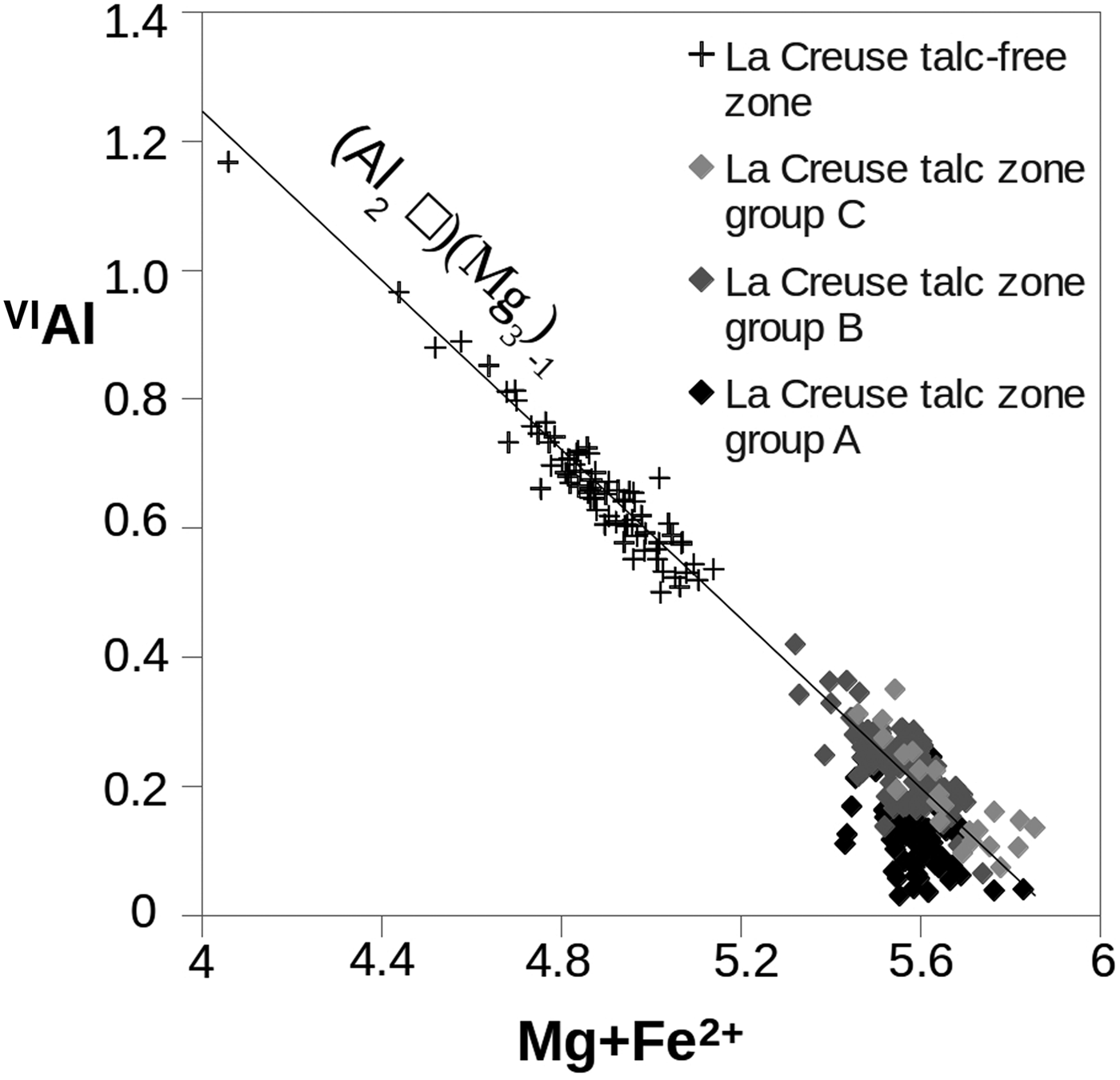
Phlogopites in the talc-absent zone are Al-rich, with variations possibly due to their occurrence in Al-rich, cordierite-bearing metasilitites, or in metarhyolites. Such variations are expressed by octahedral vacancies VI□ ranging from 0.1 to 0.4 pfu (for 44 valencies), due to the muscovitic (VI□VIAl2)(Mg3)–1 substitution in which VIAl is inversely correlated (–2:3) to (Mg + Fe2+) (Fig. 4). Another feature of these phlogopites is the presence of interlayer vacancies ranging from 0.10 to 0.46 ± 0.08 (Fig. 1a, Table 1), as already reported from metapelites from a contact metamophic aureole (Guidotti and Dyar, Reference Guidotti and Dyar1991; see below).
Compositional variations in the octahedral site (Al, Mg + Fe2+) of the phlogopites from La Creuse correspond to variable muscovitic substitution (VI□VIAl2)(Mg3)–1 in the talc-free rocks. Ba-rich phlogopites from the talc–baryte rocks have a much smaller muscovite content.

The gap in phlogopite compositions associated with the talc ‘front’
At the talc front, phlogopite is present on both sides but with strong differences both in composition and textural relations. Phlogopites from the talc zone differ without transition from their counterparts from the downstream talc-free zone, not only by their high Ba contents but also by higher Mg, lower Fe and Al, and partial replacement of K by Na (Tables 1, 2, Figs 4, 5). Each zone corresponds in various plots (Figs 4 to 7) to a dense, almost continuous, cluster of points, both clusters being separated by a gap.
Part of a triangular plot of K, Na and Ba proportions in the phlogopites from La Creuse. In the Ba-rich phlogopites K is partly replaced not only by Ba but also by Na.

The increased amount of Mg in phlogopite occurs mainly as a replacement of Fe2+ but also to a large extent of octahedral Al. Two classical substitutions involving replacement of VIAl by Mg are known as Tschermak (MgSi)(VIAlIVAl)–1 substitution, with a positive 1:1 correlation between Si and (Mg + Fe2+) as a diagnostic feature, and muscovitic substitution (Mg3)(VI□VIAl2)–1. The small increase in Si (<0.2 apfu, Fig. 1b, hardly higher than the standard deviation 0.18) that accompanies the large increase in (Mg + Fe2+) (>0.6, much larger than the standard deviation 0.14) indicates that the loss of Al is only marginally due the Tschermak substitution, and the change from one zone to the other mainly corresponds to the effect of the muscovitic substitution (Fig. 4).
Ba-phlogopites in the talc zone
Within the talc zone, phlogopite has a limited compositional range characterized by strikingly constant Mg + Fe2+ (Fig. 6a) whereas the Ba contents range from 0.22 ± 0.04 to 0.82 ± 0.08 apfu. Three comparatively homogeneous samples or groups of samples, A, B and C respectively, can be defined according to the Ba contents of the phlogopites. The increase in Ba from group C to group A is accompanied by an increase in octahedral vacancies and a correlated decrease in VIAl (Figs 7b,c), without change in either Mg + Fe2+ (Fig. 6a) or interlayer vacancy (Fig. 6c). The change in Ti with increasing Ba, hardly larger than the 2σ of the linear regression (Fig. 6b), may be ignored in the first approximation. With regard to Si (Fig. 7a), apart from a correlation with Ba within group A (a single sample) that can be accounted for by the Wendlandt substitution (BaIVAl)(KSi)–1 (see text below), no change is observed from one group to the others. Therefore, the whole range of compositions occurring in the talc zone corresponds approximately to a substitution involving only Ba, K, Al and octahedral vacancies, i.e. (BaVI□⅓)(KVIAl⅓)–1. The corresponding vector indicated on Figs 7a,b,c suggests that the set of analyses is adequately described by this substitution.
Elements virtually independent of the Ba content in the Ba-phlogopites from La Creuse: Mg + Fe2+(a); Ti (b); and interlayer vacancies (c). The linear regressions with standard deviations are indicated on the diagrams.

Variations correlated to Ba in the Ba-phlogopites from La Creuse. (a) Si remains in the same range in different sample groups, but in individual samples there is a –1:1 correlation consistent with the Wendlandt substitution. In contrast, octahedral Al (b) and vacancies (c) show trends consistent with the substitution (BaVI□⅓)(KVIAl⅓)–1 .

Before getting further precision, note that both ends, along this substitution, of the whole compositional range of the talc-zone phlogopites correspond to essential crystal chemical constraints, i.e. positive or null values for octahedral Al (Fig. 7b) and octahedral vacancies (Fig. 7c), respectively. These observations indicate that phlogopite in the talc zone requires sufficient Ba to be stable, the lower Ba contents corresponding to an entirely trioctahedral character of the phlogopite. At the other end of the trend, further incorporation of Ba is blocked by exhaustion of octahedral Al. This is probably the reason why, in the Ba-rich sample referred to as group A, a few compositions with higher Ba contents depart from the average through the Wendlandt substitution (BaIVAl)(KSi)–1 (Fig. 7), however, with a small extent due to the lack of Al in the host rock. This lack of Al is expressed by the good negative correlation observed between Fe3+ and Al, with significant amounts of Fe3+ restricted to the few analyses lowest in Al and highest in Ba (Fig. 3, Table 2).
The Ba substitution
The element-element plots of Figs 4 to 7 are clear enough to illustrate the general tendencies outlined above, but they do not provide full evidence for complex substitutions involving at least five independent end-members in micas. In order to obtain undisputable information on the substitution(s) involved in the Ba-rich phlogopite observed in the talc zone, we used a simple method of recalculating the phlogopite compositions on the basis of a set of independent exchange vectors applied to the additive component phlogopite K2Mg6Al2Si6O20(OH)4. In the present case, we first reduce the number of parameters by defining
 $$\eqalign {&{\rm K}{^\ast} = {\rm K} + {\rm Na},\; \cr & {\rm Mg}{^\ast} = {\rm Mg} + {\rm Fe}^{2 +} + \hbox{ Mn and }\cr & {\rm Al}{^\ast} = {\rm Al} + {\rm Fe}^{3 +}.} $$
Our choice of exchange vectors is

For each analysis, the set of values (x, y, z, t, u) has been determined from the composition (Si, Al*, Mg*, VI□, Ti, K*, XII□) by a linear regression. As the interlayer vacancy (z) remains quasi constant in the talc zone, compositional variations are entirely described by x, y and t (Fig. 8), with a possible small contribution of u. Linear regressions of x(t), y(t) and u(t) (Figs 8a,b, 6b) yield the main exchange vector controlling phlogopite compositions from the talc zone: –0.98 x + 0.29 y + 0.03 u + t, i.e. (BaVI□0.29Mg*0.08Ti0.03IVAl0.08)(K*VIAl*0.40Si0.08)–1. This exchange vector confirms, within uncertainties taken as 2σ of the linear regressions, the simplified vector anticipated above (BaVI□0.33)(KVIAl0.33)–1. The extent of replacement of K by Ba is constrained in the range ~0.24 to 0.80 apfu by the sum octahedral Al + octahedral vacancies, itself constrained by the constant (buffered) contents in other octahedral components, Mg + Fe (~5.62 ± 0.14) and Ti (~0.14 ± 0.014).
Linear regressions observed between the Wendlandt substitution t and: (a) the Tschermak substitution x; (b) the muscovitic substitution y, in the Ba-phlogopites from La Creuse. The standard deviations are indicated in brackets.

It must be emphasized that this substitution is observed within the talc zone, but cannot be extended to join the Al-rich phlogopite of the talc-absent zone. The Ba-richest compositions correspond approximately, apart for the small Ti content, to Ba0.76□0.56K*0.68Mg*6Al2.20Si5.80O20(OH)4 i.e. kinoshitalite0.38phlogopite0.34talc0.28, the interlayer vacancy being accounted for by the ‘talc’ substitution. The whole compositional range can be described chemically as solid solutions between talc and Ba-rich micas ranging from phlogopite0.79kinoshitalite0.21 to phlogopite0.47kinoshitalite0.53.
If the phlogopite–kinoshitalite solid solution is well documented (e.g. Bailey, Reference Bailey and Bailey1984; Brigatti and Poppi, Reference Brigatti and Poppi1993), the existence of a solid solution between talc and phlogopite is debated. There is evidence that in some cases the total number of atoms (K, Na and Ba) in the interlayer of trioctahedral micas is less than 2, down to 1.4 and even 1.3, as shown for instance by biotites from pelitic rocks belonging to a contact-metamorphic aureole in Maine, USA (Guidotti and Dyar, Reference Guidotti and Dyar1991; Brigatti et al., Reference Brigatti, Guidotti, Malferrari and Sassi2008). In that occurrence the number of vacant interlayer sites in the biotite seems to depend on the metamorphic grade, ranging on average from 0.34 ± 0.04 in the lower grades to 0.22 ± 0.06 in the sillimanite and anatectic zones. Si-rich phlogopites with up to 0.30 pfu vacancy in the interlayer region have also been described from peridotites. They correspond to the incorporation of significant amounts of talc component, tentatively interpreted as stabilized at high H2O pressure by the translation of talc (+H2O) to a 10 Å phase (Comodi et al., Reference Comodi, Nazzareni, Fumagallo and Capitani2011). The only described case of a large range of solid solution with talc occurs in the interlayer-deficient Na-mica wonesite (Spear et al., Reference Spear, Hazen and Rumble III1981).
If the Ba-rich phlogopite of La Creuse is a single phase, it is an interesting case. Other a priori possibilities are an interstratified compound with talc layers (such compounds however have never been described) or a non-homogeneous crystal with talc-rich nano-domains.
XRD data and structural refinements
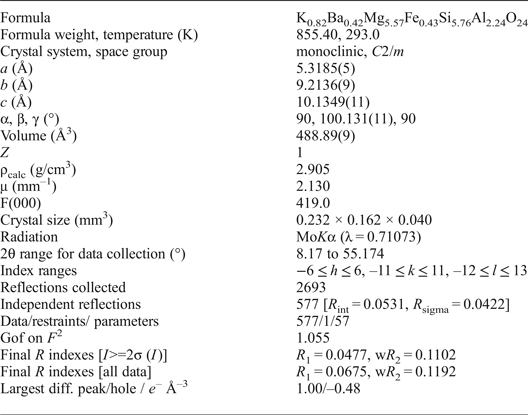
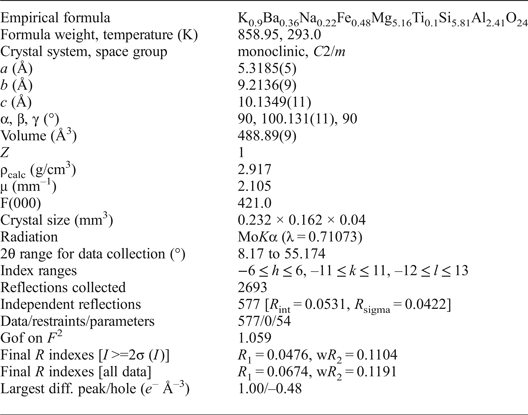
Single-crystal XRD analysis of sample Mica4_18092014 leads to a monoclinic C2/m cell (R = 5.31%) with a = 5.3185(5) Å, b = 9.2136(9) Å, c = 10.1349(11) Å and β = 100.131(11)°. The refinement procedure was carried out in two independent ways: first by refining Mg/Fe and Ba/K content at the octahedral site and at interlayer space, respectively, without any charge compensation consideration; second, by systematically testing a series of compositions determined from electron microprobe analysis. The results were then compared.
Refinement 1
As the Al/Si content at the tetrahedral site does not significantly influence the refinement, it was fixed to the usually accepted 1:3 ratio for phlogopite. The interlayer site was fixed with 100% K and the two octahedral sites were considered fully occupied by a 1:1 Mg/Fe ratio. Then, only the Mg/Fe ratios were refined and gave rise to a 92:8 Mg/Fe ratio for each site (R1 factor = 5.02%). These values were consistent with those obtained from microprobe analysis.
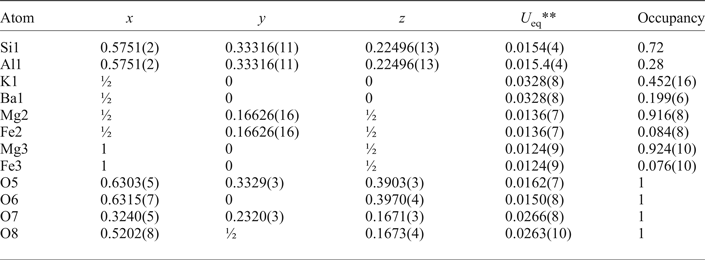
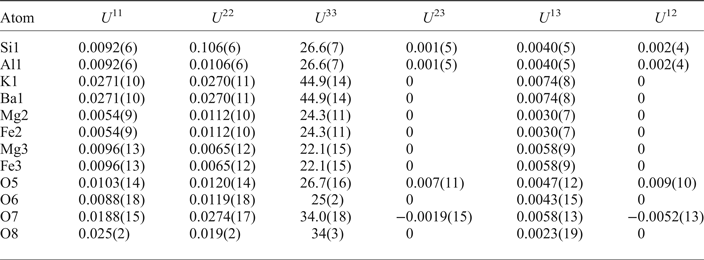
The refinement of K occupancy led to 109%, which partially confirmed the presence of a heavier atom within the interlayer space. We then introduced Ba and the K/Ba fraction was refined: a 96:3 K/Ba ratio was obtained (R 1 = 4.86%). As the expected proportions of Ba from EMPA are generally higher, this result is in favour of a vacancy in this site. Thus, we systematically refined the occupancies of Mg/Fe and K/Ba exploring different vacancies. The solutions giving the best R factor (4.77%), goodness-of-fit (1.06) and residuals (highest peak = 1) values were obtained with 15%<vacancy < 40% at the interlayer site. Such values for R, goodness-of-fit and residuals are fairly acceptable for this type of structure. Details for the data collection and structure determination parameters for an arbitrary retained 35% vacancy are given in Table 3, supplemented with Tables 4 and 5.
Crystal data and structure refinement of Mica4_18092014*.

*For an arbitrary retained 35% vacancy in interlayer site.
Fractional atomic coordinates and equivalent isotropic displacement parameters (Å2) of Mica4_18092014*.

* for an arbitrary retained 35% vacancy in interlayer site
** U eq is defined as ⅓ of the trace of the orthogonalized U ij tensor.
Anisotropic displacement parameters (Å2)* of Mica4_18092014**.

* The anisotropic displacement factor exponent takes the form: –2π2[h 2a*2U 11+2hka*b*U 12+…].
** for an arbitrary retained 35% vacancy in interlayer site.
Refinements 2 (based on chemical analysis)
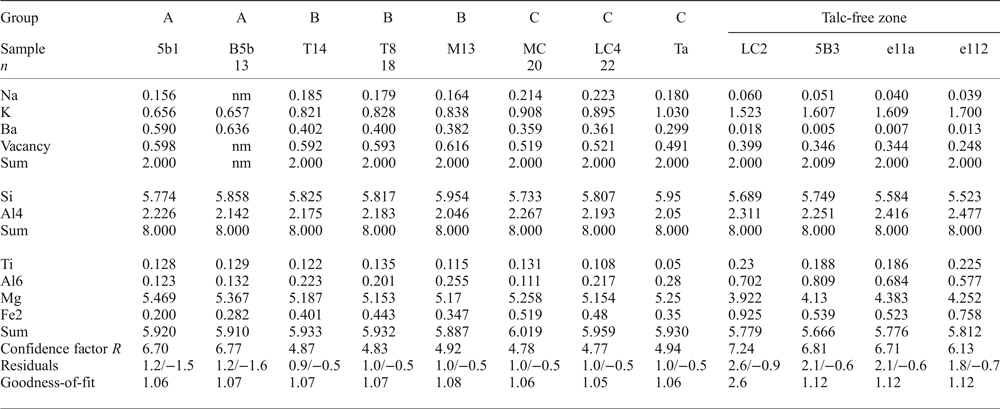
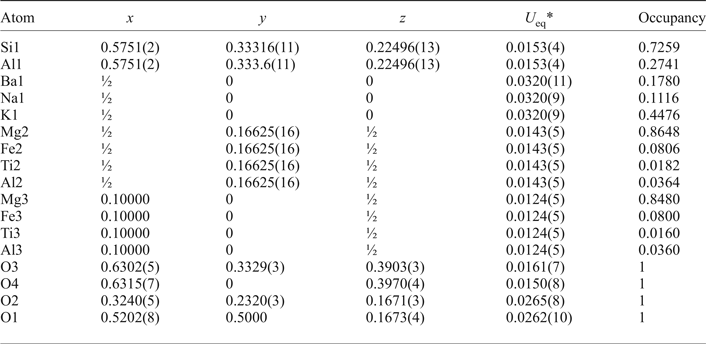
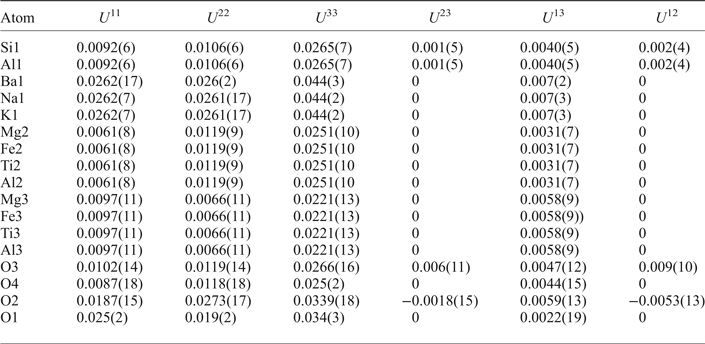
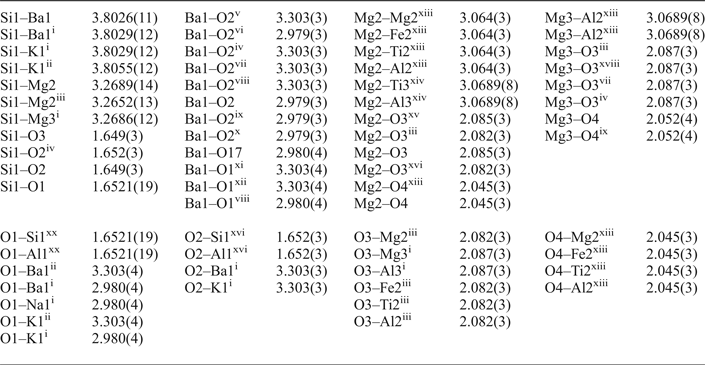
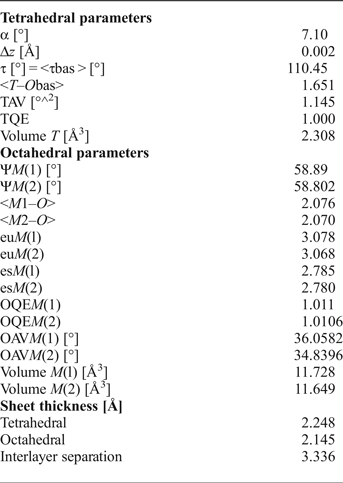
We then tried out a series of compositions determined from electron microprobe analysis (Table 6) for the crystal-structure refinement. We mainly observed that the models from the groups B and C (samples T14 to Ta) significantly stand out according to crystallographic agreement factors. The best fits were obtained with MC and LC4 compositions. These compositions were consistent with those obtained from our first refinement. The refinements assuming composition LC4 for the studied crystal, with empirical formula Ba0.36□0.52K0.90Na0.22Mg5.6Fe0.48Ti0.10Al2.42Si5.80O20(OH)4, are given in Tables 7, 8 and 9. Bond lengths are given in Table 10 and chemical crystal parameters, in Table 11, are based on the model of Mercier et al. (Reference Mercier, Rancourt, Redhammer, Lalonde, Robert, Berman and Kodama2006).
Mica compositions* tested in structural refinements.

* from EMPA. n = number of analyses; nm = not measured.
Crystal data and structure refinement* for LC4 composition.

* of Mica4_18092014.
Fractional atomic coordinates and equivalent isotropic displacement parameters (Å2)* for LC4 composition.

*U eq is defined as ⅓ of the trace of the orthogonalized U ij tensor.
Anisotropic displacement parameters (Å2)* for LC4 composition.

*The anisotropic displacement factor exponent takes the form: –2π2[h 2a*2U 11+2hka*b*U 12+…]
Bond lengths (Å) for LC4 composition.

Symmetry codes: (i) –½+x,½+y,+z; (ii) ½+x,½+y,+z; (iii) 3/2–x,½–y,1–z; (iv) ½+x,½–y,+z; (v) ½–x,–½+y,–z; (vi) 1–x,+y,–z; (vii) ½+x,–½+y,+z; (viii) ½–x,½–y,–z; (ix) 1–x,–y,–z; (x) +x,–y,+z; (xi) 3/2–x,½–y,–z; (xii) –½+x,–½+y,+z; (xiii) 1–x,–y,1–z; (xiv) –1 + x,+y,+z; (xv) 1–x,+y,1–z; (xvi) –½+x,½–y,+z; (xvii) 1 + x,+y,+z; (xviii) 3/2–x,–½+y,1–z; (ix) 2–x,–y,1–z; (xx) +x,1–y,+z
Chemical crystal parameters for LC4 composition.

α: Tetrahedral rotation angle; τ: tetrahedral flattening angle; TAV: tetrahedral angle variance (Robinson et al., Reference Robinson, Gibbs and Ribbe1971); TQE: tetrahedral quadratic elongation (Robinson et al., Reference Robinson, Gibbs and Ribbe1971); Ψ: octahedral flattening angle (Donnay et al., Reference Donnay, Donnay and Takeda1964; Toraya, Reference Toraya1981); OQE: octahedral quadratic elongation (Robinson et al., Reference Robinson, Gibbs and Ribbe1971); OAV: octahedral angle variance (Robinson et al., Reference Robinson, Gibbs and Ribbe1971).
Existence or not of a solid solution between phlogopite and talc
As mentioned above, a large range of solid solution with talc has been shown to occur in the interlayer-deficient Na-mica wonesite (Schreyer et al., Reference Schreyer, Abraham and Kulke1980; Spear et al., Reference Spear, Hazen and Rumble III1981), observed to contain exsolutions of talc lamellae (Veblen, Reference Veblen1983a,Reference Veblenb; Kogure et al., Reference Kogure, Miyawaki and Banno2005). Wonesite is structurally closer to talc than K-phlogopite as regards the layer offset (Kogure et al., Reference Kogure, Miyawaki and Banno2005) which is caused by repulsion between facing basal oxygen atoms across the interlayer region. The amount of layer offset is limited by the interlayer cations located in the cavity space of the oxygen hexagonal (ditrigonal) rings. In accordance with the small size of Na+ ions, the interlayer-deficient Na mica wonesite contains a large layer offset (1.25 Å), thus more resembling talc (1.55 Å, Ďurovič Reference Ďurovič and Wilson1992) than K-rich micas. In accordance, talc exsolutions observed in wonesite are believed to indicate an appreciable range of solid solution between talc and Na-rich phlogopite (Veblen, Reference Veblen1983a). In the case of large cations (K+ and Ba2+), even if the hexagonal rings are not reduced in size by tetrahedral rotation, no layer offset occurs (Bailey, Reference Bailey and Bailey1984).
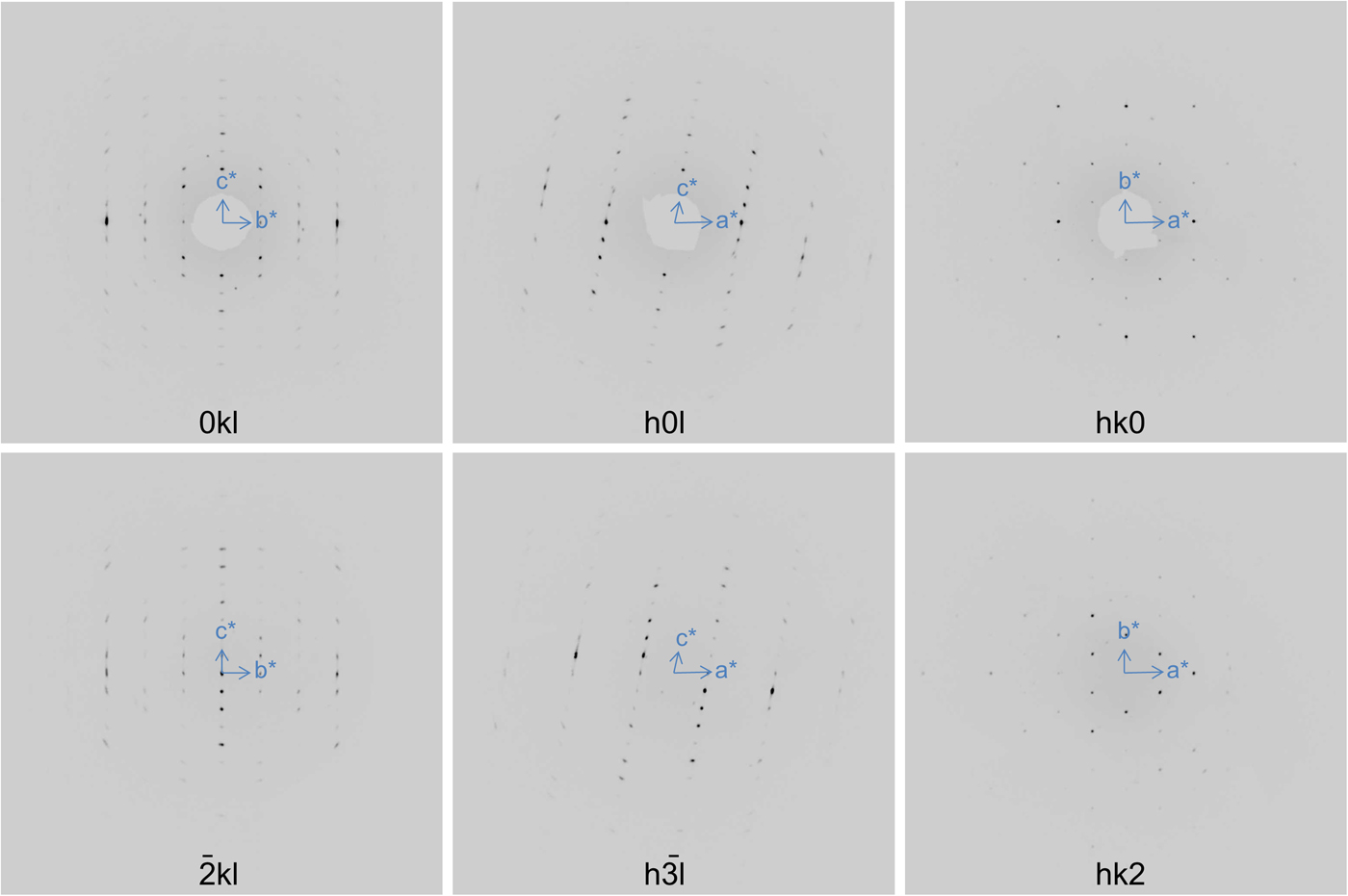
We performed a series of reconstructions of precession images (Fig. 9) showing different hkl planes, in which can be noticed the absence of any systematic Bragg spots incompatible with the unit-cell parameters determined for the crystal LC4. These images reveal a good crystalline quality, although it remains impossible to detect any intercalated nano-domain using the XRD technique.
Series of (hkl) precession images of the Ba-phlogopite from La Creuse (Mica4_18092014).

The hypothesized presence of talc layers in amounts as high as 28 mol.% would result in a departure from monoclinic symmetry towards hexagonal symmetry and in appreciable changes in crystallographic parameters, in particular β and c. β in LC4 is 100.131°, larger than in both phlogopite (100.08°) and kinoshitalite (99.99°), contrary to the expected effect of talc (98.68° for triclinic talc). The c parameter of a solid-solution phlogopite–kinoshitalite 72:28 is calculated as 10.190 Å. Assuming that the measured c parameter of a hypothetical mixture of this Ba-mica and talc (c = 9.46 Å) can be inferred from their proportions, in order to obtain the value of c measured in LC4 (10.1349 Å) the proportion of talc should be as low as 6.5%, far below 28%.
The cell parameters of LC4 can be compared to phlogopites from literature (review in Brigatti and Guggenheim, Reference Brigatti, Guggenheim, Mottana, Sassi, Thompson and Guggenheim2002) selected according to: (1) the octahedral sheet, as similar as possible to that of La Creuse, Fe- and Ti-poor, in order to minimize differences in dimension of the octahedral sheet; and (2) the interlayer filling, either mainly K, or including Ba in phlogopite–kinoshitalite solid solution, or including vacancies. The tetrahedral rotation 7.1° is small, consistent with that in Si-rich potassic phlogopites, in agreement with the composition of the tetrahedral sheet close to Si:Al = 3 (Fig. 10a,b). In contrast, in kinoshitalites characterized by an increased substitution of Al to Si balancing the substitution of Ba to K, the tetrahedral rotation is increased to counterbalance the larger mean size of the tetrahedra (Bailey, Reference Bailey and Bailey1984; Brigatti and Poppi, Reference Brigatti and Poppi1993; Brigatti and Guggenheim, Reference Brigatti, Guggenheim, Mottana, Sassi, Thompson and Guggenheim2002). The interlayer separation in LC4 is smaller than in phlogopite, and consistent with that in kinoshitalites with similar Ba content (Fig. 10c), in agreement with the stronger attraction on tetrahedra exerted by Ba2+ than by K+ (Brigatti and Poppi, Reference Brigatti and Poppi1993). This apparent lack of influence of the assumed vacancies on the interlayer separation may seem surprising because with a partly vacant interlayer space, repulsion between facing basal oxygen atoms is expected to result in an enlarged interlayer separation. However, the cavity space for the interlayer cations is larger in LC4 than in a phlogopite–kinoshitalite solid solution having the same Ba content because the tetrahedral rotation is smaller in LC4, in accordance with the general inverse correlation between interlayer separation and tetrahedral rotation (Brigatti and Guggenheim, Reference Brigatti, Guggenheim, Mottana, Sassi, Thompson and Guggenheim2002).
Comparison of structural parameters between the Ba-phlogopite from La Creuse (LC4) and selected trioctahedral micas from literature listed below: relationships between the tetrahedral rotation angle α and: (a) the Ba content in kinoshitalites and phlogopites with or without interlayer vacancies; (b) the composition of tetrahedral sheet in a large range of compositions. (c) Dependence of the interlayer separation on the Ba content.
1 – (K0.70Na0.22Ba1.16)( ${\rm Fe}_{{\rm 0}{\rm. 10}}^{{\rm 3 +}} $ Al0.44Mg4.14
 ${\rm Mn}_{{\rm 1}{\rm. 04}}^{{\rm 2 +}} $)(Si4.10Al3.88Ti0.02)O20.66F0.10(OH)3.24 Kato et al. (Reference Kato, Miùra, Yoshii and Maeda1979)
2 – (K1.16Na0.18Ba0.70)( ${\rm Fe}_{{\rm 0}{\rm. 08}}^{{\rm 3 +}} $ Al0.70Mg4.20
 ${\rm Mn}_{{\rm 1}{\rm. 04}}^{{\rm 2 +}} {\rm Mn}_{{\rm 0}{\rm. 44}}^{{\rm 3 +}} $)(Si4.66Al3.30Ti0.02)O21.50F0.14(OH)2.36 Guggenheim and Kato (Reference Guggenheim and Kato1984)
3 – (K0.12Na0.02Ba1.98)(Al0.08Mg5.28Mn0.62)(Si4.06Al3.94)O20F0.74Cl0.04(OH)3.22 Gnos and Armbruster (Reference Gnos and Armbruster2000)
4 – (K0.81Na0.08Ca0.02Ba1.09)(Al0.33 ${\rm Fe}_{{\rm 0}{\rm. 54}}^{{\rm 2 +}} $ Mg5.07Ti0.05)(Si4.34Al3.66)O19.88F1.43(OH)2.70 Brigatti and Poppi (Reference Brigatti and Poppi1993) #27
5 – (K0.95Na0.08Ca0.01Ba0.96)(Al0.40 ${\rm Fe}_{{\rm 0}{\rm. 59}}^{{\rm 2 +}} $ Mg4.88Mn0.04Ti0.09)(Si4.40Al3.60)O19.94F1.34(OH)2.72 Brigatti and Poppi (Reference Brigatti and Poppi1993) #26
6 – (K1.77Ba0.23)(Al0.49 ${\rm Fe}_{{\rm 0}{\rm. 47}}^{{\rm 3 +}} {\rm Fe}_{{\rm 1}{\rm. 53}}^{{\rm 2 +}} $ Mg3.16Mn0.01Ti0.34)(Si5.17Al2.83)O21.05F0.52(OH)2.43 Brigatti and Poppi (Reference Brigatti and Poppi1993) #25
7 – (K1.76Na0.16Ba0.07)(Al0.23 ${\rm Fe}_{{\rm 0}{\rm. 93}}^{{\rm 3 +}} {\rm Fe}_{{\rm 0}{\rm. 84}}^{{\rm 2 +}} $ Mg3.70Mn0.02Ti0.28)(Si5.30Al2.70)O21.12F0.03(OH)2.85 Brigatti and Poppi (Reference Brigatti and Poppi1993) #23
8 – (K1.75Na0.14Ca0.05Ba0.06)(Al1.86 ${\rm Fe}_{{\rm 0}{\rm. 82}}^{{\rm 3 +}} {\rm Fe}_{{\rm 0}{\rm. 78}}^{{\rm 2 +}} $ Mg2.21Mn0.05Ti0.28)(Si5.36Al2.64)O22.71F0.29(OH)1.00 Brigatti and Poppi (Reference Brigatti and Poppi1993) #20
9 – (K1.96Na0.02)( $\; {\rm Fe}_{{\rm 0}{\rm. 16}}^{{\rm 3 +}} {\rm Fe}_{{\rm 0}{\rm. 26}}^{{\rm 2 +}} $ Mg5.46Ti0.12)(Si5.64Al2.08
 ${\rm Fe}_{{\rm 0}{\rm. 28}}^{{\rm 3 +}} $)O20.02F0.22(OH)3.76 Brigatti and Guggenheim Reference Brigatti, Guggenheim, Mottana, Sassi, Thompson and Guggenheim2002) #73
10 – (K1.86Na0.10Ba0.04)( $\; {\rm Fe}_{{\rm 0}{\rm. 32}}^{{\rm 3 +}} {\rm Fe}_{{\rm 0}{\rm. 18}}^{{\rm 2 +}} $ Mg3.30Ti0.16)(Si5.68Al2.08
 ${\rm Fe}_{{\rm 0}{\rm. 24}}^{{\rm 3 +}} $)O20.34F0.02(OH)3.64 Brigatti et al. (Reference Brigatti, Medici, Saccani and Vaccaro1996) #Tae23-1a
11 – (K1.92Na0.06Ba0.02)( $\; {\rm Fe}_{{\rm 0}{\rm. 42}}^{{\rm 3 +}} {\rm Fe}_{{\rm 0}{\rm. 14}}^{{\rm 2 +}} $ Mg5.28Mn0.02Ti0.12)(Si5.70Al2.20
 ${\rm Fe}_{{\rm 0}{\rm. 10}}^{{\rm 3 +}} $)O20.26F0.12(OH)3.62 Brigatti et al. (Reference Brigatti, Medici, Saccani and Vaccaro1996) #Tas27-Bb
12 – (K1.80Na0.04)(Al0.14 ${\rm Fe}_{{\rm 0}{\rm. 32}}^{{\rm 2 +}} $ Mg5.40Ti0.06)(Si5.82Al2.18)O19.80F2.26(OH)1.94 Brigatti and Guggenheim (Reference Brigatti, Guggenheim, Mottana, Sassi, Thompson and Guggenheim2002) #70
13 – (K1.86Na0.08)(Al0.48 ${\rm Fe}_{{\rm 0}{\rm. 18}}^{{\rm 3 +}} {\rm Fe}_{{\rm 0}{\rm. 24}}^{{\rm 2 +}} $ Mg4.96Mn0.02Ti0.04)(Si5.48Al2.52)O19.98F0.12(OH)3.90 Alietti et al. (Reference Alietti, Brigatti and Poppi1995) #1a
14 – (K1.86Na0.08)(Al0.48 ${\rm Fe}_{{\rm 0}{\rm. 14}}^{{\rm 3 +}} {\rm Fe}_{{\rm 0}{\rm. 22}}^{{\rm 2 +}} $ Mg5.10Mn0.02Ti0.04)(Si5.30Al2.70)O19.92F0.18(OH)3.90 Alietti et al. (Reference Alietti, Brigatti and Poppi1995) #1b
15 – (K1.86Na0.04Ba0.02)(Al0.36 ${\rm Fe}_{{\rm 0}{\rm. 30}}^{{\rm 3 +}} {\rm Fe}_{{\rm 0}{\rm. 06}}^{{\rm 2 +}} $ Mg5.26Ti0.04)(Si5.20Al2.80)O19.86F0.22(OH)3.92 Alietti et al. (Reference Alietti, Brigatti and Poppi1995) #2a
16 – (K1.90Na0.04Ba0.02)(Al0.94 ${\rm Fe}_{{\rm 0}{\rm. 30}}^{{\rm 3 +}} {\rm Fe}_{{\rm 0}{\rm. 14}}^{{\rm 2 +}} $ Mg4.46Mn0.08Ti0.02)(Si5.00Al3.00)O20.04F0.08(OH)3.88 Alietti et al. (Reference Alietti, Brigatti and Poppi1995) #3a
17 – (K1.54Na0.32Ba0.10)Mg6.00 (Si5.90Al2.10)O20F2.60(OH)1.40 Hazen and Burnham (Reference Hazen and Burnham1973)
18 – (K1.94Na0.02Ba0.04)( $\; {\rm Fe}_{{\rm 0}{\rm. 06}}^{{\rm 2 +}} $ Mg4.92
 ${\rm Ti}_{{\rm 0}{\rm. 18}}^{{\rm 3 +}} $ Li0.46Na0.22) (Si6.62Al0.08
 ${\rm Fe}_{{\rm 1}{\rm. 30}}^{{\rm 3 +}} $)O20F4.0 Hazen et al. (Reference Hazen, Finger and Velde1981)
19 – (K1.72Na0.04)(Al0.96 ${\rm Fe}_{{\rm 1}{\rm. 20}}^{{\rm 2 +}} $ Mg3.38Mn0.06Zn0.02Ti0.22)(Si5.50Al2.40
 ${\rm Fe}_{{\rm 0}{\rm. 10}}^{{\rm 3 +}} $)O20.28F0.24(OH)3.48 Brigatti et al. (Reference Brigatti, Guidotti, Malferrari and Sassi2008) #O-K-9
20 – (K1.50Na0.12Ba0.12)(Al0.2Cr0.06 ${\rm Fe}_{{\rm 0}{\rm. 04}}^{{\rm 3 +}} {\rm Fe}_{{\rm 0}{\rm. 32}}^{{\rm 2 +}} $ Mg5.42Ti0.12)(Si5.62Al2.38)O20.24F0.06Cl0.04(OH)3.66 Comodi et al. (Reference Comodi, Nazzareni, Fumagallo and Capitani2011) #MO10-1
21 – (K1.48Na0.18Ba0.12)(Al0.24Cr0.06 ${\rm Fe}_{{\rm 0}{\rm. 04}}^{{\rm 3 +}} {\rm Fe}_{{\rm 0}{\rm. 32}}^{{\rm 2 +}} $ Mg5.34Ti0.10)(Si5.70Al2.30)O20.24F0.06Cl0.04(OH)3.66 Comodi et al. (Reference Comodi, Nazzareni, Fumagallo and Capitani2011) #MO10-2
22 – (K1.62Na0.06Ba0.02)(Al0.28Cr0.06 ${\rm Fe}_{{\rm 0}{\rm. 02}}^{{\rm 3 +}} {\rm Fe}_{{\rm 0}{\rm. 26}}^{{\rm 2 +}} $ Mg5.54Ti0.02)(Si5.66Al2.34)O20.14F0.04Cl0.04(OH)3.86 Comodi et al. (Reference Comodi, Nazzareni, Fumagallo and Capitani2011) #300b-1
23 – (K1.62Na0.06Ba0.02)(Al0.32Cr0.06 ${\rm Fe}_{{\rm 0}{\rm. 04}}^{{\rm 3 +}} {\rm Fe}_{{\rm 0}{\rm. 30}}^{{\rm 2 +}} $ Mg5.30Ti0.06)(Si5.68Al2.32)O20.14F0.04Cl0.04(OH)3.86 Comodi et al. (Reference Comodi, Nazzareni, Fumagallo and Capitani2011) #300b-2
24 – (K0.17Na0.95)(Al0.78Cr0.01Fe0.75Mg4.21Ti0.07)(Si6.20Al1.80)O20(OH,F)4 Kogure et al. (Reference Kogure, Miyawaki and Banno2005)

Reasons for doubting the likelihood of the talc substitution (charge imbalance on the basal oxygen atoms, large expected interlayer cavity following the presence of vacancies compared to that in kinoshitalite) probably set limits on this solid solution. What is observed is that the mole fraction of talc is neither smaller nor larger than 0.28 (±0.03). This value thus may reflect the saturation in talc component. Most importantly, if the Ba-mica were a mixture of two phases, talc and Ba-phlogopite, with talc nano-domains or layers, the relative amounts of both components would be unconstrained, as the bulk chemical composition of the rocks is highly variable, especially as regards the Ba content. In contrast, there is no exception to the constant character of the mole fraction of the talc component, in spite of the large number of available analyses (201). Therefore, the observed composition must correspond to a single phase, or possibly to a former single phase secondarily unmixed as in the case of wonesite with talc exsolutions. Owing to the probably moderate temperature of the talc-forming metasomatic process, such a single phase may well have been metastable at the time of its formation.
Control by petrochemistry
The Ba-rich phlogopite of La Creuse occurs in talc-bearing metasomatic rocks of felsic volcanosedimentary origin, characterized by high contents of Si and Ba (as celsian and as baryte lenses), in contact with metasiltites and metarhyolites, devoid of typical Ba-rich minerals, in which the same metasomatic process developed more common Al-rich phlogopite. The Ba-rich phlogopite compositional range differs from the Al-rich phlogopite by: (1) lower K and correlatively higher Ba, Na and interlayer vacancies; and (2) higher Mg and a reduced content, down to 0, in the muscovite end-member.
Mg-metasomatism vs protolith chemistry
In the talc-absent zone, Al-rich phlogopite formed through reaction between the Mg-rich infiltrating fluid and K-feldspar or muscovite. In the part of the metasomatic sequence observed in La Creuse, muscovite (and pseudomorphs after cordierite) persist as residual islands. The presence of Ba is restricted to the occurrence of hyalophane replacing K-feldspar close to the baryte zone (apart from a few late-stage crosscutting baryte geodic veinlets). In the talc + baryte zone, the Ba-rich phlogopite was produced by a similar reaction between feldspar, now present as celsian, and the talc-producing magnesian fluid. The Ba contents of both phlogopite and feldspars are related by a reciprocal equilibrium between celsian, K-feldspar, phlogopite and kinoshitalite:
 $$\eqalign{& {\rm K}_2{\rm Mg}_6{\rm Al}_2{\rm Si}_6{\rm O}_{20}\lpar {{\rm OH}} \rpar _4{\rm +} 2{\rm BaAl}_2{\rm Si}_2{\rm O_8} = \cr & \quad {\rm Ba}_2{\rm Mg}_6{\rm Al}_4{\rm Si}_4{\rm O}_{20}\lpar {{\rm OH}} \rpar _4 + 2{\rm KAlSi}_3{\rm O}_8} $$
which involves the Wendlandt substitution (BaAl)(KSi)–1 as an exchange vector in both solid solutions. However, this substitution is not that observed in the phlogopite. The remarkable invariance of both Si and Mg + Fe2+ contents in phlogopites from the talc zone, emphasized above as the major control on the compositional range of the Ba-rich phlogopite, is suggested to result from buffering by the metasomatic conditions that produced large amounts of talc and preserved the persistence of quartz, especially inside some baryte lenses. The observed composition of the Ba-rich phlogopite is therefore controlled by the Mg-metasomatic process that produced talc in a Ba-rich and Si-rich, Al-poor rock, and this mineral is essentially a Ba-mineral, therefore not the same mineral (from a petrological viewpoint) as the Al-rich phlogopite.
Interlayer vacancies
A distinctive feature of the metasomatic process is the leaching of K, evidenced by: (1) the replacement of K by Na between the Ba-poor, talc-absent zone and the talc zone (Fig. 5); (2) the replacement of K by Ba in both the feldspar and the phlogopite in the Ba-rich zone in which no K-feldspar is left; and finally (3) the absence of any K-bearing mineral in the upstream, phlogopite-absent, talc-chlorite zone. This tendency is consistent with the high level of interlayer vacancy in the phlogopites from La Creuse (0.56 pfu in phlogopite in equilibrium with talc), compared to more common Ba-rich phlogopites. Whereas the micas from granites, pegmatites and volcanic or subvolcanic alkaline rocks, all rocks in which the mica is in equilibrium with K-feldspar or leucite, have usually two atoms in the interlayer site (Foster, Reference Foster1960), a total number of atoms (K, Na and Ba) less than 2, down to 1.4, can be found in micas from rocks devoid of K-feldspar such as the metapelites belonging to the contact-metamorphic aureole mentioned above (Guidotti and Dyar, Reference Guidotti and Dyar1991; Brigatti et al., Reference Brigatti, Guidotti, Malferrari and Sassi2008) or the talc-absent metarhyolites and metapelites at La Creuse. A possible interpretation could be that the chemical potential of K2O would be too low to saturate the biotite interlayer site. Such an interpretation is consistent with the peculiarities of phlogopite in the talc zone of La Creuse, undoubtedly stabilized by the availability of Ba in conditions of K leaching out.
To conclude, this Ba-phlogopite is original by a composition chemically corresponding to the vacancy-producing substitution (Ba0.5□0.5)(K)–1 which maintains the maximum Si content. This substitution can be decomposed as ½ Wendlandt substitution (BaAl)(KSi)–1 + ½ ‘talc’ substitution (□Si)(KAl)–1. The interlayer vacancy is therefore essential to the charge balance in a phlogopite rich in both Ba and Si. This result is supported by the XRD analysis and is consistent with a single phase close to phlogopite for most cell parameters and with an interlayer vacancy. It is also supported by the petrology of the Ba-rich rocks at La Creuse in which Si-rich and Mg-rich conditions are evidenced by the important development of talc. As counter examples, phlogopites from rocks containing baryte and devoid of talc are unknown at La Creuse but are commonly observed in the nearby sulfide deposit of Chessy (Fig. 2a), where the mineralized area is also located in a Mg metasomatic aureole. Only one sample of ore containing Ba-rich phlogopite has been reported (Poupon, Reference Poupon1989), and this Ba-phlogopite belongs to the ordinary type with filled interlayer (Fig. 1a).
Acknowledgements
We are indebted to Imène Esteve (Plate-forme de microscopie électronique MEB-FIB, IMPMC, Sorbonne Université) for MEB assistance, and to Michel Fialin for EMPA assistance (service CAMPARIS, Sorbonne Université).
Many thanks are due to the collection de minéraux de Sorbonne Université for providing specimens of mica. They have been analyzed at the Service d'Analyse des Roches et des Minéraux of the CRPG (Nancy) thanks to Olivier Beyssac. We also thank Philippe d'Arco (ISTeP) for fruitful discussions. Many thanks are due to several reviewers whose careful reading, questions and comments helped improve this paper.
Supplementary material
To view supplementary material for this article, please visit https://doi.org/10.1180/mgm.2018.124