

Introduction
The financial and economic crisis that hit Europe from 2008 onwards has the potential to strongly influence voting behaviour in European democracies. Even though multiparty systems and coalition governments in Europe obscure clarity of responsibility (Powell and Whitten, Reference Powell and Whitten1993), previous research has indicated strong economic effects in elections across Europe (Lewis-Beck and Stegmaier, Reference Lewis-Beck and Whitten2000; Lewis-Beck, Reference Lewis-Beck2006; van der Brug et al., Reference van der Brug, van der Eijk and Franklin2007; Duch and Stevenson, Reference Duch and Stevenson2008). Furthermore, a general negativity bias among voters and in the media leads to the expectation that economic effects are even more pronounced in times of crisis (Bloom and Price, Reference Bloom and Price1975; Soroka, Reference Soroka2006; Dassonneville and Lewis-Beck, Reference Dassonneville and Lewis-Beck2014a).
At first sight, these considerations apply to national levels of governance only. At a local level, by contrast, one could expect economic factors to be of less importance. The strong results of previous research on economic voting across countries and contexts, however, lead to the expectation that vote choices at a local level can also be affected by the economy. While scholars in the field of economic voting have predominantly focussed on national electoral contexts, some authors have already investigated the economic vote in subnational contexts (Johnston and Pattie, Reference Johnston, Pattie, Dorling, MacAllister, Tunstall and Rossiter2001; Cutler, Reference Cutler2002; Jérôme and Jérôme-Speziari, Reference Jérôme and Lewis-Beck2005; Berry and Howell, Reference Berry and Howell2007; Auberger and Dubois, Reference Auberger and Dubois2011). Most of these studies, however, either focus on how national economic conditions affect the local vote or on how the local economic context affects voting in national elections. The limited number of studies that sheds light on how local economic conditions affect voting in local elections, furthermore, is mostly focussing on the aggregate level, that is, investigating shifts in the incumbent’s vote share (Sakurai and Menezes-Filho, Reference Sakurai and Menezes-Filho2008; Boyne et al., Reference Boyne, James, John and Petrovsky2009; Martins and Veiga, Reference Martins and Veiga2013). While insightful, such an approach is also subject to ecological fallacy, which is why these findings have to be complemented with insights from individual-level studies (Oliver and Ha, Reference Oliver and Ha2007).
In this paper, we aim to shed light on this link between local economic conditions and the individual vote choice in local elections. We do so by means of an analysis of individual voting behaviour in the Belgian municipal elections of October 2012. We make use of the data of the PartiRep exit poll 2012, containing data on over 4500 voters in 40 Belgian municipalities. The Belgian electoral context can be considered a hard test for investigating the presence of economic voting, as the multilevel institutional Belgian political context mutes clarity of responsibility for the economy. Additionally, the second-order traits of local elections in Belgium and the fact that the 2012 elections in particular were framed as a referendum on the national incumbent government (Marien et al., Reference Marien, Dassonneville and Hooghe2015) can be thought to have further obfuscated mechanisms of accountability at the local level.
Our focus on the local level, with voters nested in 40 Belgian municipalities, has a number of clear advantages. First, lowering the level of analysis to the local level increases the number of cases and investigating the economic vote in 40 electoral contexts should result in more robust and reliable estimates, compared with analysis of the economic vote in a single (national) election. Second, and importantly, as our comparative analysis is embedded in a single nation – a lot of the confounding factors (e.g. the electoral system, but also the impact of time) are held constant in our analysis (Boulding and Brown, Reference Boulding and Brown2015). This turn to focussing on a subnational level for testing general theories has previously been taken in the literature on party competition (Bäck, Reference Bäck2003, Reference Bäck2008; Skjaeveland et al., Reference Skjæveland, Serritzlew and Blom-Hansen2007) and we think the voting behaviour literature as well can benefit from testing its theories at subnational levels.
This paper proceeds as follows. We first elaborate on the specificities of the Belgian electoral context before giving an overview of theories of economic voting and economic voting in local elections. Next, we present the data used for testing our hypotheses, the PartiRep exit poll 2012. After introducing the methods used, we describe the results and end with a discussion on the implications of our findings.
Belgian local elections
We investigate how the local economy affects voting behaviour in local elections by means of a focus on the Belgian 2012 municipal elections. Despite the institutional complexity of the political context, previous research has already given indications of some degree of economic voting in Belgium (Dassonneville and Hooghe, Reference Dassonneville and Hooghe2012; Hooghe and Dassonneville, Reference Hooghe and Dassonneville2014) and in local elections more specifically (Vermeir and Heyndels, Reference Vermeir and Heyndels2006).
Belgium is divided into 589 municipalities, 308 of which are in Flanders and 262 in Wallonia. The remaining 19 municipalities are part of the Brussels-Capital Region. Every 6 years, Belgian voters go to the polling booth to choose a local parliament. Belgian municipalities are governed by a mayor and a college of aldermen, who can either be of one or of multiple parties having a majority of the seats in the local parliament. As holds for elections at higher levels of governance, municipal elections are characterized by a system of compulsory voting and Belgian citizens over 18 years old are required to go to the polling booth (Deschouwer, Reference De Winter, Swyngedouw and Dumont2012). Despite the fact that compulsory voting in Belgium is not strictly enforced, turnout levels are generally quite high. With 90% turnout in the 2012 local elections, absenteeism was at a record high level for local elections in Belgium (Marien et al., Reference Marien, Dassonneville and Hooghe2015).
Within the Belgian electoral system, votes are translated into seats proportionally, which is one of the reasons for a high level of fragmentation of the Belgian party system (De Winter et al., Reference de Vries and Giger2006). This fragmented political landscape is reflected at the local level as well, where besides national lists there are multiple local or semi-local lists running for election (Ackaert et al., Reference Ackaert, Herwig and Van Aelst2007). Furthermore, this presence of local lists has remained quite strong over time, countering arguments of a nationalization of local politics (Wille and Deschouwer, Reference Wille and Deschouwer2007). As a result, the heterogeneity in local politics is quite high, with different and unique choice sets of parties taking part in the election in each Belgian municipality.
Local elections in Belgium should not simply be defined as second-order elections. Instead, local elections appear to be taking a middle position in between, on the one hand, the federal and regional elections (that are first order) and, on the other, European Parliament elections (that are of second order) (Deschouwer, Reference De Winter, Swyngedouw and Dumont2012; Marien et al., Reference Marien, Dassonneville and Hooghe2015). Despite their subordinate position as opposed to federal or regional elections, they do matter to both parties and voters (Vermeir and Heyndels, Reference Vermeir and Heyndels2006; Hooghe et al., Reference Hooghe, Heyndels, Jottier, Bircan and Botterman2010). The competences of the municipalities encompass fields as housing, education, public order, and social policy. These areas of activity really matter to citizens and are highly visible as well (Deschouwer, Reference De Winter, Swyngedouw and Dumont2012). Consequently, the local-level elections in Belgium can be an excellent case for investigating mechanisms of accountability, because at a local level it is much clearer to voters what incumbents actually deliver.
The local elections of 14 October 2012 received substantial media coverage and the stakes were perceived as being very high. Since the previous local elections of 2006, the balance of power in the Belgian electoral space has altered substantially. On the Flemish side the N-VA (New Flemish Alliance), no longer running in an electoral alliance with the Christian-Democrats, won the 2010 federal elections (Abts et al., Reference Abts, Dmitriy and Swyngedouw2012). The party was eager to confirm its position as a major political party at the local level as well. During the 2012 local election campaign, the N-VA tried to make the policies of the federal government and the position of the Francophone prime minister Di Rupo the main issue of the election by framing the local elections in national terms.
Changes have been less fundamental in the Francophone electoral space, but here as well the local elections were perceived as an important test for the federal government and more specifically for the PS (Socialist Party, the party of the prime minister). This framing of the local elections as a referendum about the national incumbent coalition can be thought to have further obfuscated mechanisms of accountability at the local level. As a result, the 2012 local elections can be considered a hard test for theories of economic voting at a local level. In the Flemish region, the N-VA can be considered the main winner of the 2012 local elections. The traditional parties Christian-Democrats, Social Democrats, and Liberals on the other hand, faced important losses. The PS remained the largest party in the Walloon region, although liberals and greens gained votes as well. In the Brussels-Capital Region, no major electoral shifts occurred on 14 October 2012 (Dassonneville et al., Reference Dassonneville, Hooghe, Marien and Pilet2013).
Economic voting
The economic voter hypothesis is without any doubt one of the most influential theories in voting behaviour research (for a literature review see Lewis-Beck and Stegmaier, Reference Lewis-Beck and Whitten2000). Having its origins in the work of Key (Reference Key1966), the theory assumes that individual voters and the electorate at large hold incumbents accountable for the economy by means of a reward-and-punishment mechanism. Voters are assumed to be more likely to vote for the incumbent party when the economy prospers and to be less likely to vote for the incumbent in a context of economic downturn.
Research on economic voting originated in the United States, but by now, numerous aggregate- as well as individual-level analyses have shown economic voting mechanisms to be present in a wide range of democracies and in multiparty systems as well (van der Brug et al., Reference van der Brug, van der Eijk and Franklin2007; Duch and Stevenson, Reference Duch and Stevenson2008; Dassonneville and Lewis-Beck, Reference Dassonneville and Lewis-Beck2014b). The assessment of the profound impact of the economy world-wide has led Lewis-Beck and Whitten (Reference Lewis-Beck and Stegmaier2013: 395) to conclude that the economy is ‘a central variable in any voting behaviour model’.
The insight that the electorate’s perception of the economic situation in a country is often based on ‘local’ impressions is not regularly taken into account in studies on economic voting. The literature on economic voting predominantly focusses on national electoral contexts. Obviously, an important reason for the lack of attention to non-national contexts is a lack of clarity. As Fauvelle-Aymar and Lewis-Beck (Reference Fauvelle-Aymar and Lewis-Beck2011: 369) specify: ‘Classical economic voting theory becomes complicated when applied to second-order elections, because there are two incumbents (…) and two economies’. In recent years, however, a fair number of studies on economic voting have given specific attention to either the subnational (Jérôme and Lewis-Beck, Reference Jérôme and Jérôme-Speziari1999; Johnston et al., Reference Johnston and Pattie2000; Johnston and Pattie, Reference Johnston, Pattie, Dorling, MacAllister, Tunstall and Rossiter2001; Cutler, Reference Cutler2002; Gélineau and Bélanger, Reference Gélineau and Bélanger2005; Jérôme and Jérôme-Speziari, Reference Jérôme and Lewis-Beck2005; Auberger and Dubois, Reference Auberger and Dubois2011; Fauvelle-Aymar and Lewis-Beck, Reference Fauvelle-Aymar and Lewis-Beck2011) or the international (Fernández-Albertos, Reference Fernández-Albertos2006) context on the national vote.
In studies that look at economic voting in local contexts, two main approaches for assessing the economic vote can be distinguished. A first strand of research follows the second-order election theory (Reif and Schmitt, Reference Reif and Schmitt1980) and considers local elections as referenda for national-level politics. It is this line of research that shows that voters react to national economic conditions and credit or blame parties in national office through local or subnational ballots (Jérôme and Lewis-Beck, Reference Jérôme and Jérôme-Speziari1999; Gélineau and Bélanger, Reference Gélineau and Bélanger2005; Jérôme and Jérôme-Speziari, Reference Jérôme and Lewis-Beck2005; Auberger and Dubois, Reference Auberger and Dubois2011; Fauvelle-Aymar and Lewis-Beck, Reference Fauvelle-Aymar and Lewis-Beck2011; Martins and Veiga, Reference Martins and Veiga2013). A second group of scholars argues that local economic conditions affect voting behaviour in national electoral contexts (Johnston et al., Reference Johnston and Pattie2000; Johnston and Pattie, Reference Johnston, Pattie, Dorling, MacAllister, Tunstall and Rossiter2001; Cutler, Reference Cutler2002). With scholars investigating the effect of the national economy on local elections and scholars assessing how local economic conditions affect the vote in national elections, a gap in the literature emerges. Remarkably, little attention has been given to the question to what extent local economic conditions affect vote choices in local elections.
Some recent studies have started to address this missing link, investigating whether local incumbents are held accountable for local economic conditions as well. Two main theoretical frameworks are the basis of these studies. On the one hand, a number of publications are inspired by the political business cycle literature, where it has been shown that local incumbents strategically increase spending or reduce the tax burden when approaching Election Day (Blais and Nadeau, Reference Blais and Nadeau1992; Foucault and François, Reference Foucault and François2005; Veiga and Veiga, Reference Veiga and Veiga2007; Sakurai and Menezes-Filho, Reference Sakurai and Menezes-Filho2011). Building further on such observations, there are investigations on whether these strategies are having an impact on voters’ electoral decisions (Vermeir and Heyndels, Reference Vermeir and Heyndels2006; Sakurai and Menezes-Filho, Reference Sakurai and Menezes-Filho2008). According to this line of research, voters opportunistically re-elect parties spending higher budgets on services, or lowering taxes. Hence, the focus here is on what economic policies are implemented and how these affect voters’ decisions on Election Day. Such a focus has been claimed to be particularly relevant at lower levels of government, where the policies that are implemented are highly relevant for and quickly visible to citizens (Blais and Nadeau, Reference Blais and Nadeau1992). On the other hand, the classic economic voting theorem of incumbents being held accountable for their performance is argued to be relevant at a local level as well. The assumption of this perspective is that voters take into account the state of the economy, that is, economic outcomes and not merely specific benefits, when casting their vote on Election Day. This is evident from recent research showing that local incumbents as well are held accountable for how they performed while being in office, with their performances operationalized by means of indicators of local economic conditions (Berry and Howell, Reference Berry and Howell2007; Oliver and Ha, Reference Oliver and Ha2007; Boyne et al., Reference Boyne, James, John and Petrovsky2009).
Research in this field is accumulating slowly and most studies are at an aggregate level, investigating the impact of the economy on incumbents’ vote share or their chances for re-election only. Aggregate-level research is, however, subject to ecological fallacy, which is why Oliver and Ha (Reference Oliver and Ha2007) conduct an analysis of voting at the individual level. Their analysis, however, is subject to another important limitation, as they rely on individuals’ subjective assessment of the state of the economy. Such measures, even though useful, are also criticized for not being exogenous (Stevenson and Duch, Reference Stevenson and Duch2013). In the current paper, we contribute to this emerging line of research by presenting an analysis of the impact of objective local economic indicators on individual vote choice in local elections, hence overcoming both limitations.
Very little research has investigated the direct link between local economic conditions and voting in local elections. Despite this lack of empirical evidence, we assume that the general economic voter theory applies to local contexts as well and that voters rely on their assessment of the local economy to reward and punish local incumbents. We hence have grounds to believe that the local economic context affected voting behaviour in the 2012 Belgian municipal elections. Consequently, we hypothesize:
Hypothesis 1 The better the state of the economy in a municipality, the more likely a voter is to vote for the local incumbent.
It can be argued that local incumbents have little impact on the state of the economy in their municipality. They have, however, a control over the local budget and they can use this control to increase spending or to reduce taxes. Such policy choices, which have previously been found to be implemented especially near the end of an electoral cycle (Blais and Nadeau, Reference Blais and Nadeau1992; Foucault and François, Reference Foucault and François2005; Veiga and Veiga, Reference Veiga and Veiga2007), should signal the incumbent’s competence in managing the economy. Assuming that voters are observing such signals (e.g. lowering taxes and /or spending on public services) in their home area, this should increase the probability of voting for the incumbent.
Hypothesis 2 The more incumbents invest in local economy, the more likely a voter is to vote for the incumbent.
The Belgian political landscape is highly fragmented (De Winter et al., Reference de Vries and Giger2006) and it is hence not surprising that this requires the formation of governing coalitions (Deschouwer, Reference De Winter, Swyngedouw and Dumont2012). At the local level as well, parties regularly form coalitions – even in addition to the ubiquitous pre-electoral cartels. In a context where coalitions of parties govern and implement policies, the clarity of responsibility can be argued to be lower (Powel and Whitten, Reference Powell and Whitten1993; Nadeau et al., Reference Nadeau, Lewis-Beck and Bélanger2002). Previous research, however, has shown that in such contexts the electorate tends to identify some parties in particular and hold them accountable for the economy (Anderson, Reference Anderson2000; Debus et al., Reference Debus, Stegmaier and Tosun2014). In the context of Belgian local politics, we can assume the list of the mayor takes on his role. Decisions at a local level are taken collegially by the college of mayor and aldermen, but it is evident that the mayor is the primus inter pares within the executive (Deschouwer, Reference De Winter, Swyngedouw and Dumont2012). This role also comes with a high visibility for the mayor, with substantial attention from local media (Rodenbach et al., Reference Rodenbach, Wauters and Steyvers2015). Consequently, we expect that our hypotheses on the economic vote will hold for a vote for the list of the incumbent mayor as well (Hypotheses 3 and 4) and in line with the findings of Debus et al. (Reference Debus, Stegmaier and Tosun2014) on the role of the chancellor in Germany, we even expect this effect to be stronger for the list of the incumbent mayor than what holds for a vote for the incumbent coalition in general.
Hypothesis 3 The better the state of the economy in a municipality, the more likely a voter is to vote for the list of the incumbent mayor.
Hypothesis 4 The more incumbents invest in local economy, the more likely a voter is to vote for the list of the incumbent mayor.
While economic voting is mostly investigated in general terms, a growing number of studies draws attention to substantial individual-level heterogeneity in the economic vote (Duch, Reference Duch2001; Gomez and Wilson, Reference Gomez and Wilson2001, Reference Gomez and Wilson2006; de Vries and Giger, Reference Deschouwer2014). A prime factor looked at in this regard is political sophistication, and it is assumed and found that high sophisticates are better able to connect the state of the economy to incumbents’ performances – as this is a cognitively demanding task. Economic voting at a local level in particular can be assumed to be highly demanding as well – all the more so as previous work has indicated that unlike low sophisticated voters, the high politically sophisticated ‘look beyond simple attributions, constructing more complex causal stories’ (Gomez and Wilson, Reference Gomez and Wilson2006: 132). While it should not be too hard to credit or blame the national incumbent for the state of the national economy, the story is more complex when it comes to local economic conditions. Especially, high politically sophisticates can therefore be thought to take into account the role played by different governmental actors, including local incumbents as well. Therefore, we hypothesize that the local economic vote will be stronger among high sophisticates than what holds for low politically sophisticated voters.
Hypothesis 5 Higher levels of political sophistication strengthen the local economic vote.
Data and method
Data
For investigating the hypotheses, we make use of the data from the PartiRep exit poll 2012. This exit poll survey was conducted at the occasion of the 2012 local elections. The exit poll format implies that voters were interviewed immediately after leaving the polling station. The main advantage of this survey method is that a bias due to recall errors and flawed memories is minimized. In order to conduct a nationally representative survey in the context of municipal elections, the sample design consisted of a three-step procedure. First, 40 of the 589 municipalities in Belgium were randomly selected within regionally based socio-economic clusters. By doing so, sufficient variation was ensured with regard to region (Flanders, Wallonia, and the capital Brussels) as well as the socio-economic composition of Belgian municipalities. Subsequently, polling stations were randomly selected in each of the municipalities in the sample, and the number of stations covered in a municipality was in proportion to its number of inhabitants. As a final step, interviewers had to invite each fifth voter leaving the polling station to participate in the exit poll survey.Footnote 1 Fieldwork resulted in a data set of 4591 randomly selected respondents. The overall response rate for the survey was 37.9%, in line with what can be expected for this specific survey format (Dassonneville et al., Reference Dassonneville, Marien and Hooghe2012).
Method
The nested structure of the exit poll data set (individuals grouped in municipals) makes it possible to approach the data in a hierarchical multilevel way. Moreover, the interest of this paper is not primarily on the effect of the individual-level indicators on voting for the incumbent, but on the municipal economic effects and on how contextual factors interact with individual-level determinants of voting behaviour. The preferred analysis method is, therefore, multilevel regression analysis (Hox, Reference Hox2010).
Variables included in the analyses
The central dependent variable is incumbency voting; therefore, a variable was constructed taking the value of 1 if a respondent reported to have voted for one of the parties of the incumbent local coalition and 0 otherwise.Footnote 2 Even though we are investigating economic voting in a multiparty context, we restrict the analyses to investigating this binary dependent variable. We cannot make use of multinomial modelling techniques, because of data and interpretation limitations. (The data cover elections in 40 different municipalities, with large variations in the choice sets on offer in each of these municipalities, and variations in the extent to which pre-electoral coalitions took part in these local elections. As a consequence, a multinomial analysis yields results that are mostly poorly identified and uninterpretable, e.g. – with 90 different outcome categories of which each respondent on average only had four on the ballot.) Given these limitations, we thus test the economic voter theory in its simplest form; that is, distinguishing between a vote for the incumbent and a vote for an opposition party. Previous research taking such an approach in multiparty contexts has already given strong indications of that the mechanics of economic voting are working (see e.g. Nadeau et al., Reference Nadeau, Niemi and Yoshinaka2013). Self-evidently, for examining the impact of economic indicators of voting for the list of the incumbent mayor as well, the dependent variable is binary and takes the value of 1 if a respondent reported to have voted for the incumbent mayor’s list and 0 otherwise.
Our first main independent variable captures state of the local economy. While the value of subjective economic perceptions for investigating the economic vote has been the subject of considerable debate (van der Eijk et al., Reference van der Eijk, Franklin, Demant and van der Brug2007; Stevenson and Duch, Reference Stevenson and Duch2013), objective indicators have repeatedly been found to not only be reflected in subjective perceptions of the economy (Sanders, Reference Sanders2000), but also to be good predictors of voting for the incumbent (Kiewiet and Udell, 1998; Lewis-Beck and Stegmaier, Reference Lewis-Beck and Stegmaier2013). We hence include an objective measure of the economy in our analyses. Within the literature on economic voting, a number of different indicators are regularly used to tap the state of the economy, of which gross domestic product growth and unemployment can be considered ‘the big two’ (Lewis-Beck and Stegmaier, Reference Lewis-Beck and Stegmaier2013: 376). Given that data on economic growth are not available at a subnational level, we rely on unemployment as the indicator of how the local economy is performing. We thus look at change in unemployment rates in each of the 40 municipalities in the sample. Research indicates that voters do not react to short-term economic fluctuations immediately before Election Day. Furthermore, voters tend not to take into account the economy over a full electoral cycle but only the more recent period (Wlezien, Reference Wlezien2015). Taking these elements into account, we look at change in unemployment rates between 2010 and 2011, and how this affects voting for the incumbent coalition.
Our second hypothesis relates to the impact of incumbent local economic policy on the probability of voting for the incumbent. Previous research has investigated the impact of these choices – usually within the framework of political business cycles – by means of data on municipal spending, as well as by means of data on local tax rates. As data on expenditures over the electoral term are not available, we rely on tax rate measures only. In line with Vermeir and Heyndels (Reference Vermeir and Heyndels2006), we focus on the two most important municipal taxes; the local income tax and the local property tax. Both taxes are surcharges to taxes at other levels of governance, and the local property tax is more easily identified as a real local tax by the citizens (Vermeir and Heyndels, Reference Vermeir and Heyndels2006). As tax rates are highly stable over the course of the electoral cycle, we do not investigate the impact of changes in tax rates but instead include actual tax rate levels in the analyses.
Self-evidently, we add a number of controls. At the individual level, we include traditional socio-demographics such as respondent age, gender, and whether or not they have a higher education degree. Furthermore, we control for the voter language group – French or Dutch – that serves as a proxy for the political system in which voters take part (Brack and Pilet, Reference Brack and Pilet2010). As a measure of ideology, we add voter self-placement on a 0 to 10 left-right scale. Furthermore, because we assume the extent to which voters are ‘embedded’ in their local communities will affect their likelihood of local incumbent voting, we control for the number of years a respondent has been living in his or her municipality. To check if high sophisticates are better able to connect the state of the economy to incumbents’ performances we have to include a political sophistication indicator in the analyses. The best single indicator to operationalize political sophistication is probably political knowledge (Lachat, Reference Lachat2007; Marthaler, Reference Marthaler2008), but the exit poll format did not allow including a battery of knowledge questions in the questionnaires. As an alternative, we focus on the mediating impact of levels of education, which is a regularly used – although imperfect – indicator of political sophistication (for a discussion on different ways of operationalizing sophistication, see Lachat, Reference Lachat2007). We thus expect the general effects of economic indicators on the probability of a vote for the incumbent to be strengthened among the high educated.
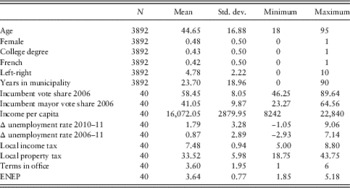
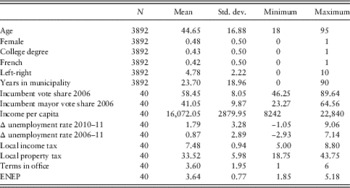
Additionally, at the level of municipalities, we control for the number of terms the party of the mayor has been in office.Footnote 3 Doing so, we control for the occurrence of a ‘cost of ruling’ effect (Lewis-Beck and Stegmaier, Reference Lewis-Beck and Stegmaier2013). We also include the effective number of partiesFootnote 4 at the local level, to take into account the fact that with fewer alternatives available, the probability of voting for the incumbent coalition increases. The 40 municipalities in our sample vary considerably, not only with respect to the type of parties and number of parties playing a role in local elections, but also with respect to the strength of incumbent coalitions. On average, the ruling incumbent coalition obtained a combined vote share of 59% of the votes, but this varies from 46% of the votes to 90% of the votes. This variation in the electoral strength of local incumbents is likely to have an impact on the probability that voters choose an incumbent party in 2012 as well. Therefore, in the analyses we control for the combined vote share that the incumbent parties obtained in 2006 – which is a municipal-level variable added to the model.Footnote 5 For the analyses explaining voting for the list of the incumbent mayor, the vote share this party only obtained in the 2006 elections is controlled for. Descriptive statistics of all independent variables are listed in Appendix 1.
Results
Before investigating the determinants of voting for the local incumbent, and the impact of the economy on the vote choice, it is worth mentioning that there is quite some variation in incumbency voting in the sample. Of the 3892 respondents included in the analyses, 54.73% voted for an incumbent list, while 45.27% did not. The main question we focus upon, is to what extent the vote choices of this 54.73% of the respondents supporting local incumbents can be interpreted as a ‘reward’ for how well the local economy is performing, or for the economic policies implemented by the incumbent.
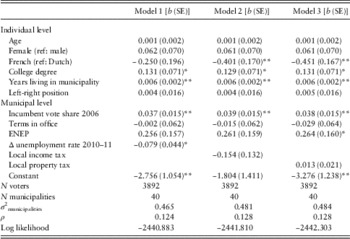
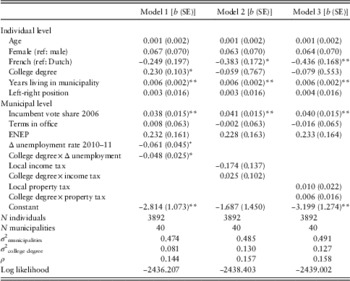
The results of the multilevel analyses explaining incumbent voting are presented in Table 1. As a first step, we estimated an intercept-only model, which allows us to assess the total amount of variance at the level of municipalities. The ρ-coefficient for this null model is 0.197, implying that almost 20% of the variance in incumbent voting situated itself at the level of municipalities. Consequently, we conclude that it does make sense to look at factors that are specific to municipalities to explain incumbent voting in local elections.
Multilevel binary logistic regression model explaining voting for an incumbent party

ENEP=effective number of electoral parties.
Entries are unstandardized coefficients and standard errors (in parentheses) of random intercept models.
Significance levels (one-tailed tests): *P<0.05, **P<0.01, ***P<0.001. ρ-value intercept-only model: 0.197.
In Model 1, we add the individual- and municipal-level control variables and we include the indicator for changes in unemployment rates between 2010 and 2011. Looking at the effects of the control variables first, voters with a college degree are significantly more likely to vote for an incumbent list compared with voters without a college degree. Furthermore, having lived in a municipality for a longer time significantly increases the probability of voting for an incumbent list. We note that the vote share the incumbent parties obtained in 2006 is a significant predictor of respondents’ likelihood of choosing an incumbent list in 2012. In addition, we included the number of terms an incumbent coalition has been in office, and the ENEP as municipal-level controls in our models. Neither of these variables, however, reaches a conventional level of statistical significance.
Now we turn to the independent variable of primary interest – unemployment. Changes in unemployment rates significantly affect the probability of voting for the local incumbent. The results indicate that the increasing unemployment rates meant voters were less likely to vote for a party of the ruling local coalition, statistically significant at 0.05.Footnote 6
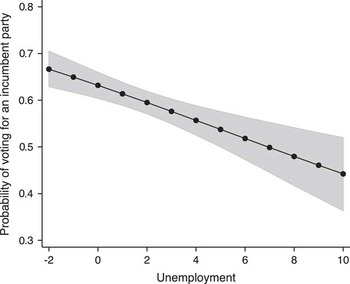
The estimated effect of changes in unemployment rates on voting for an incumbent party is, furthermore, substantively significant, as is evident from the simulated predicted probabilities in Figure 1. These results suggest that – all other things equal – the probability that a citizen chooses a local incumbent is 67% when unemployment rates have decreased by 2 percentage points, this probability is reduced to 56% when unemployment rates have increased 4 percentage points and is reduced further to <45% in the extreme case of a 10 percentage point increase in unemployment rates. Consequently, we can conclude that there is strong evidence of local economic conditions affecting the probability that voters choose an incumbent party, with deteriorating economic conditions decreasing the probability that citizens vote for the incumbent.
Estimated effect of change in unemployment rates (2010–11) on probability to vote for an incumbent party. Mean probabilities and 90% confidence intervals (one-tailed) of voting for an incumbent coalition for different levels of change in unemployment rates. Mean values from 10,000 simulated observations based on Model 1 in Table 1.

It has previously been argued that because local incumbents have little control over macro-economic indicators, it is not economic conditions but rather incumbent use of budgetary instruments that should affect citizens’ probability of voting for an incumbent list. Therefore, in Model 2 and Model 3, we assess the impact of local tax rates on the probability that respondents choose an incumbent list. The expectation is that higher tax rates decrease the probability of voting for an incumbent party. As evident from the results in Table 1, however, neither the local income tax rate (Model 2), nor the local property tax rate (Model 3) is significantly related to the probability that a voter has voted for one of the incumbent parties, in the context of the 2012 local elections.
These null findings lead us to reject our second hypothesis. How incumbents use their fiscal tools – and at what level they set local tax rates – does not seem to be affecting the probability that voters vote for the local incumbent. Local economic conditions more generally, by contrast, are significantly affecting the probability that a citizen votes for an incumbent party list. Furthermore, it could be argued that not tax rates as such, but differences in tax rates from one municipality to another are affecting voter behaviour, in line with the findings of Vermeir and Heyndels (Reference Vermeir and Heyndels2006) who show mechanisms of yardstick voting. Therefore, we also investigated the impact of deviations from the mean tax rates in our sample, with the expectation that incumbents are punished for levying higher than average tax rates. The results of these additional tests, however, do not indicate a significant impact of tax rates on choosing an incumbent party either.Footnote 7
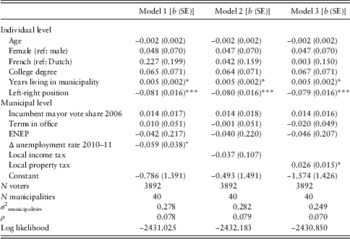
In line with previous research on economic voting in multiparty contexts (Debus et al., Reference Debus, Stegmaier and Tosun2014), we expect that the head of the local coalition in particular – the mayor – will be held responsible for local economic conditions by the voters. In Table 2, we present the results of a series of multilevel logistic analyses examining the determinants of a vote for the list of the incumbent mayor. The model specification of the three models presented is identical to the main results included in the manuscript – except for the dependent variable, as we focus on voting for the list of the incumbent mayor only. The dependent variable hence takes the value of 1 if a respondent indicates to have voted for the list of the incumbent mayor and 0 otherwise (regardless of whether one voted for an opposition party or for a member of the ruling coalition). Overall, 34% of our respondents did indicate to have voted for the list of the incumbent mayor. Obviously, the control for the vote share in the 2006 elections as well relates to the list of the incumbent mayor only.
Multilevel binary logistic regression model explaining voting for the incumbent mayor

ENEP=effective number of electoral parties.
Entries are unstandardized coefficients and standard errors (in parentheses) of random intercept models.
Significance levels (one-tailed tests): + P<0.10, *P<0.05, **P<0.01, ***P<0.001. ρ-value intercept-only model: 0.084.
Looking at the results of the analyses in Table 2, contrary to Hypotheses 3 and 4, we note that none of the economic indicators seems to be significantly related (at 0.05) to casting a vote for the list of the incumbent mayor. For change in unemployment rates – the factor we found to be of relevance for casting an incumbent vote in general – the effect is in the expected direction (negative), but statistically significant only at 0.10, not 0.05. It is somewhat puzzling to observe that we find the general effect of economic conditions on voting for the incumbent mayor to be weaker than for the incumbent coalition as a whole, especially as theoretically we expected this effect to be even stronger than the general effect. The results seem to suggest that – at a local level at least – Belgian voters identify the ruling coalition, and they distinguish less between parties that are more visible as an incumbent (i.e. the list of the mayor) and the other parties that are part of the ruling coalition. As the local level is much closer to the voter compared with higher levels of governance, perhaps voters are much better aware of what incumbent parties deliver – and of the fact that it is not only the party of the mayor that is (not) delivering.
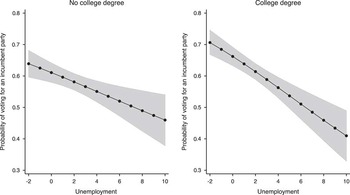
Finally, in Table 3, we present the results of our analyses investigating individual-level heterogeneity in the economic vote. We focus on the impact of political sophistication and add to the main models that were presented in Table 1 interaction terms between education (having a college degree) and our indicators of the state of the economy. As can be read from the table, we find a significant interaction effect – in the expected direction – for unemployment, but not for the other indicators.
Multilevel binary logistic regression model explaining voting for an incumbent list – cross-level interactions

ENEP=effective number of electoral parties.
Entries are unstandardized coefficients and standard errors (in parentheses) of random intercept models.
Significance levels (one-tailed tests): + P<0.10, **P<0.05, **P<0.01, ***P<0.001.
The results hence suggest that the general relation we observed, that local incumbents are punished for worsening unemployment rates and rewarded for improving unemployment rates, is strengthened for voters with a college degree. This effect is visually illustrated in Figure 2, which shows the predicted probability of voting for the incumbent at different levels of Δ unemployment rate, for voters without and with a college degree separately. Clearly, while for both groups of voters we observe the expected negative relationship – with strong increases in unemployment rates decreasing the probability of a vote for the local incumbent – this effect is weaker for voters without a college degree, compared with what holds for higher educated voters. These findings suggest that holding accountable local incumbents for the state of the local economy is a cognitively demanding task, that higher educated voters appear more capable of.
Estimated effect of change in unemployment rates (2010–11) on probability to vote for an incumbent party – the impact of having a college degree. Mean probabilities and 90% confidence intervals (one-tailed) of voting for an incumbent coalition for different levels of change in unemployment rates. Mean values from 10,000 simulated observations based on Model 1 in Table 3.

Discussion
Our aim has been to investigate whether economic voting is at play in local elections. We focussed on the impact of local economic conditions and economic policies on voting in local elections, an approach other scholars have not regularly taken. Our analyses indicate that local economic conditions do seem to matter for the vote choice in local elections; increasing unemployment rates are associated with a significantly smaller probability of voting for the local incumbents. By establishing that the local economy has an impact on local vote choice, our results compliment research showing an impact of local economic conditions on national voting behaviour, or an impact of the national economy on subnational vote choices. Through investigation this ‘local economy-local vote’, we appear to have begun to fill in a ‘missing link’ within the literature on economic voting.
Looking at the impact of economic conditions (measured as changes in unemployment rates), as compared with the impact of economic policies (measured as tax rates), we find that only the former significantly affect the probability of an incumbent party vote. The implication is that citizens care about and pay attention to outcomes, not specific economic policies. Even at a local level, therefore, Fiorina’s claim that voters’ ‘primary emphasis [is] on policy outcomes rather than the means that lead to those outcomes’ (Reference Fiorina1981: 194) seems valid. Accountability is generally considered an essential element for the well functioning of representative democracies (Przeworski et al., Reference Przeworski, Stokes and Manin1999). Our results point out that, even at the local level, such accountability mechanisms are present – and it is not one local actor in particular but the local coalition as a whole that is held accountable for local economic conditions. One could wonder, however, whether it is fair that voters punish and reward their local incumbents for the state of the local economy – as local politicians have only a limited number of available instruments for influencing economic conditions.
Overall, our results argue for the presence of economic voting at a local level in Belgium. This finding, in a highly fragmented electoral system, indicates the relevance of taking into account that the economy can affect voting behaviour at a local level as well. While we find a general effect of unemployment rates on voting for the local incumbent, this appears to be a cognitively quite demanding task – as for the higher educated in particular we observe the presence of economic voting at a local level. The appearance of this locally based accountability mechanism seems all the more surprising, given that, during the campaign, the election was strongly framed as a referendum on the national incumbent government, obscuring clarity of responsibility. Focussing on how local economic conditions influence voting in local elections, we zoomed in on only one aspect of a more complex framework where different levels of governance can affect each other. Further research, therefore, should explicitly explore how politics and the economy on different levels of governance are intertwined. On a final note, including local public spending data, in models about the impact of local-level policy on incumbent voting, can further fine-tune analysis of the possible policy impact in local elections of the future.
Financial Support
The research for this paper was supported by the PartiRep research project (www.partirep.eu), funded by the Belgian Federal Science Policy Office (BELSPO).
There are no conflicts of interest.
Data
The replication data set is available at http://thedata.harvard.edu/dvn/dv/ipsr-risp
Appendix
Descriptive statistics of independent variables