The world trading system has become significantly more “legalized” in the recent period (Goldstein and Martin 2000), with the adoption of the Dispute Settlement Procedure (DSP) as part of agreements forming the World Trade Organization (WTO). In contrast with national law, however, the WTO has no enforcement powers, “no jailhouse, no bail bondsmen, no blue helmets, no truncheons, no tear gas” (Bello 1996), to induce compliance. Absent any enforcement power, what function does international dispute settlement serve? Do these mechanisms condition state behavior in any significant way?1
Beyond the DSP and the WTO, we seek to identify whether international law has an independent effect on the behavior of states. We might call this the “endogeneity problem”: do states sign international agreements because they intend to comply anyway, or do they comply because they have signed an agreement and take actions (or refrain from taking actions) contrary to what they would have done absent the agreement (Chayes and Chayes 1993; Downs et al. 1996)?
The standard view of the WTO is that the institutions must be “capable of identifying and sanctioning (or at least authorizing sanctions against) cheating on the cooperative equilibrium” (Trebilcock and Howse 1999, 54). The hardening of the dispute provisions of the WTO is seen as making the potential punishments more severe, with the intent of extracting more cooperative behavior among the member states. The DSP also closes loopholes, eliminating “grey areas,” limiting further the possibility of opportunistic behavior. The system is viewed now as less flexible, and this greater rigidity associated with the shift to legalization is expected to lead to more compliance (Goldstein et al. 2000; Smith 2000; Yarbrough and Yarbrough 1997). Many scholars (and negotiators and WTO officials) have viewed the introduction of the WTO DSP as highly successful and effective (Jackson 1997a), and the relatively frequent appeal by its members to the (new, as of 1995) DSP is taken as evidence of the increased compliance with treaty provisions.
Others disagree. Reinhardt (1999) suggests that instead the frequent use of the DSP is not evidence of “success,” but marks “potential challenges to the system” (2). The increased filings of disputes observed since the introduction of the revised DSP are not attempts to maintain cooperation but are instead evidence of increased violation of treaty obligations. Setear (1997) also argues that the enhanced DSP is a “step backward in the process towards greater cooperation”: its relative ease of use increases opportunities for noncooperation and increases the likelihood of defection.
This article attempts to resolve this confusion and does so by clarifying the key role played by the DSP. The revised DSP enhances the stability of the cooperative regime; it does so not because it has become more rigid, but because it has become more flexible. The DSP now permits “compensation” for violations once authorized and emphasizes that the compensation is limited to an amount proportional to the loss experienced—and consequently adds a degree of flexibility which leads to an enhanced stability of the world trading system. Moreover, a wider variety of countries are more willing to sign an agreement with a DSP procedure of this type than any agreement without. Agreements with such a mechanism are easier to strike ex ante (cf. Fearon 1998).
Cooperation (at least in the long run) and discretion are therefore not mutually incompatible; it is overstating the case to argue that agreements have to be designed to deal with the “domestic political trade-off between treaty compliance and policy discretion” (Smith 2000, 138), or that “more” legalization may “threaten liberalization” (Goldstein and Martin 2000, 630). There is, instead, a trade-off between rigidity and stability. A DSP embodying the proportionality principle reduces the rigidity of the system and increases the long-run stability of the cooperative institution.2
A number of important works have argued the effectiveness of the General Agreement on Tariffs and Trade (GATT)/WTO system and its DSP. Bown (2001) claims that the DSP (or, more specifically, tolerated threats of retaliation) has been successful in generating liberalization. Staiger and Tabellini (1999) suggest that the GATT/WTO provides a (time-consistent) commitment device for governments in the game with their domestic political supporters. Bagwell and Staiger (1999) show that the principles of nondiscrimination and “most-favored nation,” the cornerstones of the GATT/WTO system, lead to countries credibly forgoing beggar-thy-neighbor terms of trade shifts. This article like that of Ethier (2001), investigates the consequences of the limited punishment actions available and the lack of enforcement power.
DOMESTIC POLITICS
A country's negotiator at the international bargaining table is a political representative, responding (optimally) to and constrained by the political pressures it faces back home (Putnam 1988). Domestic political pressures and alignments, however, are subject to changes that are imperfectly anticipated or even unexpected. In periods in which the political pressure to provide some sort of protection to the domestic import-competing industry becomes unexpectedly acute, a government may be willing (in the absence of any means of escape) to abrogate its responsibilities under a trade agreement entirely to protect its domestic constituency (and its own incumbency). If, however, there are opportunities for signatories to escape their obligations (at least temporarily until the unexpected political pressure passes to a more “normal” state of affairs), an affected country may take such an opportunity while remaining within the parameters of the international agreement. One such avenue of escape is a willingness to be subject to the discipline of the DSP under the WTO. That is, a violation incurred for political reasons may be tolerated by other signatories under the agreement if the violation is temporary, and some sort of compensation scheme is available for the affected country(ies). The use of the DSP therefore allows a contracting partner to violate the agreement, compensate the losers, and still remain within the community of cooperating nations. Hence, an agreement with a DSP is less prone to abrogation by a state suffering intense political pressure to protect; such an agreement is more stable than one without a DSP.3
This argument also provides a justification for the existence of the escape clause and other safeguard measures of the GATT. Article XIX measures may play the role of providing a crucial escape valve for domestic political pressures that may have accumulated. See Rosendorff and Milner (2001) for a formal model that establishes that agreements with an escape clause Pareto dominate those without in the presence of imperfect information regarding future political pressures. Sykes (1991) provides a compelling argument that the purpose of Article XIX safeguards is to accommodate politicians' need to accommodate the pressures of materially injured sectors. A comparison of the DSP and Article XIX actions is discussed in what follows.
Although this paper studies the WTO's DSP in some detail, the underlying intuition regarding the utility of such procedures readily applies to other, regional agreements that embody dispute settlement procedures. See, for example, Gruber (1999) on supranational governance in the North American Free Trade Agreement, or Busch (1999) on forum shopping across agreements, or Levy and Srinivasan (1996) on the effect of allowing private parties access to a regional agreement's DSP on the government's willingness to sign such an agreement.
A self-interested international negotiator pondering the gains and losses of entering into an international agreement may be more willing to sign such an agreement (and be constrained by its provisions) if s/he is aware that breach of its obligations is permitted under certain circumstances. The possibility that future political pressures to protect might become intense implies that an astute politician will want to preserve a policy instrument to deal with that pressure. Commitment to a trading regime where some sort of instrument remains in the hands of the politician is easier to achieve than without it. The “shadow of the future” stretches less far and is less penal when temporary accommodation to political pressure is available (Fearon, 1998; Rosendorff and Milner 2001; Sykes 1991). Whereas only the most patient politicians who value the future very highly can sustain cooperation in an environment without a DSP, an appropriately designed DSP can facilitate entry into the agreement by states less “patient,” or with a lower valuation of the future.
Enforcement and the Proportionality Principle
The self-enforcing nature of the agreement makes the DSP effective without explicit enforcement powers. An astute politician may prefer to protect a politically powerful industry in periods of unexpected stress and, at the same time, compensate its trading partners for any burden. Although the compensation demanded may be severe, the domestic political costs of paying the compensation are likely to be smaller than the political benefits from protecting the industry. But what is more crucial is that, by paying the compensation voluntarily, the country is signaling to its trading partners that it intends to return to a cooperative stance as soon as the temporary pressure rescinds. The payment of compensation acts as a signal of the country's intent to continue to cooperate in the future, an intent justified by the continued benefits of cooperation. The payment is a penalty paid to preserve a country's reputation as a cooperator (at least in “normal” times). In response, the trading partners observe this willingness to pay to preserve its reputation and opt not to punish the offending partner by revoking concessions or even exiting the system.4
Reinhardt (2001) offers an explanation for the willingness of defendants to settle (offer a concession) prior to the determination of the DSP panel, absent enforcement. In a model where the defendant might be “compliant” and the plaintiff may be “tough,” it may be cheaper for a compliant defendant to concede than to risk retaliation after a panel finding. Hence, the threat of retaliation makes the WTO process self-enforcing. Downs et al. (1996) argue that enforcement is not necessary—the WTO, members of which have self-selected themselves into the agreement, is fundamentally cooperative. Alternatively, enforcement is not necessary because the structure and rulings at the WTO reflect the underlying power relations of the disputants and, when retaliation is possible, compliance is observed (Garrett and Smith 2002).
The “proportionality principle” (that compensation is limited to that which restores “balance” to previously negotiated concessions) is a crucial element of the DSP. If the cost associated with using the DSP was excessively large (the retaliatory punishment exceeds the political gains), countries would not be willing to apply these penalties to themselves and the DSP would lose its teeth. The proportionality principle limits the costs associated with adopting the DSP and thereby increases the stability of the system.
CHARACTERIZATION OF THE DSP
The procedures specified in the Dispute Settlement Understanding (DSU) adopted during the Uruguay Round are consistent with the practice that had developed since the GATT was first implemented in 1947. A contracting party may file a complaint with the WTO regarding a perceived violation of the treaty on the part of another member. If formal, bilateral consultations are unproductive (an attempt at a negotiated resolution), the complainant may request that a panel of independent experts investigate the matter and make a recommendation (a more “judicial” approach). If the panel finds that the offending action is GATT-inconsistent, the offending party is obliged, should the panel so recommend, to terminate the violating measure and bring its practice back into conformity with its GATT obligations. The finding is “legally binding” on the members (Jackson 1997b) and can be appealed to the Standing Appellate Body, a panel of three experts drawn from a permanent roster of seven, selected for a four-year term on a staggered basis. There is no possibility that any member can “block” the report. If the recommendations of the panel are not implemented within a reasonable amount of time, the DSU permits possible “compensation” or retaliation. The purpose is to provide compensatory benefits to restore the balance of negotiated concessions disturbed by the noncomplying measure (Dunoff and Trachtman 1999; Jackson 1997b). If the offending state does not change its offending action or provide compensation, the WTO may authorize a retaliation to restore balance. Although the agreement clearly favors compliance with negotiated concessions, it is clear that the WTO system “authorizes a Member to choose to ‘breach’ an obligation, and pay compensation to the injured party” (Dunoff and Trachtman 1999, 26).5
Jackson (1997a, 1998) argues that there is an obligation to “perform” under the terms of the agreement—an offending nation does not have a “choice” to compensate. Yet the DSU specifically authorizes retaliation if an offending country has not complied with a ruling. This view is consistent with the legal hypothesis of “Efficient Breach”—where breach is more efficient in a Pareto sense than is performance under a contract. In this view, the WTO can be viewed as an incomplete contract, and, while there is no true court-like mechanism to compel payment in the case of breach, here we show that voluntary compliance can work just as well. See Dunoff and Trachtman (1999).
In most cases, the defendants are found in violation.6
Between 1973 and 1998, over 100 cases were paneled in which a defendant country has either raised its tariffs or refused to liberalize as agreed to. The defendant was found guilty in all but 9 of the cases (Bown 2001).
In most of those, the defendants abide by the findings of the DSP. This is taken by a number of observers as evidence of the “success” of the institution. Punishments for breach of obligations under the treaty are usually set at a level “commensurate with the violations” (Ethier
2001) and only the country harmed is compensated (Jackson
1998).
The effect of a finding by a panel that there has been a violation is an obligation by the offending state to restore the losses experienced by the partner state. The DSP therefore takes four crucial actions: (1) it hears evidence of violation; (2) it rules whether or not a violation has occurred; (3) if a violation is identified, it estimates the compensation that is due; and (4) it reports that compensation has been made (by virtue of closing of the case).
The institution then serves a crucial information-providing role. It establishes the facts, adjudicates on a violation, estimates the damages, and reports a successful completion of the process. It is this informational role of the DSP that determines its effectiveness in the world trading system.7
Consistent with Keohane (1984), this explanation of the effectiveness of the DSP lies in its informational role, thereby reducing transaction costs and increasing transparency. For the informational role of multilateral institutions see Oye (1986). This role for the DSP has also been suggested by Kovenock and Thursby (1994) in a model without domestic politics but with a set of “demons” who introduce random deviations from the cooperative regime. Maggi's (1999) model has the WTO informing third parties of any observed violation of a country's obligations. The effect is to facilitate enforcement efforts. Similarly, Ozden (2001) has the DSP informing third parties if noncontractible implementing investments have been made. Here the information provided by the WTO prevents mistaken punishments from being applied. More generally, a variety of economic and political institutions have developed to provide crucial information to interacting parties; for example, the Law Merchant (Milgrom et al. 1990) or lobbies (Milner and Rosendorff 1996).
THE INSTITUTION AS EQUILIBRIUM
The DSP is a mechanism embodied within the broader set of institutions that govern trading relations between states. Following North (1990), an institution is viewed as an equilibrium to a game of strategic interaction. In what follows we specify a pair of strategies for two countries that embody a procedure for dealing with violations of a commitment to cooperate that is consistent with the dispute settlement procedures as articulated in the DSU. If this pair of strategies is a Nash equilibrium to the game of repeated strategic action that describes relations between trading states, then we can say that the DSP is an equilibrium institution. In the next section we compare two games of international trade policy played between two contracting parties. In the first game there is no DSP institution; in the second, at each period, the players listen to the information provided by the DSP. The institution with the DSP is shown to be more stable than without a DSP; moreover, a wider variety of states will be willing to sign agreements when a DSP is available than when no such possibility exists.
THE ECONOMY
Consider two countries that are identical, except for their endowments. Each country is endowed with and consumes three goods labeled x, m, and z, where z is the numeraire good (with units chosen that the price of a unit of z is 1). On the supply side, the home country is relatively well endowed with good x, and the foreign country with m. More specifically, the world endowment of x and m are both set at unity; home is endowed with fraction β>1/2 of good x and 1−β of y; foreign is endowed with 1−β of x and β of y. The Heckscher–Ohlin theorem implies that home will import m and export x.
On the demand side, utility is assumed to be additively separable. U(x,m) = u(x)+u(m)+z. Each country has a single instrument at its disposal: a tariff on its imported good. Home can apply the specific tariff t on the imports of good m while foreign levies τ on its imports of x. Utility maximization and market clearing implies that the price of m at home rises, and hence the home consumer surplus falls with t, whereas an increase in the tariff abroad actually lowers the price of x at home, raising consumer surplus. The domestic firms earn profits Πm(t) (for the import-competing firms) and Πx(τ) for the export firms, with Πm(t) rising with t and Πx(τ) falling with τ. Tariff revenues are denoted T(t) which rise and then fall with t. The foreign country's payoffs are symmetric. A government's (one-period) utility depends on the sum of consumer and producer surpluses, and tariff revenues.8
For any given level of the foreign tariff τ, the home government's objective function rises and then falls with the home tariff t; for any given t, G falls with τ since the marginal losses to the export firms always outweigh the benefits to the consumer of a higher foreign tariff.
Moreover, political pressure, which import-competing firms bring to bear, is added to the objective function by weighting the firms’ profit term. Let
a>0 denote the weight that government attaches to firm's profits. The home government's (one-period) utility function then is
. Similarly for the foreign government,
, where α is the weight put on the interests of the import-competing sector in foreign by the foreign government.9
These “politically optimal objective functions” capture the idea that government officials are politically motivated (Baldwin 1987) and are consistent with the derived political support functions from a political contributions model such as those by Grossman and Helpman (1994).
The stochastic political pressure parameters a and α are independently and identically distributed over the support (0,∞), with cumulative distribution function Φ. At the beginning of each period, the government in each country knows the level of political pressure it faces at home; it is uninformed about the political pressures that have emerged in the foreign country. And each is equally uninformed about the nature of the politics each might face in any future period.10
This one-sided asymmetry of information is in fact not necessary for the results that follow but is useful to maintain for ease of exposition and seems the most realistic of the possibilities. What is key for the results is the presence of uncertainty regarding the political future either country might face in future periods.
International Cooperation
We characterize the fundamental problem of sustaining cooperation between countries in the realm of international trade.11
This section follows Rosendorff and Milner (2001), (RM).
Because we are interested in the role of the DSP within an ongoing agreement in which the tariff bindings have been previously set, we take the existence of a previously negotiated pair of cooperative tariffs (
tC,τ
C) as given. Presumably they are the (Pareto optimal) pair of tariffs that maximize the present discounted value of the sum of both governments’ expected utility over the infinite future. Moreover, since these were negotiated before the following games are played, these cooperative tariffs were set before the players are aware of the political conditions in the current period in their own countries.
12 Hence, tC and τC are exogenous from the point of view of the current game and, therefore, not functions of the political parameters drawn for the current period, a and α.
At the beginning of each period, the players’ types
a and α are revealed to each country—i.e., home sees
a but not α and foreign vice versa. Each country decides on its current period tariff rate simultaneously—whether to renege on the cooperative agreement (and apply the optimal defection tariff) or implement the cooperative tariff. This extensive form description yields payoffs that can be written in the normal form of a standard prisoner's dilemma (PD).
Under Cooperation
The utility of the home government under cooperation is
, which is not a function of α. Similarly,
. Since the cooperative agreement is negotiated before any details of the domestic politics in either country are revealed, the payoffs for each country are functions only of each country's domestic politics parameter.
Under Nash Equilibrium
Under the Nash equilibrium (NE) to the one-shot game, each player chooses a level of domestic trade barriers as a best response to the behavior of the opponent. In any period in which a and α are known, we can solve for the NE in trade barriers for that period. Let
, and,
, and, solving simultaneously, we obtain the Nash pair
. Denote home government's utility under the Nash as
.
What about Defections?
What are the payoffs when, say, home defects and foreign cooperates in the one-shot game? The optimal defection is
, and utility under the optimal defection is
. If, instead, foreign defects and home cooperates, home receives the sucker's payoff:
The Prisoners' Dilemma
In any play of the game we have
for any pair
, a PD, as represented by the standard 2×2 normal form matrix.
To simplify the notation, D(a)-C(a)≡B(a). Notice that, as the political pressure to protect becomes larger, the gains from defection relative to cooperation rise; i.e., B′(a)>0. Each player is susceptible to political pressure both to protect against foreign imports and to open export markets; in the future both are equally unsure how much pressure each will experience.
This one-shot game is infinitely repeated, and the players choose strategies to maximize the expected sum of their discounted one period utilities:
We can view the cooperative outcome to this game as characterizing the international agreement in the absence of a mechanism to deal with disputes or other episodes of unfair practice. We consider an NE supported by the usual grim trigger—an infinite punishment in the event of a deviation. In equilibrium, each player cooperates every period until the domestic political shock breaches some threshold. Then defection occurs and punishment continues henceforth.
Lemma 1. The following pair of strategies constitutes an equilibrium: for some
in the support of a, home plays C if
, or plays D if
or if
has been played by foreign in the past; for some
in the support of
, foreign plays
if
, or plays
if
or if D has been played by home in the past.
The proofs are in the Appendix. The incentive to defect in any period with draw a is B(a). If the incentive to defect is less than the present discounted expected losses of future punishments, cooperation is sustained; i.e., the no-defect condition is
. Define
, such that
, and the no-defect condition becomes simply
. In this equilibrium, each player cooperates until the pressure to protect gets extraordinarily high. Then it defects and incurs the infinite punishment.13
If there is an upper bound to the magnitude of the shock, say
, then, for all discount factors large enough, cooperation dominates defection. That is, cooperation is assured in any period iff
, or iff
. Therefore, we have the standard result that cooperation (here in the face of political pressure) is sustainable only when the players are very patient (when maximal shocks are fiinite).
This equilibrium is illustrated in
Figure 1.
The No-Defect Condition for the PD Game is $B({\bm a})\leq \frac{\delta}{1\,{-}\,\delta}(C-N)\equiv \Lambda _{PD}$
The Dispute Settlement (DS) Game
Consider a period in which the government of the domestic country receives a high shock in the PD game. The unexpectedly large value of a implies that the government has come under excessive pressure to protect the local import-competing industry. The options that the government faces are first to stick with the purely cooperative agreement and play tC and earn C(a), or alternatively to play tD(a) and earn D(a). In the event that home chooses to play the defect strategy, D, it would invoke an infinite punishment in the PD game, and the cooperative world trading system breaks down.
The Ruling
Instead consider the following DS game structure. After the domestic country has adopted a defect action (a violation) in any period, the other country (the complainant) files a dispute (requests a panel) with the WTO. Then the panel hears the case and makes a decision. If it finds a violation, it also decides on a penalty; finally the defendant decides whether to pay the penalty or not. The panel faces the same informational constraints as the other players. If the foreign country has played τ C, no information can be gleaned about foreign's domestic politics; however, home has defected and played t=tD(a), both foreign and the panel can invert the function describing the optimal defect tariff, and infer the state of politics at home, a. When a is known to all the players we will designate it â. Clearly, both players and the DSP identify that a defection has occurred, since all can see that tD(a)>τ C. But the WTO permits a country to rescind its commitments in various instances. For instance, the defendant might argue that it has become concerned that the good is not safe for human, plant, or animal health, or that its continued import may harm the environment (such as the debate over genetically modified foodstuffs between the United States and the European Union (EU), or hormone-fed beef). The DSP will have to make a determination as to whether the measure is “a disguised restriction on international trade” for political purposes or a legitimate health, safety, or environmental measure14
Article XX of the WTO agreement.
. The probability that the DSP finds in favor of the plaintiff is set (as in Reinhardt
2001) at θ ∞ (0,1), which is common knowledge.
Should the panel find in favor of the plaintiff, the panel will attempt to measure the loss that the complainant has sustained due to the defect action of the other member. If home defects, foreign receives S*(a,α) instead of C*(α). Then the actual losses are L*(a,α)=C*(α)-S*(a,α). However, the panel cannot verify (ex ante) the actual value α. Instead it must take its best guess given the information at its disposal. The actual estimate of the losses incurred by foreign will be the expected value of L*(â,α), since â is known, which we write as L*(â)=∫αL* (â,α) d Φ. Similarly, if foreign is the defecting party, the panel will establish a compensation of L(αcirc;)=\intaL(a,αcirc;) d Φ, which is the expected losses experienced by home. As far as the plaintiff country is concerned, the expected loss (before the ruling is made) for which it will be compensated is θ L*(â) for foreign and θ L(αcirc;) for home. For notational purposes, define L=∫a∫αL(a,α) d Φ d Φ.
Compensation
In any period of the DS game, a player can take the Pareto action, i.e., play C as in the aforementioned PD, or can incur the costs of violating the agreement and pay the compensation, DS, at expected cost θ L(αcirc;) (or θ L*(â), which accrues to the other player) or can defect D as before. That is, the panel has no enforcement powers, and the defendant can choose not to pay any compensation whatsoever. Any compensation that is paid in equilibrium is done so on the volition only of the defendant state.15
Note that the cost associated with “escape” here—the use of the DSP mechanism—is endogenous, and changes period by period. Moreover, the event that the cost is actually applied to the defendant is stochastic (it occurs with probability θ) and is the outcome of the dispute settlement process. This is a generalization of the study of escape clauses by Rosendorff and Milner (2001), in which the cost of escape was exogenous to the repeated game, in which the escape cost is incurred with certainty if the state chooses the escape clause action in any period, and in which the WTO had no arbitration role and merely reported if the offending country has penalized itself by incurring some exogenous adjustment costs.
The stage game payoffs can now be expressed in the normal form as a 3×3 matrix, with the payoff structure as in the table below, viewed from the moment the political pressures are revealed but before any (possible) ruling by the DSP panel:
To describe the NE to this game, it is necessary to divide the support of the politics parameter a into three subsets. Define
such that
; define
such\vadjust that
(where
, and
. Lemma 3 in the Appendix shows that a sufficient condition for
is
Definition 1
A Dispute Settlement Strategy (for home), denoted DSS, is a strategy in which home, having drawn politics of type
, plays
has been played in any period in the past otherwise home plays
, plays
if
, and plays
if
.
As before, the extent of the political shock determines the gains to be had from defection this period; these gains rise with the political pressure that the firms bring to bear; i.e.,
. It is also the case that the (expected) losses experienced by one's trading partner rise as a rises; i.e.,
. Given a draw
, if the gains from defection are small relative to the compensation it would have to pay (
, i.e.,
), then the government sticks to the Pareto play
. If the expected penalty is not too onerous
, or
, then the possible gains from defection
, which occur when
cause the government to violate its obligations and suffer the consequences of a negative finding by a WTO panel,
, which includes the (expected) payment of compensation. If the gains from defection are large, and the penalty is too large (
, or when
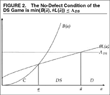
), then the government ceases to cooperate entirely, violates its treaty obligations, and refuses to pay any compensation. A useful way to summarize the government's strategy is to say that the government cooperates (by playing
) when
and defects otherwise (see Figure 2
The No-Defect Condition of the DS Game is $\min (B(\skew2\hat{\bm a}),\theta L(\skew2\hat{\bm a}))\leq \Lambda _{DS}$
The critical value of ΛDS is the level of the cost such that, if the government plays the “cooperate” strategy (either C or DS) into the indefinite future, the expected (net) benefits from doing so are equal to the expected benefits of defecting once and exiting the system forever. It is intuitive, therefore, that if the costs of the dispute procedure and the gains from defection are large, the government will cease to cooperate entirely.
Proposition 1
A pair of DSS strategies is an NE
An international agreement with features similar to the DSP emerges as an equilibrium to the game of international trade. In any period a country (say, home) can stick to the cooperative deal and play tC, or in response to political pressure â, can defect to tD(â). The other country (foreign) observing that the tariff applied is larger than the agreement tariff (tD(â) >tC) files a complaint. The panel also observes tD(â) and undertakes its first responsibility, to adjudicate if the violation of the tariff binding is permissible under WTO codes. If it finds against the defendant, the panel must now try to establish its best guess of the loss foreign has incurred, L*(â). This penalty is paid voluntarily; the WTO verifies the payment and closes the file. Ex ante—at the time of the decision to violate—the expected cost of the violation is θ L*(â). Cooperation resumes in the next period. Hence, the role of the institution is to verify the facts of the matter to its best ability, make a legal ruling, and then to rely on the voluntary behavior of the participants.16
Downs and Rocke (1995) present a series of games of international cooperation in the face of uncertain domestic politics, not unrelated to the game presented here. They argue that less severe punishments are necessary than the grim trigger required here in order to facilitate cooperation or, alternatively, a probabilistic approach to punishment. Agreements must therefore incorporate a degree of “optimal imperfection” to be effective. Here we include the dispute settlement strategy in the action space and obtain long-run cooperation under the grim trigger, and without uncertainty about whether the punishment, once authorized, will be applied.
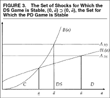
The next proposition and its corollary establish the central results of this paper: agreements with a DSP are more stable than those without. We establish that the set of shocks that the agreement can withstand is greater when a DSP is present; i.e., >ã<ā. The corollary establishes that it is exactly those countries who are not patient enough to sustain cooperation in the pure PD who will gain from incorporating a DSP into the agreement. The DSP effectively lowers the threshold value of the discount rate necessary to sustain a cooperative outcome.
Proposition 2
The DSP is more stable than the PD; i.e., the per-period probability of breakdown is smaller under the DSP than under the PD.
The set of shocks that can be withstood without the equilibrium breaking down under the DSP,
, is larger than (is a superset of) the set of shocks that can be withstood in the PD game,
. The implication here is that the DSP game is more robust against political shocks than is the pure PD version. To prove this result, we superimpose Figures 1 and 2 in Figure 3. Notice that
for all
. This can be seen by considering the PD game as a special case of the DS game where
, then
; when
,
, and
is monotonic in p. As the diagram is drawn, it is easily observed that
; interestingly, for the result to hold in general, we require
; i.e., there must be sufficient uncertainty about the decision of the DSP. The effect of this restriction is to require (weakly) that there is an upper bound on the costliness of making use of the DSP. In addition to limiting the loss to an estimate of the damages incurred, the loss is lower in expectation if there is some probability that the panel will not penalize the offending member state.
The Set of Shocks for Which the DS Game is Stable, $(0,\skew4\bar{\bm a})\supset (0,\skew3\tilde{\bm a})$, the Set for Which the PD Game is Stable
Corollary 1
Stable agreements with a DSP are feasible for a wider variety of countries than one without.
If the variety of countries is captured by variations in their discount factors, a long-term stable equilibrium (one that does not break down) in the PD game is feasible only if both countries have discount rates that are high enough. For the PD game, the equilibrium is stable if and only if
; for the DS game, the equivalent condition is
; since
(the condition for the existence of the equilibrium), then
and, hence, a larger set of (i.e., lower) discount factors can support a stable equilibrium under a PD. Countries with low discount factors which might not have been able to join a stable PD agreement are now able to join a stable agreement by virtue of the DSP.
The Trade-off between Rigidity and Stability
This extra stability of the DS game comes at a price, of course. Consider the interval
in Figure 3. In the PD game, we would see pure cooperation; in the DS game for a shock in this interval, DS is played. The DS action is a defect action. There is no “true” cooperation in that period. Therefore the extra flexibility provided by the DS action (permitting cooperation when it was previously not possible) comes at the cost of its being used in periods when pure cooperation was previously available. Hence, an agreement with a DSP yields lower per-period cooperation (less rigid) but has a lower probability of breakdown (more stable).17
One can estimate the price of this extra stability: consider the set of shocks
–in the PD, we would see pure cooperation; in the DS game we see use of the DSP. The expected loss from the DSP relative to the PD is
. The expected gains accrue when the shocks lie in the interval
:
THE PRICE OF ESCAPE
A similar argument provides a rationale for the inclusion of escape clauses in the WTO agreements (Rosendorff and Milner 2001; Sykes 1991).18
A crucial distinction between the model here and that of RM is that in this model we require direct compensation of the injured trading partner, whereas in RM the offending state simply penalized itself by incurring some adjustment costs. Since the foreign country was not receiving a payment, its willingness to tolerate a temporary defection is actually lower in an escape clause environment than in one with a DSP. Hence, an escape clause can sustain cooperation only if the cost of doing so is higher, ceteris paribus, than the cost of exercising the DSP.
Article XIX allows signatories to renege on their commitments under certain circumstances. When increased imports “cause or threaten serious injury to domestic producers” of import-competing goods, a country may, for a limited time, suspend its obligations under the GATT/WTO. This clause allows governments to escape their commitments in periods in which domestic industries are under pressure from increased imports from abroad.
19 It is sometimes called a “safeguard” action.
There are other forms of escape available throughout the GATT. Article VI of the GATT, the Antidumping (AD) and Countervailing Duties (CVD) codes (all part of the GATT agreement), allow member states to apply duties when imports are “dumped” or “sold at less than fair value” or when the foreign competitor is being subsidized (in the case of CVD), and these have the same effect of allowing temporary relief when the local industry comes under pressure from foreign competitors and/or increases its lobbying and political pressure on the local government. Balance of payments exceptions (Articles XVII and XII), infant industry protection (XVIII), and tariff renegotiation (XXVII) all allow temporary escape from a country's obligations under the GATT. Optimal institutional design is to include possibilities for escape or relief when unanticipated political pressures become too intense to endure without some sort of accommodation.20
Hoekman and Kostecki (2001) describe these exceptions as “safety valves” (38), designed specifically to deal with political and social problems associated with increased imports. Sykes (1991) suggests that political gains to one party of exercising an escape clause must be larger than the losses that accrue to the trading partner for an escape clause to be “politically Pareto efficient.” Notice we make no such demand here—rather the payment of the penalty acts as a signaling device of the intention of the rogue state to return to the fold of cooperating nations.
Notice that RM, Sykes (1991), and this paper all require some penalty to be paid for demanding relief that is tolerated by the trading partners. In that sense, these opportunities for escape resemble the penalties a private contractor might incur if it chose to breach a contract. Such a promisor might find it preferable to renegotiate, or pay damages, once the time to perform arrives rather than perform under the terms of the contract.
The agreement has over time made escape more accessible, or easier to achieve; as a consequence we have seen an increased use of these measures. Some scholars and a number of negotiators have argued that it is time to tighten up some of these practices—an attempt to reform the Antidumping practices was unsuccessful during the Uruguay Round. The question is effectively: How easy should it be for a state to obtain tolerated relief? The model provides a clear way to think about this: lower costs clearly mean more frequent, tolerated escape, and less per-period cooperation. But it also works to increase the stability of the agreement and may permit more countries to accede to the deal. Stricter rules mean more cooperation, but fewer members and a more unstable agreement.
Evidence
In 1996, the United States requested a DSP panel arguing that the EU's prohibition on the imports of beef treated with hormones was inconsistent with its obligations under the WTO. The panel found that the EU ban was unjustified on a number of grounds, and the decision was upheld by the appellate body. Arbitration resulted in agreement that 15 months would elapse by which time the ban was to be removed. The EU did not comply with the finding and failed to remove the offending measure within that time period. The panel authorized retaliation/compensation of 116.8 million (and C 11.3 million in a similar case filed by the Canadians). The EU has not complied, and the United States continues to suspend concessions. Hoeckman and Kostecki (2001) remark that the EU was politically unable to comply with the ruling: “Political constraints reflecting a strong lobby in the EU that opposed the use of hormones in meat production made it (compliance) impossible” (84). In addition, any increase in the productivity of European beef farmers would actually increase the costs of the common agricultural policy, something the EU could ill afford.
Other cases fit this pattern—a panel ruling to cease the offending measure, with which the defendant fails to comply because the political costs of doing so are too high, and retaliation is authorized and applied: the Bananas case, in which the United States retaliated (with DSP authorization) against the EU in 1999 by applying tariffs up to 100% on a rotating set of goods, valued at 191 million annually. This remained in effect until July 2001. In February 2000, a DSP panel found that Australia was illegally subsidizing the manufacture of automotive leather and was ordered to cease the measure and reimburse about 19 million to the plaintiff, the United States. Perhaps in retaliation to the outcome in the Bananas case, the EU filed a dispute over a U.S. tax rule that allowed U.S. exporters to establish an offshore Foreign Sales Corporation. The panel authorized, in August 2002, penalties of 100% tariffs on $4 billion worth of trade and raises, according to Lawrence (2003), the average import-weighted tariffs on U.S. exports to the EU by 1.8%, enough to wipe out the gains made during the Uruguay Round.
A similar dispute concerned the 30% U.S. steel tariffs applied in 2002. As a consequence of the close presidential election of 2000, the steel industry in electorally pivotal states like West Virginia, Ohio, and Pennsylvania were able to apply increased political pressure and extract temporary protection under the safeguard provisions. The appellate body of the DSP ruled the tariffs illegal and authorized compensation to the plaintiffs (EU, China, South Korea, Brazil, Switzerland, Japan, New Zealand, and Norway) of $2.2 billion.
As to the durability of regimes with DSPs, we can look to the recent proliferation of regional and preferential trading arrangements, many of which have adopted dispute resolution mechanisms of various kinds. These mechanisms vary from “soft”—ad hoc negotiations among the parties to “hard”—standing independent tribunals whose determinations are legally binding. Smith (2000), for instance, examines a set of 63 post-1957 Preferential Trading Agreements (PTAs) and explains variations in the degree of “legalism” or “bindingness” of the DSPs by the degree of economic asymmetry of the signatories, especially when interacted with the proposed depth of liberalization.
While the argument here has focused on the institutions of the WTO, a similar logic applies to any PTA with a DSP with the aforementioned characteristics. Using the richer universe of PTAs, we can consider two testable hypotheses emerging from the model:
- Those PTAs with DSPs, especially those that embody the proportionality principle, will be more durable, or last longer, than those without such an institutional characteristic.
- The number of signatories will be higher in those agreements that embody a DSP relative to those that do not.
Pevehouse at al. (2002) estimate a duration model of PTA survival and find that those that embody a DSP have a lower failure rate. Using a sample of 85 agreements, they show, ceteris paribus, that the presence of a DSP is positively and significantly related to the duration of the PTA. Moreover, using Smith's (2000) ranking of the degree of “legalization” of the DSP, Pevehouse et al. (2002) find that more legalism results in longer-lasting agreements.21
Other explanatory variables include measures of democracy, economic concentration, and depth of integration, and they control for GDP, the presence of a major power in the region, the number of members, the presence of military disputes and the degree of hegemony in the international system. Democracy and the DSP variables are consistently significant. See Mansfield et al. (2000, 2002) on the links between regime type and trade policy.
We can use the Smith's (2000) data to investigate whether the number of signatories rises with a DSP. Smith's “legalism” is measured on a five point scale: is third-party review in the instance of disputes available (0, if not)? If available, is the determination of the review panel binding (coded 1 if not)? If binding, is there a standing tribunal of judges (2 if not)? And is a standing panel present, but only states have standing before it (coded 3)? If states, treaty organs, and individuals can bring complaints, the degree of legalism is coded 4. Although this measure maps incompletely to the question at hand (is a DSP present and does it embody the proportionality principle) the correlation is likely to be very close.
The correlation between the number of members in an agreement and the Smith (2000) measure of legalism for the agreement is positive (0.27) and significantly different from zero at the 5% level (p=0.034). Higher levels of legalism are associated with larger numbers of signatories. Of course, this correlation is merely suggestive but does lend some support to the hypothesis.22
A referee correctly remarks that there is the possibility of selection bias here: members may sign on to the PTAs with good DSPs because they have more harmonious relations, perhaps. Nevertheless, the link between durability and the number of signatories to PTAs and the presence of a DSP is striking.
Anecdotal evidence as to the EU's bargaining position during the Uruguay Round also lends support to the argument that key to cooperation in the presence of political uncertainty requires retaliation, if authorized, to be limited in magnitude to an estimate of the losses incurred. Section 301 of the U.S. Trade Act of 1974 gave the President the authority to unilaterally retaliate against its trading partners if their practices were deemed by the President to restrict U.S. exports. This law was rendered more ominous by changes in 1988 (Super 301), which required the U.S. Trade representative to identify targets and set dates for retaliation. There was no limit to the number of countries, or the value of the punishments. During the Uruguay Round negotiations, the EU Commission frequently expressed its concern about the provisions in U.S. law for unilateral behavior and saw the revised DSP as a measure to bind the United States to the same legal standard as other members. The United States (and other WTO members) is precluded from making unilateral determinations as to violations, or nullification or impairment of benefits, and members must appeal to the DSP. The room for unilateral measures has shrunk. The EU was clearly more inclined to sign on to the new WTO as a result of the removal of the possibility of highly punitive, unilateral trade sanctioning measures (Bhagwati and Patrick 1990).
DSP and Cooperation
Whereas the WTO is a multilateral system, the analysis here is bilateral—two countries engaged in a dispute. Maggi (1999) establishes the supremacy on welfare grounds of a system of (unlimited) punishments from multiple sources relative to bilateral punishment (especially when small countries are involved); this paper establishes the benefits of a system of limited punishments—limited by the level of punishment from a single source for a temporary period. Although the approach here is clearly limited to circumstances in which countries have the capacity to inflict nontrivial harm on each other, extending this approach to a multilateral context may yield further insights that are relevant to small countries. However, the WTO's DSP explicitly limits standing (and restricts any authority to retaliate) to those member states whose concessions have been “nullified and impaired” by an offending state's actions.23
The DSU permits third-party involvement in the DSP in some instances: when more than one member wishes to complain about the “same matter”—that is, the third parties are alleging harm from the original infraction (Article 9). Article 10 permits “intervenors” to make oral or written submissions to a panel. Given the emphasis on “rebalancing” concessions, however, an unharmed country has no compensation due and cannot lawfully engage in “retaliation” (Trebilcock and Howse 1999).
We might reevaluate the debate mentioned in the introduction. Does the introduction of the DSP increase or reduce the degree of cooperation between states who are signatories to the WTO? The answer is that it does both. If we have two countries that are very patient, then they always cooperate irrespective of the domestic political conditions, and adding a DSP will reduce the per-period cooperation by allowing temporary defections. If, however, the signatories are of moderate patience (where we would expect most countries to fall), then the agreement (before a DSP) carried the risk that at some point a political shock would hit that is large enough to warrant complete abrogation of the treaty and an exit from the system. Such an agreement generates much cooperation while in place but runs the risk of breakdown, a probability one event at some point in the future. Hence, an introduction of a DSP reduces the per-period cooperation (i.e., some periods there is temporary, tolerated defection), but the risk of breakdown of the entire treaty falls.
So yes, there are more disputes and less cooperation at any instant; but the agreement is clearly more stable and better able to endure despite the vicissitudes of domestic politics that affect the willingness of the signatories to remain within the community of cooperating nations.
APPENDIX
Definition 2
Let
.
Recall that
. Without loss of generality, normalize the cooperative tariff
; i.e.,
.
Proof of Lemma 1
The no-defect condition is
. Define
, such that
. The no-defect condition becomes
(since
Lemma 2
In the nondegenerate case, there exists
such that
, and
for
, and
for
.
Proof
;
. So B intersects the origin, and rises at an increasing rate. By comparison,
; and
. So this rises (from a positive intercept) at a decreasing rate. Either they intersect once at
, or
for all a, in which case there is never any incentive to defect, a degenerate case.
Note that a consequence of Lemma 2 is that if we define
; i.e.,
, then
. Define
. We now make an assumption about the likelihood that the DSP finds in favor of the defendant.
Assumption
.
This assumption is maintained in what follows. Notice that it is a sufficient, but not necessary, condition: if
and
are both larger than 1, then the assumption is met by the requirement that θ is a probability with a value bounded above by 1. Intuitively, we require there to be sufficient doubt that the DSP will find in favor of the defendant—i.e., that there is a limit to the costs associated with the use of the DSP, and therefore it is sufficiently attractive to use.
Lemma 3
Define
such that
. Then
.
Proof
From the assumption
; then
. Now
, so
.
Proof of Proposition 1
Given that foreign is playing a DSS, we must show that playing the DSS satisfies the no-defect condition for home. Given the current period draw
, the expected current period return from defection at home is
, and hence the gains from defection are
. Consider the event in which a deviation has been observed in some period. From then on, the one-shot Nash strategies are played, yielding the Nash payoff (in expectation, because the draws in the future periods are unknown) forever. That is the aggregate Nash is payoff
. What is the foregone cooperative aggregate payoff? If cooperation occurred in the last period, in the next, each player has the option of cooperating again, or defecting. Then the value of the game in a cooperative phase is the earnings from the play in that period, plus the continuation value:
Solving, we have
. Hence,
. The no-defect condition in any period after
is observed (and punishment starts in the next period) is
or
.
If
, then
and the benefits of defection are too small to make either pure defection or use of the DSP mechanism worthwhile; if
, the benefits of the DSP outweigh pure cooperation, but it is still intertemporally optimal to voluntarily pay the proportionality penalty to benefit from the possibility of cooperation in the next period. The no-defect condition is violated when
; then the gains from pure defection, and the Nash reversion play from then on are preferred to cooperation. Hence, a pair of DSSs is an equilibrium.
Proof of Proposition 2
The assumption implies
. Since
,
.
Proof of Corollary 1
. Now
, and
, so
. Clearly,
. The set of discount factors under which the standard PD under uncertainty can support a co- operative equilibrium is
, the set of discount factors for which a DSS equilibrium exists.






Comments
No Comments have been published for this article.