Introduction
The conservation of biodiversity and ecosystems at landscape scales is crucial for addressing a range of complex and interconnected global issues, including climate change, poverty alleviation and food security (Campbell et al. Reference Campbell, Sayer and Walker2010, Bixler et al. Reference Bixler, Wald, Ogden, Leong, Johnston and Romolini2016c, Reed et al. Reference Reed, Van Vianen, Deakin, Barlow and Sunderland2016). Protected areas have traditionally been the primary mode of conserving biodiversity and ecosystems. However, despite the expansion of protected areas over recent decades, exponential loss of biodiversity and degradation of ecosystems continue unabated (Grooten & Almond 2018). Human development and expansion are the key drivers of environmental change, having such a significant global impact that this epoch has been deemed the Anthropocene (Lewis & Maslin Reference Lewis and Maslin2015).
Globally, there is a trend towards expanding biodiversity and ecosystem conservation beyond the boundaries of formal state protected areas (Freeman et al. Reference Freeman, Duguma and Minang2015, Bixler et al. Reference Bixler, McKinney and Scarlett2016b, Reed et al. Reference Reed, Van Vianen, Deakin, Barlow and Sunderland2016). Recognizing the potential contribution of multiple land uses (e.g., farmlands and rural areas), these initiatives aim to encourage and support the conservation of ecological processes and biodiversity at landscape scales through the responsible management of human activity (Sayer et al. Reference Sayer, Sunderland, Ghazoul, Pfund, Sheil and Meijaard2013, Bixler et al. Reference Bixler, Wald, Ogden, Leong, Johnston and Romolini2016c, Talbot & van den Broeck Reference Talbot, van den Broeck, Chabay, Frick and Helgeson2016). Landscapes are complex social-ecological systems, which are multifunctional and heterogeneous terrestrial regions that bring together ‘many multiples’, such as stakeholders, ecosystems, land uses, organizations and institutions (O’Farrell & Anderson Reference O’Farrell and Anderson2010, Milder et al. Reference Milder, Hart, Dobie, Minai and Zaleski2013, Sayer et al. Reference Sayer, Sunderland, Ghazoul, Pfund, Sheil and Meijaard2013, Cockburn et al. Reference Cockburn, Cundill, Shackleton and Rouget2018). Landscapes are considered a suitable scale for working towards solving complex global issues and are an appropriate arena for stakeholders to come together in order to find solutions for complex challenges through processes of co-management – joint negotiation, decision-making and conflict management (Berkes Reference Berkes2017, Cockburn et al. Reference Cockburn, Cundill, Shackleton and Rouget2018, Reference Cockburn, Cundill, Shackleton, Cele, Cornelius and Koopman2020).
The implementation of landscape-scale approaches, however, faces various challenges, particularly those related to institutional arrangements, governance and performance evaluation (Sayer et al. Reference Sayer, Sunderland, Ghazoul, Pfund, Sheil and Meijaard2013, Bixler et al. Reference Bixler, Wald, Ogden, Leong, Johnston and Romolini2016c, Cockburn et al. Reference Cockburn, Cundill, Shackleton and Rouget2018, Reference Cockburn, Cundill, Shackleton, Cele, Cornelius and Koopman2020). While landscape-scale approaches aim to encourage and support ecological connectivity, integrity and heterogeneity, a key defining feature is the recognition that win–win scenarios between biodiversity conservation and human wellbeing are unlikely (Freeman et al. Reference Freeman, Duguma and Minang2015, Reed et al. Reference Reed, Van Vianen, Deakin, Barlow and Sunderland2016). The meeting of multiple objectives is about negotiating trade-offs and defining realistic outcomes (McShane & Wells Reference McShane and Wells2004, Sayer et al. Reference Sayer, Sunderland, Ghazoul, Pfund, Sheil and Meijaard2013, Bixler et al. Reference Bixler, Johnson, Emerson, Nabatchi, Reuling and Curtin2016a). To this end, a paradigm shift is needed from short-term project-orientated actions and top-down engineered solutions towards bottom-up process-orientated activities with no defined end (Sayer & Wells Reference Sayer, Wells, McShane and Wells2004, Talbot & van den Broeck Reference Talbot, van den Broeck, Chabay, Frick and Helgeson2016, Cockburn et al. Reference Cockburn, Cundill, Shackleton, Cele, Cornelius and Koopman2020). Landscape approaches should focus on what is acceptable versus what is unacceptable to a broad array of stakeholders rather than on what donors, governments and development agencies deem as ‘success’ or ‘failure’ (O’Farrell & Anderson Reference O’Farrell and Anderson2010, Sayer et al. Reference Sayer, Sunderland, Ghazoul, Pfund, Sheil and Meijaard2013, Talbot & van den Broeck Reference Talbot, van den Broeck, Chabay, Frick and Helgeson2016, Cockburn et al. Reference Cockburn, Cundill, Shackleton, Cele, Cornelius and Koopman2020).
Environmental policy increasingly emphasizes the involvement of stakeholders to democratize decision-making. Despite this, landscape conservation planning is typically a bureaucratic–scientific endeavour of identifying biophysical attributes for protection (Gregory Reference Gregory2000, Schultz et al. Reference Schultz, Folke and Olsson2007). The importance of paying attention to stakeholders and building trusting relationships has, however, increasingly been recognized as key to negotiating the conflicts and trade-offs between conservation and development objectives in multi-use landscapes (Milder et al. Reference Milder, Hart, Dobie, Minai and Zaleski2013, Sayer et al. Reference Sayer, Sunderland, Ghazoul, Pfund, Sheil and Meijaard2013, Freeman et al. Reference Freeman, Duguma and Minang2015, Cockburn et al. Reference Cockburn, Cundill, Shackleton and Rouget2018). Engaging with relevant stakeholders and identifying what matters most to them highlights areas that require careful attention, as trade-offs in these areas could have significant consequences for participation and rule compliance (Gregory Reference Gregory2000, Cockburn et al. Reference Cockburn, Cundill, Shackleton, Cele, Cornelius and Koopman2020).
Stakeholders, however, have different needs and beliefs, meaning that complete consensus on landscape objectives would be highly unlikely (Stringer et al. Reference Stringer, Dougill, Fraser, Hubacek, Prell and Reed2006). Therefore, identification of common concerns and shared objectives should serve as entry points for co-management (Sayer et al. Reference Sayer, Sunderland, Ghazoul, Pfund, Sheil and Meijaard2013, Freeman et al. Reference Freeman, Duguma and Minang2015, Cockburn et al. Reference Cockburn, Cundill, Shackleton, Cele, Cornelius and Koopman2020). Incorporating common concerns and shared objectives when co-designing landscape objectives can act as an incentive towards better landscape-scale management and reduce the transaction costs of sustaining conservation efforts in the long term through the development of trust (Fabricius & Koch Reference Fabricius and Koch2004, Sayer et al. Reference Sayer, Sunderland, Ghazoul, Pfund, Sheil and Meijaard2013, Bixler et al. Reference Bixler, McKinney and Scarlett2016b). Once a certain level of trust and engagement is established, ongoing negotiation to minimize trade-offs and maximize synergies in the landscape are more likely to materialize. Landscape objectives should therefore reflect widely shared objectives, together with key biological attributes, to improve co-management.
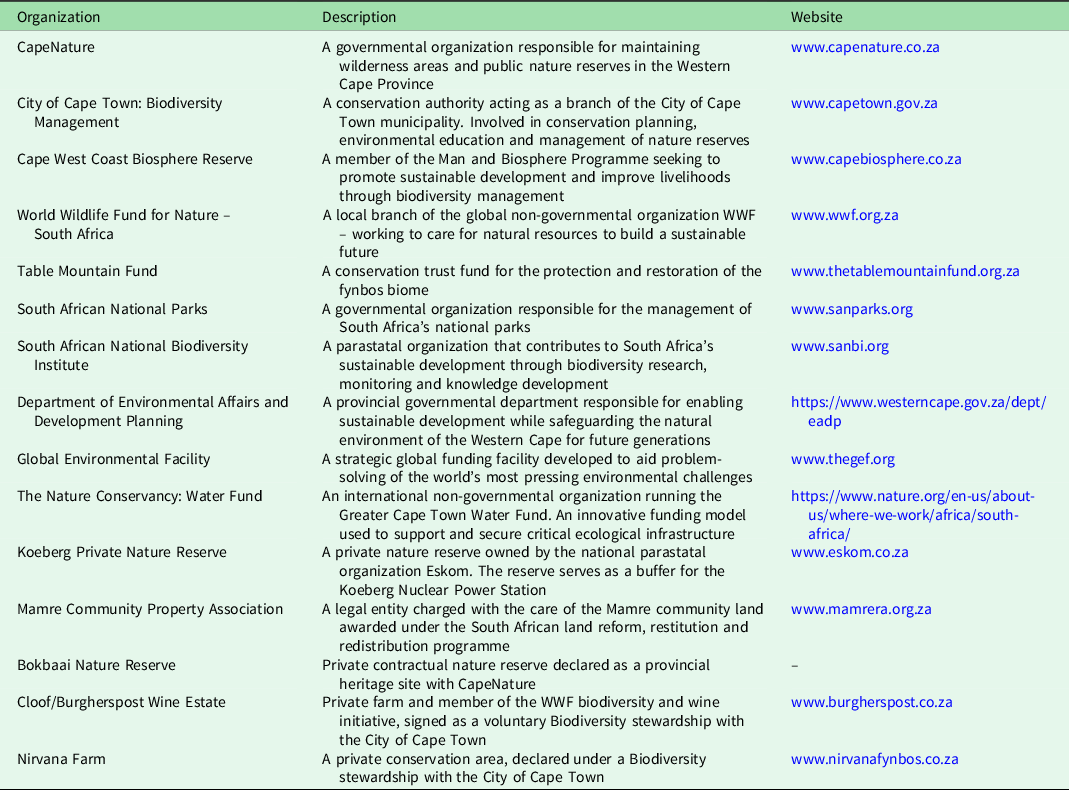
The Dassenberg Coastal Catchment Partnership (DCCP) is a landscape conservation initiative, located c. 40 km North of Cape Town, along the West Coast of South Africa. The DCCP is a partnership between various public, private and non-governmental organizations (NGOs) (Table 1). Forming the southern core of the Cape West Coast Biosphere Reserve, the area encompasses c. 30 000 ha of mostly undeveloped land with some of the most extensive, ecologically functioning portions of endangered and critically endangered Lowland Fynbos habitats (Dorse et al. Reference Dorse, Wood, Scott, Paterson, Scott, Davies and New2019). The DCCP also contains an important fresh water source, the Witzands aquifer, which provides neighbouring communities with 40% of their potable water (Dorse et al. Reference Dorse, Wood, Scott, Paterson, Scott, Davies and New2019).
A list of organizations identified as partners in the Dassenberg Coastal Catchment Partnership (DCCP) initiative.

Due to its unique biodiversity and critical water provisioning ecological infrastructure, the DCCP area was identified as a high priority area for the Western Cape Province to meet policy requirements in terms of protected area expansion and climate change adaptation (Holmes & Pugnalin Reference Holmes and Pugnalin2016). Ecological infrastructure refers to specific naturally functioning ecosystems that provide society with services (e.g., naturally filtered fresh water) (Cumming et al. Reference Cumming, Shackleton, Förster, Dini, Khan, Gumula and Kubiszewski2017). It is a nature-based equivalent that can either support, sustain or even substitute built infrastructure. For example, the Witzands aquifer in the DCCP supplies 40% of the neighbouring community’s fresh water. The cost of replacing this critical water resource was estimated at ZAR 1 billion to pipe water from further afield or ZAR 15 billion for a desalination plant (Dorse et al. Reference Dorse, Wood, Scott, Paterson, Scott, Davies and New2019).
Land ownership in the DCCP comprises 39% state owned, 29% privately owned, 20% community owned and 12% owned by the City of Cape Town municipality (Dorse et al. Reference Dorse, Wood, Scott, Paterson, Scott, Davies and New2019). The area also supports five impoverished communities with unemployment estimated at c. 31%, making it a target area for socioeconomic development (Stats SA Reference Stats2011, Dorse et al. Reference Dorse, Wood, Scott, Paterson, Scott, Davies and New2019). Of these, the Mamre community was the beneficiary of a land redistribution claim with the South African government. The Mamre land (c. 6460 ha) is central to the DCCP, as it contains critically endangered habitat and is crucial for the establishment of an east–west climate change adaptation corridor (Holmes & Pugnalin Reference Holmes and Pugnalin2016).
In 2012, representatives from the City of Cape Town, CapeNature, World Wildlife Fund for Nature – South Africa, the South African National Biodiversity Institute and the Table Mountain Fund agreed to four main objectives for the DCCP landscape initiative (Dorse et al. Reference Dorse, Wood, Scott, Paterson, Scott, Davies and New2019): (a) protect the critical ecological infrastructure, particularly the Witzands aquifer; (b) ensure the protection of the identified critical climate change adaptation and mitigation corridor; (c) deliver socioeconomic opportunities to the surrounding communities; and (d) protect and promote the valuable natural and cultural heritage of the area.
Once these objectives (which we refer to as the DCCP objectives) had been agreed upon by the conservation organizations, the partners lobbied for support from donor funders, other government sectors, political leaders, local landowners and communities through a series of engagements. In 2015, through a combined effort between the City of Cape Town and CapeNature, a funding proposal was submitted to, and granted by, the Global Environmental Facility. The funding was based on improving coordination and developing institutional cooperation and planning for the DCCP. This culminated in, amongst other things, the hiring of a landscape coordinator for 3 years and a series of professionally facilitated co-management planning workshops with diverse stakeholder representation from September to November 2017. The workshops and their facilitation were based on the Open Standards for the Practice of Conservation, which is an open-source adaptive management model and toolkit developed by the Conservation Measures Partnership (Schwartz et al. Reference Schwartz, Deiner, Forrester, Grof-Tisza, Muir and Santos2012).
To achieve their objectives, the DCCP promotes formal and informal protected area expansion with private and communal landowners through the Biodiversity Stewardship Programme (BSP). The City of Cape Town and CapeNature act as implementing agents for the BSP in the DCCP, whereby they petitioned willing landowners to join the programme and commit to better protecting and managing land in conservation priority areas. Empowered through national legislation and policy, the conservation agencies offer support to landowners through various incentives, such as assistance with the development of environmental management plans, clearing of invasive alien plants and burning of fire breaks (SANBI 2014, Cumming et al. Reference Cumming, Shackleton, Förster, Dini, Khan, Gumula and Kubiszewski2017). The BSP includes five different biodiversity conservation arrangements (SANBI 2014), ranging in commitment from long-term (30–99 years) formally declared conservation areas, to medium-term (5–10 years) non-binding agreements and short-term informal agreements (SANBI 2014). The combination of these factors makes the DCCP an ideal setting to explore the alignment between shared stakeholder objectives with those that were predetermined by top-down decision-makers for the landscape.
We explore bottom-up stakeholder objectives and their alignment with the established top-down management objectives of the DCCP landscape-scale conservation initiative in South Africa to gain insight into how alignment could be used to improve co-management. We (1) identify stakeholders and their objectives through a social-ecological inventory (SEI) process and (2) assess which objectives were shared and how well they aligned with the established objectives for the DCCP landscape initiative. We then used these results and accompanying narrative data for reflection and to make recommendations to improve co-management.
Methods
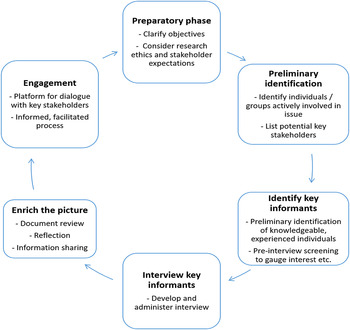
To explore the alignment of stakeholder objectives with the predetermined landscape objectives of the DCCP, we followed the phased approach of the SEI (Fig. 1) outlined in Schultz et al. (Reference Schultz, Plummer and Purdy2011). The SEI was developed as a tool for conservation managers to systematically identify key stakeholders and to prepare the ground for participation in natural resources management (Schultz et al. Reference Schultz, Folke and Olsson2007, Reference Schultz, Plummer and Purdy2011). The SEI captures qualitative data about stakeholders and their motives, knowledge, experience, activities and networks, thereby explicitly bridging social and ecological systems by considering human factors and influences (Schultz et al. Reference Schultz, Plummer and Purdy2011, Plummer et al. Reference Plummer, Baird, Armitage, Bodin and Schultz2017). While described as a stepwise process, phases can occur concurrently and are dynamic, with the intention of iterative feedback.
The six general steps of a social-ecological inventory (SEI) process as outlined by Schultz et al. (Reference Schultz, Plummer and Purdy2011). The diagram represents a ‘generic’ process, starting with the preparatory phase from initial application. While organized into a stepwise illustration, the SEI process does not always occur concurrently. Rather, it is a dynamic and iterative process, requiring continuous feedback between steps.

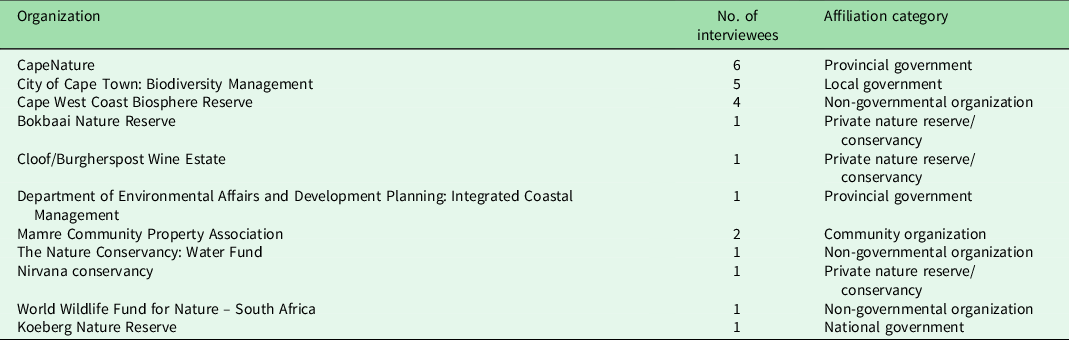
The SEI was conducted with managers and individuals we identified as key stakeholders in the governance of the DCCP (Plummer et al. Reference Plummer, Baird, Armitage, Bodin and Schultz2017). These stakeholders were asked to identify other stakeholders who represented their individual, departmental or organizational interests by frequently participating in management and governance activities for the DCCP objectives. A limitation of this method was that it favoured stakeholders who either represented government agencies responsible for state-owned land or landowners within the landscape. Therefore, of the five impoverished communities mentioned above, only the Mamre community, as landowners, were represented in the sample. Through this snowballing technique (Miles & Huberman Reference Miles and Huberman1994), we interviewed a total of 24 stakeholders from 11 organizations (Table 2). The 11 organizations were further clustered into six affiliation categories: local government, provincial government, national government, a community organization, NGOs and private nature reserves/conservancies.
Breakdown of stakeholders interviewed and their affiliation categories.

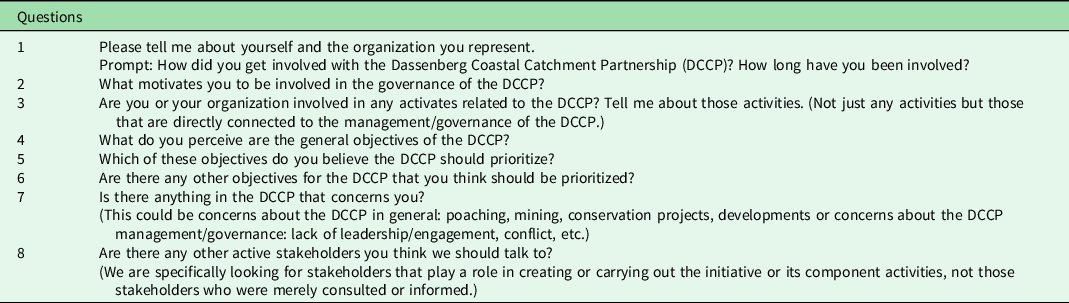
To identify stakeholder objectives, we used a semi-structured interview schedule, designed as part of the SEI, to enquire about stakeholders’ motivations for participating in the DCCP initiative, what objectives they believed should be prioritized and any concerns they had regarding the DCCP initiative (Table 3). Interviews lasted 30–45 minutes and were carried out in person or over the phone during a 4-month period (February–May 2018). All interviews were voice recorded and, upon initiating each interview, participants were informed about their rights and the ethical integrity of this study (REF: H17-SCI-NRM-007).
Social-ecological inventory: semi-structured interview schedule.

The qualitative data were transcribed and coded into themes with shared characteristics (Creswell Reference Creswell2003, Creswell & Plano-Clark Reference Creswell and Plano-Clark2011) under the topics of motivations, priorities and concerns. These three topics were broadly interpreted as stakeholder objectives. To account for the fact that some stakeholder groups were more represented during interviews than others (Table 2), each theme was only noted once per stakeholder affiliation. In this manner, we aimed to reduce bias against minority voices represented in the sample and to give equal weight to all responses. We then analysed the frequencies of the themes that emerged to identify shared stakeholder objectives (i.e., those that emerged from two or more affiliation categories). The results were then compared with the four DCCP objectives to look for alignment.
Results
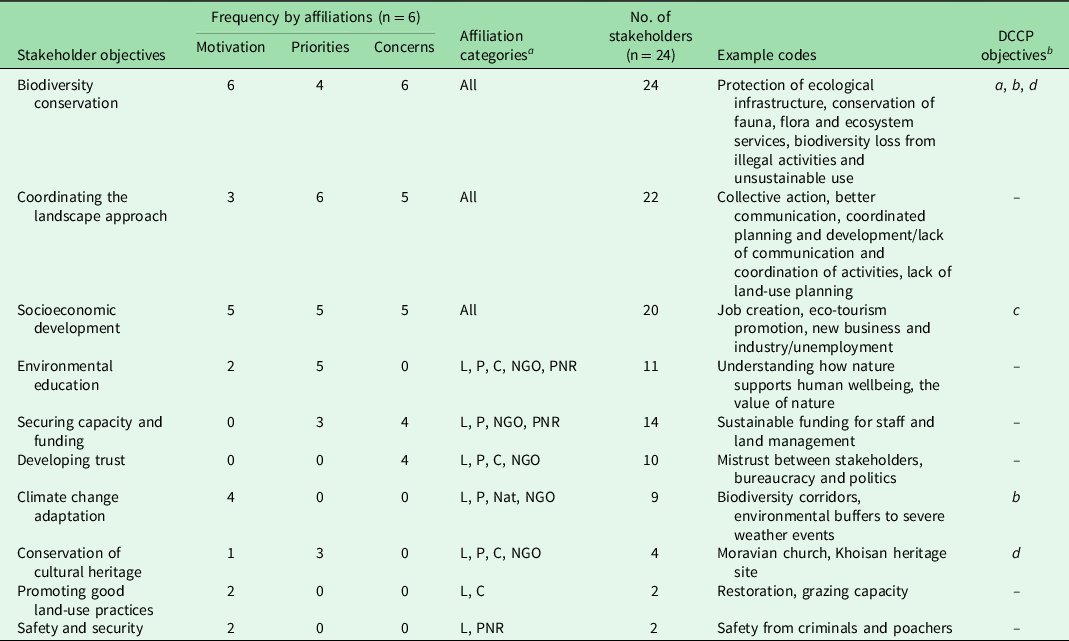
Through our investigation, ten shared stakeholder objectives were identified (Table 4), four of which aligned with the DCCP landscape objectives. Of the four that aligned, two were shared amongst all affiliations, namely biodiversity conservation and socioeconomic development. Biodiversity conservation was most frequently noted; it emerged from all six affiliation categories and with 100% consensus from all interviewees. As a theme, biodiversity conservation was related to the conservation of fauna, flora, ecosystem services, critical biodiversity and ecological infrastructure. For example, when asked about what objectives the DCCP should prioritize, interviewees gave responses such as, ‘The conservation of functioning ecosystems and [fynbos] lowlands, as they are the last [critically endangered] relatively big patch that we have left in Cape Town’ (D5) and ‘Primarily conservation. There are lots of threatened species …, ecosystems and one large open space where you can still do conservation in the city … then Witzands Nature Reserve … which is very important for water conservation in the city … and both the north, south … and the uplands, lowlands connectivity. So you have essentially got two climate change corridors in one location’ (D16).
Results of thematic analysis indicating stakeholder objectives and their relationships to the Dassenberg Coastal Catchment Partnership (DCCP) objectives.

a C = community property association; L = local government; Nat = national government; NGO = non-governmental organization; P = provincial government; PNR = private nature reserve/conservancy.
b Objectives as listed for the DCCP: (a) protect the critical ecological infrastructure, particularly the Witzands aquifer; (b) ensure the protection of the identified critical climate change adaptation and mitigation corridor; (c) deliver socioeconomic opportunities to the surrounding communities; and (d) protect and promote the valuable natural and cultural heritage of the area.
Biodiversity conservation as an objective was therefore found to align with the DCCP objectives a, b and d. However, it did not include the protection of cultural heritage, which was noted by four of the six affiliations separately. The DCCP has rich cultural heritage links to the San people and the Moravian church. One interviewee noted, ‘The cultural heritage of the area is unique, and people still have that pride. Especially in Mamre with the Moravian history, and the buildings and stories of the past’ (D19).
Socioeconomic development aligned with landscape objective c. Biodiversity conservation and socioeconomic development therefore aligned directly and indirectly with all of the DCCP objectives, bar the exclusion of cultural heritage. Biodiversity conservation and socioeconomic development were considered as an important and interlinked motivation, priority and concern for the landscape initiative. Interviewees explained: ‘We [the DCCP] have beautiful coastlines, dunes, unique biodiversity … [and] more than enough land for development of industry. I think the biggest challenge for all of us is to prove that conservation is a viable … and preferable land use [to aid socioeconomic development]’ (D4), and ‘Unemployment will be better now because people will get [conservation] jobs. Even if it is just an EPWP [Expanded Public Works Programme] position … Previously there was nothing … Now there are opportunities’ (D19).
The DCCP, however, needs to attract more private-sector investment to the area in order to enhance socioeconomic development in the long term. One interviewee noted, ‘The people that are working on the [DCCP] corridor are conservationists. We are not tourism operators [or] small business leaders. I think if we want to make a meaningful impact, we need to get people in from outside to push [socioeconomic] development’ (D16).
A widely supported objective that did not align with the DCCP objectives was coordinating the landscape approach that emerged from all affiliations. It was considered as an important motivation, priority and concern for the landscape and seen as important to facilitating all of the DCCP’s objectives. For example, when asked what motivated their participation in the DCCP, interviewees gave responses such as, ‘So it [the DCCP] has got a conservation focus … but at the same time it’s got the imperative to bring stakeholders closer to management of that landscape … it’s about tapping into ways and means to unlock co-partners or co-management arrangements … everybody needs to understand where they plug into this bigger picture … from a site level to a landscape level’ (D1), and ‘Think integration of the protected areas into the landscape [and] when a landowner is planning development, we want his planning to take due consideration of the protected areas [the DCCP] and its objectives …’ (D14).
However, many interviewees also expressed concerns when it came to the coordination of the landscape approach, especially considering the short-term contract of the landscape coordinator. One interviewee noted, ‘… I do believe it [the DCCP] requires warm bodies. If it is decided that a coordinator is not necessarily needed … then what is needed is extension services … If you have the conservation manager …, extension services and community conservation, together they can facilitate the landscape. Once it’s established you don’t necessarily need a coordinating body …’ (D14).
Environmental education was shared as a stakeholder objective by five of the six affiliation groups. This stakeholder objective was considered as a motivation and priority but not a concern for the DCCP. It was especially noted as key to bringing the impoverished communities on board with the landscape initiative. Responses included statements such as, ‘The communities that are involved [the DCCP] should also be taken by the hand and must be taught what it’s all about. Because I think they don’t see the necessity of conservation …’ (D3), and ‘Environmental education, focusing on youngsters, getting them on board. And showing the older … and younger guys how they can … make a living off conservation and tourism’ (D7).
Climate change adaptation, which aligns with DCCP objective b, emerged as a stakeholder objective from four of the six affiliation categories. Interestingly, this excluded the community and private nature reserve/conservancy affiliations. Other prominent stakeholder objectives, identified by four of the six affiliations, included securing capacity and funding and developing trust. Developing trust specifically emerged as an objective due to concerns and mistrust between stakeholder groups. This was especially noted as an issue between conservation entities and the communities; one interviewee stated, ‘So that is the one thing, the challenge with trust … Because everybody had this whole thing about land reform and there are land claims on the conservation areas and people are excited because they can get their land back. And suddenly there is CapeNature, and they are here to fence off everything’ (D19).
Less widely supported objectives included promoting good land use practices, safety and security and equitable costal access.
Discussion
Limitations
At the outset, we note some important caveats of this study. Firstly, the 24 interviewees were not necessarily fully representative of all interested and affected stakeholders for the DCCP. Rather, they represent those stakeholders that we identified through the SEI as participating in the management and governance of the DCCP. This led to a bias towards stakeholders in the conservation sector, as the organizations affiliated with this sector, to date, have played a large role due to the largely eco-centric focus of the DCCP. We attempted to mitigate this by probing interviewees about stakeholders representing other sectors (e.g., tourism and agriculture) and affiliations (private and community landowners), who participate in decision-making and co-management activities within DCCP. We therefore recognize that this approach has potentially perpetuated the inherent power dynamic already existing within the DCCP (Edmunds & Wollenberg Reference Edmunds and Wollenberg2001).
We also recognize that the data were interpreted subjectively, in accordance with the authors’ thematic analysis, and were not subjected to independent review. We attempted to mitigate this limitation through the design and implementation of the questions by clarifying parameters or key terms (e.g., what we meant by ‘active stakeholders’) within the interview schedule. Furthermore, we acknowledge that objectives that emerged less frequently were not necessarily unimportant. They may have been underrepresented because of our sampling strategy.
Alignment between stakeholder objectives and DCCP objectives
The fact that the biodiversity conservation objective, which was shared across all affiliation categories and by all interviewees, can be directly and indirectly linked to three of the four DCCP objectives indicates the essentially eco-centric nature of the initiative. Considering that the objectives were co-designed by predominantly conservation organizations, this was not surprising. Biodiversity conservation has frequently been noted as the motivation for initiating multi-objective landscape initiatives, such as in Latin America (Estrada-Carmona et al. Reference Estrada-Carmona, Hart, DeClerck, Harvey and Milder2014) and Sub-Saharan Africa (Milder et al. Reference Milder, Hart, Dobie, Minai and Zaleski2013), with protected area expansion being a key driver behind these initiatives. The DCCP has formally declared 6000 ha under the Protected Areas Act of 2003, with a further estimated 6000 ha under negotiation through the BSP, indicating its commitment to biodiversity conservation. The planned formal and informal protected area expansion in the DCCP will conserve the unique natural heritage and critical ecological infrastructure of the area and create climate change corridors that reach across the landscape. Stakeholder consensus around the biodiversity conservation objective, and its close alignment with the DCCP objectives, is perhaps a tribute to the success of the initiative to date. This, however, could not have been achieved without the expertise of the conservation agencies driving the landscape initiative.
The objective of socioeconomic development was emphasized as a priority due to the high levels of unemployment in the area. To date, a major contributor to socioeconomic development has been the provision of low-income work opportunities and training related to the management and eradication of invasive alien plants (Dorse et al. Reference Dorse, Wood, Scott, Paterson, Scott, Davies and New2019). Collectively, the conservation partners have reported spending over ZAR 32 million (c. USD 2.5 million in 2021) since 2012, through the government-funded Expanded Public Works Programme, having created over 142 000 person-days of employment, with a further 45 000 person-days projected for another 3-year period (Dorse et al. Reference Dorse, Wood, Scott, Paterson, Scott, Davies and New2019, M. Albertus, personal communication 2019). Unfortunately, the sustainability of these opportunities is questionable, as they depend on the persistence of government funding and the presence of the invasive plants they are working to eradicate. Other contributions in this regard include a small, medium and macro business enterprise (SMME) initiative by the Table Mountain Fund and a green industrial development initiative within the neighbouring town of Atlantis (WESGRO 2021).
At this early stage of the DCCP, the partners are making a valid contribution towards economic growth and job creation for the area. However, they are aware that the DCCP needs to further facilitate the development of other conservation-friendly industries. The area has particular potential for eco-tourism due to its natural and cultural heritage and its proximity to Cape Town. Achieving this potential will likely require significant investment from the private sector. However, private-sector involvement has been commonly cited as a major challenge for integrated landscape initiatives, as submitting to decision-making processes with unclear outcomes is associated with a high risk of uncertainty and minimal financial gain (GEF 1998, Milder et al. Reference Milder, Hart, Dobie, Minai and Zaleski2013, Estrada-Carmona et al. Reference Estrada-Carmona, Hart, DeClerck, Harvey and Milder2014).
Coordination of the landscape approach was a widely shared objective that did not correlate with any of the landscape initiative’s objectives. Most stakeholders noted that coordination of landscapes was a motivation, priority and concern for the successful long-term functioning of the DCCP. The presence of individuals who support and drive the initiative on the ground was noted as being particularly important; often referred to as champions, change agents or institutional entrepreneurs (Barnes et al. Reference Barnes, Bodin, Guerrero, McAllister, Alexander and Robins2017, Baird et al. Reference Baird, Schultz, Plummer, Armitage and Bodin2019), these individuals are at the forefront of developing trusting relationships and lobbying for support at multiple levels and across sectors. Typically, the role is performed by several individuals with specific skills, including skills for developing strategic relationships, connecting important actors, mobilizing resources and identifying potential opportunities for innovation and policy development (Baird et al. Reference Baird, Schultz, Plummer, Armitage and Bodin2019).
Between 2012 and 2017, this role was voluntarily performed by several actors from CapeNature and the City of Cape Town municipality. These individuals were responsible for initiating the DCCP and for lobbying much of the high-level political support that led to the proclamation of state-owned land. A substantial influence of the donor funding, awarded in 2015, was the creation of a landscape coordinator position under CapeNature. The designated coordinator was able to benefit the initiative by playing a key brokering role between stakeholders. Ultimately, this reduced the cost of transaction between stakeholders by creating a central point about which the governance network could liaise and coordinate (Carlsson & Sandström Reference Carlsson and Sandström2008, Provan & Kenis Reference Provan and Kenis2008, Lubell et al. Reference Lubell, Robins and Wang2014). Administrative models of landscape governance such as these have been found to stimulate stakeholder network growth through targeted funding and/or facilitation to ensure that objectives are met (Provan & Kenis Reference Provan and Kenis2008). However, this position was based on a 3-year contract with no obligation or commitment that it would be continued after the funding cycle closed. The uncertainty of what will happen in terms of the DCCP’s coordinating body following this period of donor funding leaves the initiative in a state of vulnerability, as a return to shared voluntary coordination is unlikely (Provan & Kenis Reference Provan and Kenis2008).
As coordination is an essential element of effective co-management (Hanleybrown et al. Reference Hanleybrown, Kania and Kramer2012, Chaffin et al. Reference Chaffin, Gosnell and Cosens2014), we recommended explicitly listing it as an objective for the DCCP. This mandate will ensure more focused attention and strategy development, as well as resource and capacity allocation to this vital function. Extensive studies of integrated landscape initiatives in Latin America (104 cases in 21 countries; Estrada-Carmona et al. Reference Estrada-Carmona, Hart, DeClerck, Harvey and Milder2014) and Sub-Saharan Africa (87 cases in 33 countries; Milder et al. Reference Milder, Hart, Dobie, Minai and Zaleski2013) have revealed that objectives regarding coordination and institutional planning represented the most crucial foundation for success in multi-stakeholder landscape governance, with overall investment in this domain producing the highest proportion of positive outcomes. In these studies, investments such as capacity building, providing technical assistance and strengthening existing bodies or developing new coordination bodies improved overall coordination and promoted the empowerment of women and local communities.
Coordinating the landscape approach could also benefit other noted stakeholder objectives, including developing trust, environmental education and securing capacity and funding. While not all of these objectives were widely shared, they can be considered as the means needed to achieve the ultimate objective: coordinated and effective co-management (Gregory Reference Gregory2000, Sayer et al. Reference Sayer, Sunderland, Ghazoul, Pfund, Sheil and Meijaard2013, Estrada-Carmona et al. Reference Estrada-Carmona, Hart, DeClerck, Harvey and Milder2014). In particular, the issue regarding trust needs to be recognized in the South African context due to the historical and current marginalization of disadvantaged groups (Edmunds & Wollenberg Reference Edmunds and Wollenberg2001, Musavengane & Leonard Reference Musavengane and Leonard2019). While this is outside the scope of this study, we clearly noted a power dynamic within the decision-making realm of the DCCP that requires attention, as the DCCP is moving forwards based on beliefs and values that exclude the voices of the majority populace. There is a need to increase the decision-making power of the disadvantaged groups within the area to truly enable inclusive participation (Edmunds & Wollenberg Reference Edmunds and Wollenberg2001, Musavengane & Leonard Reference Musavengane and Leonard2019). Because other protected area expansion projects have noted that the development of trust, awareness and capacity with impoverished landowning communities takes more than 4 years to develop (GEF 1998, Scherl & Hahn Reference Scherl and Hahn2018), landscape coordination will require a consistent long-term effort. Listing ‘coordination of the landscape approach’ as an objective not only highlights its value, but also acknowledges that it is an ongoing effort of developing relationships and not something that terminates with the closure of a funding cycle (O’Farrell & Anderson Reference O’Farrell and Anderson2010, Talbot & van den Broeck Reference Talbot, van den Broeck, Chabay, Frick and Helgeson2016, Cockburn et al. Reference Cockburn, Cundill, Shackleton, Cele, Cornelius and Koopman2020).
What did we learn about co-management in the DCCP?
We set out to explore the alignment of stakeholder objectives with the DCCP landscape objectives because the DCCP objectives were not inclusively co-designed and represented a typical bureaucratic–scientific endeavour. We found that the DCCP objectives aligned with the main expectations of its stakeholders in terms of their objectives of biodiversity conservation and socioeconomic development. However, we also revealed shared objectives that were not catered for, highlighting potential areas for improving co-management. Incorporating shared objectives can improve co-management, as they act as incentives for stakeholders to participate and aid in the development of trust (Sayer et al. Reference Sayer, Sunderland, Ghazoul, Pfund, Sheil and Meijaard2013, Freeman et al. Reference Freeman, Duguma and Minang2015). Failure to acknowledge shared objectives can hinder co-management, as stakeholders will only partake in processes that they deem to be in their best interests. Coordinating the landscape approach was a specific shared stakeholder objective of importance that did not align with the established management objectives listed for the DCCP. Including it as a landscape objective will ensure allocation of capacity and resources to enable its vital functioning.
We therefore conclude that exploring stakeholder objectives and their alignment with landscape objectives can highlight functions of co-management that have been overlooked. Revising landscape objectives to incorporate stakeholder objectives can potentially lower the transaction costs of sustaining conservation efforts in the long term. Furthermore, considering the dynamic nature of landscapes, we recommend further research to explore whether stakeholder objectives are equally dynamic and whether cyclical revisions are needed to improve co-management and promote long-term adaptive management. Lastly, research approaches are needed to consider how to incorporate and counter the inherent power dynamics that are found within landscape-scale initiatives such as the DCCP.
Acknowledgements
We gratefully acknowledge all of the stakeholders who took part in the interviews and shared their time and views with us. Special acknowledgement goes to CapeNature and the City of Cape Town Biodiversity Management Branch for their continuous support. We are also grateful to two anonymous reviewers whose constructive comments helped to strengthen this manuscript, and to Professor Polunin for his guidance through the review process.
Financial support
This research was supported by scholarship funding from the UNDP-GEF Project: Improving Management Effectiveness of the Protected Area Network (UNDP PIMS ID:4943) and from Nelson Mandela University.
Conflict of interest
None.
Ethical standards
This research was approved by Nelson Mandela University’s Faculty of Science Human Research Ethics Committee (REF: H17-SCI-NRM-007). All participants were informed about the ethical integrity of this study and their rights prior to obtaining their consent.