INTRODUCTION
During its lifetime an organism experiences significant changes in its ecological relationships and plays sequentially different roles in the ecosystem, either as a result of metamorphic changes between successive life-history stages or merely as a consequence of change in size due to growth (Brose et al. Reference BROSE, JONSSON, BERLOW, WARREN, BANASEK-RICHTER, BERSIER, BLANCHARD, BREY, CARPENTER, BLANDENIER, CUSHING, DAWAH, DELL, EDWARDS, HARPER-SMITH, JACOB, LEDGER, MARTINEZ, MEMMOTT, MINTENBECK, PINNEGAR, RALL, RAYNER, REUMAN, RUESS, ULRICH, WILLIAMS, WOODWARD and COHEN2006, Ebenman Reference EBENMAN1992, Werner & Gilliam Reference WERNER and GILLIAM1984).
Trees in tropical rain forests pass through an exceptionally great range in size as they grow from seedlings to mature plants and, although stationary, they may play successively different roles in the ecosystem, i.e. constitute different econes (Heatwole Reference HEATWOLE1989). As the leafy portion of the plant passes through different strata, successive cohorts of leaves differ in size, shape and function; grow at different rates; have different longevities (Bongers & Popma Reference BONGERS, POPMA, Werger, van der Aart, During and Verhoeven1988, Garwood Reference GARWOOD1983, Lowman & Box Reference LOWMAN and BOX1983, Lowman & Heatwole Reference LOWMAN and HEATWOLE1992); and occupy different spatial and microclimatic environments, each with its own suite of interacting organisms. The lower strata, where seedlings and young saplings grow, experience low light intensities, high CO2 levels, high humidities, still air and equable, moderate temperatures, whereas at the top of the canopy, the diurnal light intensity is high, and humidity, wind and temperature are more variable and reach greater extremes (temperature and wind speed higher than at ground level and humidity lower) (Barker Reference BARKER1996, Blanc Reference BLANC, Hallé and Blanc1990, Fitzjarrald & Moore Reference FITZJARRALD, MOORE, Lowman and Nadkarni1995, Parker Reference PARKER, Lowman and Nadkarni1995, Richards Reference RICHARDS1957).
Foliage is subject to attack by herbivorous animals and parasitic fungi, to encrustation by epiphyllous fungi, lichens, liverworts, mosses and micro-organisms, and to mechanical breakage from wind, falling objects and animals. The present study was designed to assess the kaleidoscope of threats facing leaves as trees grow through the vertical mosaic of the forest.
One would expect fungi to thrive better in the moister, shadier and less windy microclimate at ground level than in canopies or exposed emergent trees, and indeed Coley & Kursar (Reference COLEY, KURSAR, Mulkey, Chazdon and Smith1996) and García-Guzmán & Dirzo (Reference GARCÍA-GUZMÁN and DIRZO2001) speculated such to be the case. Accordingly, one would expect fungal attack on leaves to be greater at ground level than in higher strata. Epiphyllae, being moisture sensitive, would also be expected to have this pattern.
Conversely, the fact that insects often have been found to be more abundant in the canopy than at ground level (Basset et al. Reference BASSET, ABERLENC and DELVARE1992, Reference BASSET, ABERLENC, BARRIOS, CURLETTI, BÉRENGER, VESCO, CAUSSE, HAUG, HENNION, LESOBRE, MARQUÉS and O'MEARA2001; Koike et al. Reference KOIKE, RISWAN, PARTOMIHARDJO, SUZUKI and HOTTA1998, Sutton Reference SUTTON, Lieth and Werger1989, Sutton & Hudson Reference SUTTON and HUDSON1980) leads to the hypothesis of greater damage by insects to leaves in the upper strata than to leaves nearer ground level.
Plants at ground level would be the recipients of the cumulative throughfall of fruits and sticks from all layers above; hence mechanical injury from this source would be expected to be higher at ground level. Lacking prior information on the relative abundance of large animals in different strata, and not having an assessment of the relative effect of wind versus falling objects as sources of mechanical injury to leaves, a directional hypothesis could not be constructed for mechanical injury.
Four hypotheses were posed for testing in the present study. Hypothesis 1: Impact of fungi on leaves is greater at ground level than in higher strata. Hypothesis 2: Impact of epiphyllae is greater at ground level than in higher strata. Hypothesis 3: Impact of insects is greater in upper strata than in lower ones. Hypothesis 4: There is no difference among strata in the mechanical injury to leaves. Operationally, the data were tested against null hypotheses of no differences among strata for all agents.
STUDY AREA
Fieldwork was conducted 31 October–13 November 2001 in the Masoala National Park on Masoala Peninsula in north-eastern Madagascar. The park includes an elevational gradient spanning habitats from lowland, humid, evergreen rain forest near sea level to montane thicket and cloud forest at >1200 m and has an area of 211 230 ha (Kremen et al. Reference KREMEN, RAZAFIMAHATRATRA, GUILLERY, RAKOTOMALALA, WEISS and RATSISOMPATRARIVO1999). There are no roads on the peninsula and inhabitants live in small villages. The populace depends on agriculture and gathering of forest products; timber is harvested only by hand-felling (Kremen et al. Reference KREMEN, RAZAFIMAHATRATRA, GUILLERY, RAKOTOMALALA, WEISS and RATSISOMPATRARIVO1999). Sufficient area was set aside outside the park to cater for local needs and since the park was gazetted in 1997, disturbance to the forest by humans has been minimal.
The study was carried out in lowland to mid-elevation humid evergreen forest from a base of operations at the Tampolo Field Station (15°43′48″S; 49°57′34″E) (Monte-Alegre et al. Reference MONTE-ALEGRE, RAKOTOMALALA, LEVEDGLE, COULIER and FAURE2005). There was a closed upper canopy at 15–22 m and a less complete mid-canopy at 10–13 m. Scattered emergent trees, up to 37 m tall, protruded above the upper canopy. Branches and trunks at all levels supported a profuse growth of epiphytes, lianes and parasitic plants. The ground layer consisted of a sparse cover of seedlings, saplings and shrubs.
MATERIALS AND METHODS
Leaves from the tops of the crowns of trees were sampled using (1) a dirigible, (2) a canopy raft, (3) prefabricated tree-houses and (4) traditional rope-climbing. The equipment and methods have been described and illustrated by Hallé (Reference HALLÉ, Mitchell, Secoy and Jackson2002), Hallé et al. (Reference HALLÉ, CLEYET-MARREL and EBERSOLT2000), Mitchell et al. (Reference MITCHELL, SECOY and JACKSON2002) and Montgomery (Reference MONTGOMERY1977).
There were 18 emergent trees within the dirigible's range and all were sampled, as were 24 canopy trees, by investigators suspended below the dirigible in a basket and using secateurs and saws to remove branches. In addition, four trees from the canopy were sampled from the canopy raft and two from tree houses. The sample size was 30 leaves, consisting of the two oldest (most basal) leaves from each of 15 branches. At ground level, saplings and shrubs were sampled from on foot at 10-m intervals along a service path, choosing the plant to the right of the transect at odd-numbered stations and the one to the left at even-numbered stations. The number of leaves in samples in this stratum varied because few of the shrubs and none of the saplings had 15 branches. Consequently, all hardened, mature leaves (as ascertained by colour, texture and sclerophylly of the leaves; Lowman Reference LOWMAN1985), not just the oldest two, were collected from individual branches. Statistical tests verified the validity of lumping mature leaves of different ages for all agents but epiphyllae (Heatwole, unpubl. data).
Procedures for assessing damage varied depending on the agent. Leaves were individually scored separately for mechanical breakage, encrustation by epiphyllae, attack by fungi, and attack by leaf miners, as: nil (no damage), + (damage estimated to be <5% of leaf area), slight (5–10%), moderate (11–15%), or heavy (>15%). Number of galls on each leaf was recorded. Finally, the outline of each leaf was traced on paper and the extent of damage by grazing insects and skeletonizing insects traced separately within the outline of the leaf. The total, undamaged area of each leaf was measured to the nearest 0.01 cm2 by a Li-Cor area meter, model LI-3100. Then, the area eaten by insect grazers was excised by manicure scissors and a second reading taken. Finally, the area eaten by skeletonizers was excised and a final measurement made. Subtraction of the various leaf areas allowed separate calculation of the percentage of the total leaf surface eaten by these two trophic categories. Insect bite marks were distinguished from mechanical breakage by the nature of the broken surfaces. Some damage caused by grazers and skeletonizers could have been inflicted at different stages in the early growth of a leaf. Even if leaves continue to grow after having been damaged, however, the proportional extent of grazing can be directly compared as Lowman (Reference LOWMAN1987) has shown that the holes caused by herbivores increase in size in proportion to the growth of the leaf itself. The number of attacks on the leaf by grazing and skeletonizing insects was taken to be the number of separate indentations or holes in the leaf. The higher numbers may have been underestimated by the coalescence of two or more separate attacks into one outline.
The scoring of damage by fungi, leaf miners and mechanical forces, and of encrustation by epiphyllae, only allowed for assessment of incidences of these types of damage, and of relative frequencies of the different categories of severity, and was qualitative. Accordingly, non-parametric statistics were used. When expected values fell below five in chi-square analyses, categories were lumped until this minimum criterion was met.
All other data were subjected to parametric statistical analysis. The data on incidence and on various measures of attack and damage to leaves by grazing and skeletonizing insects were skewed strongly to the left. Accordingly, two separate analyses were performed, one comparing the percentages of leaves that were attacked and the other comparing various aspects of herbivory only on those leaves that had suffered attack. The data for attacked leaves were skewed so they were normalized by logarithmic transformation before analysis. In analyses of variance (ANOVA), each entity was also tested pairwise against each other entity by Fisher PLSD tests. Parametric statistical tests were performed using a Statview 1992–1998 program from SAS Institute.
Local botanists identified a few trees to genus or species, but most lacked flowers or fruits and could only be identified to family. The short time allotted to each participant of the expedition, the high biodiversity of the trees and the distant spacing of conspecific trees did not allow for controlled replication of individual taxa of trees.
The average of the values from the leaves from each individual tree was used as the basic datum for use in statistical analyses, i.e. the individual tree, not the individual leaf, was the unit of comparison. The means of the values for individual trees were used to calculate the ‘grand mean’ for strata. Values are expressed as mean ± SE.
RESULTS
Four kinds of assessment of impact by agents were made: (1) number of agents (the number of different agents attacking an individual leaf), (2) incidence of attack (per cent of leaves suffering one or more attacks by a given agent), (3) intensity of attack (number of attacks by a given agent per attacked leaf) and (4) extent of damage to attacked leaves, indicating the reduction of photosynthetic area available to the plant (percentage of total area of leaf lost to grazing or skeletonizing insects, but qualitative ranking for other agents).
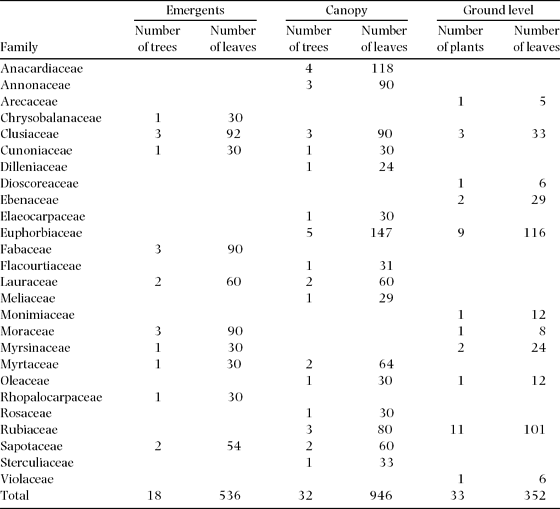
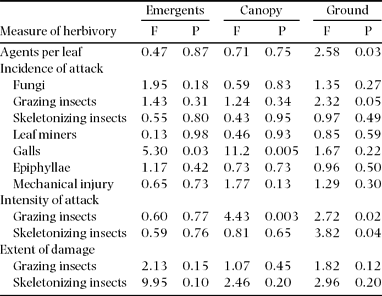
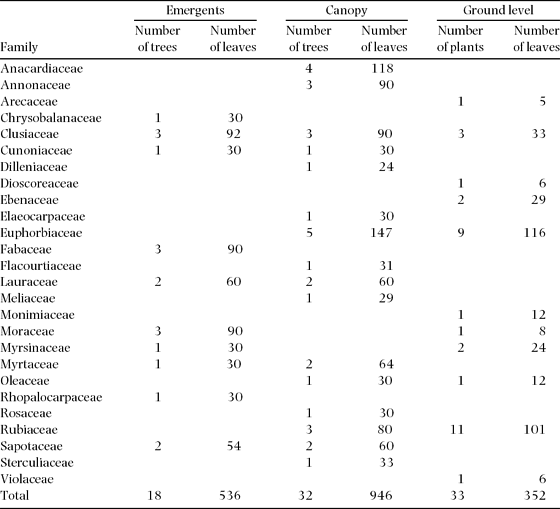
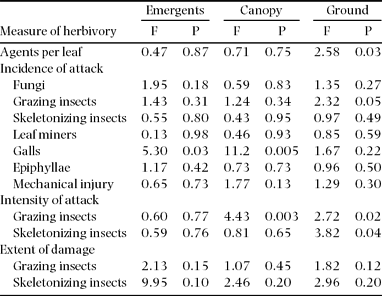
A total of 1834 leaves from 83 plants of 26 families was collected. Appendix 1 shows the allocation of samples among families. Families of trees were not uniformly represented in the samples and if families differ in the degree to which they are attacked, such disproportionate representation could bias the results toward the characteristics of the families with the most trees in the sample. In one or more strata there were significant differences among families in the number of agents attacking leaves, in the incidences of attack by galls, and in intensity of attack by grazing and skeletonizing insects (Table 1); consequently, interstratal comparisons could not be made for galls or for intensity of attack; the number of comparisons for number of agents was limited. For other agents and measures of attack or damage, differences among families within levels were not significant and valid comparisons among strata could be made.
Statistical tests (ANOVA) for differences among families for various measures of herbivory on leaves in different strata of a rain forest in Madagascar.
Number of attacking agents
Leaves often suffered attack from multiple agents and fewer than 4% escaped unscathed by any agent. Overall, the mean number of agents attacking a leaf was 1.83 ± 0.02 and the percentages of leaves attacked by 0, 1, 2, 3, 4 and 5 agents were 3.4, 34.5, 41.6, 17.3, 3.0 and 0.3 respectively. No leaf was attacked by more than five of the seven agents studied.
The number of agents attacking an individual leaf averaged 1.90 for the emergents, 1.69 in the canopy and this difference was significant (PLSD: P = 0.047). The value at ground level was highest (2.10) but because families differed significantly within the ground layer, statistical comparison could not be made between it and other strata. Thus, the number of agents attacking leaves decreased from emergents to canopy and may have increased again at ground level.
Incidence of attack
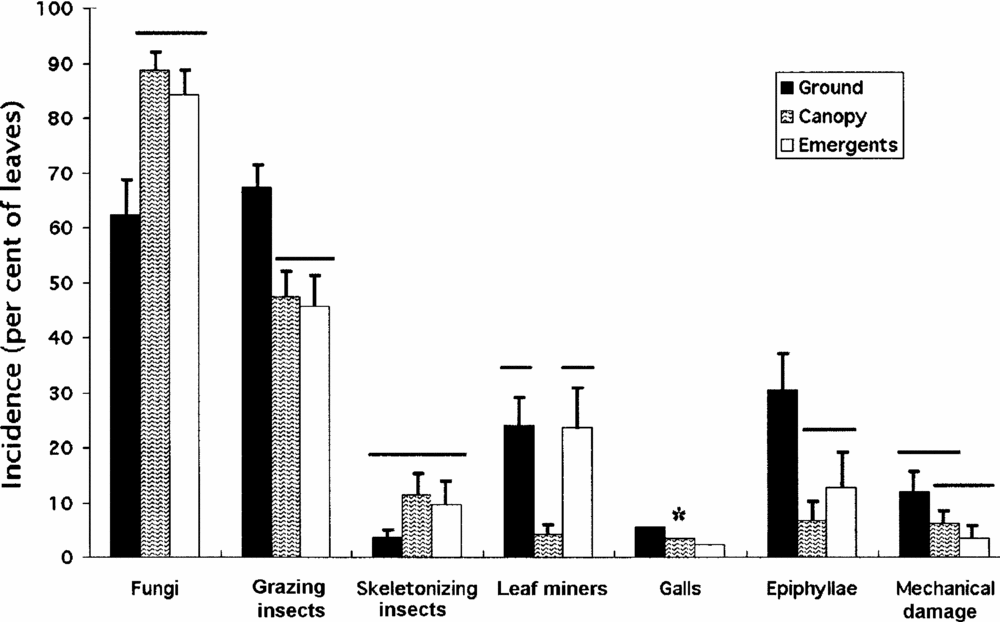
Incidence of attack varied among agents, with fungi having the highest values (>60% in all strata), followed by grazing insects (between 45% and 65%); all other agents had values between 3% and 30%, with leaf miners and epiphyllae mostly falling below 30% and skeletonizing insects, galls and mechanical injury below 15% (Figure 1).
Incidence of attack by various agents on leaves in different strata of a tropical rain forest in Madagascar. Error bars indicate 1 SE. Horizontal bars indicate strata, for a given agent, that are not significantly different from each other. An asterisk indicates that statistical comparisons among strata could not be validly performed because of significant differences among families of trees in one or more strata.
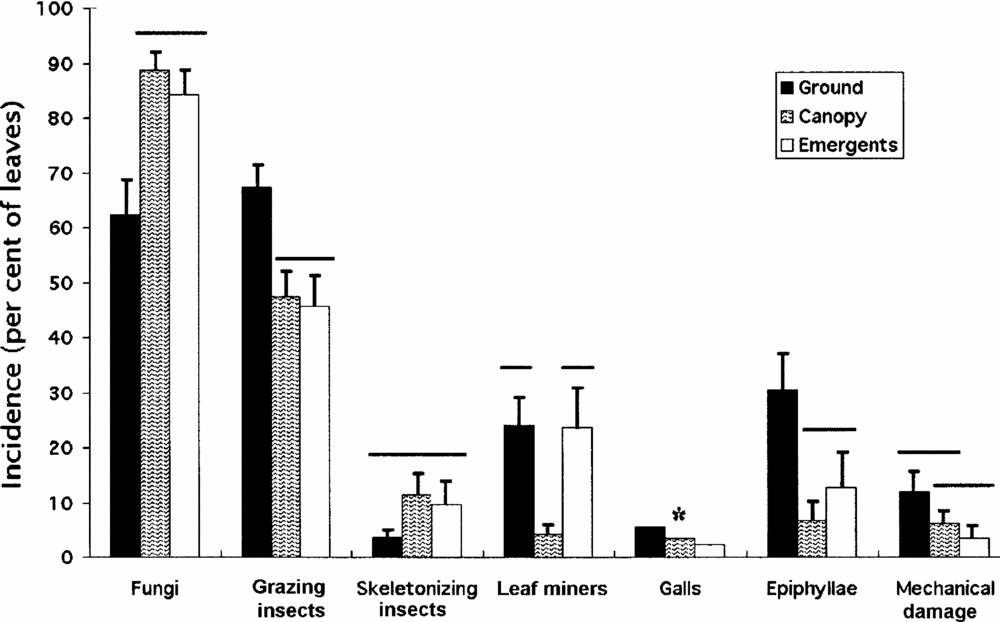
The percentage of leaves that were attacked by fungi differed significantly among strata (F = 10.4; P < 0.0001) (Figure 1), with the values for emergents (E) and canopy (C) both being significantly higher than those for the ground layer (G) (PLSDs: P = 0.003, P < 0.001 respectively), but the two upper strata did not differ significantly (PLSD: P = 0.530). The most common pattern, however, was the inverse, with grazing insects (F = 6.76; P = 0.002), epiphyllae (F = 6.66; P = 0.002) and mechanical injury (F = 3.71; P = 0.029) having significantly higher incidences at ground level than in the two upper strata. For grazing insects and epiphyllae the emergents and canopy did not differ significantly from each other (PLSD for E versus C: grazing insects P = 0.837; epiphyllae P = 0.449) but each differed significantly from the ground layer (grazing insects: E vs. G, P = 0.004, C vs. G, P = 0.002; epiphyllae: E vs. G, P = 0.028, C vs. G, P = 0.006). The incidence of mechanical breakage progressively increased from higher to lower strata. The differences were significant overall (F = 3.71; P = 0.029) as was the pairwise comparison between the emergents and ground level (PLSD: P = 0.013); however, the individual intermediate increments were not significant (P = 0.054 and 0.384 for G vs. C and C vs. E respectively). By contrast incidence of skeletonizing insects did not show any significant differences in incidence among strata (F = 1.95; P = 0.149) overall (Figure 1) or in pairwise comparisons.
Incidence of attack by leaf miners (Figure 1) was significantly lower in the canopy than at ground level (PLSD: P = 0.0003) or in the emergents (P = 0.002), but the emergents and ground level did not differ significantly (P = 0.955).
Unlike other agents, infestation by galls was strongly influenced by family of host tree in the emergents and in the canopy (Table 1) and that precluded rigorous assessment of the slight differences among strata.
Intensity of attack
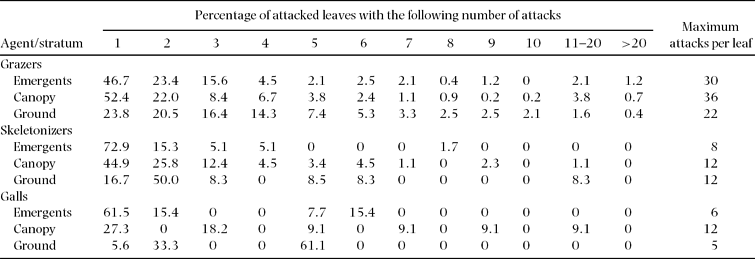
Many of the leaves that sustained damage from either grazing or skeletonizing insects or galls in the emergent trees and canopy were subject to only one attack, with successive numbers of multiple attacks sharply declining to very low proportions (Table 2). At ground level, for all three groups, the intensity of attack was greater, in that a lower proportion of leaves suffered single attacks but accordingly a higher proportion suffered multiple attacks than did the higher strata.
Intensity of attacks on attacked leaves by various guilds of insects in a tropical rain forest in Madagascar.
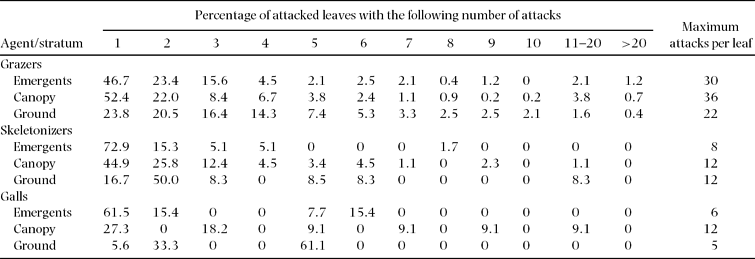
The mean number of attacks per attacked leaf by grazing and skeletonizing insects progressively increased from emergents to canopy to ground level (grazers: E 1.94, C 2.18, G 2.45; skeletonizers: E 1.53, C 2.39, G 3.33). The mean intensity of attack by galls was 6.9 in the emergents, 3.5 in the canopy and 4.5 at ground level. The difference between the emergents and canopy for skeletonizers was significant (P = 0.008) but other tests among strata for the three kinds of insects were precluded by the significant differences among families of trees in some strata.
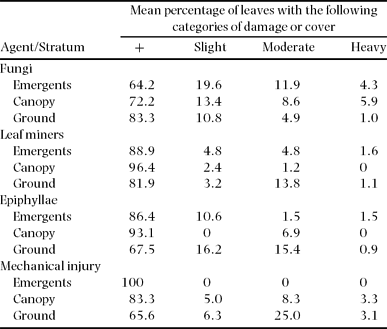
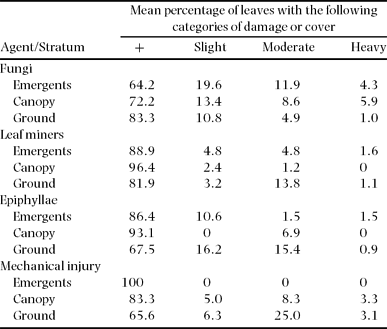
The more qualitative assessment for the other agents required a different method of assessment of intensity. There was a sharp decline in the proportion of leaves affected by fungi, leaf miners, epiphyllae and mechanical breakage with increasing category of severity (Table 3). For all these groups, more than 70% of the leaves suffered only the smallest category of damage, with values generally declining to very low percentages of leaves subjected to heavy damage.
Damage to leaves by various agents in different strata of a rain forest in Madagascar. Damage levels: +, < 5% of leaf area; slight, 5–10%; moderate, 11–15%; heavy, > 15%. Chi-squared tests of differences among strata: fungi χ2 = 10.3, 0.05 > P > 0.02; leaf miners χ2 = 10.8, 0.01 > P > 0.001; epiphyllae χ2 = 30.1, P < 0.001; mechanical injury χ2 = 41.9, P < 0.001.
Extent of damage
The distribution of leaves in the various categories of damage by fungi differed among strata. The incidence of attack was lower at ground level (Figure 1), i.e. a greater percentage of leaves escaped damage altogether (nil damage), than in the two upper strata. Furthermore, among those leaves that were attacked, there was a significant, progressive shift from the ground upward toward decreasing proportions of leaves in the category of least damage (+) and increasing proportions in the categories of greater damage (slight, moderate, heavy) (Table 3). Thus, the extent of fungal damage increases progressively from the ground upward.
The extent of damage by leaf miners differed significantly among strata (Table 3), with a lower proportion of leaves at ground level suffering minimal damage and a greater proportion suffering moderate damage than was true for the upper two strata. Thus, the extent of damage by leaf miners is greatest at ground level.
At ground level, the proportion of leaves with minimal coverage by epiphyllae (category +) was relatively lower, and the proportion with greater coverage (slight, moderate, heavy) relatively higher, than for the canopy (Table 3). The emergents were intermediate, but more similar to the ground layer than to the canopy.
The extent of mechanical injury to leaves progressively increased from the upper to the lower strata and the differences among strata were significant (Table 3). In the emergents, all attacked leaves suffered only minimal damage, whereas at ground level only about two-thirds of the leaves had minimal damage and a quarter of them suffered moderate damage; the canopy was intermediate.
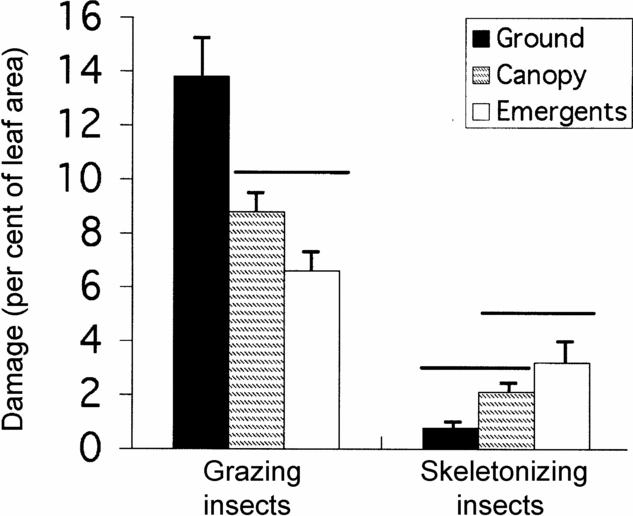
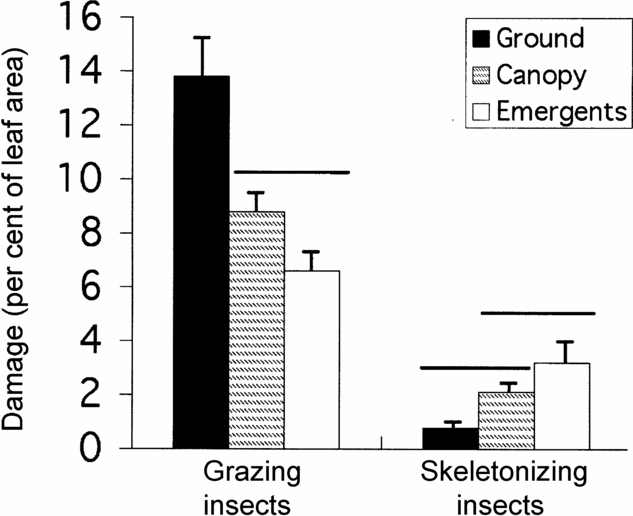
The percentage of the leaf area of attacked leaves that was consumed by grazing insects was least in the emergents and increased progressively to the canopy and to ground level (Figure 2). The ground layer had significantly higher values than did either the canopy (PLSD: P = 0.002) or the emergents (PLSD: P = 0.0003), but the canopy and emergents were not significantly different (PLSD: P = 0.258). The pattern of impact was the opposite for skeletonizing insects; they consumed progressively greater percentages of leaf area from ground to canopy to emergents (F = 3.56; P = 0.03) (Figure 2). The incremental increases were not significant (PLSD: P = 0.090 from ground to canopy, and 0.269 from canopy to emergents), but ground level did differ significantly from emergents (PLSD: P = 0.012) (Figure 2).
Per cent of leaf area eaten by grazing and skeletonizing insects in different strata in a tropical rain forest in Madagascar. Error bars indicate 1 SE. Horizontal bars indicate strata, for a given agent, that are not significantly different from each other.
DISCUSSION
The various analyses of the present study converge to reveal three basic vertical patterns of impact of agents on leaves: (1) greatest impact at ground level, (2) greatest impact in the upper two strata and (3) no discernible difference among strata. These were the three patterns proposed by the original four hypotheses but in only one of the four did the empirical data support applicability to the hypothesized agent.
Most agents exhibited the first of the above three patterns. On average, the number of different agents attacking a leaf progressively declined from the ground through the canopy to the emergent trees. Not only did grazing insects attack a greater proportion of leaves at ground level than in the upper strata, but the number of attacks per leaf and the proportion of the leaf area consumed were also greater. Leaf miners had more extensive damage and galls had greatest intensity of attack near the ground than in other strata but otherwise measures of herbivory for these two agents did not differ significantly among strata. Thus, for these three groups of insects, the hypothesis of greater impact of insects in the higher strata than at ground level (hypothesis 3) was not supported; in fact, the reverse was found to be the case.
Epiphyllae had a higher incidence and a greater coverage of the leaf at ground level than in upper strata and thus the data support original hypothesis 2.
Mechanical injury showed a progressive increase in incidence and extent of damage from emergents to canopy to ground and thus the null hypothesis (Hypothesis 4) was falsified.
The second pattern was found in pathogenic fungi and skeletonizing insects, i.e. the vertical trend was in the opposite direction to that of the three previous agents. For fungi, incidence of attack and the degree of damage inflicted both were greater in the two upper strata than at ground level. Thus, Hypothesis 1 was falsified and fungi conformed to just the opposite pattern. Although skeletonizing insects had a greater intensity of attack near the ground, the damage inflicted by these attacks was less than in the higher strata and hence this trophic category conformed to hypothesis 3.
Fungi constituted the agent with the highest incidences of attack overall. Their incidence of attack was lowest at ground level but, even so, it was equivalent to that of the second most important agent, grazing insects, whose peak incidence occurred at that level. The incidence of attack by grazing insects, however, may be an underestimate. Recall that at ground level, all hardened, mature leaves were harvested for the samples, rather than just the two oldest ones on the branch. Although grazing on leaves after they have matured and hardened is minimal in the study area (Heatwole, unpubl. data), some of the leaves may not have sustained the full amount of grazing they would suffer in their lifetime. Hence, the observed values of grazing on the leaves at ground level may be underestimates and the differences between the ground layer and the upper strata may be even more pronounced than portrayed here. The same consideration would apply even more strongly to epiphyllae as they were demonstrated to continue to increase their impact after maturation and hardening of leaves (Heatwole, unpubl. data). Thus, correction for this possible source of bias would strengthen, rather than weaken, the conclusions drawn.
García-Guzmán & Morales (Reference GARCÍA-GUZMÁN and MORALES2007) noted that fungal diseases were common in tropical forests and were perhaps the most important source of plant damage, with 53–92% of plants affected, depending on type of forest. This conclusion was supported by the present study in which fungi had a higher incidence than did any other agent. By contrast, Benítez-Malvido et al. (Reference BENÍTEZ-MALVIDO, GARCÍA-GUZMÁN and KOSSMANN-FERRAZ1999) and Benítez-Malvido & Lemus-Albor (Reference BENÍTEZ-MALVIDO and LEMUS-ALBOR2005) found the reverse, i.e. damage by herbivorous insects greater than that by pathogenic fungi. Attack of leaves by fungi and by insects may not be independent events; García-Guzmán & Dirzo (Reference GARCÍA-GUZMÁN and DIRZO2001) found that wounding of leaves by herbivorous insects paved the way to establishment of pathogenic fungi.
Various authors have found incidence of fungal attack to be more prevalent in the open, sunny edges of forests than in the darker interior (Benítez-Malvido & Lemus-Albor Reference BENÍTEZ-MALVIDO and LEMUS-ALBOR2005, Gilbert et al. Reference GILBERT, REYNOLDS and BETHANCOURT2007) and Benítez-Malvido et al. (Reference BENÍTEZ-MALVIDO, GARCÍA-GUZMÁN and KOSSMANN-FERRAZ1999) suggested that perhaps the acidic, heavily leached soils may have inhibited fungal growth. Gilbert et al. (Reference GILBERT, TALARO, HOWELL and SYMSTAD1997) found that the density of the fungus Scolecopeltidium on leaves in lowland tropical forests in Panama and Costa Rica showed a strong positive relationship with the degree of openness of the canopy, and indicated that individual plants subjected to high light intensities had more extensive colonization by the fungus. This accords with the greater incidence of fungi in emergent trees and top of the canopy than at ground level in the present study. In a later study, however, Gilbert et al. (Reference GILBERT, REYNOLDS and BETHANCOURT2007) concluded that sites in the dark understorey were 2.5–4 times more likely to have fungi than were those in the exposed canopy, but the numbers in their table 1 showed the opposite. Gilbert (pers. comm.) indicated that some numbers had been inadvertently inverted for canopy and understorey in the table and that the conclusions drawn in their text were correct. Thus, in that study they did find the fungus to be more abundant in the darker understorey than in the canopy, the reverse of the present study.
Strong skewness in the frequency distribution of levels of leaf damage toward lower levels, as observed in the present study, may be generally applicable, as de la Cruz & Dirzo (Reference DE LA CRUZ and DIRZO1987) found that 41% of leaves remained free of insect-inflicted damage and only 0.5% showed damage greater than 25%.
Estimates of the leaf area consumed annually by herbivorous insects in tropical forests have varied from about 7% to about 20%, with episodic outbreaks reaching higher levels (reviewed by Marquis & Braker Reference MARQUIS, BRAKER, McDade, Bawa, Hespenheide and Hartshorn1994) with slightly lower levels occurring during the dry season (Sterck et al. Reference STERCK, Van Der MEER and BONGERS1992). In Madagascar, the mean per cent of leaf area eaten was 13% for the ground layer, 9% for the canopy and 7% for emergent trees for mature, hardened leaves. Such herbivory constitutes a significant loss of photosynthetic capacity and hence of primary productivity.
The vertical stratification of damage from grazing was inverse to that normally found for insect numbers in rain forests. Basset et al. (Reference BASSET, ABERLENC, BARRIOS, CURLETTI, BÉRENGER, VESCO, CAUSSE, HAUG, HENNION, LESOBRE, MARQUÉS and O'MEARA2001) found that herbivorous insects were significantly more abundant (by a factor of 2.5) in the canopy than in the understorey of a rain forest in Gabon. Sutton & Hudson (Reference SUTTON and HUDSON1980) found small flying insects to be more abundant just above and within the canopy than they were at lower levels; this pattern was consistent between two different forests, between two trapping methods, and among various orders and families of insects. Similar results have also been obtained from rain forests in Cameroon (Basset et al. Reference BASSET, ABERLENC and DELVARE1992), Brunei, Panama, Papua New Guinea and Sulawesi (reviewed by Sutton Reference SUTTON, Lieth and Werger1989) and Kalimantan (Koike et al. Reference KOIKE, RISWAN, PARTOMIHARDJO, SUZUKI and HOTTA1998). The most relevant study is that by Ramilijaona et al. (unpubl. data) because they conducted their investigations at the same time and place as the present one. They found that not only were arthropods in general more abundant in the canopy than in the understorey, but that this applied specifically to leaf-feeders. Thus, the greater grazing damage in the understorey than in the canopy, noted in the present study, does not result from an unusual concentration of herbivorous insects there, compared with other rain forests studied, but to other factors. One possible influence is relative amount of foliage; the canopy may have a greater number of insects but there is also much more foliage there and the ratio of mass of insects to volume of food may be less than at ground level where there are fewer insects but relatively less food for them to eat, and consequently greater damage per unit area of leaf. Mean size of insects may also be a consideration. If insects are bigger on average at ground level, they would cause greater damage per individual than would smaller insects in the canopy. A third possible hypothesis is that canopy trees and emergents have more effective defences against herbivory and hence suffer less damage, a view supported by the finding of Hallé (Reference HALLÉ1998) that canopy leaves had a greater resistance to grazing by insects than did those in the understorey. These hypotheses are not mutually exclusive and all require further empirical testing.
Coley (Reference COLEY1983) found that the susceptibility of trees to grazing by insects in Panamanian rain forest was not strongly correlated with phylogenetic relatedness and de la Cruz & Dirzo (Reference DE LA CRUZ and DIRZO1987) noted that in a Mexican rain forest interspecific variation in levels of herbivory could not be explained on the basis of plant life history or growth form and suggested that plants with different life histories employ equally successful (or unsuccessful) anti-herbivore mechanisms. In the present study, most measures of herbivory did not differ among families of trees within a particular stratum. Galls, however, were an exception in that both incidence and intensity of attack were strongly influenced by the familial designation of the host tree. By contrast to the present study, in which infestation by galls was not consistently related to stratum, Fonseca et al. (Reference FONSECA, FLECK and FERNANDES2006) found that the density of galls from hymenopterans increased by 50-fold from ground layer to the canopy, whereas those of hemipterans decreased to a tenth. Thus, taxonomic position, both of the galls and of their host plants, may influence spatial distribution of galls.
A striking result of the present study is how few leaves are affected by any single agent; only fungi and grazing insects attacked even half of the leaves. This initial impression is misleading as the collective threat of all agents combined is great and few leaves escape completely intact. Whereas the incidence of attack by any particular agent is relatively low, the likelihood of attack by some agent is greater than 95%. This means that leaf survivorship requires adaptation against a suite of different types of danger, some of low probability of occurrence individually, but of high collective probability.
The vicissitudes of leaves change during the life of the tree as it grows through different vertical strata. At ground level, leaves have to contend not only with heavy fungal attack but also with attack by a number of other agents, especially grazing insects. In the upper strata, fungal attack increases but that by grazing insects declines.
ACKNOWLEDGEMENTS
We thank Pro-Natura International and Operation Canopée for financial and logistic support; Judith Thomas for use of the leaf meter; Francis Hallé for unstinting attention to our needs and sharing his expertise; the dirigible pilots, Dany Cleyet-Marrel and Jean Drouault, for their expert flying; Giles Ebersolt, Thierry Aubert and François Idiené, for technical support. Laboratory assistance was supplied by the late Audry Heatwole and the late Shirley Waters, in whose memories this paper is dedicated.
Distribution of samples of leaves among families of trees from three strata in a tropical rain forest in Madagascar.