Introduction
The diagnosis of healthcare facility-onset Clostridioides difficile (HO-CDI) is challenging partly due to suboptimal diagnostic assays. Reference Kraft, Parrott and Cornish1 Nucleic acid amplification-based assays, such as polymerase chain reaction (PCR), demonstrate high sensitivity, but poor clinical specificity, resulting in difficulty distinguishing between colonization and clinical infection. Reference Burnham and Carroll2,Reference Polage, Gyorke and Kennedy3 Current guidelines published by the Infectious Disease Society of America recommend one-step testing by PCR alone if testing meets preagreed institutional criteria such as ≥3 unformed stool in a 24–hour period in the absence of laxatives or tube feeds. Reference Mcdonald, Gerding and Johnson4 Diagnostic stewardship remains crucial to address HO-CDI diagnosis and prevent overdiagnosis and its harms, such as unnecessary antibiotic exposure, contact precautions, missed diagnoses, and additional costs.
Prior to our diagnostic stewardship intervention, C. difficile testing at our institution was available by PCR alone or as a component of a multiplex Gastrointestinal PCR (GI PCR) panel. Our Infection Prevention and Control (IPaC) Program detected an increasing number of HO-CDI cases during the summer of 2023. In coordination with our Microbiology Laboratory, we removed the C. difficile results on our GI PCR, leaving stand-alone C. difficile PCR as the method for testing. We hypothesized this intervention would guide providers to assess pretest probability to improve diagnostic accuracy.
Intervention and Follow Up
Our large academic tertiary care center removed the C. difficile test component on our GI PCR panel on 01 November 2023. The test was not performed, as opposed to suppressing the results, to prevent providers from circumventing the initiative. The change was communicated via departmental leadership before implementation. Late diagnoses and complications of delayed diagnoses were tracked by the IPaC Program to ensure no lapses in patient safety. Typical C. difficile program management strategies remained in place.
All positive C. difficile results from 01 January 2023 to 03 September 2024 were retrieved from the electronic medical record (EMR), which included 10 months of pre- and postintervention data respectively. Seasonality was considered during the design of this intervention, and every attempt was made to collect data across all seasons pre- and postintervention. Data collection and analysis was performed under National Health Surveillance Network (NHSN) surveillance duties. IRB review deemed this work Not Research. PCR results meeting the NHSN definition for LabID HO-CDI, excluding any patients that were persistently positive during a 14 day period after their initial positive test, were included for analysis. 5 Preintervention, all PCR testing was conducted using either the Xpert C. difficile/Epi PCR (Cepheid, Sunnyvale, CA, USA) or Biofire Filmarray Gastrointestinal Panel (GI PCR) (bioMérieux, Salt Lake City, UT, USA). Postintervention C. difficile PCR testing was conducted with Xpert C. difficile/Epi PCR with the retained ability to order the GI PCR. All other data was collected through inpatient chart review. Data related to our institutional testing criteria, defined as ≥3 bowel movements in the preceding 24 hours and the absence of laxative or tube feed use, and polymicrobial data (additional targets identified on the GI PCR) was collected.
Pre- and postintervention groups were compared using Fisher’s exact test for categorical variables, Poisson rate test for case rates, or Mann-Whitney test for continuous variables. The median number of HO-CDI cases was determined for each month. NHSN Standardized Infection Ratio (SIR) was determined using NHSN data.
Results
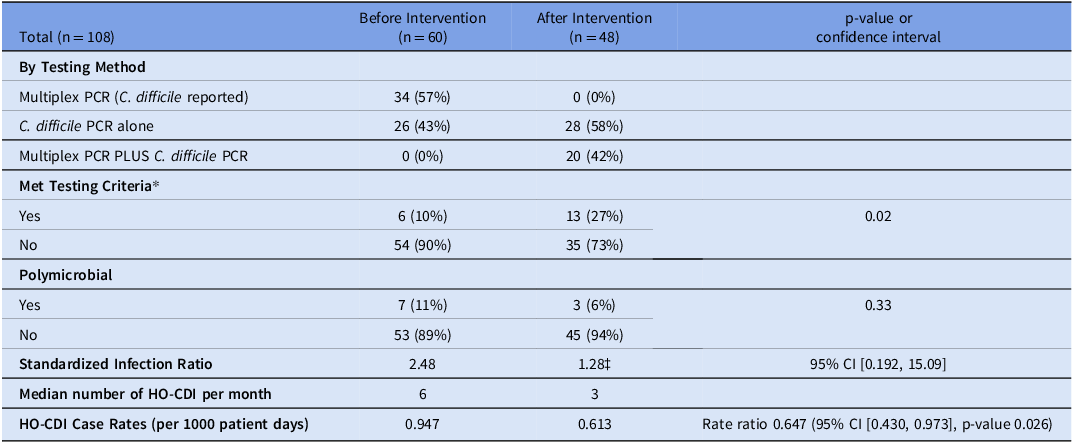
A total of 108 positive PCR tests met inclusion criteria during the study period; 60 preintervention and 48 postintervention. In the preintervention period, 34 (57%) positive PCR results were reported from the GI PCR and 26 (43%) resulted from stand-alone C. difficile PCR. Positive PCR results in the post intervention period resulted exclusively from stand-alone C. difficile PCR; 20 (42%) patients had GI PCR performed in addition.
Preintervention, 10% (N = 6) of positive tests met testing criteria. This increased in the postintervention period to 27% (N = 13, p = 0.02). The most common disqualifier for testing was inadequate number of documented stools (41%), followed by laxative use (35%), and then tube feeds (24%, Table 1).
Characteristics of Positive C. difficile Tests Before and After Removal of C. difficile Results from GI PCR

* Testing criteria: ≥3 bowel movements in a 24hr period, no tube feeds or laxative use in the preceding 24hrs; PCR: Polymerase chain reaction, HO-CDI: Healthcare facility-onset Clostridioides difficile infection.
‡Includes one month of preintervention data.
Pre- and postintervention groups were compared by Fisher’s exact test for categorical variables or Mann-Whitney test for continuous variable. Case rates compared by Poisson rate test.
Polymicrobial results, defined as GI PCR positive for C. difficile plus other organism(s), were evaluated. There were 10 polymicrobial results across the study period, one of which met testing criteria. Fewer polymicrobial results were seen in the postintervention period than the preintervention period (6% versus 11%. P = 0.33).
The median number of HO-CDI cases per month was determined and a decrease from 6 to 3 was observed (Figure 1). HO-CDI case rate significantly decreased from 0.947 to 0.613 cases per 1000 patient days postintervention (RR 0.647, 95% CI [0.430, 0.973], p-value 0.026). Our facility’s SIR was calculated and compared pre- and postintervention. The SIR decreased postintervention from 2.18 to 1.28, 95% CI [0.192, 15.09]. As SIR is reported quarterly, our postintervention SIR includes one month of preintervention data.
Number of HO-CDI per Month.

Discussion
The diagnosis of HO-CDI is complicated by high rates of C. difficile colonization in hospitalized patients, suboptimal testing modalities, and high prevalence of non-infectious diarrhea in the hospital setting. Reference Bettger, Giancola, Cybulski, Okulicz and Barsoumian6,Reference Boly, Reske and Kwon7 The NHSN definition of HO-CDI adds additional diagnostic complexity by not requiring ordering physicians to consider testing criteria or the clinical scenario. Efforts to address diagnostic stewardship for HO-CDI are paramount to improve healthcare costs and patient outcomes by reducing overdiagnosis
Diagnostic stewardship for C. difficile may include laboratory-based interventions, like stool submission criteria. The EMR can be leveraged to include “hard stops” requiring ordering providers to confirm appropriate testing criteria. Reference Boly, Reske and Kwon7 However, this is not without limitations and can be overly restrictive in cases where pretest probability is high despite not meeting classic testing criteria, such as in fulminant CDI with ileus. These interventions still rely on accurate clinical assessment and add alarm fatigue without functional improvement in diagnostic stewardship.
A retrospective review of C. difficile results from a gastrointestinal pathogen panel deemed only 40% as true CDI based on subsequent standard of care testing, suggesting a potential target for diagnostic stewardship efforts. Reference Wadskier Montagne, Cowman and Guo8 There is little evidence exploring removal of the C. difficile result on GI PCR panels. Reference Madden, Poulter and Sifri9 A recent study demonstrated an increase in stand-alone C. difficile PCR testing with such an intervention. Reference Ilges, Graf and Grant10 We observed a similar increase in stand-alone C. difficile PCR tests suggesting a more targeted diagnostic approach driven by pretest probability.
Similarly, our intervention resulted in a statistically significant increase in positive tests meeting testing criteria likely suggesting higher pretest probability for HO-CDI. Although not statistically significant, we saw a decrease in polymicrobial results postintervention further supporting improvement in diagnostic accuracy.
This study has several limitations including small sample size and performance at a single center. The heterogeneity of testing algorithms at other facilities may limit generalizability. Less than 12 months of pre- and postintervention data may introduce bias related to seasonality. However, at least a portion, if not all, of each season were represented in the data mitigating some of this concern. The postintervention SIR includes one month of preintervention data given quarterly reporting. The true postintervention SIR is likely lower than reported.
In conclusion, removal of the C. difficile results on our GI PCR panel resulted in a statistically significant decrease in HO-CDI case with a concurrent increase in tests meeting testing criteria. Our results likely reflect an increase in pretest probability for HO-CDI prior to testing. This observational study supports the challenges in making an accurate diagnosis of HO-CDI and designing interventions to maximize patient safety and minimize opportunities for overtreatment, harm, or error.
Financial support
None.
Competing interests
None.
Disclaimer
The views expressed in this article reflect the results of research conducted by the author(s) and do not necessarily reflect the official policy or position of the Defense Health Agency, Department of Defense, nor the U.S. Government.