Children's and young people's views and urban experiences lack legitimacy and voice in the majority of current urban planning processes. Children and young peopleFootnote 1 are primarily restricted to commenting about specific design features of parks and playgrounds, as it is assumed that they have little interest and ability to provide relevant feedback more broadly about their urban environments. Research with children and young people traditionally has been undertaken by adults who regarded children and young people as emerging or developing adults with little consideration of their competence and agency.
Hart (Reference Hart1992) and Hinton (Reference Hinton2008) have argued that many of the reasons children and young people are excluded from planning processes are based on socio-cultural assumptions. These assumptions arise from a complex image of children and young people, and their abilities. These images automatically associate younger age with spontaneity, immaturity, and lack of experience, rather than recognise the diversity of children's and young people's personalities, skills, knowledge and experience (Driskell, Reference Driskell2002; Hart, Reference Hart1992; Hinton, Reference Hinton2008). As Driskell (Reference Driskell2002) notes, claims against children's and young people's ability to participate in planning activities also applies to adults. Studies by a number of Australian and international researchers have provided further support, as they have found children and young people to be competent participants and informants about their lives and their environments (Freeman, Reference Freeman, Gleeson and Sipe2006; Lynch, Reference Lynch1977; Malone, Reference Malone1999; Owens, Reference Owens1994).
The ‘new’ sociology of childhood has been an important development that has helped planners and urban designers challenge the status quo. This developing research perspective enables children's and young people's participation and their views to be heard. Children and young people are positioned as valid informants of their own worlds, compared with traditional research where adults who claim to speak on behalf of children and young people regard them as ‘objects’, excluded from the research process (Christensen, Reference Christensen2004; Christensen & James, Reference Christensen and James2008; James, Reference James1997; James & Prout, Reference James, Prout and Jenks2005; O'Kane, Reference O'Kane, Christensen and James2008).
Arising in the late 1980s, the new sociology of childhood acknowledged the rights of children and young people as espoused in Articles 12 and 13 of the 1990 United Nations Convention on the Rights of the Child (CRC). These Articles enshrine children's and young people's rights to expression and to participation. Drawing on the CRC and also earlier work from the UNESCO Growing Up in Cities project (Lynch, Reference Lynch1977) researchers in the 1990s developed frameworks to create spaces for the views of children and young people, most notably UNICEF's 1996 Child Friendly Cities initiative (UNICEF, 2004).
Thus a research focus has been steadily growing over the last decade on children's and young people's agency in urban environments. The validity of children's and young people's views is also extending beyond research. Evidence is slowly mounting that local governments are starting to increase their engagement with children and young people through research, consultation and planning initiatives. In some cases, planning outcomes have been significantly influenced by young people's contribution (Children's Research Reference Team & Adult Research Team, 2011; Malone, Reference Malone2006; Rudner, Kennedy et al., Reference Rudner, Kennedy, Holland, Wilks, Donovan, Shaw and Butt2012; Wilks, Reference Wilks2010).
The emergence of more collaborative community-based approaches to discussing planning and urban design at the local level has been a welcome change to expert-led projects. In the past, there was a limited number of projects that included and were influenced by community views, especially those in which planners and urban designers were willing or able to substantially incorporate the views, experiences, and aspirations of children and young people. Participation by children and young people in planning and urban design projects is important, and requires the scope to assist them to apply observations of their world in their imaginings of potential future scenarios (Bohnet, Gooch, & Hickey, Reference Bohnet, Gooch and Hickey2010). Therefore, achieving more meaningful and influential contributions from children and young people rather than a tokenistic type of consultation is a difficult outcome to achieve, and careful methods and approaches are required. Meaningful in this context is the framing of children's and young people's knowledge in such a way that it can easily be transformed into ‘useable’ knowledge for advocates, and for planning and urban design practitioners. As environmental educators, we would add, ‘meaningful’ in the sense that there are strong curriculum links to the teaching of civics and citizenship in schools. It is recognised that our notion of ‘meaningful’ contribution can create uncomfortable tensions for some academics and advocates of children's and young people's rights.
While recognising children and young people as they ‘are’, we need to also recognise the opportunities and constraints of current planning and political systems. The authors assert that researchers and practitioners must assist children and young people to know, understand, and be able to ‘do’ planning in order to most effectively participate in existing planning processes and procedures. This approach both provokes and challenges existing images of the ‘child’ and of adult–child interactions.
In this article we focus on the value of involving children and young people in participatory processes relevant to planning and urban design matters. Two exploratory programs developed by the authors and conducted in regional centres in the Australian states of New South Wales (NSW) and Victoria are introduced. These programs have promoted children's and young people's sense of spatial competence, confidence and efficacy in their local environment. They also link substantially to environmental learning elements of school curricular, most especially in the opportunities created for active civics and citizenship. This is especially evident in the establishment of leadership groups with the confidence and skills to contribute to ongoing local government planning and urban design activities. A brief review of theory, practice and relevant international case studies will be presented prior to introducing and discussing these initiatives.
Background
Planners and the planning profession in general have had a strong history of paternalism that has been vigorously interrogated over the past 10 years from both within and outside the profession (Churchman, Reference Churchman2003; Gleeson & Sipe, Reference Gleeson and Sipe2006; Iveson, Reference Iveson, Gleeson and Sipe2006; Walsh, Reference Walsh, Gleeson and Sipe2006). Academics and planning professionals alike have grappled with the challenge of creating participatory planning processes that lead to better outcomes in terms of policy and the people thus affected (Healey, Reference Healey1997; Manzo & Perkins, Reference Manzo and Perkins2006; Rydin, Reference Rydin2007; Sarkissian, Hirst, & Stenberg, Reference Sarkissian, Hirst and Stenberg2003). A primary objective of participatory planning, and its corollaries of collaborative and communicative planning, is to create more inclusionary processes within which participants have greater influence than has been possible by past approaches of information provision around planning initiatives and the often accompanying tokenistic consultation processes.
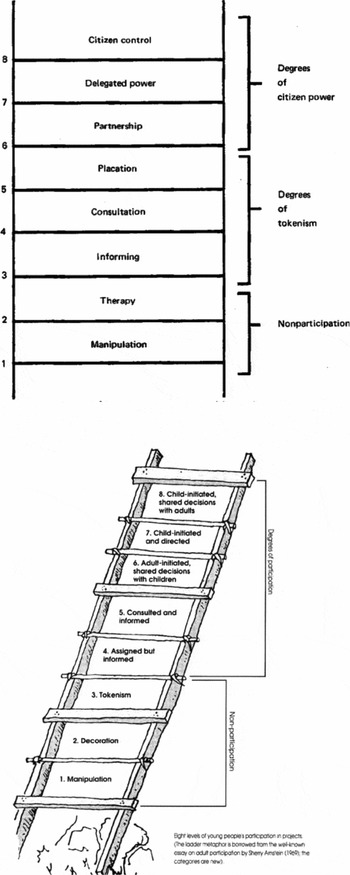
For example, Arnstein (Reference Arnstein1969) helped to fracture established practices by problematising the methods and degree of participant influence through her ladder of participation. The ladder categorises the degree of power sharing within a consultation-participation spectrum that includes the following: manipulation, therapy, informing, consultation, placation, partnership, delegation and citizen control. Adapting Arnstein's work to engagement with children and young people, Hart (Reference Hart1992) developed the children's ladder of participation. Hart's ladder is similar to Arnstein's in context and scope, as shown in Figure 1, and although there are differences in terminology, their conceptual frameworks are similar in terms of highlighting increasing levels of shared power. The points of greatest difference between Arnstein and Hart occur at rung 2: therapy and decoration; and rung 5: placation-consultation and consulted/informed — assigned/informed. These elements reflect differences between the authors as to whom they are applying the scale. Arnstein (Reference Arnstein1969) evaluated processes in relation to adults, and her notions of therapy refer to professionals ‘curing’ the participants’ views with information (p. 217). She also discussed participants’ power to engage in tradeoffs and negotiations. In contrast, Hart's (Reference Hart1992) focus was on children and young people; his notion of decoration refers to inclusion of children and young people for reasons of performance rather than genuine participation in events, and he discussed children's and young people's power to set and manage agendas (p. 10).
Top: Arnstein's (Reference Arnstein1969) ladder of citizenship participation; and below: Hart's (Reference Hart1992) ladder of children's participation. Note: Reproduced with permission.

Reflecting on ‘The Ladder’ in 2008, Hart stated that its original focus was on ‘programs and projects’ rather than on children's ‘everyday informal participation in their communities’ (p. 20). Hart also observed that one of the misrepresentations of his original design intent for the ladder has been related to the notion ‘performance’. Hart (Reference Hart, Reid, Jenson, Nickel and Simovska2008) corrected this interpretation by stating that the ladder represents a scale of ‘competence’ accompanied by children's ‘confidence’ to ‘engage in the ways outlined on any rungs of the ladder’ (p. 24). Recognition of these limitations in focus and interpretation show how our understanding continues to evolve, with the potential for creating better outcomes in relation to children's and young people's participation in planning and design processes.
Increasing academic and professional maturity and sophistication when working with children and young people is becoming evident. In particular, Barratt Hacking, Hacking, and Scott's (Reference Hacking, Barratt and Scott2007) review of the literature indicates there is now a strong awareness of, and responsiveness to, the cultural contexts of the development of children's perspectives and their role in society and the environment. In a more recent article referring to the work of Quinones (2009, as cited in Barratt Hacking, Cutter-Mackenzie, and Hacking), Barratt Hacking et al. (Reference Hacking, Cutter-Mackenzie, Barratt, Stevenson, Brody, Dillon and Wals2013) interrogated the mostly uncontested notion of the researcher ‘hearing’ children's ‘voices’, contending that ‘voices’ arise out of cultural and community contexts. Variability of contexts raises ‘questions about the universal applicability of the youth voice and children as active researchers across cultures and societies’ (p. 433), suggesting that democratic participation, civic involvement, and leadership can mean many different things — a theme discussed by Hart (Reference Hart, Reid, Jenson, Nickel and Simovska2008) a few years earlier in his reflections on ‘The Ladder’.
Such typologies as those presented above are nevertheless valuable for discussion and reflection. The ladders have proven to be durable starting points, if not end points of two decades of work in research and thinking associated with children and young people's roles as researchers and active participants in environmental education. Arnstein's (Reference Arnstein1969) and Hart's (Reference Hart, Reid, Jenson, Nickel and Simovska2008) schemata of engagement are useful for assisting researchers and planning practitioners to conceptualise, situate, and assess the degree to which participants engage in planning processes. However, practical problems still arise as to how different processes produce usable knowledge in the current context of ‘evidence-based’ policy.
Head and Gleeson (Reference Head and Gleeson2007) lamented the lack of attention given to children's and young people's needs in urban policy, and the scarcity of research into ‘understanding how the built environment shapes children's and young people's well-being’, and how children and young people participate in planning and urban design processes (p. 1). This is partially due to the murky status of children's and young people's citizenship. Iveson (Reference Iveson, Gleeson and Sipe2006) noted that children and young people tended to be viewed as ‘citizens in waiting’, rather than ‘competent beings and capable social agents’ (p. 107), and their proficiency in making ‘creative “functional” contributions within environments’ is frequently overlooked (Tranter & Sharpe, Reference Tranter and Sharpe2007, p. 191). James, Jenks, and Prout (Reference James, Jenks and Prout1998) likewise argued for the views of children and young people to be listened to, insisting that they are capable social actors in their own right.
Atencio (Reference Atencio and Malone2007) believed that the spaces and places in cities are, in effect, important environmental education ‘resources’ for children and young people to use in order to understand ‘who they are and to interact with those around them’ (p. 97). Malone (Reference Malone2007) regarded the frequent positioning of children and young by adults as ‘invisible’ and as ‘passive recipients’ of whatever environments they happen to find themselves in as both ill-conceived and ill-informed (p. 15). She argued that children and young people are constantly ‘negotiating and reconstructing spaces in powerful and significant ways’. Yet the relationships that children and young people develop with their environments when young, can influence their level of care and attachment as adults (Chawla, Reference Chawla2007).
Iveson (Reference Iveson, Gleeson and Sipe2006, p. 109) argued for local planning processes to recognise the things that ‘children and young people can do rather than one which is premised on a series of (adults’) assumptions about what they cannot do’. If we cannot manage to do this, we will continue to see ‘collisions between adults’ and children's worlds, with children coming out the losers more often than not’ (Gleeson & Sipe, Reference Gleeson and Sipe2006, p. 153). Similarly, Morrow (Reference Morrow2001) called on government agencies to start viewing children and young people as ‘stakeholders’ in government policy as opposed to evaluating their contributions as ‘successful or unsuccessful outcomes’ (p. 46). Her advocacy stemmed from her assessment that social capital in the form of civic participation was generally lacking for young people, and that they moved through ‘virtual’ and geographically fragmented networks and social spaces. Morrow also asserted that children and young people are denied a range of participatory rights that limits their sense of self-efficacy and feelings of control over their environment.
Corkery, Grant, Roche, and Romero (Reference Corkery, Grant, Roche and Romero2006), in their research into the perceptions of young people about the built environment, found substantial evidence that they need to be acknowledged as ‘equal stakeholders in the design and development process’ (p. 8). Participation simultaneously benefits children and young people through enhanced environmental education outcomes such as environmental awareness, knowledge and skills, and helps adults form more realistic assumptions about children's and young people's needs, desires, and ambitions. Interestingly, these authors found many children and young people ‘possessed a limited awareness of public spaces as a designed environment for any activity other than sports’, and concluded that:
To ignore the voice of young people in the creation of the built environment risks ignorance in pretending to know what is meaningful and relevant to them . . . (thus) we must be conscious of involving and empowering young people in the creation of their world. (Corkery et al., Reference Corkery, Grant, Roche and Romero2006, p. 8)
Unfortunately, the past paucity of empirical research specifically related to children and young people participating in urban design and assisting in the design of their environments, has contributed to the continuing dominance of rational planning approaches to children's and young people's environments. These approaches assume adult technical knowledge about planning and urban design is adequate for understanding and addressing children's and young people's environmental needs and aspirations. Rational planning uses demographic information and minimum requirement calculations to quantify service and infrastructure provision, as exemplified by childcare, school and park provision and location and road crossing facilities. Therefore, policy development is often grounded in conceptual interpretations of children and young people's needs and aspirations that may be far removed from the richness of their spiritual, psychological, emotional, social and physical lived experience. As Hoch (Reference Hoch2006) observed, planning often neglects ‘instincts, drives and feelings originating from physiological and psychological conditions and social experience’ (p. 368).
We argue that adult-initiated, shared decisions with children and young people is an effective space in which to work with children and young people to ensure meaningful and influential contributions to planning and urban design processes. This space allows adults to use their knowledge and skills as technical experts who assist children and young people in research, planning and urban design activities and processes. Adult-initiated activities and processes can still facilitate a high level of self-direction by children and young people, but this occurs within the broader constraints of policy development requirements, to which all citizens are bound, regardless of age. Researchers and practitioners as adult technical experts can ensure that data provided by children and young people (their environmental experiences) can be transformed into a format considered useful and appropriate within the planning and urban design profession.
Alongside generalised advocacy for more participatory methods of planning, there has been a growing emphasis on ‘evidence-based’ policy within the academy (Bryson & Mowbray, Reference Bryson and Mowbray2005; Marston & Watts, Reference Marston and Watts2003; Young, Reference Young2006). A definition of evidence-based policy is difficult to find, but Marston and Watts (Reference Marston and Watts2003) noted: ‘[i]n much of the policy literature, the meaning is considered self-explanatory or is defined simply as the systematic appraisal and view of empirical research findings’ (p. 144). Evidence-based policy relies on relevant and timely research that has been or can be conducted to meet an identified need. This approach to policy development by governing agencies is justified on the grounds that it ‘[i]mprov[es] an organisation's ability to find, create or use research to support its practice and enables decision-makers and stakeholders to become increasingly confident that they are making the best investments possible to improve the lives of service users’ (Frost et al., Reference Frost, Tierney, Hutton, Ellis, Duffy and Newman2006, p. 3).
Against this theoretical background, and in the context of urban planning and design, the remainder of this article explores how semi-formal programs jointly conducted by local councils, universities and schools (primary and secondary) can support children's and young people's participation in planning and urban design, while simultaneously bringing about significant environmental learning outcomes. The authors seek to demonstrate how sharing knowledge and skills between professionals and children and young people can lead to more meaningful and influential contributions from children and young people in planning and urban design processes. Outlined below are some outstanding case studies that have influenced the authors’ work with children and young people in Australia. These case studies represent a heartening growth in activity incorporating children's and young people's views and experiences about their environments into planning and urban design projects.
Case studies
London's My City Too!
The My City Too! program was established in 2007 through London's Open-City campaign to assist young people to engage with the design of the built environment, and to develop the skills to evaluate, make input and comment on development proposals. This program seeks to achieve deeper engagement with young people about their use, perceptions and feelings about their built environments, promoting meaningful participation in matters of urban design by these young people.
In the My City Too! program, urban design practitioners work with young people across London to enhance their design skills, and to inspire and encourage them to take an active role in helping create spaces and places in London more suited to their needs. The project thus seeks to place young people at the heart of built environment policy:
Young people are our future. Yet research shows that many of them feel that they have little or no influence in decisions about their city. Young people must be fully involved in place making and policy-making if they are going to value, respect and take ownership of the spaces and places around them. (My City Too!, 2011)
My City Too! has established a panel of about 35 young people aged 12–16 years known as the youth ambassadors. These young Londoners have a strong desire to see spaces created for them in the heart of their communities, rather than what they regard as always being pushed to the edges of their communities. To assist them with their goals, volunteer architects and urban planners work with them to engage them with urban design and architecture, and to equip them with the skills and understandings they need to make informed contributions to planning and design in and around London. As a result of these efforts, many London boroughs have invited the youth ambassadors to sit on their local Design Review Panels in an advisory capacity, where they provide feedback and commentary on public design proposals from an informed the young people perspective.
A similar project also in London and undertaken by the Hammersmith and Fulham Urban Studies Centre (HFUSC) is the Design Matters Summer School, which partners with the nearby Central St Martins College School of Arts and Design. The aim of the project is to encourage young people to become involved in consultations on local planning designs and development proposals, while at the same time maintaining strong links with local teachers and relevant curriculum elements of geography and history syllabi (Personal communication, Josie Fowler, Education Officer, HFUSC, May, 2009).
By 2030, large parts of the Borough of Hammersmith and Fulham will have been redeveloped, and the philosophy of this project is to recognise the importance of obtaining teenagers’ views now — as opposed to waiting until they are adults and the developments are a reality. This project also aims to encourage young people to pursue careers in architecture, and planning and design through helping them with their resumes; having first-year architecture students mentor secondary school students; and to generally demystifying the transition to university process.
Finland, Tokyo and Bendigo's Everyday Urbanity Project
Kyttä and her research team from Aalto University in Helsinki Finland have developed a soft-GIS program for children and young people. The soft-GIS program is an interactive mapping program accessible over the internet by selected participants. The project is currently being implemented (2011–2013) and participants include primary and secondary school children and young people in Helsinki, Tokyo, and Bendigo, Australia. Using aerial images, drawing features and pop-up survey questions residents’ experiences and opinions about their urban spaces, health, mobility and activities can be elicited (Kyttä, Broberg, & Kahila, Reference Kyttä, Broberg and Kahila2010, Reference Kyttä, Broberg and Kahila2012; Rudner, Omiya, & Manabe, Reference Rudner, Omiya and Manabe2012).
The aim of the project is to gain a better understanding of the places children and young people like and do not like, how they feel in these places, and rationales for their assessment. The data collection focuses on behaviours, activities, feelings and the social environment. It is an advanced participatory planning tool that combines qualitative and quantitative data, helping planners and other practitioners negotiate different scales of experience from individuals, small groups, and broader populations across geographic and temporal scales. This project has implications for how researchers and planners communicate with children and young people about their uses, views and experiences of public space.
Outcomes from this project include children's and young people's increased understandings of citizenship and participation in planning and urban design processes, improved spatial knowledge of their neighbourhoods, and cross-cultural awareness of children's and young people's experience in other cities and countries. Importantly, this project provides useable quantitative and qualitative data for planners from a larger cohort of children and young people than can usually be achieved using other more traditional methods of data collection. This project inspired the authors with regard to the possibilities of applying new technologies, the value of mixing quantitative and qualitative data in new ways, and the need to ensure data is useable by practitioners.
Dapto Dreaming Project, NSW
Malone has elicited and reported on children's and young people's views of their environments in Australia and overseas over 14 years (Malone, Reference Malone1999, Reference Malone2006; Malone & Tranter, Reference Malone and Tranter2003; Rudner & Malone, Reference Rudner and Malone2011). Malone's most recent research project, commissioned by Stocklands, an urban developer, and implemented in 2011 in Dapto, New South Wales, Australia focused on the development of a master plan for a new residential estate. Development of the masterplan included an extensive participatory planning process with children and young people living in Dapto (Children's Research Reference Team & Adult Research Team, 2011).
The primary aim of the Dapto project was to engage children and young people in a planning and urban design process that would result in meaningful and influential contribution to the final masterplan. Methods of participation included questionnaires that surveyed children's and young people's use of space, local area photography, neighbourhood assessments, data analyses, site visits by children and young people, and knowledge and skills development with professionals.
The project resulted in the analyses of data, prioritising of ideas and development of a report by children and young people. The children and young people identified that they believed it was important to protect nature, provide direct travel pathways but also pathways that meander through natural areas, and promote community building, physical activity and learning. It is intended that the contribution of children and young people to the planning and urban design process will be expressed through the built form of the new estate. Once the site is constructed, a post-development assessment will be conducted to identify the extent to which the final product incorporated children's and young peoples’ visions and aspirations.
The case studies outlined above, although contrasting in origin, location and nature, are inspiring. They demonstrate how researchers and practitioners can work with children and young people to elicit their knowledge, experience and expertise to confront urban design conundrums and challenges, and to address planning policy needs. The following discusses two Australian projects developed by the authors that drew inspiration from these international and national examples.
Exploratory Programs in New South Wales and Victoria
Coffs Harbour's Young Ambassadors for Design
Drawing on elements of London's successful My City Too! and Design Matters programs, Southern Cross University in collaboration with a local high school and Coffs Harbour City Council (NSW), established the Young Ambassadors for Design project in 2010 in collaboration with a local high school. Every two weeks through 2010–2013 during the school term, local planners, engineers and architects volunteer their time to attend workshops and site visits with the students to talk about their work and the career paths they have followed. Each year the workshops have involved approximately 12 students from Years 8–11. These students have identified as being interested in pursuing a career in the urban design and environmental professions.
The school has an enrolment of a significant number of students from backgrounds of disadvantage. It was hoped, among other things, that participation in the Young Ambassadors for Design project would assist these students to keep ‘rolling’ with their goals to enter university to study in one of these professions. In the meantime, the Coffs Harbour City Council identified some opportunities and avenues for the Young Ambassadors to make an input into its planning and design processes. In doing so, the council was addressing a strongly expressed desire by the young people for ongoing (as opposed to occasional) and meaningful consultation in local government planning processes.
Through their workshop activities with a range of local design professionals, the Young Ambassadors have learned about things such as the contested nature of ‘the public interest’ in urban design. They have also become familiar with important design principles in the planning of the natural and built environments, and with how design professionals interface with each other. They have developed an understanding of how urban design projects ‘work’ in terms of practicalities such as choice of materials, colour, texture and form, of timelines, and of wider frames such as the dynamics of human/environment interactions. Importantly, they have spent time with design professionals learning about their many and varied pathways into higher education.
Over the past 3 years the young ambassadors have been able to implement the knowledge and skills acquired through their ongoing participation in a range of local planning initiatives. For example, they have written a lengthy submission to the council's draft 2010 Coffs Harbour City Centre Plan and provided detailed comment on several planning and design proposals and ‘vision’ documents.
As youth representatives, they have participated in recent community forums at the Coffs Harbour campus of Southern Cross University. The local council has also sought their involvement at the conceptual stage of a new youth hub in the town's main central park, providing ideas and commentary that have elicited not only praise for their insights and creativity, but more importantly, follow-up from council planners in the tangible form of being able to see their ideas on public display. The project has also enjoyed a high level of support from a school executive keen to raise its students’ aspirations about continuing to higher education. An essential ingredient in the success of the program has been the work of teachers in ensuring the curriculum links of the program into environmental learning outcomes are being constantly reinforced to the students.
Bendigo: The Place of Our Children in Community Building
The Place of Our Children in Community Building project aimed to elicit children's and young people's views about their urban environment (Rudner, Kennedy et al., Reference Rudner, Kennedy, Holland, Wilks, Donovan, Shaw and Butt2012; Wilks & Rudner, Reference Wilks and Rudner2011). The project, commissioned by the City of Greater Bendigo, Victoria, was conducted in one suburban primary school, one suburban secondary school and one inner urban secondary school. University researchers worked with children and young people alongside council staff. Children and young people in the suburban schools provided specific comment about a council urban design project for which a masterplan had already been produced, while young people from the inner urban school contributed more general comment about their use and feelings in the city centre.
A series of activities were conducted in all three schools over a period of 9 hours spread over three non-consecutive days. In addition to data collection, children and young people were taught photography skills by a professional photographer, and learned about the work of planning and urban design professions. These activities were designed to increase children's and young people's understanding of cities, their local environments and planning and urban design issues. Data about children's and young people's perceptions, use and relationship to their natural and built environments was systematically collected using:
• workshops and discussions aimed at increasing children's and young people's knowledge and skills for participation in planning and urban design projects
• neighbourhood walks: during the walks, children and young people took photographs of their surroundings and discussed them; researchers provided some prompts for further discussion; and researchers observed and recorded their observations of children's and young people's physical use of space and children's and young people's conversations
• photo elicitation: while downloading photographs from cameras into computers, researchers talked with groups of children and young people about their photographs
• audience evaluation: researchers developed a questionnaire about planning and urban design matters based on children's and young people's photographs and discussions; this questionnaire was embedded in a powerpoint presentation that enabled children and young people to anonymously complete the questionnaire via electronic hand-held devices; and outcomes from the questionnaire were immediately shown to children and young people and discussed
• drawing and discussion: through further discussion and drawing, children and young people were invited to provide suggestions for planning policy and urban development.
The final report to council presented both qualitative and quantitative data categorised in relation to common planning and urban design themes, such as transport, commercial streets, residential areas, parks and nature, and urban amenity. The project team deliberately used mixed-methods to elicit both qualitative and quantitative data to ensure richness, rigour and legitimacy. For example, while children and young people observed that traffic travelled too quickly and expressed concern over poor driver behaviour, the use of the electronic questionnaire provided numerical data as to which streets the children and young people visited felt safest and were easiest to cross (Rudner, Kennedy et al., Reference Rudner, Kennedy, Holland, Wilks, Donovan, Shaw and Butt2012).
Discussion: Creating Meaningful and Influential Contributions — The Nexus Between Researchers, Practitioners and Children and Young People
The projects described above provided opportunities for children and young people, council staff, teachers, design professionals, and researchers to communicate about planning and urban planning issues. A variety of approaches supported by the methodologies and techniques of the ‘new’ sociology of childhood were applied when working with the children and young people. These approaches have created opportunities for children and young people to express their views around their experiences to be considered in policy development (Alderson, Reference Alderson, Christensen and James2008; Graham & Fitzgerald, Reference Graham and Fitzgerald2009), which is essential. As Barratt Hacking et al. (Reference Hacking, Barratt and Scott2007, p. 53) note: ‘[r]esearch suggests children have significant concerns for their local environment and a sense of injustice that their experience is not systematically considered’. However, when making the links into practice, the road is not always straightforward, therefore it is important to recognise the successes as well as the tensions between children's and young people's participation and rational planning practice. Focusing on the Young Ambassadors and the Place of Our Children in Community Building initiatives, matters related to learning-centred approaches, impact, representation, and influence are highlighted below.
Learning opportunities grounded in participatory planning practice and a strong belief about children's and young people's competence in planning and design initiatives provided a key focus for these initiatives. Active and innovative communication channels and opportunities for social and environmental learning were created for children and young people, researchers, council staff and teachers. Integral to this success of these projects was the nurturing of meaning, control and connectedness through both professional interest and respect for children's and young people's views. According to Oliver, Collin, Burns, and Nicholas (Reference Oliver, Collin, Burns and Nicholas2006): ‘youth participation requires recognising capacities and building skills . . . where there is meaning, control and connectedness’ (p. 3). They asserted that ‘connectedness’ arises as a result of working with others, and through developing positive relationships with adults and other young people. ‘Meaning’ on the other hand develops through control and autonomy and from being involved in activities that possess for young people significance and authenticity.
Issues of representation and interpretation can be problematic in children's and young people's research (Jackson & Mazzei, Reference Jackson and Mazzei2009), and thus the role of children's and young people's participation in rational planning processes was documented within the project materials in such a way as to emphasise their ability to participate. Children's and young people's submissions to council, quotations, photos, and urban assessments, simultaneously focused project reports on issues relevant to their needs, comprised the material content of the reports in relation to urban environmental issues, and recorded children's and young people's views about planning and urban design issues and possibilities. This approach aligned with James’ (Reference James2007, p. 270) belief that to be fully understood and to have an impact beyond the academy, children's and young people's own roles in social structures need to be documented. It is hoped that both examples will contribute to real change in the local governments involved in these projects; however, this is likely to require ongoing advocacy.
The impact of the public on planning and urban design activities is still fairly limited, and it is even more so for children and young people. Researchers and practitioners, in many cases working with teachers within curriculum frameworks, have a role to play in enhancing children and young people's ability to actively participate. The projects reported above concentrated their objectives around equipping the young people taking part with participatory skills. Researchers and practitioners can further assist by legitimising children's and young people's participation through guiding the exchange of information and interactions so they ‘fit’ within rational planning and urban design processes and practices.
Although the implementation of participatory planning principles and practices by planners and urban design professionals is more common than in the past, the depth of participation and the level of ongoing influence is still strongly criticised and questioned. In the case of the Young Ambassadors program, almost 18 months was initially dedicated to communicating and negotiating with council to support the development of the children's and young people's leadership group. Council's initial lack of engagement in the project changed when its own ‘Vision 2030’ consultations in 2009–2010 highlighted the need for ongoing consultation with Coffs Harbour's youth. In the case of the Place of Our Children in Community Building project, resistance came from a teacher within one of the schools who questioned researcher and council commitment to the children and young people, school and project. While the project at this Bendigo site can be considered successful in terms of engagement and reporting, it did not result in an ongoing relationship. In contrast, researchers and the Council continue to work with the other schools when new project opportunities arise. In addition, it was envisioned that this project would lead to the creation of a Young Ambassador's program in Bendigo, however this has not yet occurred.
The Young Ambassadors and Place of Our Children in Community Building initiatives have provided vehicles for placing children and young people as active citizens and participants within local councils’ planning and design processes. As such, children's and young people's engagement in relation to Hart's (Reference Hart1992) ladder of participation moved from virtual invisibility toward adult-initiated and shared discussions, and ultimately towards child-initiated and child-directed discussions and activities. The young ambassadors’ participation in planning and urban design processes was managed through a learning, development and engagement program that resembled other type of community-council interactions. In the case of the Place of Our Children in Community Building project, participation in planning and urban design processes included council staff working with children and young people as part of the broader research program, and the provision of final reports for the children and young people so they had ‘ownership’ of their own information. In both cases, adults who had strong knowledge and skills in planning practice helped children and young people to engage effectively with council processes, otherwise the children and young people would not have been able to influence the planning systems and outcomes, an issue that often befalls these types of projects (Barrett Hacking et al., Reference Hacking, Barratt and Scott2007). These outcomes indicate that creating channels for children and young people to communicate their own ideas about their environment and the communities they live in, and providing the scaffolding to assist them to develop such participatory skills in authentic contexts, ought to strongly characterise future research with children and young people in policy settings.
The authors’ experiences highlight two fundamental challenges to rational planning regimes. These could be summarised as first, the competence of children and young people in relation to participating in planning and urban design activities; and second, the role of researchers in legitimising children's and young people's participation by helping transform their views into forms suitable for planning and urban professionals. These challenges are significant as they point toward a need to reform planning process, practice and perhaps regulation to ensure children and young people have greater opportunity to participate in planning and urban design decision-making, and their views are taken seriously.
Conclusion
While it is difficult to assess whether these projects and methods can actually produce a shift in power sharing, they do have the potential to create shared planning by better integrating the relationships between researchers, practitioners and children and young people. Importantly, this work has contributed to the broader program of involving children and young people in planning and urban design decision-making, and has certainly brought about strong environmental learning outcomes by way of active civics and citizenship. Ultimately, these approaches have the potential to address the gap between policy and the lived experience of children and young people, facilitating better planning outcomes for themselves and their communities.
There is still much to be done and thought about in terms of enabling children and young people to understand and take part in the decision-making processes of the many institutions that affect the quality of their daily lives. However, the number, variety, and scope of emerging projects present us with optimism for the future. Children's and young people's participation in the activities described in this article indicated their ability to learn and become skilled in matters relating to planning and urban design. They have provided researchers and practitioners with valuable observations and insights about their environments, and creative suggestions to planning and urban design problems. Perhaps one of the most powerful questions that can be asked as we conduct our work, challenge professionals in their work, and seek to engage children and young people in planning and urban design initiatives is to initiate self-reflection: ‘What happens when you don't participate?’
Author Biographies
Dr Judith Wilks is a Senior Lecturer in Southern Cross University's School of Education. Her research interests stretch across a number of fields, including participatory methodologies for children and young people in urban planning and design settings, civics and citizenship education, child friendly cities, and access and participation in higher education for Indigenous students.
Dr Julie Rudner is a lecturer in the Community Planning and Development Program, La Trobe University, Bendigo. Through research, consulting and teaching, Julie explores children's views and experience of their environments, promotes cities as sites for experiential learning, and supports children's citizenship through participation in planning and urban design. She seeks to understand how adults and children can expand their confidence and skills to encourage children's active exploration and engagement with their environments. She has over 10 years professional experience as a planner and consultant.