1. INTRODUCTION
Since the fall of the Taliban in late 2001 and the ushering of the international community into Afghanistan, a burgeoning body of literature has slowly emerged recognizing the complexity of the legal system within the country. Legal pluralism in Afghanistan is marked by complex interactions between state civil law, Islamic law, and customary law,Footnote 1 among other forms of normativity. However, a decade and a half later, lack of clarity still persists as to what legal pluralism actually means for the operations of the country’s legal system. While some of this uncertainty revolves around the myriad of problems faced by any post-conflict society—including the non-uniformity of legal training, lack of access to legal information, and corruption—part of the problem can be ascribed to the lack of conceptual clarity surrounding the very concept and usage of legal pluralism.Footnote 2 Legal pluralism has taken on a variety of meanings depending on the context as well as the intentions of the researcher. While this multiplicity on the one hand may create uncertainties about the precise definition of the concept, on the other hand, it facilitates diverse approaches to legal inquiry, each of which provides a new lens to view legal phenomena. Minimally, these various approaches to legal pluralism have provided alternatives to purely orthodox, positivist treatments of law by showing that “law is everywhere” and traverses society in all directions.Footnote 3
In this paper, I propose revisiting the concept of critical legal pluralism, which considers law from the perspective of the individual subject-citizen. The discourse on legal pluralism is punctuated with diverse approaches to studying law in society. Critical legal pluralism adds the unique perspective that the individual can be considered a site of normativity with the capacity to create legal knowledge and construct her own legal universe. While various works have raised the significance of the subjective viewpoint, it has never garnered much attention within the legal pluralism discourse. To help operationalize the usage of critical legal pluralism, I propose a methodological framework that places individual choices along a continuum. On one side of continuum, legal pluralism can be viewed as facilitating fully discrete choices that ascribe to one legal order or another, indicating that the individual has complete agency over her/his choices. On the other side of the continuum, the legal order assumes a hegemonic form that compels individual to adopt particular modes of behaviour. In such instances, while the environment may be marked by legal pluralism, its manifestation in society does not permit any choice on the part of the individual. After outlining this methodological approach to critical legal pluralism, I demonstrate its utility by analyzing the legal system of Afghanistan, since the country is often described as an environment marked by legal pluralism though the implications flowing therefrom are far from clear.
In the second section of this paper, I provide a brief overview of the wider discourse on legal pluralism to date. This overview helps to situate the unique contribution of critical legal pluralism within the existing literature, which is the focus of Section 3. In this section, I develop the methodological approach of viewing individual choices in a legally plural environment as taking place along a continuum. In Section 4, I consider how critical legal pluralism can enrich the discussion on the legal system of Afghanistan by showing how legal orders overlap and interact with one another at the level of the individual. In Section 5, I demonstrate the relevance of critical legal pluralism through my interviews with two Afghan justice actors: (1) a former judge and (2) an active defence lawyer. The proposed methodology is applied to analyze how these actors make choices in an environment with overlapping legal orders. Their comments provide insights on how the individual is a site of multiple competing selves and how legal orders are continually being re-constituted by individual choices.
2. PRELIMINARY REMARKS ON LEGAL PLURALISM DISCOURSES
While legal positivism remains the dominant paradigm through which the law is understood, legal pluralism has made major strides over the past 30 years by widening the scope of legal inquiry and inviting explorations into the multiple instantiations of law in the world, which may vary drastically from one society to another.Footnote 4 The claim of legal pluralism is that several legal or normative orders may coexist within a given social field.Footnote 5 Orthodox discourses on the definition of law consider a legal system to be attached to a single monistic state.Footnote 6 Within the legal positivist tradition, exemplified by the works of H.L.A. Hart and others, law is largely viewed as the enforcement of institutionalized norms.Footnote 7 Legal pluralism attempts to destabilize this dominant paradigm by (forcefully) asserting that law is poly-centric.Footnote 8 State law is but one of various sources of law that may influence individuals’ behaviour. The difference between a “legal” and “normative” order remains elusive, and thus I treat them as synonymous throughout this paper, preferring the use of “legal order,” whether it is in reference to state or non-state orders.
The primary criticism levied against legal pluralism—most notably by Brian Tamanaha—is that definitions are often cast so widely that it becomes difficult, if not impossible, to separate law from general social control.Footnote 9 Such definitions lead to much uncertainty on how far the boundaries of “law” extend. The difficulty lies in the inability to craft a sufficiently meaningful definition of what constitutes “law” so that non-legal and other social phenomena can be separated.Footnote 10 Tamanaha has criticized the prevailing discourse on legal pluralism as adopting a largely monistic approach that treats law as a single phenomenon. For example, studies that look into legal pluralism within a country may identify state law and religious law (like in many Middle Eastern countries)Footnote 11 or state, religious, and customary law (like in Afghanistan, Thailand, and Indonesia)Footnote 12 or state and customary law (like in certain African states).Footnote 13 In each case, the pluralism is marked by a variety of the same function-based phenomenon, namely the maintenance of social order. Aware of this dilemma, Woodman chooses to embrace the position that “all social control is part of the subject matter of legal pluralism.”Footnote 14 Tamanaha alternatively proposes a conventionalist approach, where law can be ascertained according to “whatever people identify or treat through their social practices as ‘law’ (or recht, or droit, and so on).”Footnote 15 Other scholars, such as Benda-Beckmann, have been quick to point out that categories for social scientific research cannot be established by usage, but rather are constructed specifically so that the researcher can study social phenomena.Footnote 16 Benda-Beckmann employs Tamanaha’s own words against him by saying “typologies and categories are analytical devices that are designed to meet the purposes of the social scientist or theorist who constructs them.”Footnote 17 Rather than seeking to define law, Benda-Beckmann adopts the approach of using law and legal pluralism as analytical categories that “only point at the theoretical possibility that what we capture with the concept may exist empirically.”Footnote 18
This animated discussion on the very framing of legal pluralism may have helped to clarify the strengths and weakness of different approaches, though at the possible cost of leaving unresolved the “unstable analytical foundation” of the concept.Footnote 19 Despite this ambiguity, discussions on legal pluralism have become increasingly advanced and widespread.Footnote 20 In many ways, the legal pluralism discourse has been able to turn the perennial (and arguably fruitless) discussion on “what is law” on its head and shift the focus to the ways that individuals and communities create and reconstitute legal orders and the interactions between such orders, labels aside.Footnote 21 While legal positivism remains the dominant paradigm for understanding law, the legal pluralism discourse has successfully carved out a permanent space that questions this orthodoxy.Footnote 22
Ongoing discussions have greatly advanced the concept by identifying “other phases of legal pluralism” beyond the simple “state” and “non-state” law dichotomy.Footnote 23 The various instantiations of law in society need not be assessed solely vis-à-vis the state, since the result is to maintain a monistic view of the law.Footnote 24 Rather, law may assume altogether different configurations depending on the role it plays, how the people view it, or how it has developed over time. For example, a country may host state law while being influenced by religious law, say Islamic law.Footnote 25 At the same time, legislation may have been transplanted from a foreign jurisdiction bringing with it certain foreign influences and, moreover, local communities may regulate themselves according to their own particular norms (Egypt and Afghanistan are two countries that would fit this description).Footnote 26 The simple dichotomy between state and non-state law does not capture the plural arrangements that the law may take. Furthermore, symbiotic fusions regularly occur between various legal orders, indicating that structures of law remain cognitively open.Footnote 27
A more recent strand of legal pluralism has put focus on the transnational legal order where the state is just one of several loci of authority.Footnote 28 “Global” legal pluralism employs the “pluralist framework to the global arena argu[ing] that this framework is essential if we are to more comprehensively conceptualize a world of hybrid legal spaces.”Footnote 29 The onset of globalization has renewed interest in conceptualizing law beyond the state, particularly when states are interacting with one another or when private parties engage in global transactions. Global interactions will inevitably lead to conflict and contestations that cannot be answered by focusing on the coercive power of a single nation-state, such as when the conflict is between two states, thereby requiring novel legal strategies.Footnote 30 Others have noted a new “international” legal pluralism associated with the labyrinth of international tribunals each operating according to their own norms—and often times overlapping in jurisdiction.Footnote 31 Given how international law is punctuated with overlapping normative spaces, the applicability of legal pluralism would seem intuitive, though it has only started garnering attention in the past decade.Footnote 32
Another expansion to the discourse on legal pluralism is the greater recognition of legal pluralism in conflict.Footnote 33 At times, legal pluralism is caricaturized as maintaining an overall sense of cohesion in which problems are resolved “in a mutually satisfactory way.”Footnote 34 However, in reality, individuals regularly feel competing pressures from various legal orders each of which traces back to its own value system.Footnote 35 As a result, conflict may be inevitable when an individual is faced with diverging choices. The choice of one set of laws over another demonstrates the ways in which individuals arbitrate normative tensions and may provide significant information on the hybrid forms of legal pluralism in different spaces. In extreme cases, such normative conflicts may lead to real violence. One clear example in Afghanistan is the case of Abdur Rahman, an individual who converted from Islam to Christianity.Footnote 36 International pressure called for Abdur Rahman to be permitted to exercise freedom of religion, as Afghanistan is a signatory to Social Political Rights, which enshrines such liberties.Footnote 37 However, citing Islamic legal doctrine, the general public as well as government lawyers sought that he be executed. Fervent demonstrations were organized throughout the country calling for the strict application of Islamic law.Footnote 38 Ultimately, his case was thrown out on procedural grounds, and he was granted asylum in Italy. As this and many other instances show,Footnote 39 understanding the instances of conflict that punctuate legal pluralism is essential for “devising ways of managing them wisely.”Footnote 40
Legal pluralism continues to be useful in emphasizing legal orderings beyond centralist and, moreover, monistic notions of the law. It helps to portray the normative attachments within a particular environment that impact human behaviour. Furthermore, in pluralizing the points of departure—most notably, in the case of global legal pluralism—the discourse has a brought a new lens to comprehending legal phenomena. In the next section, I consider an alternative approach, namely critical legal pluralism, which emphasizes the individual as the site of inter-normative encounters.
3. REVISITING CRITICAL LEGAL PLURALISM
A Chinese sociologist, Fei Xiaotong, provided an evocative metaphor to explain the social structure of Chinese society.Footnote 41 Chinese society, he argued, can be conceptualized as the concentric ripples that spread out when a pebble is thrown into a still pond. Throw several pebbles and the multiple sets of concentric circles will overlap in a seemingly chaotic manner. “Each person is the centre of a unique network of countless relationships, and while every person is embedded in such a network, no two persons share the same network.”Footnote 42 Society consists of the complex operation of networks of fluid, amorphous, and highly contextual human relationships. The most basic unit within such a structure of society is the individual, who serves as the irreducible site of knowledge production, reinforcing not only networks of relationships, but also the normative universe in which she finds meanings.Footnote 43
Xiaotong’s description is an invitation to legal pluralists to consider the individual as a site of normativity, where legal norms find meaning and expression in the natural world. A number of scholars have pointed to the significance of legal pluralism in “subjectivity,” which considers the perspective of the individual faced with inter-normative choices.Footnote 44 The subjective perspective provides a glimpse of “law from the inside”Footnote 45 where different legal orders do not neatly operate alongside one another, but rather create real spaces of overlap and normative contestation. In such instances, individuals may need to make “jurispathic” decisions that advance one set of meanings over others.Footnote 46 This inter-normative clash is a regular state of affairs for the individual confronted with multiple normative possibilities and required to make choices in real time. Thus, the individual is not simply a “passive recipient of legal regulation,” but rather serve as an “active agent for the law” by deciding how law ultimately finds expression in the social environment.Footnote 47
I suggest that the concept of “critical” legal pluralism, developed by Martha-Marie Kleinhans and Roderick Macdonald, holds considerable importance, despite the scant attention it has received in the literature, and thus requires greater explorations to appreciate the rich contribution it adds to the existing discourse on legal pluralism. Critical legal pluralism represents one of the most advanced explications of legal pluralism in subjectivity. It focuses on the individual subject-citizen as a site of normativity through which hypothesized meta-orders find expression and existence in the real world.Footnote 48 Just as a play is constituted by its actors’ performances, a legal order requires the participation of individuals who ascribe to that order. Critical legal pluralism posits that individuals are not simply the objects of law, but rather possess a “construct capacity” with the ability to manipulate and transform the contours of their own normative behaviour.Footnote 49 Individuals learn, analyze, reflect, and make decisions concerning the law based on their personal and subjective knowledge and experiences.Footnote 50 Legal meanings are maintained through the individual’s own self-understandings.Footnote 51
Critical legal pluralism holds that law is endogenous to the individual, not exogenous. Normative legal communities are a function of the structures of knowledge produced by social actors in a particular time-space.Footnote 52 Social actors thus become “law-inventing” rather than simply “law-abiding.”Footnote 53 Individual behaviour is of particular importance, since subjective interactions serve as instantiations of inter-normativity. Thus, normativity is continually being reasserted and re-shaped by the ongoing personal choices of the individual. The dynamism of law in society and its ability to influence the behaviour of individuals cannot be fully understood in objective and positivist terms where the individual citizen is viewed simply as a recipient of law. The individual has the ability to abide by, resist, subtly alter, or radically transform the law, which in all instances shows her ability to assert agency within her legal universe.
Legal anthropologists have for a long time been emphasizing the importance of empirically observing individuals, and thus critical legal pluralism is not necessarily a revolutionary approach to studying the social world. I do not deny that legal anthropology and critical legal pluralism may have much in common, particularly their emphasis on empirical research. However, the specific contribution made by critical legal pluralism is providing a fresh perspective within the legal pluralism scholarship by emphasizing the individual as a site of inter-normativity, which still remains an underdeveloped strand of discourse.
One of the significant corollaries of critical legal pluralism is the importance of empirical observations, as it allows for the researcher to observe how the individual simultaneously reproduces legal order and asserts agency. In this respect, critical legal pluralism can greatly benefit from the existing literature in legal anthropology, which is replete with ethnographic studies that demonstrate the operation of law in context.Footnote 54 Mir-Hosseini’s seminal work on Islamic family law in Morocco and Iran focused on how litigants seeking a divorce manipulate religious beliefs and the law to “translate their religious precepts into practice.”Footnote 55 She stresses the importance of focusing on litigants, stating: “Strategies adopted by litigants in the course of marital disputes give us insight into not only power relations in the family but how these relations are sustained or modified in the legal order.”Footnote 56 Nelson’s research into land and inheritance rights in the province of Punjab in Pakistan showed how many Muslim men often employed the rhetoric of shari’a while in practice actively tried to “resist Islamic laws of inheritance because they wished to secure the integrity of specific agnatic (all-male) estates.”Footnote 57 Chaudhary conducted an ethnographic study of a Pakistani Punjabi village to understand the interaction of state law and traditional law.Footnote 58 His research into both court and village practices revealed how legal pluralism often entangles individuals into a web of social relations that permeate both settings based on power, wealth, and position, and how the state law-traditional law dichotomy is actually much more fluid in practice. This body of literature contains many other works, such as Solanki, Bowen, Hirsch, Feener, and Osanloo,Footnote 59 all of which explore legal practices in various contexts from the ground up.
The claim of critical legal pluralism is not that legal orders have no value or do not exist. Rather, their existence is inextricably linked to the individual and her ability to manipulate the law.Footnote 60 Legal orders, however defined,Footnote 61 are the human constructs of those who ascribe to them. The individual breathes life into these orders through her individuation, transforming ideation into practice. She may choose to ascribe to the “expected” behaviour of one or several orders, or may radically deviate from them. Individual behaviour creates a distinct form of normativity from which a legal order draws its content and authority. The continuance of an order rests upon its legitimation by the individuals it serves. Legal orders and formal legal institutions are constructed upon the informal legal institutions created by such human behaviour.Footnote 62 Human behaviour thus creates a significant source of normativity that a legal order serves to formalize.Footnote 63 The existence of a legal order may influence individual choices; however, the individual remains a distinct site of normativity where several orders may come into contact and where norms may be legitimated or denied. Furthermore, the boundaries between orders may not be clearly demarcated for the individual, since her engagement with various forms of normativity is porous and fluid.Footnote 64
Critical legal pluralism brings to the fore the discussion on legal pluralism in conflict.Footnote 65 The individual is a site of inter-normativity because several legal orders may command authority and thus have influence on her behaviour. At times, real conflicts arise, since different orders may prescribe different responses to a particular situation. It may also be the case that the formal legal system prescribes a particular hierarchy to various legal orders.Footnote 66 However, the individual has the ultimate power to make decisions on her behaviour notwithstanding any prescribed hierarchy. From the individual’s perspective, the various orders to which she is associated may provide a spectrum of potential choices. Certain actions may be backed by the coercion of the state and thus exert considerable influence. However, the individual may also view religious norms, family values, business practices, or otherwise as incredibly authoritative. Furthermore, the relative weighting of such normative forces may very well change for a single individual across time and space. The point here is that legal pluralism often leads to intense clash of norms and that the precise contours of these contestations can be best understood through the inter-normative choices of the individual.
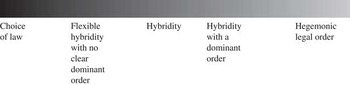
A methodologically helpful way of employing the concept of critical legal pluralism is viewing individual choices in a legally plural environment as taking place along a continuum. The continuum represents the level of individual choice that an individual has within an environment marked by legal pluralism. One end represents a situation in which the individual can easily allow for choice between legal orders, and thus the individual can decide to completely adopt one order over another. In these instances, the individual generally possesses a high level of agency and thus can navigate between legal orders easily. This end of the continuum may be denoted by the term “choice of law.” The other end of the continuum represents situations in which a particular legal order has a hegemonic presence. In such instances, an individual may have very little ability to make a choice based on her own will. This end may be denoted by the term “hegemonic legal order.” Situations fall on this side of the continuum when the individual is compelled to prescribe to a particular set of behaviours, which may even violently oppose other legal orders. The flexibly that an individual has in making choices in a legally plural environment will differ according to both context and the position of the individual within that context. In some cases, the individual will be in a position to make either–or choices between normative rules, thereby controlling the normativity of her immediate environment. In other cases, the individual will be compelled to ascribe to a particular set of behaviours despite the environment being characterized by pluralism. These two situations are captured by each end of the continuum. In a sense, both sides of the spectrum lead to a “jurispathic” outcome in that one legal order may be legitimized over another. However, the core distinction is the ability of the individual to make choices between legal orders on the “choice of law” side of the continuum, but not on the “hegemonic legal order” side.
In reality—and more interestingly—a great number of situations will fall somewhere within this continuum. In certain instances, the individual’s behaviour will adopt a hybrid form at the interstices of several orders. The hybrid position is represented at the centre of the continuum. In these instances, legal orders overlap with one another and simultaneously exert influence on the individual. The degree of influence that a legal order has on an individual is subjective and difficult to quantify, and thus what is important to note is that that each legal order commands relatively the same level of authority for the individual such that he considers each to be of relatively the same importance. In such cases, the individual may feel caught between two (or more) legal orders and pursues an option that legitimizes the authority of both (or each of them), thus not explicitly rejecting any legal order nor choosing any one over others. The individual asserts agency by choosing a hybrid form of behaviour that occupies a space between these orders.Footnote 67 Hybridity signifies the unique agentic capacity on the part of the individual, since it allows for the individual to give expression to her/his multiple selves by simultaneously identifying with several legal orders since each of exerts manifest influence on her behaviour.
In other situations, the individual may feel that a particular order is dominant, in that it exerts a relatively strong pressure to conform, though still permitting some possibilities for agency (in this case, choice falls between “hybridity” and “hegemonic legal order” on the continuum). In these instances, the individual will feel compelled to adopt a form of behaviour that is highly influenced by the dominant legal order, though still being influenced—though to a lesser degree –by other orders. In yet other situations, an individual may have significant flexibility in choosing between legal orders, since no order is particularly dominant; however, at the same time, no order is completely dismissed by the individual, as each one commands some authority (in this case, choice falls between “hybridity” and “choice of law” on the continuum). In such instances, the individual exerts a large amount of autonomy in her choices, but she still pursues a hybrid choice of behaviour that legitimized the various legal orders, though to varying degrees, depending on the choice pursued.
Figure 1 summarizes the continuum of choices available to the individual who is influenced by several legal orders. An individual’s behaviour will be dependent upon several factors, including the relative authority of each order as commonly understood, her relations with members of various communities, the existing power hierarchies between the various orders, the flexibility commonly associated with each order, and even the individual’s personal resolve to assert agency.Footnote 68 This analysis will be very context-specific and requires a careful examination of the forces influencing individual behaviour.
Continuum of individual choices

This methodological approach to operationalizing critical legal pluralism is helpful in two ways. First, it avoids simplistic representations of individual behaviour. The continuum reveals how individual behaviour in a legally plural environment may assume of variety of forms. The mere presence of multiple legal orders does not immediately imply that the individuals will be able to access a variety of choices in every situation. Difference situations may bring different encounters to the foreground, in which one legal order or another may dominate. Second, this continuum provides a context for understanding how individual choices can be constitutive of law within a particular environment. The left side of the continuum represents instances where the individual has the ability to choose one legal order over another. In such cases, the chosen order is legitimized at the expense of all other orders. In this way, the individual is simultaneously norm-enforcing and a source of legal legitimacy. This may lead to a separate line of inquiry as to why such a choice has occurred. Furthermore, as one continues further right along the continuum, varying degrees of hybridity are represented, indicating how a single act can serve to legitimate multiple legal orders. At the right end of the continuum, the individual is compelled towards a particular form of behaviour because of the domination of a legal order. This compelled behaviour is the result of a hegemonic order, but also serves to legitimate the continued hegemonic presence of that order.
The hijab ban in France for Muslim schoolgirls is an elucidating example.Footnote 69 In 2004, France passed legislation that prevented students from wearing any ostentatious religious symbol in the classroom, as such behaviour purportedly went against the secular values of the state. The law directly impacted Muslim schoolgirls who believed that wearing the headscarf was an individual religious obligation.Footnote 70 Thus, Muslim women were faced with the choice of removing the hijab or exiting the public-school system. The inter-normative conflict between state law and Islamic law is most vibrantly captured by the array of responses by students. Some schoolgirls removed their hijab, while others pulled out of public schools and pursued private-school or home-school education. Both these choices would be represented on the right end of the continuum, since they fundamentally turn on the hegemonic rule laid down by the state, namely remove the hijab or exit the school system. Both the girls who removed their hijab and those who left the school system conformed to this state rule (as it provided for these two options). Thus, both actions had the result of further legitimating the hegemony the state legal order.
Furthermore, in between these two choices, one finds an eclectic range of responses that show attempts by schoolgirls to solve the dilemma by asserting agency. A handful of schoolgirls who removed the veil opted to wear wigs to school, thus still “covering” their hair while abiding by the new rule, indicating a choice somewhere near the middle of the continuum.Footnote 71 In one particularly provocative instance, a schoolgirl who was forced to remove her hijab shaved her head in protest (and thus had no hair to cover), thereby pursuing a hybrid course of action also situated near the middle of the continuum.Footnote 72 In both the case of wigs and head-shaving, schoolgirls adopted a hybrid form of behaviour that legitimized both state and Islamic legal orders.Footnote 73
These varied responses by French schoolgirls who wore the hijab raise significant considerations for both the state and Islamic normativity. For the state, questions arise as to whether the new law has led to the ghettoization of certain members of the population and what wider impact such ghettoization has for nation-building purposes. Concerning Islamic normative discourse, questions arise on whether or not doctrines within the discourse such as “necessity”Footnote 74 may be invoked to justify removing the hijab to attend school and whether responses such as wearing wigs or even shaving oneself bald could be normatively justified given the circumstances. While legal orders may prescribe particular behaviour, their real-world instantiation can only be adduced from the behaviour of the individual. Focusing on the individual schoolgirls provides a vibrant picture of the inter-normative tensions and their consequences for both the schoolgirls and the various meta-orders implicated. The individual’s choices reveal how conflicts are dealt with, which may have an impact on the existence and coexistence of the legal orders that have come into contact.Footnote 75 Furthermore, focusing on the individual also brings attention to other orders that may also influence individual choice—in the case of the schoolgirls, this may include not only the state and Islam, but also family, community, and even international norms.Footnote 76
The significance of critical legal pluralism may be viewed as a logical extension of the concept of global legal pluralism.Footnote 77 The latter is a product of increased globalization and the corresponding rise in interest in the global legal order.Footnote 78 Globalization has resulted in greater attention given to the operation of society at the local level. Local communities have increasingly seen the presence of “internal globalization” or “glocalization”Footnote 79 whereby individuals’ everyday experiences are shaped by global flows of information. A single person may find themselves part of several normative communities, some of which have a transnational character.Footnote 80 Such communities may include religious and political movements, transnational corporations, and even immediate or extended family located across the world. The porosity of society brought about by globalization has allowed for information to permeate individual spheres almost instantaneously.Footnote 81 An individual may thus feel the influence of various overlapping legal orders, each of which exerts influence on her behaviour. By focusing on the individual, it becomes possible to assess how local, trans-local, national, and global orders interact with one another, how and when normative conflict occurs, and what strategies are employed to deal with such conflict.
Two questions remain about the usage of critical legal pluralism. The first is whether the present approach conceives of legal pluralism too widely, as mentioned in the initial critique of legal pluralism, such that all forms of normative influence may be given the title “law.”Footnote 82 The answer is both yes and no. On the one hand, the focus on the legal subject is to specifically understand the forms of normativity that influence her behaviour. Whether those orders take the name “law” or not is secondary to the actual role they plan in influencing—and being influenced by—the individual’s behaviour.Footnote 83 Thus state law is a priori viewed at the same level as, say, community norms, since the latter may command incredibly strong influence on an individual’s behaviour. On the other hand, the present approach does address some of the ambiguity surrounding the use of legal pluralism (as implied by the question) by focusing analysis on the individual. The individual is a remarkably complex site of normativity, since she brings together so many currents of knowledge. However, this emphasis on the role of the individual provides a clear point of reference for the researcher, which then allows for various forms of interrogation. As long as the point of departure is made clear from the onset, a certain level of analytical coherence is maintained.Footnote 84
The second question is whether critical legal pluralism would still prove to be relevant under an autocratic regime or in the event an individual is wrongfully punished under some legislation and forced to serve a jail sentence, since such situations would seem to place severe restrictions on individual agency (such situations would fall on the “hegemonic legal order” side of the continuum). Law may thus appear to be exogenous to the individual. The answer is that, as a general statement on legal inquiry, the precise contours of the individual’s legal universe are best attained by examining the individual rather than through implicit assumptions on her state of affairs. Some legal systems may be oppressive or authoritarian and, as such, the individual may be forced to adhere to a very particular law. This very inability to assert agency provides valuable information on agency (namely, its absence) and how law is constituted in society. Here, one may say that, while law is endogenous to the individual, she may be fully coerced by the legal system, thereby limiting her ability to manipulate the law. However, the significance of treating law as endogenous to the individual remains as her normative universe may reveal a much more complex dynamic than is immediately apparent. The human capacity is incredibly resilient and capable of finding unique ways of resisting and manipulating the law. For example, a woman may be wrongfully convicted of a crime but feel too disempowered to dispute the court’s disposition (possibly due to social or racial inequalities). The judge may require her to perform community service as part of the conviction. However, she may seek to fulfil this obligation through church volunteering, which she already performs though unbeknown to the court. Through this action, the punishment of community service associated with the conviction is rendered obsolete.Footnote 85 As this and similar instances show, the individual often has the ability to discretely assert agency with the result of shifting law’s normativity. The point here is that scrutinizing the individual helps to reveal the nature of the legal orders in question and the possibilities (if any) of individual agency.
Law is constituted through the individual just as it influences her behaviour in a reciprocal relationship. Observing the individual reveals the “jurisgenerative” and “jurispathic” processes that continually re-shape the contours of the law when normative spaces come into contact with one another.Footnote 86 Consequently, the ultimate understanding of the legal ordering that eventually arises will benefit from the dynamic lived experiences.Footnote 87 The next section focuses on legal pluralism in Afghanistan and shows how critical legal pluralism helps in translating macro understandings of the legal system into everyday lived practice.
4. CRITICAL LEGAL PLURALISM IN AFGHANISTAN
Over the past decade, a body of literature has slowly emerged documenting and analyzing legal pluralism in Afghanistan.Footnote 88 These works generally identify three legal orders that can be found in the country: state civil law, Islamic law, and customary law. Each one of these three sets of laws commands authority in varying degrees throughout the country.
The formal state legal system generally follows the Romano-French civil-law tradition.Footnote 89 Enacted law serves as the primary source of law when a problem arises.Footnote 90 In Afghanistan, one finds a range of codified laws including the Civil Code of Afghanistan, the Commercial Code of Afghanistan, the Civil Procedure Code, the Criminal Code of Afghanistan, the Criminal Procedure Code, as well as innumerable enacted statutes. An individual can become a judge after graduating from a law or sharia faculty at the university level and completing a judge-training programme (known as Dowra-e-Sataj or Sataj-e-Qazaee).Footnote 91 Judges are supposed to arbitrate cases by directly referring to the law. If the law is ambiguous on a particular matter, the issue may be sent to the Supreme Court that will provide its explanation of the law, which the lower court judge will then apply to the case.Footnote 92 There are three levels of courts: primary courts, appellate courts, and the Supreme Court.Footnote 93 In the primary- and appellate-level courts, judges sit in a panel of three, though a single judge may dispose of the case in the Primary Court—a practice particularly common in rural areas.Footnote 94 The Supreme Court is presided over by two judges as well as two judicial advisers.Footnote 95 The process is inquisitorial, as judges play a probative role in inquiring into the situation from the parties involved.Footnote 96 When the court renders a decision, it only produces one opinion. Dissenting opinions are sometimes recorded, though the practice is not consistent; in cases where a dissent occurs, the likelihood of an appeal is very high.Footnote 97
While structurally Afghanistan’s legal system follows the civil law, the substance of the law is greatly influenced by Islamic law. The Civil Code of Afghanistan largely replicates the Egyptian Civil Code.Footnote 98 The latter was the product of a distinguished Egyptian jurist, Abdal Razzaq Sanhuri, who possessed great prowess in Romano-civil law but sought to create a national code that integrated Islamic law.Footnote 99 The Civil Code that he ultimately put forward followed a Romano-civil structure while also retaining the substantive principles of Islamic law.Footnote 100 Such a code would naturally be appealing for a country like Afghanistan, where local sentiment is so strongly aligned to Islamic law that attempts to mitigate its importance have led to rebellions in the past.Footnote 101 Islamic law is also prominently mentioned in the Constitution of the Islamic Republic of Afghanistan.Footnote 102 Article 3 states that any law that is passed must be consistent with the tenets of Islam.Footnote 103 Moreover, Article 130 provides that Islamic law is the second source of law, after enacted law.Footnote 104
It would be overly simplistic and rather misleading to say that Islamic law has significance specifically because it is recognized by law. Rather, Islamic law is deeply revered by the vast majority of Afghan society, independently of the state’s legitimation. Islamic law is safeguarded by a class of ulama who in turn trace their authority to Islamic law.Footnote 105 Authority thus resides outside of the state.Footnote 106 Looking at Afghanistan’s recent history, Islam has at times served as a means for bringing about political change. During Amir Amanullah’s efforts to politically centralize Afghanistan, and later during the mujahideen’s resistance against Russian occupation in the 1980s, Islam was employed to garner public support. However, for Amanullah and the mujahideen to make claim to Islamic legitimacy, they had to submit to the authority of the ulama, with the result of strengthening the class of ulama in society.Footnote 107
To focus solely on state civil law and Islamic law would be to greatly misconstrue Afghanistan’s legal environment. In reality, customary law yields the most authority in society, particularly outside of the urban areas.Footnote 108 Customary law refers to the norms, values, rules, and customs defined by a particular community (i.e. the qawm) and practised by its adherents.Footnote 109 In Afghanistan, once one leaves the city centres, formal state law quickly evaporates and customary law comes to dominate. While its content varies from community to community, certain salient characteristics can be identified. Emphasis is placed on restorative rather than punitive justice, and thus rules are applied flexibly so as to facilitate the most likely resolution to a dispute.Footnote 110 Put simply, the end may justify the means. The central adjudicative mechanism under customary law in Afghanistan is the shura (or jirga).Footnote 111 The shura is a consultative body comprised of male elders in the given community that deals with all community matters. For this reason, the line between the legal, social, and political are blurred within the shura. Footnote 112
Employing the concept of legal pluralism to Afghanistan’s legal system provides an insightful description of the various legal orders that occupy the given social space. As an interpretive heuristic, legal pluralism brings attention to the tensions in authority between state civil law, Islamic law, and customary law. Appreciating these legal orders is necessary for understanding the complexity of legal interactions in Afghanistan. However, the presence of a particular order does not immediately reveal its instantiations in society, particularly when several such orders each vie for normative control. The overlap and at times contestations between these legal orders arguably add greater uncertainty to how to understand Afghanistan’s legal environment by widening the scope of normative possibilities.Footnote 113 Nonetheless, grasping this normative spectrum brings to light the true complexity of the legal, thereby allowing for responses to be devised that abate potential conflict.
The challenge, thus, is to comprehend how these overlapping legal orders ultimately find expression in society. Starting the analysis at the level of the individual may be one means of pragmatically confronting this challenge.Footnote 114 Critical legal pluralism attempts to decipher the legal system from the vantage point of the individual. An individual’s initial exposure to law is not through a textbook discussion of legal orders, but through the individual’s own lived experiences.Footnote 115 While this is true of any society, it is particularly the case in countries with weak legal systems like Afghanistan, where formal law is largely aspirational and engaged in ever-present struggles with other forms of normativity. As they grow, individuals are socialized into various identities and become familiar with each of their associated patterns of behaviour.Footnote 116 People define their own behaviour by continually arbitrating between these identities according to their own fluid reasoning.Footnote 117 An Afghan may simultaneously feel the influence of state law (through her identity as an Afghan), Islamic law (as a Muslim), customary law (as a member of a particular qawm), institutional norms (as a member of the environment where she works or studies), family norms, international norms, and so forth. Individual behaviour is constantly engaging with multiple forms of normativity and arbitrating points of tension.
An individual will often find herself occupying an ambivalent space between conflicting normative rules and possessing the ability to choose between them. Legal pluralism in conflict takes its most definitive form in such instances. An example is elucidating. Where I previously worked at the American University of Afghanistan in Kabul, an issue once arose concerning the dress code of women. A number of female students chose to adopt Western clothing choices instead of traditional Afghan attire while on campus. As the raison d’être of the university was to allow liberal expression, it placed no official restrictions on women’s attire. This struck a nerve with more traditional members of the university (primarily students) who felt that such attire went against Afghan religious and customary norms. In the end, no restriction was placed on women’s clothing. However, the normative reverberations were clearly felt. While the university did not institute any official policy, the incident raised important considerations for university members on how “liberal” institutional values should find expression in a conservative society. For female students who adopted strictly Western attire, their choices may be viewed as destructive towards traditional norms. However, many female students asserted agency by adopting a hybrid look, where their clothes had both Western and traditional elements.Footnote 118 Significantly, the individuals’ choices led to various legal orders exerting influence on one another, whether constructively or destructively. The various contours of this inter-normative contact are best revealed by observing the behaviour of the students. Furthermore, their choices impact the spatialized meta-existence of the various orders by demonstrating how instantiations of conflict are dealt with. The “law-inventing” capacity of the individual thus becomes manifest. The students’ inter-normative experiences create a form of normativity that bears its influence on the implicated legal orders, since the continued existence of the latter is contingent upon legitimation by its individual adherents.
Focusing on the individual as the point of departure for studying legal pluralism allows for various forms of inter-normativity to enter into legal analysis that may otherwise be overlooked. In the case of Afghanistan, such an approach can assist in understanding the ways in which legal pluralism plays out in particular contexts and what this means for the meta-existence of those orders that overlap with one another. The following section focuses on two interviews with actors in the formal justice system and their experiences in dealing with overlapping normative regimes.
5. NORMATIVE CONTESTATIONS IN THE AFGHAN COURTROOM
In May 2015, I interviewed a former judge as well as a defence lawyer in Kabul to better understand how legal issues were dealt with in the courtroom. The judge presided over the Primary Court of the 4th and later the 5th districts of Kabul and subsequently served as the judge of the Appellate Court, Criminal Division, in Kapisa Province.Footnote 119 The defence lawyer had been working with criminal and civil cases for the past seven years.Footnote 120 The choice of interviewing justice actors was intentional, as they occupied roles specifically associated with the formal justice system, and thus could provide insight on the tensions between legal orders when issues come before state legal institutions. Each interview lasted roughly 30 minutes and was preceded by approximately 10 minutes of introductory pleasantries. I began each discussion with a few background questions and thereafter allowed for the conversation to develop organically.
My interviews focus on two legal actors who are formally part of the legal system. Their direct engagement with legal normativity would seem immediately apparent given their roles. Just these two interviews helps to reveal the ways in which individuals—in this case ones with a more formal role in the legal system—navigate normative overlap and assert agency in their own ways. These preliminary observations on normative contestations arising in the Afghan courtroom are not meant to be conclusive of courtroom—much less general societal—behaviour. Rather, they provide a window into the real-life instantiations of normative tensions. They show how critical legal pluralism can enrich the existing literature by revealing how perceptions of behaviour map onto reality.Footnote 121 The insights of this limited study suggest the importance of studying a variety of individuals with different roles in society, including litigants, government bureaucrats, community leaders, religious clerics, and so forth. Hopefully, this article demonstrates the significance of further empirically driven research for understanding legal pluralism in practice.
The initial remarks of the judge emphasize the low capacity of the course as well as his view on the official hierarchy of laws:
The judge’s knowledge is limited in terms of legal reasoning. They learned just traditionally from the other judges but they never learned academically how to [conduct] legal research and legal reasoning and which law to refer to at what time. … Judges have to apply the law. They cannot go directly to Sharia. They cannot go directly to custom. Whatever they do not have in the law, they are referring it to the Supreme Court. The Supreme Court Judicial Council has a weekly meeting. They [have] the authority of interpretation of the law, to see that the laws are consistent with each other or to see if there in a new issue that needs to be explained, then they are going to do that.
These comments not only place a primacy on state law, but also largely mitigate the significance of Islamic law and customary law. The judge took this point further by adding that “judges do not use international law.” His comments emphasize the little role played by any law other than state law despite the fact that Article 130 of the Constitution and Articles 1 and 2 of the Civil Code of the Islamic Republic of Afghanistan sanction the use of Islamic law and customary law,Footnote 122 while Article 7 of the Constitution permits the use of international law, provided that the relevant conditions are met in each instance.Footnote 123 The judge also mentioned that the area of criminal law is one notable exception, since Islamic law serves as the primary source of law for fixed (hudud) crimes, while the Criminal Code applied in cases of discretionary (ta’zeer) crimes.Footnote 124
The courtroom is a unique environment because it carries with it the authority and coercive power of the state. The decisions that a judge renders must (in theory) reflect this reality by adhering to legislation enacted by the state. At the same time, Islamic and traditional values have widespread influence on people’s outlook on society and prevailing sensibilities on how problems (whether legal or otherwise) should be dealt with. The following remarks by the judge concerning the case of a young couple seeking a divorce brings out the ways that different normative values come into contact with one another in the courtroom:
I experienced a divorce case in 2005 in Kabul’s 4th District Court …. It was a young boy and young girl and two kids and they were saying we want to get a divorce. And as a judge, it is one of those thing you have to tell them are you sure you want to divorce. Can you go back and think one more time? And this is how divorce works—if you do talaq by end, then you will never be able to get back, and so you need to think about that more than one time. And we gave them a few days to think about this issue. After a few days, they came back and they said we thought about this and it’s not going to work. We are just going to go and do this divorce. The boy was saying if she wants to live with me, I would be happy to live with her. If she wants to take talaq, I will give it. I won’t argue with her. But I want to live with her. I want to raise our kids, and here and there things happen and we can work it out. They didn’t have a very big dispute between themselves. Only that someone interfered in their affairs from the lady’s side. Also the lady did not have a very strong reason. She was just saying that this gentleman is a singer. Well, you knew that he was a singer. Traditionally, being a singer is not a good thing …. And in the end she was saying that he promised me lots of things and it never happened, that’s why. So finally we said if you want a divorce we are going to register it. And we did. After their case has been finalized, a few weeks later they came back and [asked]can we take our divorce back. We said, well we explained to you everything. You can do that, but there are certain rules under sharia and family law of Afghanistan. You have to do halala.Footnote 125
The courtroom serves as a normative space where not only state laws, but also other normative forces come to the fore. A judge may find himself bound to uphold not only state law, but also other societal norms. In this sense, the actual boundaries between state law and other forms of normativity are more porous than the rigid hierarchy of laws initially described by the judge. Fluid and competing normative interests enter into the judge’s analysis. In the case of the young couple before the court, the case is not as simple as the judge granting a divorce. Rather, the judge also assumes the role of a mediator by seeking to guide the parties to possibly reconcile their problems before proceeding with the divorce. This behaviour bears the traces of Islamic law, which emphasizes reconciliation (sulh),Footnote 126 as well as customary law, which is fundamentally reconciliatory in nature. Similarly, the judge’s comments on singers generally being looked down upon in Afghan society shows how the facts of the case are absorbed into a complex repertoire of ideologies that allow for assessments of “right” and “wrong.” The judge himself serves as a site of fluid and interlacing forms of normativity. The judge is thus not simply applying state law. Rather, his application of state law as an official of the court remains deeply influenced by Islamic law and customary law. Furthermore, while elements from various orders can be traced within the discussion, quantifying the extent to which each bears influence, would be an exceedingly difficult (if not impossible) exercise, since norms fuse with one another and take on a hybrid manifestation for the judge.
The judge went on to make a few general remarks about the relationship between the courts and jirgas that administer customary law. Customary law remains highly authoritative in Afghanistan, and courts are cognizant that they often need the support of the community for a decision to be upheld:
It happens that they [i.e. the judge] are referring court [cases] to the qawm for thinking all about these critical things about the future of the family. You know Afghanistan’s situation, the kids will not have a good situation without their dad or mom or all these things. That’s why they are referring their case. And in some parts of the country, they believe to refer the case to jirgas or peace councils—to refer it to the informal system. Especially in civil cases more. And people trust them in the rural areas. It’s cheap and quick.
The defence lawyer made the following remarks, reiterating the significance of customary law when dealing with family-related issues:
The courts, they refer cases. Like for the case of separation, because of harm or because of anything, they refer it several times to the customary law, to the community for informal justice system. Like whenever there is case of separation between husband and wife. First of all, the judge advises both parties, and they assign a musalaha or hakam—a representative from both parties—and so they settle inside of their home and the court is not going to make a decision about it. They do this action even three times before a judge makes a decision about it. … And even this was a rule of Sharia law as well. Omar bin Khattab and other sahaba, they were sending both parties—plaintiff and defendant, go and solve the problem through mediation. Because if the court makes a decision, then it is going to qa’tia’—final—so whatever you didn’t get or whether you get, this is going to your final right.
The simple fact that legal pluralism is present in a particular environment does not immediately reveal how individual decisions are affected. This information is obtained by studying subjective experiences that implicate the law. Courts are tasked with resolving cases in an environment where legal authority is dispersed. For this reason, cases that come before the court may be sent back to the local community to be dealt with through traditional means. The defence lawyer’s comments on divorce show how power relations between different legal orders have fossilized such that a “natural” legal process has emerged. In this case of divorce, the home becomes the forum of first instance, followed by the community where representatives of each party are called upon. Finally, the court may be available as a venue of last resort if all other options fail. If one goes to the wrong forum, they will be referred to the appropriate one. De Lauri’s research on Afghan judges makes a similar finding on the process of separation.Footnote 127
The lawyer’s comments on divorce can be analyzed using the continuum of individual choice explained above in Section 3.Footnote 128 The lawyer’s comments would fall on the rights side of the continuum, since the Afghan legal order compels an individual to follow a particular procedure when seeking a divorce. This result is particularly intriguing since, in this case, the hegemonic legal order itself consists of a mixture of various legal orders, namely state law, Islamic law, and customary law. Within the public arena, power hierarchies may already exist between orders, resulting in a normative mélange that may not easily permit individual choices.Footnote 129 From the vantage point of the individual actor (whether a judge, lawyer, or one of the parties), the various legal orders may have become interlocked in a hybrid form that strongly influences individual behaviour, making it difficult—and sometimes impossible—for the individual to treat the various orders as separate. DeLauri has employed the term “inaccessible normative pluralism” to describe the legal environment in Afghanistan, since individuals often do not have the ability to choose between legal orders.Footnote 130 Rather, the legal orders have become interlocked in a manner that compels individuals to go through the prescribed fora in seeking a divorce. Thus, legal pluralism in this instance represents a form of hegemony, and the behaviour it compels from individuals serves to legitimate this continued hegemony.
Returning now to the judge’s initial comments on the hierarchy of laws in the country, his remarks identify state law as the dominant order, even if other orders exert influence. However, as the judge continues, he makes clear how other forms of normativity impact his reasoning. His comments on talaq are explained in the language of Islamic law, and he himself tacitly assumes the role of a mediator though simultaneously occupying the post of a formal judge of the state. On the continuum of choice, his behaviour seems to be situated somewhere near the middle, assuming a hybrid form that integrates elements of Islamic law and state law. By operating at the interface of both orders, he becomes a source of their continued existence—he is not only norm-enforcing, but also norm-creating. He actualizes both state and Islamic normativity in the particular context, revealing the way in which legal pluralism is navigated, balanced, and preserved.
The defence lawyer specifically references Islamic law and the actions of the sahaba to legitimize the practice of having a case sent back to the community for conciliation, while no reference is made to formal enacted statutes to justify this practice. In this instance, Islamic normativity serves to legitimize the widespread practice of mediation such that it has a direct bearing on the choices of judges within the courtroom. Furthermore, the line between tradition and religion becomes blurred, as mediation comes to simultaneously represent both normative systems. This time the lawyer’s comments seem to be located near the middle of the continuum of choice, though right of centre, since Islamic law and customary law are clearly dominant in his interpretation of conciliation. At the same time, state law may have not altogether escaped his analysis, but rather assumes secondary importance in providing normative meaning. The lawyer’s comments demonstrate a balancing of legal orders, which simultaneously provides authority to their continued widespread influence.
Inquiry at the individual level reveals how inter-normative choices bear the mark of ongoing contestations between legal orders. In certain instances, normative choices may be constrained by existing power hierarchies, whilst, in other instances, the individual may maintain the ability to assert agency. For example, some Afghan judges have the ability to choose from a variety of official (e.g. courtroom) and unofficial (e.g. mediation) remedies and legitimize their choice through norms other than state law; other judges (particularly in rural areas) may feel compelled to remand a given case to the community level. Studying state law, Islamic law, and customary law as distinct orders can only go so far in explaining the real-life instantiations of normative overlap and contestations that lead to legal norms being accepted, denied, or transformed. Individual subjectivity as a distinct form of normativity thus becomes manifest, as the individual makes choices on how orders interact with one another and what this means for the continued existence of these orders.
6. CONCLUSION
Critical legal pluralism helps to reveal the complexity of normative tensions within a particular environment by viewing the individual as capable of constructing her own legal universe. The individual serves as the site of a number of overlapping legal orders of which the state is merely one. The individual constitutes her legal reality at the interface of various forms of normativity, which may involve choosing one legal order over another (as in the case of a judge explicitly choosing state laws over other laws) or operating at the interstices of two or more orders by codifying actions plurally (as in the case of community mediation being as both customary and Islamic norms). The proposed methodological approach is that critical legal pluralism through a continuum of individual choice helps to shed light on the complex considerations that affect individual choices, which in turn affect how various legal orders are legitimated.
In the case of Afghanistan, critical legal pluralism allows for discussions to venture beyond simplistic discussions on Islamic law, customary law, and state law being wholly independent orders.Footnote 131 In reality, the individual is continually reconstituting acceptable behaviour by engaging in a fluid dialectic. Critical legal pluralism does not take legal orders for granted, but rather views them as being related to the individual in a reciprocal relationship. A legal order possesses a hypothesized existence that is in constant flux, and its contents and boundaries are continually influenced by individual behaviour. Individual experiences help to define the indigenous form that the law takes within a particular environment.
Critical legal pluralism has the potential to reveal a wide variety of configurations of pluralism in society. My interviews provide preliminary insights into the inter-normative mixing that occurs amongst formal justice actors. Other studies on Afghan judges have shone light on how issues of corruption and poverty also constrain state-sanctioned legal practices.Footnote 132 Venturing outside of the courtroom and into other spheres of activity will undoubtedly reveal other forms of normativity that permeate various aspects of society. One would suspect that a student or professor would be influenced by certain university norms or that a doctor would be influenced by norms governing physicians. These varying forms of normativity are significant for the researcher, since they help explain human behaviour, regardless of whether the label of “law” is applied. Critical legal pluralism unleashes the imaginative potential of the law by requiring the researcher to make sense of the myriad forms of normativity that influence—and that are influenced by—the individual. And we ought not to be weary of such complexity—we ought to welcome the opportunity to elaborate on law’s dynamism by peering into the eyes of the individual and uncovering the legal universe that lies therein.