Introduction
Farming practices such as application of chemical fertilizers and pesticides, irrigation, and tillage may selectively determine which species predominate in the weed community within a field crop (Barroso et al. Reference Barroso, Miller, Lehnhoff, Hatfield and Menalled2015; Derksen et al. Reference Derksen, Lafond, Thomas, Loeppky and Swanton1993; Hyvönen and Salonen Reference Hyvönen and Salonen2002; Maillet and Lopez-Garcia Reference Maillet and Lopez-Garcia2000). For example, a shift in cropping systems can drastically alter the composition, richness, density, and cover of weeds (Barroso et al. Reference Barroso, Miller, Lehnhoff, Hatfield and Menalled2015; Riar et al. Reference Riar, Norsworthy, Steckel, Stephenson, Eubank, Bond and Scott2013). Infestation by weeds usually causes crop yield losses (Cousens Reference Cousens1985), and chemical control introduces environmental costs (Fletcher et al. Reference Fletcher, Pfleeger and Ratsch1994; Tsai Reference Tsai2013). Thus, it is necessary to identify reasonable farming practices—rotation, application of animal manures, and the return of crop residues to the soil—that are beneficial to soil fertility, crop yields, farmland biodiversity, and ecosystem health.
It is well known that soil properties such as texture, organic carbon content, nutrient content, and pH significantly influence the occurrence of plant species (Andreasen et al. Reference Andreasen, Streibig and Haas1991; Fried et al. Reference Fried, Norton and Reboud2008; Gaston et al. Reference Gaston, Locke, Zablotowicz and Reddy2001). In grasslands, the addition of multiple limiting resources (nitrogen, phosphorus, potassium, and other nutrients) reduces species niche dimensionality and grassland diversity and increases living and dead biomass, shifting productivity from being nutrient limited to water or light limited (Harpole et al. Reference Harpole, Sullivan, Lind, Firn, Adler, Borer, Chase, Fay, Hautier, Hillebrand, MacDougall, Seabloom, Williams, Bakker, Cadotte, Chaneton, Chu, Cleland, D’Antonio, Davies, Gruner, Hagenah, Kirkman, Knops, La Pierre, McCulley, Moore, Morgan, Prober, Risch, Schuetz, Stevens and Wragg2016; Harpole and Tilman Reference Harpole and Tilman2007). However, when the total resource supply is maintained at a high level, exploitation of soil nutrients by co-occurring grassland species is individually affected by nutrient type, nutrient distribution, and irrigation (Zaller Reference Zaller2007). These species-specific differences in nutrient acquisition may be related to the ability of a species to exploit nutrient-rich microsites. Thus, the species with a greater relative growth rate will produce more biomass and longer roots, allowing increased nutrient capture in heterogeneous soils (James et al. Reference James, Ziegenhagen and Aanderud2010). Consequently, microsites that affect germination, time of emergence, and seedling establishment in an agricultural soil may potentially influence weed population processes (Bullied et al. Reference Bullied, Van Acker and Bullock2012). However, it is difficult to quantify these properties of soil microsites, which include microclimate, nutrient distribution, microtopography, and residue cover, in fields. Both weed seedbanks and emerged flora respond to the intensity of farming practices (Hawes et al. Reference Hawes, Squire, Hallett, Watson and Young2010); thus, we assumed that different fertilizer application regimens, including treatments of no fertilizer, chemical fertilizer only, compost with chemical fertilizers, and straw return with chemical fertilizers, may result in diversified agrestal habitats for weeds.
The intensive rotation of winter wheat (Triticum aestivum L.) and summer rice (Oryza sativa L.) along the middle and lower reaches of the Yangtze River in China has been established for several decades (Ju et al. Reference Ju, Xing, Chen, Zhang, Zhang, Liu, Cui, Yin, Christie, Zhu and Zhang2009). Long-term application of chemical fertilizers under rice–wheat rotation not only has already caused severe environmental pollution but also may alter the biodiversity of agroecosystems (Guo et al. Reference Guo, Zhu, Wang, Wu and Zhang2004; Owens et al. Reference Owens, van Keuren and Edwards2000; Yin et al. Reference Yin, Cai and Zhong2005). To remediate the severe environmental pollution caused by excessive application of chemical fertilizers, replacing a portion of chemical fertilizer with organic fertilizer and returning straw to the soil are urged by Chinese governments at all levels (Huang et al. Reference Huang, Gao, W, Tian, Tao and Wang2016a; Li and Wu Reference Li and Wu2008; Zhang et al. Reference Zhang, Wang and Chen2008).
Research into the effects of different fertilizer application regimens on weed composition and species density under the rice–wheat rotation may foster ecologically sound field management. Hence, the objectives of this study were to compare the weed composition and species density within wheat fields subjected to different fertilizer application regimens under a rice–wheat rotation system.
Materials and methods
Experimental site
The experimental field was located in Jianchun Village (31.662°N, 119.473°E), Jiangsu Province, China. The site is 10 m above sea level, and the region has a humid subtropical monsoon climate; the average annual temperature, humidity, and precipitation are 15.3 C, 78%, and 1,084 mm, respectively. The soil is a typical clay loamy Fe-leachic-gleyic-stagnic anthrosol. After continuous application of different fertilizers for nine seasons, the chemical properties of the soil were analyzed in 2015 after wheat harvest and are presented in Table 1.
Soil fertility properties in 2015 after wheat harvest.a

a Mean values ± SDs. The values with different capital letters within a column are significantly different at P < 0.05.
b CF, chemical fertilizer; CK, control; PM, composted pig manure plus chemical fertilizer; SF, straw return plus chemical fertilizer.
Experimental design
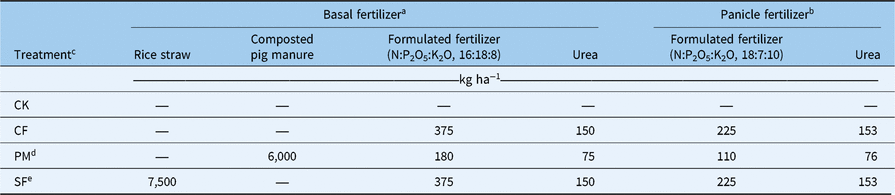
The field experiment has been ongoing since the wheat season of November 2010, with long-term annual rotation of summer rice and winter wheat, and involving four replicates of four treatments in a randomized block design. During the wheat season, fertilizer treatments consisted of four treatments, as follows (Table 2): (1) a control (CK): no fertilizer applied; (2) chemical fertilizer only (CF): 375 kg ha−1 formulated fertilizer (N:P2O5:K2O, 16:18:8) plus 150 kg ha−1 urea as a basal fertilizer before planting, and 225 kg ha−1 formulated fertilizer (N:P2O5:K2O, 18:7:10) plus 153 kg ha−1 urea as a supplementary fertilizer at the panicle stage; (3) composted pig manure in addition to chemical fertilizers (PM): 6,000 kg ha−1 composted pig manure plus 180 kg ha−1 formulated fertilizer (N:P2O5:K2O, 16:18:8) and 75 kg ha−1 urea as a basal fertilizer, and 110 kg ha−1 formulated fertilizer (N:P2O5:K2O, 18:7:10) plus 76 kg ha−1 urea as a supplementary fertilizer at the panicle stage; and (4) straw from the preceding rice crop plus chemical fertilizers (SF): the rice straw was shredded to less than 5 cm and broadcast back onto the soil surface as a portion of basal input, while the chemical fertilizers were applied in the same quantities as they were in the CF treatment. Each treatment was replicated four times. The plots measured 40 m2 (8 m by 5 m), and adjacent plots were isolated by cement ridges to prevent the interflow of water and fertilizer. Wheat (‘Yangfumai 4’) harvested on June 3 in 2014 and June 4 in 2015 was sown on the same date (November 5) in 2013 and 2014, respectively, while weed control was performed 20 d after wheat sowing by applying 987 g ai ha−1 isoproturon plus 63 g ai ha−1 bensulfuron methyl using 2.1 kg ha−1 of a commercial formulation of 50% bensulfuron methyl + isoproturon WP. Drainage was provided by one 20-cm-deep furrow in the middle of each plot that emptied into the lateral side channels. Additionally, the amounts of composted pig manure during rice season were the same as those during wheat season, and wheat straw was applied during the rice season. The levels of nitrogen and potassium in the rice season proportionally increased, while the level of phosphorus decreased in response to chemical fertilizers in the CF, PM, and SF treatments (e.g., 300 kg N ha−1, 37.5 kg P2O5 ha−1, and 71.25 kg K2O ha−1 for CF).
Type and composition of the fertilizers applied as treatments in the study.

a As a basal fertilizer applied before planting.
b As a supplementary fertilizer applied at the panicle stage.
c CF, chemical fertilizer; CK, control; PM, composted pig manure plus chemical fertilizer; SF, straw return plus chemical fertilizer.
d The composted pig manure was composed of 45.4% organic matter, 2.0% N, 2.9% P2O5, 1.2% K2O, and 29.1% water
e The straw from the previous rice crop was carefully harvested from each plot to exclude weed seed. The straw was shredded to a particle size <5 cm and uniformly returned by broadcasting to the plots from which it had been harvested.
Survey method
At the wheat dough stage, the number and species of weeds and plant height of wheat and weed species in each experimental plot were determined from May 13 to 14 of 2014 and May 17 to 18 of 2015 in nine 0.25-m2 (0.5 m by 0.5 m) quadrats positioned in accordance with an inverted W nine-point sampling method (Thomas Reference Thomas1985). Wheat grain in 20 m2 was collected from each plot to measure yield at maturity.
Data processing
The relative abundance (RA) of the weed species in each plot was calculated in accordance with the following formula: RA = (RD% + RF% + RH%)/3, where RD, RF, and RH are the relative density, relative frequency, and relative height, respectively, of a weed species present in a wheat field. The frequency of a weed species is the ratio of the number of quadrats in which a weed species occurs to the total number of quadrats in a plot. The density and height are, respectively, the mean density and mean height of a weed species in a plot. The relative frequency is the ratio of the frequency of a weed species to the sum of the frequency of all weed species. Correspondingly, the relative density and relative height represent the ratio of the density and height of a weed species to the sum of the density or height of all weed species, respectively. The relative abundance of a species indicates its degree of dominance or subordination in the weed community (i.e., the greater the relative abundance of a species in the weed community, the greater its dominance [Poggio Reference Poggio2005]).
The biodiversity of weeds was assessed based on the following parameters: species richness, S (i.e., the number of species included in a quadrat); species diversity, measured using the Simpson index (Lal et al. Reference Lal, Gautam, Raja, Nayak, Shahid, Tripathi, Bhattacharyya, Mohanty, Puri, Kumar and Panda2014; Parish et al. Reference Parish, Lakhani and Sparks1994), D = 1 − ΣPi 2, in which Pi = Ni/N is the proportion of the number of individuals of species i to the total number of individuals of each species in the quadrat; N is the total number of individuals of each weed species; and Ni is the number of individuals of species i; and community evenness, as measured by the evenness index or Pielou index (Santin-Montanyá et al. Reference Santin-Montanyá, Martín-Lammerding, Zambrana and Tenorio2016), J = (−ΣPi lnPi )/lnS.
Once the normal distribution (Shapiro-Wilk test, P > 0.05) and homogeneity of variance (Levene’s test, P > 0.05) of the data were confirmed, parametric tests were used. To assess whether differences in the density, plant height, and yield of wheat as well as the density, plant height, and diversity index of the weed community were due to climatic factors (different sunlight duration, temperature, and rainfall between years), fertilization regimen, or an interaction between the two, two-way ANOVA was used. Multiple comparisons were performed using the LSD test. The probability level was 95%; all analyses were performed using SPSS v. 18.0 (IBM, Armonk, NY, USA), and the figures were generated using Origin v. 8.0 (Origin Lab, Hampton, MA, USA). Canonical correspondence analysis (CCA) was performed to explore the relationships among fertilizer resources, pH factors, and species distributions (by the RA of weed species in 2014 and 2015), and a Monte Carlo permutation test was also applied to investigate the statistical significance of the effects of fertilizer resource factors on species distributions using CANNOCO for Windows v. 4.5.
Results and discussion
Wheat height, density, and yield
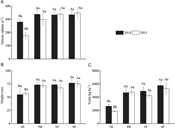
Compared with the CK treatment, the fertilizer amendment treatments (PM, CF, and SF) significantly increased wheat density, height, and yield (Figure 1). Wheat density and yield with the CF treatment were lower in 2015 than in 2014.
The density (A), height (B), and yield (C) of wheat under different fertilization regimens in 2014 and 2015. CF, chemical fertilizer; CK, control; PM, composted pig manure + chemical fertilizer; SF, rice straw + chemical fertilizer. The different capital letters represent significant differences (P < 0.05) between different fertilization regimens during the same year. The lowercase letters represent significant differences (P < 0.05) in the same fertilization regimen during different years.

Although the different fertilizer regimens (CK, PM, CF, and SF) modified the soil chemical properties (Table 1), soil aggregates, and microbial communities in the plots of this study, as reported by other researchers (Huang et al. Reference Huang, Jiang, Li, Ma, Tang, Ran and Shen2016b; Liu et al. Reference Liu, Guo, Ran, Whalen and Li2015; Zhao et al. Reference Zhao, Ni, Li, Xiong, Ran, Shen, Shen and Zhang2014), wheat density, height, and yield did not differ with the PM, CF, and SF treatments. Our results suggest that the significantly lower crop density and plant height in the CK treatment provided more light and space for weeds than in the PM, CF, and SF treatments.
Number, composition, and distribution of weed species
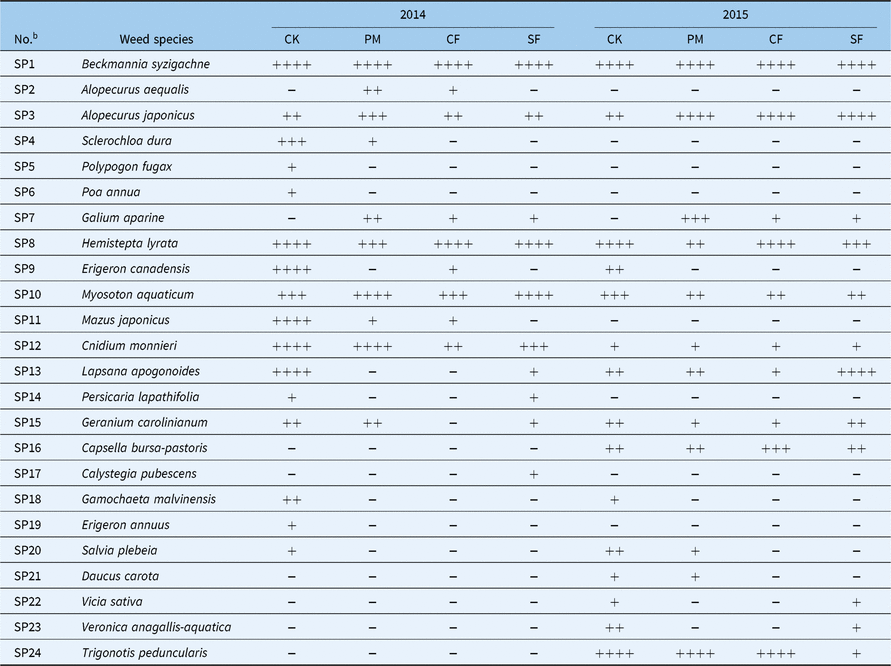
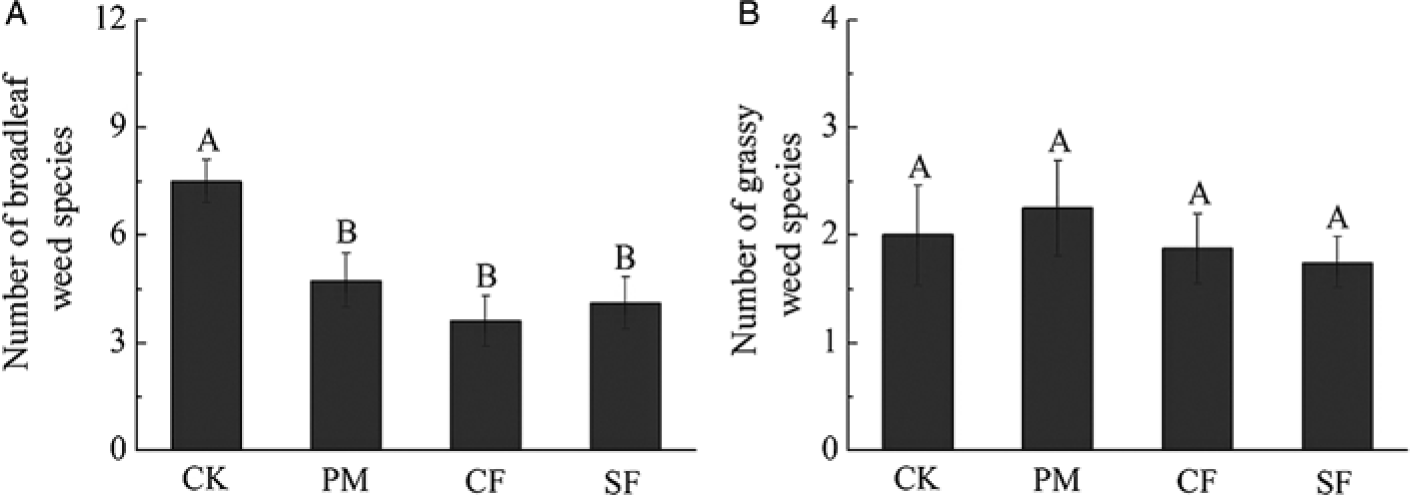
In total, 19 weed species representing 18 genera and 10 families were recorded in the experimental wheat fields in 2014, and 16 weed species belonging to 16 genera and 11 families were found in 2015 (Table 3). Of the 24 total species found in the two wheat seasons, 21, 15, 13, and 14 species occurred in the CK, PM, CF, and SF plots, respectively. Five species, American sloughgrass [Beckmannia syzigachne (Steud.) Fernald], Japanese foxtail (Alopecurus japonicus Steud.), lyrate hemistepta (Hemistepta lyrata Bunge.), water starwort [Myosoton aquaticum (L.) Moench], and Monnier’s snowparsley [Cnidium monnieri (L.) Cusson ex Juss.], were widely distributed regardless of treatment in 2014 and 2015. Among these weeds, B. syzigachne is the most predominant and troublesome weed in the wheat fields rotated with rice along the middle and lower Yangtze River (Li et al. Reference Li, Bi, Liu, Yuan and Wang2013; Rao et al. Reference Rao, Dong, Li and Zhang2008), and it accounted for at least 35% of total weed density in all treatments in 2014 and 2015. Eight weed species were found in 2014 but not in 2015; five weed species occurred in 2015 but did not occur in 2014. Four species, Asia Minor bluegrass (Polypogon fugax Nees ex Steud.), cudweed [Gamochaeta malvinensis (H. Koyama) T.R. Dudley], annual bluegrass (Poa annua L.), and annual fleabane [Erigeron annuus (L.) Pers.], grew only in the CK plots, whereas three species, shortawn foxtail (Alopecurus aequalis Sobol.), catchweed bedstraw (Galium aparine L.), and hairy bindweed (Calystegia pubescens Lindl.), were absent in the CK plots in the two wheat seasons. Our results (Figure 2A) indicate that the fertilizer treatments significantly reduced the number of broadleaf weed species in the wheat fields, while no significant effect from or interaction with climatic factors occurred. However, there was no significant difference in the number of grassy weed species among the different fertilization regimens averaged over 2014 and 2015 (Figure 2B).
Weed community composition in wheat fields under different fertilization regimens.a

a CF, chemical fertilizer; CK, control; PM, composted pig manure plus chemical fertilizer; SF, straw return plus chemical fertilizer. ++++, +++, ++, and + indicate occurrence of the listed weed species in 4, 3, 2, and 1 replication/s, respectively; −, no occurrence of the listed weed species.
b SP1–6, grassy weeds; SP7–24, broadleaf weeds.
Number of broadleaf (A) and grassy (B) weed species in wheat fields under different fertilization regimens. CF, chemical fertilizer; CK, control; PM, composted pig manure + chemical fertilizer; SF, rice straw + chemical fertilizer. Bars indicate mean values ± SDs. Bars with different letters are significantly different at P < 0.05.

That P. annua and E. annuus appeared only in the CK plots indicated that the two weeds were possibly sensitive to canopy shade that resulted from intensive wheat growth under the fertilizer treatments. Poa annua and E. annuus are known to tolerate high solar radiation (Andreasen et al. Reference Andreasen, Hansen and Streibig1999; Guo et al. Reference Guo, Fang, Ni, Chen and Shi2006). In contrast, the absence of A. aequalis and G. aparine in the CK plots implied that these weeds or their seedbanks and seedlings might be sensitive to light or weakly competitive with wheat in the fertilized plots. A previous study showed that covering a field with rice straw when oversowing rice stands made A. aequalis a dominant species in a barley (Hordeum vulgare L.) field (Kim et al. Reference Kim, Son, Kim, Shon, Kang and Shin1996). It is unclear why G. aparine, a weed that is typical in wheat fields (Fahad et al. Reference Fahad, Hussain, Chauhan, Saud, Wu, Hassan, Tanveer, Jan and Huang2015) and that was present in all fertilized plots in 2014 and 2015, was absent in the CK plots. Shorter persistence of G. aparine seeds placed directly on the soil surface, rather than incorporated below 2-cm depth, has been reported (Jensen Reference Jensen2009). The occurrence of B. syzigachne, A. japonicus, H. lyrata, M. aquaticum, and C. monnieri in all plots reflects their role as common weed species in rice–wheat rotation systems.
Height and density of the weed community
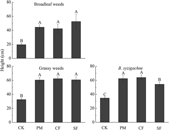
The heights of both the broadleaf and grassy weeds and B. syzigachne in the wheat fields under different fertilization regimens are presented in Figure 3. Because there was no significant effect of climatic factors on the heights of grassy (P = 0.557) and broadleaf (P = 0.105) weeds and B. syzigachne (P = 0.094), the data were averaged over both years. However, as seen with wheat (Figure 1), the grassy and broadleaf weeds, in particular, were shorter in the nonfertilized CK treatment than in all the fertilized treatments (PM, CF, and SF; Figure 3), indicating that nutrients were limiting resources for weed growth in the rice–wheat rotation system. When nutrients shifted from poor to rich, as occurred for the PM, CF, and SF treatments (Table 1), the broadleaf and grassy weeds were similar in height, but the height of B. syzigachne was less responsive to the SF treatment than the other fertilizer treatments.
Height of broadleaf weeds, grassy weeds, and Beckmannia syzigachne in wheat fields under different fertilization regimens. CF, chemical fertilizer; CK, control; PM, composted pig manure + chemical fertilizer; SF, rice straw + chemical fertilizer. Bars indicate mean values ± standard deviations. Bars with different letters are significantly different at P < 0.05.

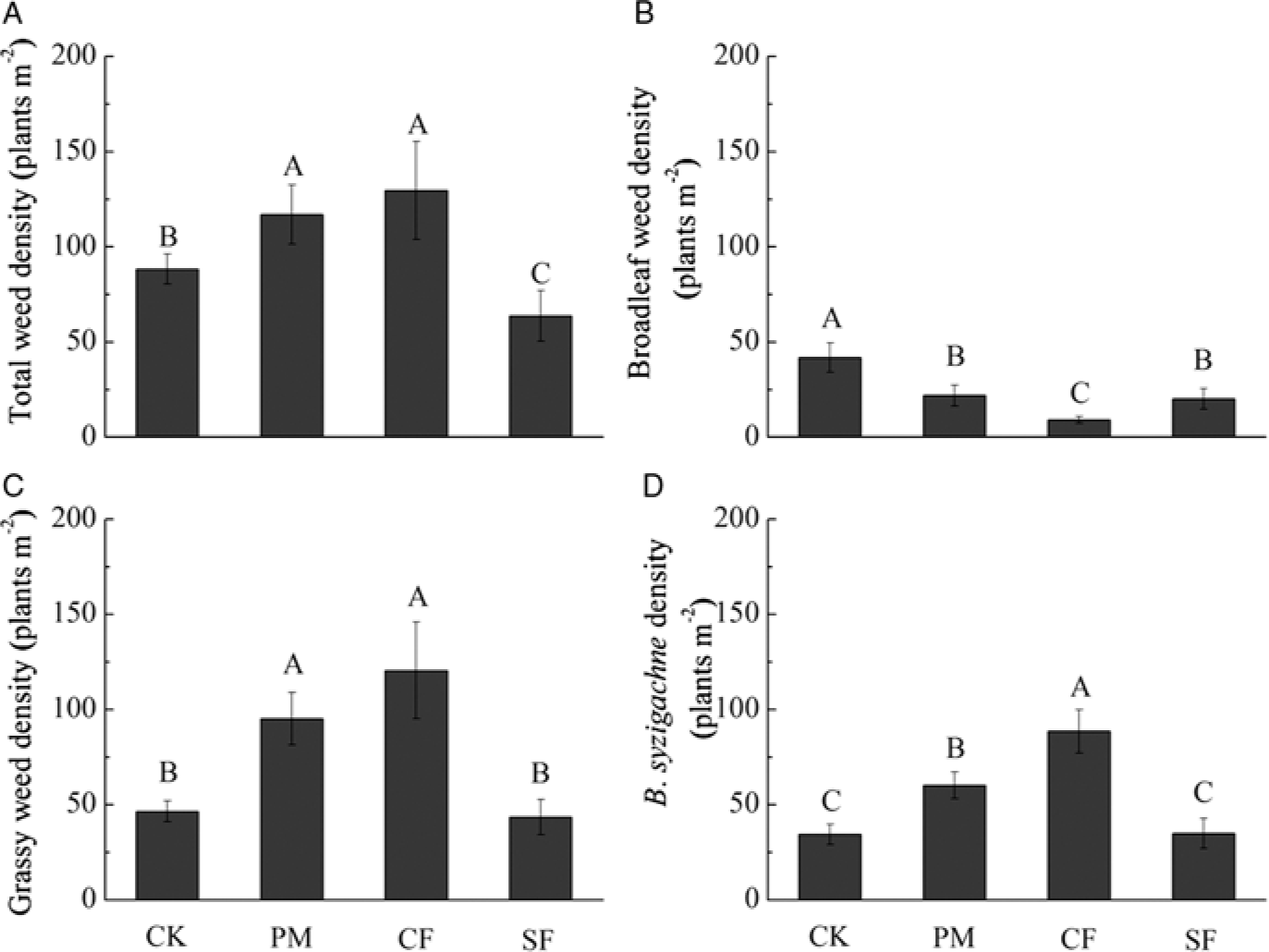
Although significant effects from climatic factors on total weed and grassy weed density were detected, because there was no significant year by fertilizer interaction, the effect of fertilization regimen was averaged over both years. Fertilization regimen significantly affected the density of total, grassy, and broadleaf weeds (Figure 4). Compared with results for the CK treatment, total weed density was higher with the PM and CF treatments but lower with the SF treatment. The increased weed density in the PM might have been caused by weed seeds contained in the applied composted pig manure (Mt Pleasant and Schlather Reference Mt Pleasant and Schlather1994; Tompkins et al. Reference Tompkins, Chaw and Abiola1998). However, there are other studies that suggest that the use of composted pig manure is unlikely to increase weed seedbank abundance, modify seed viability, or affect weed seedling emergence (Menalled et al. Reference Menalled, Kohler, Buhler and Liebman2005). Several studies have reported that the composting process itself can reduce weed seed viability (Eghball and Lesoing Reference Eghball and Lesoing2000; Grundy et al. Reference Grundy, Green and Lennartsson1998; Tompkins et al. Reference Tompkins, Chaw and Abiola1998). All fertilizer treatments significantly reduced the density of broadleaf weeds, but the density of broadleaf weeds was lowest in the CF treatment. The reduction in broadleaf weed density was consistent with the reduced number of broadleaf weed species (Table 3), indicating that application of chemical fertilizers with or without composted manure or rice straw reduced the broadleaf weed diversity.
Density of total weeds (A), broadleaf weeds (B), grassy weeds (C), and Beckmannia syzigachne (D) in wheat fields under different fertilization regimens. CF, chemical fertilizer; CK, control; PM, composted pig manure + chemical fertilizer; SF, rice straw + chemical fertilizer. Bars indicate mean values ± SDs. Bars with different letters are significantly different at P < 0.05.

The grassy weed community in all treatments was dominated by B. syzigachne, and thus densities of both B. syzigachne alone and all grassy weeds were significantly lower in the CK and SF than in the PM and CF treatments (Figure 4C and D). In particular, application of chemical fertilizer only without compost or straw return resulted in the highest infestation of B. syzigachne (Figure 4D). To our knowledge, the occurrence and extent of damage from B. syzigachne was common in the wheat fields of the study region. Because B. syzigachne may be a herbicide-resistant weed (Li et al. Reference Li, Luo and Wang2017), its suppression by means of fertilizer management may prove to be an important method for the integrated management of this species. It has been reported that rice-straw mulching reduced the occurrence of Benghal dayflower (Commelina benghalensis L.) in forage sorghum [Sorghum bicolor Moench × Sorghum sudanense (Piper) Stapf.], forage millet (Pennisetum americanum L.), and finger millet [Eleusine coracana (L.) Gaertn] (Correia et al. Reference Correia, Durigan and Klink2005); extracts of wheat and rice straw have been reported as suppressing the seedling growth of flixweed [Descurainia sophia (L.) Webb ex Prantl] and wild oat (Avena fatua L.) in a rape (Brassica napus L.) field (Sun et al. Reference Sun, Mu and Hu2014). The low density and height of B. syzigachne in SF treatment (straw return with same levels of chemical fertilizers as in CF treatment) implied that returning rice straw to the soil may have inhibited the growth of B. syzigachne. The influence of environmental factors, including temperature, moisture, salinity, and seed placement on both seed germination and seedling emergence of B. syzigachne has been studied (Rao et al. Reference Rao, Dong, Li and Zhang2008), but the effect of rice straw has not been reported thus far.
Relationships between the distribution of weed flora and fertilizer resource cactors
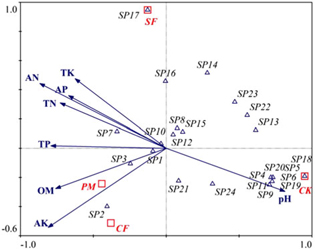
CCA was used to analyze the distribution of weeds (the RA of the weed species) and the soil nutrient indices under different treatments. The Monte Carlo test for both the first canonical axis and overall was significant (P = 0.002, F = 2.327). Therefore, the null hypothesis was rejected, and it was concluded that the weed species were not distributed randomly but were significantly correlated with fertilizer source and pH variables (Figure 5). Alopecurus japonicus (SP3) and A. aequalis (SP2) at high density in the PM and CF treatments were positively correlated with organic matter and available potassium; G. aparine (SP7) at high density in the SF and PM treatments was positively correlated with total N, total P, total K, available N, and available P; hardgrass [Sclerochloa dura (L.) Beauv.] (SP4), P. fugax (SP5), P. annua (SP6), horseweed (Erigeron canadensis L.) (SP9), Asian mazus [Mazus japonicus (Thunb.) O. Kuntze] (SP11), G. malvinensis (SP18), and E. annuus (SP19) presence in the CK treatment was positively correlated with pH, and this presence was higher in the CK treatment than in the other treatments; B. syzigachne (SP1), H. lyrata (SP8), M. aquaticum (SP10), C. monnieri (SP12), Carolina geranium (Geranium carolinianum L.) (SP15), wild carrot (Daucus carota L.) (SP21), and cucumber herb [Trigonotis peduncularis (Trev.) Benth. ex Baker et Moore.] (SP24) occurred in the center of the two-dimensional plots, meaning that they occurred regardless of fertilizer treatment. Species such as common nipplewort (Lapsana apogonoides Maxim.) (SP13), pale smartweed [Persicaria lapathifolia (L.) Delarbre] (SP14), shepherd’s-purse (Capsella bursa-pastoris Medik.) (SP16), common vetch (Vicia sativa L.) (SP22), and water speedwell (Veronica anagallis-aquatica L.) (SP23) in all treatments were not sensitive to soil resource factors. Our survey also showed that G. aparine grew well in the fertilized plots and was taller than wheat, while V. sativa and G. carolinianum grew well in the CK plots, indicating that various microsites in the field favored different weed species. By climbing into more favorable light conditions, G. aparine grew well under higher soil fertility by internode elongation, whereas the heights of V. sativa and G. carolinianum increased to acquire light under limited nutrient conditions (Tang et al. Reference Tang, Cheng, Wan, Li, Wang, Tao, Pan, Xie and Chen2014). Different fertilizer treatments altered the soil organic matter, nutrients, and pH (Table 1), while dynamic changes in nutrients in time and space may also have caused variation in weed distribution, composition, and quantity (Table 3; Figure 4), as reported previously (Fried et al. Reference Fried, Norton and Reboud2008; Pinke et al. Reference Pinke, Karácsony, Czúcz, Botta-Dukát and Lengyel2012). However, in other rotation systems, the effect of fertilizer treatments on weed occurrence might differ from results reported in this study. For example, thymeleaf sandwort (Arenaria serpyllifolia L.), blue mustard [Chorispora tenella (Pall.) DC.], wallflower mustard (Erysimum cheiranthoides L.), and Persian speedwell (Veronica persica Poir.) were best adapted to nitrogen, phosphorus, and potassium deficiencies or balanced treatments in the wheat fields of a corn (Zea mays L.)–wheat rotation system (Yin et al. Reference Yin, Cai and Zhong2005).
Canonical correspondence analysis of different fertilization regimens and the distribution of the weed community. AK, available K; AN, available N; AP, available P; OM, organic matter; TK, total K; TN, total N; TP, total P. pH values are the same as those in Table 1. Arrows, related to soil nutrient factors; squares, related to different fertilization treatments; triangles, related to weed species. SP1–SP24 are the weeds listed in Table 3. CK (control), PM (composted pig manure + chemical fertilizer), CF (chemical fertilizer), and SF (rice straw + chemical fertilizer) are presented here as nominal variables.

Weed community biodiversity
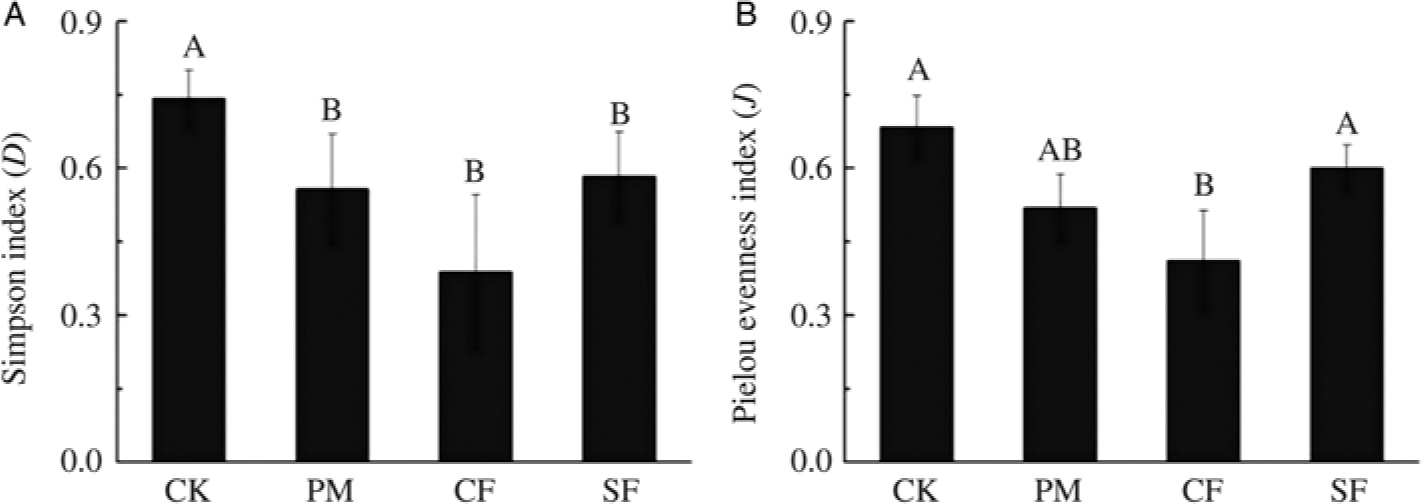
The Simpson indices (D) and Pielou evenness indices (J) in the wheat fields under different fertilization regimens averaged over both years are presented in Figure 6. Compared with the control (CK), application of fertilizers (PM, CF, and SF treatments) reduced the Simpson index. However, only the CF treatment resulted in a lower Pielou evenness index than the CK treatment (Figure 6). All three fertilizer treatments resulted in a significant decrease in broadleaf weed species (Table 3; Figure 2A), which is in accordance with the decreased Simpson indices indicative of lower biodiversity. In addition, compared with results for the CK treatment, the weed vegetation in the CF treatment was predominantly composed of a few species, such as B. syzigachne (Figure 4), consistent with the lower Simpson and Pielou evenness indices, which indicate high dominance, low biodiversity, and low community evenness. Our results suggest that the negative impact of chemical fertilizers on weed diversity could be remediated by returning rice straw to the soil and provide new information from a rice–wheat rotation on the effects of soil amendments on agricultural weed infestation, which is relevant to no-till and organic cropping systems (Albrecht Reference Albrecht2005; Anderson Reference Anderson2015).
Weed species diversity (A) assessed using the Simpson index (D) and weed species distribution (B) assessed with the Pielou evenness index (J) in wheat fields under different fertilization regimens. CF, chemical fertilizer; CK, control; PM, composted pig manure + chemical fertilizer; SF, rice straw + chemical fertilizer. Bars indicate mean values ± SDs. Bars with different letters are significantly different at P < 0.05.

Although all fertilizer treatments resulted in higher wheat yields than the CK treatment, fertilizer application also resulted lower weed community diversity. This effect was most apparent with the CF treatment, which also exhibited the lowest weed species evenness. Our results show that the high infestation of grassy weeds and the dominant species B. syzigachne that occurred with the application of the CF treatment were reduced by the incorporation of rice straw into the soil. The improvement in weed suppression with less adverse effect on evenness seen with the SF treatment may be due to the high C:N ratio of the rice straw temporarily immobilizing nitrogen and thus affecting weed germination and growth of nitrophilous species.
Author ORCID
Guojun Sun, https://orcid.org/0000-0002-7215-5162
Acknowledgments
We thank Bernal E. Valverde (Tropical Agriculture Research and Development, Costa Rica), who helped modify the paper, and Pinglei Gao (Nanjing Agricultural University, China), who helped analyze the data. This work was supported by the Special Fund for Agro-scientific Research in the Public Interest (201103004) and the Independent Innovation Project of Agricultural Science & Technology of Jiangsu Province [CX(14)4044]. No conflicts of interest have been declared.