Introduction
The crucifer flea beetle, Phyllotreta cruciferae (Goeze) (Coleoptera: Chrysomelidae), is native to Eurasia and was first documented in North America in the early 20th century (Milliron Reference Milliron1953). It is a serious pest of commercially important brassicaceous plants including Brassica napus Linnaeus and Brassica rapa Linnaeus (Brassicaceae) in Eurasia, India, and North America (Burgess Reference Burgess1977; CABI 1982). Canola (primarily B. napus) is an important seasonal crop in North America (Dosdall and Mason Reference Dosdall and Mason2010), occupying some 7.7 million ha of production over six ecoregions in 2013 (Canola Council of Canada 2014), and constitutes the major host of P. cruciferae in western Canada.
Although its congener, Phyllotreta striolata (Fabricius), is regionally dominant in the Peace Lowland and Boreal Transition ecoregions of western Canada, and apparently growing in prevalence (Soroka et al. Reference Soroka, Otani and Cárcamo2008) potentially due in part to its lesser susceptibility to commercial neonicotinoid seed treatments (Tansey et al. Reference Tansey, Dosdall, Keddie and Sarfraz2008, Reference Tansey, Dosdall and Keddie2009), P. cruciferae remains the prevalent pest of seedling canola in north-western North America (Soroka et al. Reference Soroka, Otani and Cárcamo2008). Flea beetle feeding damage to cotyledons and stems can cause significant seedling mortality (Westdal and Romanow Reference Westdal and Romanow1972). Moderate feeding can delay plant development and reduce yield (Lamb Reference Lamb1984).
The crucifer flea beetle is univoltine in much of its naturalised North American range (Westdal and Romanow Reference Westdal and Romanow1972). Adults overwinter in shelterbelts and wooded areas. Emergence of overwintered adults peaks in spring when soil temperatures reach 15°C (Ulmer and Dosdall Reference Ulmer and Dosdall2006), and coincides with germination of canola crops in much of its naturalised North American range (Burgess Reference Burgess1977; Wylie Reference Wylie1979). Although oviposition can begin as early as mid-May, eggs are usually laid in the soil near host plant stems in June and early July (Westdal and Romanow Reference Westdal and Romanow1972; Wylie Reference Wylie1979). The three larval instars feed on root hairs and roots of host plants, and pupation occurs in the soil (Feeny et al. Reference Feeny, Paauwe and Demong1970; Burgess Reference Burgess1977). Emergence of the new generation of adults occurs in late summer (Westdal and Romanow Reference Westdal and Romanow1972; Ulmer and Dosdall Reference Ulmer and Dosdall2006). Pod-feeding by the new generation of adults can further damage crops (Knodel and Olson Reference Knodel and Olson2002).
This beetle moves from overwintering sites to crops in the spring by hopping, walking, or short flights (Knodel and Olson Reference Knodel and Olson2002). Traps baited with allyl-isothiocyanate captured more P. cruciferae when conditions were warm and dry (Toshova et al. Reference Toshova, Csonka, Subchev and Tóth2009). A negative correlation of beetle captures with wind speed has been documented (Lamb Reference Lamb1983). Cool, rainy, and windy conditions concentrate populations and damage on field margins whereas warm, dry, and calm conditions are associated with greater damage throughout fields (Knodel and Olson Reference Knodel and Olson2002).
In the current study, we quantify the effects of specific weather parameters on P. cruciferae capture heights (as a proxy indicator of flight behaviour) and discuss the implications of these effects on crop invasion and applications for this information to integrated pest management (IPM) strategies. Results of this study will contribute much to our understanding of and ability to predict responses of P. cruciferae to weather factors. This understanding will allow more appropriate and therefore efficacious use of foliar insecticides to limit damage to brassicaceous crops.
Methods and materials
Study sites and experimental design
A trapping study using yellow plastic bowls (15 cm in diameter and 9 cm deep), half-filled with propylene glycol (Tansey et al. Reference Tansey, Dosdall, Keddie and Blake2012) was used to capture beetles throughout three growing seasons at four sites. Traps were set between B. napus fields and shelterbelts near Lethbridge, Alberta, Canada (49.6916, −112.7584) in 2007, near Lethbridge, Alberta, Canada (49.6856, −112.7462) in 2008, near St. Albert, Alberta, Canada (53.6944, −113.6273) and near Saskatoon, Saskatchewan, Canada (52.1602, −106.5762) in 2010. Traps were set at heights of 1.0, 2.0, 3.0, 4.0, 5.0, and 6.0 m in 2007 and 0.2, 1.0, 2.0, 3.0, 4.0, 5.0, and 6.0 m in 2008 and 2010. Bowl traps were set in metal brackets mounted to a metal poles at heights of 0.2–3.0 m. Bowl traps at heights of 4, 5, and 6 m were set in metal brackets; each bracket was fastened to a braded cable, run through a pulley at the top of the pole (Tansey et al. Reference Tansey, Dosdall, Keddie and Blake2012). Each trap height was replicated four times on individual poles; poles were separated by 8 m. Trapping arrays were 10 m from and parallel to a Populus Linnaeus (Salicaceae) species-dominated shelterbelt on the field’s western edge in 2007, 5 m from and parallel to the field’s southern edge and bordered by a grassy berm in 2008, contiguous with a Populus species-dominated shelterbelt near St. Albert and 10 m from and parallel to the western edge of a Picea Dietrich (Pinaceae) species-dominated shelterbelt near Saskatoon. Beetles were collected from traps approximately weekly from 15 June to 10 August 2007 near Lethbridge, 13 May to 27 August 2008, and 14 May to 26 August 2010 near St. Albert, and 27 May to 14 October 2010 near Saskatoon. Trapped flea beetles were identified according to Fauske (Reference Fauske2006).
Weather data
Weather data consisting of mean, maximum, and minimum weekly temperatures (°C), relative humidity (%), wind speed (km/hour), precipitation (mm), and atmospheric pressure (kPa) were obtained from the Environment Canada Lethbridge A (49.6189, −112.8), Namaio A (53.6667, −113.4667), and Diefenbaker International A (52.1667, −106.7167) weather stations (Anonymous 2010). Environment Canada weather stations are installed according to World Meteorological Organisation guidelines: temperature and relative humidity sensors are ~1.25 m above the ground; Environment Canada anemometers are installed at 10 m (Oke Reference Oke2006). Weather data were collected within 10 km from study sites. Because of relatively close proximity to study sites and great similarities in topography, elevation, and vegetation, data from climate stations were considered to reasonably represent conditions at the study sites. Environment Canada weather measurements for the Saskatoon site were supplemented with on-site data.
Data analysis
All analyses were conducted with SAS version 9.1 (SAS Instituite 2008). A peak in capture numbers in July to early August indicates emergence of the summer generation (Ulmer and Dosdall Reference Ulmer and Dosdall2006); therefore effects of generation and site were evaluated. Evaluation of the differences in capture heights among sites and between generations were evaluated by analysis of variance with the SAS Mixed procedure. Capture data used for evaluations of site and generation effects were corrected for differences in the numbers of days between the collections of samples. Therefore, weekly capture data were analysed as beetles per day rather than beetles per week. All factors were considered fixed. Differences in the distributions of data associated with specific factors were found. Mean, maximum, and minimum and the ranges of temperature, relative humidity, and wind speed and the ranges of atmospheric pressure and precipitation were normally distributed. Mean, maximum, and minimum atmospheric pressure and precipitation were Poisson-distributed. Capture heights of individual beetles were used to evaluate relationships of capture heights and atmospheric parameters. Relationships of normally distributed data and capture heights were evaluated using a stepwise multiple regression analysis: the SAS reg procedure with the “selection=stepwise” statement. Relationships of Poisson-distributed data and capture heights were evaluated using a multiple regression model specifying a Poisson distribution (SAS proc Genmod). When significant relationships between factors and capture heights were found to be significant, contributions of each factor to the model were evaluated using the deviance R 2:
 $$R^{2} _{{DEV}} =\left[ {\log L\left( M \right){\minus}\log L\left( 0 \right)} \right]/\left[ {\log L\left( S \right){\minus}\log L\left( 0 \right)} \right]$$
where logL(M), logL(0), and logL(S) are the maximised log likelihoods for the fitted, null, and saturated models, respectively (Shtatland et al. Reference Shtatland, Moore and Barton2000). R 2DEV is used to compare log-likelihood gain associated with the fitted model relative to the null model with potential log-likelihood gain; therefore, this comparison can be considered a measure of goodness-of-fit (Shtatland et al. Reference Shtatland, Moore and Barton2000).
Results
Greatest numbers of P. cruciferae were captured at all sites except St. Albert late summer (Fig. 1). These results are consistent with prior reports of emergence of the new generation of adults in univoltine populations of P. cruciferae in temperate regions (Wylie Reference Wylie1979; Lamb Reference Lamb1983; Ulmer and Dosdall Reference Ulmer and Dosdall2006; Toshova et al. Reference Toshova, Csonka, Subchev and Tóth2009). A significant effect of site was detected (F=11.37; df=3, 31; P<0.001). Capture heights at Lethbridge 2007 were significantly higher than for the other sites (P<0.05 for all comparisons). Capture heights at the other sites were comparable (P>0.05 for all comparisons). No effect of beetle generation (P>0.05) on capture heights or interaction of generation and site were detected (P>0.05). Results of multiple regression analysis of effects of mean, maximum, minimum, and the range of temperatures (°C), relative humidity (%), and wind speed (km/h) on capture heights at all sites indicated significant effects of mean temperature (Fig. 2), minimum relative humidity and mean wind speed (P<0.05 for all) (Table 1). However, the partial R 2 associated with each factor indicated a much greater contribution to the model by mean temperature (partial R 2=0.651) than minimum relative humidity (partial R 2=0.067) or mean wind speed (partial R 2=0.033) (Table 1); effects of other factors were not significant (at α=0.05). Neither the ranges of atmospheric pressures (kPa) nor precipitation (mm) were related to capture heights (P>0.05 for both). Model results suggest a lowest mean temperature for beetle flight of ~15°C.
Mean Phyllotreta cruciferae per trap per day by sampling date from approximately weekly trapping samples taken at each of four study sites. Lethbridge 2007: n=446. Lethbridge 2008: n=625. St. Albert 2010: n=32. Saskatoon 2010: n=26.

Relationship of mean temperature (°C) to Phyllotreta cruciferae capture heights from sample sites in Alberta, Canada in 2007, 2008, and 2010 and Saskatchewan, Canada in 2010.
Models developed by multiple regression analysis to assess the contribution of weather parameters on Phyllotreta cruciferae capture heights.

Analysis of variance indicated no interaction of site and temperature (F=0.24; df=3, 31; P=0.867), site and minimum relative humidity (F=0.62; df=3, 31; P=0.609) or interaction of site and wind speed (F=0.89; df=3, 31; P=0.458). However, multiple regression analysis of the Lethbridge 2008 site data indicated significant effects of mean temperature and minimum relative humidity on capture heights (F=66.43; R 2=0.826; P<0.001 and F=12.06; R 2=0.084; P=0.004, respectively). Mean temperature was the only influential factor detected in analysis of Lethbridge 2007, Saskatoon, and St. Albert capture heights (F=11.42; R 2=0.620; P=0.012, F=26.61; R 2=0.792; P=0.001 and F=8.86; R 2=0.596; P=0.025, respectively). Mean wind speed and mean atmospheric pressure were negatively correlated (Spearman correlation coefficient=−0.342; P=0.033).
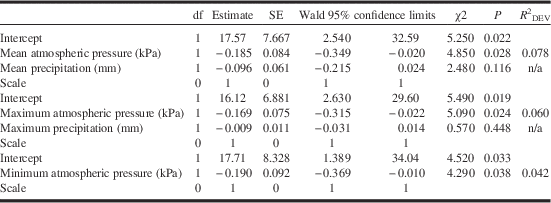
Of the Poisson-distributed factors mean atmospheric pressure (kPa) and mean precipitation (mm), multiple regression analyses indicated a significant relationship between mean (P=0.028; R 2DEV=0.078), maximum, and minimum (P<0.05 for both) atmospheric pressure and capture height (Table 2). No relationships between weekly mean, maximum, and minimum precipitation associated with these site-years were detected (P>0.05 for all) (Table 2). No effects of mean, maximum, or minimum atmospheric pressure or precipitation were detected when sites were examined individually (P>0.05 for all assessments).
Models developed by multiple regression analysis to assess the contribution of Poisson distributed weather parameters on Phyllotreta cruciferae capture heights.
Note: Minimum precipitation was “0” for all sampling intervals, therefore was not included.
Discussion
Our results indicate that mean temperature, minimum relative humidity, mean wind speed, and mean, minimum, and maximum atmospheric pressure influence P. cruciferae capture heights. These results support previous reports that P. cruciferae is influenced by ambient temperature (Lamb Reference Lamb1983) and relative humidity (Toshova et al. Reference Toshova, Csonka, Subchev and Tóth2009), and provide new evidence that capture height is also affected by wind speed, and atmospheric pressure. The greatest contribution to models was associated with mean temperature; this factor explained ~65% of the variability in P. cruciferae capture heights detected in these trials. The contributions of the other factors, while significant, accounted for relatively little of the variability in capture heights.
Beetles were captured at significantly greater heights at the Lethbridge, 2007 site; the lowest traps set at this site were 1 m. Because traps were also set at 0.2 m at the other sites, this difference in capture heights can be attributed to the difference in trap deployment. A lack of significant difference in capture heights among Lethbridge 2008, St. Albert, and Saskatoon sites and no significant interaction between Site and Generation when all sites were evaluated support this conclusion. Greatest numbers of P. cruciferae were captured at all sites except St. Albert in late summer. These results are associated with emergence of the new generation of adults and are consistent with prior reports (Lamb Reference Lamb1983; Ulmer and Dosdall Reference Ulmer and Dosdall2006; Toshova et al. Reference Toshova, Csonka, Subchev and Tóth2009). We found that the effect of mean temperature on capture heights did not differ by beetle generation. Importantly, P. cruciferae can be multivolitine in parts of its naturalised range in North America (Kinoshita et al. Reference Kinoshita, Svec, Harris and McEwen1979). The effect of beetle generation on responses of P. cruciferae to weather conditions for these populations is unknown. Although the effect of maximum temperature was not determined to significantly influence capture heights, beetles were captured at heights greater than minimum only when maximum temperatures exceeded 15 °C. This observation suggests that 15 °C is an important threshold for P. cruciferae flight. According to our linear model of the relationship between capture heights and mean temperatures, captures at 1 m coincided with mean temperatures of 15 °C and increased linearly with mean temperature. Emergence of spring generation P. cruciferae coincided with mean soil temperatures of 15 °C (Ulmer and Dosdall Reference Ulmer and Dosdall2006). Lamb (Reference Lamb1983) reported that beetles flew only when temperatures reached 14 °C.
Weekly minimum relative humidity was also found to be a significant factor influencing P. cruciferae capture heights. Ceutorhynchus obstrictus (Marsham) (Coleoptera: Curculionidae) flight height is also greatest when relative humidity is low (Tansey et al. Reference Tansey, Dosdall, Keddie and Olfert2010). Toshova et al. (Reference Toshova, Csonka, Subchev and Tóth2009) also reported that P. cruciferae captures were negatively correlated to relative humidity. High relative humidity indicates the likelihood of rain. Because rain is associated with mortality of small insects (e.g., C. obstrictus) (Bonnemaison Reference Bonnemaison1957), reduced activity in these conditions is likely adaptive. However, the low partial R 2 associated with the relationship of minimum relative humidity and capture heights and no indication of a significant relationship of precipitation and capture heights indicate the low relative importance of these factors compared with temperature. These results also suggest that effects of often-brief precipitation events were difficult to model when measured against weekly capture data.
The partial R 2 associated with the relationship of mean wind speed model fit in the current study was poor. We initially suspected that the effect of wind speed we detected was an artefact of correlations between this factor and relative humidity and temperature. However, no such correlation was detected. The effect of wind speed, when measured at the resolution provided at weekly sampling intervals, is not considered influential in the current study.
Although associated with relatively low R 2DEV values, a significant negative effect of atmospheric pressure was also detected. In the current study, a significant negative correlation between mean wind speeds and mean atmospheric pressures was detected. Wind speed and atmospheric pressure are related (Wooten Reference Wooten2011). These results suggest that, although temperature is still the dominant factor, an increase in P. cruciferae capture heights with reduced pressure and associated windy conditions occurs. Undirected locomotor activity, including flight, increases in many migratory insects in response to low atmospheric pressure; these changes in behaviour occur in a range of temperatures and humidities indicting that pressure is the driving factor (Wellington Reference Wellington1946). Understanding the effects of atmospheric pressures on P. cruciferae behaviours requires further testing.
Greater P. cruciferae damage to plants on field margins in cool, rainy springtime conditions has been attributed to concentration of beetles in these areas as they invade from overwintering sites (Knodel and Olson Reference Knodel and Olson2002). Relationships between capture heights and temperature indicate that this factor is the most effective predictor of the extent and speed of flea beetle invasion of Brassicaceae crops. Dispersal distances of C. obstrictus are related to flight height (Tansey et al. Reference Tansey, Dosdall, Keddie and Olfert2010) and P. cruciferae dispersal distances are also likely proportional to flight behaviour. However, flight mill studies are required to determine flight duration and rigorous trapping studies are needed to accurately determine effects of weather factors on P. cruciferae field invasion. Effects of minimum relative humidity, wind speed, and atmospheric pressure require further examination. It is important to note that the resolution provided by weekly samples is a potentially limiting factor on their assessment.
Toshova et al. (Reference Toshova, Csonka, Subchev and Tóth2009) reported that the greatest effects of environmental conditions on Phyllotreta species captures were apparent in the late summer in Bulgarian cabbage, Brassica oleracea Linnaeus. However, our results indicate that effects are sustained throughout the growing season. Lamb (Reference Lamb1983) also found that flight continued throughout the growing season. Many mobile phytophagous insects, including P. cruciferae, move actively among host plant patches (Kareiva Reference Kareiva1982). In monocultures of relatively uniform host plants, movement by P. cruciferae continues throughout the growing season (Altieri and Schmidt Reference Altieri and Schmidt1986). Results of the current study are consistent with these reports.
Although regional populations of flea beetle species have fluctuated, the naturalised geographic range of P. cruciferae in western North America has remained relatively static in recent years (Soroka et al. Reference Soroka, Otani and Cárcamo2008). However, concerns regarding the effects of predicted climate changes, particularly warmer, drier springs, on beetle phenology in North America and Europe have been raised (Vänninen et al. Reference Vänninen, Worner, Huusela-Veistola, Tuovinen, Nissinen and Saikkonen2011). Our models, coupled with phenology models (Kinoshita et al. Reference Kinoshita, Svec, Harris and McEwen1979) will also allow for more accurate estimates of invasion patterns at the crop and regional levels by this important pest species. These results should allow for more judicious and efficacious application of foliar-applied chemical controls.
Prophylactic use of neonicotinoid-containing seed dressings, particularly thiamethoxam and clothianidin, has been the dominant means of limiting flea beetle feeding in North American canola producing regions. These dressings are effective at reducing P. cruciferae feeding damage to canola cotyledons (Tansey et al. Reference Tansey, Dosdall, Keddie and Sarfraz2008, Reference Tansey, Dosdall and Keddie2009). However, recent restrictions on the use of clothianidin, imidacloprid, and thiamethoxam in Europe (European Commission 2013), will likely result in greater reliance on foliar-applied chemicals with other modes of action in many crops. Although similar legislation has not yet come into effect for North American jurisdictions, a ban of neonicotinoids in Ontario has been proposed (Ontario Beekeepers Association 2013). Better understanding of the effects of weather on P. cruciferae flight behaviour could contribute much to our understanding of crop invasion and increase the precision and efficacy of foliar applications of insecticides if they become more dominant components of flea beetle IPM strategies. Importantly, IPM strategies should also incorporate dormant seeding in fall (Dosdall and Stevenson Reference Dosdall and Stevenson2005), planting large seeds (Bodnaryk and Lamb Reference Bodnaryk and Lamb1991), increasing plant density, wide row spacing and zero tillage regimes (Dosdall et al. Reference Dosdall, Dolinski, Cowle and Conway1999).
Acknowledgements
The authors are very grateful to Michael Gretzinger, Christina Gretzinger, Jesse Hill, Brett Hoffman, Jordana Hudak, Analea Mauro, and Corielle Walsh for technical assistance. Funding for this research was provided by the Canola Council of Canada and the Government of Canada (Canola Cluster Program), University of Alberta, a grant to L.M.D. from the Natural Sciences and Engineering Research Council of Canada and an Agriculture and Agri-Food Canada personal services contract to J.A.T.