


INTRODUCTION
The criminal prosecution of aviation professionals for errors and mistakes is considered a problematic rising global trend in many national jurisdictions (Reference DekkerDekker, 2011, Reference Dekker2017; Reference Lawrenson and BraithwaiteLawrenson & Braithwaite, 2018; Reference Michaelides-Mateou and MateouMichaelides-Mateou & Mateou, 2010). Scholars have long argued that exposure to criminal legal proceedings is a major deterrent to professionals' reporting of vital safety information and willingness to cooperate with aviation safety investigations (Reference DekkerDekker, 2010; Reference SchubertSchubert, 2004). Serious issues concerning legitimacy, trust, and ethical responsibility arise if information reported in the interest of safety is subsequently used to hold aviation professionals legally accountable (Reference DekkerDekker, 2007, Reference Dekker2017). This practice is referred to as “blame culture,” in which deterrence for unacceptable behavior is sought through punitive means and retributive ends, often through different levels of law and legality (Reference PellegrinoPellegrino, 2019; Reference ReasonReason, 1997). A recent newspaper article exemplifies this phenomenon of criminalization and “the finger of blame” being pointed at a licensed aircraft maintenance engineer who fought an eight-year legal battle against being held accountable for an air accident, the Helios flight 522 aircraft crash in 2005 (The Guardian, September 19, 2020). The article explains how the certifying engineer and three others, including the chief pilot, were found guilty in a Greek court of the manslaughter by negligence of 121 people. The engineer, found not guilty on appeal, describes how “the experience of being held accountable for a tragedy that was part human error, part design flaw” will never leave him.
One of five key sub-components of safety culture,Footnote 1 “just culture” was conceptually devised in safety science to facilitate open reporting in safety management systems, negate the negative effects of blame culture and legal proceedings, and provide “a more nuanced approach to culpability” for human errors while avoiding a purely “no-blame” culture (Reference HodgesHodges, 2015; Reference Cromie and BottCromie & Bott, 2016, p. 258; see Reference ReasonReason, 1997, Reference Reason2000; Reference DekkerDekker, 2007, Reference Dekker2012, Reference Dekker2017). The basic premise of a just culture is to help people willingly report safety information beyond fear of legal consequences (Reference DekkerDekker, 2017, p. 6) and to balance safety with accountability by building a culture of trust and learning (Reference DekkerDekker, 2017, p. ix). Just culture is a legal concept in the EU legal order since 2010 (Reference PellegrinoPellegrino, 2019, pp. 54–56; see Reference HodgesHodges, 2015, p. 594) and is defined under Art. 2(12) of EU Regulation No. 376/2014 on the reporting, analysis, and follow-up of occurrences in civil aviationFootnote 2 (OJ L 122, 24.4.2014, pp. 18–43):
‘just culture’ means a culture in which front-line operators or other persons are not punished for actions, omissions or decisions taken by them that are commensurate with their experience and training, but in which gross negligence, willful violations and destructive acts are not tolerated.
A problem of assumed legitimacy?
Despite EU law's embrace of just culture, safety research continues to highlight a broader underlying tension between blame culture and its legacy of retribution, and just culture and its promise of fairness (see Reference Bükeç and GeredeBükeç & Gerede, 2017; Reference PellegrinoPellegrino, 2019). In particular, “retributive just culture” programs are problematized for assuming “a priori legitimacy” of existing rules. Retributive just culture means approaches to justice that primarily seek to find out who was responsible for wrongdoing and how to deal with such persons rather than asking what was responsible and how to fix that problem. Scholars, therefore, promote just culture policies that are attentive to the merits of procedural justice that outline “legitimate processes for determining rule-breaches, offer protections for the accused and governs who should make such determinations” (Reference Dekker and BreakeyDekker & Breakey, 2016, p. 189–190). Procedural justice is a theory which claims that perceived fair treatment by legal authorities enhances legitimacy and promotes compliance behavior with “manifest implications for public policy” (Reference Nagin and TelepNagin & Telep, 2017, p. 9). Against this backdrop and the trend of criminalizing aviation professionals, procedural justice-focused sociolegal research in the field of civil aviation is timely and relevant. However, there remains a gap concerning empirical studies that explore aviation professionals' perceptions of procedural justice and legitimacy in the context of regulated occurrence reporting and just culture policies.
A case study of European licensed aircraft maintenance engineers
Through a comparative survey-based study of European licensed aircraft maintenance engineers, “LAMEs,” (see Reference Hampson, Junor and GregsonHampson et al., 2012) working as certifying staff in the commercial air transport (CAT) sector of Norway, Portugal, and Sweden, this article addresses these gaps and explores the relationship between occurrence reporting and just culture, both as EU regulated requirements and as applied policy in aircraft maintenance organizations operating in these countries. Drawing on Tylerian theory and related scholarship, which distinguishes between instrumental and normative perspectives of procedural justice and legitimacy, the research applies correlation and regression analysis to examine if certifying LAMEs working in these three countries experience occurrence reporting as procedurally just processes and if, by extension, these experiences enhance legitimacy perceptions of EU/EASA rules and levels of regulatory authority (Reference TylerTyler, 2006a; see Reference Karanikas and ChionisKaranikas & Chionis, 2017). To address if noncompliance with regulated reporting requirements is a continuing consequence of blame culture, the study examines if “legal anxiety” continues to instrumentally affect professionals' safety reporting behaviors (Reference Langer and BraithwaiteLanger & Braithwaite, 2016, p. 987; see Reference GeredeGerede, 2015a, Reference Gerede2015b). Legal anxiety is defined here as apprehension experienced by aviation professionals when submitting reports and concerns about legal accountability for submitted reports as a consequence of blame culture, perpetuated by fear of actual and potential legal consequences. Given that previous research has suggested 30%–40% of aircraft maintenance personnel regularly deviate from official procedures and rules, this research helps to better understand, from a bottom-up perspective, the dynamics between aviation professionals, legal regulations, and compliance in a highly regulated risk and safety-critical EU sector (Reference Dekker and BreakeyDekker & Breakey, 2016; Reference McDonald, Corrigan, Daly and CromieMcDonald et al., 2000; Reference Tsagkas, Nathanael and MarmarasTsagkas et al., 2014; Reference Ward, McDonald, Morrison, Gaynor and NugentWard et al., 2010). Bottom-up focused sociolegal research focuses on what and/or how people experience law in “their everyday relationships and collective activities” (Banakar, 2019, p. 4). Ultimately, the main aim of the article is to explore if just culture, as procedural justice-infused legal interventions framing aviation organizational policy in Europe, negates legal anxiety to uniformly bring about observable changes in the occurrence reporting behaviors of European aviation professionals. The research was guided by this question;
How can the relationship between law and safety be understood from European licensed aircraft maintenance engineers' perceptions of regulated occurrence reporting and just culture as procedurally just processes?
BACKGROUND: A CHANGING REGULATORY ENVIRONMENT IN EU CIVIL AVIATION
From reactive to proactive safety through safety management systems
Traditionally, the aviation sector has managed accidents and errors through a reactive approach to safety that relies on enforcing adherence to rules and regulations (Reference Hodges and GardnerHodges & Gardner, 2014). However, as Fitzgerald has noted, regulating safety requires more than learning from past aircraft accidents but “involves taking intelligent and proactive steps to avoid an accident” (Reference FitzgeraldFitzgerald, 2012, p. 8). Accordingly, international commercial aviation has evolved from reactive approaches to safety reliant on accident investigation toward more proactive approaches highlighting accident prevention as the key priority for managing risk and safety (Reference Cusick, Cortes and RodriguesCusick et al., 2017). This shift toward proactive safety is manifest in international aviation through the 2013 adoption by the International Civil Aviation Organization (ICAO) of Annex 19 (to the Convention on International Civil Aviation) and related Standards and Recommended Practices (SARPs) for Safety Management Systems (SMS). Annex 19 requires that the Safety Management Systems (SMS) implemented by aviation service providers, such as commercial airlines, must be in agreement with the state safety programs (SSP) developed, implemented, and enforced by the legislators and national aviation authorities (NAAs) of ICAO member states (ICAO, 2020a, 2020b, 2020c). In short, SMS is part of a broader international strategy to construct and embrace a performance-based regulatory environment in aviation (Reference Ulfvengren and CorriganUlfvengren & Corrigan, 2015, p. 220). In line with this strategy and to meet international requirements for SMS, the EU (although not a sovereign state) has adopted a proactive approach to safety that moves away from a prescriptive, compliance-based (command and control) approach toward a performance-based (purpose-oriented) approach to aviation regulation. In other words, from law as “regulation” to law as “safety management” (EASA, 2019a; EASA, 2020a; Reference HodgesHodges, 2015, pp. 585–588; Reference Hodges and SteinholtzHodges & Steinholtz, 2017, p. 67; Reference Kringen, Bieder and BourrierKringen, 2013, p. 208).
Occurrence reporting and just culture: SMS ensured in aircraft maintenance?
Occurrence reporting is a key component of SMS for the European Aviation Safety Programme and, since 2015, is regulated through Regulation (EU) 376/2014 (EPAS, 2015, p. 26; EASA, 2019a; cf. Reference Pérezgonzález, McDonald and SmithPérezgonzález et al., 2005). The European Union Aviation Safety Agency (EASA) outlines that a main objective of Regulation (EU) 376/2014 is the application and enhancement of just culture to “ensure continued availability of safety information” (EASA, 2019b). More specifically, this implies that NAAs and aviation organizations in EU/EASA member states are obliged under Art. 16 (11–13) of Regulation (EU) 376/2014 to adopt internal rules aspiring to just culture principles in managing occurrence reporting systems. Member states are further obliged to designate a body to monitor just culture implementation to ensure acceptable and uniform compliance with EU/EASA regulatory requirements (OJ L 122, 24.4.2014, pp. 35–37; EASA, 2019b). As Pellegrino highlights:
/…/despite the introduction of a legal definition of ‘just culture’, the European legislature did not introduce new safety regulatory requirements for the implementation of this culture, but it only confined itself to monitor the implementation (Reference PellegrinoPellegrino, 2019, p. 61).Footnote 3
Scholars have suggested that despite sought-after uniformity regarding the application of Regulation (EU) 376/2014, differences in the application of just culture exist (Reference HodgesHodges, 2015, p. 596; Reference PellegrinoPellegrino, 2019). While NAAs are identified in scholarship as key actors with the capacity to eliminate such problems from European aviation, these state authorities are also identified as contributors to problems of poor just culture implementation, not least concerning aircraft maintenance (Reference GeredeGerede, 2015b). A European Commission (EC, 2021) evaluation of Regulation (EU) 376/2014 (working document) substantiates these claims and reports significant shortcomings surrounding the legal obligation of some member states to designate a (state) body responsible for ensuring that just culture principles are implemented (EC, 2021, p. 12). However, state safety reports from Sweden, Norway, and Portugal show a general increasing trend in occurrence reporting to authorities since 2015 when Regulation (EU) 376/2014 entered into force (ANAC, 2018; CAAN, 2019; STA, 2019).
To meet the specific requirements of Regulation (EU) 376/2014, approved aircraft maintenance organizations must establish an internal occurrence reporting system as detailed in their “maintenance organization exposition” (MOE) (OJ L362, 17.12.2014, p. 74). This “means the document or documents that contain the material specifying the scope of work deemed to constitute approval and showing how the organization intends to comply with this Annex (Part-145)” (OJ L362, 17.12.2014, p. 75). Organizations are also legally obliged to establish a continuation training program to ensure certifying staff have up-to-date knowledge of regulatory requirements, company procedures, and human factors (OJ L362, 17.12.2014, p. 70; Reference Sulocki and CartierSulocki & Cartier, 2003).
Reviewed literature
There is a large body of literature concerning safety culture in aviation across various fields of scholarship with a shared focus on SMS (Reference Atak and KingmaAtak & Kingma, 2011; Reference Cusick, Cortes and RodriguesCusick et al., 2017; Reference Ek, Akselsson, Arvidsson and JohanssonEk et al., 2007; Reference Gordon, Kirwan and PerrinGordon et al., 2007; Reference Langer and BraithwaiteLanger & Braithwaite, 2016; Reference Patankar, Sabin, Maurino and SalasPatankar & Sabin, 2010; Reference SchubertSchubert, 2004; Reference Taylor and ThomasTaylor & Thomas, 2003; Reference Ulfvengren and CorriganUlfvengren & Corrigan, 2015). Aviation safety culture literature on air traffic management/air traffic control (ATM/ATC) discusses uniformity and harmonization regarding the implementation of EU safety rules. These pan-European studies in ATM/ATC claim that safety culture and organizational safety attitudes are associated with national culture and contexts which present challenges to safety culture development and stability. Perceptions of safety culture were found to vary with occupation, particularly concerning occurrence reporting where it is proposed that “industry-tailored” safety culture models can be developed to operate across national boundaries and occupational groups (Reference Kirwan, Reader and ParandKirwan et al., 2019; Reference Reader, Noort, Shorrock and KirwanReader et al., 2015; Reference Tear, Reader, Shorrock and KirwanTear et al., 2016). Aircraft maintenance-focused studies of safety culture and SMS have found that informal work practices and deviations compensate for shortcomings of formal rules and that a professional (sub)culture, which extends beyond site, and national context, affects the safety behavior of aircraft engineers who commonly demonstrate strong positive safety attitudes (Reference McDonald, Corrigan, Daly and CromieMcDonald et al., 2000, Reference McDonald, Corrigan and Ward2002; Reference Pettersen and AasePettersen & Aase, 2008; Reference Pettersen, McDonald and EngenPettersen et al., 2010).
Scholarly literature has long addressed just culture in aviation and covers several fields of research: legal scholarship (Reference KaupatKaupat, 2013; Reference PellegrinoPellegrino, 2019; Reference SchubertSchubert, 2004), sociolegal scholarship (Reference HodgesHodges, 2015; Reference Hodges and SteinholtzHodges & Steinholtz, 2017; Reference Woodlock and HydénWoodlock & Hydén, 2020), and safety science (Reference DekkerDekker, 2007, Reference Dekker2009, Reference Dekker2017; Reference McMurtrie and MolesworthMcMurtrie & Molesworth, 2018; Reference ReasonReason, 1997). Aircraft maintenance-focused just culture scholarship stems from these scholarly fields (Reference Bükeç and GeredeBükeç & Gerede, 2017; Reference Cromie and BottCromie & Bott, 2016; Reference GeredeGerede, 2015a, Reference Gerede2015b; Reference Karanikas and ChionisKaranikas & Chionis, 2017).
For example, Reference GeredeGerede's (2015a, Reference Gerede2015b) studies of a large number of aircraft maintenance organizations in Turkey (a pan-European partner of EASA, PANEP) (see EASA, 2020b), found that SMS involves challenges such as poor safety culture and weak performance by top management (Reference GeredeGerede, 2015a). Poor just culture was found at both the regulation and implementation of SMS (Reference GeredeGerede, 2015b) with the potential to “impair reporting, organizational learning, safety commitment and managing of change” (Reference GeredeGerede, 2015a, p. 238). Adopting punitive approaches to human error was found to negatively affect safety reporting with poor just culture found to reduce the success of SMS, by diminishing trust and decreasing the possibility for voluntary feedback (Reference GeredeGerede, 2015b).
To examine culpability determination processes within a just culture framework, (Reference Cromie and BottCromie and Bott 2016) surveyed a large sample of personnel in an aircraft maintenance company located at six sites across Europe and North America. Respondents were found to consider just culture principles in their culpability determination, where “who gets to draw the line” was a critical factor. No significant differences were observed in the patterns of response concerning the variables of job role, geographical location, and level of experience. However, initial and final levels of proposed discipline did differ, with North American sites found to be more severe than European (culture), engineers and managers more lenient than operational personnel (job role), and experienced staff more lenient than their juniors (professional experience) (Reference Cromie and BottCromie & Bott, 2016, p. 259). The study concluded that there is a need for (global) exploration of the interaction between local, national, and just cultures concerning regulated SMS (Reference Cromie and BottCromie & Bott, 2016, p. 272).
Reference Karanikas and ChionisKaranikas and Chionis' (2017) survey-based research explored military aviation employee perceptions of the punitive and preventative actions that management of a large aviation organization can take in the face of errors and violations (Reference Karanikas and ChionisKaranikas & Chionis, 2017, p. 174). Although the employees shared the same nationality, statistically significant differences were observed across occupationally specialized groups (pilots, ATC staff, and technicians) regarding “the appropriateness of specific measures especially in the case of errors.” Moreover, differences were also found concerning years of experience (Reference Karanikas and ChionisKaranikas & Chionis, 2017, p. 183). Their findings suggest that a just culture process can be successfully established to deal with these issues but must embrace a “bottom-up” approach that is acceptable to employees and open to revision (Reference Karanikas and ChionisKaranikas & Chionis, 2017, p. 174).
As part of a broader discussion on “new” aviation safety management, Reference Bükeç and GeredeBükeç and Gerede (2017) explored discipline systems and their effect on just culture in seven large aircraft maintenance organizations in Turkey. Adopting a “top-down” management-focused approach, using interviews with maintenance, human resources, and quality and safety managers, they found that discipline systems were used preventatively for both errors and violations. They found that organizational managers resort to punishment measures to deter unsafe behaviors, with most agreeing that disciplinary rules and punishment are necessary, and some claiming that Turkish national culture necessitates disciplinary procedures (Reference Bükeç and GeredeBükeç & Gerede, 2017, p. 191). They found a relationship between the discipline system and just culture of an organization, with participants remarking that an organizational discipline system affects perceptions of justice (Reference Bükeç and GeredeBükeç & Gerede, 2017, p. 191).
The scholarship reviewed here points to a need for exploring bottom-up approaches to just culture in aircraft maintenance which considers years of experience, geographical location, and recognizes occupational variance. It also illuminates how research has associated punitive/retributive just culture applications and the continuance of blame culture practices with national cultures. Of significance to the study here is that previous research has reported that aircraft maintenance is a sector within which violations of standards, rules, and procedures are commonplace among maintenance staff (Reference Hodges and GardnerHodges & Gardner, 2014, pp. 6–7; Reference Reason and HobbsReason & Hobbs, 2003; Reference Tsagkas, Nathanael and MarmarasTsagkas et al., 2014; Reference Ward, McDonald, Morrison, Gaynor and NugentWard et al., 2010, pp. 249–250); blame culture continues to be a problematic phenomenon that can hinder open reporting of errors (Reference GeredeGerede, 2015a, Reference Gerede2015b; see also Reference ReasonReason, 1990, Reference Reason1997); procedural justice approaches to human error are considered beneficial for open reporting (Reference DekkerDekker, 2017; Reference Dekker and BreakeyDekker & Breakey, 2016); and education and training are paramount for effective reporting systems (Reference Sulocki and CartierSulocki & Cartier, 2003; Reference Ward, McDonald, Morrison, Gaynor and NugentWard et al., 2010, p. 265;). Important to point out is that many scholars champion just culture as a solution to blame culture and criminalization of error (Reference HodgesHodges, 2015; Reference Kováčová, Licu and BálintKováčová et al., 2019; Reference McCall and PruchnickiMcCall & Pruchnicki, 2017), with others scholars more critical to the interaction between law, safety, and just culture (Reference DekkerDekker, 2017; Reference SchubertSchubert, 2004).
PROCEDURAL JUSTICE AND LEGITIMACY: THEORY AND REVIEW
The theory underpinning procedural justice approaches to regulation is that legitimacy perceptions are based on judgments that legal authorities, such as the courts, police, or regulatory agencies, act fairly when dealing with the public (Reference TankebeTankebe, 2009, p. 1267; see Reference Leventhal, Gergen, Greenberg and WillisLeventhal, 1980, p. 16). Of interest to this paper is Tyler's theoretical approach, which focuses on how people react to personal experiences with legal authorities and the impact these experiences have on views of the legitimacy of legal authorities and the rules they enforce. According to Tyler:
The extent to which people define the fairness of a procedure by using aspects of the procedure that are related and unrelated to its outcome reflects the influence of instrumental and normative aspects of experience on their judgements of whether they have received a fair procedure (Reference TylerTyler, 2006b, p. 7).
Based on a relational model of authority (Reference Tyler, Lind and ZannaTyler & Lind, 1992) and related group-value model (Reference Lind and TylerLind & Tyler, 1988), a normative perspective of procedural justice understands that people concern themselves less with the favorability of outcomes than with aspects of experience such as neutrality, respectful treatment, voice, trust, trustworthiness, and genuine attempts to be fair and unbiased (Reference TylerTyler, 2006b, p. 7). An instrumental explanation of procedural justice is rooted in the control theory of Reference Thibaut and WalkerThibaut and Walker (1975), which argues that people do not focus directly on the fairness of outcomes but more on the amount of influence they can exert over third-party decisions and receiving fair outcomes. In other words, indirect control can produce desired fair outcomes (Reference TylerTyler, 2006b, p. 7). However, questions addressing the importance of perceived fairness “necessitate a clearer definition of the theoretical boundaries of the analysis of fairness” (Reference Leventhal, Gergen, Greenberg and WillisLeventhal, 1980, p. 34).
Van den Bos outlines other key scholarly explanations of procedural fairness or “fair process effect.” The social influence explanation offers that people's positive or negative reactions due to fair or unfair process effects may be influenced through social comparison of other people's opinions about the equity of outcome distribution. The referent cognition explanation theorizes that reactions to procedural justice, not least when a procedural rule is broken, rely on counterfactual thoughts where people evaluate what has happened by mentally comparing with what might have happened. The uncertainty explanation is concerned with equity theory and how people evaluate outcome fairness as a question of social comparison information with the received outcomes of others (see Reference Van den Bos, Greenberg and ColquittVan den Bos, 2005, p. 282–292).
Legitimacy
In the eyes of the public, legitimacy is a key precondition for the effectiveness of legal authorities and a necessary factor for ensuring compliance with laws. Accordingly, observable changes in legitimacy will affect the level to which people comply with laws framing their everyday lives (Reference TylerTyler, 2006b, p. 5; see also Reference MurphyMurphy, 2009; Reference Murphy, Hinds and FlemingMurphy et al., 2008; Reference TankebeTankebe, 2009, Reference Tankebe2013). Commonly regarded as “the normative factor of greatest concern to authorities” (Reference TylerTyler, 2006a, p. 161), legitimacy means “a property of an authority or institution that leads people to feel that that authority or institution is entitled to be deferred to and obeyed” (Reference Murphy, Hinds and FlemingMurphy et al., 2008, p. 137; Reference Sunshine and TylerSunshine & Tyler, 2003). In procedural justice scholarship, perceptions of legitimacy are expressed as obligation to obey and/or as support for law and legal authority. Obligation to obey is more commonly deployed in research as the most direct measure of public perceptions of legitimacy. Scholars note, however, that the capacity of legal authorities to perform their duties is highly dependent on levels of public support (Reference SaratSarat, 1975, pp. 3–4; Reference TylerTyler, 2006b, p. 48; Reference TankebeTankebe, 2013), with obedience less likely if the public does not support the law (Reference TylerTyler, 2006b, p. 26).
The procedural justice literature focusing on legitimacy in relation to law is expansive and is currently dominated by research on policing and law enforcement with the effect of procedurally just treatment on citizens' compliance with the law is well established (see Reference Barkworth and MurphyBarkworth & Murphy, 2015; Reference Jackson, Bradford, Hough, Myhill, Quinton and TylerJackson et al., 2012; Reference Mazerolle, Antrobus, Bennett and TylerMazerolle et al., 2013; Reference Nagin and TelepNagin & Telep, 2017; Reference TylerTyler, 2011). This literature includes numerous survey-based studies demonstrating that procedural justice can predict legitimacy and encourage voluntary compliance with the rules and directives of legal authorities (see Reference Murphy, Hinds and FlemingMurphy et al., 2008; Reference Sunshine and TylerSunshine & Tyler, 2003; Reference TylerTyler, 1990). Of key interest to this article is that criminological scholars have illuminated how few studies beyond a policing context have directly tested the relationship between procedurally just treatment and legal compliance, when manipulated by actual policy (Reference Nagin and TelepNagin & Telep, 2017; see Reference Mazerolle, Antrobus, Bennett and TylerMazerolle et al., 2013), or adequately demonstrated if associations between perceived procedural justice and legitimacy reflect a causal relationship in which policy changes, which are effective in changing “actual procedurally just treatment” by legal authorities, bring about observable changes in “legal compliance and perceived legitimacy” (Reference Nagin and TelepNagin & Telep, 2017, p. 5).
This paper approaches EU/EASA-regulated occurrence reporting and just culture through the lens of Tylerian theory. This is because procedural justice, as a more accommodative approach to law, is understood to underpin just culture as a legal concept in EU law. From its emergence, the terms “fair” and “just” were proposed to describe the spirit in which laws should be applied to safety (Reference SchubertSchubert, 2004, p. 63). Because treating reporters of safety information fairly and justly defines the spirit that law should be applied to safety (Reference SchubertSchubert, 2004), this paper considers that, when adopted into the internal rules of aviation organizations, just culture policies represent prime examples of a procedural justice-infused legal intervention in action. Several sociolegal studies exploring the effects of procedural justice in other fields have shown that regulated actors are more likely to report mistakes, wrongdoing, and errors to authorities (or employers) if they perceive the authority as treating people fairly (Reference Murphy, Tyler and CurtisMurphy et al., 2009; see Reference Lind and TylerLind & Tyler, 1988; see also Reference MurphyMurphy, 2016). While just culture policies aim to positively affect aviation professionals' compliance behaviors with regulated reporting requirements (See recital 33 of Regulation (EU) No. 376/2014), procedural justice theory predicts that these policies may also serve to enhance the legitimacy of the EU regulatory framework and the authorities and organizations implementing and enforcing these rules.
METHODOLOGY
Hypotheses
Three hypotheses were tested in this study where legitimacy, the dependent variable, was operationalized as support for regulatory authorities and rules. Based on findings from previous studies that have comprehensively demonstrated the effect of procedural justice on perceived legitimacy (Reference Murphy, Tyler and CurtisMurphy et al., 2009; Reference Sunshine and TylerSunshine & Tyler, 2003; Reference TankebeTankebe, 2009; Reference TylerTyler, 2006a), this study predicts that perceived procedurally just treatment for occurrence reporting will positively enhance legitimacy perceived as support for regulatory authorities and rules. It is also predicted that employer education on the (EU) rules and authority will positively affect perceived legitimacy, as previous research highlights the importance of education and training for effective safety reporting systems (see Reference Sulocki and CartierSulocki & Cartier, 2003; Reference Ward, McDonald, Morrison, Gaynor and NugentWard et al., 2010). Finally, the study predicts that perceived procedural justice will have a greater meaningful influence on normative perceptions of legitimacy, measured as support for the authorities and rules, than instrumental judgments such as legal anxiety. As Tyler argues, the social value of normative influences is vital so people will “voluntarily act against their own self-interest” (Reference TylerTyler, 2006b, p. 24). Scholars argue that aviation professionals value just culture as a fair process with the potential to negate fears of organizational blame culture and retribution or punishment through law (see Reference Cromie and BottCromie & Bott, 2016; Reference Dekker and BreakeyDekker & Breakey, 2016; Reference SchubertSchubert, 2004; cf. Reference Bükeç and GeredeBükeç & Gerede, 2017).
Participants and procedure
The current study presents the data and results of a survey conducted in 2019 which was distributed among certifying licensed aircraft maintenance engineers working in the European commercial air transport sector (CAT) in Sweden, Norway, and Portugal, all of which are EASA member states (N = 187) but Norway not an EU Member State. Previous research in a European aviation context has reported differences in safety culture between Northern and Southern regions of the EU (see Reference Reader, Noort, Shorrock and KirwanReader et al., 2015). These selected countries are also interesting from a sociolegal perspective where trust in law and legal authority has been found to be high in the Nordic states but lower in Portugal (ESS, 2011). Certifying licensed aircraft maintenance engineers are highly qualified maintenance personnel who legally certify the release of aircraft into service following performed maintenance (AEI, 2020; Reference YadavYadav, 2010). Only participants who are currently working as certifying staff in Part-145 approved aircraft maintenance organizations in the selected countries were randomly sampled through professional associations affiliated with Aircraft Engineers International (AEI),Footnote 4 the main sampling frame for the research. A questionnaire was pretested at a medium-sized aircraft maintenance organization in Sweden. Following analysis of the test study responses and feedback, some items were reformulated and the questionnaire shortened. Pretest study respondents were excluded from participation in the main survey.
Using a survey program, a weblink to the main survey was distributed by three gatekeepers to their respective members via email, with three reminders sent throughout the four-month survey period. No respondents' personal data or email addresses were handled by the researcher, with all returned questionnaires anonymously received. The total population who received the survey link was approximated to 1211 (Norway, N = 384, Portugal, N = 262; Sweden, N = 565). The final full sample for these countries was 227 returned survey responses, equating to a response rate of 19%. The survey program showed that all who started the survey completed and submitted responses.
In the final sample, 95.6% of those who wished to state their gender were male.Footnote 5 This was expected as this profession is known to be male-dominated (Reference Newcomer, Clark, Button and WeilandNewcomer et al., 2018). Beyond gender, no personal data were gathered (such as age or salary). Demographic/professional data were collected on the country of employment, type of employing aviation organization, years of experience as certifying LAME, and the number of aircraft type rating qualifications. The language of the survey was English with almost 80% of respondents having no problems answering the questionnaire (cf. Reference Drury, Ma and MarinDrury et al., 2009). From the final sample, 83% reported working in the (airline/passenger) CAT sector.
An extracted sample for CAT (N = 187) was found to be evenly distributed for each country—Portugal (N = 61), Norway (N = 64), and Sweden (N = 62). The response rate from other aviation maintenance sectorsFootnote 6 was low and the data found to be poorly distributed in each country sample. Therefore, only the data from the extracted CAT sample(s) is analyzed and discussed in this paper. Most CAT respondents were well-experienced multiple type-rated LAMEs with almost 60% having more than five aircraft types on their aircraft maintenance license and 50% having more than 20 years of experience as an LAME. It is noteworthy that only 20% of respondents indicated working 10 years or less as a certifying LAME.
Questionnaire design
The survey contained 32 questions and Likert scale-based items on occurrence reporting and just culture, with five demographic and professional information variables (see Reference de Vausde Vaus, 2014).Footnote 7 Items were included to measure general perceptions of occurrence reporting and just culture, such as interpersonal communication between LAMEs before and after submission of safety reports. The survey design included three scales made up of items seeking to tap procedural justice, obligation to obey, and support for legal authority and rules. These scales were largely based on Tylerian scholarship (the Chicago study) but were modified and adapted to the context of aircraft maintenance and EU civil aviation regulation (see Reference Sunshine and TylerSunshine & Tyler, 2003; Reference TylerTyler, 2006a). The scale items were also selected and formulated to correspond with previous scholarship on safety culture, just culture, and occurrence reporting within the pan-European context of aviation (see Reference Bükeç and GeredeBükeç & Gerede, 2017; Reference Cromie and BottCromie & Bott, 2016; Reference McDonald, Corrigan, Daly and CromieMcDonald et al., 2000, Reference McDonald, Corrigan and Ward2002; Reference Reader, Noort, Shorrock and KirwanReader et al., 2015). Two other scales were constructed to measure employer education on EU/EASA regulation (control) and, legal anxiety for occurrence reporting (instrumental judgment) (cf. Reference SaratSarat, 1993).Footnote 8 Using the extracted sample for CAT (the combined data for Portugal, Sweden, and Norway), a principal components factor analysis (PCA) was first carried out to test for conceptual differentiation between 22 of the nondemographic variable items used prior to constructing the five scales. Table A7 in Appendix A displays the item loadings and the five-factor components. Only one variable loaded onto two factors but conceptually seemed to fit Factor 5.
Procedural justice
Procedural justice was measured using five variables adapted from previous procedural justice scholarship (Reference Barkworth and MurphyBarkworth & Murphy, 2015, Reference Murphy, Hinds and FlemingMurphy et al., 2008, Reference Murphy, Tyler and Curtis2009, Reference TylerTyler, 1988, Reference Tyler2006a; cf. Reference SaratSarat, 1975). Included were items known to tap procedural justice: voice (1 item), trustworthiness (2 items), neutrality (1 item), and respectful treatment (1 item). As an example, “My current employing organization always provides feedback within a reasonable timeframe for reported occurrences” measured respectful treatment. Previous aircraft maintenance research has suggested that showing appreciation to reporters involves the provision of timely and regular feedback (see Reference Ward, McDonald, Morrison, Gaynor and NugentWard et al., 2010, p. 265). All items were measured on a five-point scale ranging from strongly disagree to strongly agree, with higher scores indicating a greater likelihood that occurrence reporting is experienced as a procedurally just process.
Two constructs of legitimacy
As two known aspects of the same underlying construct of legitimacy, separate scales for obligation to obey and support for rules/authority were constructed (Reference TylerTyler, 2006a). The scale for support for legal authority and regulations included five items adapted from Reference TylerTyler (2006b), and Reference SaratSarat (1975), modified to fit the aviation context of this study. Three of the items tapped satisfaction with formal (hard law) and applied (soft law) regulation to capture EU, national, and organizational levels of regulation and authority, measured on a five-point scale ranging from very dissatisfied to very satisfied. Two items tapped LAME appreciation of the EU/EASA regulations and perceived effectiveness of NAAs, known indicators of support for the rules and regulatory enforcement by an authority (see Reference TylerTyler, 2006b, pp. 46–56; see also Reference Murphy, Tyler and CurtisMurphy et al., 2009). An example item was “The national aviation authority do a good job for the regulatory control of the aircraft maintenance sector in my current country of employment.” These items were measured on a five-point scale ranging from strongly disagree to strongly agree with higher scores indicating stronger support and if found reliable, greater perceived legitimacy of the rules/authority.
The obligation to obey scale included four items measured on a five-point scale ranging from strongly disagree to strongly agree, adapted from Tylerian scholarship, also modified to fit the aviation context of this study (see Reference TylerTyler, 2006b, p. 46; see also Reference MurphyMurphy, 2004; Reference Murphy, Hinds and FlemingMurphy et al., 2008, Reference Murphy, Tyler and Curtis2009; Reference Sunshine and TylerSunshine & Tyler, 2003; Reference TankebeTankebe, 2009, Reference Tankebe2013). An example item was “A certifying licensed aircraft maintenance engineer should always comply with the regulatory requirements even if they go against what she/he thinks is right.” Higher scores indicating stronger sense of obligation to obey regulatory authority and rules, and if reliable, greater perceived legitimacy (see Reference Jackson, Bradford, Hough, Myhill, Quinton and TylerJackson et al., 2012).
In this study, legitimacy was operationalized only as support for rules/authority with obligation to obey not found to be a reliable construct of legitimacy in this context.
Employer education
Previous research highlights the importance of education and maintenance training for safety reporting systems and knowledge of regulations and procedures (Reference Sulocki and CartierSulocki & Cartier, 2003, p. 325; Reference Ward, McDonald, Morrison, Gaynor and NugentWard et al., 2010, p. 265). A four-item index was constructed to measure employer education received on the EU/EASA regulations for aircraft maintenance, organizational procedures (MOE), requirements for human factors and safety training, and occurrence reporting. All items were measured on a five-point scale ranging from strongly disagree to strongly agree. Higher scores indicate a higher level of education and strong competence on the rules/authority.
Legal anxiety
Previous research problematizes fear of legal consequences as a hindrance to safety reporting (Reference DekkerDekker, 2007; Reference Dekker and BreakeyDekker & Breakey, 2016; Reference McCall and PruchnickiMcCall & Pruchnicki, 2017; Reference ReasonReason, 1997) and identifies aircraft maintenance as a sector where blame culture exists and has lower reporting rates than other aviation sectors (Reference Cromie and BottCromie & Bott, 2016; Reference GeredeGerede, 2015a, Reference Gerede2015b; Reference Langer and BraithwaiteLanger & Braithwaite, 2016, p. 987). A fifth scale was constructed to measure legal anxiety about occurrence reporting. Three items measured apprehension when writing occurrence reports due to potential legal consequences for oneself, other LAMEs, or one's employer. A fourth item measured worry about legal accountability when submitting reports. All items were measured on a four-point scale ranging from never to always with higher scores indicating a higher level of legal anxiety related to occurrence reporting.
Expected outcome fairness
Two variables independently explored expected outcome fairness (see Reference Van den Bos, Greenberg and ColquittVan den Bos, 2005, p. 277); that LAMEs who report errors should always be treated justly by their employer and that employers should not punish LAMEs who report violations.
ANALYSIS AND RESULTS
Univariate analysis
The gathered survey data were examined and analyzed using SPSS software. Univariate analysis showed that the majority of LAME respondents from each country agreed that the EU/EASA regulation for occurrence reporting is commonly appreciated as positive for safety improvement in the maintenance sector of their country of employment; 87% of Portuguese respondents were positive to this rule, slightly higher than for Sweden and Norway at approximately 70%. Moreover, 44% of Norwegian LAMEs indicated that they frequently to very frequently discuss among themselves before submitting occurrence reports, compared with 29% of Portuguese and Swedish respondents. 45% of the Portuguese LAMEs and 33% of Swedish respondents answered that LAMEs never or rarely discuss feedback received for submitted reports, significantly higher than the 12.5% observed for Norwegian LAMEs. Between 80% and 90% of respondents across the three samples indicated that their employer has an official just culture policy.
This was considered a positive result from a compliance perspective because it suggests that maintenance organizations across all three jurisdictions meet European regulatory requirements for occurrence reporting. It is noteworthy that 10% of Swedish and Portuguese LAMEs reported not knowing if their employer has a just culture policy. Yet despite these encouraging findings, 34% of Portuguese LAMEs answered that they never use the occurrence reporting system, a result that is 11 times higher than Swedish or Norwegian respondents (3%). Significant differences were also observed concerning responses on the use of employer reporting systems with 72% of Norwegian LAMEs reporting occasional to frequent use of the employer's reporting system, compared with 47.5% for Swedish respondents and only 20% for the Portuguese LAMEs, a figure more than three and half times lower than for Norway.
There was a remarkable concordance across the three samples in respondents' expectations of outcome fairness. Between 92% and 97% of all LAME respondents agreed/strongly agreed that their employer should always treat certifying staff justly for reporting their errors. Similarly, 31% of respondents from each country agreed that their employer should never punish LAMEs for reported violations. However, Swedish respondents differed noticeably concerning nonpunitive approaches for reported violations with only 29.5% strongly agreeing compared with 52% and 53% for Portuguese and Norwegian respondents, respectively.
Survey participants were also given three options and asked to rank them according to the most, second-most, and least significant reason for why they report occurrences—professional duty to uphold safety, duty to obey legal requirements, or fear of legal consequences for not reporting. Based on previous safety scholarly arguments, it was expected that fear of legal consequences for not reporting would be the most significant. However, across all three country-based samples, a professional duty to uphold safety was found to be the most significant reason for reporting occurrences. Duty to comply with legal requirements was commonly ranked as the second-most significant reason, with fear of legal consequences for not reporting found to be the least significant reason (see Table 1).
Comparison of reason for LAME reporting safety occurrences (ranked)

Bivariate correlations
The correlations between the five indexes are shown in Table 2, including the Cronbach's alpha coefficient for each scale. All alpha coefficients were satisfactory except for obligation to obey, which was lower than 0.7 for the Portuguese, Norwegian, and combined CAT samples. For the combined European CAT sample, support for authority/rules was found to be the most significant correlate of procedural justice (r = 0.488, p < 0.01). Perceived obligation to obey was, in comparison, a weak correlate of procedural justice (r = 0.193. p = <0.05). However, it was also a weak correlate of support for rules/authority (r = 0.252, p < 0.01), a finding which replicates Tyler's Chicago study findings (see Reference TylerTyler, 2006b, p. 47). Put differently, LAME respondents differentiated between a perceived obligation to obey and support for the rules/authority, which was found to be a more reliable measure of legitimacy to operationalize in this aviation context. Employer education was found to be a moderate but statistically significantly correlate of procedural justice (r = 0.381, p < 0.01) and of support for rules/authority (r = 0.351, p < 0.01) but a weaker correlate of obligation to obey (r = 0.213, p < 0.01). Given the extensive safety scholarship discussed above, a surprising finding was that legal anxiety was not found, in this context, to be significantly correlated with any of the other indexes.
Bivariate correlations (Pearson) between the procedural justice, obligation to obey, support for authority and rules (legitimacy), employer education, and legal anxiety scales including Cronbach alpha coefficients

Note: Cronbach Alpha coefficients in parentheses. *Correlation is significant at the 0.05 level (two-tailed). **Correlation is significant at the 0.01 level (two-tailed).
The correlations between the different scales were also analyzed to explore similarities and differences across the country-based samples. For Portuguese LAME respondents, support for rules/authority was found to be significantly correlated with procedural justice (r = 0.440, p < 0.01), employer education (r = 0.376, p < 0.01), and obligation to obey (r = 0.331, p < 0.05). For Norwegian LAME respondents, procedural justice was found to be moderately but significantly correlated with support for the rules/authority (r = 0.379, p < 0.01). Legal anxiety was found to be significantly but negatively correlated with procedural justice (r = −0.264, p < 0.05), the only country sample showing this significant association. For Swedish LAME respondents, legal anxiety was not found to be meaningfully correlated with the other scales. Perceived procedural justice was, however, found to have the strongest correlation with support for the authority/rules in Sweden (r = 0.669, p < 0.01), and moderately correlated with employer education (r = 0.426, p < 0.01). There was also a significant correlation between employer education and support for the rules and authority (r = 0.378, p < 0.01). In the Swedish and Norwegian samples, perceived obligation to obey was not found to be significantly correlated with any of the other indexes. This may be a result of an alpha coefficient below 0.7, or perhaps that the scale measures something distinct from obligation to obey such as perceptions of shared moral values (see Reference Jackson, Bradford, Hough, Myhill, Quinton and TylerJackson et al., 2012, p. 1062). Given that LAMEs also indicated that the primary reason to report occurrences is to uphold safety, obligation to obey was not considered a reliable measure of legitimacy which gives added value to this study.
Hierarchical regression
Support for legal authority and rules, as the most significant measure of legitimacy, was the dependent variable for legitimacy in the regression analysis. Hierarchical multiple regression was used to assess the ability of perceived procedural justice conceptualized as a normative judgment variable, to predict support for legal authority and rules operationalized as perceived legitimacy. Despite the correlation analysis findings, legal anxiety was included in the OLS regression as an instrumental judgment. The results of OLS hierarchical regression models are presented, showing both the findings for the combined European CAT sample (Table 3) and the split samples for each country (Table 4).
Predictors of legitimacy (Support for regulations and authority)

Note: Table shows standardized regression coefficients (β) for predictors. SE in parentheses.
*p < 0.05, **p < 0.001.
Predictors of legitimacy (support for regulations and authority)

Note: Table shows standardized regression coefficients (β) for predictors. SE in parentheses.
*p < 0.05, **p < 0.001.
Model 1 (Table 3) of the OLS regression for the combined CAT sample analyzed the effect of employer education on legitimacy as support for regulations and authority, with a control variable “years of experience as a certifying LAME” also entered (reference category >20 years highly experience). The model explained 12.4% of the variance in perceived legitimacy with employer education found to be a significant predictor (β = 0.349, p < 0.001). Years of experience as an LAME had no meaningful influence and was not found to be a significant predictor in the model (or in Models 2 and 3) (cf. Reference Cromie and BottCromie & Bott, 2016; Reference Karanikas and ChionisKaranikas & Chionis, 2017). When perceived procedural justice was entered into the equation, the variance was 27.3%, F(4, 136) = 12.776, p < 0.001 explaining an additional 15% of the variance in perceived legitimacy, R 2 change = 0.149, F change (1, 136) = 27.824, p < 0.001 and causing the effect of employer education to diminish (β = 0.181, p < 0.05). Perceived procedural justice was found to be the most significant predictor in Model 2 (β = 0.420, p < 0.001). Legal anxiety was next entered into the equation showing a negligible increase in explained variance, F(5, 135) = 10.231, p < 0.001 but not altering the total variance in a meaningful way, R 2 change = 0.002, F change (1, 135) = 0.312, p > 0.05 (p = 0.578). The introduction of legal anxiety saw the effect of employer education increase slightly (β = 0.187, p < 0.05) with perceived procedural justice remaining the predominant predictor variable in Model 3 (β = 0.413, p < 0.001).
Based on the results of the regression analysis for the combined CAT sample, the OLS regression analysis for the country-based samples excluded years of experience as a control variable. As Table 4 shows, Model 1 for all three samples found employer education to be a moderately significant predictor of legitimacy but with varying degrees of statistical significance: Portugal (β = 0.376, p < 0.05), Norway (β = 0.331, p < 0.05), and Sweden (β = 0.378, p < 0.05). For the Portuguese sample, the inclusion of perceived procedural justice in Model 2 saw the variance explained increase to 23.6%, F(2, 34) = 5.251, p ≤ 0.01 explaining an additional 9.4% of the variance in perceived legitimacy, R 2 change = 0.094, F change (1, 34) = 4.202, p < 0.05 and causing the effect of employer education to diminish (β = 0.228, p > 0.05). Although the entry of legal anxiety in Model 3 had no meaningful effect or significance, it saw a slight increase in shared variance with (24.5%) and procedural justice diminishing as a significant predictor of legitimacy. In Model 2, the effect of employer education as a predictor of legitimacy diminished for both the Norwegian and Swedish samples. In Model 3, perceived procedural justice was found to be the sole statistically significant predictor of legitimacy among Norwegian (β = 0.312, p < 0.05) and Swedish LAMEs (β = 0.615, p < 0.001), with procedural justice having the strongest effect on support for the regulatory system in Sweden.
In the Norwegian sample, Model 1 explained 11% of the variance, increasing to 19.3% for Model 2, F (2, 55) = 6.582, p < 0.005. There was no significant increase in variance for Model 3 (19.4%), with the effect of legal anxiety found to be negligible. The Swedish sample differed, with Model 1 explaining 14.3% of the variance in legitimacy but Model 2 explaining all of 45.7% of the variance, F(2, 41) = 17.285, p < 0.001. The inclusion of perceived procedural justice into the equation explained an additional 31.4% of the variance in perceived legitimacy, R 2 change = 0.315, F change (1, 41) = 23.799, p < 0.001. For Model 3, there was only a slight change in variance (45.9%) with perceived procedural justice still the main predictor, and legal anxiety having no meaningful effect or statistical significance.
DISCUSSION
The findings of this study generally support previous studies that demonstrated the effect of procedural justice on perceived legitimacy across different settings (Reference Sunshine and TylerSunshine & Tyler, 2003; Reference TankebeTankebe, 2009; Reference TylerTyler, 2006a). The main finding of this study is that occurrence reporting perceived as a procedurally just process is positively associated with and therefore enhances perceived legitimacy when measured as support for the authorities and regulations among LAMEs working in the European CAT sector. Moreover, the relationship between perceived procedural justice and legitimacy remains significant when perceived legal anxiety is included in the regression model. These results must consider that the greater majority of LAMEs indicated that their employer has a written just culture policy but also that the main reason they report occurrences is to uphold aviation safety. The split samples for Sweden, Portugal, and Norway show that perceived procedural just approaches to occurrence reporting are experienced differently by LAMEs in each country. Procedural justice was most effective in enhancing legitimacy measured as support for the regulatory authorities and regulations among LAMEs in Sweden, to a lesser degree in Norway and diminishes in significance as a predictor of legitimacy in Portugal when legal anxiety is entered into the equation. The discussion that follows here addresses how a normative commitment to safety may explain why obligation to obey was found to be a poor measure of legitimacy in this study. Legal anxiety is also discussed in relation to differentiated experiences of procedurally just culture and to explain why differences in occurrence reporting rates across EU/EASA member states should not be reduced to questions of “national culture” but rather of “legal culture.”
Duty to uphold safety versus duty to obey law: Buttressing legitimacy or legitimacy erosion?
The majority of LAME respondents in this study indicated that the most significant reason for reporting occurrences was a professional duty to uphold aircraft safety. To understand what this means in terms of procedural justice, legitimacy, and compliance, this finding must be understood in relation to the second-most significant reason, that is, LAMEs report or would report occurrences to comply with the regulated obligation to report. Put differently, safety reporting as a felt obligation to comply with formal legal requirements takes second place to a normative commitment among LAMEs to put safety first. This suggests that independent of workplace, organization, and country of employment, a shared socio-professional norm of safety first is influential for decision-making concerning occurrence reporting among these aviation professionals. This result supports previous research, which found evidence of a professional culture in aircraft maintenance involving a shared “strong sense of responsibility for the overall safety of the system” (Reference McDonald, Corrigan and WardMcDonald et al., 2002, p. 199). Technicians were shown to share a common set of values and a shared belief in using professional judgment based on “experience, knowledge, and skill” to perform their work tasks “rather than blindly following” procedures and set standards to perform technical tasks (Reference McDonald, Corrigan and WardMcDonald et al., 2002, p. 199; see Reference McDonald, Corrigan, Daly and CromieMcDonald et al., 2000; Reference Pettersen, McDonald and EngenPettersen et al., 2010).
According to Tylerian theory, people's behavior is “strongly affected by the normative climate created by others” (Reference TylerTyler, 2006b, p. 24). Tyler argues that group influences can place normative pressure on compliance behavior where people turn to the social group for “information about appropriate conduct” (Reference TylerTyler, 2006b, p. 24; See also Reference Tyler, Lind and ZannaTyler & Lind, 1992). Although significant variance was observed between the three country-based samples, most Swedish and Norwegian LAMEs commonly answered that they discuss among themselves both before submitting reports and following received feedback for submitted reports, albeit to varying levels. As a common practice among LAMEs spanning all three countries, this suggests that normative pressure may be mediated through interpersonal communication to exert influence on LAMEs in a way that guides professionally appropriate reporting conduct. McDonald et al. suggest that the professional culture among maintenance engineers serves as a likely mediator between the SMS of an organization and safety outcomes (Reference McDonald, Corrigan, Daly and CromieMcDonald et al., 2000, p. 151).
In the context of the study presented here, it merits asking if these findings mean that rather than assuming “a priori legitimacy for existing rules” (Reference Dekker and BreakeyDekker & Breakey, 2016), “safety first” as an embedded socio-professional value-based norm holds greater legitimacy among European LAMEs as a source of guidance for acceptable professional behavior rather than a perceived obligation to obey rules? If so, does this shared deference to a safety-first norm imply an erosion of legitimacy, as a perceived obligation to obey legally binding formal rules, in a way that undermines compliance? To answer this, it is important to consider the normative constructs of legitimacy and what the LAMEs consider as a legitimate source of guidance for their professional conduct where safety is concerned. As discussed in the introduction, studies have consistently found that 30%–40% of aircraft maintenance personnel regularly deviate from official procedures and rules, and often because they feel the rules are inadequate to meet their needs. This is suggestive of legitimacy erosion if LAMEs do not feel obligated to obey the rules and compensate for inadequate rules through a normative commitment to safety first (Reference McDonald, Corrigan, Daly and CromieMcDonald et al., 2000, Reference McDonald, Corrigan and Ward2002). Does this mean that perceived obligation to obey the law is surplus to requirement in a procedurally just culture where safety as a professional norm guides compliance behavior for reporting?
Studies focused on obligation to obey as a construct of legitimacy are increasingly problematized for failing to provide “compelling” evidence as to the value of legitimacy as a concept for understanding law and legal compliance (Reference TylerTyler, 2006b, p. 38). This critique is mainly rooted in the argument that the entitlement of a legitimate authority to have its directives and rules complied with is not dependent upon the exercise of power to impose an obligation to obey, but because legitimacy is understood to be conferred by the public (Reference Murphy, Hinds and FlemingMurphy et al., 2008, p. 137). This might explain why obligation to obey was generally found to be a poor correlate of procedural justice in this study—it may not be a reliable construct of legitimacy in this context because mandatory reporting obligations in Regulation (EU) 376/2014 are imposed as an exercise of power by the authorities enforcing law.
As an influential force guiding adherence to a norm of safety first, it can be argued that LAMEs collectively confer legitimacy for formal authority through the professional culture alignment with the norm of safety first. Even if LAMEs report primarily in the interest of safety, they are also by default complying with the legal requirements to report where compliance may depend more on a normative commitment to safety than to law. In the face of organizational and structural deficiencies that allow only official forms of action to resolve problems, “The professional culture mediates this providing a normative understanding of how it is appropriate to behave in the context of what the system requires” (Reference McDonald, Corrigan and WardMcDonald et al., 2002, p. 201). Professional culture can, in this sense, be understood to act as a complimentary de facto authority, mediating acceptable and unacceptable safety behavior, while at the same time buttressing the legitimacy of the formal official system as support for the authority/rules, and ensuring compliance behavior, visible as improved reporting rates.
Does legal anxiety affect legitimacy in a procedurally just culture?
As discussed previously, scholarship has shown that 30%–40% of aircraft maintenance staff frequently deviate from formal procedures and rules. These findings also seem to conflict with scholarly claims that fear of legal consequences instrumentally affects compliance to (or not) report occurrences. In this study, most LAMEs answered that fear of legal consequences for not reporting was the least significant reason for reporting safety information. Moreover, the regression analyses show that legal anxiety is not significantly associated with the relationship between procedural justice and legitimacy, (although the inclusion of this variable did see procedural justice diminish in significance among Portuguese LAMEs). In other words, occurrence reporting perceived as a procedurally fair process is more strongly associated with legitimacy than legal anxiety.
When just culture became “law” through EU civil aviation regulation, it did not mean that an accommodative approach to law immediately replaced deterrence as the new philosophy underpinning the administration of justice for wrongdoing in aviation by formal law in different European jurisdictions. It can be argued that deterrence was strengthened by legally defining just culture in EU law where the legal definition in Regulation (EU) 376/2014 outlines how “gross negligence,” “willful violations,” and “destructive acts” are not tolerated. In the wake of just culture juridification in civil aviation through EU law, noncompliance in the form of failing to report mandatory safety obligations may now, following just culture principles and EU legal requirements for reporting, be grounds for criminal legal proceedings in some EU countries (UKCAA, 2020; Reference PellegrinoPellegrino, 2019, p. 60; see Reference KaupatKaupat, 2013).
Already in the early 2000s, legal scholars engaging with safety discussed how, although a fundamental assumption underpinning just culture emergence was the overcoming of legal barriers to building a safety culture, this may depend more on the way law is applied than on the actual formulation of the law. In this sense, a just culture is not only about trying to balance safety and legal interests but also about balancing the various legal interests at stake (Reference SchubertSchubert, 2004, p. 63). This was arguably the case facing the EU, where just culture was elaborated upon “with the intent to resolve a lack of uniformity of the Member States' national laws” following the enactment into the EU regulatory framework of Art. 8(3) of Directive 2003/42/EC on occurrence reporting in civil aviation, subsequently repealed by Regulation (EU) 376/2014 where just culture is currently legally defined (Reference PellegrinoPellegrino, 2019, p. 54). Although just culture is still a relatively recent insertion into EU legislation and the administration of justice is the responsibility of EU/EASA Member States and their legal authorities (and third countries complying with EU regulations), the application of just culture principles and policies rely on national legal frameworks (Reference HodgesHodges, 2015; Reference PellegrinoPellegrino, 2019). Given that just culture emerged as a concept based on critiques of legal interventions in safety matters, it is somewhat ironic that the scope and effect of a just culture intervention in EU and EASA-compliant countries may now rely even more on law and the legal authorities enforcing national applications of EU civil aviation regulation (see Reference PellegrinoPellegrino, 2019).
Although over 60% of LAME respondents in this study indicated that they are satisfied working under EU/EASA regulations and NAA governance, 25% of the Swedish LAMEs and almost 16% of Portuguese respondents indicated that they do not feel that the NAA do a good job in their country of employment. In other words, a significant percentage of the surveyed LAMEs had issues with the authority enforcing the legal rules in their country of employment. It is not surprising then that almost one-fifth of the Swedish and Portuguese respondents also indicated dissatisfaction with their employers' MOE, the operational document approved by their NAA to presume compliance with the law. This also suggests that many LAMEs may have conflictual issues regarding the legitimacy of employer applications of regulated requirements in aircraft maintenance settings. These findings lend support to Gerede's claims that NAAs and organizational management are the key actors undermining just culture implementation by upholding a culture of blame and fear (Reference GeredeGerede, 2015b, pp. 114–115; Reference Dekker and BreakeyDekker & Breakey, 2016).
Safety, national and professional culture: One for all or all for one in a procedurally just culture?
A key finding in this study regarding how national legal frameworks may affect just culture suggests that Portuguese LAMEs differ from their Nordic counterparts where legal anxiety surrounding occurrence reporting is concerned. It is remarkable that although the protection of reporters is considered paramount for applying Regulation (EU) No. 376/2014 to negate such fears,Footnote 9 11 times more Portuguese respondents indicated that they never use their employers occurrence reporting system compared with their Swedish and Norwegian counterparts. It is also remarkable that the Portuguese LAMEs were five and a half times more likely to worry about legal accountability issues when submitting reports than Swedish LAMEs (and four times more likely than Norwegian LAMEs).
Although state issued safety reports from each country show increasing trends in occurrence reporting to authorities in the overall sector, differences between the Nordic states and Portugal are noticeable. A Norwegian aviation safety report for 2019 reports that 9600 occurrences were received by authorities, slightly lower than for 2018, where over 10,000 reports were submitted (CAAN, 2019, p. 11–12). Overall, between 2007 and 2017, occurrence reporting in Norway has increased from 148 to 7424 reports (CAAN, 2021). Similarly, a 2019 Swedish safety report shows that 8900 unique occurrences were submitted in 2019, also lower than 2018 when 9700 reports were received. In the wake of the entry into force of Regulation (EU) No. 376/2014 across Europe, occurrence reports to the authorities have steadily increased in Sweden between 2015 and 2017 (STA, 2019, p. 11–12). A Portuguese annual aviation safety report (statistical yearbook) for 2018 suggests that the authorities received ~4700 reports (estimated from graphical tables in the report), significantly less than the Nordic countries (ANAC, 2018, p. 62). By considering that reporting rates are known to be lower in aircraft maintenance, the LAME reporting differences found in this study reflect similar differences in national reporting rates for these countries.
An EC evaluation report (working document) found that the most significant shortcoming regarding the implementation of Regulation (EU) 376/2014 requirements concerned the obligation laid down for Member States to designate a body responsible for ensuring that just culture principles are implemented. By extension, the EC identified that 11 Member States had “failed to designate a ‘just culture body’ responsible for the implementation of paragraphs 9, 10, and 11 of Article 16” (EC, 2021, pp. 12, 24). It is noteworthy that paragraph 10 of Art. 16 lays down when the protection of the reporter afforded under paragraphs 6, 7, and 9 “shall not apply” (OJ L 122, 24.4.2014, p. 36). The current study makes no inferences about the findings of this evaluation report in relation to the country-based sample findings presented here. More broadly however, it asks what this means for the merits of accommodative approaches to law, experiences of occurrence reporting as procedurally just processes, and the uniform application of the EU regulations? If national authorities are failing to implement the necessary just culture rules, what does this say about legitimacy as support for the authorities and EU/EASA regulations?
According to Reference Van den Bos, Greenberg and ColquittVan den Bos (2005, p. 287–288), the relational explanation of people's perceptions of procedural fairness center around long-term relationships with authorities and groups employing rules, where procedures may reveal relational information exposing what that authority or institution thinks about those receiving the procedure (see Reference Lind and TylerLind & Tyler, 1988; Reference Tyler, Lind and ZannaTyler & Lind, 1992). However, more broadly it can be argued that member state failures to designate a “just culture body” responsible for implementing these procedural rules for occurrence reporting may well communicate to professionals that the NAAs in some countries do not feel obligated to ensure that just culture is applied. It may also reveal what these NAAs think about the receivers of a just culture policy and their needs to have a just culture implemented and monitored as required by EU law.
Tyler's theory supports the notion that the meaning of procedural justice changes as a consequence of the nature of the experiences people (citizens) have with legal authorities and argues that individual actors do not have a singular schema of a fair process applicable to all occasions. He suggests that people “are concerned with different issues under different circumstances” and therefore, it is probable that universally fair procedures that can be generically applied to resolve conflicts and disputes do not exist. Instead, Tyler argues that “different procedures are appropriate under different circumstances” (Reference TylerTyler, 1988, p. 132). By this rationale, he also suggests that “legal authorities are aided in their efforts to resolve public problems by shared cultural values about the meaning of procedural justice within the context of particular situations” (Reference TylerTyler, 1988, p. 132). This is because, in a procedurally just system, people are more concerned that the procedures behind the outcomes are fair and perceived as neutral (e.g., court procedures). They place less focus on the actual outcomes of their legal experiences (Reference TylerTyler, 2006b, pp. 5–6).
Although most LAMEs in this study experienced occurrence reporting and just culture as procedurally just processes, the univariate analysis results show that LAME respondents differ in expectations of outcome fairness for reported errors and violations. Across all three samples, LAMEs overwhelmingly agree that employers should treat people who report their errors justly with the majority of respondents also agreeing that reported violations should never be punished. Yet although 25% more Portuguese and Norwegian respondents strongly agreed compared to their Swedish counterparts, these results demonstrate a commonly shared bottom-up rejection of legal and organizational blame culture and retributive just cultures.
These findings contrast with the top-down study conducted by Bükec and Gerede in Turkey who found that their study participants, managers, considered that disciplinary rules support prescribed rules and standards and have a positive effect on the profession, improving the quality of maintenance and management of safety (Reference Bükeç and GeredeBükeç & Gerede, 2017, p. 191). That Swedish LAMEs, to some degree, differentiate between expected outcome fairness regarding treatment for reported errors and violations suggests that they expect unintentional mistakes to be less punishable than intentional deviations. This is an interesting finding because perceived procedural justice to occurrence reporting had the strongest effect for enhancing legitimacy among the Swedish LAMEs. Given that a key component of procedural justice is trust in law and legal authority, a look at the European Social Survey (ESS) discussed earlier may shed some light on these and other observed differences across the samples. Sweden and Norway are countries where public trust in legal institutions is generally high with Portugal showing significantly lower scores on this issue (see ESS, 2011). Does this imply that LAMEs legal experiences and trust in national legal institutions are reflected in experiences of reporting where trust is also paramount in a just culture?
As discussed above, several ATM-focused studies have uncritically argued that “national culture” is a factor affecting how safety culture is interpreted and applied. Aircraft maintenance studies have suggested that poor just culture in organizations and a desire to punish wrongdoing are associated with national cultural tendencies (Reference Bükeç and GeredeBükeç & Gerede, 2017) and scholars have reported that differences exist between North American and European sites of the same aircraft maintenance organization concerning the severity of levels of proposed discipline (Reference Cromie and BottCromie & Bott, 2016). This article problematizes these claims for being embedded in an essentialist ontology that tries to explain punishment and culpability through ascribed collective identity traits deemed characteristic of national culture and which can determine expectations of justice and safety behaviors. Whereas all LAMEs working in a country may not identify with a single notion of national culture, if at all, all are subject to EU regulations implemented within the national legal framework of the EU/EASA Member State in which they work. Concerning the multilevel regulatory structure in EU civil aviation, where the Member States willingly delegate or share specific functions at the European level, criminal jurisdiction and the system of sanctioning are still dealt with primarily at the national level (Reference PellegrinoPellegrino, 2019, p. 62). In other words, given that this sector is embedded in law and legality, national legal culture may better explain, in a less deterministic manner, variations in safety culture interpretation, culpability determination, and experiences of occurrence reporting and just culture as a procedurally just process. Professional culture, as a complimentary de facto authority serves to buttress legitimacy as support for the authority and rules, where safety first ensures compliant reporting behavior, not least when authorities fall short of meeting their own obligations for their own rules.
CONCLUSION
The research presented in this article was an exploratory venture and the findings should be interpreted within the confines of this study. The research has limitations which need to be discussed. The response rate of the survey was low, but is equivalent to previous studies conducted in this sector (see EASA, 2018; Reference VeritasVeritas, 2007). Limiting the sampling frame to AEI was to ensure representativeness in that only certifying LAMEs could participate. However, given the differential nonresponse of other aviation sectors (see note 6), representativeness is limited to CAT. Although a skewed nonnormal distribution was observed among some variables, the analysis progressed using Pearson correlation given that the data were found to be robust. Although the respondents from the three country-based samples responded in a similar way to the content of some variables, this was interpreted to show that profession-specific commonalities may well affect how individual engineers relate to the subject matter of the research. Future studies might include other maintenance personnel and occupations, such as unlicensed mechanics to provide for greater variance. However, the nonnormal distribution of some variables may be suggestive that the use of Tylerian instruments require a more nuanced approach to accommodate a profession specific public where knowledge of the regulatory framework is a legal requirement.
To the best of my knowledge, no studies to date have empirically explored occurrence reporting and just culture in aviation as questions of procedural justice, legitimacy, and legal anxiety. Therefore, the aim of this sociolegal study was to explore if just culture, as a procedural justice-infused legal intervention for occurrence reporting, enhances the legitimacy of the EU/EASA rules/authority in a way which controverts legal anxiety to improve compliance among European aviation professionals in Sweden, Portugal, and Norway. The findings presented here generally support previous studies which have demonstrated the effect of procedural justice on perceived legitimacy across different regulated settings. The main contribution of the article is to show how, from a broader European perspective, occurrence reporting when perceived as a procedurally just process, enhances perceived legitimacy if measured as support for the regulatory authorities and rules among licensed aircraft maintenance engineers working in the European CAT sector. The article further argues that professional culture defined by a common sectorial normative commitment to safety-first in the social setting of aircraft maintenance can mediate a shared meaning of procedural justice, that can improve compliance and buttress legitimacy to overcome so-called legal barriers to safety. However, more empirical sociolegal research is needed to explore the extent to which professionals' behavior in other safety critical sectors is guided by a normative commitment to safety. Therefore the findings of this research may be significant beyond an aviation context by providing a starting point for future studies to explore law, safety and just culture in other regulated high risk and safety critical sectors.
The study also concludes that occurrence reporting perceived as a procedurally just process is more strongly associated with legitimacy than legal anxiety among licensed aircraft maintenance engineers. A comparative look across the samples for Sweden, Portugal, and Norway showed that procedurally just treatment for occurrence reporting was most effective in enhancing perceived legitimacy (as support for the regulatory authorities and rules) among LAMEs in Sweden and to a slightly lesser degree in Norway. However, perceived procedural just treatment for occurrence reporting among Portuguese respondents was not found to predict legitimacy in a meaningful way when legal anxiety was entered into the equation. This finding must also consider that higher levels of legal anxiety were observed among Portuguese certifying staff with over one third never using the occurrence reporting system.
Yet, as the least significant given for why the respondents report occurrences in all three countries, this finding needs to be further explored in a way that accounts for the sociopolitical and sociolegal contexts of various regulated societal sectors across different countries. Therefore, the article concludes that the promise and effect of just culture as a procedural justice-infused legal intervention varies across different legal jurisdictional settings, with legal meaning most likely determined by national legal cultures and regulatory compliance reliant on a professional cultural normative commitment to safety first.
One implication of the research conducted in this study is that safety scholarship, in the wake of just culture juridification, should engage more with sociolegal scholarship on procedural justice, legitimacy, and compliance to reassess understandings of legal anxiety and noncompliance concerning regulated occurrence reporting. Other sectors such as healthcare, where just culture is promoted and frequently studied, may also benefit from exploring the relationship between legal anxiety and just culture as questions of procedural justice. This is because procedural justice, in a changing regulatory environment, can be integral to ensure a smoother transition from law as regulation to law as safety management where compliance and performance are more contingent than conflictual.
ACKNOWLEDGMENTS
I wish to thank all the participants in this research project. I also extend my gratitude to Associate Professor Ida Nafstad and to Professor Måns Svensson for commenting on an earlier draft of the text. Thanks also to Dr. Nicolas Serrano and Dr. Mimmi Barmark for insightful comments on the survey questionnaire, and to Dr. Peter Bergwall for encouraging comments on the results and tables. I am also thankful to the editors and anonymous reviewers at Law & Society Review for their comments and helpful suggestions on this manuscript. Sincerest thanks to Dr. Cansu Bostan, Dr. Martin Joormann, and Dr. Kadri Kuusk for their collegial support and much valued friendship these past few years. Finally, I wish to pay tribute to the memory of the late Professor Reza Banakar who, for a period, was main supervisor on my doctoral research project but who sadly passed away in 2020.
CONFLICT OF INTEREST
I have no conflicts of interest to disclose and no financial support to declare.
APPENDIX A
Survey questions and items

Scale variables for perceived obligation to obey (normative judgment)

Scale variables for perceived legitimacy (support for legal authority and rules)

Scale variables for perceived procedural justice (normative judgment)

a Respondents who indicated that they have never reported occurrences were included in missing values.
Scale variables for employer education (competence on regulations and procedures)

a Multiple modes exist. Lowest value given.
Scale variables for legal anxiety (occurrence reporting context)

Factor analysis differentiating variables of perceived procedural just treatment, perceived obligation to obey and support for authority and rules as distinct components of legitimacy, received employer education on EU/EASA regulation/procedural rules, and legal anxiety in occurrence reporting context

Note: Only factor loadings ≥0.3 were included.

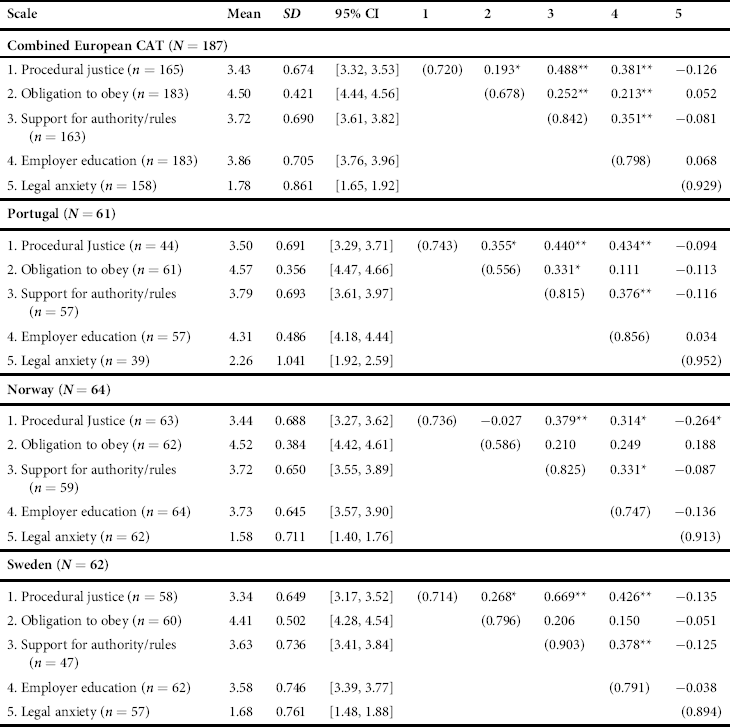
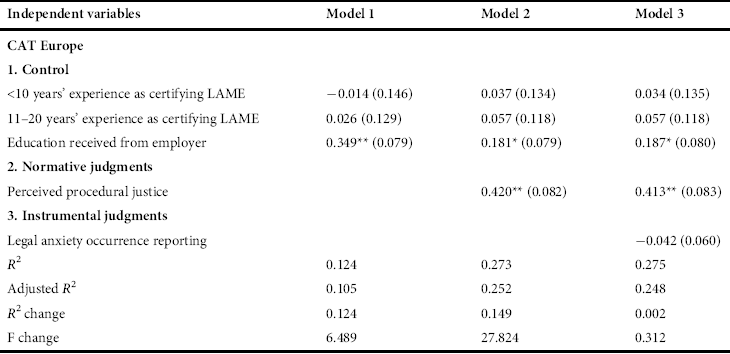
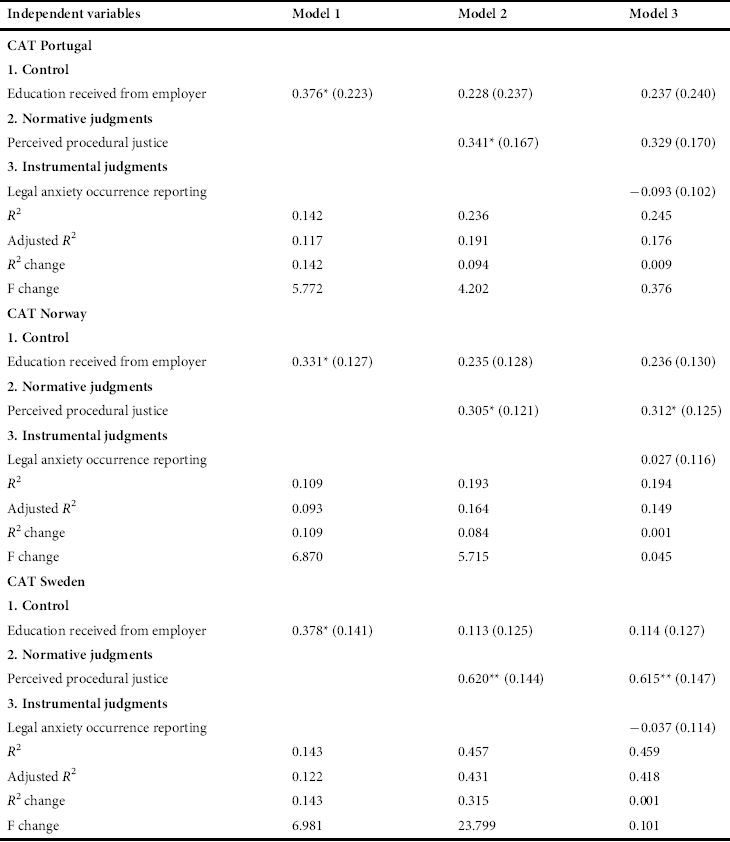

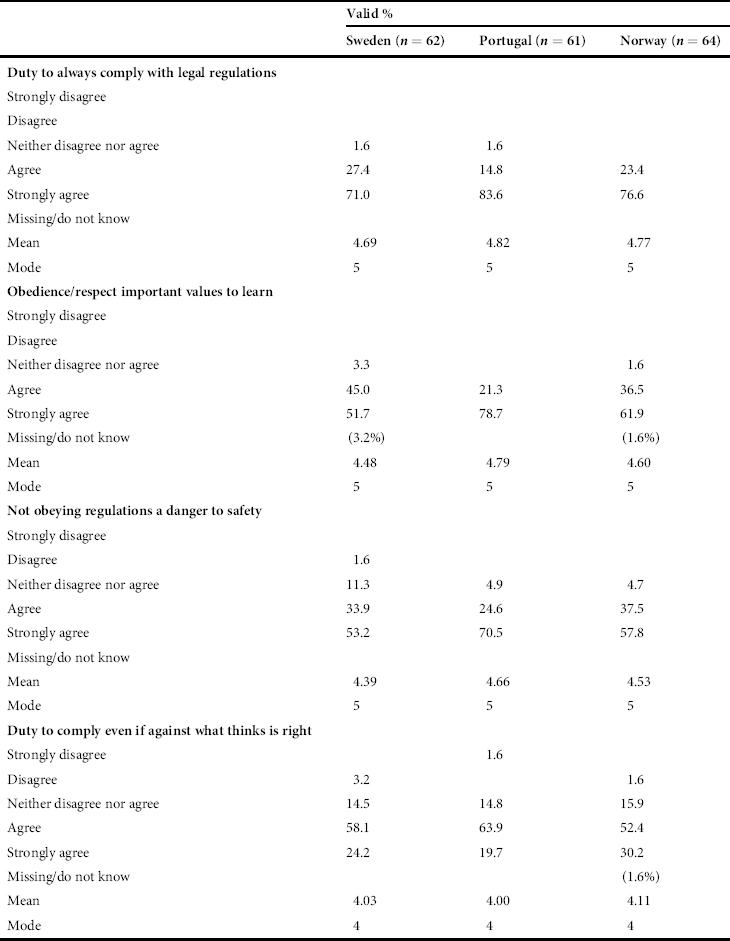
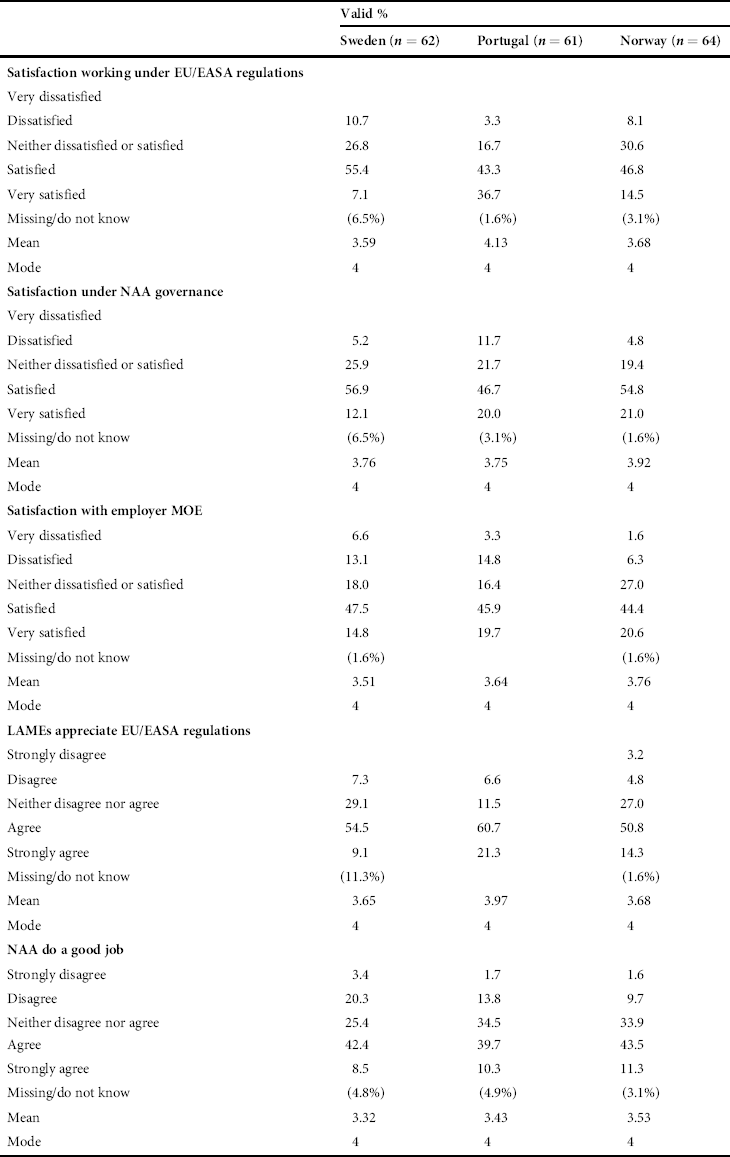
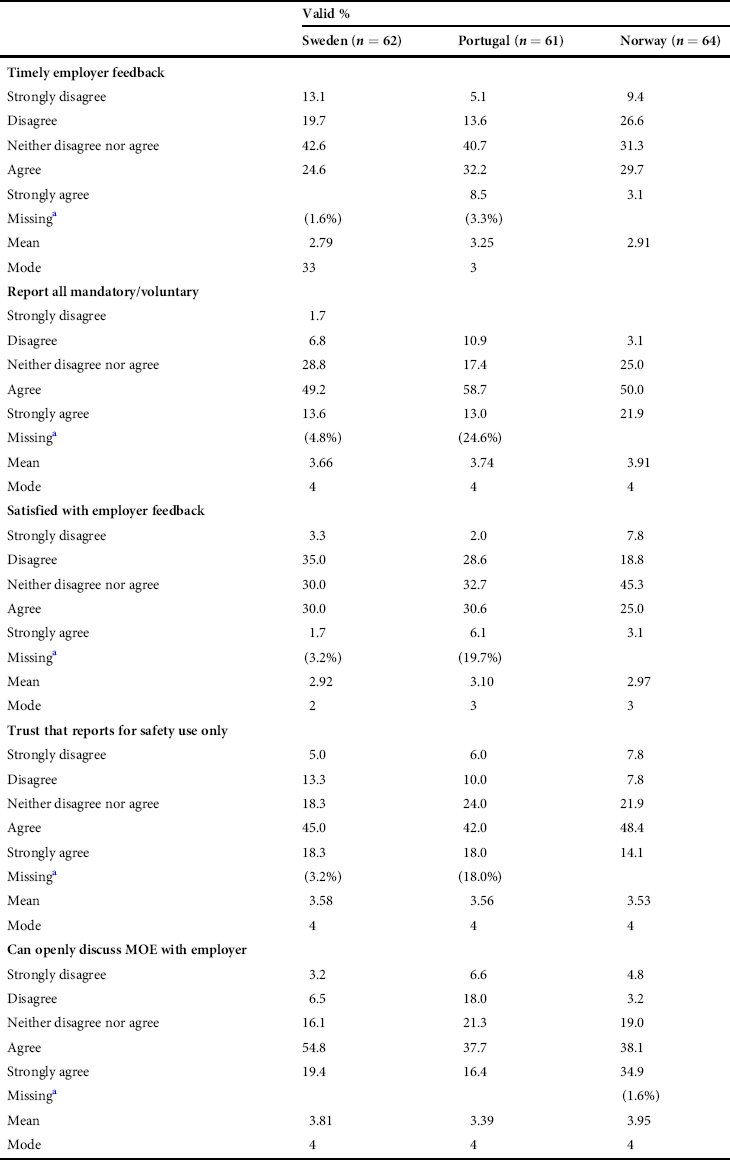
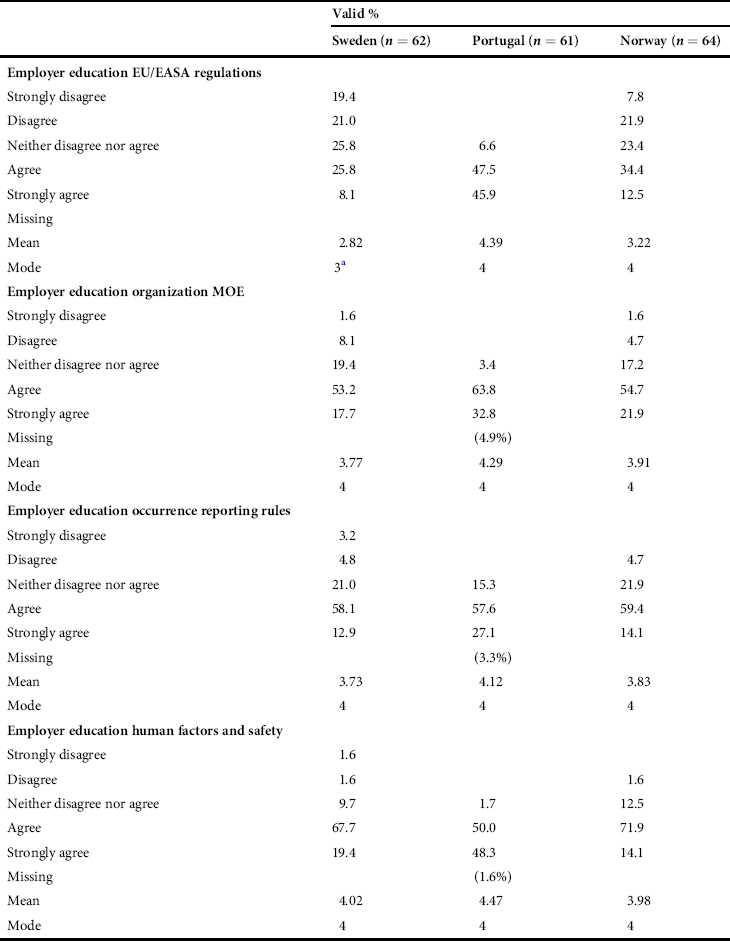

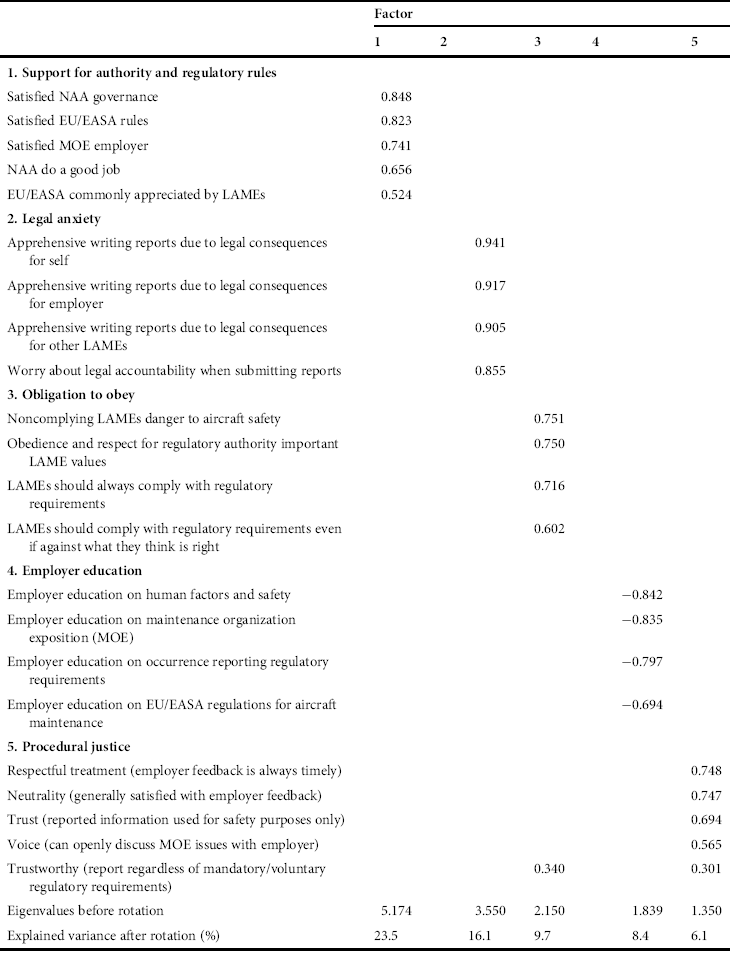

 Open access

