The Netherlands can be regarded as a hotspot in the debate about creation and evolution, or—as some prefer to call it—as “a frontline in the creation-evolution battle.” In his authoritative book on the rise of modern creationism, The Creationists, the historian of science, Ronald L. Numbers, remarks that “the Dutch took the lead” in promoting young-earth creationism in continental Europe in the 1970s. It has become apparent in recent years that creationism still constitutes a considerable social-religious phenomenon. In 2005 the Netherlands attracted attention when the minister of education expressed herself favourably about the idea of Intelligent Design. One Dutch commentator then feared that his country was becoming “the Kansas of Europe.”Footnote 1 Moreover, young-earth creationists are still very active in the Netherlands. In the year of Darwin's bicentenary, 2009, they distributed millions of flyers, entitled Evolution or creation: What do you believe?, in which they advocated strictly creationist ideas.Footnote 2 This action elicited heated debates.
A recent poll on the acceptance of evolutionary theory shows that about 60% of the Dutch population believes that the theory of evolution is (probably) true, which is much higher than for example Turkey (30%) or the USA (40%), but lower than other secularized European countries like Denmark or France (about 80%).Footnote 3 Dutch anti-evolutionism is mainly supported by conservative Protestants: members of both evangelical “free churches” and several orthodox Reformed denominations. As in many other countries, American young-earth creationism has strongly influenced the Dutch anti-evolution movement since the 1970s. This raises the question of how these “American ideas”—which were developed in a different cultural context and theological tradition—could so easily take root in the Netherlands, not only in American-modelled evangelical churches, but also in traditional Reformed (Calvinist) circles.
The question becomes even more interesting when we take into account the previous history of the Dutch Calvinists, especially their attitude toward the sciences in general and evolution in particular. The Dutch (neo-)CalvinistsFootnote 4 have never been hostile to science as such. In 1880 they had founded their own “Free University,” which initially comprised only faculties of Theology, Arts, and Law, but was expanded with a Faculty of Science in 1930. Moreover, the turn-of-the-century Calvinist leader Abraham Kuyper is often considered a supporter of the concept of “divine evolutionistic creation,” or at least as somebody who accepted evolution “as a working hypothesis.”Footnote 5 On the other hand, in a recent historical study the Calvinist geologist Davis A. Young has argued that early-twentieth-century Dutch Reformed Calvinists were rather suspicious of mainstream geology. While it is now generally known that many nineteenth-century Presbyterian Calvinists in Scotland and the United States were quite favourable to the idea of the great antiquity of the earth and some even to one or another theory of biological evolution, Young is surprised about the attitude of their Dutch fellow-believers. He even wonders whether there had already been something like an independent young-earth-creationist movement in the Netherlands in the late nineteenth century.Footnote 6
In this paper I will trace the historical sources of creationism in the Netherlands by addressing the question of how exactly Dutch Calvinists have dealt with evolution and related issues. Is there continuity between the ideas of the turn-of-the-century Calvinist leaders, such as Kuyper, the next generation of theologians and scientists in the interbellum period, and Calvinist young-earth creationists who have been active in the Netherlands since the 1960s?
The historiography of the engagement of science and religion has become increasingly “complexified” in recent decades. One way this has happened is by contextualizing encounters of “science” and “religion” in their socio-spatial settings. David N. Livingstone, for example, has shown that Calvinists with similar religious convictions in Princeton, Belfast, and Edinburgh responded very differently to Darwinism. Similarly the way the creation-evolution debate developed in the twentieth century in the United States can only be understood by taking the uniquely American combination of religious, legal, and educational circumstances into account.Footnote 7 Analogously, the attitude of the Dutch Calvinists toward evolution should first and foremost be understood within the Dutch context. In the Dutch setting, Calvinists tried to come to terms with the modern world and to formulate their own coherent view of science, society and culture. In the course of the twentieth century they fiercely debated the issues; they argued about the direction that should be taken; and, if they failed to realize their ideals, they at times adjusted them.
Science, however, is not only a local but also a global phenomenon. In a complex way, yet often very successfully, scientific knowledge travels far beyond local contexts, even if in a form more or less adapted to the new circumstances. In the wake of science, ideas about the relationship between science and religion have spread around the world. Ronald Numbers recently has pointed to this process of globalization as an important pattern in the history of science and religion. Even creationism, long viewed as an “indigenous American bizarrity,” has in recent decades successfully spread into very different cultures all over the world.Footnote 8 To understand how creationist ideas became part of the Dutch Calvinist discourse on evolution, networks between Dutch Calvinists and fellow-believers elsewhere, especially in the United States, should be taken into account. International contacts have never been as natural for Calvinists as they were for Roman Catholics or Anglicans. Calvinist churches and movements usually functioned in a national context. However, they did look across the borders to fellow believers in other countries and sometimes they actively sought closer cooperation. There was a natural bond with Dutch immigrants in the United States, and in addition new ties were forged with, for example, Calvinist Presbyterians and other groups of evangelical Christians. These networks offered the possibility of exchanging ideas, and they became an important factor in the development of the debate about evolution in the Netherlands.Footnote 9 By focusing on the long-term dynamics between the local and the global, this case study sheds more light on the interesting phenomenon of the globalization of the so-called “science-and-religion dialogue.”
I. Dutch Calvinists and evolution around 1900
It was not until the last decade of the nineteenth century that the orthodox Dutch Calvinists gave a comprehensive evaluation of Darwinism. Less doctrinal Protestants, who had dominated the Dutch Reformed Church in the previous decades, had already arrived at a certain synthesis of religion and evolution. The Calvinists, however, had long kept aloof from the academic world and especially considered Darwinism as a materialistic theory.Footnote 10 In general, the Calvinists of this period were on the sidelines of Dutch society. However, in the final decades of the century, they increasingly participated in modern culture. Under the leadership of the charismatic theologian, journalist and statesman, Abraham Kuyper (1837–1920), orthodox Calvinism experienced a revival, resulting in a view of life often denoted as “neo-Calvinism.” In Kuyper's view Calvinism was not merely a religious system, but an all-embracing life system or “worldview,” with implications for all domains of life and thought, including society and science. Consequently, the Kuyperian Calvinists began to establish their own schools, and in 1880 they created their own “Free University” (Vrije Universiteit) in Amsterdam. This university was completely funded by sympathizers. Most of Kuyper's followers were members of the Reformed Churches in the Netherlands (Gereformeerde Kerken in Nederland), a denomination that had broken away in two stages from the Dutch Reformed Church (Nederlandse Hervormde Kerk), the former public church of the Dutch Republic. The Free University, however, was not a denominational seminary or college. It was intended to develop into a “complete university,” comparable to the other Dutch universities, but distinguished by its religious character. It was to offer an alternative for the modernist and secular way of thinking prevalent at the state universities and aimed at developing a “Christian science.” According to Kuyper, science was not religiously neutral, but was affected by faith. Therefore a conflict between Christian and non-Christian science was inevitable, because they were based on different religious “presuppositions,” or principles. While a naturalistic worldview involved a naturalistic science, a Christian worldview would lead to a Christian science.Footnote 11
This “antithetical” view of science has to be understood against the background of the ecclesiastical and political developments around the end of the nineteenth century. In their zeal to organize themselves the neo-Calvinists clearly staked out their position against other groups. Theologically they targeted first and foremost liberal and moderate theologians, who had accepted the historical-critical approach of the Bible. In the social sphere their criticism was mainly directed at the socialists. Both “opponents” were somehow associated with evolution: Biblical criticism was an evolutionist view of the Bible; the socialist class struggle stemmed from an evolutionist view of society.Footnote 12
Neo-Calvinism stimulated a greater involvement in society for many ordinary Calvinists. They developed many initiatives to establish their own organizations, resulting in a strong Calvinist subculture in the 1920s and 1930s. Other groups in the country, such as the Roman Catholics and socialists followed their example, a process—later called “pillarization” (verzuiling)—that was accommodated by the state. It resulted in a pluralistic structure, in which society was “vertically stratified” along religious and ideological lines that was to last into the 1960s. This “cradle-to-grave pluralism” meant that different groups of society were to a certain extent shielded from each other and from modern influences. The phenomenon of pillarization, however, was not in itself anti-modern. It was the route along which the modernization process of Dutch society took place: political parties, broadcasting corporations and schools were formed on a religious or ideological foundation. Within the pillars the questions of modernity were not shirked, but rather people tried to find religious or ideological answers to these questions. The neo-Calvinist movement was, like the others, an attempt to bring classical Calvinism in rapport with modern times. As a result of the creation of the Free University the academic world became involved in the process of pillarization as well. The foundation of this university was inspired by a certain view of science, but once it was there its existence endowed the question of the relation of science and religion with a lasting relevance for the Dutch Calvinists.Footnote 13
In 1901 Abraham Kuyper became the prime-minister in a coalition cabinet of orthodox Protestants and Roman Catholics, which illustrates the increasing influence of the religious or, as they were called, confessional parties in Dutch politics and of the religious groups in society more generally. In this period, the Calvinist leaders also formulated their views about evolution. Kuyper had given a rectorial address at the Free University on Evolution in 1899, starting with the grandiloquent sentence: “Our nineteenth century is dying away under the hypnosis of the dogma of Evolution,” which formed the prelude to fifty-one pages of criticism of the theory of evolution.Footnote 14 His main focus was the monist philosophy of life advocated by Ernst Haeckel and the evolutionary ethics of Herbert Spencer. These systems, according to Kuyper, repudiated the essence of ethics, aesthetics, and religion. Therefore, he exclaimed: “The Christian religion and the theory of evolution are two mutually exclusive systems.”Footnote 15 Throughout his speech, Kuyper was also critical of the more restricted idea of biological evolution. Like many of his contemporaries, Kuyper pointed to the scientific problems in the Darwinian theory of evolution of the time, like the lack of an adequate theory of heredity, and the incompleteness of the fossil record. But his principal criticism was that Darwin's theory of natural selection in particular was naturalistic, mechanistic, and a-teleological. Therefore it could not be combined with belief in a providential and interventionist God, “who first prepares the plan and then omnipotently executes it.”Footnote 16
It should be noted that Kuyper's evaluation of Darwinism was not based on a literalistic reading of the first chapter of Genesis, as is the practice of many present-day creationists. In his lecture he only made one remark about the Genesis story, which seems to support a kind of developmental view on creation: “Scripture states that ‘the earth brought forth herb yielding seed after its kind’ and also that ‘the earth brought forth the cattle and everything that creepeth upon the earth,’ not that they were set down upon the earth by God like pieces upon a chessboard.” He explicitly asked “whether religion as such permits a spontaneous unfolding of the species in organic life.” His answer is affirmative: “We will not force our style upon the Chief Architect of the Universe.” When considering the possibility of “evolutionistic creation,” both in his address and in his courses in dogmatics, Kuyper referred to the beliefs of co-religionists in the Anglo-Saxon world, many of whom had accepted evolution.Footnote 17 Kuyper was informed about the ideas of (Presbyterian) Calvinists outside the Netherlands by American friends and colleagues.Footnote 18 He was in close touch with theologians of the orthodox Princeton Theological Seminary, like Benjamin B. Warfield, defender of the doctrine of biblical inerrancy, who was at the same time an evolutionist, although with certain reservations.Footnote 19 In 1898 Warfield had invited Kuyper to visit Princeton to receive an honorary doctorate and to give the so-called Stone Lectures. In these lectures, Kuyper introduced his “neo-Calvinist” view of culture, science and society to an American audience.Footnote 20 Kuyper's relatively open attitude to evolution, which he expressed in his Evolution address, can perhaps be ascribed to his American contacts. The reason why, in the end, he viewed evolution more negatively than his US colleagues, is to be found in Kuyper's neo-Calvinist view of science, which focused on presuppositions and principles, rather than on concrete results of scientific research. As Warfield remarks in his short review of the lecture: Kuyper “lifts the discussion out of the ruts in which it usually runs and contemplates it in a higher atmosphere and amid its broader relations.”Footnote 21 For Kuyper, Darwinism was not just a theory, but an integral part of a naturalistic-mechanistic worldview. Nevertheless, Kuyper was aware that the matter was undecided, and that further scientific research should be done. In the closing stages of his address, Kuyper stated that Calvinist scientists—and thus the establishment of a Calvinist Science Faculty at the Free University—were essential to clarify the questions of religion and evolution.Footnote 22
The theologian Herman Bavinck (1854–1921) is the second founding father of Dutch neo-Calvinism (See fig. 1). His publications include a contribution to a pamphlet in which opinions “pro” and “contra” evolution were discussed.Footnote 23 Not surprisingly, Bavinck defended the “contra” position. Like Kuyper's, his criticism of the idea of evolution in modern science concentrated on its “mechanistic character.” Therefore, according to Bavinck, “it leaves no room for a plan or goal, but has an accidental character.”Footnote 24 The “mechanistic worldview” that, according to Bavinck, underlies the Darwinistic view of evolution, a priori excluded supernatural interventions and prescribed that everything “should be reduced to mechanical motion.” Therefore, Darwinists claim that mankind has descended from animals, and that life has emerged spontaneously from inorganic matter. How could it have happened otherwise?Footnote 25 If the mechanistic, or “modern,” worldview were to be abandoned, Bavinck believed, a different worldview could produce a different theory. This theory could contain elements of Darwinism and would still be in harmony with belief in creation.Footnote 26
Leaders of the Dutch neo-Calvinists around 1900: Abraham Kuyper (1837–1920) and Herman Bavinck (1854–1921); (photos: Historical Documentation Centre for Dutch Protestantism).

Beside this criticism on the level of worldview and presuppositions, there was the question of the factual discrepancy between the biblical creation story and the evolutionary account. The Dutch neo-Calvinists had always stressed—against the historical-critical approach of modern theologians—that Scripture is the infallible Word of God. This also implied that it accurately presented historical and natural facts.Footnote 27 This raises the question of how the Dutch Calvinists dealt with the results of geology and palaeontology, in which questions of worldview indeed appear to be less important, but certain results—the great antiquity of the Earth and of fossils—seem to contradict the Biblical account of creation. Nevertheless, in his Evolution address, Kuyper had stressed that “well-established facts can never be written off.”Footnote 28
Among Protestants in the Anglo-Saxon world, the findings of geology were traditionally harmonized with the creation account of Genesis 1 in a “concordistic” way. The so-called “day-age” interpretation, for example, states that the days of the creation story should be understood as long periods. The “gap theory” assumes that there was a time interval between the creation in the beginning, and the formation of the earth in the creation week. These and other approaches made it possible to accept the time scale of conventional geology, while at the same time holding on to the account of Genesis 1 as an historical account.Footnote 29
The Dutch neo-Calvinist leaders did not themselves develop comprehensive, concordistic theories. However, concordistic elements can be found throughout their publications. In a series of articles in the influential Reformed weekly De Heraut in the 1910s Kuyper discussed the results of palaeontology. He expressed his belief that many species were already extinct before human beings entered the stage and that geological strata and fossils were formed during the creation week or “between the creation days.”Footnote 30 Elsewhere it becomes clear that Kuyper did not believe that the Noachian Flood was a world-wide catastrophe. Expressions as “the whole earth,” “the highest mountains” and “all the animals” were not to be taken literally. Moreover, Kuyper believed that “in the depths of the Earth,” many fossils had been found that had nothing to do with the Flood.Footnote 31 On the other hand, Kuyper certainly did not question the historical character of Genesis and he took it for granted that mankind had existed for only 6000 years.Footnote 32 It remains unclear how exactly Kuyper combined the “well-established facts” of science with the “biblical facts.” He may have believed in a progressive creationist theory, in which the species were successively created in different geological epochs.
In his Reformed Dogmatics (1897), Bavinck dealt with geological issues in some detail. It is clear that, in his discussion of the biblical creation account, he did not adhere to the view that the days of Genesis 1 were ordinary 24-hour days, nor did he believe that God had created the world only 6000 years ago. Bavinck stated that he was ready to accept the “facts advanced by geology.” However, when he discussed the various attempts to harmonize Genesis 1 with the results of geology, he saw problems with all of them. Despite his starting point, in the end Bavinck criticized mainstream geology for being captive to the theory of evolution.Footnote 33
Beside the views of the founding fathers of neo-Calvinist thinking, Kuyper and Bavinck, those of G. H. W. J. Geesink (1854–1929), professor of ethics at the Free University, were influential. From 1901 onwards, he published a series of articles in De Heraut, in which he dealt in a popular way with issues concerning the natural sciences. He discussed the theory of evolution in the context of “the mechanistic monistic worldview” and he disqualified it for being “irreligious, as it denies both God's activity in, and his goal with, His creatures.”Footnote 34 Like Bavinck's, Geesink's attitude to historical geology and palaeontology is ambiguous. On the one hand he declares that he is willing to accept the idea that fossils can inform us about the past. But on the other hand, he is skeptical about mainstream geology because it was influenced by Darwinism and, therefore a priori, excluded the possibility of divine intervention.Footnote 35 Nevertheless, Geesink states, to understand the formation of the Earth both Scripture and the results of the study of nature are to be taken into account.Footnote 36 The “story of the six days” already suggests that it was a slow process in which God created all things through secondary causes, since it repeatedly states that God used “the earth” to “bring forth” the creatures, not that they appeared suddenly. Moreover, so many things were created in one day that it was unlikely that the days of the creation story should be taken as ordinary 24-hour days. This interpretation made it possible to identify the creation days with the geological ages and to accept the day-age view as a convincing harmonization of Genesis and (some of) the results of geology and palaeontology.Footnote 37
Concordistic ideas remained popular among Dutch Calvinists in the early decades of the twentieth century. A case in point is Kuyper's support for the ideas of the American geologist and apologist G. F. Wright. Kuyper had made efforts to get Wright's Scientific Confirmation of Old Testament History (1906) translated into Dutch, and in the preface to the translation, Kuyper recommended the book wholeheartedly.Footnote 38 In the 1870s, Wright had been a defender of theistic evolution and had interpreted Genesis 1 as a “poem,” a “rhetorical protest against polytheism.” In his new book, however, he distanced himself from that interpretation. He now defended the opinion that there were so many parallels between the recent results of geology and the account of creation given by Genesis 1 that they affirmed its divine inspiration. Nevertheless, he interpreted the creation days as longish periods, and accepted many results of historical geology and palaeontology, which—he admitted—did not always show exactly the same order as the Genesis account. He therefore advocated a moderate concordism, meaning that the results of science are in basic agreement with Genesis 1.Footnote 39 It is unclear to what extent Wright in these years still accepted elements of evolutionary theory, as he does not explicitly deal with evolution in this book. What is important for us, however, is that Wright, who did have opinions that deviated from conventional geology, was clearly not a young-earth creationist, nor did he criticize the results of mainstream geology as such.
In sum, the neo-Calvinist leaders around the turn of the century were quite negative about a general theory of evolution, especially Darwinism, but they were ambiguous about questions of historical geology. However, Kuyper in particular did not condemn the attempts of fellow-Christians to combine a (non-Darwinian) theory of evolution with belief in a providential God. Moreover, their views allowed for several concordistic attempts at harmonization. More important than answers to concrete questions, however, was the general approach to science that Kuyper and Bavinck had developed with its strong emphasis on an underlying worldview and presuppositions. This approach—developed during a time of growing self-awareness of the Calvinists in the Netherlands—determined the focus of the debate among both Calvinist scientists and theologians in the twentieth century.
II. The next generation of neo-Calvinist scientists and theologians
For the next generation of neo-Calvinists the question was what relevance Kuyper and Bavinck's late-nineteenth-century theology and views of science still had in the light of new developments in society and culture. In order to understand the debates about this question—including the creation-evolution issue—it is important to have a balanced view of the Calvinist community in the interbellum period. What position did the neo-Calvinists occupy in Dutch society, how did their theology develop, and how can their lifeway be characterized?
Sociologists have described the history of the Dutch Calvinists as a process of emancipation of a socially backward section of the population, which went through several distinct phases. In this view the decades around 1900 were characterized by a confrontation with other worldviews under the leadership of the charismatic Abraham Kuyper. From about 1920 there was a period of diminished zeal and of consolidation of what had been achieved, and finally, from the 1950s, integration in society followed.Footnote 40 Although this scheme ignores factors other than that of social emancipation and also disregards the diversity within the group, as a first approximation it provides helpful insights. The neo-Calvinists did indeed achieve a great deal during the interbellum period. Their social-economic position improved; their Christian schools had gained equal rights with public schools; and their political party was a partner in every coalition cabinet. At the same time they realized that other ideals—particularly the re-christianization of society—were out of reach. As a result a great deal of energy was put into the development of the neo-Calvinist subculture. In the seclusion of the subculture they could shape their lives as they saw fit and develop their own lifeway. Consequently, the Calvinist lifeway was characterized in this period by clear boundary markers. Ordinary Calvinists attended a Reformed church, sent their children to a Calvinist school, voted for a Calvinist party, read a Calvinist newspaper, listened to the Calvinist broadcasting company and were members of a Calvinist professional organization or trade union.Footnote 41 This shows that the neo-Calvinists were not world eschewing or simply anti-modern, as were for example Calvinists of a pietistic bent. The neo-Calvinists were, on the contrary, very actively involved in society, self-confident, trying to remould the modern world nearer to their hearts' desire.Footnote 42 In the subculture theologians and ministers had a leading position. They counselled people about how to live and what to think. They did this through the many religious periodicals and, for example, in the six-volume Christian Encyclopaedia (1925–1931), which did not hesitate to make outspoken judgments about scientific matters.Footnote 43
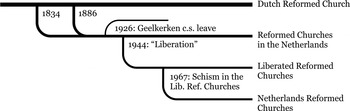
At the same time ordinary Calvinists were closely involved with their own organisations, such as the Free University, which they supported financially. Because of the involvement of the rank and file, the leaders were inclined to set a theologically conservative course. Their primary aim was to preserve and apply Kuyper's theology, as renewal would only create unrest. This meant, for example, that they rejected Karl Barth's “neo-orthodox” theology, which, contrary to neo-Calvinism, disconnected faith from culture, politics, and science. There were, admittedly, young Calvinist intellectuals who wanted to blaze new trails, but they came into collision with the leading theologians. These tensions culminated in 1926 in an ecclesiastical conflict (discussed in detail below, see also fig. 2) that resulted in the innovators being silenced. All this meant that the neo-Calvinist subculture remained very much isolated from the rest of society until the 1950s.Footnote 44
Taxonomy of the Calvinist denominations in the Netherlands that appear in this paper.

The debate about creation and evolution has to be seen against this background. Initially this debate was mainly conducted in the small circle of Calvinist scientists. These Calvinist scientists had already established, in 1896, a Christian Association of Natural and Medical Scientists, which aimed at practicing science and medicine “by the light of God's Word.”Footnote 45 Most of the members had been trained at one of the Dutch state universities, and therefore they were familiar with the practice of science. At the same time, the scientists of the 1920s and 1930s had learned from the neo-Calvinist leaders that “the mechanistic worldview” and naturalistic science were in conflict with Christianity. Encouraged by some ideas of the late Bavinck, who had shown more openness to modern culture, they stressed that the contemporary situation was different from that in the nineteenth century. “Naturalism” was a thing of the past, they believed, and mainstream science could not be considered suspect just because it was based on non-Calvinist principles.Footnote 46 Moreover, many of the practicing scientists increasingly demarcated a domain of “pure” scientific research from so-called “natural philosophy.” They argued that the debate about the proper relationship between science and religion was only relevant for the latter domain.Footnote 47
This allowed some of the Calvinist scientists to go so far as to accept the biological theory of evolution. One of them was J.P. de Gaay Fortman (1887–1983), a zoologist by training, biology teacher, and co-author of a series of biology textbooks for Christian secondary education. In several lectures and articles for the Association and for Calvinist student groups, he argued that “if it is used purely scientifically, there is no objection to the idea of evolution.” It was simply “a useful summary” of the present state of biological science.Footnote 48 As long as the theory of evolution was not combined with a mechanistic worldview, it could be accepted. He regretted that Bavinck and others had simply identified evolution with the mechanistic worldview, although that had been understandable 30 years ago.Footnote 49Another problem remained, De Gaay Fortman admitted, namely the prevailing Calvinist view of Genesis 1, which was difficult to combine with a general theory of evolution. Therefore the doctrine of Scripture, or, as he called it disparagingly, “the dogmatic-theological system that was developed at a time when the biological arguments in favour of evolution were non-existent,” had to be revised. It could then be combined with the idea of evolution, “while retaining the essential elements of Scripture and History.” De Gaay Fortman stressed that he was looking for a “synthesis,” and not for “concordism,” because “concordism usually leads to a hopeless compromise.”Footnote 50
The young biologist J. H. Diemer (1904–1945) wholeheartedly agreed with De Gaay Fortman and stated that Christians “can accept the idea of evolution as a scientific theory [and at the same time] hold on to the principle that the essence of evolution is a plan of the Divine Spirit.” In addition, Diemer expressed his agreement with De Gaay Fortman's clear disapproval of concordistic attempts.Footnote 51 However, in debates in the Christian Association and in Calvinist student groups, De Gaay Fortman and Diemer did not find all their fellow-scientists on their side. One critic argued that the theory of evolution was indeed in essence connected to the monistic-mechanistic worldview. Therefore it could never be accepted and there was no need to change the prevailing view of Scripture.Footnote 52
In 1925 one of the leading figures of the Christian Association, the astronomer W. J. A. Schouten (1893–1971), lectured on “The present state of the problem of evolution.” Schouten declared that he did not want to judge the theory of evolution negatively a priori. The issues simply had too many aspects and therefore “the question of whether the theory of evolution contradicts the dogmas of the Christian Church is not easy to answer.”Footnote 53 Nevertheless, he showed a bias toward recent anti-evolutionary publications. He referred to the recent Scopes Trial in the American town of Dayton, Tennessee, where the science teacher J.T. Scopes was convicted for teaching the Darwinian theory of human evolution. According to Schouten, this showed that in the United States the battle about the theory of evolution was not over yet. More important than this trial, however, were some recent publications that had strongly attacked the validity of the theory of evolution. Schouten gave extensive summaries of these publications, including George McCready Price's The New Geology (1923). Schouten had stressed that he did not want to give his own opinion in this lecture. One of the listeners, however, concluded that Schouten had given the impression “that the creation story was consistent with scientific research.”Footnote 54 However, when he published a book entitled Evolution in 1935 Schouten again stressed that he did not want to join those who judged a scientific theory on the basis of the Bible.Footnote 55 In the book he explained the theories of evolution of Lamarck, Darwin, Hugo de Vries and others. Yet, time and again he concluded that none of those theories had been “proved.” Schouten finally stated that more research was needed to reach a decisive answer to the question of whether species are constant.Footnote 56 However, in this context he formulated two restrictions. First, that Christians could never accept that “man is descended from some ape species.” Secondly, that Christianity cannot be combined with an “evolutionary worldview,” which teaches that everything develops by chance. Contrary to this doctrine “Christians believe in God, the Father Almighty, Creator of Heaven and Earth.”Footnote 57
Interestingly, Diemer published two review articles of Schouten's book in Calvinist newspapers, in which he praised the initiative to publish a book about the theory of evolution for a general public, but regretted that it was written by an astronomer instead of a biologist.Footnote 58 He agreed with Schouten that Christians had to condemn a “deistic or pantheistic evolutionism, which takes the place of belief in creation,” but while Schouten was right in accepting the results of astronomy and geology, Diemer blamed him for being too critical about the biological evolutionary hypothesis. Diemer concluded: “I hope that Schouten's view of evolution will not be considered the only one possible for a Christian biologist.”Footnote 59
While the scientists were not united about the question of whether some theory of evolution could be accepted, they agreed that the prevailing ways of combining Genesis 1 and (some) results of science had no future. Most of them embraced the exegesis of the Reformed Old Testament scholar of Utrecht University, A. Noordtzij (1871–1944), who had interpreted Genesis 1 as a literary construction. Noordtzij argued that in this chapter the works of creation were arranged according to a literary scheme and distributed over the six days. A critic of evolution like Schouten also preferred this “framework interpretation.” In a book in his own field, entitled Stars and Galaxies, Schouten discussed a number of theories of the origin of the universe and he saw no conflicts between these theories and belief in a Creator; with Noordtzij's exegesis difficulties and conflicts disappear completely.Footnote 60
The majority of Calvinist theologians, however, followed a different path. They did not accept a literary or prophetic interpretation of the Genesis account, and they reduced the debate about the relation of faith to evolution and geology to one issue: the authority of Scripture vs. the authority of science. De Gaay Fortman criticized this attitude, which he described as “a domination of all areas of science on the basis of an indisputable view of Scripture.”Footnote 61
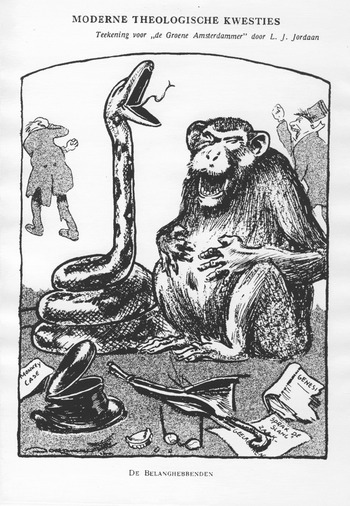
A case in point is the controversy that arose in the Reformed Churches in the 1920s about the question of whether the story of the Fall (Genesis 2–3) should be taken literally. The Reverend J. G. Geelkerken (1879–1960) had called into question the literal-historical character of this story. After a lengthy procedure the Synod of the Reformed Churches of 1926 decided to suspend Geelkerken, causing a schism in which a small group of relatively liberal members left the churches. Several Dutch newspapers compared the Geelkerken Case, which was often simplified to the question “did the serpent really speak?” with the “Scopes Monkey Trial” in the United States (fig. 3).Footnote 62 It should be noted, however, that the Geelkerken Case was actually an ecclesiastical process about the interpretation of Scripture and was not about teaching evolution in public schools. After all, the Dutch Calvinists had their own schools for secondary education. The theory of evolution was simply ignored in their Christian biology textbooks until the 1960s.Footnote 63 To understand what was really going on in the Geelkerken Case, one should be aware of the complex situation in the Calvinist subculture in this period.Footnote 64 Behind it were conflicting views concerning the course the Dutch neo-Calvinists should take. One of the tricky issues was their attitude to the sciences: the leading Calvinist theologians of this generation had a different approach than Kuyper and Bayinck. Although they stressed that the 1926 Synod had not made a decision about Genesis 1, nor about the natural sciences, it cannot be denied that the Geelkerken Case strongly influenced the debate about evolution and faith in the following decades. One of the theological advisors of the Synod explicitly made the link, when he remarked that, in his view, “the blurring of the story of the Fall . . . involves embracing the doctrine of evolution.”Footnote 65
Caricature comparing the Geelkerken Case in the Netherlands (“Did the serpent really speak?”) to the “Monkey Trial” in the USA: A serpent and an ape are portrayed as “the interested parties” in “modern theological issues.” (photo: De Groene Amsterdammer, September 19, 1925).

A militant supporter of the Synod's rulings was the young church minister K. Schilder (1890–1952). Schilder, later professor of dogmatics, was conservative in his theology and view of society, but at the same time attempted to radicalize neo-Calvinist thought. After 1944 he was to become the leader of the “Liberated Reformed Churches.” In this denomination his radical theology would lead to an even greater social isolation than the neo-Calvinists had known in the interbellum period. According to Schilder the results of scientific research could never be a “binding criterion” in the exegesis of Scripture. In his opinion extra-biblical information had not been decisive for predecessors like Kuyper and Geesink in their—not very literal—exegesis of the days of the Creation and the Flood. Schilder emphasized the importance of presuppositions in exegesis: is one willing to bow to the authority of Scripture, or does one take evolutionism as one's starting point?Footnote 66
Soon afterward it became clear how the attitude of the theologians to the sciences was worked out. In 1930, the Free University professor of dogmatics V. Hepp (1879–1950) visited Princeton to give the Stone Lectures on the topic of “Calvinism and the Philosophy of Nature.”Footnote 67 In giving these lectures, he followed in the footsteps of Kuyper in 1898 and Bavinck in 1908, but it turned out that his approach differed from that of his predecessors. According to Hepp, a Calvinistic philosophy of nature provides the principles from which one can deduce hypotheses to explain the facts. He downplayed the role of the inductive method in the natural sciences, formulating his starting point as: “Why should not Calvinism have just as much right to set up an hypothesis as the unbelieving philosophy of nature?” In his lecture about “Calvinism and geology” he made it clear that he was not willing to accept any of the results of mainstream geology and he approvingly referred to George McCready Price.Footnote 68
Nowadays the Canadian amateur-geologist and Seventh-day Adventist Price (1870–1963) is considered the founding father of twentieth-century “young-earth creationism.” At that time, however, Price was one of the few proponents among anti-evolutionists of the idea that the world was created some 6000 years ago. He did not believe that there was a natural order in the fossil-bearing rocks, but instead proposed that all the fossils were deposited during a worldwide flood. He had published several books in the early decades of the twentieth century. His best-known work was a college textbook, The New Geology, published in 1923. Outside Seventh-day Adventist circles, however, support for his ideas was limited. The broader movement of anti-evolutionary fundamentalists in the United States—who had started to organize themselves around the time of the Scopes Trial—had not yet embraced this “flood geology.” Although anti-evolutionary leaders used some of Price's arguments against evolution in the interbellum period, it was not until the 1960s that his alternative geology became popular in wider evangelical circles.Footnote 69
It is therefore interesting to note that already in 1930 the Dutch Calvinist Hepp warmly recommended Price's theory in his lectures at Princeton.Footnote 70 Moreover, Hepp was not the only Dutch Calvinist who referred to Price in this period. Others, who may have been more influential in the long run, relied on Price as well. In 1932, the Free University professor of Old Testament, G. Ch. Aalders (1880–1961), published a 552-page commentary on the Genesis account of the creation and the fall in Divine Revelation in the First Three Chapters of Genesis. Aalders, who had been one of the theological advisors of the 1926 Synod, wrote this book to justify the verdict of the Synod. In his book he explicitly condemned all opinions about the creation days that did not view them as “real days,” such as the day-age theory, the gap theory, and the frame-work theory. Aalders admitted that it may not be possible to determine the exact lengths of the days as days of 24 hours—they were after all “working days of God”—and one could best qualify them as “extraordinary days.”Footnote 71 However, in criticizing mainstream historical geology and evolutionary theory, Aalders took several arguments from Price: he contested the idea that the strata of rocks are in the same order all over the globe; he reproached mainstream geology for reasoning in a circle—the age of rocks is determined by the fossils which they contain and the age of fossils by the rocks in which they are found; and he contested Lyell's principle of uniformity.Footnote 72 Aalders did not confine himself to criticism only, but stressed that it was necessary to produce an alternative for mainstream geology. He stressed the significance of catastrophes as an alternative for “the millions of years that geology and palaeontology think they need.” According to Aalders, catastrophes—especially the Deluge—provided a better explanation of the fossil record, because the geological strata showed “richly developed floras and faunas that seem to have disappeared suddenly from the face of the Earth.” Aalders praised “the American geologist G. McCready Price,” who had more than anybody else pointed to the Biblical Flood as the major cause in geology.Footnote 73
Another channel through which Price's flood geology found its way into Dutch Calvinism was the above-mentioned six-volume Christian Encyclopaedia, published in the years 1925–1931. The entries about evolution and Darwinism briefly explained the results of modern science, but stressed that evolutionary theory had not been and could not be proved. Moreover, the idea that mankind was descended from some prehistoric ape was in flat contradiction to the biblical story of creation.Footnote 74 The geographer A. van Deursen (1891–1963), a teacher in Christian secondary education, was asked to write about geology. He used most of the entry to advance several of Price's arguments against conventional geological theories: he challenged Lyell's principle of uniformity, he emphasized that all methods of calculating the age of the Earth were mere speculation, and denied the idea that fossils generally occur in chronological order.Footnote 75
The Calvinist natural scientists were not amused about the “alternative theories” advanced in these publications. “If only the facts would really be known,” De Gaay Fortman sighed, “they could not be evaded by embracing some improbable speculations.”Footnote 76 As indicated above, the scientists' attitudes to the issue of biological evolution were not uniformly positive. Some of them saw insurmountable problems in accepting the theory of evolution in its entirety, but they were willing to accept the results of geology and they asked the theologians to cooperate in providing an answer to the problem of evolution and creation. Therefore, between 1926 and 1932 some meetings were held, composed of Calvinist theologians and scientists to discuss issues of science and religion. However, these meetings were not fruitful. The Geelkerken Case had cast a cloud over the relation between scientists and theologians. As an unofficial spokesman of the Calvinist scientists, Schouten had fiercely disputed the verdict of the Synod in 1926, and he was engaged in a polemic with Aalders about the interpretation of the first chapters of Genesis and the difference between the “antique-eastern world-picture of the Bible” and the “modern, scientific world-picture” in one of the Calvinist periodicals. This only drove them further apart. The relation between theologians and scientists came to a crisis when Schouten published a devastating review of Hepp's Stone Lectures. According to Schouten, the lectures contained “so many inaccuracies and groundless speculations, that it was impossible to refute them all.” Hepp was invited to react in the Christian Association of Scientists, but the parties did not get closer to each other and no further meetings of scientists and theologians were organized in the 1930s.Footnote 77
The disturbed relation between scientists and theologians was also apparent in the fact that when a Science Faculty was established at the Free University in 1930 it was almost impossible to find candidates for professorships. New professors had to conform to the verdict of the 1926 Synod. When finally three young men—a chemist, a physicist and a mathematician—accepted the appointments, it turned out quickly that at least one of them, the young physicist G. J. Sizoo (1900–1994), had serious doubts about a literalist interpretation of Genesis 1. Sizoo was shocked by Hepp's lectures, which were published in May 1930 shortly after he had been appointed. Later he said: “If this should be called Calvinist natural philosophy . . . doubts about the future of the new Science Faculty are completely justified.”Footnote 78
In the following years, the scientists continued to voice their criticism. In 1932 J. Verseveldt (1903–1987), who had graduated in both biology and physical and social geography, attacked the invasion of flood-geological ideas in Calvinist circles in a lecture about “The approach of geology in orthodox-Christian circles,” at a meeting of the Christian Association of Scientists.Footnote 79 The reason for this lecture was the completion of the Christian Encyclopaedia and especially the way Van Deursen had dealt with geological issues in it. Van Deursen had advocated the same approach in a recently released geography textbook for Christian schools that he co-authored. In these works, to Verseveldt's dismay, the influence of “the dubious amateur-geologist” Price was unmistakable. Verseveldt wondered: why did Van Deursen follow Price in blaming conventional geology for formulating groundless speculations, while at the same time postulating a “purely hypothetical World Catastrophe”? The main problem with this approach was that it tried to solve geological problems by using the Bible as a scientific textbook. This was wrong for two reasons: it could “degenerate into making a compromise with the scientific data, and haggling with the biblical text.”Footnote 80
A majority of Calvinist scientists agreed with Verseveldt in his condemnation of Van Deursen and Price. Nonetheless Schouten—who was critical of evolution himself and a good friend of Van Deursen—had been seriously interested in theories that could serve as alternatives for Darwinism. In his above-mentioned review lecture of 1925 he had discussed several contemporary American anti-evolution books, including those of Price and he had expressed his sympathy for Price's endeavour. In his 1935 Evolution book, however, he clearly distanced himself from Price. For Schouten the results of astronomy and the radioactivity measurement of the age of the earth had become conclusive and as a consequence he also accepted the great antiquity of strata and fossils, although he admitted to have no alternative for the evolutionary explanations.Footnote 81
In 1933, Sizoo published a book entitled Radioactivity, which was his own research subject at the Free University. In this book he also discussed methods to determine the age of rocks and strata and he finally stated that the conclusion that the earth is millions of years old is unavoidable.Footnote 82 Geologist A. de Graaf agreed, publishing that same year General Geology, a book that openly discussed the great antiquity of the earth and fossils. He added that the millions of years that geological epochs had lasted should not alarm us, because God “often works with very large numbers in his creation.”Footnote 83 In the same period De Graaf published a booklet dealing with Genesis and geology that opposed Aalders. He argued that Aalders had been wrong to adduce Price, “who is an exception amongst geologists,” as an authority in his Genesis commentary.Footnote 84
The books by Schouten, Sizoo and De Graaf were published in the series Christianity and Science Footnote 85 of the Christian Association of Scientists and were addressed to a general public. It appears, however, that most ordinary Calvinists were not receptive to a balanced account of the age of the earth and the great antiquity of fossils. They only took up the critical remarks about evolution. Anyhow, the natural scientists were much less influential in the Calvinist pillar than the theologians and other vocal anti-evolutionists.
The attitudes of the theologians and their allies on the one hand and the scientists on the other can only be understood when we take into account their different positions in the Calvinist subculture, and the position of the Dutch Calvinists in society during this period. As mentioned in the introduction of this section, the received view portrays the neo-Calvinists in the interbellum period as purely conservative and as having arrived. Once the leaders Kuyper and Bavinck had passed away and several emancipatory goals had been achieved the main concern for the next generation was to consolidate the legacy of the past. Nevertheless, as I have indicated, several movements of renewal were active in the Calvinist world at the same time. These renewals were novel attempts at conciliation with modern culture and contemporary science. The Geelkerken Case, however, makes it clear that the leading theologians rejected these initiatives.Footnote 86 While the Synod insisted that its verdict was purely theological and that no wider issues of philosophy or natural science were at stake, it did implicitly address these issues and in doing so they did more than just stick to the tradition and conserve the theology of their predecessors.Footnote 87 It is no coincidence that leading theologians, who had played an important role in the Geelkerken Case, gave their blessings to (alternative) flood theories soon afterward. In their attempts to fight the modernizing tendencies in their own subculture, they drew on the resources of a foreign “alternative theory.”
For the Calvinist scientists, however—whether they were attached to one of the public universities or to the Free University—it was of great importance to keep in touch with their scientific colleagues. Therefore they could not afford to sever the ties with mainstream science and modern culture. The encounter with contemporary science made them reconsider the neo-Calvinist ideal of science. Most of them stayed loyal to the Calvinist faith and subculture, but they did not want to submit to the authority of the theologians in the field of science. They simply considered the theologians' views on scientific issues untenable and distanced themselves from them; however, because the theologians were more influential in the Calvinist subculture, from now on strictly creationist ideas became part of neo-Calvinist thinking. Although there were fierce discussions among theologians and scientists, for the ordinary Calvinist there was hardly any debate about creation and evolution in this period. “Evolution” was something for liberal Protestants and socialists; “anti-evolutionism” was simply part of the Calvinist lifeway.
III. Evolutionary theory accepted in wider Calvinist circles?
After World War II, the situation initially remained unchanged. The negative view of evolution, in particular Aalders's stance, seemed to become even more influential. The first Reformed Ecumenical Synod of Grand Rapids (1946)—a counsel of delegates of Reformed Churches in the Netherlands, South Africa and the United States—decided to formulate a statement concerning “Evolution.”Footnote 88 A pre-advice, which was presented at the Synod of Amsterdam (1949), relied heavily on what was called Aalders's “magnum opus” about Genesis 1–3.Footnote 89 Several Dutch scientists—including Schouten, Verseveldt and the historian of science Reijer Hooykaas (1906–1994)—expressed themselves critically about the pre-advice and, to their relief, the Synod's final verdict was slightly more moderate. It still stressed, however, the historicity of Genesis 1 and 2, and rejected “all evolutionary teaching which either rules out God entirely, or conceives of God as dependent upon the process of a so-called creative evolution, or allows for Him to enter into the process only incidentally.”Footnote 90 Despite their criticism of the pre-advice, as in the pre-war period, not all of these Calvinist scientists were convinced evolutionists themselves. Nonetheless, they all agreed that it was scientific research and not theology that should determine whether the theory of evolution was true. As Hooykaas formulated it: the theory of evolution belongs to the domain “about which Scripture remains silent, and which has to be decided by laborious biological research and not by synodal verdicts.” He rejected all attempts to develop a “Christian science” on the basis of a Mosaic cosmology. Hooykaas blamed the Synod for not having consulted Calvinist scientists, who had been debating these questions for decades.Footnote 91
The scientists now increasingly aired their views in public and gradually they became more influential. In 1948 Sizoo took the initiative to organize a conference about “The Age of the Earth.”Footnote 92 At this conference (1950), Sizoo himself, the biologist Verseveldt, the young geologist from Utrecht University J. R. van de Fliert (1919–2001), and a number of other Calvinist scientists discussed several methods of determining the age of the earth and they all agreed that there was no doubt that it was at least hundreds of millions of years. A conference volume was published, which was reviewed surprisingly favourably in several Calvinist periodicals and went into its fourth edition in 1955.Footnote 93 In the wake of the conference another discussion between Calvinist theologians and scientists reluctantly got off the ground.
The new climate of openness is illustrated by the scientists' contributions to the second edition of the Christian Encyclopaedia (1956–1961).Footnote 94 The entries of the first edition that had been sympathetic to flood-geological argumentations were all replaced. Van de Fliert was responsible for new entries about geology, palaeontology, fossils, and stratigraphy. He frankly distanced himself from all kinds of “flood theories” or concordistic harmonisations. He expressed his disappointment that books advocating such theories were very popular in Reformed circles. The young biologist Jan Lever (1922–2010), who had been appointed professor of zoology at the Free University a few years earlier, wrote the entries about evolution and evolutionism.Footnote 95 Lever and Van de Fliert—the latter was appointed professor of geology in 1960—were to become the central figures in the creation-evolution debate in Calvinist circles in the following decades (fig. 4).
The biologist Jan Lever (1922–2010), one of the main figures in the creation-evolution debate among the Dutch Calvinists in the 1950s–70s. (photo: Historical Documentation Centre for Dutch Protestantism).

As a student and young researcher at Utrecht University in the 1940s, Lever had become increasingly convinced that some general theory of evolution had to be accepted. In 1952 he delivered his inaugural lecture at the Free University, entitled Creationism, in which he especially opposed evolutionism as an “offshoot” of the materialistic worldview.Footnote 96 In his oration—and more assuredly in his book Creation and Evolution (1956)—Lever also explained that it was possible to accept the biological theory of evolution and at the same time to adhere to belief in a providential God who guided the evolutionary process. He called this “divine evolutionistic creation,” referring to Kuyper.Footnote 97 The publications by J. H. Diemer about miracles and God's activity had made it clear to Lever that one was not forced to regard “miracles” as direct supernatural interventions by God in an otherwise self-sufficient nature, but that “God's activities in creation, providence and recreation” are all miracles and, at the same time, happen in accordance with the divine world-order. In his so-called “creationism” Lever applied this view of God's activity in nature to the process of evolution, which he regarded as a divine plan. All aspects of reality—life, the animal psyche, human mental capacities—were created in the beginning, but only later did they “unfold within the incomprehensible miracle of the created reality.”Footnote 98 Although Lever himself was inclined toward a kind of “progressive creation” in his oration, in his 1956 book he made it clear that he disagreed with those who were looking for incidental actions of God in the evolutionary process, like the US Baptist theologian Bernard Ramm in his recent The Christian View of Science and Scripture (1954). From the great gaps in the geological record Ramm inferred to “several acts of fiat creation in the history of the earth.”Footnote 99 Later, when young-earthers monopolized the term “creationism,” Lever abandoned it, but he continued to believe that the theory of evolution could be incorporated in the Christian worldview, and did not necessarily imply “evolutionism,” a worldview that conceives the process of evolution as autonomous and independent of God.Footnote 100
Interestingly, Lever was appointed chairman of a committee that was set up by the Reformed Ecumenical Synod of Edinburgh (1953) to restudy the issue of creation and evolution. The reason for establishing this committee was that the US Christian Reformed Church (CRC) raised objections to the earlier report. According to the CRC it did not distinguish with sufficient clarity between the Reformed position and “so-called theistic evolution.”Footnote 101 Ironically, the new report, presented at the Synod of Potchefstroom (1958), did not meet the objections of the CRC, but instead stated that “the qualification ‘theistic’” effectively precludes views of evolution that are opposed to the belief that God is the Creator. According to Lever and his committee this approach was “entirely in line with Kuyper's teaching” in his Evolution address, which unfortunately many had misunderstood.Footnote 102
When Van de Fliert delivered his inaugural lecture on 18 May 1960, he also started by citing extensively from Kuyper's Evolution address. According to Van de Fliert, Kuyper's address was “a polemic against a monistic-mechanistic evolution creed, not against the reality of evolution as a fact of creation.”Footnote 103 Lever and Van de Fliert may have been right when they claimed Kuyper as an ally in criticizing the evolutionary worldview. In the end, however, he had rejected Darwinist evolutionary theory. Lever and Van de Fliert, however, stretched the concept of a Christian science until every evolutionary theory would fit into it.
Interestingly, a new generation of theologians was willing to engage in a renewed discussion about the theory of evolution. In 1954–55, Aalders's successor as professor of Old Testament at the Free University, N.H. Ridderbos (1910–1981) gave several lectures on Genesis 1. In these lectures, and in later publications—including the English-language Is There a Conflict Between Genesis I and Natural Science (1957)—Ridderbos defended the “frame-work” exegesis of Genesis 1.Footnote 104 The new attitude of the theologians, and a younger generation of scientists urging that questions of science and religion be addressed, initiated a debate about evolution among a wider public. Although the ideas that were advanced by Lever and Van de Fliert caused quite a stir among many non-academic Calvinists, reactions were not completely unsympathetic.
It appears that around 1960 the results of historical geology and evolutionary theory gradually began to find acceptance among the Calvinist elite. On October 5 and 6,1966, a conference was organized for teachers in Christian secondary education, at which Lever presented his views on evolution, and the issue was discussed of how to deal with evolution in Christian schools.Footnote 105 In the same period, a number of leading Calvinist theologians adopted increasingly liberal viewpoints, and their attention shifted to other theological issues. Noticeably, in 1967 the verdict of the 1926 Synod concerning Genesis 2–3 was revoked.Footnote 106 One of the high-profile theologians disqualified “the issue of creation and evolution” as a “rearguard action,” which nowadays “worries only orthodox Protestants in the Netherlands.”Footnote 107 For many ordinary Calvinists, however, it was still a hot issue and the acceptance of evolution by Dutch Calvinists was certainly not a straightforward process. In the 1960s the debate was very fierce and in 1968 and 1969 the Free University still organized meetings about “Scientists and Genesis” that aroused emotions. During these and many other meetings, Lever and Van de Fliert were critically questioned about their views, but they patiently explained them time and again. In 1968 Lever addressed an even wider audience when he had the opportunity to give a series of radio lectures for the Calvinist Broadcast Company NCRV. In these lectures, more explicitly than before, he addressed the theological consequences of his views for issues such as the origin of man, the Fall, and the mission of Christians in modern times.Footnote 108
In the early 1970s the debate seemed to die out. In the same period, the Free University lost its explicitly Calvinist character and became less and less distinguishable from other Dutch universities; in 1971 the Calvinist statutory principles were replaced by a Christian mission statement. Analogously, the Reformed Churches had changed from a closed, orthodox, to an open, pluralistic denomination.Footnote 109 It seemed that the Darwinian theory of evolution had finally found acceptance among Dutch Calvinists. On the face of it, there was no indication that the creation-evolution debate in the Netherlands was to harden in the next decades, as it was to do in the United States.
However, this is not the whole story. It should be noted that there was no longer one Calvinist subculture during this period. A schism in 1944 had resulted in two “Reformed Churches in the Netherlands.” Both denominations saw themselves as heirs of the pre-war neo-Calvinist tradition. In the following decades, however, they were to develop completely differently. In the course of the 1960s the larger Reformed Churches began to absorb modernist tendencies and became increasingly pluralistic, as we saw above. The smaller “Liberated Reformed Churches” (“Liberated,” because the 1944 schism was called the “Liberation” [Vrijmaking]) were to become increasingly conservative. This denomination, whose most important leader was the theologian K. Schilder, followed a very isolationist course and like their nineteenth-century forefathers, the members again founded their own schools for primary and secondary education as well as a theological seminary, a political party, periodicals and a Liberated-Reformed daily newspaper, resulting in a Liberated-Reformed “mini-pillar.” They increasingly distanced themselves from existing Calvinist organizations like the Free University, which they now dismissed as a bulwark of modernism.Footnote 110 Although Liberated-Reformed scientists too had advocated more openness toward historical geology and evolutionary biology, their appeal fell on deaf ears with the leading theologians.Footnote 111 It was among members of this church that the resurgent flood geology first took root in the 1960s.
In the United States, Price's young-earth creationism had undergone a revival in the early 1960s, after the publication of The Genesis Flood: The Biblical Record and its Scientific Implications (1961), by the Old Testament scholar John C. Whitcomb Jr. and the hydraulic engineer Henry M. Morris. It was followed by the foundation of the Creation Research Society (CRS), the release of the CRS Quarterly, and many other initiatives. Outside the United States the success of young-earth creationism was initially limited to a few countries, the Netherlands being one of them.
IV. Calvinist creationists contra Calvinist evolutionists
On May 16 and 17, 1967, “concerned brothers” of the Liberated Reformed Churches organized a conference entitled “Creation-Evolution.” The conference was especially meant to warn of the devastating influence of evolutionism in theology, ethics and society and more specifically of the ideas of Lever and Van de Fliert (although the latter was himself Liberated-Reformed). According to the organizers, the forthcoming revocation of the Geelkerken verdict in the Reformed Churches had to be interpreted as a capitulation to the theory of evolution. The conference started with lectures about the exegesis of the first chapters of Genesis, and the philosophical background of evolutionary theory. The lecturers made an analysis of the situation in the churches, society, and the universities and used arguments against evolution that were explicitly based on recent publications by Morris and Whitcomb. The programme culminated in a lecture by the young geology student and son of a Liberated-Reformed minister, N. A. Rupke (1944), entitled “Redating the past.” It dealt with “polystrate dendrolytes,” fossilized tree stems extending through two or more strata of sedimentary rock.Footnote 112 Already in the early 1960s, the young Rupke had stumbled upon flood geology and had contacted the ageing Price in the United States. Afterward he became a member of the Creation Research Society, did some creationist research work, and published several articles in the CRS Quarterly. In the second half of the 1960s, he taught creation science as a biology teacher at the Liberated-Reformed school for secondary education in Groningen. He gave lectures for Liberated-Reformed student clubs, which were reported with high praise in the Liberated-Reformed daily. In the autumn of 1968, however, Rupke left the Netherlands for the United States and, some time after he had left his native country, he also abandoned his father's religion.Footnote 113
However, the story of creationism was to continue in the Netherlands. In 1969 a Liberated-Reformed publishing company released a translation of Henry M. Morris's The Twilight of Evolution.Footnote 114 Interestingly, Morris himself had written a preface for the Dutch translation, in which he lamented the far-reaching influence of evolutionism, even among Dutch Calvinists, “who, in a previous generation, had known such faithful men as Abraham Kuyper and G. Ch. Aalders.”Footnote 115 One year later a translation of A. M. Rehwinkel's The Flood in the light of the Bible, geology and archaeology was published. It was the initiative of another group of Liberated-Reformed Calvinists who were organized around a Foundation for the Publication of Reformed Books.Footnote 116 Rehwinkel's book was mainly a popularization of the ideas of Price, and the first American edition had preceded the Whitcomb-and-Morris revival, as it had been published as early as 1951. The Dutch translation was made by one of the founding fathers of the Foundation, the businessman F. J. Kerkhof (1915–1999), who had travelled all over the world and contacted Christians in many countries.Footnote 117The Flood was jubilantly reviewed in the Liberated-Reformed daily, where it was praised as an “important publication,” which “can help us in developing a Christian science.” In a Liberated-Reformed educational magazine, it was praised for its fierce criticism of “modern scientific heresies” and its “reverence for God's Word.” This approach appealed to the radical Liberated-Reformed Calvinists in this period; their beliefs left no room for “a middle way.” The reviewer concluded: “We wish this book a wide circulation, among young and old.”Footnote 118 In the following years his wish came true, as Rehwinkel's book went through seven editions and found its way onto the bookshelves of many Liberated-Reformed families.
Remarkably, in the 1960s young-earth creationism came to the Netherlands after initiatives by the Dutch themselves. Conservative Calvinists were looking for support in their struggle against advancing evolutionism in their environment and they found an ally in resurgent young-earth creationism, which appeared to concur at a basic level with their own theology.
The situation in the Liberated Reformed Churches in the late 1960s was complex, with several factions fighting each other. Another schism developed and the moderate wing broke away and formed a new denomination (later dubbed the Netherlands Reformed Churches). The few Liberated-Reformed evolutionists became members of this church, including Van de Fliert. However, proponents of young-earth creationism ended up in different denominations.Footnote 119 For this and other reasons—despite a favorable early reception—the Liberated Reformed Churches never became the bulwark of young-earth creationism that some members had hoped. Nonetheless, the Liberated-Reformed leaders shared a strong anti-evolutionism with the scientific creationists, and the temptations of “flood geology” were strong. In a review article in the authoritative Liberated-Reformed weekly De Reformatie, a reviewer expressed his sympathy for The Twilight of Evolution. He especially appreciated the fact that it advocated a completely different approach than Van de Fliert's, which allowed the results of geology to influence the exegesis of Genesis. The reviewer agreed with many of Morris's arguments and conclusions, including those concerning the young age of the earth (despite its “apparent” old age), the (supposed) circular reasoning of historical geology and the influence of a world-wide flood.Footnote 120 In a series of following articles, the Liberated-Reformed theologian J. Kamphuis (1921) also commented positively on the translation, but at the same time warned against the danger of “unwittingly drifting from Calvinism into fundamentalism.” He particularly criticized Morris's exegesis of some Bible passages, which he saw as foreign to Reformed theology. The Liberated-Reformed leader K. Schilder had after all opposed evolutionism in a very different way than Morris, Kamphuis argued.Footnote 121 Here it should be noted, however, that Morris's flood geology was less foreign to the twentieth-century Dutch neo-Calvinist tradition than Kamphuis may have suspected. He was right that some Calvinist theologians in the early twentieth century had interpreted elements in the story of creation and of the flood less “literally” than Morris did, but—as was shown above—Aalders and others had already incorporated ideas of Morris's spiritual father, George McCready Price, into their theological systems. At that time Schilder had glowingly reviewed Aalders's writings on Genesis 1–3.Footnote 122
In the Liberated-Reformed daily, J. A. van Delden (1943), a mathematician by training and an ardent supporter of young-earth creationism, reviewed Morris's book. He wondered why the theologians did not wholeheartedly embrace flood geology. Morris, Van Delden believed, continued the work that had been started by Bavinck, Aalders and Schilder. Van Delden argued that, despite theological differences, Morris's basic principles were right. In any case, he stated, “rather the book by Morris than the leadership of Lever.”Footnote 123 However, because of Kamphuis's criticism, the Liberated-Reformed publishing company decided not to release a second edition.Footnote 124 Nonetheless, strict creationism became widespread among the ordinary church members, particularly because of the strongly organized, closed Liberated-Reformed subculture. As we saw above, it was taught at Liberated-Reformed schools, promoted in the Liberated-Reformed daily, and in several periodicals. Although from time to time some Liberated-Reformed academics criticized it as unscientific, they appear to have met with little response.Footnote 125
In later years, another development may have been more important for the dissemination of young-earth creationism. After the initial arguments in Liberated-Reformed circles, the promotion of creationism was not adopted as a self-imposed task by this denomination, nor by any of the other orthodox Reformed churches. In the 1970s, it took shape in newly founded organizations in which conservative Christians from several Reformed and evangelical churches joined forces. (The evangelical churches had mainly been founded after missionary campaigns in the 1950s.) Especially important for the dissemination of strictly creationist ideas in the Netherlands were the activities of the evangelical broadcasting organization EO, founded in 1967, and the Foundation for the Advancement of Studies Faithful to the Bible, established in 1974. The latter founded the Evangelical College (EH) and produced the creationist journal Bible and Science.Footnote 126 Among the founders of these organizations were Kerkhof, Van Delden and the evangelical biologist W. J. Ouweneel (1944), who was a flamboyant speaker, a rigorous polemicist and the prolific author of many creationist books.Footnote 127
The EO was set up with assistance by American evangelical advisors, and was partly modelled after American examples. Nevertheless, it was also unmistakably a product of Dutch neo-Calvinism. It stemmed from dissatisfaction with the existing Christian broadcasting company NCRV that was losing its distinctive character, and many conservative Calvinists took an active part in the development of the EO. Neo-Calvinist influence is also apparent in the EH. This College was intended to develop into a fully-fledged “International Christian University” and the need for such a Christian university was defended by referring to the foundation of the Free University and the views of science of Calvinist leaders like Kuyper and Bavinck.Footnote 128 In subsequent years a new “evangelical-Reformed” network emerged around the EO. This was not a genuine “pillar” of the kind that the Calvinists had had previously, but the growth of this network of organizations can only be understood against the background of the pillarized history of the Netherlands. The options that this structure of society still offered—for example by setting up their own broadcasting corporation—were exploited to the full. And many new evangelical-Reformed organisations were formed out of discontent with the direction taken by existing Calvinist organisations. Although, beginning in the sixties, the pillars gradually crumbled while the main churches gradually emptied and society became more and more secularized, the neo-Calvinist tradition was in a way perpetuated by this new movement.Footnote 129 The EO and affiliated organizations made the dissemination of young-earth creationism part of their core business and their statutory principles were more unequivocal than orthodox Calvinist organizations had been earlier on.Footnote 130 They were extremely successful in making strict creationism generally accepted by members of several orthodox Reformed churches and the conservative wing of the Dutch Reformed Church.Footnote 131
Calvinists who were active in these evangelical-Reformed organizations were eager to present their creationist views as the inevitable consequence of their Calvinist theology. Van Delden, who was active in the EO and EH, frequently published both in the Liberated-Reformed daily and in the journal Bible and Science. In 1977 he published a book entitled Creation and Science, in which he combined the neo-Calvinist idea of a Christian science with elements of flood geology. This book was positively reviewed—“a great asset”—in the Liberated-Reformed daily.Footnote 132
Both the members of the Liberated-Reformed pillar and the (partly overlapping) evangelical-Reformed network fiercely criticized the changes that were taking place in the Reformed Churches and traditional Calvinist organizations in the 1960s and 70s. These changes sometimes occupied them even more than the wider cultural, political and social changes that were taking place in the Netherlands in this period. To their dismay, the leaders of the Calvinist pillar did not resist this “revolt,” but they appeared to accept the “spirit of the age” with open arms. The Liberated-Reformed and the evangelical-Reformed pillar can be qualified—each in its own way—as counter-cultures. As the invasion of evolutionism in Calvinist organizations was conceived of as a sign of secularization, conservatives embraced the strictest form of anti-evolutionism available. Doing so, they tried to pinpoint the boundaries of true, orthodox faith amidst a culture and a church adrift.Footnote 133
The revival of refurbished young-earth creationism among Dutch Calvinists, however, also caused a counterreaction. It particularly alarmed Van de Fliert, who worried about the consequences if his fellow-believers would link their faith closely with some (pseudo-)scientific theory. He therefore set himself the task of fighting the creationist movement. Already in December 1961, when he published an article about the exegesis of Genesis 1–3 in Lucerna, a journal of Liberated-Reformed academics, he appears to have been aware of the upcoming revival of flood geology. He disqualified the “recently published book The Genesis Flood” as “scientifically completely unjustified.” In general he warned against attempts of interpreting Genesis 1 with the selective use of results of modern science, “for then the content of Scripture becomes dependent on the progress of science.” Looking back and evaluating his own tradition, he especially blamed Aalders for using (pseudo-)scientific results in his exegesis of Genesis.Footnote 134 In a lecture Van de Fliert criticised both Aalders and Morris and Whitcomb, whose views were, he realised, “in many respects closely related.”Footnote 135
In 1968, Van de Fliert published a devastating review article of The Genesis Flood, entitled “Fundamentalism and the Fundamentals of Geology.” The article was published in three English-language journals including the journal of the evangelical American Scientific Association (ASA) and, in Dutch translation, in Lucerna. Footnote 136 His opinion was clear from the start, as he remarked: “It is almost incredible that such an effort, which must have cost an enormous amount of work and money, has been made for such a bad [project] as this.” His general criticism of this kind of “reviving diluvianism” was that “Any attempt to harmonize the historical geology of today with the account of the first chapters of Genesis represents a colossal overestimation of science as well as a misunderstanding of the Genesis record.” His more specific criticism on the book of Whitcomb and Morris included their “uncritical criticism of geological principles,” several geological misunderstandings, and their method of citation.
Morris, who was still a member of the ASA (despite its increasingly positive attitude toward evolution), published a reply in its journal, in which he blamed Van de Fliert for missing his central point, that is his theory simply takes into account the “fundamental fact that the written Word of God unequivocally teaches that there was a world-destroying cataclysm in the days of Noah!” In the Netherlands, Van Delden reviewed Van de Fliert's pamphlet in the Liberated-Reformed daily and stated that “Its content is disappointing, negative. The tone is unsympathetic, haughty.” According to Van Delden “Van de Fliert's basic principle is not good, not Scriptural.” He reversed Van de Fliert's reproach of overestimating science against him, and exclaimed: “Van de Fliert is teaching us that Scripture is not transparent, but that the present state of science has to correct and guide our understanding of Scripture.”Footnote 137
When Van de Fliert visited the Christian Reformed Calvin College in Grand Rapids (established by Dutch immigrants in the nineteenth century) as a key-note lecturer at the conference “The Christian and Science” in September 1969, he referred to his recent review of The Genesis Flood. He was told that people had been hurt by the way he had formulated his opposition against it.Footnote 138 He expressed his regrets, but he held on to his conviction that Morris and Whitcomb did Christianity a bad turn. The tragedy was that the young-earth-creationists' approach to the Bible—although they wanted to place the Bible above science—resulted “in the dominance of a pseudo-scientific human world picture of this scientific age over the prophetical word of the Old Testament.” In this way “science and the Bible are brought on the same level” and as a consequence “we are losing the Bible altogether.”Footnote 139
Despite his emotional concern, Van de Fliert appears not to have convinced any of his creationist opponents and their followers in the USA or in the Netherlands. In the 1970s and 1980s, the Dutch creationists attracted much attention, amongst other things with a television series produced by the EO, entitled “Adam or Ape,” presented by Van Delden (fig. 5) and a television production about the Bible, in which Whitcomb himself made an appearance.Footnote 140 During an emotional debate at the Free University, organized by biology students on 14 March 1977, it became clear that it had become impossible to bridge the gap between Calvinist evolutionists and creationists. Van de Fliert and Lever did not want to choose between creation and evolution, and the creationists on the other hand simply preached that real science—they had now adopted the strategy of “scientific creationists”—showed that the theory of evolution was wrong.Footnote 141 In his valedictory lecture on 24 January 1986, Van de Fliert characterized this group of former supporters of the Free University as “fundamentalists,” who had “disappointedly turned away and now support the EO and the EH.”Footnote 142 Many conservative Protestants had now definitely fallen under the spell of strict creationism, and Christian evolutionists and creationists increasingly lived in different worlds. It was especially in the early years of the twenty-first century that the debate intensified as a result of the publication of books introducing Intelligent Design in the Netherlands. However, the frontlines had moved in the meantime. The dividing line between creationists and evolutionists ran right across the former creationist strongholds. The creationist movement, however, proved itself resilient, and during the Darwin centenary year a great many activities were organized.Footnote 143
One of the leading Dutch creationists of the 1970s, J. A. van Delden (1943), presenting the television series “Adam or Ape,” 1977. (photo: Evangelical Broadcasting Organization EO).

V. Conclusion
We will now return to the main question of this paper concerning the origins of creationism in the Netherlands, and the way it was appropriated by Dutch Calvinists. Although the transatlantic outlook of the Dutch Calvinists has been discussed extensively in this paper, I want to emphasize again that the Dutch debate can only be understood in the national context, and by taking specific events into account. In the Netherlands a neo-Calvinist movement developed with very characteristic views of culture and science. When the Dutch situation is compared with that in the US, it is clear that creationism played a different role in the Netherlands. In the US the debate has focused on who controls public education. Basically it is a clash between two competing responses to modernity. In this cultural struggle, creationism introduces, as it were, a separation between cultural traditionalists and progressivists.Footnote 144 Dutch neo-Calvinists had equally outspoken views about culture and science, but as a result of the pillarized, pluralistic structure of Dutch society the general debate about these views was subdued. Consequently the debates amongst the Calvinists themselves, including those between theologians and scientists, were often more heated than those with the outside world. Especially in culturally turbulent times, such as the interbellum period and the sixties, when the Calvinists were forced to reflect on a renewal of their tradition, creationist ideas acted chiefly as a reinforcement of group identity.
Despite the importance of the local cultural context, the Dutch creation-evolution debate cannot be understood without also taking into account the Dutch-American connection. Creationism in the Netherlands was neither a legacy from the nineteenth century, nor an indigenous twentieth-century invention by the neo-Calvinists. However, the channels through which American creationism reached the Netherlands were not straight-forward, as there was no close-knit international network of Calvinist cooperation. As a result Dutch Calvinists were not always well informed about discussions in the US. The contacts that existed were sufficient, however, to enable an exchange of ideas. During the interbellum period the neo-Calvinist theologians derived their ideas about geology from Price's publications. And it was Morris's book The Twilight of Evolution—translated by a Dutch immigrant—that in the sixties escalated the debate in the Netherlands. Given the importance of these channels for the development of the debate in the Netherlands, it is not surprising that there was also an influence in the opposite direction. Morris was aware of the work of Kuyper and Aalders, and The Genesis Flood has even been called “an unusually happy marriage of evidentialism and presuppositionalism.”Footnote 145
The shared tradition and the resulting channels of communication played an important role in the spread of creationism. By detailing the long-term interaction between Dutch Calvinism and American young-earth creationism, I have shown that many Dutch orthodox Calvinists could easily accept creationism in the 1970s because it “resonated” with their own tradition. The seeds of young-earth creationism had been sown in the fertile soil of Dutch neo-Calvinism in the 1920s and 30s, and were then hidden in Biblical Commentaries and in the Christian Encyclopaedia. After several decades of relative quiet, it re-emerged and blossomed in orthodox circles following renewed pollination by the ideas of Rehwinkel, Whitcomb and Morris, not coincidentally in a period of major cultural changes in Dutch society and the churches. However, creationism has never been undisputed, as Christian advocates of evolution also claimed continuity with the ideas of the founding fathers of neo-Calvinism. Likewise, during the heated debates of the Darwin year celebrations of 2009, different Christian groups tried to reinforce their positions by appealing to the same tradition. However, the real historical position of creationism in the Netherlands can only be understood if the complex long-term interaction between the local debate and the global exchange of ideas is taken into account.