Introduction
Bearded sprangletop [Diplachne fusca (L.) P. Beauv. ex Roem. & Schult. ssp. fascicularis (Lam.) P. M. Peterson & N. Snow], also known as common diplachne, is an annual grass weed, adapted to a moist environment and commonly found in shallow water and paddy fields. It has been reported that D. fusca has become problematic in Shanghai and coastal areas of Hebei Province, and it has become a dominant weed in some paddy fields (Tian et al. Reference Tian, Wang, Wu, Gu and Shen2017; Zhang and Zhang Reference Zhang and Zhang2016). In addition, a D. fusca plant can produce an average of 2,643 seeds (S Yuan, unpublished data) that can be moved by water or agricultural activities.
Acetyl-CoA carboxylase (ACCase)-inhibiting herbicides are often used to control grass weed in oilseed rape (Brassica napus L.), wheat (Triticum aestivum L.), or rice (Oryza sativa L.) fields. ACCase is a key enzyme that catalyzes the first step in the biosynthesis of fatty acid (Nikolau et al. Reference Nikolau, Ohlrogge and Wurtele2003), which is the target of commercial herbicides categorized as aryloxyphenoxypropionates (APPs), cyclohexanediones (CHDs), and phenylpyrazolins (DENs). ACCase-inhibiting herbicides are widely used in crop fields and have proved to be prone to resistance evolution (Powles and Yu Reference Powles and Yu2010). A total of 48 weeds species have evolved resistance to ACCase-inhibiting herbicides (Heap Reference Heap2019), posing a serious threat to agriculture. Target-site resistance (TSR) and non–target site resistance (NTSR) mechanisms can both be responsible for ACCase-inhibitor resistance (Kaundun Reference Kaundun2014). Mutations at the Ile-1781 (substituted by Leu, Thr, or Val) (Collavo et al. Reference Collavo, Panozzo, Lucchesi, Scarabel and Sattin2011; Kaundun et al. Reference Kaundun, Hutchings, Dale and McIndoe2013; Zagnitko et al. Reference Zagnitko, Jelenska, Tevzadze, Haselkorn and Gornicki2001), Trp-1999 (Cys, Ser, or Leu) (Xu et al. Reference Xu, Li, Zhang, Cheng, Jiang and Dong2014; Yuan et al. Reference Yuan, Liu, Bi, Du, Guo and Wang2015), Trp-2027 (Cys) (Xu et al. Reference Xu, Zhu, Wang, Li and Dong2013), Ile-2041 (Val or Asn) (Du et al. Reference Du, Liu, Yuan, Guo, Li and Wang2016; Guo et al. Reference Guo, Chi, Feng, Tian, Liu and Wang2018; Papapanagiotou et al. Reference Papapanagiotou, Paresidou, Kaloumenos and Eleftherohorinos2015), Asn-2078 (Gly) (Guo et al. Reference Guo, Chi, Feng, Tian, Liu and Wang2018; Papapanagiotou et al. Reference Papapanagiotou, Paresidou, Kaloumenos and Eleftherohorinos2015), Cys-2088 (Arg) (Papapanagiotou et al. Reference Papapanagiotou, Paresidou, Kaloumenos and Eleftherohorinos2015; Yu et al. Reference Yu, Collavo, Zheng, Owen, Sattin and Powles2007), or Gly-2096 (Ser or Ala) (Cruz-Hipolito et al. Reference Cruz-Hipolito, Domínguez-Valenzuela, Osuna and De Prado2012; Du et al. Reference Du, Liu, Yuan, Guo, Li and Wang2016) sites were identified in ACCase inhibitor–resistant grass weeds. In addition, amplification of the ACCase gene was also related to herbicide resistance in large crabgrass [Digitaria sanguinalis (L.) Scop.] (Laforest et al. Reference Laforest, Soufiane, Simard, Obeid, Page and Nurse2017). Moreover, some cases of NTSR, mainly metabolic resistance, have been reported in rigid ryegrass (Lolium rigidum Gaudin) (Han et al. Reference Han, Yu, Owen, Cawthray and Powles2016a; Vila-Aiub et al. Reference Vila-Aiub, Neve and Powles2005; Yu et al. Reference Yu, Han, Cawthray, Wang and Powles2013b), blackgrass (Alopecurus myosuroides Huds.) (De Prado and Franco Reference De Prado and Franco2004; Letouzé and Gasquez Reference Letouzé and Gasquez2001, Reference Letouzé and Gasquez2003), sterile oat (Avena sterilis L.) (Maneechote et al. Reference Maneechote, Preston and Powles1997), American sloughgrass [Beckmannia syzigachne (Steud.) Fernald.] (Pan et al. Reference Pan, Gao, Xia, Zhang and Dong2016), Japanese foxtail (Alopecurus japonicus Steud.) (Chen et al. Reference Chen, Xu, Zhang, Bai and Dong2018), and shortawn foxtail (Alopecurus aequalis Sobol.) (Zhao et al. Reference Zhao, Yan, Ge, Zhu, Liu and Wang2019).
Cyhalofop-butyl, an APP herbicide, has been registered to selectively control grass weeds in rice fields in China since 2006. Overreliance on this herbicide has led to resistance in weeds, for example, Dinebra chinensis (L.) P. M. Peterson & N. Snow (Yu et al. Reference Yu, Gao, Pan, Yao and Dong2017) and barnyardgrass [Echinochloa crus-galli (L.) P. Beauv.] (Wu et al. Reference Wu, Li and Guo2018). Some farmers in the coastal region of Jiangsu Province have reported that cyhalofop-butyl could not effectively control D. fusca, even at double the recommended rate. The aims of this study were: (1) to determine the level of resistance to cyhalofop-butyl in the suspected resistant D. fusca population; (2) to characterize the molecular basis underlying this population; and (3) to confirm cross-resistance to other ACCase-inhibiting herbicides in this population.
Materials and methods
Plant material
Seeds of the putative resistant D. fusca population (JSHH) were sampled in 2016 from a rice field with a history of cyhalofop-butyl use in the Huaihai farms of Yancheng City, Jiangsu Province. Seeds of the susceptible population (JSXC) were collected from a roadside in the Xincao farms of Yancheng City, Jiangsu Province. The collected seeds were dried naturally and stored in an envelope at 4 C.
Dose response to Cyhalofop-Butyl
Seeds of the JSHH and JSXC populations were placed in 9-cm petri dishes with wet filter paper for germination in an artificial-climate chamber (35/20 C, 12/12-h, day/night). Three days later, 12 germinated seeds were evenly planted in square plastic pots (7-cm edge length, 8-cm height) and then cultured in the greenhouse with temperatures between 30 C (day) and 20 C (night). When the seedlings had grown to the 3- to 4-leaf stage, the plants were sprayed with cyhalofop-butyl using a laboratory sprayer delivering 450 L ha−1 of water at 0.2 MPa. The cyhalofop-butyl rates were 9.4, 18.7, 37.5, 75, 150, and 300 g ai ha−1 for the JSXC population and 75, 300, 600, 1,200, 2,400, and 4,800 g ha−1 for the JSHH population. The recommended dose for cyhalofop-butyl is 75 to 115 g ha−1. The fresh weight of aboveground plants was measured 3 wk later. Each herbicide dose had three replicates, and the experiments were repeated.
ACCase gene sequencing
Plants of the JSHH and JSXC populations were cultured as described earlier. Genomic DNA was extracted from 100 mg of young leaves from plants at the 4- to 5-leaf stage with the Plant Genomic DNA Kit (Tiangen, Beijing, China). Based on the conserved regions in ACCase genes of A. myosuroides (AJ310767), B. syzigachne (KF501575), A. japonicus (JQ068820), and wheat (AF029895), primers (ACCase-F: 5′-TCATTTGGCCCAAGGGAAG-3′; ACCase-R: 5′-CGAGCTTCTATGCTCTTCTGAA-3′) were designed to amplify a 1,392-bp fragment containing the seven resistance-endowing mutation sites. The PCR reaction was performed in a 50-μl mixture, which included 1 μl of DNA templates, 2 μl of each primer (10 μM), 25 μl of Taq PCR Master Mix, and 20 μl of ddH2O. The PCR procedures were as follows: 94 C for 10 min; then 34 cycles of 94 C for 15 s; 58 C for 15 s; and 72 C for 2 min. The PCR product was purified and then sequenced using the forward and reverse primers (ACCase-F/ACCase-R). Ten plants of each population were used for sequencing. The sequences obtained for each plant were analyzed and aligned using DNAMAN v. 5.22 software (Lynnon Biosofe, Quebec, Canada).
Cross-resistance to other ACCase-inhibiting Herbicides
Metamifop, sethoxydim, and pinoxaden, representing three different classes of ACCase-inhibiting herbicides, were chosen for the dose–response experiments. The dose–response tests to determine the cross-resistance of the JSHH population to different herbicides in the greenhouse were conducted as described earlier for the cyhalofop-butyl dose–response tests. The doses for the three herbicides (Table 1) were selected according to the results of preliminary experiments.
Acetyl-CoA carboxylase–inhibiting herbicides used in this study and herbicide doses used in cross-resistance assays.

a EC, emulsifiable concentrate.
b APP, aryloxyphenoxypropionates; CHD, cyclohexanediones; DEN, phenylpyrazolins.
c R, resistant (JSHH); S, susceptible (JSXC).
Statistical analyses
The fresh-weight data obtained from the dose–response tests were presented as the percentage of control and were subjected to the following log-logistic equation to calculate the herbicide dose causing 50% plant growth reduction (GR50) (Seefeldt et al. Reference Seefeldt, Jensen and Fuerst1995):
 $$y = C + (D - C)/[1 + {(x/{\rm{G}}{{\rm{R}}_{50}})^b}]$$
([1])
In this equation, C is the lower limit, D is the upper limit, b is the slope, x is the herbicide dose, and y is the fresh-weight percentage of the control. The resistance index (RI) was expressed as the ratio of GR50 of the JSHH population to that of the JSXC population.
Results and discussion
Dose response to Cyhalofop-Butyl
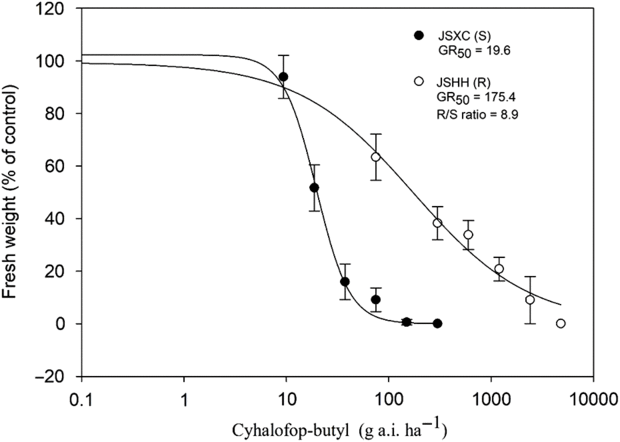
The dose–response curve showed that cyhalofop-butyl reduced fresh weight of JSXC and JSHH D. fusca population to about 18% and 80% of the control, respectively, at the recommended field dose (75 g ai ha−1) (Figure 1). The dose–response assays demonstrated that the D. fusca population (JSHH) was highly resistant to cyhalofop-butyl compared with the susceptible population (JSXC). The GR50 value was 19.6 g ha−1 for JSXC and 175.4 g ha−1 for JSHH, which suggests that the JSHH populations evolved 8.9-fold resistance to cyhalofop-butyl (Figure 1).
Cyhalofop-butyl dose–response curves for the susceptible (JSXC) and resistant (JSHH) Diplachne fusca populations. GR50, herbicide dose causing 50% plant growth reduction.

Cyhalofop-butyl has been used to control grass weeds in rice fields for more than 10 yr. Because cyhalofop-butyl is very safe for rice, the dose of cyhalofop-butyl reaches 225 to 300 g ha−1 (triple the recommended dose) in some regions, which presents a strong selection pressure. As a result, resistant weeds are becoming more common. Indeed, some cases of cyhalofop-butyl-resistant grass weeds in rice fields have been reported (Wu et al. Reference Wu, Li and Guo2018; Yu et al. Reference Yu, Gao, Pan, Yao and Dong2017) in recent years. Therefore, effective measures need to be taken to control the resistant weeds. Herbicide mixtures or rotations with different mechanisms of action and other management programs, such as crop rotation, removal of weed seeds, and clean machinery, are important for controlling the development of cyhalofop-butyl-resistant weeds.
ACCase gene sequencing
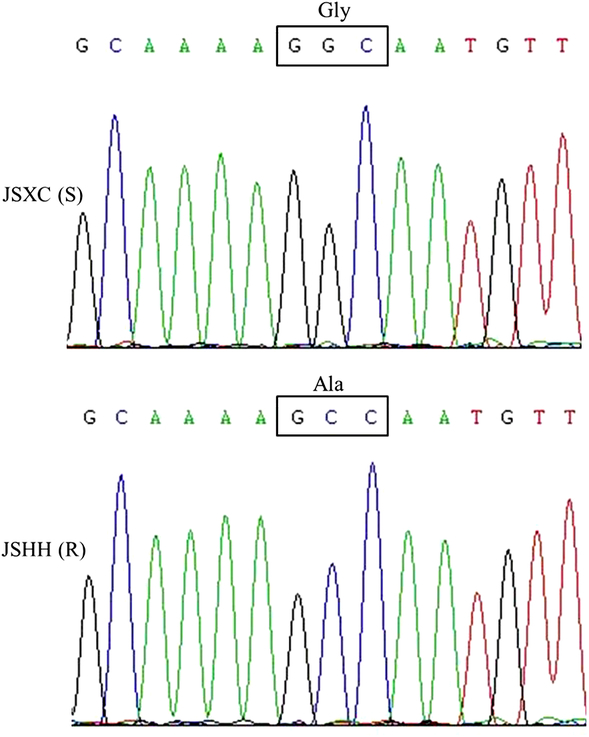
The amplified ACCase gene fragment, with a length of 1,317 bp, was compared with the ACCase sequence of A. myosuroides (AJ310767). The sequence-alignment results indicated that the homology reached 81.6% between the ACCase gene fragment from D. fusca and A. myosuroides. In addition, the ACCase gene obtained from the JSXC and JSHH D. fusca populations showed 99.0% similarity, and a single-nucleotide mutation of GGC to GCC resulted in an amino acid substitution at position 2096 from glycine in the JSXC population to alanine in the JSHH population (Figure 2). The frequency of the Gly-2096-Ala mutation was up to 90% in 20 plants of the JSHH population, and no Gly-2096-Ala mutation was found in JSXC population.
ACCase sequencing chromatogram showing GGC for Gly-2096 in the susceptible Diplachne fusca population (JSXC) and GCC for Ala-2096 in the resistant D. fusca population (JSHH).

The ACCase gene sequence analysis indicated that the Gly-2096-Ala mutation was the molecular basis of resistance to cyhalofop-butyl in the resistant population (JSHH). The same mutation at the Gly-2096 position has been identified in other resistant weed species, such as B. syzigachne (Pan et al. Reference Pan, Li, Zhang, Zhang and Dong2015), Lolium spp. (Scarabel et al. Reference Scarabel, Panozzo, Varotto and Sattin2011), and A. myosuroides (Délye et al. Reference Délye, Zhang, Michel, Matéjicek and Powles2005). To our knowledge, this is the first report of the Gly-2096-Ala mutation in D. fusca. Zhu et al. (Reference Zhu, Ge-Fei, Zhan and Yang2009) found that large conformational changes in the binding pocket caused by the Gly-2096-Ala mutation may contribute to the reduced sensitivity of ACCase enzyme to herbicides, which may be the cause of resistance to ACCase-inhibiting herbicides. In addition, we noted that the JSHH D. fusca population only has moderate resistance to cyhalofop-butyl (RI = 8.9), while the same mutation showed high levels of resistance to ACCase-inhibiting herbicides in B. syzigachne (Pan et al. Reference Pan, Li, Zhang, Zhang and Dong2015), Pseudosclerochloa kengiana (Ohwi) Tzvelev (Yuan Reference Yuan2016), and A. myosuroides (Délye et al. Reference Délye, Zhang, Michel, Matéjicek and Powles2005). It has been demonstrated that multiple target-site genes had a dilution effect on mutant alleles in polyploid weed species (Han et al. Reference Han, Yu, Widderick and Powles2016b; Yu et al. Reference Yu, Ahmad-Hamdani, Han, Christoffers and Powles2013a), which resulted in low resistance to herbicides. Spies et al. (Reference Spies, Van der Merwe, Du Plessis and Saayman1991) reported that D. fusca was diploid. Therefore, the possibility of multiple ACCase genes in D. fusca could be excluded; the moderate resistance to cyhalofop-butyl in D. fusca may be related to the weed species or the specific herbicide.
Cross-resistance to other ACCase-inhibiting Herbicides
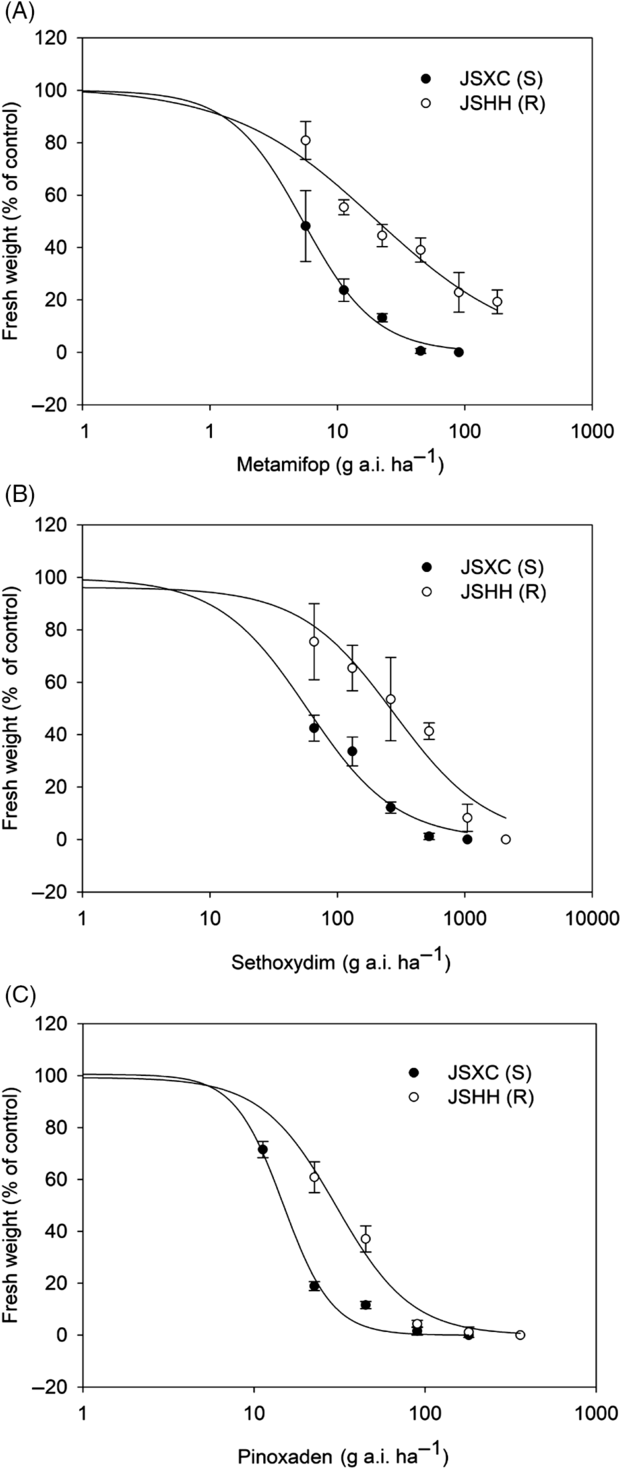
The dose–response experiments were performed to determine the cross-resistance to ACCase-inhibiting herbicides in the JSHH population with the Gly-2096-Ala mutation. The results indicated that the JSHH population showed significant cross-resistance to the APP herbicide metamifop, the CHD herbicide sethoxydim, and the CHD herbicide pinoxaden. As shown in Table 2, the RIs of the JSHH population to metamifop, sethoxydim, and pinoxaden were 3.7, 4.8, and 2.1, respectively. As shown in Figure 3, the fresh weight of the control was 13% for the JSXC population and 45% for the JSHH population when metamifop was applied at dose of 22.5 g ha−1 (Figure 3A). Sethoxydim reduced the fresh weight of the control to 12% and 53% for the JSXC and JSHH populations at a dose of 262.5 g ai ha−1, respectively (Figure 3B), and pinoxaden reduced the fresh weight of the control to 11% and 37% for the JSXC and JSHH populations at a dose of 45 g ha−1, respectively (Figure 3C).
GR50 and RI values for three different acetyl-CoA carboxylase–inhibiting herbicides for the susceptible (JSXC) and resistant (JSHH) Diplachne fusca populations. a

a Abbreviations: APP, aryloxyphenoxypropionates; CHD, cyclohexanediones; DEN, phenylpyrazolins; GR50, herbicide dose causing 50% plant growth reduction; RI, resistance index.
b Data are the mean ± SE. GR50 values with different letters in a column indicate a significant difference at p = 0.05 probability level.
c RI = GR50 of JSHH/GR50 of JSXC.
Metamifop (A), sethoxydim (B), and pinoxaden (C) dose–response curves for the susceptible (JSXC) and resistant (JSHH) Diplachne fusca populations.

The dose–response experiments indicated that the JSHH population carrying the Gly-2096-Ala mutation exhibited broad cross-resistance to the APP herbicide metamifop, the CHD herbicide sethoxydim, and the DEN herbicide pinoxaden. The different cross-resistance patterns conferred by the Gly-2096-Ala mutation have been observed in other resistant weeds. For example, P. kengiana and A. myosuroides with the Gly-2096-Ala mutation were resistant to APP herbicides, but sensitive to CHD and DEN herbicides (Petit et al. Reference Petit, Bay, Pernin and Délye2010; Yuan Reference Yuan2016). Beckmannia syzigachne with the same mutation was resistant to APP herbicides, sethoxydim, and pinoxaden, but sensitive to clethodim (Pan et al. Reference Pan, Li, Zhang, Zhang and Dong2015). The coexistence of TSR and NTSR has been demonstrated in other ACCase inhibitor–resistant weed species, including L. rigidum (Han et al. Reference Han, Yu, Owen, Cawthray and Powles2016a), Italian ryegrass [Lolium perenne ssp. multiflorum (Lam.) Husnot] (Zhang et al. Reference Zhang, Wu, Xu, Gao, Zhang and Dong2017), A. aequalis (Zhao et al. Reference Zhao, Yan, Ge, Zhu, Liu and Wang2019), and A. japonicus (Chen et al. Reference Chen, Xu, Zhang, Bai and Dong2018). It is unclear whether NTSR plays a role in the resistance of the JSHH population. Thus, the influence of NTSR on cross-resistance cannot be ruled out. The ACCase enzyme activity needs to be determined in future studies.
Author ORCIDs
Wei Deng, https://orcid.org/0000-0003-0996-4781
Acknowledgments
No conflicts of interest have been declared. This research received no specific grant from any funding agency or the commercial or not-for-profit sectors.