


When are men most useless, would you say?
When they can’t command and can’t obey.
(J. W. von Goethe)
Political theorists since the time of the ancient Greeks have observed that democracy depends in crucial respects on the presence of trust (Gambetta Reference Gambetta1988; Hetherington Reference Hetherington2005; Hetherington and Rudolph Reference Hetherington and Rudolph2015; Mara Reference Mara2001; Warren Reference Warren and Warren1999). If citizens cannot or will not accept, at least to some degree, that elected officials will place the collective good above more selfish and parochial interests, the entire political system is in a precarious position. Much as economic systems that involve the voluntary exchange of monetary instruments could not survive unless individuals trust that they will be able to buy goods and services from others with the instruments they have acquired through trade, political systems that prioritize the consent of the people are in danger of collapsing unless there is widespread agreement that the community as a whole will accept and honor the outcomes of free and fair elections. To put it even more starkly, the success of democracy depends on electoral losers’ willingness to accept the legitimacy of their loss and to concede, in some important sense, to the will of the majority.
In recent years, expert observers have worried that democratic norms are breaking down in the United States and that declining trust in governmental institutions is a key reason. According to Hetherington and Rudolph (Reference Hetherington and Rudolph2015, 1), “partisans whose party is out of power have almost no trust at all in a government run by the other side” and there is no longer any trust to be found “among the opposition,” that is, when one’s own preferred party is on the sidelines (see also Alford Reference Alford, Hibbing and Theiss-Morse2001; Keele Reference Keele2005). It stands to reason that citizens would be more enthusiastic about “the government” when it is led by members of the party (or ideology) they support than when it is not (Citrin and Green Reference Citrin and Green1986). Nevertheless, this seemingly mundane aspect of human behavior—the tendency to trust those who are similar more than those who are dissimilar—spells danger for democratic institutions, which require some level of tolerance for the ideas and policies of those who are, in fact, dissimilar.
In this research program, we investigate the possibility that ideological differences exist between liberals and conservatives in the United States when it comes to accepting the legitimacy of a democratically elected government run by the other “side.” We draw on accumulating evidence in psychology and political science of ideological differences and asymmetric polarization to investigate the hypothesis that conservatives would be more likely than liberals to exhibit a “president-in-power” effect—that is, a stronger tendency to trust the government more when the top elected office is held by an executive who is similar (rather than dissimilar) in terms of ideology. We focus on the presidency because it is most symbolic of government (Citrin and Green Reference Citrin and Green1986), although Congressional approval clearly influences trust in government as well (Citrin and Luks Reference Citrin, Luks, Hibbing and Theiss-Morse2001; Hetherington and Rudolph Reference Hetherington and Rudolph2015, 66).
Our analysis of public opinion in nationally representative samples in the United States spanning several decades provides consistent evidence of an asymmetrical president-in-power effect on trust in the government; citizens who are conservative trust the government more when the leader of the government shares their own ideology, and they do so more than citizens who are liberal. Conversely, liberals grant more legitimacy to governments led by conservatives than vice versa. A similar asymmetry applies to Republicans compared with Democrats.
IDEOLOGICAL DIFFERENCES IN POLITICAL TRUST
Political trust is not only “essential to a democratic community’s well-being” (Mara Reference Mara2001, 820) but also a necessary requirement for the implementation of public policy (Hetherington Reference Hetherington2005, 5). An important variation, however, exists in the extent to which citizens trust the government, depending on demographic and socioeconomic factors (Hetherington Reference Hetherington2005, 16–7) as well as ideology (Alford Reference Alford, Hibbing and Theiss-Morse2001; Rudolph and Evans Reference Rudolph and Evans2005) and partisanship (Hetherington and Rudolph Reference Hetherington and Rudolph2015; Keele Reference Keele2005). Following Keele’s (Reference Keele2005, 875) analysis, if we suppose that “governance is really party governance” and that the president is the “de facto leader of the party,” one might expect, on the basis of homophilic preferences, that citizens would trust the government more when a president from their party is in power than when it is not. However, there are two major reasons why we might anticipate that any “president-in-power” effect would be stronger among conservatives than liberals. These reasons, we hasten to point out, are far from mutually exclusive; on the contrary, we suspect that they work together in tandem.
The first reason pertains to the fact that Republican elites have become ideologically extreme. Although some political scientists hold that ideological conflict and polarization are symmetrical rather than asymmetrical (Fiorina and Abrams Reference Fiorina and Abrams2008; Iyengar, Sood, and Lelkes Reference Iyengar, Sood and Lelkes2012; Levendusky Reference Levendusky2010), there is increasing evidence that polarization is stronger on the right than on the left (Abramowitz Reference Abramowitz, Thurber and Yoshinaka2015, 33–4; Barber and McCarty Reference Barber, McCarty, Mansbridge and Martin2015; McCarty, Poole, and Rosenthal Reference McCarty, Poole and Rosenthal2006; Hacker and Pierson Reference Hacker and Pierson2006; Mann and Ornstein Reference Mann and Ornstein2012) and that Republicans are especially distrusting of Democratic governance (Hetherington and Rudolph Reference Hetherington and Rudolph2015, 9). Grossmann and Hopkins (Reference Grossmann and Hopkins2016) argue that—for a variety of historical reasons—including demographic changes and “the construction of the conservative media universe” (316), the Republican Party has become more ideologically intense (and unified) than the Democratic Party. Presumably, this is why “Republicans in Congress have moved further to the right than Democrats have to the left over the last 40 years” (Hare and Poole Reference Hare and Poole2014, 424).
The second reason pertains to psychological differences between liberals and conservatives. A recent meta-analytic review of more than 180 studies involving 130,000 individual research participants reveals that, in comparison with liberals, conservatives score higher on measures of dogmatism, intolerance of ambiguity, cognitive and perceptual rigidity, and epistemic needs for order, structure, and closure (Jost Reference Jost2017). In addition, they score higher on measures of self-deception, negativity bias, subjective perceptions of threat, and various relational motives to conform to and share a sense of reality with like-minded others and the tendency to maintain more homogeneous, cohesive social networks (Barberá et al. Reference Barberá, Jost, Nagler, Tucker and Bonneau2015; Boutyline and Willer Reference Boutyline and Willer2017; Federico, Deason, and Fisher Reference Federico, Deason and Fisher2012; Hibbing, Smith, and Alford Reference Hibbing, Smith and Alford2014; Jost et al. Reference Jost, van der Linden, Panagopoulos and Hardin2018; Miller, Saunders, and Farhart Reference Miller, Saunders and Farhart2015; Schwartz et al. Reference Schwartz, Caprara and Vecchione2010; Stern et al. Reference Stern, West, Jost and Rule2014). Insofar as citizens regard domestic politics as a form of in-group/out-group competition, it follows—from all of these psychological differences—that conservatives would exhibit more loyalty, commitment, and tenacity when it comes to supporting government run by their own “side,” and to exhibit more distrust, rejection, and contempt when it comes to government run by the other “side.” These two levels of explanation—political and psychological—are compatible insofar as “top-down” processes of elite influence connect up with “bottom-up” needs and interests of followers (Jost, Federico, and Napier Reference Jost, Federico and Napier2009). Or, to adopt an economic metaphor, in the marketplace of ideology there are both supply-side and demand-side dynamics at work.
DATA AND MEASURES
Our analysis relies on pooled cross-sectional surveys from the American National Election Studies (ANES) and the General Social Survey (GSS). Both ANES and GSS datasets span five decades (from the early 1970s to 2016). We consider only those surveys that include at least one question about trust in government as well as a question about ideology. This leaves us with a total of 20 surveys from ANES and 28 surveys from GSS.Footnote 1
American National Election Studies
To measure trust in government, we rely on the following question, which has been consistently included in all ANES surveys: “How much do you trust the Federal Government to do what is right?” Respondents chose among four answers: “None of the time,” “Some of the time,” “Most of the time,” and “Just about always.”Footnote 2 To increase comparability of analysis across datasets, we treat the variable as a quasi-interval variable, with values rescaled from 0 (“None of the time”) to 1 (“Just about always”).
Our key explanatory variable is based on a standard seven-point question about respondents’ ideology, which we recoded as a dummy (liberal versus conservative).Footnote 3 In addition, we created a president-in-power variable, which took either the value of 0 if the president in power at the time the survey was conducted was from a party that differed from the respondent’s self-reported ideology (“other-ideology president”) or the value of 1 for the opposite case (“own-ideology president”). In all regression models, we includesociodemographic covariates that are usually correlated with trust in the government, such as gender, age, education, work status, ethnicity, income, and religious denomination (Hetherington Reference Hetherington2005). In addition, we replicate the analysis using party identification instead of ideology.Footnote 4
General Social Survey
Our main dependent variable in the GSS dataset is a question about confidence in the executive branch of the government.Footnote 5 Respondents could choose whether they had “Hardly any,” “Only some,” or “A great deal” of confidence in the government. Again, we treat responses as a quasi-interval variable. We recoded the original seven-point question about respondents’ ideology as a dummy and created the president-in-power variable following the same procedure used for ANES data. We include the same set of covariates used in the ANES analysis.
PRESIDENT-IN-POWER EFFECTS ON POLITICAL TRUST
Figure 1 illustrates how trust in government changed for liberals and conservatives under various presidencies since the early 1970s. Despite fluctuation over time, time trends from ANES and GSS reveal that the major source of variation in trust in the government is on the conservative side, whereas confidence in the government among liberals does not vary systematically as a function of the president in power. In addition, historical trends suggest that the trust gap between liberals and conservatives widened slightly over the last two decades (see Appendix G for further analysis).
Trust in the Government by Ideology

We pooled all cross-sectional surveys from ANES and GSS and conducted regression models using trust in government as a dependent variable. In each model, we interacted respondents’ ideology with a dummy variable for the president in power at the time the survey was conducted, either excluding or including covariates, and with different time specifications.Footnote 6
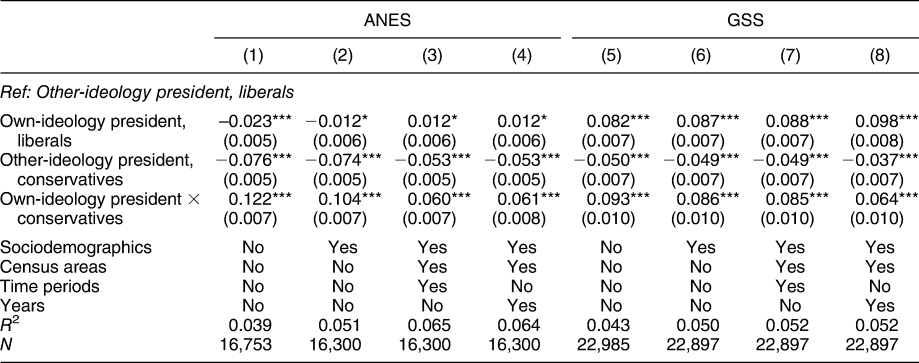
As the results in Table 1 show, conservatives trust the government five- to eight-percentage points (ANES) and four- and five-percentage points (GSS) less than liberals do when a president with a different ideology is in the White House. In addition, positive interaction coefficients consistently reveal the existence of an asymmetrical president-in-power effect: conservatives trust the government six- to 12-percentage points (ANES) and six- to nine-percentage points (GSS) more than liberals do under a like-minded president.
President-in-Power Effects on Trust in the Government by Ideology

Note: OLS regressions with robust standard errors in parentheses. Pooled cross-sectional data from 1972/1974 to 2016. Dependent variables rescaled from 0 (minimum trust) to 1 (maximum trust). Weighted data. Complete regression models available in Table A.3 and Table A.4 in Appendix A.
* p < 0.5, ** p < 0.01, *** p < 0.001, two-tailed tests.
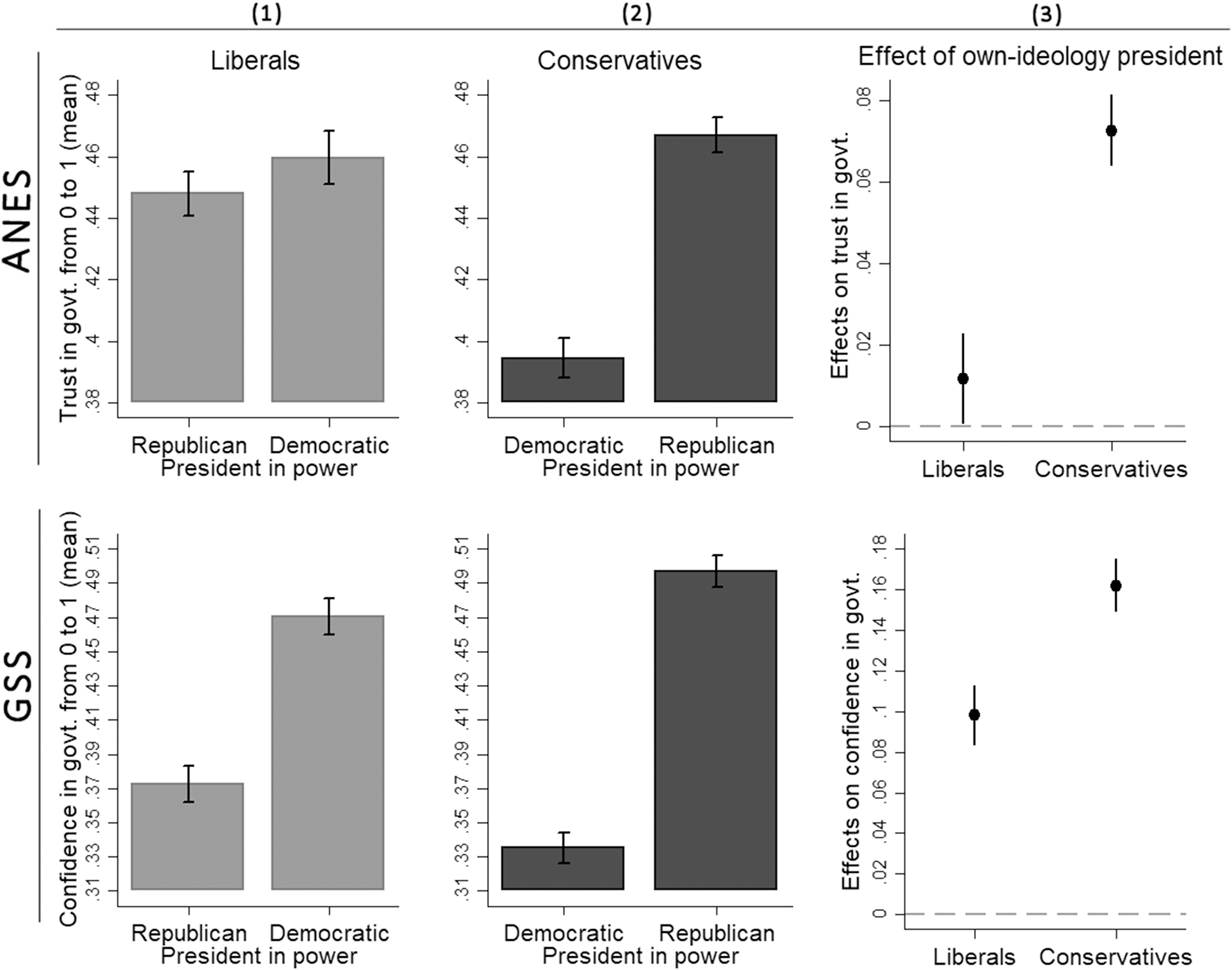
In Figure 2, we illustrate the results from regression models 4 and 8. As the bar graphs show, trust in government is higher among both liberals and conservatives under a like-minded president, but the gap is clearly larger for conservatives. The average marginal effects in the third column illustrate the magnitude of the president-in-power effect by ideology categories. Although the general effect of an ideologically similar (versus dissimilar), president on governmental trust is larger in GSS than ANES data, both analyses reveal that the effect is consistently larger for conservatives (versus liberals). In ANES data, conservatives trust the government seven-percentage points more under a like-minded president (versus a not like-minded president), whereas the increase among liberals is only of one-percentage point. In GSS data, conservatives’ confidence in the government increases by 16-percentage points under a like-minded president, whereas liberals’ confidence increases only by 10-percentage points.
President-in-Power Effects on Trust in the Government by Ideology
Note: Estimates based on models 4 and 8 in Table 1. Column 3: Average marginal effects of a president with similar ideology, relative to a president with different ideology (value 0 on Y-axis). Vertical bars correspond to 95% confidence intervals.

Alternative Model Specifications
The results are robust to several alternative specifications of the models, in which we controlled for partisanship (thus indicating that the effect of ideology is independent from partisanship), controlled for which parties had the majority in either branches of the Congress, and replaced the dependent variable in ANES data with either a dummy variable or an index of trust in government (see Appendix A). In addition, we restricted the analysis to all pairs of consecutive surveys in which a change from a Democratic to a Republican president (or vice versa) occurred to determine whether the effects identified in the pooled dataset depended on specific presidential transitions. Results from both ANES and GSS confirm that a significant, asymmetrical president-in-power effect occurs for every pair of switch years except two,Footnote 7 with no increase in magnitude over time (see Table A.8). Furthermore, we tested whether the detected effects changed under periods of either united or divided Congress. The results indicate that asymmetrical president-in-power effects are stronger when the Congress is divided, thus suggesting that conservatives take sides with a Republican president especially when political elites in the legislative branch send “conflicting signals” (see Table A.9).
We also investigated whether differences between liberals and conservatives depended on ideological extremity, using a four-category version of the ideology scale. Results reveal that there is a larger president-in-power effect for extreme (versus moderate) liberals, but the ideological asymmetry remains. That is, extreme conservatives show a significantly stronger president-in-power effect than extreme liberals (see Figure A.1 in Appendix A).
Party Identification
In Appendix B, we replicated the models listed in Table 1 using party identification rather than ideology. The results reveal that a similar asymmetrical president-in-power effect occurs between Republicans and Democrats. Depending on the datasets and model specifications, Republicans trust the government 4–7-percentage points less than Democrats do when an out-party president is in the White House. In addition, Republicans trust the government between eight- to–13-(ANES) and 12–15-(GSS) percentage points more than Democrats under a president from the same party. The fact that these results hold when we adjust for ideology indicates that both partisanship and ideology contribute to the asymmetry we have identified.
What About Moderates and Independents?
We also investigated the attitudes of moderates and independents (Appendix C). If we specify that moderates’ “own-ideology president” is a Republican, we find either that trust does not substantially change depending on the president in power (GSS) or that trust in government is higher than under a Democratic presidency (ANES). Importantly, however, the increase in trust under a Republican (vs. Democratic) president is larger among conservatives than moderates. When we compare Republicans with Independents, we reach a similar conclusion. These results strengthen our confidence that the asymmetrical president-in-power effect depends on specific characteristics of conservative followers and elites, rather than more general trends.
Additional Data
We replicated the analysis using two additional datasets. First, we pooled nine surveys conducted by the PEW Research Center throughout the period 2006–17. The results confirm the existence of an asymmetrical president-in-power effect that also applies to the most recent change of presidency. That is, conservatives and Republicans exhibited a stronger tendency to trust the government more under a Trump (vs. Obama) presidency in comparison with liberals’ and Democrats’ tendency to trust the government more under an Obama (vs. Trump) presidency (see Appendix E). Second, we collected aggregate levels of trust in the government from 128 surveys conducted by six research institutes between 1972 and 2017. Again, we see that conservatives and Republicans trust the government substantially and significantly more than liberals and Democrats do under a like-minded president (see Appendix F).
CONCLUSION
In an era of polarized politics, it is conventional wisdom to assume that citizens trust the government more when it is led by a chief executive who shares their own political views in comparison to a leader from “the other side.” Importantly, however, we have discovered that American citizens are not equally prone to exhibit a “president-in-power” effect on governmental trust. Consistent with growing evidence of left–right ideological asymmetries in psychology and political behavior (Jost Reference Jost2017; Jost et al. Reference Jost, van der Linden, Panagopoulos and Hardin2018), there is a clear asymmetry in the president-in-power effect: conservative citizens trust the government more than liberals do when the president in power shares their own political views. Conversely, liberals are more willing than conservatives to grant legitimacy to a government led by the opposition. A similar asymmetry applies to Republicans compared with Democrats. These findings are in contradiction to the notion that liberals and conservatives are equally “biased” and intolerant of one another (e.g., Brandt et al. Reference Brandt, Reyna, Chambers, Crawford and Wetherell2014; Frimer, Skitka, and Motyl Reference Frimer, Skitka and Motyl2017), and they suggest that conservatives’ ostensibly principled opposition to “big government” may apply more to Democratic than Republican governance.
These findings also add to the expanding literature on asymmetric polarization (e.g., Grossmann and Hopkins Reference Grossmann and Hopkins2016). Because the starting point of our analysis (early 1970s) coincides with the apparent rise in asymmetric polarization in Congress (Hare and Poole Reference Hare and Poole2014), we cannot determine whether our results are primarily attributable to top-down processes of elite influence or bottom-up individual differences. We suspect that both factors work together: elites play to their bases, and the bases elicit certain patterns of communication from elites. Furthermore, if elite communication were the only driving force, we would expect that liberal–conservative differences in the president-in-power effect would have grown over the past five decades. In fact, although the trust gap between liberals and conservatives appears to have increased slightly over time, we do not observe a clear historical increase in ideological asymmetry (see Appendix G), suggesting that somewhat more stable psychological differences between liberals and conservatives may play a role. In any case, the fact that robust (and heretofore undetected) differences between liberals and conservatives can be demonstrated on longstanding topics of social scientific research, such as political trust, suggests a need for future research to more seriously consider ideological asymmetries when it comes to investigating social and political phenomena.
Our findings raise a number of theoretical and practical questions about democratic functioning. How is it possible to guarantee democratic stability if trust in the government shifts substantially—and systematically—as a reaction to the chief executive in power? Does the ideological asymmetry we have identified tilt the playing field disproportionately in favor of conservatives and against liberals? In light of recent developments in American politics, it is worth asking: if politicians were to promote a less adversarial environment and to frame politics less in terms of intergroup conflict and more in terms of national unity, would citizens (especially conservative citizens) be more willing to trust a democratically elected government with a decidedly different point of view?
SUPPLEMENTARY MATERIAL
To view supplementary material for this article, please visit https://doi.org/10.1017/S0003055418000850.
Replication materials can be found on Dataverse at: https://doi.org/10.7910/DVN/XF1157.





Comments
No Comments have been published for this article.