Introduction
Since its introduction in 1985, transcranial magnetic stimulation (TMS) has been employed in the treatment of a variety of neurological diseases, such as neurodegenerative and movement disorders, tinnitus, chronic pain, stroke rehabilitation, and psychiatric disorders, including major depression, psychotic, addictive, and anxiety disorders.
TMS is based on the application of magnetic fields generated by electrical energy passing through a coil located on the scalp. The magnetic field is characteristically pulsating and has a variable intensity (1.5-3 Tesla). This energy is able to penetrate to a variable depth—usually 2 to 3 cm—below the skull, generating an electric current that interferes with neuronal depolarization, increasing or reducing cortical excitability, depending on stimulation parameters.
In relation to the rationale of TMS efficacy in depressive disorders, it is well established that two neuronal networks are involved in the development of the main depressive symptoms: a ventral network and a dorsal one. Depressive symptoms are generated by a concomitant hypoactivation of the dorsal prefrontal brain regions with a hyperactivation of the ventral ones, particularly in the left hemisphere.Reference Davidson1 Treatment with repetitive TMS (rTMS) is aimed to induce a stimulation of the prefrontal dorsal regions and an inhibition of the ventral ones, re-establishing the normal balance between the two hemispheres.Reference Walpoth, Giupponi and Pycha2, Reference Mayberg3 Therefore, the mechanism of action of rTMS relies on the high-frequency stimulation (with activating effects) of the dorsolateral prefrontal cortex (DLPFC) at the level of the left hemisphere or, alternatively, on the low-frequency stimulation (with inhibitory effects) at the level of the DLPFC of the right hemisphere.Reference George and Belmaker4
The efficacy of acute repetitive TMS (rTMS) in the management of treatment-resistant depression has been proved by several randomized sham-controlled studies,Reference Padberg and George5 including over 1200 patients, and by numerous meta-analyses.6–Reference Couturier8 On the other hand, to date, few studies have focused on the post-acute effects of TMS. Dannon and colleaguesReference Dannon, Dolberg, Schreiber and Grunhaus9 followed a group of patients who responded to acute treatment with Electro Convulsive Therapy (ECT) (n = 20) or rTMS (n = 21) and found 6 months relapse rates of 20% in both groups.
Efficacy of a new course of rTMS for relapsing patients has been assessed by two studies that reported sustained efficacy for a new cycle of stimulations.Reference Fitzgerald, Benitez, De Castella, Brown, Jeff Daskalakis and Kulkarni10, Reference Demirtas-Tatlidede, Mechanic-Hamilton and Press11 In particular, the average interval between the first and the second cycle of treatment—that is, the average duration of clinical effect—was approximately 5 months.
Subsequently, Cohen and colleaguesReference Cohen, Boggio and Fregni12 investigated the time to remission and maintenance of remission after a TMS cycle in a large naturalistic retrospective study of 204 patients followed up for 6 months. About 75.3% of the sample was found to maintain remission after 2 months, 60.0% at 3 months, 42.7% at 4 months, and 22.6% at 6 months. More recently, a similar study, conducted by Mantovani and coworkers,Reference Mantovani, Pavlicova and Avery13 showed that, 3 months after acute TMS, 58% of the sample (50 enrolled subjects) was still in remission, regardless of the pharmacological treatment.
Given that investigation of post-acute TMS effects is crucial to determine whether, when, and for whom maintenance sessions are recommended, the aim of the present study was to assess the post-acute effect of rTMS over a 6-month follow-up period, quantifying post-acute relapse rates in acute TMS responders as well as late responses in acute TMS nonresponders.
Methods
A sample of 37 patients of either gender, with a cross-sectional diagnosis of moderate to severe major depressive episode and a longitudinal diagnosis of major depressive disorder or bipolar disorders, was recruited. Diagnoses were performed by psychiatrists, on the basis of DSM-5 criteria,14 using the SCID-5.15 In a preliminary interview, the main sociodemographic (age, education, marital status, employment) and clinical (psychiatric history, family history, age at onset, age at fist pharmacological treatment, pharmacological treatments history, pharmacological treatment at the time of the interview) characteristics of the patients had been collected. Patients were recruited at the University Department of Mental Health of the Fondazione IRCCS Ca’ Granda Ospedale Maggiore Policlinico of Milan and followed up at the same institution and at the Department of Mental Health of the Ospedale Sacco-Polo Universitario of Milan. The study protocol obtained the approval of the local Ethics Committee, and recruited patients received and subscribed a written informed consent before the enrollment.
Inclusion criteria were represented by the presence of a condition of partial or absent response to at least one (ie, poor response) or more (ie, treatment resistance) adequate antidepressant trials (given at therapeutic dosages for at least 8 weeks), during the current episode. For patients with bipolar depression, the condition of poor treatment response or resistance included adequate treatment with lithium or mood stabilizers plus lamotrigine or quetiapine at therapeutic doses.Reference Pacchiarotti, Mazzarini and Colom16
Response had been defined as a ≥50% reduction of the Hamilton Depression Rating Scale, 21 items (HAM-D 21)Reference Hamilton17 total score, compared to baseline. Patients with a HAM-D score < 8 were considered remitters. Partial response was defined as a reduction between 25% and 50% on HAM-D total score, compared to baseline; absent response was defined as a ≤25% reduction on the same scale.Reference Nierenberg and DeCecco18 Psychopharmacological treatment had to remain unchanged for the 4 weeks of the acute TMS treatment and then for the follow-up period.
Exclusion criteria were represented by the presence of neurological disorders (epilepsy or family history of epilepsy, previous significant head injuries, brain surgery, and traumas with loss of consciousness for at least 15 minutes), pregnancy or lactation, significant medical (severe cardiac disorders, hypertension, sleep apnea, delirium) and/or psychiatric comorbidities (schizophrenia and other related psychosis, mental retardation, depression due to another medical condition), substances abuse in the last 1 year, presence of a pacemaker, or any other electrical stimulation device or metallic elements (ie, clips) inside the brain. In relation to Substance Use Disorder (SUD) comorbidity, we excluded subjects with a diagnosis of SUD but have included subjects without a daily use of alcohol or substances not fulfilling the criteria for SUD. Among substances, we did not consider tobacco, so that patients with previous or current tobacco smoking were included. Recruited subjects had to be >18 and <80 years old. Another exclusion criterion was represented by the occurrence of major variation in the psychopharmacological treatment, intended as a switch of antidepressants, the introduction of a mood stabilizer or a significant variation of the dosages during both the acute trial and the follow-up period.
During the acute TMS trial, patients had been randomized into three groups of treatment that followed three different stimulation protocols, all of which chosen within those recommended in the International Safety GuidelinesReference Rossi, Hallett and Rossini19: (i) right DLPFC, LF-rTMS (1 Hz), 110% of Motor Threshold (MT), 7 trains of 60 seconds each (420 stimuli per session) interspersed by 1 minute of pause; (ii) right DLPFC, low frequency (1 Hz), 110% of MT, continuous, 15 minutes of treatment (900 stimuli per session); (iii) left DLPFC, high frequency (10 Hz), 80% of MT, 15 trains of 5 seconds each, interspersed by 25 seconds of pause (750 stimuli per session) (Details on the acute TMS trial have been previously published from Dell’Osso et alReference Dell’Osso, Oldani and Camuri20). We then proceeded to evaluate patients for a 6-month follow-up period, in order to monitor the effects of TMS in the long-term. More in detail, the study included five phases: (i) screening and recruitment, (ii) randomization in one of the three stimulation protocols, (iii) motor threshold assessment, (iv) acute rTMS trial (20 applications for a total of 4 weeks), and (v) observational follow-up up to 6 months. In the last phase, representing the focus of the present study, follow-up evaluations were conducted through psychometric scales at 1, 3, and 6 months after the completion of acute TMS. Patients had to complete the entire cycle of acute treatment with rTMS to be included in the follow-up study.
The efficacy has been assessed using the following psychometric scales: Hamilton Rating Scale for Depression (HAM-D 21 items),Reference Hamilton17 Montgomery Asberg Depression Rating Scale (MADRS),Reference Montgomery and Asberg21 Hamilton Anxiety Scale (HAM-A),Reference Hamilton22 Clinical Global Impression-Severity of Illness (CGI-S).Reference Guy23 Moreover, the Young Mania Rating Scale (YMRS)Reference Young, Biggs, Ziegler and Meyer24 had been administered in order to detect manic/hypomanic switches. This entire test battery was administered 1 month (T5), 3 months (T6), and 6 months (T7) after the end of treatment.
The possible presence of side effects, both spontaneously reported by patients or detected by clinicians, has been registered for the entire duration of the follow-up period, in order to evaluate the tolerability of the technique.
At the end of the acute trial, patients were categorized into acutely responders (full and partial responders, remitters) and nonresponders. Among acutely responders, those who reached a >18 score on the HAM-D scale at any time-points of the follow-up (T5-T7) were considered as relapsed. On the other hand, the occurrence of late response was evaluated at the three timepoints in the acutely nonresponders. A characterization of the type of response (full, partial, remission) was performed at the end of the follow-up period.
Statistical analyses
The sample was characterized through the analysis of the main clinical and demographic variables (median and range for continuous variable, frequencies for categorical ones). The percentages of response both early and at the end of treatment were analyzed. Time to response was represented by survival curves (Kaplan–Meier method). Moreover, possible correlation between response to treatment and the different clinical-demographic variables were analyzed with Student t-test for continuous variables and Chi-squared test for categorical ones, with Mann–Whitney analysis for nonparametric variables. A possible correlation between the response to treatment and the three different stimulation protocols was analyzed using Kruskal–Wallis test. Survival curves (log-rank test) were performed in order to analyze the relationship between the time to response and different clinical variables.
The relapse rates occurring in the follow-up were calculated on the basis of the previous type of response. Recurrence occurring in the follow-up period had been represented on a Kaplan–Meier curve. Finally, to assess manic or hypomanic switches, YMRS scores were analyzed using one-way ANOVA.
The level of significance was set at P value <.05. All statistical analyses were performed using IBM SPSS Statistics for Macintosh, Version 25.0. Armonk, NY: IBM Corp.
Results
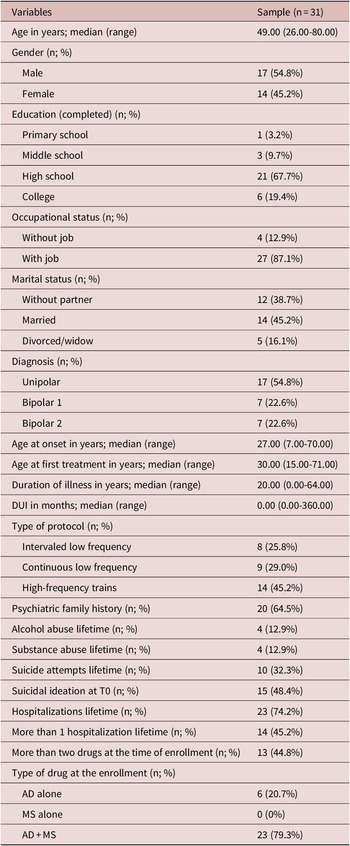
A total of 37 patients (21 males and 16 females) have been recruited for the acute trial. From this total sample, 33 completed the entire stimulation treatment. Drop-outs (n = 4; 11% of the sample) have been motivated by the need for hospitalization due to worsened conditions (n = 2), poorly tolerated side effects (n = 1), and concomitant substance abuse (n = 1). Two (6%) of the 33 subjects who completed the treatment with rTMS were excluded from the follow-up as they underwent major changes in their pharmacological treatment. Clinical-demographic characteristics of the 31 subjects who participated in the follow-up study are reported in Table 1.
Clinical-Demographical Characteristics of the Study Sample

Abbreviations: AD, antidepressants; DUI, duration of untreated illness; MS, mood stabilizers.
Considering the 31 patients enrolled, 20 (64.5%) subjects were categorized as acutely responders, while the remaining 11 (35.5%) subjects did not acutely respond and were, therefore, evaluated for the occurrence of a late response. Indeed, 7 (63.64%) of these subjects showed a response during the follow-up, while 4 (36.36%) did not show any late response.
In respect to relapse rates among acutely responder patients (n = 20), two of them (10%) relapsed. The loss of response occurred early from the end of treatment with rTMS (median time to relapse = 6.25 weeks), between T5 and T6.
Among the 25 subjects who, at the end of the follow-up period, showed some degree of response, 17 (54.8%) were classified as partial responders, 4 (16.1%) as full responders, and 4 (16.1%) as remitters.
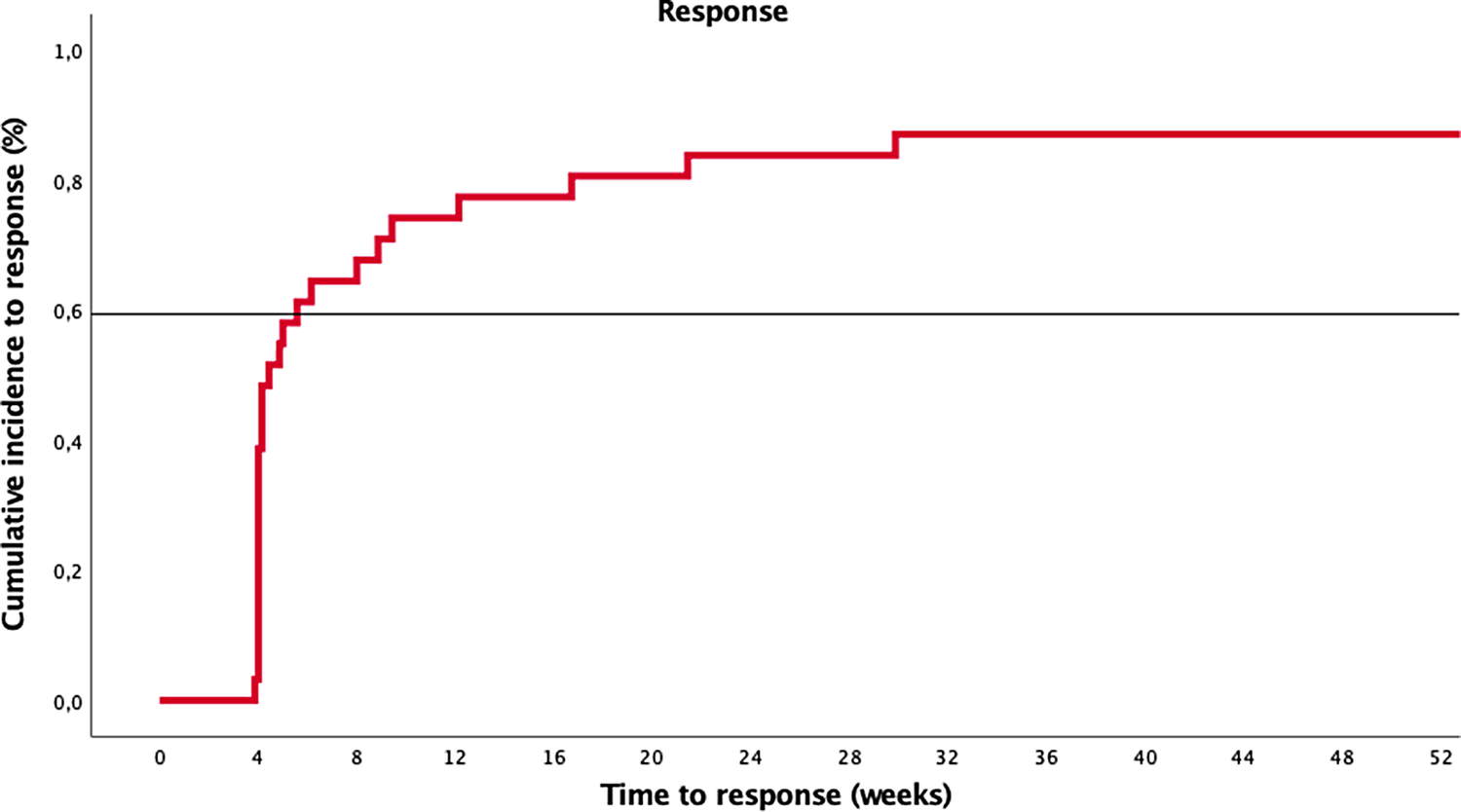
Figure 1 shows the time to response during the whole observation period. The median response time resulted in 4.43 weeks, thus starting from T5 (first month of follow-up).
Cumulative incidence of the response in the observation period; the median response time resulted in 4.43 weeks.

Considering the possible correlation between treatment response and clinical-demographic variables of the sample, a statistically significant relationship was observed only for the age at first treatment (P = .02). No statistically significant relationship between response and type of stimulation protocol was observed (P > .10).
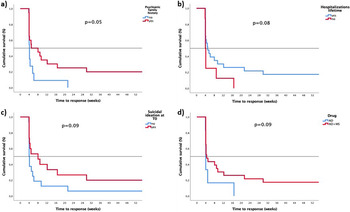
Evaluating a possible relationship between the time to response and the main clinical indicators of severity (diagnosis, age at first treatment, age at onset, duration of untreated illness, lifetime hospitalization, psychiatric family history, suicidal ideation at enrollment, number, and class of psychotropic drugs), a statistically significant correlation was found only for psychiatric family history (log-rank P = .05), while a trend of statistical significance was observed for lifetime hospitalizations (log-rank P = .08), suicidal ideation at enrollment (log-rank P = .09) and for the concomitant therapy with antidepressants and mood stabilizers (log-rank P = .09). Survival curves showing these correlations are reported in Figure 2. No statistical significance emerged between time to response and the three different protocols of stimulation (log-rank P = .21).
(A) Relationship between time to response and psychiatric family history; (B) relationship between time to response and hospitalizations lifetime; (C) relationship between time to response and suicidal ideation at T0 timepoint; and (D) relationship between time to response and type of drug used.

No statistically significant variations of the YMRS scores were found.
Discussion
Due to the paucity of data in the field, in this follow-up study, we focused on the post-acute effects of TMS with specific focus on response and relapse rates. These effects were monitored in the absence of maintenance TMS sessions and major modifications in the pharmacological treatment.
Concerning response maintenance, we found that 90% of patients who responded at the end of the acute TMS trial, remained responders also throughout the entire follow-up period. These findings parallel results of previous studies in the fieldReference Mantovani, Pavlicova and Avery13, Reference Dell’Osso, Camuri and Castellano25 and seem of particular clinical interest, since the sample consisted of patients fully or partially resistant to psychopharmacological treatment. Moreover, the hypothesis that the effect of the stimulation can persist up to 6 months after the end of the treatment seems to be supported by our findings. In addition, our findings further support the efficacy of TMS vs ECT in the management of treatment-resistant depression. In this regard, relapse rates of 40% or greater in the 6 months following termination of acute phase ECT are documented.Reference Prudic, Haskett and McCall26
Our analyses showed encouraging results concerning the possibility to obtain a clinical response also after the end of an acute TMS trial. In fact, among 11 patients who, at T4, had shown no response, more than half of them showed a response in the follow-up. Furthermore, in most of these patients, response occurred after reaching T5, that is, 1 month after the end of TMS. Of note, the exclusion of patients who, during the follow-up, required a major change in their pharmacological treatment, should have limited potential confounding therapy-related factors. Indeed, the continuation of the same antidepressant and/or mood-stabilizing therapy during the whole course of the trial also seems to support the effectiveness of the combination of neuromodulation techniques and available pharmacotherapies beyond the acute stimulation phase, without any side nor adverse event, as confirmed by the recent reports in the field.Reference Martinotti, Montemitro and Pettorruso27 From a biological perspective, both the sustained efficacy of rTMS in the long-term and the possibility to obtain a response even after the end of the acute treatment could be explained by the modifications of cortical plasticity, documented in several studies.28–Reference Yukimasa, Tamagawa and Uozumi31
Analyzing the possible relationship between treatment response and different clinical-demographical variables, only age at first treatment was found to be statistically significant. Indeed, we expected that patients with characteristics of higher severity of illness (ie, longer duration of illness and longer DUI, greater number of hospitalizations, presence of psychiatric family history) would exhibit lower rates of response than subjects with a minor clinical severity. On the other hand, these results could be explained by the small sample size. Evaluating the differences in terms of efficacy between the three stimulation protocols, considered as the total scores reduction in HAM-D, we did not find any significant difference. Moreover, no significant difference was found when grouping the two low-frequency protocols and comparing them with the high-frequency one. Regarding the different protocols of stimulation, we found that the time to response did not depend on the type of protocol selected, showing that the three different protocols were similar in relation to this parameter. Overall, our findings, in terms of efficacy and tolerability between the stimulation parameters used, confirm the safety of these protocols.
The present study showed that the time to response was significantly longer in patients with a positive psychiatric family history, with a trend of significance in patients with: (i) at least one previous hospitalization, (ii) suicidal ideation at the time of enrollment, and (iii) combined treatment. These results may suggest that late response can be achieved also by patients with a greater clinical severity of illness. Furthermore, present data add valuable information to previous reports, showing that greater severity of illness and pharmacological resistance were related to worse/lack of response to rTMS.Reference Dell’Osso, Camuri and Castellano25, Reference Mitchell and Loo32
With respect to relapse, the present study showed that 10% of acutely responders patients experienced this condition during the follow-up period and this event occurred approximately 2 months after the end of the stimulation. Data about relapse rates seem to be consistent with those found in other follow-up studies reporting a 20% rate of relapse, with a mean persistence of clinical benefit of about 5 months.Reference Fitzgerald, Benitez, De Castella, Brown, Jeff Daskalakis and Kulkarni10, Reference Demirtas-Tatlidede, Mechanic-Hamilton and Press11
In our study, relapse occurred both in patients who achieved a full response and in those who were remitters at the end of acute TMS. It is worth noting that the relapse rate in the acutely responders was only 10% (2 out of 20), while 63.64% of the acutely nonresponders showed a late response during the follow-up period (7 out of 11). While these data indicate an overall response rate (at T7) of 80.65% (25 out of 31), which is higher than previously published data in the field, our study is one of very few, if any, evaluating the late-response rate to an acute rTMS trial. From this perspective, although needing further confirmation from larger sample trials, our study reports novel findings that are difficult to be compared with existing data, which are mostly related to the acute or short-term effects of TMS in the treatment of depressive episodes. Moreover, in the follow-up period, as in the stimulation phase, no manic or hypomanic switch occurred. From this perspective, rTMS may be considered safer than antidepressant treatments in BD. The present study thus confirmed that rTMS in the follow-up period, as well as in the acute treatment, is a valid therapeutic approach for bipolar depressed patients.
The limitations of the present study are represented by the open-label design with lack of a control group treated with sham rTMS during the acute trial and by the limited sample size. In this regard, the lack of differences, in terms of efficacy, relapse rates, and time to response between the three different stimulation protocols used, could likely depend on the limited number of patients included in the sub-samples. Moreover, in relation to the survival calculations, it needs to be considered that due to the exploratory nature of the analysis and the presence of small and unequal samples, our log-rank analyses might just indicate nonsignificant outcomes.Reference Rappoport and Shamir33 Overall, the limitations of our study highlight the need for further investigation with larger samples to additionally elucidate these specific aspects.
Conclusions
TMS is a noninvasive brain stimulation technique with proven efficacy for the acute treatment of depressive episodes and growing evidence of sustained efficacy in the mid- to long-term, as this study seems to confirm. In particular, we observed that patients can develop a late response, occurring after the end of the acute stimulation. Furthermore, the relapse rates in acutely responder resulted lower than the rates of late response in acutely nonresponders, and were not correlated to the different acute stimulation protocols (high vs low frequency). Moreover, neither manic nor hypomanic switch was observed during the follow-up. While our results seem to corroborate the efficacy of rTMS also in at least 6 months after stimulation occurred, further randomized studies with acute sham rTMS, larger samples, and longer follow-up are needed, in order to confirm the present findings.
Funding
This research received no specific grant from any funding agency, commercial or not-for-profit sectors.
Disclosures
In the last 3 years, Dr. Dell’Osso has received lecture honoraria from Angelini, Lundbeck, Janssen, Pfizer, Neuraxpharm, Arcapharma and Livanova. Other authors have none to declare.