Ca homoeostasis has a high priority for every animal because any positive or negative fluctuation of blood Ca, if extreme enough, can lead to death. Consequently, natural selection has led to accurate physiological mechanisms to monitor blood Ca and respond by modulation of urinary excretion, enhancement of gastrointestinal absorption and control of bone turnover (DeGaris & Lean, Reference DeGaris and Lean2008; Goff, Reference Goff2008).
Modern dairy cows produce quantities of milk that by far exceed the amount required to feed their progeny. This creates a discontinuity between Ca requirements for gestation and subsequent lactation after calving (Martín-Tereso & Verstegen, Reference Martín-Tereso and Verstegen2011). This unique phenomenon represents an unusual challenge to Ca homoeostasis, which can result in hypocalcaemia. Especially multiparous dairy cows undergo this challenge after a long period in which Ca supply has exceeded daily requirements and consequently gastrointestinal absorption has been down-regulated. Up-regulation of Ca absorption requires time to become effective (Armbrecht et al. Reference Armbrecht, Boltz, Christakos and Bruns1998) and also bone resorption requires days to react (Liesegang et al. Reference Liesegang, Sassi, Risteli, Eicher, Wanner and Riond1998). The delay in up-regulation of intestinal absorption, combined with reduced feed intake at calving and beginning lactation can explain hypocalcaemia in dairy cows around parturition. This disease is specific to dairy cattle breeds and is known as milk fever.
Limiting Ca availability in the weeks before calving has been proposed as means to activate the dormant homoeostatic mechanisms. Reducing Ca intake was proposed already decades ago (Goings et al. Reference Goings, Jacobson, Beitz, Littledike and Wiggers1974; Shappell et al. Reference Shappell, Herbein, Deftos and Aiello1987). More recently, reducing the intestinal availability of Ca by feeding zeolite clays has been reported successful (Thilsing-Hansen et al. Reference Thilsing-Hansen, Jorgensen, Enemark and Larsen2002).
Phytic acid is a well-studied dietary antagonist of Ca absorption in monogastric animals and rice bran is the common feed with the highest content. Phytic acid is normally degraded in the rumen (Morse et al. Reference Morse, Head and Wilcox1992), but this can be prevented by rumen protection (Martín-Tereso et al. Reference Martín-Tereso, Gonzalez, Van Laar, Burbano, Pedrosa, Mulder, den Hartog and Verstegen2009).
Feeding rumen protected treated rice bran before calving has been tested in a prospective controlled study resulting in an improved rate of recovery of calcaemia after calving (Martín-Tereso et al. Reference Martín-Tereso, Wijlen, Laar and Verstegen2014). Such benefits should be the consequence of the reduction of total Ca intake and the reduction of Ca availability (Martín-Tereso et al. Reference Martín-Tereso, van Puijenbroek, van Laar, den Hartog and Verstegen2011). The present study evaluates the effect on peri-parturient Ca homoeostasis of a practical inclusion of formaldehyde treated rice bran in the close-up ration of a large commercial dairy operation.
Materials and methods
Animals and feeds
This research was approved by the ethical committee of the Thueringer Landesanstalt fuer Landwirtschaft and took place at a commercial dairy farm in Thuringia, Germany. The herd consisted of approximately 1100 lactating Holstein dairy cows. The close-up group included cows and heifers (not observed in the experiment) from 3 weeks before expected calving date. The size of the close-up group varied between 60 and 100 animals, depending on calving pattern. At calving, cows were taken into a separate calving pen. Clinical milk fever cases were diagnosed subjectively by farm staff, leading this to the application of an intravenous Ca infusion. Hours after calving they were transferred to an early lactation group. Along the lactation, animals were culled from the herd following farm management considerations independent from the present study.
Before the start of the study, the close-up group was fed a total mixed ration (TMR) that included Ca chloride to reduce the dietary cation-anion difference (DCAD). For the study, 3 kg of concentrates of this TMR including all supplemental minerals were replaced by 3 kg of the experimental feeds. Two different test feeds were used: control (C) and rice bran (RB). Rice bran feed contained 800 g/kg fresh weight of fat-extracted rice bran, treated with formaldehyde at 3000 ppm (fresh weight). As control, a feed was formulated with common feedstuffs to match the macronutrient profile of the RB feed.
Experimental design
The use of a large commercial farm provided 113 multiparous calving events in just 9 weeks. On the other hand, a single close-up feeding group made impossible to randomise animals across treatments. Because of this constraint, the trial was organised as a prospective-cohort study, in which there was no animal assignment to dietary treatments. Instead the effects of the diet fed to the animals at calving, and the effects of time of exposure to the diets are discussed as treatment effects. The experimental feeds were applied to all cows present in the close-up group in 3 periods of 3 weeks: first control (C1), then RB and then back to control (C2). Therefore, the number of days in the group close-up group was variable, and also the number of days of exposure to the RB diet varied between 1 and 21 d.
Inevitably, in this experimental design treatment effects are confounded with environmental effects of the feeding periods. Nevertheless, period effects were expected to be small provided their short length. Furthermore, the switch-back application of the experimental diet between two control periods partially mitigates this disadvantage.
Samples and analyses
The original protected rice bran, the 2 experimental compound feeds and pools of samples of the 3 TMR rations taken during feeding at the farm were analysed using the same methods as in Martín-Tereso et al. (Reference Martín-Tereso, Wijlen, Laar and Verstegen2014) for dry matter (DM), ash, ether extract (EE), crude protein (CP), sugars, starch, neutral detergent fibre (NDF), Ca, P, Mg, Na, K, Cl, S, oxalic acid and phytic acid.
Every week, a blood sample was taken from the tail vein of all multiparous cows in the close-up group. Blood samples were also taken right after, 6 and 12 h after calving and at 3 and 28 d in lactation. Blood samples were analysed for total Ca, Mg and P using the same methods as in Martín-Tereso et al. (Reference Martín-Tereso, Wijlen, Laar and Verstegen2014).
Calculation of days of exposure to the diets
Variability of dietary exposure is especially relevant in period 2 (RB), when exposure to rice bran increases for cows calving as the period advances, and in period 3 (C2), when exposure to rice bran decreases as cows calve later in the period.
Previous experiments have demonstrated that rice bran feeding has effects on Ca metabolism depending on time of exposure and on time after withdrawal (Martín-Tereso et al. Reference Martín-Tereso, Derks, van Laar, Mulder, den Hartog and Verstegen2010, Reference Martín-Tereso, van Puijenbroek, van Laar, den Hartog and Verstegen2011). In order to study the effect of the time of exposure to the product, for each blood sample taken pre-calving, the number of days of exposure to rice bran was determined, or if a cow calved during C2, the number of days after withdrawal of rice bran was calculated. For post-calving observations, the total number of days of rice bran feeding for each cow was used, considering days in RB period or days in C2 period as two separate time variables.
Statistical analysis
Before analysis of variance, the distribution of the different observations was checked for normality, and upon need mathematically transformed. Blood Ca, Mg and P in the pre-calving period presented a normal distribution after the elimination of samples taken less than 3 d before calving. Post-calving Ca and P analyses presented negative skewness and required transformation with the inverse functions ‘Ca′ = 1/(4 − Ca)’ and ‘P′ = 1/(4·5 − P)’. Post-calving blood Mg also presented negative skewness and was transformed with ‘Mg′ = 1/(Mg + 1)’. Furthermore, binomial observations as receiving Ca infusion or not, retained placenta and culling in the first 8 weeks of lactation were processed under logit transformation and were analysed with PROC GENMOD of SAS.
Analysis of variance was done on blood observations with the MIXED procedure of SAS considering observations as repeated measures on the subject cow. Non-equally spaced post-calving samples were assigned a banded (Toeplitz) covariance structure, and weekly, equally spaced, samples from the pre-calving period were computed with autoregressive (AR1).
Analysis of variance of pre-calving observations included diet and parity (co-variable). Days on rice bran feeding and days after withdrawal were included for estimating linear and quadratic contrast. Least square means by diet were calculated including only the factors that showed a P < 0·10 in the model.
Post-calving observations analyses included parity (co-variable), diet at calving, time point after calving, and the interaction of diet at calving and time point. Additionally, the average of the last 2 pre-calving determinations for that parameter was per cow included as a co-variable, and linear and quadratic contrasts were tested for total days of rice bran consumption, rice bran consumption ending at calving, and days between rice bran withdrawal and calving. Least square means by diet at calving were calculated using a model with only the factors that had a P < 0·10.
Incidence of retained placenta, culling, Ca infusion treatment and serum Ca nadir were analysed including diet at calving, parity (co-variable) and production in the previous lactation. Linear and quadratic contrasts were tested for total days of rice bran consumption, and days between rice bran withdrawal and calving. Least square means by diet at calving were calculated including in the model the factors that showed a P < 0·10.
Results
Diets
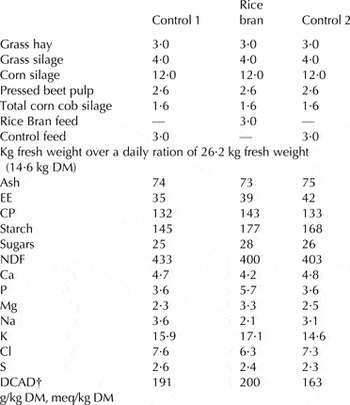
Chemical analysis of original rice bran confirmed the expected very low Ca, low fat and high phytic acid content (data not shown). The differences in composition of the TMR diets were small except for the mineral profiles (Table 1). Rice bran diet contained 0·5 g/kg DM less Ca and 2·1 g/kg DM more P compared to the control diet. Inclusion of rice bran in the experimental diet was 140 g/kg DM.
Raw material composition and analyses of the TMR diets fed in the 3 periods

†DCAD: dietary cation:anion difference
Age structure of the animals consisted in one third of second lactation cows, 30% third lactation, and cows beyond the fourth lactations were exceptional, representing less than 10% of the total. The distribution between the dietary periods was unbalanced in animal numbers and parity structure of the groups. More cows calved during rice bran feeding than during control periods and these cows were older.
Close-up period
Dietary effects on serum minerals before calving is displayed in Table 2. Rice bran feeding significantly reduced serum Ca, and it was negatively related both linearly and quadratically to the number of days of exposure to the diet before sampling (P < 0·01). Serum Mg was reduced by the withdrawal of rice bran from the diet, and was affected by the time elapsed from the withdrawal. Phosphorus was reduced by the inclusion of rice bran and remained low in C2 after withdrawal.
Serum mineral content before calving, by diet, parity and days of RB feeding or days after product withdrawal

ns, not significant
Difference in letters indicates significant difference at P < 0·05
Calving and early lactation
The incidence of blood Ca infusions, retained placenta, culling in the first 8 weeks, and serum Ca nadir are presented in Table 3. The fraction of cows receiving a Ca infusion after calving was affected by parity and by milk production level in the preceding lactation, but appeared to be independent from pre-calving diets. Instead, the nadir of serum Ca for the animals was significantly higher for cows calving during RB period and was affected by days of exposure to rice bran, parity and production level. The fraction of animals with retained placenta and culling during early lactation were unaffected by pre-calving diet, parity or production level.
Fraction of cows receiving a Ca infusion, suffering from retained placenta, leaving the herds in the first 8 weeks, and nadir of serum Ca after calving

ns, not significant
Difference in letters indicates significant difference at P < 0·05
† SEM is reported in the different transformed scales, because confidence intervals are not symmetric from the mean
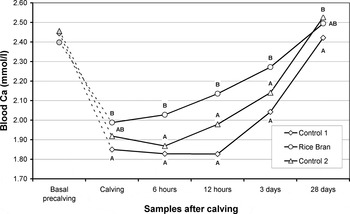
Average serum Ca after calving was higher in cows calving during RB period and in cows calving in C2 period (Table 4). Calcaemia after calving was influenced by days of exposure to the product, parity and sampling time point. These results were very similar when the samples taken after a Ca infusion were not excluded from the calculation. Serum Ca drop at calving was less severe for animals consuming RB until calving, and immediately started recovery, whereas control cows stayed at minimum values for hours after calving (Fig. 1). Three days after calving, cows fed rice bran until calving still had significantly better Ca status than the controls.
Effect of diet at calving on the time course of serum Ca after calving (mmol/l).

Serum mineral contents after calving as affected by diet at calving, sampling time point, parity and time of exposure to rice bran in the close up period

ns, not significant
Difference in letters indicates significant difference at P < 0·05
† SEM is reported in the different transformed scales, because confidence intervals are not symmetric from the mean
‡ Ca are serum Ca measurements including those obtained 24 h after Ca infusion
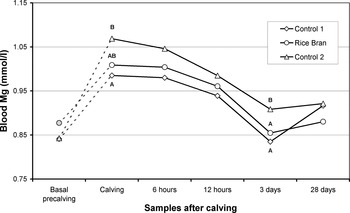
Blood Mg seemed to be mostly dependent on time point after calving and on the total exposure time to RB diet. Serum Mg was not clearly influenced by treatment group and was independent from parity (Table 4). Magnesium level increased at calving and then declined to return to the original range 3 d after calving (Fig. 2).
Effect of diet at calving on the time course of serum Mg after calving (mmol/l).

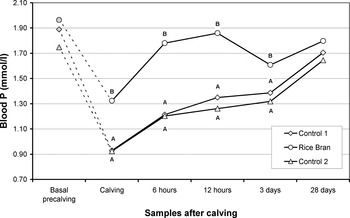
Serum P was clearly higher in cows that calved during rice bran supplementation, and was dependent on days of RB feeding before calving. In this case, parity was a significant factor, but also time point and its interaction with diet at calving (Table 4). Serum P decreased much less in animals fed RB at calving as compared with the controls, and already between 6 and 12 h after calving they had recovered pre-calving values (Fig. 3). Differences with controls were sustained until day 3 after calving.
Effect of diet at calving on the time course of serum P after calving (mmol/l).

Discussion
Rice bran acts on Ca availability in two ways: by diluting Ca content in the diet with its very low Ca content, and by affecting the nutritional accessibility of Ca by gastro-intestinal precipitation with phytic acid (Martín-Tereso et al. Reference Martín-Tereso, van Puijenbroek, van Laar, den Hartog and Verstegen2011). Phytic acid accumulates into the bran during polishing, while Ca is excluded (Kennedy & Schelstraete, Reference Kennedy and Schelstraete1975) resulting in Ca being generally below 1 g/kg DM. Rice bran in the ration created a difference in Ca intake of 0·5–0·6 g/kg DM (Table 1), which for a DMI of 14 kg represents a reduction of 7 g/d.
The rice bran used in this trial contained 61·5 g of phytic acid per kg DM, which is the main Ca binding component of rice bran. This amount has a theoretical binding potential of 22 g of Ca, for a 6 to 1, Ca to phytic acid molar ratio. In the ration, the inclusion of approximately 140 g/kg DM rice bran represents a potential binding in the total ration of 3 g of Ca per kg DMI. Formaldehyde treated rice bran has a phytic acid bypass fraction of nearly 30% (Martín-Tereso et al. Reference Martín-Tereso, Gonzalez, Van Laar, Burbano, Pedrosa, Mulder, den Hartog and Verstegen2009). Consequently, this would result in binding capacity of near 1 g of intestinally available Ca per kg of DMI.
Normal farm variation in calving pattern caused that 45 cows calved during RB supplementation, against 31 and 37 cows that calved during control periods. In addition to that, cows calving during RB feeding were older. Parity increases the risk of milk fever by 9% per lactation (DeGaris & Lean, Reference DeGaris and Lean2008), so it is reasonable to assume that these cows were substantially more susceptible to hypocalcaemia than the controls.
Cows in the close-up group showed transient lower serum Ca during RB feeding (Table 2), lower if sample was taken shortly after product introduction. This is in agreement with the similar drop and later recovery consistently observed at the introduction of low Ca diets (Goings et al. Reference Goings, Jacobson, Beitz, Littledike and Wiggers1974; Shappell et al. Reference Shappell, Herbein, Deftos and Aiello1987). In contrast, this pattern is not observed at the introduction of zeolites in the diet (Thilsing-Hansen et al. Reference Thilsing-Hansen, Jorgensen, Enemark and Larsen2002; Pallesen et al. Reference Pallesen, Pallesen, Jørgensen and Thilsing2008; Grabherr et al. Reference Grabherr, Spolders, Furll and Flachowsky2009).
The fraction of cows receiving a Ca infusion at calving was not affected by the diet, although it was affected by parity and production level (Table 3). Under these conditions, rice bran did not alter of milk fever diagnosis by farm staff. In contrast to this, rice bran had a clear effect on the magnitude of hypocalcaemia measured on the cows. Also the number of days of RB feeding affected serum Ca status of cows after calving, and this was also associated to feeding until the calving date, because the number of days of feeding before calving was more explanatory of calcaemia at calving than the total number of days of RB consumption. Rice bran induced an adaptation of Ca homoeostasis that was useful to sustain serum Ca at calving, supporting the main hypothesis of the experiment. This effect is further confirmed by the average serum Ca (Table 4) and its evolution after calving (Fig. 1). Calcaemia recovery started immediately, whereas control animals delayed recovery for hours after calving. Speed of recovery of Ca may be more indicative of dietary induction of homoeostatic adaptation than the extent of hypocalcaemia. This effect of rice bran is highly consistent with our controlled experiment (Martín-Tereso et al. Reference Martín-Tereso, Wijlen, Laar and Verstegen2014). The immediate start of the recovery of calcaemia demonstrates that homoeostatic mechanisms are capable to react earlier reducing the lag time for adaptation.
Phytic acid does not affect Mg availability (Coudray et al. Reference Coudray, Demigné and Rayssiguier2003) and blood Mg is not as tightly regulated as Ca, but it is affected by Ca homoeostasis (Fontenot et al. Reference Fontenot, Allen, Bunce and Goff1989). In this experiment, rice bran feeding pre-calving had no apparent effect on blood Mg, although there was a clear reduction caused by the withdrawal of the product. Urinary excretion of Mg is modulated by PTH (Deetz et al. Reference Deetz, Tucker, Mitchell and DeGregorio1982) in parallel with Ca excretion. The increase of serum Mg at and after calving (Fig. 3) is typical of peri-parturient cows with an adequate Mg status (Goff, Reference Goff2006), and reflects PTH secretion in a situation of hypocalcaemia, which increases renal reabsorption of Mg.
Serum P pre-calving was reduced by rice bran feeding despite the high P content in this diet (Table 2). In ruminants, P absorption is mostly directly related to intake, since its regulation is controlled by salivary excretion and to a smaller extent by urinary excretion (Horst, Reference Horst1986). Serum P may correlate positively with P intake (Lopez et al. Reference Lopez, Kanitz, Moreira, Wiltbank and Satter2004), but not in every case (Peterson et al. Reference Peterson, Orth, Goff and Beede2005). Lower serum P during high P intake may be explained by indirect effects of the reduction in Ca availability. PTH reduces serum P by its effect on salivary excretion (Horst, Reference Horst1986) and by increasing its urinary excretion (Goff et al. Reference Goff, Littledike and Horst1986). This effect of PTH lowering serum P has also been observed during low Ca diets for the prevention of milk fever (Shappell et al. Reference Shappell, Herbein, Deftos and Aiello1987).
Serum P decreases at calving with the combined effect of P drain into colostrum (Kume & Tanabe, Reference Kume and Tanabe1993) and the effect of PTH on increased urinary and salivary P excretion (Goff et al. Reference Goff, Littledike and Horst1986). However, serum P was clearly higher in the RB fed cows and this effect was independent from days of exposure to rice bran before calving (Table 4). Calcitriol stimulates P absorption (Breves & Schröder, Reference Breves and Schröder1991), and in this way, serum Ca and P are brought back together to normal levels. Rice bran fed before calving created wide differences in the evolution of P concentration after calving (Fig. 3). Not only was the value reached at calving higher, but also recovery to pre-calving levels was immediate. Because this effect is strictly related to rice bran fed the day before calving and independent from time of exposure to the product, most likely the difference was caused by a much greater presence of P in the gastrointestinal tract in cows fed rice bran until calving.
In conclusion, feeding rumen-protected rice bran, with a phytic acid content of 61·5 g/kg DM, at an inclusion of 140 g/kg DM, positively affected Ca homoeostasis at calving. Serum Ca presented higher values up to 3 d after calving, after being significantly lower before calving. Dietary rice bran may cause reduced gastrointestinal availability of dietary Ca below the threshold required to induce an adaptation of Ca metabolism before calving.