Introduction
Population aging has increased the number of older people living with dementia, with many requiring residential care. Indeed, marked dementia is now the most common medical diagnosis affecting older adults living in care facilities (Rosewarne et al., Reference Rosewarne, Opie, Bruce, Ward, Doyle and Sach1997; Australian Institute of Health and Welfare, 2006), but concerns remain as to how to optimize the quality of life of people living in residential care facilities (RCF). Education of staff is often considered a critical aspect of the response of government and service agencies to this concern (Nolan et al., Reference Nolan2008).
Training programs in dementia care for RCF staff are now common and have been systematically reviewed (Kuske et al., Reference Kuske, Hanns, Luck, Angermeyer, Behrens and Riedel-Heller2007). However, the evidence identified was mostly drawn from studies performed in the U.S.A., and frequent methodological weaknesses limit the conclusions that can be drawn from those. Few recent data focus on education to improve care delivery by GPs and staff in the residential care sector. We undertook a study of the perceived educational needs of GPs and RCF staff in relation to dementia care. Data were collected from GPs, RCF staff, family carers of people with dementia and an expert reference group utilizing individual interviews, surveys and focus groups (Beer et al., Reference Beer2009). Participants identified the need for a person-centered philosophy to underpin educational interventions. Despite high levels of participation in dementia education, specific perceived educational needs relating to behaviors of concern, communication, knowledge regarding dementia, system factors and the multidisciplinary team were consistently and frequently cited. Small group education which is flexible, individualized, practical and case-based was sought. Options for joint education of GPs and RCF staff were recommended. Adult learning principles, such as building on prior knowledge, were supported.
In the present study, we aimed to develop two tailored educational interventions, maximizing content relevance and using recommended educational delivery modes to enhance participation among busy GPs and RCF staff. The overall aim was to meet the perceived educational needs of GPs and RCF staff working in the residential care sector.
Methods
Participants
This education program was developed to form the intervention in a larger randomized controlled trial (Beer et al., Reference Beer2010). The randomized controlled trial was prospectively registered in the Australian New Zealand Clinical Trials Registry (ACTRN12607000417482). All residential care facilities (RCFs) in the Perth metropolitan area (n = 184) were sent information packages regarding the study. Of those, 36 agreed to participate, 19 of whom formed the intervention group and participated in development and evaluation of the education program. GPs attending the intervention facilities were invited to participate in the study. In this way, 55 GPs were recruited to the study, and 27 of these GPs were randomly assigned to the intervention group and participated in development and evaluation of the education program.
Development of the education intervention
We undertook an initial scoping study that included a literature review and “stock take” of available resources. The literature review, stock take and data from GPs and RCF staff (Beer et al., Reference Beer2009) were used to define a pedagogic framework for the education program. Key components of the agreed framework were (i) a learner-centered approach, (ii) use of the best available evidence, and (iii) use of active learning strategies. Data gathered from GPs and RCF staff were also used to determine the proposed content and delivery of the education programs. Learning objectives and practical training format were revised with reference to published work in this area (Mace, Reference Mace2005). Lesson plans were developed by breaking the broader learning objectives into smaller lessons with defined outcomes. Detailed learning objectives covering attitudes, knowledge and skills for each topic were then drafted.
The education package was refined over the course of six months from February to July 2008, utilizing feedback from multiple sources in an iterative approach and seeking to respond to the input of participants and stakeholders. An Expert Reference Group (ERG) comprising national and local experts in dementia education (see Acknowledgments), provided critical review of evolving iterations of the educational package (after the broad learning objectives were proposed and after the individual lesson plans were written). The ERG provided ongoing review of the development of the lesson plans, and contributed to the development of the concept of identifying “Dementia Champions” in each facility to support sustainability of the RCF intervention. The ERG also advised underpinning the theoretical concepts with practical examples and activities to assist staff in learning how to implement learned concepts into their work practice.
After the development of the first set of lesson outlines, study staff met with a convenience sample of four GPs and three RCF Managers, recruited from participating facilities. The lessons, delivery style, and role of Dementia Champions were further revised in accordance with feedback from this group. Interviews with 12 Facility Managers, Quality Managers and Clinical Educators, drawn from ten RCFs, provided further feedback regarding the length of sessions, availability of audiovisual equipment and delivery style. RCF Managers suggested onsite training and advised design of brief sessions to achieve maximum flexibility. Lessons were thus reformatted into half-hour blocks. These “blocks” could be built into sessions of varying lengths of time to suit each facility. Short key messages were added to each lesson plan in light of the Facility Managers' feedback to facilitate reinforcement of the key messages of the lesson.
The concept of local Dementia Champions was modified substantially in this iterative process, evolving to focus on liaison with the education program staff, and facilitation of the education program. GPs suggested that the educational program should be offered as part of the Continuing Professional Development (CPD) activity for GPs. The GP education program was adjusted to meet Royal Australian College of General Practitioners (RACGP) requirements for 40 Category 1 CPD points for the 2008–2010 triennium. Expert speakers were recruited and provided with objectives to guide them in the preparation of their presentations. Professional actors were recruited to support delivery of case scenarios as part of the GP education program.
Content of the education intervention
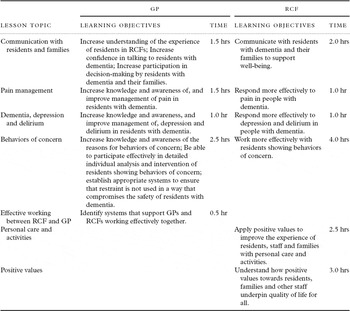
The RCF education intervention comprised 27 lessons relating to the objectives listed in Table 1. The RCF education program was designed for all disciplines of staff providing care to residents with dementia, with an emphasis on direct care staff. The 27 lessons were delivered onsite at each facility by one of two educators. The RCF program covered six main topics (Table 1):
• communication with residents and family members
• personal care and activities
• positive values
• behaviors of concern
• pain management
• dementia, depression and delirium
Education program structure

Identifying and supporting Dementia Champions was a central component of the education program. Participating Facility Managers were invited to nominate a Dementia Champion from their staff members. The study team suggested that the staff member nominated should have an interest in quality dementia care, be enthusiastic about caring for residents with dementia, and have good communication skills. The Dementia Champions were offered a facilitator's role in the education program. This involved:
• attending each education session,
• encouraging staff attendance,
• providing short education sessions for those staff who were unable to attend using simplified lesson plans and resource package,
• assisting in scheduling of education sessions,
• maintaining education program resources and lending resources to staff,
• providing a brief orientation to new staff using the simple lesson plans and resource package, and
• cultivating the enthusiasm of the staff caring for residents with dementia.
Additional components of the RCF education program were:
(i) Introductory Workshops held for Facility Managers and Dementia Champions to provide them with an overview of the education program and present the options for scheduling the program at their facility. Individual meetings were held with Managers and Dementia Champions unable to attend the Introductory Workshops.
(ii) Engagement of Facility Managers. At the beginning of each program onsite, the educator invited the Facility Manger to provide an opening statement endorsing the dementia education. In addition, the Managers were encouraged to attend the full program along with their staff.
(iii) A final workshop held for Facility Managers and Dementia Champions at the conclusion of the training. This workshop reinforced the key messages of the dementia education, allowing time for group reflection and recognition of the changes that had occurred as a result of the education. Each Facility Manager and Dementia Champion received a lapel pin and certificate in recognition of their role and their ongoing effort in providing quality care.
(iv) Provision of supporting materials including a resource package and five posters covering key topics.
The broad objectives developed for the GP education program are listed in Table 1. The GP education program consisted of five “lessons”, delivered during three evening sessions each held a week apart. The final fourth session was held a month later as a reflective session where GPs could consolidate the principles learned at the previous sessions. The content of the fourth session, selected by participating GPs at the end of the third session, covered two main topics: (i) GPs working effectively with RCFs; and (ii) the management of delirium. These four sessions included guest speakers, audiovisual presentations, professionally acted role plays and digital video clips of case scenarios. A self-directed learning package was offered to GPs who did not attend the face-to-face workshops. The self-directed learning package consisted of four digital video discs of the face-to-face sessions, a learner workbook, an electronic resource compendium and supporting materials. A concluding face-to-face reflective session was offered to GPs who completed the self-learning package.
Process evaluation
We evaluated the educational program by:
(i) recording participation rates
(ii) collecting participants' feedback after each learning encounter using feedback forms
(iii) collecting feedback from RCF staff regarding changes in care practices that occurred at their workplace following the education program.
Feedback forms were distributed at each educational visit with GPs and RCF staff, and distributed with the GP self-directed learning package. Feedback forms were collected from all participants. In the Feedback Form, GP participants rated each session in five areas:
• degree to which the learning objectives were met (not met/ partly met/ met)
• degree to which the participant's learning needs were met (not met/ partly met/ met)
• relevance to their care/practice (not relevant/ partially relevant/ entirely relevant)
• the presenter's subject knowledge, encouragement of participation, time management, and effectiveness of their style (strongly disagree/ disagree/ agree/ strongly agree)
• whether the venue provided an excellent learning environment, was easy to get to, and provided excellent catering (strongly disagree/ disagree/ agree/ strongly agree).
Two additional items for the evaluation forms were free-text: “What was the best thing about the session?” and “What could be improved?”
RCF participants rated each session in four areas:
• degree to which the aims were met (not met/partly met/ met)
• perceived overall usefulness of training (not useful/partly useful/ useful)
• the trainer's subject knowledge, effort to help participants “join in”, time management, and effective style (strongly disagree/ disagree/ agree/ strongly agree)
• whether participants could “use what I learned in the workplace” (strongly disagree/ disagree/ agree/ and strongly agree).
Two additional items for the evaluation forms were free-text: “The things I found most helpful about this session were:” and “These sessions would be better if you:”.
Three focus groups of six or seven Dementia Champions, and two focus groups of 10 Managers each, were arranged to collect their “stories of change” at the conclusion of the education program. Incidental information regarding any changes in care practice that staff had introduced as a result of the dementia training was also collected. For example, at the end of practical lessons, participants were given the opportunity to discuss changes they wanted to trial in their day-to-day work. At the beginning of the next session, staff were invited to report the changes they had attempted. This feedback was transcribed and compiled from focus group notes, notes taken from research journals and email correspondence.
Ethics
The Human Research Ethics Committee at the University of Western Australia approved this research (RA 4/1/1685).
Results
Participation
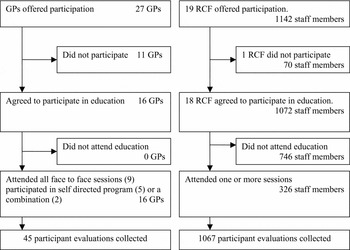
Participation is summarized in Figure 1. Sixteen (59%) of the 27 GPs completed the assigned educational program in its entirety or in part. Eleven GPs attended one or more of the face-to-face program sessions. Most (nine) attended all four sessions, including two GPs who chose to participate in both the face-to-face sessions as well as the self-directed learning package. A further five GPs participated in the self-directed learning package and reflective session.
Participation in education program and process evaluation

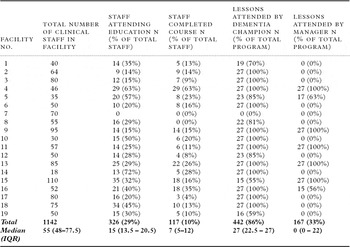
Eighteen out of 19 RCFs which were offered the education program participated in the training to some degree, and 326 (29%) of the 1142 RCF clinical staff working in the 18 participating facilities attended some or all of the education program, and 117 (36%) of these 326 staff completed the entire educational program (representing 10% of the entire staff of participating facilities) (Table 2). The duration of the education sessions ranged from 1.5 to 7 hours. Twenty-two Dementia Champions were nominated, with at least one Dementia Champion at each of the 18 facilities. Four of the facilities nominated two Dementia Champions. Most (16) Dementia Champions (72%) completed the entire program. Most Facility Managers did not attend the education sessions; however five Managers (28%) did attend all 27 lessons.
RCF participation

Participants' evaluations
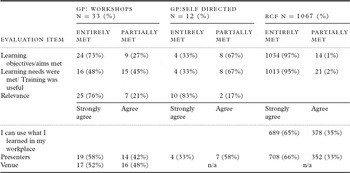
In total, 45 session evaluations were completed by participating GPs, and 1067 by participating staff members. The programs were perceived as highly satisfactory by the large majority of both GP and RCF participants (Table 3). Free text feedback also tended to be generally very positive.
Participants' evaluations

“Very worthwhile, stimulating” Enrolled Nurse
“The variety in the presentation keeps it interesting and maintains focus. Good use of DVD, group work, questionnaire, brainstorming” Enrolled Nurse
“New approaches to all aspects of care” Carer
“Practical sessions to improve observational documentation” Occupational Therapist
“New information on delirium and dementia” General Practitioner
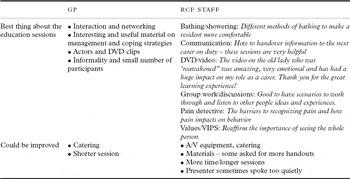
Common themes in the qualitative feedback are summarized in Table 4.
Qualitative positive and negative feedback from GPs and RCF staff

Feedback gathered at the Facility Manager and Dementia Champion workshop regarding the education program and resource package was also positive. In addition, the Facility Managers requested ongoing education, particularly for the Dementia Champions and new staff, and perceived the package as more practical than other educational programs. Participants emphasized the need for ongoing education to support Dementia Champions and new staff.
I think this program and resource really hits the mark. All of the materials were relevant and accessible. In particular, the delivery was very suitable for us – style/pace/content.
Would love to see more sessions as mandatory training, particularly for new staff.
Need to keep the champions motivated and keep them educated. Continue workshops for Dementia Champions.
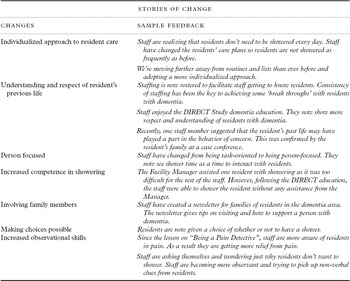
In focus groups, these staff cited multiple “stories of change” which were perceived as important to their work. These tended to focus on individualized and person-centered approaches to care, but included improved skills in observation and delivery of personal care. These are summarized in Table 5.
RCF Managers' and Dementia Champions' “Stories of Change”

Discussion
These data provide a practical example of the development of a tailored educational intervention, which is perceived to meet the needs of GPs and RCF participants. To our knowledge the detailed attempt to respond to the perceived needs of learners (both GPs and RCF staff) is unique. Although much work has been done, and is ongoing (Perry et al., Reference Perry2008), to train GPs and nurses in early recognition of dementia in non-residential care settings, there are virtually no systematic data regarding training programs for dementia care in residential settings for medical practitioners. In addition, the program we have developed for RCF staff differs from those previously evaluated (Kuske et al., Reference Kuske, Hanns, Luck, Angermeyer, Behrens and Riedel-Heller2007). Previous programs have tended to focus on specific aspects (such as behavior management skills or communication) or were delivered inflexibly. In the present package, we provided flexible onsite education to a greater extent than any previous package. Feedback suggested that this program was much more practical than other packages currently offered in Australia. Other aspects, such as combined sessions for GPs and Facility Managers, are also novel among currently offered dementia education packages for GPs and staff working in RCF. In addition, this work confirms that the “Dementia Champion” model of local empowerment is acceptable and feasible. The Dementia Champion model is important given its potential to provide effective ongoing local reinforcement and sustainability.
The study has several strengths. We used a rigorous methodology with several safeguards (comprising detailed consideration of learners' perceived needs, regular feedback from an expert reference group, and frequent input from stakeholders) to ensure that the development process had integrity. Limitations of the study include the potential for volunteer bias, restricting the generalizability of the data. Participating facilities may tend to be those that are led by facility managers and staff who are enthusiastic regarding dementia care; GPs who attended education sessions may also already be enthusiastic about dementia care. Furthermore, our results are not necessarily generalizable to other countries' health care systems. Another limitation relates to the measurement of learners' perception that their learning needs were met. Participants perceived the education programs developed as meeting their needs. However, we did not validate participants' actual knowledge or behaviors, and it is thus uncertain whether meeting the perceived educational needs of care providers translates to improved outcomes for residents. Finally, interpretation of the study results is limited by the absence of follow-up evaluation of sustainability. Although the Dementia Champions were envisaged to provide ongoing reinforcement, the extent to which this occurred remains uncertain.
Despite detailed attempts to meet the educational preferences of potential participants, and overcome remediable barriers to educational participation, overall participation in the program remained poor. Only 29% of eligible RCF staff actually participated in the education. Multiple cycles of education would be needed to achieve full penetration of the educational messages. Data collection from RCF staff and GPs who did not attend the education would be required to understand the barriers to participation, and develop strategies to improve participation in future educational interventions.
The process evaluation reported in the present analysis is descriptive. The education intervention developed will be further evaluated in an ongoing controlled trial. This future work will determine the effect of delivery of the educational intervention on outcomes, including the quality of life of care recipients and the knowledge and attitudes of participating GPs and care staff.
Conflict of interest declaration
Although Professor Lautenschlager was Editor-Elect of International Psychogeriatrics at the time of this paper's submission, she played no role in the assessment of the paper by other editorial staff.
Description of authors' roles
C. Beer assisted in study design, supervised the conduct of the study as chair of the Steering Committee and led drafting of the paper. R. Lowry assisted in the development of the education, scheduled and delivered the RCF education and part of the GP education, supervised the data collection, and assisted in writing the paper. N. Bretland assisted in the development of the education, delivered the GP education, was a member of the Steering Committee, and assisted in writing the paper. B. Horner, O.P. Almeida, S. Scherer, N. Lautenschlager, P. Flett, F. Schaper and L. Flicker contributed to study design, were members of the steering committee overseeing the study, and contributed to drafting and revision of the paper.
Acknowledgments
Funding by the NHMRC (Dementia Research Grant Program Strategic Award Grant 458797) for the DIRECT (Dementia In REsidential Care education intervention Trial) is gratefully acknowledged. The DIRECT trial is registered in the Australian New Zealand Clinical Trials Registry (ACTRN12607000417482). The authors thank the staff who worked on this component of the DIRECT study: Kelly Banz, who contributed to development of the GP and RCF education and contributed to earlier drafts of this paper; Geoff Jones, who developed the GP and RCF education and contributed to earlier drafts of this paper and Philippa Wharton. The authors thank the WA GP Network, who assisted with the RACGP accreditation of the GP Education, and Silver Chain, who supported secondment of Geoff Jones to the Study staff.
The authors acknowledge the members of the DIRECT Study Expert Reference Group: Dr Sam Davis (Monash University), Nina Graham (WA Dementia Training Study Centre), David Gribble (Alzheimer's Australia WA), Geoff Jones (Silver Chain), Bruce MacAdam (McCusker Learning), Virginia Moore (Brightwater Group), Pam Nichols (Alzheimer's Australia WA) and Ashley Osborne (WA GP Network). Lastly, the investigators and study team would like to thank all participating GPs and RCF Staff and Divisional Staff.