I want to address Vincenzo Bellini, and in particular an aria that occurs in the introduction of his Beatrice di Tenda (written for Venice’s La Fenice in 1833). The scene is laid in darkness, in the inner courtyard of a fifteenth-century Milanese castle, lights and festivities seen within. Enter Filippo, a Visconti duke, and his male courtiers, who have escaped the ball. Filippo has had to leave, he explains, because he can no longer suffer the presence of his wife Beatrice di Lascari. The duke sings distractedly of his arranged marriage in repeated gestures and irritated accents, whilst the sycophantic chorus exhort him to relax and direct his attention elsewhere. Sure enough, as Filippo calms and gains control of his thoughts, the sounds of a harp are heard offstage, and the seductive voice of an unidentified woman (but not Beatrice) wafts in from the wings. The scene stills for a scene of absorbed listening, set to words remote from dramatic proceedings so far. A romanza, sounding far off, unfurls in two strophes.
Beatrice di Tenda is one of Bellini’s lesser-known operas and ‘Ah! non pensar’ one of his more obscure songs. A vocal line undulates expansively across a single octave span, arpeggiating the underlying harmony in unaffected ways. All the standard tropes about romanzas apply. The enchanting woman, whoever she is, strums an obligatory lute. The offstage aria is a structurally superfluous insertion in the complicated course of a multi-part Italianate coro d’introduzione.Footnote 1 A simple bar form marks the music out as ‘naïve’, this naïveté betraying Bellini’s talent for throwing vaguely French forms into the dramatic mix.Footnote 2 Filippo’s gasping interjections between strophes reveal that the far-off voice belongs to the ‘beautiful’ Agnese del Maino. Or rather, the duke hears what he wants and sings dreamily of her sensuous presence in his head. The artless melody is remarkable for the way it summons through song a woman of as-yet-unknown origin.
The catalogue of Bellini’s works in The New Grove Dictionary lists this aria as ‘spurious and doubtful’.Footnote 3 In the autograph score of Beatrice di Tenda, now held at the Biblioteca musicale governativa del Conservatorio Santa Cecilia in Rome, significant chunks of the outer numbers and framing pillars of the opera (i.e., introduzione and finale secondo) are not in Bellini’s hand. The manuscript’s ‘tormented history’ is evident, as much in the first as in the midst of the final scene of the opera.Footnote 4 In the latter instance, at the point of ‘Angiol di pace’, a second offstage intrusion returns the audience to the situation of ‘Ah! non pensar che pieno’. This second intrusion reprises the harp accompaniment, and is sung by Beatrice’s would-be lover, a serenading Orombello, both from his prison cell offstage and inside Beatrice’s head. Here the sounds of Orombello’s offstage voice save Beatrice from blasphemy in her two-soprano confrontation with Agnese, bathing the climactic scene in forgiveness and love. The whole of the scena ultima is in fact a beatified fresco of religious proportions, having been set up by a vast choral-panoramic preghiera, where a chorus observes Beatrice, recently condemned to death by Filippo, in pious supplication before God.
In the Rome autograph, this final ‘foreign’ insertion appears, together with the ensuing trio, on different paper in the handwriting of a copyist. Our second intrusion, to complicate matters, is recycled from a duet in Bellini’s earlier Zaira, all of which has been taken to suggest either last-minute addition or heavy revision undertaken during the rush to the opera’s already delayed premiere.Footnote 5 ‘Ah! non pensar’, meanwhile, is also notated on different paper in the handwriting of the same anonymous copyist, but is inserted into the opening folios at the other end of Bellini’s autograph. As in the case of ‘Angiol di pace’, the circumstances of the romanza’s insertion are difficult to reconstruct. Unlike Orombelli’s solo, however, the source of ‘Ah! non pensar’ is as obscure as the circumstance of its sonic presentation in the first scene, which explains the solemn musicological conclusion that it may have nothing to do with Bellini at all.Footnote 6 The fact that the aria was ‘tipped in’ to the score as an afterthought may account for the strangeness, perhaps even the incompetence of its text from a narrative point of view.
At the start of this piece, I described ‘Ah! non pensar’ as one of the lesser known arias in all ‘Bellini’. That is true enough, though the library catalogues will bear out that the aria enjoyed an extraordinarily rich reception, listing as they do numerous reprintings of the aria from the early nineteenth century to the present day. A glance at such catalogues will immediately bring us to a crux, because if we examine that fame at all closely, it becomes clear that we have up to now been scrutinising the wrong text. ‘Ah! non pensar’ largely disappeared, soon after its appearance; by far the greater part of the aria’s reception history has instead been provoked by its manifestation in other, strikingly different guises. The source of the offstage sounds first heard by Filippo, in other words, may be more remote than so far imagined.
In German lands, ever since Beatrice’s debut in Vienna in 1836, the romanza was known as ‘Ach! Denke nicht’ in the translation of George Ott. In French-speaking countries, it was usually ‘Ah! quelle ivresse’. Within the decade, the aria had been performed in Hungarian, and had been heard as far afield as Mexico City, Athens, Valletta in Malta, London, Lisbon, New Orleans, St Petersburg, New York, Havana and Bône (Annaba) in Algeria. In English, it assumed many forms, as in a paean to love ‘Ah! let me e’er conceal’ by Theodore Baker (a pioneering comparative musicologist and specialist in the music of the Native American Seneca people). Other versions, tailored to the domestic charms of the Victorian parlour, included ‘Ne’er hast thou known the power’, popular in 1860s Boston, as well as ‘Ah! who call tell how lonely’, which harped on the romanza’s melancholic aspects.
‘Ah! non pensar’, to move still further afield, took on its most magical forms in a land far off the standard operatic map: the independent kingdom of Lesotho, a landlocked country often forgotten in the mists atop the dramatic eastern escarpment of southern Africa. Here, on the far side of the uKhahlamba, ‘the Barrier of Spears’ in the clouded realms of the Maloti and Thaba Putsoa mountains, ‘Bellini’s’ romance bore possibly its richest fruit. How exactly ‘Ah! non pensar’ became ‘Khakolo ea ntlo ea Thapelo’ (loosely meaning ‘Consecration of the House of Prayer’ in Sesotho) is difficult to tell. What we do know is that, from at least the 1890s, the romanza was somehow appropriated to the cause of the foundation of a so-called indigenised Basotho church and an indigenised Basotho nation-state.
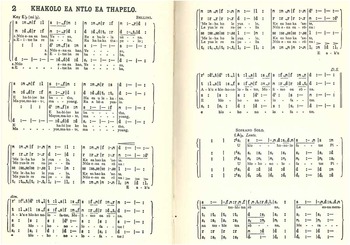
One likely scenario is that the score was transported (in some unidentified French version) to the mountain citadel of the king of the Basotho by protestant missionaries of the Société des Missions Evangéliques de Paris (PEMS). It is likely that its extraordinary appropriation was the product of creative collaborations between such local translators as Nathanael Makotoko and Swiss missionary-musicians stationed in Basotholand such as Adolphe Mabille and François Coillard. Whatever its provenance, the four-voice choral adaptation was first published in tonic sol-fa notation in 1890 at Morija, a mission station set up at the foot of the Makhoarane mountain at the invitation of Moshoeshoe I, the ‘greatest southern African of the nineteenth century’ who consolidated a ‘national language’ – with the help of his vassal-missionaries – and gathered the diverse clans of the region into a people now known as the Basotho (see Fig. 1).Footnote 7 ‘Ah! non pensar’ was issued as the second cantique chrétien in a book of choruses that attributed its contents to a mixture of European, native and anonymous authors. The collection was entitled Lipina tsa likolo tse phahameng, which translates as Songs of the Higher Schools (Morija Sesuto Book Depot, 1890), a volume so popular that it is still in print today.Footnote 8
(colour online) The first phrase of ‘Ah! non pensar’ in Sesotho tonic sol-fa adaptation, inserted as a ‘soprano solo’ (on the third system of the left-hand page), during the course of the choral prayer: ‘Prega! Ah no, non sia la misera’. Lipina tsa likolo tse phahameng (Morija, 1890), 8–9.

Those who compiled ‘Khakolo ea ntlo ea Thapelo’ had intimate knowledge of Beatrice di Tenda. The chorus opens with a call to bless the building of God’s House to the tune of the same aforementioned choral preghiera that inaugurates the finale of Bellini’s opera. Instead of the intrusion of Orombello’s ecstatic offstage song, however, the mood softens for the spotlighting of a solo soprano voice heard as if from above. Here, far off in the Kingdom of the Sky (at the mission stations of Leribe and Morija), ‘Ah! non pensar’ is heard in perhaps its most affecting and faraway form. The romance of the opera’s opening scene returns. ‘U hlohonolofatse pina tsohle tsa rona’, the soprano sings, ‘Le eona merapelo, e tla beoa mona’ (‘Give a blessing to all our songs and the prayers put before you’).