INTRODUCTION
In the United Kingdom, the Department of Health advocates the use of interviews and mailed questionnaires with bereaved relatives to assess and evaluate the provision of end-of-life care (Department of Health, 2008). However, conducting research with the bereaved presents an obvious ethical challenge, as they are undoubtedly a vulnerable group, associated with high levels of distress and who are susceptible to both physical and mental health issues (Parkes, Reference Parkes1996; Stroebe et al., Reference Stroebe, Stroebe and Hansson1993).
As part of a larger study examining the experiences of patients who die at home, our paper focuses on the experiences of bereaved relatives participating in the pretest cognitive interviews for the Care of the Dying Evaluation (CODE), a mailed questionnaire, focusing on the final 48 hours of a patient's life. CODE is an abridged version of another validated tool, Evaluating Care Health Outcomes—for the Dying (ECHO–D), used with bereaved relatives to assess the experience of dying patients in a hospital or hospice setting (Mayland et al., Reference Mayland, Williams and Ellershaw2012; Reference Mayland, Williams and Addington-Hall2014).
BACKGROUND
Previous studies indicate that bereaved relatives are a valid and consistent proxy in assessing end-of-life care, and a relative's perspective has been shown to be consistent with the patient's, specifically on issues of service provision and quality of care (Addington-Hall & McPherson, Reference Addington-Hall and McPherson2001). However, a review of the literature revealed a small number of studies suggesting that it may be unethical to involve certain vulnerable groups, such as the newly bereaved, in research because of the potential risk for undue distress and psychological harm (Rosenblatt, Reference Rosenblatt1995; Robertson et al., Reference Robertson, Jay and Welch1997). Conversely, other research indicates more positive outcomes, and several studies exploring the use of bereaved relatives in palliative care research, either in conjunction with the patient or as a proxy, reported that, with appropriate safeguards, sensitivity, and the use of a suitable methodological design, relatives may also experience cathartic and psychologically therapeutic outcomes (Robertson et al., Reference Robertson, Jay and Welch1997; Addington-Hall, Reference Addington-Hall2002; Stroebe, Reference Stroebe2003; Koffman et al., Reference Koffman, Higginson and Hall2012).
Clearly, a comprehensive understanding of the potential therapeutic benefits for bereaved relatives participating in palliative care research is lacking, and many of the studies reviewed explored the perspectives of bereaved parents following paediatric deaths (Riches & Dawson, Reference Riches and Dawson1996; Dyregrov, Reference Dyregrov2004; Hynson et al., Reference Hynson, Aroni and Bauld2006). Therefore, the ethics of engaging this group remains questionable, with limited understanding of appropriate methodologies to be adopted or time constraints within which to engage grieving relatives. It is perhaps in the absence of a conclusive understanding that many research proposals involving such vulnerable participants as the bereaved may be challenged by ethical review boards (Ceci et al., Reference Ceci, Peters and Plotkin1985; Seymour et al., Reference Seymour, Payne and Reid2005; Stiel et al., Reference Stiel, Heckel and Bussmann2015).
However, a review of recent bereavement theories reveals a number of therapeutic concepts where participation in a research study focusing on the end-of-life care received by a relative may not be overwhelmingly distressing or cause harm but in fact may have beneficial outcomes for bereaved participants. These include such issues as an opportunity to share their narrative account (Cook & Bosley, Reference Cook and Bosley1995; Cook, Reference Cook1995; Walters, Reference Walters2000; Dyregrov et al., Reference Dyregrov, Dyregrov and Raundalen2000), to continue a bond or attachment to the deceased (Attig, Reference Attig1996; Klass, et al., Reference Klass, Silverman and Nickman1996; Vickio, Reference Vickio1999; Klass, Reference Klass2006), and to search for some personal sense of meaning in their loss (Neimeyer, Reference Neimeyer2001). These themes can be explored through their motivations to participate in research and the narrative accounts given during the interviews conducted.
The aim of our paper is to explore the motivations and potential benefits for bereaved relatives participating in qualitative interviews for the CODE project. We describe a secondary analysis of the data collated from participants' interview responses and the subsequent debriefing with the interviewer. The data were examined with reference to the adaptive concepts identified in current bereavement theory.
Our paper explores the participants' experiences of participating in the research with the specific focus of reflecting on the final 48 hours of their relative's life.
METHODS
Cognitive interviewing methodology was adopted for our study in order to pretest the CODE questionnaire and ensure that the instrument was clear, comprehensive, and sensitive. The aim of cognitive interviewing is to understand the participant's comprehension of the questions asked and discover their personal interpretation.
Participants' responses within the cognitive interview also provided a further subset of data, which was then used in a secondary analysis to explore the impact of their participation in the research study. The data were collated with participants' discussions during the debriefing at the end of the interview. This debriefing specifically explored a participant's perception and emotional response to their involvement in the research project and the interview process. The project team agreed that the debriefing was an essential part of the interview process due to the sensitive nature of the project and that it also provided an opportunity to ensure that support was given and participants provided with details of ongoing therapeutic support if required.
Participants were recruited from an urban area in North West England. Patients who had an expected death in their own home and were cared for by a community health team were identified from the Preferred Place of Care database, which holds a patient's choice for where they wish to be cared for and die, and is part of the Department of Health's End-of-Life Care Strategy (2008). A further database held by the community health team was employed to access the patient's name, date of death, and last known address, which was then utilized as the contact for the carer.
After a minimum of two months after a death, relatives were contacted and provided with the details of the study and a copy of the CODE questionnaire for completion and return by prepaid post. Bereaved relatives completing the questionnaire were asked if they would be willing to participate in an interview focusing on their experience with the CODE questionnaire and/or complete the questionnaire again in a month's time. Those indicating that they would be willing to participate in an interview were telephoned to confirm their agreement and decide on the interview date and venue.
There appears to be no empirical evidence suggesting an appropriate timeframe for contacting the bereaved to participate in research. Previous studies have suggested that newly bereaved relatives may have more accurate recall of information than the longer-term bereaved (Addington-Hall & McPherson, Reference Addington-Hall and McPherson2001). However, another study exploring bereaved relatives' views on participation in research revealed little regarding how soon it was appropriate to make contact after a death (Beck & Konnert, Reference Beck and Konnert2007). Therefore, within the context of our study, two months was agreed upon as an appropriate time period to balance the need for sensitivity with enhanced memory recall. Beck and Konnert (Reference Beck and Konnert2007) found no evidence to indicate that bereaved individuals lack the capacity to give informed consent for research, while others have highlighted the need for researchers to explore understanding and to clarify consent on an individual basis (Flory & Emanuel, Reference Flory and Emanuel2004).
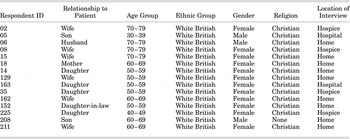
Participants recruited for our study were identified as the next of kin to a patient who had died an expected death in a community setting between January of 2011 and the end of January of 2012. All were aged over 18 and deemed able to give informed consent (see Table 1). Respondents were excluded from the study at the discretion of the healthcare team or by the researcher's assessment that any involvement could potentially lead to undue distress (e.g., participants with a mental health condition or those with complex bereavement issues). In addition, participants were not considered if they had experienced bereavement within the previous two months.
Participant demographics

The decision for participants to self-select in this way was explored by the project team and acknowledged as a potential limitation of the study, with those who would not benefit from participation opting out in this manner. However, given the nature of the study, it was decided that this was the most appropriate and sensitive approach to adopt.
Relatives consenting to an interview were telephoned by the researcher to decide on the details of the interview. Before commencing interviews, informed written consent was obtained, including permission to audiotape. During the interviews, participants were advised that the recording could be stopped at any time and that they could also choose to withdraw from the research during the interview or after it was completed. An information sheet with comprehensive details of the project together with contact details for further information were provided to each participant.
Ethical approval for the study was granted by the National Research Ethics Service's Committee North West (approval number 11/NW/0159). All data were stored in a secure area with restricted access, and all reports and interview transcripts were anonymized to protect the confidentiality of respondents, in accordance with accepted data-protection guidelines and the university's policy on data storage.
Interviews were undertaken by one member of the research team (AG), who has extensive experience with the psychological aspects of palliative care and bereavement counselling. The interviews lasted between one and two hours, which complies with the suggested timeframe for cognitive interviewing, and took place at a local hospice or in the participant's home. Each interview was audiotaped for transcription and the analysis process. The data were collected between May and October of 2012.
Upon completion of each cognitive interview, time was spent exploring the emotional impact of the interview process and, as appropriate, the details of local bereavement services were provided for ongoing therapeutic support. The impact of an individual's participation in the interview was explored through a number of open questions, with the initial one being “How have you found your experience of taking part in this research study?” Participants were also asked about the emotional impact of being involved in the research, revisiting the final 48 hours of their relative's life, and exploring that experience during the interview. These were asked of all interviewees so as to explore the “lived experience” of their participation and reinforce their sense of well-being before the end of the research interview.
The data were analyzed within a content analysis framework, which is widely regarded as an objective and systematic methodology for defining and evaluating phenomena (Krippendorff, Reference Krippendorff1980; Sandelowski, Reference Sandelowski1995). The transcripts were initially coded using the three main categories defined by the research aims, specifically focusing on the respondents' ability to recall the details of the final 48 hours of the patient's life, their comprehension of the questions asked and the specific categories, as well as words and phrases with shared meaning. A random selection of interview transcripts was also reviewed independently by a researcher not involved in the data analysis (BJ) to ensure consistency of theme presentation.
A content analysis framework was employed again for the secondary analysis to classify the data according to the six recurring concepts identified as adaptive in current bereavement theories:
-
1. An opportunity to share the narrative accounts of the final hours of a relative's life (Cook & Bosley, Reference Cook and Bosley1995; Cook, Reference Cook1995; Dyregrov, Reference Dyregrov2004; Walters, Reference Walters2000; Dyregrov et al., Reference Dyregrov, Dyregrov and Raundalen2000).
-
2. A search for sense and meaning in loss—immediate, practical, or spiritual/existential (Neimeyer, Reference Neimeyer2001).
-
3. An ongoing bond/attachment with the deceased (a continuing relationship) and a spiritual duty to live as the deceased would have wanted them to (Attig, Reference Attig1996; Klass et al., Reference Klass, Silverman and Nickman1996; Vickio, Reference Vickio1999; Klass, Reference Klass2006).
-
4. An altruistic motivation: to ensure that good care is replicated or that others receive better care than they had received (Neimeyer, Reference Neimeyer2001; Gysels et al., Reference Gysels, Shipman and Higginson2008).
-
5. Oscillation between loss and restorative orientations: a focus on loss and emotional components and movement to secondary losses, adjusting to life without the deceased (Stroebe & Schut, Reference Stroebe and Schut1999).
-
6. A sense of resilience: defined by openness to emotional recall and acknowledgment of grief with emotional adaptation and functional adjustment (Machin, Reference Machin2006).
RESULTS
In total, 26 respondents agreed to be interviewed. Two of these were relatives of the patient who volunteered to participate on behalf of their next of kin, who felt it would be too emotionally distressing to take part. The remaining 24 were in fact the next of kin. Of the 26 participants consenting to be interviewed, 7 could not be contacted despite several attempts, 1 was excluded from the research because the patient did not die at home, and 3 decided not to proceed with the interview. All the interviewed participants (n = 15) stated that their experience in the study was positive and therapeutic.
Themes Identified
In the data analysis, many of the themes identified were interlinked and categorized accordingly. The themes are presented here and supported by direct quotations from participants.
1. An opportunity to share the narrative accounts of the final hours of a relative's life (Cook & Bosley, Reference Cook and Bosley1995; Cook, Reference Cook1995; Dyregrov, Reference Dyregrov2004; Walters, Reference Walters2000; Dyregrov et al., Reference Dyregrov, Dyregrov and Raundalen2000).
I thought it would be a chance to express myself. (ID 129: patient's wife, aged 50–59)
Respondents varied in their ability to recall the final two days of the patient's life, with some speaking of vivid memories easily recalled and others describing a “blurring” of memory. Three respondents described how the research had helped to give structure and clarity to the events retrospectively, while at the time they had functioned almost mechanically, living only in the moment:
You don't take it in. You don't— It's not happening to you … All you're thinking is what's going to happen in the next hour. (ID 162: patients wife, aged 60–69)
However, all participants were keen to tell their story, and this involved revisiting events outside of the 48-hour timeframe. Many of the respondents (n = 7) wanted to share other details about their relative, including anecdotes from their earlier life together, photographs, or achievements:
Understanding who they were. (ID 18: patient's mother, aged 50–59)
For some, talking about their experiences involved a level of philosophical reflection, which resulted in some level of narrative reconstruction:
My mum's experience was respectful, dignified, and peaceful. It was a beautiful ending to a wonderful life. (ID 129: patient's daughter, aged 50–59)
In the last two days, so many things were taken out of my hands. Maybe I resented that … But in some ways, maybe it was good. (ID 211: patient's wife, aged 60–69)
2. Search for sense and meaning in the loss (Neimeyer, Reference Neimeyer2001)
For some participants, there was a need to order or make sense of the events that led up to their relative's death, and this sometimes appeared to result from a lack of information or communication:
Would he have had a heart attack with getting that big bad pain? (ID 129: patient's wife, aged 50–59).
For others, there was a searching or “replaying” of events to find comfort or reassurance:
I sometimes wonder if there was something I should have done for him. (ID 211: patient's wife, aged 60–69)
For others, there was an existential or spiritual search for personal meaning:
Maybe in our bereavement we are looking back and trying to make sense … as we know we do? (ID 208: patient's son, aged 60–69)
3. Ongoing bond/attachment with the deceased (Attig, Reference Attig1996; Klass et al., Reference Klass, Silverman and Nickman1996; Vickio, Reference Vickio1999; Klass, Reference Klass2006)
Many of the participants (n = 7) cited “duty” as a strong motivation to participate in the research:
They [the deceased] would have wanted me to do this. (ID 129: patient's wife, aged 50–59)
This theme appeared to have a significant and powerful influence. The ongoing duty of care and attachment to the relative was a recurring issue, with a need to “do the right thing” or a sense that it was something that the deceased would have approved of or been involved with themselves if they had the opportunity. As one respondent stated,
Whatever it took to help anybody else … I felt it was my duty to do it. (ID 15: patient's wife, aged 70–79) (theme 4)
For others, this attachment was described as an ongoing presence in their lives:
You believe in the white feather … the fact that they're always around you. (ID 225: patient's daughter, aged 40–49)
Of the interviews conducted in a participant's home (n = 9), the majority of respondents (n = 8) were keen to show the researcher the room where their relative had died.
4. Altruistic motivation to participate in the study (Neimeyer, Reference Neimeyer2001; Gysels et al., Reference Gysels, Shipman and Higginson2008)
Analysis of the interview transcripts highlighted that some of the motivation to complete the questionnaire and take part in the interview process was to have an opportunity to share the high quality of care they had received, with the hope of ensuring the same level of care be received by others. This was sometimes described as a “duty”:
I'd do it to help someone else. (ID 08: patient's wife, aged 70–79)
Or, conversely, to highlight the gaps in the service and care received, with the hope of improving service provision in the future.
5. Oscillation between loss and restorative orientations (Stroebe & Schut, Reference Stroebe and Schut1999)
In the data analysis, there was a sense of participants “reliving” the experience of the final two days of the patient's life. This was a conscious and consensual act and often resulted in high levels of distress, but all wanted to continue with the interview:
It's amazing how much this [the interview] takes you back, isn't it? (ID 05: patient's son, aged 30–39)
For many (n = 8), there was a need to talk about the whole of their journey, not just the final 48 hours of life:
I kept on wanting to recall or think about a longer period of time [than just the last two days].” (ID 208: patient's son, aged 60–69)
But for all participants there was a movement toward or refocus on the present, the reality of living without their loved one, and adaptation and adjustment to their grief.
6. Sense of resilience (Machin, Reference Machin2006)
Resilience in grief is difficult to define and measure. For the purpose of our analysis, it was defined as the ability to demonstrate a level of autonomy and adaptation during bereavement. It combined two complementary concepts of flexibility or movement between emotion and control, together with indications of adjustment in their lives since the death:
Afterwards, I wasn't crying all the time, but I just felt everything had gone so smoothly … It did give me a lot of help … I felt satisfied that he got what he wanted. (ID 08: patient's wife, aged 70–79)
DISCUSSION
From the secondary data analysis, it is evident that the interviewed participants experienced additional and beneficial outcomes as a result of their involvement in our study. There is a strong correlation between adaptive coping and adjustment to life following a significant bereavement. Inviting participants to reflect on the final 48 hours of a relative's life provided an opportunity to revisit their experiences and tell their personal “story,” which in itself could facilitate a sense of value and concern (Cook & Bosley, Reference Cook and Bosley1995; Cook, Reference Cook1995; Dyregrov, Reference Dyregrov2004). Our participants had been bereaved for between 9 and 12 months, a time period beyond the usual societal boundaries for compassionate leave and several months extended from the culturally perceived “acceptable” period to talk openly about a death (Walters, Reference Walters2000). Interestingly, Cook (Reference Cook1995) highlighted the societal contradiction that the newly bereaved have limited compassionate leave and are then assumed to be capable of returning to work and yet their capacity to participate in research is often challenged. In his exploration of this societal “policing” of grief, Walters (Reference Walters2000), suggested that the potential distress associated with conversations about the deceased or the events leading up to the death may have specific cultural boundaries and time limits imposed. This was highlighted in a previous study by Cook and Bosley (Reference Cook and Bosley1995), with participants acknowledging the societal pressure to “get on with their lives” and not continue to discuss their loss.
However, for the participants in our study, the opportunity to share the narrative of their experience caring for a dying relative may in itself have provided a sense of cathartic relief, and the focus of the interview “gave permission” for them to revisit the experience and their thoughts and feelings associated with the death. All the interviewed participants engaged readily in this process, sharing responses to the questions asked and also providing information and details beyond the remit of the questions and the timeframe of the final 48 hours of their relative's life.
In another study, Doka (Reference Doka1999) identified specific scenarios where grief can be disenfranchised and how, in consequence, individuals do not receive appropriate levels of support or acknowledgment of their loss. Such disenfranchisement can lead to a sense of further isolation and exclusion. Walters (Reference Walters2000) identified the value for the bereaved in sharing their biographies with those who knew the deceased. In contrast, research can be seen as an opportunity for open dialogue with a stranger—someone for whom there is no previous connection or ongoing relationship that may provide a deeper level of exploration and a greater openness. The impartiality of the researcher can also be helpful to an individual who feels unable to talk to friends or family for fear of upsetting or burdening them with their grief. Riches and Dawson (Reference Riches and Dawson1996) suggested that the actual process of telling their story in an interview context can contribute to an altered understanding of that story for the participants and assist in their reconstruction of the experience.
Similarly, Neimeyer (Reference Neimeyer2001) identified this reconstruction as a common, though often painful and protracted, process in the aftermath of a significant loss, where the bereaved search to make sense and meaning of their experience and integrate the loss into their adjusted self-constructed narrative. This reconstructed self-narrative can be associated with significant “posttraumatic growth” (Calhoun & Tedeschi, Reference Calhoun and Tedeschi2006). As previously discussed, the structure of the interview was based on the framework of the CODE questionnaire, and this led to a focus of attention on specific aspects of the experience: the care received, control of physical symptoms, the issues of spirituality, or details related to the death. This imposed structure could also add to the process of sensemaking, with the reordering of events or reframing of the experience, as described by Neimeyer (Reference Neimeyer2001).
The motivation of bereaved relatives to participate mirrors findings from previous studies with palliative care patients and carers involved in research, where the primary motivators were shown to be altruistic, gratitude for and concern about care, the need to have someone to talk to, the need for information, or the need for access to services (Gysels et al., Reference Gysels, Shipman and Higginson2008). The strong sense of altruism that acted as a key motivator for participation in our study can perhaps be viewed within Neimeyer's reconstruction paradigm (Reference Neimeyer2001). For the bereaved, there are potential opportunities for finding a sense of comfort or existential benefit from the pain of their loss by using their experience to help others. This was a consistent theme for all the participants in our study.
The initial consent to participate in our study and engage in the interview process can also be seen as a movement toward a “loss orientation,” as described in “the dual process model,” where the bereaved focus on the circumstances and events surrounding the death (Stroebe & Schut, Reference Stroebe and Schut1999). In a sense, it also gives “permission” to reengage with the emotions associated with the loss—the sadness, yearning, or anger—and also to reconnect with the deceased, as an ongoing attachment and relationship. Within the concept of the dual process model of coping, it is understood that the loss orientation may dominate the focus of the bereaved in the immediate aftermath of a death, and as time passes, there is increased focus on an orientation toward “restoration,” with attention given to the secondary consequences and losses resulting from the death (Stroebe & Schut, Reference Stroebe and Schut1999). This may include such practical issues as adjusting to loneliness, learning new skills to complete tasks previously undertaken by the deceased, or a changed identity or role. The model describes an oscillation between these two orientations and does not offer prescriptive timeframes. However, within the interviews and debriefings with relatives, it was apparent that much of their focus in the recent weeks and months had been within the restoration paradigm and that the interview had provided a shift of focus back to the time of loss.
The oscillation between these two states is seen as a necessary component of the grief process, with the bereaved person needing to employ distraction and avoidance at times to minimize or avoid the enormity of the pain of their loss while equally acknowledging that continued avoidance and suppression of emotions can be detrimental to coping and to mental and physical well-being (Stroebe & Schut, Reference Stroebe and Schut1999). Therefore, reengaging with loss during the interview process can be viewed as a considered and consensual move to confront the issues associated with the death, which can be therapeutically beneficial.
The dual process model is a core element in the recent development of bereavement assessment, which examines a person's individual style of coping and focuses on their level of resilience rather than the traditional model of assessing risk factors associated with poor coping in loss (Machin, Reference Machin2006). In the assessment, attention is given to the tension between the overwhelmed, with a focus on feelings, and the controlled, with a focus on action. Machin's model recognizes that a resilient person moves comfortably between these two states, while the more vulnerable are often in a more persistent state of being overwhelmed, or equally a more controlled individual unable to express emotion. Our participants showed an openness to move between these two states, with most becoming distressed at times but then appearing to focus and regain control, actively reengaging with the objectives of the study and a determination to continue with the interview. Interestingly, in a previous study with bereaved parents, Dyregrov (Reference Dyregrov2004) noted that even the participants who found the interviews most distressing reported that their involvement had been helpful and constructive.
Historically, traditional models in bereavement theory suggest that healthy adaptation in grief involves a breaking of bonds and attachments with the deceased (Bowlby, Reference Bowlby1971; Parkes, Reference Parkes1972; Sanders, Reference Sanders1989). However, recent theorists recognize that maintaining a bond or connection with the deceased can be both necessary and adaptive (Attig, Reference Attig1996; Klass et al., Reference Klass, Silverman and Nickman1996; Vickio, Reference Vickio1999; Klass, Reference Klass2006).This ongoing relationship can then be integrated into the life of the bereaved, providing a healthy adaptation to grief. Similarly, Worden (Reference Worden1991), who initially advocated a need for emotional detachment and withdrawal from the deceased, acknowledged the importance of maintaining a relationship with the deceased and a “relocation” of the attachment. The ongoing attachment or bond with the deceased is thus seen as a key mediator in adaptation.
Attig (Reference Attig1996) explained this process as an attempt by the bereaved to absorb the values of the deceased or model their interests and way of life. Furthermore, Crenshaw (Reference Crenshaw1990) suggested that this sense of continuation of values and interests serves to add meaning and richness to the life of the bereaved and is an effective strategy for continuing an ongoing relationship and attachment with the deceased.
Clearly, our paper does not represent a systematic review of the therapeutic benefits for bereaved relatives participating in research, as previous studies have explored, but instead seeks to discuss potential benefits in the context of current bereavement theory and models of coping. Our findings are based on a small sample size, representing only those who consented to participate in the interview process and from a single locality, so that this may have led to selection bias. Our sample was also limited in that all participants were white and British, and those who indicated a religious belief were Christians. Nevertheless, the sample spanned a wide age range (30 to 79 years), with varied relationships to the deceased.
Furthermore, our findings are based on data collected at the time of the interviews. Future studies might adopt a longitudinal methodology and assess the longer-term effects of participation in research.
CONCLUSION
Exploring potential therapeutic outcomes for the bereaved participating in research raises several questions: First, it contests the need for ethics committees to adopt a generalized paternalism with bereaved participants and questions the need for a prescriptive minimum timeframe before contacting participants after a death. Further, it challenges committees to consider the potential benefits as well as the possible risks for this group and indicates a need for further research to maximize any potential therapeutic benefits in participation.
Second, the study highlights the importance of an appropriately skilled researcher who can offer effective communication skills to provide for a safe environment in engaging the bereaved during research. Previous studies have stressed the importance for researchers working with the bereaved to have relevant experience or knowledge of loss and grief models with a variety of skills to respond appropriately and compassionately during interviews (Cook, Reference Cook1995; Parkes, Reference Parkes1995). Rogers (Reference Rogers and Koch1959) described these basic skills as the core conditions for empathy, unconditional positive regard, and congruence. While these were developed for a therapeutic relationship, it could perhaps be argued that the role of the researcher working with vulnerable participants requires an equal measure of sensitivity and openness and a nonjudgmental approach to ensure the safety of the respondents. In addition, the methodological design of any study involving bereaved participants should undoubtedly reflect an appropriate level of sensitivity.
For health and social care professionals working in palliative care, research around end-of-life care is essential to ensure appropriate interventions and adequate service provision; and involving bereaved relatives in the retrospective evaluation of this care should be approached with a high level of sensitivity and ethical consideration. One of the most painful of all human experiences, loss can nevertheless provide an opportunity for personal growth and spiritual insight. Instead of causing harm and distress, participation in research can perhaps be viewed as an enriching experience (Riches & Dawson, Reference Riches and Dawson1996; Dyregrov et al., Reference Dyregrov, Dyregrov and Raundalen2000), one that provides an opportunity to facilitate the search for meaning and understanding, and should therefore be encouraged.