Rheumatoid Arthritis (RA) is an autoimmune, inflammatory, chronic disease that causes pain, swelling, stiffness and loss of function with a prevalence range from 0.35% to 0.50% (Monjardino, Lucas, & Barros, Reference Monjardino, Lucas and Barros2011). Besides its prevalence differ across the countries(Alamanos, Voulgari, & Drosos, Reference Alamanos, Voulgari and Drosos2006; Cimmino et al., Reference Cimmino, Parisi, Moggiana, Mela and Accardo1998; Helmick, et al., Reference Helmick, Felson, Lawrence, Gabriel, Hirsch, Kwoh and Stone2008), literature have shown that, in Portugal, RA is the main reason of temporary disability, responsible for the cases of long-term disability and early retirement (Keefe et al., Reference Keefe, Smith, Buffington, Gibson, Studts and Caldwell2002; Newman, Fitzpatrick, Revenson, Skevington, & Williams, Reference Newman, Fitzpatrick, Revenson, Skevington and Williams1996).
Since the relation between persistent pain and physical disability have become clear in literature, researchers have turned their attention to questions concerning the processes by which catastrophizing impacts on pain outcomes, identifying several psychological, interpersonal (Cano, Reference Cano2004), physiological (Wolff et al., Reference Wolff, Burns, Quartana, Lofland, Bruehl and Chung2008) and neuroanatomical (Gracely et al., Reference Gracely, Geisser, Giesecke, Grant, Petzke, Williams and Clauw2004) correlates of catastrophizing that might explain its impact on pain experience.
Catastrophizing has been defined as an exaggerated negative orientation to actual or anticipated pain experience and comprises elements of rumination, magnification and helplessness (DeGood & Tait, Reference DeGood, Tait, Turk and Melzack2001; Sinclair, Reference Sinclair2001; Sullivan, Reference Sullivan2012; Sullivan et al., Reference Sullivan, Thorn, Haythornthwaite, Keefe, Martin, Bradley and Lefebvre2001; Turner, Mancl, & Aaron, Reference Turner, Mancl and Aaron2004). It is characterized by unrealistic thoughts such as “this pain will never end”, an exaggerated worrying and distress-amplifying thoughts, which trigger an active process that occurs not only in response to pain but also anticipates pain experience (Dixon, Thorn, & Ward, Reference Dixon, Thorn and Ward2004). The strong links between catastrophizing, pain, disability and distress have influenced the development of conceptual models such as the fear-avoidance model of chronic pain (Vlaeyen & Linton, Reference Vlaeyen and Linton2000). Accordingly to Vlaeyen and Linton (Reference Vlaeyen and Linton2000), catastrophizing is a key role on pain related disability, responsible for the increase of fears of movement and for the hypervigilance to pain symptoms. So, the degree to which patient catastrophises about pain and its consequences is usually considered as an important precursor of pain-related fear. Pain-related fears are feature by behaviors of escape and avoidance of daily activities and its immediate consequences. These behaviors may persist partially because they occur after pain rather than as a response to pain and result, frequently, in functional disability (Vlaeyen & Linton, Reference Vlaeyen and Linton2000; Vowles, McCracken, & Eccleston, Reference Vowles, McCracken and Eccleston2007).
Although a good deal of research on fear-avoidance model has been conducted, Sullivan (Reference Sullivan2012) suggested that cognitive conceptualizations of pain catastrophizing were very simplistic and lack in explanatory power. Accordingly to Sullivan (Reference Sullivan2012), these conceptualizations are essential intraindividual models that are silent on interpersonal factors associated with pain catastrophizing. Sullivan (Reference Sullivan2012) suggested a radical reformulation in catastrophizing from an intraindividual perspective (involving thoughts, emotions and appraisals) to an interpersonal one, involving communicative displays, escape behavior, rescuing responses from others. This is to say that high catastrophisers might engage in exaggerated pain expression in order to maximize proximity, social assistance and empathic responses from others. These pain expressions might also be used to induce others to alter their expectations, reduce performance demands or manage interpersonal conflicts (Sullivan, Reference Sullivan2012).
Research has shown that the effect of catastrophic thoughts on patient functioning presumably relies, not only on their content or frequency, but also on the experiences and current circumstances (Vowles, McCracken, & Eccleston, Reference Vowles, McCracken and Eccleston2008). In this line, a third wave of psychological approaches have emerged in the 1990´s within the behavioral tradition and have represented a move away from cognitivism toward a radical behaviorism and also other forms of behaviorism, particularly functional analysis and behavioral models of verbal behavior (Pérez-Álvarez, Reference Pérez-Álvarez2012). This third generation of therapies is, in part, characterized by the promotion of acceptance of painful and the unwanted psychological experiences and also by the commitment to value-focused action. It emphasizes the importance of the context within thoughts, feelings and actions, in addition to the specific form and frequency of these events (Hayes, Reference Hayes2004; Hayes, Strosahl, & Wilson, Reference Hayes, Strosahl and Wilson1999; Vowles et al., Reference Vowles, McCracken and Eccleston2007).
In fact, acceptance entails having contact with painful experiences without some of their added influences on behavior, particularly those that lead to avoidance and that limits life or value goals. Acceptance involves being experientially open to the present moment, which creates a choice to consistently move away from struggling for control and live the kind of life they want to live based on valued goals (Hayes et al., Reference Hayes, Strosahl and Wilson1999; McCracken, Reference McCracken2005; Vowles et al., Reference Vowles, McCracken and Eccleston2008). This is to say that one has pain and physical limitations but give up unproductive attempts to control these symptoms. Doing that one is able to commit one´s efforts toward living a satisfying life despite the disease (McCracken, Reference McCracken1998; McCracken, Reference McCracken1999).
Previous research has in fact suggested that acceptance may be a key process involved in behavior change in individuals with chronic pain (Vowles, McNeil et al., Reference Vowles, McCracken and Eccleston2007), being related with low pain intensity, anxiety and avoidance, depression, low physical and psychological disability, more daily uptime and better work status (McCracken, Reference McCracken1998; McCracken, Reference McCracken1999; McCracken & Eccleston, Reference McCracken and Eccleston2005).
In a cross-sectional study with 344 individuals with mixed chronic pain disease, Vowles et al. (Reference Vowles, McCracken and Eccleston2008) explored how acceptance influenced the relations between catastrophizing and patient functioning. From the Vowels´s et al. (Reference Vowles, McCracken and Eccleston2008) perspective, the impact of catastrophizing on moods and behavior was considered to be variable and dependent of the context in which the catastrophic thoughts occur. Vowles et al. (Reference Vowles, McCracken and Eccleston2008) results indicated that acceptance of pain partially mediates the effects of catastrophizing across measures of depression, pain-related fear and disability. These findings showed that the levels of acceptance of chronic pain influence how catastrophizing affects patients’ functioning (Vowles et al., Reference Vowles, McCracken and Eccleston2008).
Given all that has been said, this study was designed to address the following aims: 1) to examine the relationship between pain, catastrophizing, acceptance and physical limitation 2 years after RA diagnosis; 2) to explore the role of acceptance as a possible mediator process between pain, catastrophizing and physical limitation.
Regarding the association between the variables under study, positively associations between pain, catastrophizing and physical limitation were expected; also negative associations between acceptance and physical limitation were expected. This means that it should be expected that individuals with lower acceptance report more physical limitation at 2 years of disease progression.
Concerning the study of the mediator process(es) between pain, catastrophizing and physical limitation, acceptance was expected to be the process by which pain and catastrophizing influence RA physical limitation.
Method
Participants
Participants included in this study were recruited from four Portuguese health units, recruited between June 2005 and May 2010. The purposive sample is a non-representative subset of the largest RA population, and it was constructed to attend the purpose of a larger investigation. The inclusion criteria were: (1) age of 18 years, or older; (2) Rheumatoid Arthritis (RA) diagnosis two years ago, based on American College of Rheumatology. The exclusion criteria were: (1) an identified terminal illness; (2) the presence of severe psychopathology; (3) attending to any interdisciplinary treatment. The first contact with participants was established by the General Practitioner or Rheumatologist, on the day of their appointment and the diagnosis was based on medical records. From the 60 patients with RA recruited from the specialist, 1 individual was excluded due to comorbidity with severe psychopathology (psychosis) and 4 declined to take part. There were no differences between those who declined to take part in the study and our sample.
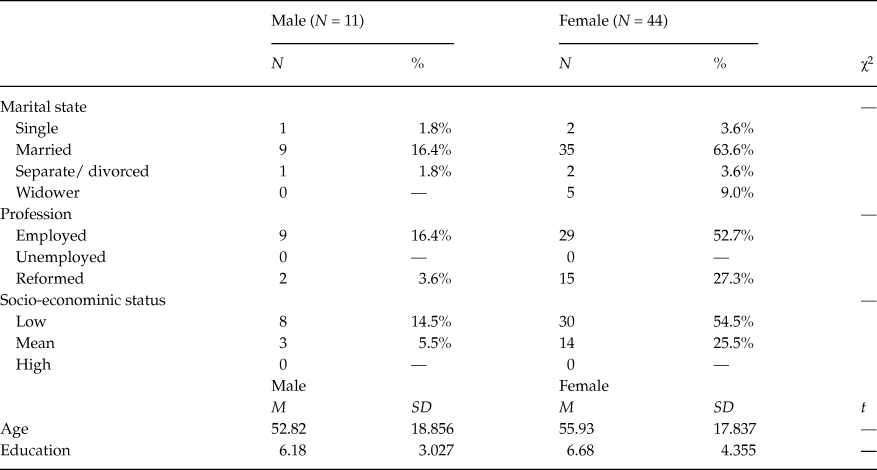
As such, 55 participants gave their informal consent and participated in this study. The sample included 11 male and 44 female participants with diagnosis of RA, with a mean age of 55.28 years old (SD = 17.91). The mean for years spent at school was 6.58 years of education (SD = 4.10) (Table 1). Spearman correlations showed that educational background was not correlated with Short-Form McGill Pain Questionnaire (MPQ: Melzack, Reference Melzack1987; translation and adaptation: Melzack, Reference Melzack2005) (Rs = .211; p = .122), The Arthritis Impact Measurement Scale 2 (AIMS2: Brandão, Zerbini, & Ferraz, Reference Brandão, Zerbini and Ferraz1995) (Rs = –.009; p = .947), PRSS (Flor, Behle, & Birbaumer, Reference Flor, Behle and Birbaumer1993; translation and adaptation: Costa & Pinto-Gouveia, Reference Costa and Pinto-Gouveia2011) (Rs = –.007; p = .962) and the Chronic Pain Acceptance Questionnaire (CPAQ; McCracken, Vowles, & Eccleston, Reference McCracken, Carson, Eccleston and Keefe2004; translation and adaptation: Costa & Pinto-Gouveia, Reference Costa and Pinto-Gouveia2009) (Rs = –.044; p = .749).
Sample demographic characteristics

M = mean; SD = standard deviation.
Measures
All measures used in the current study were translated into Portuguese by a bilingual translator. Conceptual and lexical similarities of both original and Portuguese versions were verified through back translation procedures.
Demographic and clinical data
Demographic variables were assessed with a general checklist including patient gender, age, marital status, profession and years of education and clinical diagnosis. Each participant completed an assessment battery that included several self-report questionnaires. Those examined in this study included the McGill Pain Questionnaire (Melzack, Reference Melzack1987; translation and adaptation: Melzack, Reference Melzack2005), The Arthritis Impact Measurement Scale 2 (AIMS2: Brandão, Zerbini, & Ferraz, Reference Brandão, Zerbini and Ferraz1995), PRSS (Flor, Behle & Birbaumer, 1993; translation and adaptation: Costa & Pinto-Gouveia, Reference Costa and Pinto-Gouveia2011) and the Chronic Pain Acceptance Questionnaire (CPAQ; McCracken, Vowles, & Eccleston, Reference McCracken, Carson, Eccleston and Keefe2004; translation and adaptation: Costa & Pinto-Gouveia, Reference Costa and Pinto-Gouveia2009).
Short-Form McGill Pain Questionnaire
(Melzack, Reference Melzack1987; translation and adaptation: Melzack, Reference Melzack2005). A 15-item adjective checklist that is rated on a 4-point intensity scale (from 0 = None to 3 = Severe) as well as two single-item measures of present pain. Descriptors from 1 to 11 represent the sensory dimension of pain experience, and descriptors from 12 to 15 represent the affective dimension; the two single-item measures, represent a visual analogue numerical scale and the present pain intensity. The measure gives both total score and partial scores. Higher results mean high levels of pain. Only the adjective checklist was used for purposes of the present study. The internal consistency estimates for the sensory and affective dimensions based on the Melzack (Reference Melzack1987) factor structure were .78 and .76, respectively. This study presented a moderate internal consistency for the 15-item adjective checklist (α = .78).
Pain Related Self-Statements Scale
(PRSS: Flor et al., Reference Flor, Behle and Birbaumer1993; translation and adaptation: Costa & Pinto-Gouveia, Reference Costa and Pinto-Gouveia2011). A 18-item self-report scale, which measure aspects of catastrophizing and active coping. A six-point Likert scale (from 0 = Almost never to 5 = Almost always) is used in each of the 18 items. The measure gives a partial result; a higher score means more catastrophizing or active coping. The Portuguese adaptation of PRSS (Costa & Pinto-Gouveia, Reference Costa and Pinto-Gouveia2011) has the same factorial structure of those obtain by Flor et al. (Reference Flor, Behle and Birbaumer1993). The Portuguese version had Cronbach’s alpha of .93 for catastrophizing and .83 for active coping. The item-total correlations showed correlation values between .42 and .89 for catastrophizing, and between .36 and .66 for active coping. In the present study we only used the catastrophizing subscale that shows a high internal consistency (catastrophyzing α = .93; active coping α = .80).
Arthritis Impact Measurement Scale
(AIMS2: Brandão et al., Reference Brandão, Zerbini and Ferraz1995). A 78-item self-report scale which assesses the health status in a multidimensional fashion using specific scales, summary components and overall impact measures. The first 57 items are broken down into 12 scales: mobility, walking and bending, hand and finger function, arm function, self-care tasks, household tasks, social activity, support from family and friends, arthritis pain, work, level of tension, and mood. The AIMS scales are scored in a consistent fashion so that a low value indicates a high health status. The 9 original AIMS scales could be combined into 3 or 5 component models of health status. For the purpose of this study we used only the physical function subscale. The physical function subscale showed a high internal consistency (α = .90).
Chronic Pain Acceptance Questionnaire
(CPAQ; McCracken et al., Reference McCracken, Carson, Eccleston and Keefe2004; translation and adaptation: Costa & Pinto-Gouveia, Reference Costa and Pinto-Gouveia2009). A 20-item self-report questionnaire that is rated on a seven-point rating scale (from 0 = Never to 6 = Always) and measures the acceptance to chronic pain. The questionnaire comprises two subscales, pain willingness and activity engagement. This questionnaire had both a total score (range from 0 to 156) and partial scores (range from 0 to 54, for pain willingness; 0 and 66, for activity engagement); higher scores mean high pain acceptance. Cronbach’s alpha was .82 and .78, for pain willingness and activity engagement, and the two scales showed to be correlated: r = .36 (McCracken et al., Reference McCracken, Carson, Eccleston and Keefe2004). The Portuguese version of this scale showed to be valid. Correlations were observed between psychopathology, self-compassion, experiential avoidance and rumination (Costa & Pinto-Gouveia, Reference Costa and Pinto-Gouveia2009). Also the Portuguese version of this scale presented a Cronbach´s Alpha of .89 for activity engagement and.83 for pain willingness (Costa & Pinto-Gouveia, Reference Costa and Pinto-Gouveia2009). In the present study CPAQ showed a high internal consistency (α = .86).
Procedure
The study was conducted with the formal approval of the participating institutions. Participants were recruited by the general practitioner or the rheumatologist at the time of their appointment.
Information related to research aims, procedures and general goals were given to those who expressed interest in participate. The researcher asked them to sign the informal consent form and the participants filled the battery of self-report measures that assessed pain, catastrophizing, acceptance and physical limitation. Measurement items were administered in a physician’s office and lasted between 45 to 60 minutes. Accordingly with ethical requirements, it was emphasized that participant´s cooperation was voluntary and that their answers were confidential ethical requirements, it was emphasized that participant’s cooperation was voluntary and that their answers were confidential.
Data was carried out via AMOS (v.18, SPSS Inc. Chicago, IL). Descriptive and correlational statistics were performed using PASW Statistics (v.18; SPSS Inc, Chicago, IL).
Data Analysis
This study has a cross-sectional design with self-report measures. Kolgomorov-Smirnov tests were used to inspect the data’s distribution. Although, some variables showed a statistically significant deviation from the normal distribution, close inspection of the skewness and kurtosis values (all within the [–0.5; 0.5] interval) showed that this deviation was not problematic for further inferential analysis (see e.g. Marôco, Reference Marôco2010; Kline, Reference Kline2005; Tabachnick & Fidell, Reference Tabachnick and Fidell2007). The presence of multivariate outliers was assessed with the Mahanalobis Distance- DM² (observations 9,13,3 showed p1 and p2 for DM² < .05 were identified as possible outliers). However, no observations were deleted from the data set, because they could contain important information related to the studied phenomena.
Path models were fitted to the cross-sectional data, in order to study the influence of all the exogenous variables on all the endogenous variables. Path models are a logical extension of multiple regression models which involves the estimation of presumed causal relations among observed variables. However the basic datum of path analysis is the covariance which includes correlation and this “does not imply causation”. Nevertheless this principle is apt because although a substantial correlation could indicate a causal relation, variables can also be associated in ways that have nothing to do with causality (Kline, Reference Kline2005).
Maximum Likelihood was used as the estimation method, a normal-theory, full-information method that analyzes all model equations in an interactive algorithm (Kline, Reference Kline2005) using SPSS-AMOS (v.20, SPSS, An IBM company, Chicago, IL). Analyses were performed on covariance matrix. The significance of path estimated coefficients were assessed by Z critical ratios. Significance of path estimated coefficients were assessed by Z critical ratios. To study possible biases in model estimates for either women or men, a multigroup analysis was performed. The hypothesis of women and men model invariance was tested by comparing the equality of women and men constrained model χ2 with the free women and men non-constrained model χ2. Invariance of the model for both groups was assumed for non-significant Δχ2 (p >.05) (Marôco, Reference Marôco2010).
Results
Pain and Physical Limitation 2 years after RA diagnosis
Table 2 illustrates Pearson product-moment correlations between pain and physical limitation 2 years after the diagnosis. Pearson correlations showed that pain was positively and moderately correlated with physical limitation (r = .531; p ≤ .001).
Correlation between Pain, Catastrophizing, Acceptance and Physical Limitation (2 year after RA diagnosis)

Catastrophizing and Physical Limitation 2 years after RA diagnosis
Pearson product-moment correlations showed that catastrophizing and physical limitation were positively and moderately correlated with physical limitation (r = .485; p ≤ .001) (see Table 2).
Acceptance and Physical Limitation 2 years after RA diagnosis
Acceptance was negatively and moderately correlated with physical limitation (r = –.476; p ≤ .001) (see Table 2).
Model 1- The influence of Pain, Catastrophizing and Acceptance on Physical Limitation
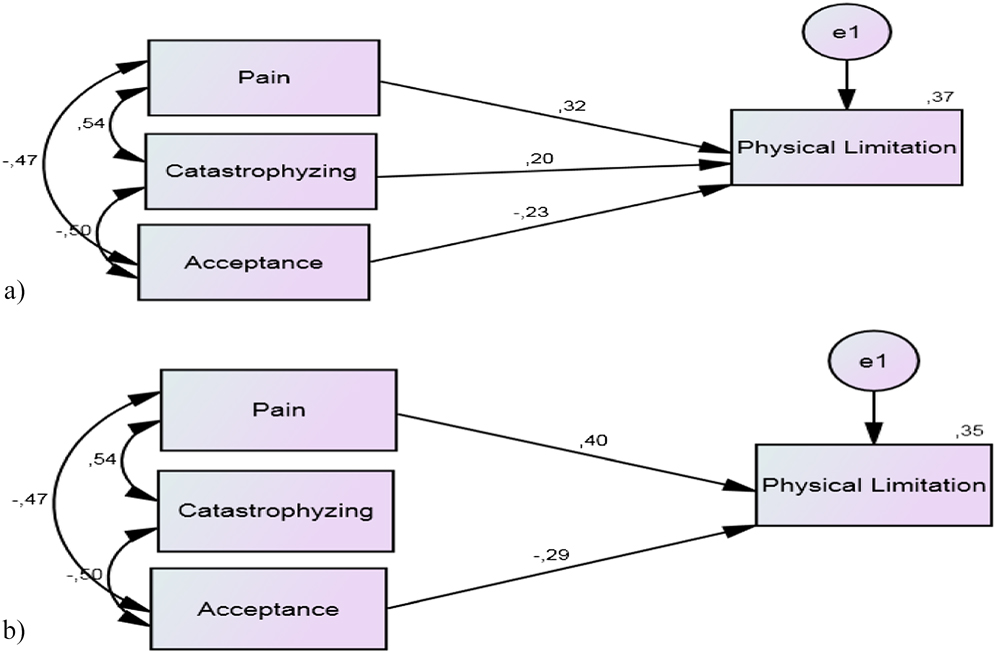
The influence of pain, catastrophizing and acceptance on physical limitation was explored with a Path Analysis model. The model consists of four observed variables: the independent exogenous variables are pain, catastrophizing and acceptance; the dependent endogenous variable is physical limitation (see Figure 1a). It was hypothesized that pain, catastrophizing and acceptance all influence physical limitation.
Model 1- The influence of Pain, Catastrophizing and Acceptance on Physical Limitation. a) Model Test; b) Final Model.
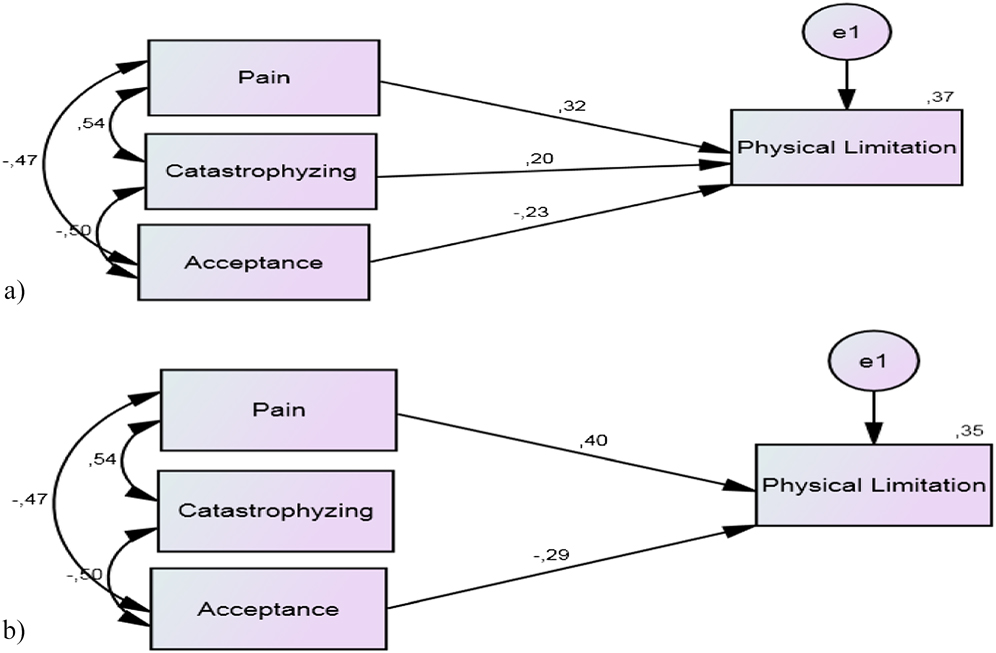
The β value associated with the path between catastrophizing and physical limitation was not significant at a .05 level (β = .199; p = .144). This particular path was deleted. Based on sample size, the path between acceptance and physical limitation was not excluded besides de β value associated was also not significant at a .05 level (see Table 3).
Standardized coefficients of the model that tests the influence of Pain, Catastrophizing and Acceptance on Physical Limitation- Model Test

The final model with the standardized path coefficients and the estimated standard error is presented in Figure 1b.
The analysis converged to an admissible solution. The Maximum Likelihood estimates of the model parameters are presented in Table 4.
Standardized coefficients of the model that tests the influence of Pain, Catastrophizing and Acceptance on Physical Limitation- Final Model

All path coefficients were statistically significant (p = .05). The final model accounted for 35% of the variance score of physical limitation. As can be observed (see Figure 1b), pain had a direct effect on physical limitation of .40, indicating that individuals with high pain did report high perception of physical limitation. Results also showed that acceptance had a direct effect on physical limitation of –.29, e.g. individuals with higher levels of acceptance reported lower perception of physical limitation.
Model 2- The Mediation Function of Acceptance on the Relationship between Pain, Catastrophizing and Physical Limitation
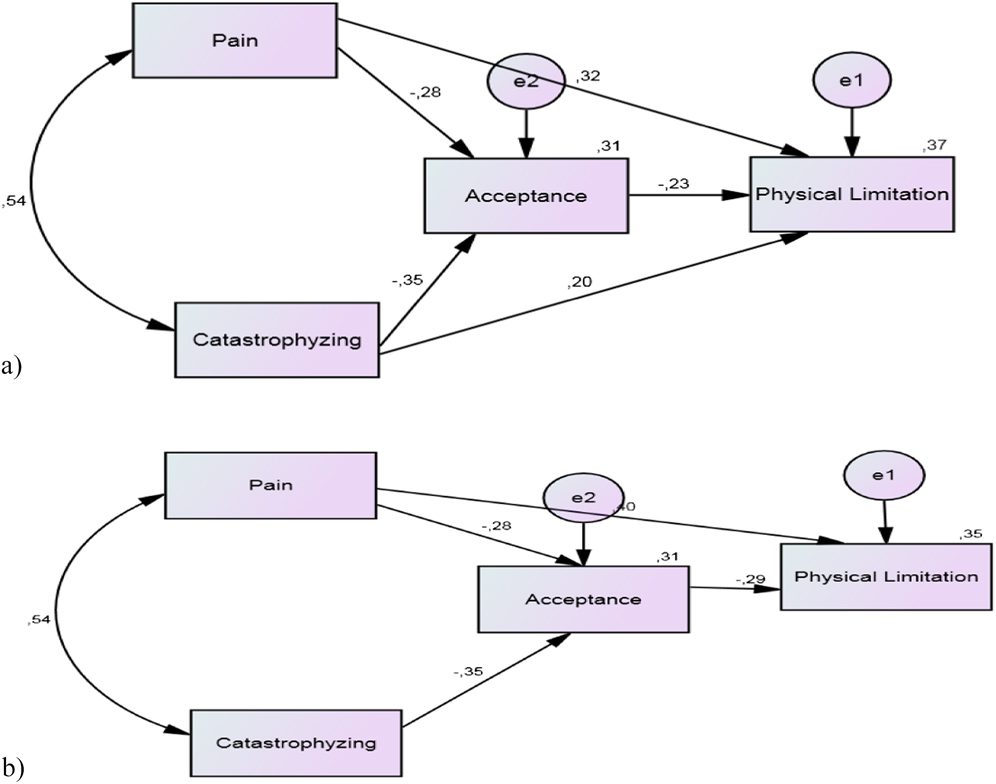
Taking into account this previous data, we further inspected the mediator function of acceptance on the relationship between pain, catastrophizing and physical limitation. The model consists of four variables: the independent exogenous variables are considered pain and catastrophizing; the mediator is considered acceptance; the dependent endogenous variable is considered physical limitation (see Figure 2a).
Model 2-The Mediation Function of Acceptance on the Relationship between Pain, Catastrophizing and Physical Limitation. a) Model Test; b) Final Model.
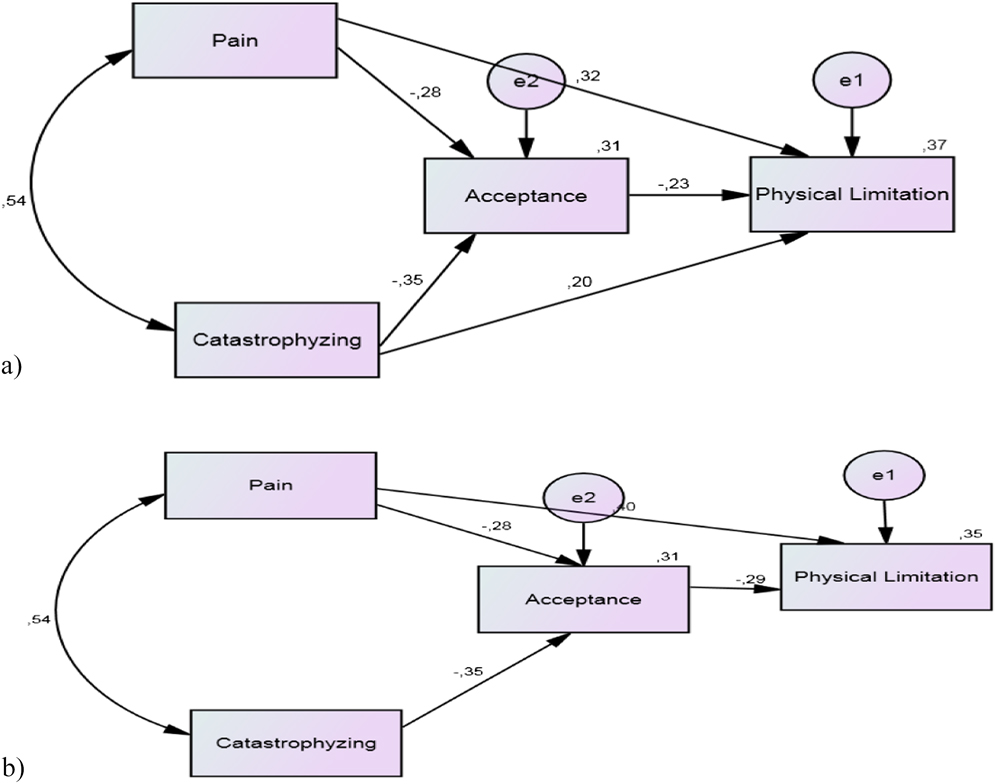
The standardized coefficients showed that the path between catastrophizing and physical limitation was not significant at the .05 level and the path was deleted. Since the p-value associated with the path between acceptance and physical limitation was around .05 (p = .079), this path was maintain in the following analysis (see Table 5). The final model is presented in Figure 2b.
Standardized coefficients of the model that tests the mediation function of acceptance on the relationship between pain, catastrophizing and physical limitation- Model Test

The analysis converged to an admissible solution. The Maximum Likelihood estimates of the model parameters are reported in Table 6.
Standardized coefficients of the model that tests the mediation function of acceptance on the relationship between pain, catastrophizing and physical limitation- Final Model

All path coefficients were statistically significant (p ≤ .05). The final model accounts for 35% of the variance score of physical limitation. The various models of fit calculated for the SEM indicated that the estimated model provided a good fit of model to the data. The chi-square fit index was statistically no significant, which is consistent with an acceptable model fit. Concerning the Relative/Normed Chi-Square, a way of minimizing the impact of the sample size in the Chi-Square value, the value obtained might be considered within an acceptable ratio (χ² (1) = 2.094), given that reference values range from 2 to 5 (Bollen, Reference Bollen1989; Marôco, Reference Marôco2010; Tabachnick & Fidell, Reference Tabachnick and Fidell2007; Wheaton, Muthen, Alvin & Summers, Reference Wheaton, Muthen, Alvin, Summers and Heise1977). In respect to the Comparative Fit Index (CFI), the value obtained (.981) is greater than the reference value indicative of good model fit (CFI = .95) (Brown, Reference Brown2006; Hu & Bentler, Reference Hu and Bentler1999; Marôco, Reference Marôco2010). The Tucker Lewis Index (TLI), the value obtained might be considered within an acceptable ratio (.883), given that reference values range from .8 to .9. In respect to the other goodness-of-fit tests both Parsimony CFI (PCFI) and Root-Mean Square Error of Approximation (RMSEA) are lower than the reference value indicative of a poor model fit as well (PCFI = .164; RMSEA = .142).
The values of fit indexes only indicate the average or overall fit of the model (Kline, Reference Kline2005). This means that some parts of the model may poorly fit the data even if the value of a particular index seems favorable.
The final model indicated the total effect of pain on physical limitation of .48, being the direct effect β = .40 and indirect effect through acceptance of .08 (β = –.28 x –.29) (see Figure 4). This means that physical limitation decreased about .08 standard deviations for every reduction in pain of one full standard deviation via its prior effect on acceptance, indicating that despite pain individuals with higher acceptance did report low physical limitation.
Cohen and Cohen (Reference Cohen and Cohen1983) reported that statistical significance of indirect effects is a necessary condition when we have less than 2 mediators. The indirect effects were analyzed with Bootstrap resampling. The estimate of indirect effects of pain on physical limitation, framed by a 95% C.I. of [.003; .225], showed an effect significantly different from zero (p = .036).
An indirect effect of catastrophizing on physical limitation through acceptance of .10 (β = –.35 X –.29), was also indicate by the results. This is to say that the individuals with lower catastrophizing and with higher acceptance did report less physical limitation. The estimate of indirect effect of catastrophizing on physical limitation was also analyzed with the Bootstrap resampling, framed by a 95% C.I. limits of [.002; .273], showing a significantly different effect from zero (p = .040).
Multi-Group Invariance of the model across Men and Women
To study possible biases in model estimates for either women or men, a multigroup analysis was performed. The women and men model invariance was tested by comparing the equality of women and men constrained model χ2 with the free women and men non-constrained model χ2. Nested model comparisons resulted in no significant values of Δχ² changes, which mean that there are no real differences between the men and women. The dataset results supported equal configural, strict measurement invariance (metric and scalar) and structural invariance of the model for both groups (non-significant Δχ2 (p >.05)) (Marôco, Reference Marôco2010). This is to say that the path analysis can be generalized to both men and women.
Discussion
Since RA has been identified as the main reason of temporary disability and early retirement, research has focused its attention in the processes by which pain and catastrophizing impacts on pain outcomes such as physical limitation (Newman et al., Reference Newman, Fitzpatrick, Revenson, Skevington and Williams1996; Sulivan, Reference Sullivan2012). Research has identified several psychological, interpersonal (Cano, Reference Cano2004), physiological (Wolff et al., Reference Wolff, Burns, Quartana, Lofland, Bruehl and Chung2008) and neuroanatomical mechanisms (Gracely et al., Reference Gracely, Geisser, Giesecke, Grant, Petzke, Williams and Clauw2004) that link catastrophizing to pain outcomes with both clinical and theoretical implications.
The strong links between pain, catastrophizing and physical limitation have influenced the development of conceptual models and it seems possible that certain emotional regulation processes (e.g. acceptance), may buffer the impact of pain and catastrophizing on pain outcomes.
Given that little is known about the influence of acceptance on the relationship between pain, catastrophizing and physical limitation, this study sought to examine the association between pain, catastrophizing, acceptance and physical limitation in a sample from the Portuguese population with 2 year RA. Furthermore, this study pretended to explore the role of acceptance as a possible mediator process between pain, catastrophizing and physical limitation.
Accordingly with our first hypothesis, we found that individuals with higher levels of pain and catastrophizing presented high physical limitation. Current data was consistent with previous research that has showed strong relationships between pain, catastrophizing and disability (Burns, Glenn, Bruehl, Harden, & Lofland, Reference Burns, Glenn, Bruehl, Harden and Lofland2003; Cook, Brawer, & Vowles, Reference Cook, Brawer and Vowles2006; Sullivan et al., Reference Sullivan, Thorn, Haythornthwaite, Keefe, Martin, Bradley and Lefebvre2001).
Simultaneously, we hypothesized that acceptance would be negatively associate with physical limitation. Again, our findings were in line with our predictions and were also consistent with what research has reported: those individuals with higher levels of acceptance also report a lower level of physical limitation. In fact, literature has suggested that an open attitude toward unwanted private experiences, without trying to modify, control or avoid them, is associated with a better physical functioning (McCracken, Reference McCracken1998; McCracken & Eccleston, Reference McCracken and Eccleston2005; McCracken, Carson, Eccleston, & Keef, Reference McCracken, Carson, Eccleston and Keefe2004; McCracken & Yang, Reference McCracken and Yang2006; Viane et al., Reference Viane, Crombez, Eccleston, Poppe, Devulder, van Houdenhove and De Corte2003).
Taking into account these data and previous findings that suggest that particular emotional regulation processes may buffer the impact of disease and may also support in times of adversity, we further inspected these results using path analysis models. Path Analysis with SEM is similar to traditional methods such as correlation and regression. Both Regression and Path Analysis are based on linear statistical models with valid statistical tests associated, if certain assumptions are met. In this line, Regression assumes a normal distribution and Path Analysis assumes multivariate normality. Finally, neither approach offers a test of causality. It has been also emphasize the importance of bootstrap estimation of the indirect effects (since the Z statistic obtained with the Sobel Test may not be normally distributed (Preacher & Hayes, Reference Preacher and Hayes2008). In this line the macro for SPSS using Preacher and Hayes Bootstrap or AMOS Bootstrap is exactly the same.
However, several differences between Regression and Path Analysis must be mention to justify performing a Path Analysis instead of a Regression Analysis. Path Analysis is a highly flexible and comprehensive methodology than regression analysis. Besides Path Analysis with SEM requires a formal specification of the model test and offers no default model, it places few limitations related with relations. As a multivariate technique, Path Analysis specifies the relationships between observed (measured) variables which could be independent and dependent whereas variables in Regression Analysis are either independent or dependent. Path Analysis specifies the error or unexplained variance while Regression Analysis assumes that the measurement occurs without error. Finally, the graphical language of Path Analysis provides a powerful way to present complex relationships, using a pictorial representation which represents a set of equations simultaneously solved to test model fit and estimate parameters (Kline, Reference Kline2005).
Regarding Path Analysis with Regression using OLS, it gives exactly the same results as Path Analysis by MLE for saturated models. The differences are that Regression Models are saturated models (were all relationships are considered in the model) while in our Path Model we have only considered the relationships relevant to our study’ hypothesis and have a non-saturated model. This is a more parsimonious, and therefore more corrected, analysis than Regression Path Analysis. In Regression Path Analysis the only measure of fit is R2 and its significance (which is also affected by sample size). In Path Analysis with SEM software we have several measures of fit. This makes Path Analysis inferences more robust and generalized to a population from a small sample size than the conclusions drawn from a OLS Regression.
A first path model was than fitted to the data in order to explore the direct effects of pain, catastrophizing and acceptance on physical limitation. The model accounted for 35% of the variance score of physical limitation. The results showed that pain and acceptance had medium effects on physical limitation, indicating that individuals with high pain and low acceptance did report high perception of physical limitation. The results also found that the influence of catastrophizing on physical limitation came through its covariance with pain. This means that catastrophizing itself had no direct effect on physical limitation but its influence came through its covariance with pain.
Accordingly to Sullivan et al. (Reference Sullivan, Thorn, Haythornthwaite, Keefe, Martin, Bradley and Lefebvre2001), catastrophizing is conceptualized as a response to pain that varies over time and is determined by situational factors. This raises the question of whether there are contextual determinants of catastrophizing and, if so, what are and how they vary across time and individuals (Turner & Aaron, Reference Turner and Aaron2001). It is suggested that social goals may play a role in the development and maintenance of catastrophizing, whereas appraisal-related processes may point to the mechanisms that link catastrophizing to pain experience (Sullivan et al., Reference Sullivan, Thorn, Haythornthwaite, Keefe, Martin, Bradley and Lefebvre2001).
A second model was fitted to the data in order to explore the mediator function of acceptance on the relationship between pain, catastrophizing and physical limitation. The path analysis was performed to explore both the direct effect of pain and catastrophizing on physical limitation depression and also to explore the buffer effect of this particular emotional regulation process (e.g. acceptance) in this relationship.
The model explained 35% of the variance score of physical limitation. Accordingly, our results indicated that acceptance shows tendencies to partially mediate the effects of pain on physical limitation. This means that individuals with pain but higher levels of acceptance report less perceptions of physical limitation. In the same line, results also indicated that acceptance fully mediate the effects of catastrophizing on physical limitation. When mediation is indicated acceptance was negatively related to criterion variable (e.g. physical limitation), such that greater acceptance was associated with less physical limitation.
It is important to notice that the model specification was not entirely driven by empirical criteria such as statistical significance, and the sample size and effect sizes of the relationships were both taking into account. As Sterne and Davey (Reference Sterne and Davey2001) said, a p-value around .05 should not necessary lead to the rejection or not of H0, but the need of additional studies to confirm the relationships found in a larger sample. A path may be statistically significant due only to chance variation, and its inclusion in the model would be akin to a type I error. Likewise, a path that corresponds to a true nonzero causal effect may not be statistically significant in a particular sample and its exclusion from the model would be essentially a Type II error.
Then these findings are a first step in the understanding of acceptance as an intervening process by which pain influences physical limitation of this field and also confirm our previous hypothesis and are consistent with previous cross-sectional studies (Vowles et al., Reference Vowles, McCracken and Eccleston2008) and also longitudinal studies (Vowles et al., Reference Vowles, McCracken and Eccleston2007) with another statistical approach.
So, according to our results pain and catastrophizing are clearly associated, but the influence of catastrophizing on physical limitation seems to only indirect manifests through acceptance. This is to say that the influence of catastrophizing on physical limitation is promoted by lower levels of acceptance. The effects of catastrophizing on patient physical limitation relied not only on their content or frequency but also on the experience and the existing circumstances. These preliminary results introduce a new approach to the study of RA physical limitation study and establishes a possible mechanism by which pain and catastrophizing operate in a contextual- based perspective. Results also suggest that empirical and clinical work may benefit from the perspective where catastrophizing is considered within the context of the behavioral process that give catastrophizing its impact (Vowles et al., Reference Vowles, McCracken and Eccleston2008).
These findings support the idea that physical limitation is not necessarily a direct product of catastrophizing and other processes seems to be associated, such as acceptance. Acceptance of catastrophic thoughts as part of the experience of pain entails an awareness of those thoughts without the need to experience the suffering that their content implies. So patients with RA may have catastrophic thoughts, notice them for what they are, but remain engaged in some activity.
This contextual approach was already reflected in Sullivan et al.’s model proposed in 2001. Accordingly to this perspective, social and interpersonal context within pain is experience have important influences on behavior (Sullivan, Reference Sullivan2012; Vowles et al., Reference Vowles, McCracken and Eccleston2008).
Our findings address an important question about the role of acceptance and catastrophizing on physical limitation in patients with RA. We believe that the finding that levels of acceptance influence the impact of catastrophizing on physical limitation is a new outcome with clinical implications to psychological interventions. The current data was also consistent with a particular research in a large sample (n = 334) of several chronic pain conditions (Vowles et al., Reference Vowles, McCracken and Eccleston2008). With the purpose of study the role of acceptance of chronic pain in the relation to catastrophizing, Vowles et al. (Reference Vowles, McCracken and Eccleston2008) found that acceptance partially mediates the effect of catastrophizing across several measures such as disability. As in the current study, the levels of acceptance influence how catastrophizing affects patient functioning.
As far as we known these effects have never been tested with a particular RA sample. The present study extends previous results showing that there is an additional aspect to consider with regard to the relations between catastrophizing and physical limitation derived from a contextual view of how thoughts variably influence behavior depending on history and situation.
The findings presented in the current research are not free of some methodological limitations. First, path analysis involves the estimation of presumed causal relations among observed variables. However the basic data of path analysis is covariance which includes correlation. It is well-known that the inference of causality requires that some conditions are met (1) there is time precedent; (2) the direction of the causal relation is correctly specified; and, (3) the association between the variables does not disappear when external variables are held constant. This type of design poses several difficulties (e.g. subject attrition, additional resources). Perhaps because these reasons, in most of path analysis the variables are concurrently measures. Some authors have also emphasized that the use of Structural Equation Model computer programs rarely yields any results that have any interpretation as causal effect (Kline Reference Kline2005). Secondly, the path analysis approach requires samples largely dependent on the specificity of the empirical context (Duncan, Duncan, & Strycker, Reference Duncan, Duncan and Strycker2010). Besides there are no absolute standards in the literature about the relation between the sample and path model complexity, each variable has normally three associated parameters. Based on that and on the restrictions imposed in the path analysis models under study, we considered a ratio of 10 observations per variable (Kline, Reference Kline2005; Marôco, 2011). Following this line of though, it is important to notice that the use of such a complex statistical procedure with a small sample is also justified by the exploratory nature of our study, the measures used in the current study have showed good psychometric properties and also there were no missing data. However, it must be emphasized that the relations found in the present paper may not replicate in other samples, since the sample under study (n = 55) and the sampling method may have produced results that may not be representative of the population of patients with RA. Even so, this sample has a practical significant size for the RA population in Portugal. Our results clearly represent a first step into an interesting scientific development on this filed. Under such circumstances, it is considered that this initial data set, despite its small size add new insights to the RA field of study.
Third, all data were collected through patients’ self-reports. This relies heavily on what patients says, the indirect nature of this assessment method allow us to several factors that may contribute to patients’ responses. A possible solution to address the limitations of self-reports is the use of additional information from laboratory methods and also from epigenetic mechanisms evolved.
Fourth, Path Analysis provides no straightforward tests to determine model fit. Instead, the best strategy for evaluating model fit is to examine multiple tests. However the availability of so many different fit indexes presents a few problems and it is difficult for a researcher to decide as to which particular indexes and which values to report. It should also be notice that the values of fit indexes only indicate the average or overall fit of the model (Kline, 2009). As mentioned before, this means that some parts of the model may poorly fit the data even if the value of a particular index seems favorable. Because a single index reflects only a particular aspect of model fit, a favorable value of those indexes do not by itself indicate good or a bad fit to data. This is also why a model fit is usually assessed based in part on the values of several index (see Marôco, Reference Marôco2010). That is, there is no single index that provides a gold standard for all models (Kline, Reference Kline2005).
Finally it is important to notice that, although the large proportion of women in the sample does not match the normative population men/women ratio (e.g. 1:3), this is not seem to be a limitation since we address a path analysis model of effects of pain, catastrophizing and acceptance on physical limitation, which should not be different between men and women as the multigroup path analysis did show.
These results showed that the effects of catastrophizing on patient physical limitation relied not only on their content or frequency but establish a possible mechanism by which pain and catastrophizing operate in a contextual- based perspective.
Acceptance of catastrophic thoughts seems to have an important contribution pain experience of pain. It entails an awareness of those thoughts without the need to experience the suffering that their content implies.
Results suggested that empirical and clinical work may benefit from a contextual based perspective where the occurrence of catastrophizing is considered within the context of the behavioral process that gives catastrophizing its impact (Vowles et al., Reference Vowles, McCracken and Eccleston2008).
Results gathered in this research have important theoretical and clinical implications. From a theoretical view, the understanding of how catastrophizing influences pain outcomes might contribute to the clarification of conceptual frameworks that address the linkages between psychology and physiology in the basis of the experience of pain. From a clinical view, the understanding of the mechanisms by which catastrophizing influences both the experience and the expression of pain might contribute to new developments in intervention. The exploration of these processes has the potential of improve the understanding of suffering from RA and perhaps from chronic physical and mental difficulties more generally. However, other studies with larger sample-sizes and/or samples from different multicultural diverse countries are in need to improve the generalizability of the conclusions of this study on RA progression, pain acceptance and psychosocial adjustment to the disease progression.