Introduction
Heritage speakers (HSs) are bilingual speakers who acquire their native heritage language (HL) in a minority setting under reduced input conditions and under the influence of a dominant societal majority language (Benmamoun, Montrul, & Polinsky, Reference Benmamoun, Montrul and Polinsky2013; Kupisch & Rothman, Reference Kupisch and Rothman2018; Montrul, Reference Montrul2015; Polinsky & Scontras, Reference Polinsky and Scontras2019). As a result, HL systems frequently differ from monolingual systems, even though HSs are exposed to the HL from birth and are considered native speakers of that language (Montrul, Reference Montrul2015). What is especially remarkable in the context of HL acquisition is that aspects of language usually acquired early by monolingual children may show a protracted developmental pattern in child HSs. The acquisition of inflectional morphology, in particular, such as case marking, has been reported as problematic for adult HSs from a range of typologically different languages: from East-Asian languages that allow for case drop (e.g., Korean, Japanese; Kim, O'Grady, & Schwartz, Reference Kim, O'Grady and Schwartz2017; Laleko & Polinsky, Reference Laleko and Polinsky2016), to Indo-European languages, where a default or a syncretic case is produced (e.g., Russian or German; Laleko & Polinsky, Reference Laleko and Polinsky2016; Montrul, Bhatia, Bhatt, & Puri, Reference Montrul, Bhatia, Bhatt and Puri2019). These issues have been shown to emerge in the speech of HL children (Flores, Reference Flores2015; Janssen, Reference Janssen2017; Janssen, Meir, Baker, & Armon-lotem, Reference Janssen, Meir, Baker and Armon-lotem2014; Kim et al., Reference Kim, O'Grady and Schwartz2017; Song, O'Grady, Cho, & Lee, Reference Song, O'Grady, Cho, Lee and Kim1997)Footnote 1 and to persist in adult HSs (see Montrul, Reference Montrul2015). This difference between the HL system and the monolingual system has been seen either as simplification by reducing the number of case distinctions in the inflectional paradigm (Chung, Reference Chung2018; Hopp & Putnam, Reference Hopp and Putnam2015; Laleko & Polinsky, Reference Laleko and Polinsky2016; Montrul, Reference Montrul2015; Montrul, Bhatt, & Bhatia, Reference Montrul, Bhatt and Bhatia2012), or simply as a system with a higher degree of variation but similar to what is also found in monolingual systems (Łyskawa & Nagy, Reference Łyskawa and Nagy2019).
From a developmental perspective, and given the integral role of case in assigning thematic roles and successfully producing and comprehending sentences, it is important to understand why an otherwise early acquired property displays such a protracted developmental pattern in child HSs. Recent studies have shown that child-level factors, such as proficiency or length and degree of exposure, may be modulating acquisition (Flores, Reference Flores2015; Gagarina & Klassert, Reference Gagarina and Klassert2018), although few studies have examined how these background variables interact and how they may (differentially) affect the two modalities in child HSs (Janssen, Reference Janssen2017; Kim et al., Reference Kim, O'Grady and Schwartz2017). Cross-linguistic studies have also shown that languages with transparent case-marking systems may lead to more accurate performance, with evidence to date from languages with object markers that unambiguously mark cases and allow them to be dropped (e.g., Korean; Kim et al., Reference Kim, O'Grady and Schwartz2017; Song et al., Reference Song, O'Grady, Cho, Lee and Kim1997), or from languages that consistently and transparently mark case on the noun (e.g., Russian and Polish; Janssen, Reference Janssen2017; Janssen et al., Reference Janssen, Meir, Baker and Armon-lotem2014; Kim et al., Reference Kim, O'Grady and Schwartz2017; Song et al., Reference Song, O'Grady, Cho, Lee and Kim1997). Importantly, difficulties with case marking in production seem to extend to the integration of case-marking cues in sentence comprehension, especially when the heritage and the societal languages provide conflicting word order and case-marking cues (Janssen, Reference Janssen2017; Janssen et al., Reference Janssen, Meir, Baker and Armon-lotem2014; Kim et al., Reference Kim, O'Grady and Schwartz2017; Song et al., Reference Song, O'Grady, Cho, Lee and Kim1997).
In the present study, we extend this line of research by focusing on how English-dominant Greek HL children acquire a complex case system like Greek, and how they perform in case production and comprehension. In comparison to existing studies, Greek allows us to investigate how case transparency and syncretism within the same language may affect the production of case and HL children's interpretation of simple transitive sentences, where case marking may facilitate disambiguation of thematic roles. Although Greek has an inflectionally rich nominal system, that is nouns and articles have distinct forms within the paradigm, it is also characterised by a high degree of paradigmatic syncretism; case-marking forms within the paradigm overlap for article and nouns. As a result, this high syncretism may counteract inflectional richness. In a cross-linguistic study, Xanthos et al. (Reference Xanthos, Laaha, Gillis, Stephany, Aksu-Koç, Christofidou and Dressler2011) showed that Greek-speaking monolingual children took longer to acquire nominal morphology compared to their Russian-speaking counterparts, a language with greater morphological richness and less paradigmatic syncretism, compared to Greek.
The availability of case in Greek allows for freer word order compared to English. Although SVO is considered a canonical word order in Greek, the case-marked object can be displaced to a sentence-initial position, giving rise to a non-canonical OVS order. In the psycholinguistic literature, displaced constituents that appear early in the sentence can be felicitously interpreted if they carry transparent cues (see Omaki, Davidson White, Goro, Lidz, & Phillips, Reference Omaki, Davidson White, Goro, Lidz and Phillips2014, for Korean-speaking monolingual children, and Roesch & Chondrogianni, Reference Roesch and Chondrogianni2016, for German-speaking sequential and simultaneous bilingual children). For English-dominant child HSs of Greek, the acquisition of these non-canonical structures with displaced constituents may prove challenging given HSs’ more general limitations with these structures (Polinsky & Scontras, Reference Polinsky and Scontras2019) and the pressure from the English dominant SVO structures. The investigation of canonical and non-canonical structures in Greek allows us to examine whether child HSs can make use of cue transparency and position to felicitously comprehend these structures. Ours is the first study to examine the interplay of these factors in the comprehension of simple transitive sentences by Greek monolingual children as well.
Finally, by focusing on a group of school-age Greek heritage bilingual children residing in New York City, we examined how performance on case production and comprehension may be differentially affected by child-level factors such as lexical and morphosyntactic competence, chronological age and the degree of early and current exposure to the HL, and how group variability within the heritage group relates to individual variability.
Word order and case in Greek and English
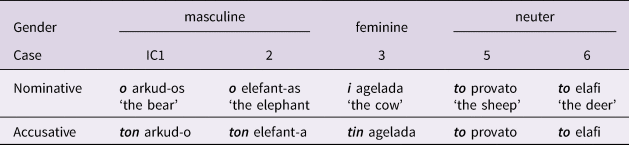
Greek is an inflectionally rich, null-subject language, which marks gender, case, and number on the noun and subject–verb agreement on the verb across all persons and numbers. Conversely, English noun phrases do not carry any case or gender information (apart from case on pronouns) and constituents most typically follow a strict Subject–Verb–Object (SVO) word order. In Greek, nouns are classified depending on their inflectional class (ICs), namely on their inflectional endings. ICs are related to gender, although there is no one-to-one mapping, and eight ICs have been proposed (Ralli, Reference Ralli2002). Greek has a four-way case system: nominative, genitive, accusative, and vocative. Case is marked on all nominal elements, that is the determiner, the adjective, and the noun. The Greek nominal system is characterised by a high degree of paradigmatic syncretism; forms within the paradigm overlap with each other across cases, and therefore it is not always possible to discern the case of the noun by looking at its ending, as indicated in the feminine and neuter nouns in Table 1. Case is discretely marked on the definite article for masculine and feminine nouns but not for neuter nouns, where the nominative and accusative case overlap (Table 1). Here, we focus on the first six ICs (apart from IC4) that include nouns from all genders, as these were targeted in the present study.
Definite article and Inflectional Classes (ICs) per gender

The availability of rich nominal morphology allows for a relatively free word order, where the subject, verb, and object can surface in different positions, as indicated in examples (1a–d). Note that only (1a) is possible in English, whereas sentences (1b–d) are ungrammatical.

Despite these variable word order permutations, pre- and postverbal subjects and objects adhere to syntactic and discourse constraints. Verb–Subject–Object (VSO) is considered to be the least marked word order in Greek (Alexiadou & Anagnostopoulou, Reference Alexiadou and Anagnostopoulou1998; Philippaki-Warburton, Reference Philippaki-Warbarton1985; Roussou & Tsimpli, Reference Roussou and Tsimpli2006) and is the most natural answer to wide focus questions of the “What happened with X?” type (Alexopoulou, Reference Alexopoulou1999). However, SVO yields higher felicity judgements in all new information contexts (Keller & Alexopoulou, Reference Keller and Alexopoulou2001), as well as in contexts where the preverbal subject receives a topic or a contrastive focus interpretation (Alexiadou, Reference Alexiadou1996; Tsimpli, Reference Tsimpli and Kiss1995). Preverbal subjects (of transitive verbs) were also more frequent than postverbal subjects, and SVO structures more frequent (49.8%) than OVS structures (7.8%) in corpus analyses (Lascaratou, Reference Lascaratou1989; Skopeteas, Reference Skopeteas, Féry and Ishihara2016). The OVS word order is derived from object displacement to a preverbal, sentence-initial focus position (Tsimpli, Reference Tsimpli and Kiss1995). The interpretational possibilities of the various word orders are further modulated by prosodic properties. To simplify a rather complex picture, preverbal subjects and objects have been associated with an identificational focus interpretation when bearing nuclear accent (Skopeteas, Reference Skopeteas, Féry and Ishihara2016). Importantly, though, there is continuing controversy about whether preverbal subjects and preverbal objects have exactly the same structural and informational status (cf. Alexiadou & Anagnostopoulou, Reference Alexiadou and Anagnostopoulou1998, p. 501; Tsimpli, Reference Tsimpli and Kiss1995).
Case marking and word order in Greek-speaking monolingual children
Case is an early acquired property in monolingual Greek-speaking children, who produce all main case distinctions (nominative–accusative–genitive) on the determiner and the noun by the age of four years, although with subtle timing differences across ICs, genders, and numbers (Marinis, Reference Marinis2003; Stephany, Reference Stephany and Slobin1997). Here we focus on the distinction between the nominative and the accusative case in the singular, as these are the structures tested in the present study, and we review the literature on the acquisition of nouns separately from that of the definite article, as the morphological processes there differ. We focus primarily on masculine nouns of ICs 1 and 2, as these forms carry a distinction between the nominative and the accusative. Feminine and neuter nouns do not overtly mark nominative–accusative case distinctions (Table 1). Nouns produced in early acquisition stages end in a stem vowel and lack overt case marking. This form is considered to be an unmarked form, although it overlaps with the accusative form of the nouns in ICs 1 and 2, and with the nominative/accusative noun form in IC5 (Marinis, Reference Marinis2003; Stephany, Reference Stephany and Slobin1997; Tsimpli & Stavrakaki, Reference Tsimpli and Stavrakaki1999). Case distinctions between the unmarked (accusative) form and the marked nominative for ICs1 and 2 are observed in the speech of children between two and three years old (Marinis, Reference Marinis2003). Case substitution errors involve the overuse of the unmarked form of the noun rather than substitutions with overtly case marked forms, e.g., the use of the genitive instead of the nominative and vice versa.
Definite articles produced in the early acquisition stages of Greek have been reported to carry only gender and no case information (Stephany, Reference Stephany and Slobin1997). Around the age of two years, nominative and accusative distinctions emerge simultaneously across genders (Marinis, Reference Marinis2003; Stephany, Reference Stephany and Slobin1997). Substitution errors involve the overuse of the unmarked form to, which corresponds to the neuter nominative or accusative singular, rather than substitutions with overtly case marked forms (Marinis, Reference Marinis2003; Tsimpli & Stavrakaki, Reference Tsimpli and Stavrakaki1999).
The early acquisition of case marking in Greek allows for the early acquisition of variable word order. Spontaneous language samples (Kapetangianni, Reference Kapetangianni, Anderssen, Bentzen and Westergaard2011; Tsimpli, Reference Tsimpli, Stavrou and Terzi2005) have shown that the various word orders in Greek are acquired almost simultaneously around the age of two to three years; OV(S) word order is acquired at the same time as SVO or VSO word orders. Additionally, children are familiar with the semantic and discourse pattern distinctions conveyed by the different word orders, as well as with the stress patterns associated with contrastive or identificational focus in OV(S) structures (Tsimpli, Reference Tsimpli, Stavrou and Terzi2005).
Turning to comprehension, experimental studies targeting complex sentences in Greek, such as relative clauses and wh-questions, have reported that case marking has a facilitatory effect on the comprehension of these structures. Preschool and school-age monolingual Greek-speaking children make use of case-marking cues to assign thematic roles when parsing complex structures in a way that may accelerate acquisition (Guasti, Stavrakaki, & Arosio, Reference Guasti, Stavrakaki and Arosio2012; Sauerland et al., Reference Sauerland, Grohmann, Guasti, Anđelković, Argus, Armon-Lotem and Yatsushiro2016; Stavrakaki, Tasioudi, & Guasti, Reference Stavrakaki, Tasioudi and Guasti2015; Tsimpli & Stavrakaki, Reference Tsimpli and Stavrakaki2001; Varlokosta, Nerantzini, & Papadopoulou, Reference Varlokosta, Nerantzini and Papadopoulou2015). For example, Guasti et al. (Reference Guasti, Stavrakaki and Arosio2012) reported that relative clauses were acquired in Greek-speaking children between the ages of four and five years, almost two years earlier than the Italian-speaking children in their study, a language without case marking.
Linguistic factors in the acquisition of case and word order in HSs
Heritage speakers from typologically distinct languages have been shown to omit case markers (e.g., object drop for East-Asian languages, such as Japanese or Korean (Laleko & Polinsky, Reference Laleko and Polinsky2016), and to simplify the case-marking distinctions in syncretic case systems, such as Russian, Polish, and German, even though the nominative–accusative distinction is retained within the system (Hopp & Putnam, Reference Hopp and Putnam2015; Polinsky, Reference Polinsky2006; Yager et al., Reference Yager, Hellmold, Joo, Putnam, Rossi, Stafford and Salmons2015), or they exhibit more variable performance than monolingual speakers in the acquisition of case rather than more simplified case systems (Łyskawa & Nagy, Reference Łyskawa and Nagy2019).
Cross-linguistic studies with HL children have also reported that the morphophonological paradigm modulates the acquisition of case. For example, although both Polish and Russian have transparent case systems, Polish has a smaller amount of ending homophony in the gender and case system than Russian. Therefore, the Polish gender and case systems are thought to be more transparent than the Russian gender and case system and might be acquired earlier than the Russian one. These predictions were borne out in a study by Janssen (Reference Janssen2017) on the acquisition of case in Russian- and Polish-speaking HL children. Both the monolingual and bilingual Polish HL children outperform their Russian monolingual and heritage counterparts.
Whether case is vulnerable in HSs of Greek remains unexplored. In the single naturalistic study to date to examine case-marking acquisition in Greek HSs, Zombolou (Reference Zombolou and Ihemere2011) found that second- and third-generation Greek–Spanish heritage bilingual speakers (13–70 years) living in Argentina tended to overuse the accusative form of the determiner and the noun in contexts where the nominative case is required (i.e., subject position), even with unambiguous, non-syncretic forms, where accusative case is clearly marked, as in ohi (not) *polus.masc.acc.pl (instead of poloi.masc.nom.pl) (many) estelnan (sent) ‘Not many sent’. This led Zombolou to argue that the Argentinian Spanish–Greek system moves towards a non-case system (Argentinian Spanish marks the dative only under certain conditions). Importantly, this type of error contrasts with what has been found in Greek monolingual acquisition, where children tend to use an unmarked, syncretic form when over-regularising. However, a closer inspection of the three examples reported by Zombolou revealed that they may not necessarily be case marking errors. They could be regarded as indeterminate as to whether it is a case or a gender error where the masculine gender of the noun is substituted with the neuter, e.g., to dromo instead of o. masc.nomdromos. masc.nom ‘the road’.Footnote 2 This form also resembles the default use of to also found in monolingual children.Footnote 3 In the absence of quantitative information, it is hard to ascertain whether or not the Greek in this particular HL context is indeed moving towards a no-case system.
Turning to comprehension, recent studies have shown that HL children are more likely to use word order over case cues to assign interpretation in the context of a language combination where the dominant societal language (English, Dutch, Hebrew) relies on word order whereas the HL (Korean, Polish, Russian) relies on case-marking cues (Janssen, Reference Janssen2017; Janssen et al., Reference Janssen, Meir, Baker and Armon-lotem2014; Kim et al., Reference Kim, O'Grady and Schwartz2017; Song et al., Reference Song, O'Grady, Cho, Lee and Kim1997). Performance on canonical SVO (for Polish and Russian) or SOV (for Korean) conditions was near ceiling, whereas performance on the non-canonical OSV (for Polish and Russian) or OVS (for Korean) conditions was at or below chance level. This was despite children having relatively high accuracy on accusative case production (Janssen, Reference Janssen2017; Kim et al., Reference Kim, O'Grady and Schwartz2017). Performance on non-canonical sentences improved under facilitatory experimental manipulations, such as prosodic stress of the fronted topic in OSV conditions (Song et al., Reference Song, O'Grady, Cho, Lee and Kim1997).
Although existing studies have reported that non-canonical sentences are problematic for HL children, the languages examined have relatively transparent case systems, thus testing primarily canonicity and not how case syncretism may influence performance. The presence of case is not sufficient for monolingual children and adults to felicitously interpret sentences (Omaki et al., Reference Omaki, Davidson White, Goro, Lidz and Phillips2014). The transparency and position of case-marking cues affects accuracy rates. Whether bilingual or HL children are equally facilitated by these types of cues in their HL has remained mainly unexplored. In a study with four- to five-year-old French L1–German L2 bilingual children on German which-questions, Roesch and Chondrogianni (Reference Roesch and Chondrogianni2016) manipulated cue position and transparency and found that performance improved as a function of cue transparency. Sentences with transparent case-marking cues on both the wh-phrase and the second NP elicited near ceiling accuracy, whereas performance was at chance when the sentence-initial cue was ambiguous, and disambiguation was resolved with sentence-final cues.
Greek offers an excellent testing ground for examining whether transparency and cue position affect bilingual children's comprehension of word order within the same HL. More specifically, we investigated whether paradigmatic syncretism influences performance in comprehension and production and how this relates to monolingual children's performance.
Age and use in HL acquisition
The diverse context of HL acquisition renders HL performance more variable and more vulnerable to child-internal factors, such as proficiency in the heritage and the community language, chronological age, onset and length of exposure to the societal language, as well as child-external factors, such as the amount of HL input. Findings to date regarding the individual contribution of these factors on HL development have been mixed and have been primarily investigated in production studies. As a result, our understanding of how these individual factors may differentially affect production and comprehension is far from complete. For example, children's production and comprehension of case has been shown to be affected by HL proficiency, but few other factors have emerged as significant predictors (Janssen, Reference Janssen2017; Janssen et al., Reference Janssen, Meir, Baker and Armon-lotem2014; Kim et al., Reference Kim, O'Grady and Schwartz2017). Similarly, whereas chronological age has been shown to lead to improvement of HL performance (e.g., Armon-Lotem, Walters, & Gagarina, Reference Armon-Lotem, Walters and Gagarina2011; Flores, Reference Flores2015; Flores, Santos, Jesus, & Marques, Reference Flores, Santos, Jesus and Marques2017), other studies have found no or a reduced effect of age compared to factors such as HL input (Gagarina & Klassert, Reference Gagarina and Klassert2018; Janssen, Reference Janssen2017; Rodina & Westergaard, Reference Rodina and Westergaard2017). It seems that improvement with age in child HL speakers does not come for free, as in monolingual typical development, but relates to the language domain under investigation and/or input quantity and quality, among other things (Gagarina & Klassert, Reference Gagarina and Klassert2018). HL input, operationalised in the present study as the proportion of language use at home as estimated by the parents, has been found to differentially affect bilingual development (see Chondrogianni, Reference Chondrogianni, Miller, Bayram, Rothman and Serratrice2018, for a review). In a study where individual variation in HL use was used as a predictor of performance, Daskalaki, Chondrogianni, Blom, Argyri, and Paradis (Reference Daskalaki, Chondrogianni, Blom, Argyri and Paradis2019) reported that postverbal subject pronoun placement in Greek-speaking HL children in Canada and the US (the preferred or grammatical option in Greek but not in English) was better predicted by HL use compared to subject realisation (overt vs. null pronouns), which was immune to this factor. Whether case marking itself is vulnerable to input effects is less clear, as few studies have examined these effects by carrying out direct statistical analyses with input as an individual-level predictor. For example, Gagarina and Klassert (Reference Gagarina and Klassert2018) found no effects of current HL use in the nuclear family on the production of case marking, whereas such effects emerged in the case of subject–verb agreement. Janssen (Reference Janssen2017) also reported that current input correlated less strongly compared to age of exposure to the societal language with case marking; however, neither of these factors survived as predictors of performance in her regression analysis.
Existing studies on HL acquisition have primarily focused on how much the HL is currently used within the family, whereas the contribution of HL use in the early years and before children are systematically exposed to the societal language through (primary) education is less explored. Early (native) input is important for both developmental rate and path in early bilingual acquisition (Place & Hoff, Reference Place and Hoff2016), and both monolingual and bilingual studies have shown that input quantity and quality in the early years are important predictors for later language development (Hoff & Core, Reference Hoff and Core2013; Weisleder & Fernald, Reference Weisleder and Fernald2013). Furthermore, empirical studies have shown that a minimum of 25% of input is required for a language to be acquired (Hoff, Reference Hoff2006; Pearson, Fernandez, Lewedeg, & Oller, Reference Pearson, Fernandez, Lewedeg and Oller1997), although language domains may develop differentially under similar input conditions (Chondrogianni & Marinis, Reference Chondrogianni and Marinis2011). In the context of HL acquisition, few recent studies have examined the role of input across the lifespan by adopting Unsworth's (Reference Unsworth2013) operationalisation of cumulative length of exposure to the HL, that is, exposure over time not just current exposure, with mixed results. Rodina and Westergaard (Reference Rodina and Westergaard2017) reported that cumulative exposure predicted performance on Russian gender in Russian–Norwegian children, whereas in Haman et al. (Reference Haman, Wodniecka, Marecka, Szewczyk, Białecka-Pikul, Otwinowska and Foryś-Nogala2017) cumulative exposure was significant for vocabulary and discourse but not for morphosyntax.
In the present study, we contribute to this ongoing research by examining how proficiency, chronological age, and early and current HL use differentially affect the production and comprehension of case. We focused on a group of English-dominant child HSs of Greek with a relatively homogeneous age of exposure to the societal language (English) and generation status, but with variable early and current exposure to heritage Greek and a wide age-range. This allowed us to more closely investigate the impact of age and input on morphosyntactic structures in the HL.
Present study
The present study investigated the linguistic and individual-level factors that influence production and comprehension of case in child HSs of an inflectional and syncretic language by focusing on Greek–English bilingual children of Greek heritage growing up in New York City. The item-level linguistic factors were the transparency and position of cue. The child-internal factors were vocabulary and morphosyntactic knowledge in the HL, whereas the child-external factors were proportion of early and current HL use. More specifically, we addressed the following research questions:
1. Is case a vulnerable area for Greek HL children in production?
2. Are HL children able to integrate case-marking cues while comprehending canonical and non-canonical sentences in Greek? And how is this ability modulated by the position of case-marking cues?
3. How do lexical and morphosyntactic knowledge and exposure affect HL children's performance on Greek word order and case marking in production and comprehension?
4. What is the role of individual variability as opposed to group performance?
Starting from the linguistic factors in our study (RQ1 & 2), we expect case to be a vulnerable area in Greek child HSs as has been reported for other languages (Flores, Reference Flores2015; Gagarina & Klassert, Reference Gagarina and Klassert2018; Janssen, Reference Janssen2017). We expect HL children's performance to be modulated by linguistic factors also found in monolingual Greek-speaking children. If HL children follow the same but protracted path as young monolingual children in their acquisition of case, we expect accuracy in case production to be influenced by the gender of the noun, with neuter noun phrases having higher accuracy than masculine and feminine ones, and the use of the same default form when substituting for case. This will demonstrate that, despite the complexity of the Greek case system, case production in child heritage Greek is characterised by systematic default substitution rather than random marking of nominal constituents or use of a default form across the board (Łyskawa & Nagy, Reference Łyskawa and Nagy2019). The high degree of paradigmatic syncretism may influence both accuracy and error types, with highly syncretic forms exhibiting lower accuracy and/or being used as the default/unmarked forms in substitution errors (cf. Marinis, Reference Marinis2003; Stephany, Reference Stephany and Slobin1997; Tsimpli Reference Tsimpli, Stavrou and Terzi2005, for L1 acquisition). In comprehension, HL children's inability to integrate case-marking cues may lead to reduced performance in the OVS but not in the SVO condition. In the SVO condition, thematic role assignment (agent–patient) maps onto linear word order. In the OVS condition, however, interpreting the sentence using linear word order will lead to the reverse outcome. Adopting a linear parsing strategy may be exacerbated by the fact that the HL children in the present study grow up in an English-dominant environment, where word order cues are the main strategy for sentence production and comprehension. Transferring this parsing strategy from English to Greek along with low accuracy on case production may lead to compromised performance in the OVS condition. We expect both monolingual and HL children's performance to be modulated by the transparency and the number of cues. More specifically, we expect children to perform better on sentences with two transparent cues (SNOM and OACC), and performance to drop when the disambiguating cues appear in sentence-final position.
In terms of the impact of individual-level factors on HL children's performance (RQ3 & 4), we expect early and current HL use to differentially affect comprehension with non-canonical sentences involving displaced constituents being more susceptible to input compared to canonical sentences (Polinsky & Scontras, Reference Polinsky and Scontras2019). We expect HL children who used the HL early on in life to perform better compared to HL children with less early HL use. However, the degree of current HL use may modulate children's ability to perform similarly to their monolingual peers, with reduced current HL use determining how accurate children may become at producing and/or comprehending case marking and non-canonical structures. Despite the wide age range of the children in our sample (six- to twelve-year-olds), we do not expect straightforward effects of chronological age as these may be counteracted by the high variability of HL use within our sample.
Participants
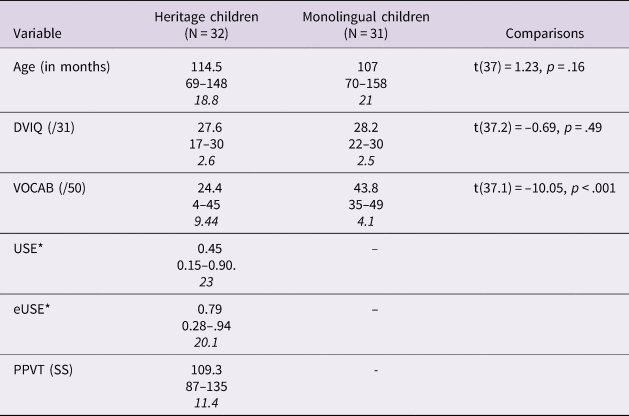
A total of 63 children participated in the study. Thirty-two were six- to twelve-year-old Greek–English bilingual children of Greek heritage residing in New York City, and 31 were monolingual age-matched controls residing in Athens, Greece (Table 2). The inclusion criteria for the HL children were the following: both parents had to be native speakers of Greek or of Greek heritage and they had to speak Greek on a daily basis to some extent before the age of five years; we excluded children whose parents were not both of Greek heritage (e.g., mother a speaker of American English and father a speaker of Greek). This way we ensured that the children who participated in our study were HSs rather than HL learners (Benmamoun et al., Reference Benmamoun, Montrul and Polinsky2013). All children included in the study were not suffering from any speech and language and/or socio-emotional disorders. Two children did not meet these criteria and were excluded from the study. In terms of migration status, there were sixteen children who were second-generation HSs, that is, their parents were first-generation immigrants, thirteen children whose one parent was a first- and the other a second-generation immigrant (2.5 generation), and three children who belonged to third-generation HSs, that is both of their parents were second-generation immigrants. The monolingual children were born, raised, and residing in Greece at the time of testing and both of their parents were monolingual speakers of Greek.
Participant biodata, performance on lexical and vocabulary tasks, and background information on early and current language use (mean, range, SD)

Notes. DVIQ = Diagnostic Verbal IQ (Tsimpli & Stavrakaki, Reference Tsimpli and Stavrakaki2001); VOCAB = Greek expressive vocabulary; USE = current use of Greek; eUSE = early use of Greek (before the age of five years); PPVT = Peabody Picture Vocabulary Task (Dunn & Dunn, Reference Dunn and Dunn2007); SS = standard scores; *figures indicate proportions.
Materials
Background tasks
Greek proficiency
To assess children's language abilities in Greek, we used a single-word expressive vocabulary task developed by Vogindroukas, Proropapas, and Sideridis (Reference Vogindroukas, Proropapas and Sideridis2009). In this task, children see a picture on a slide and they are asked to name it. There are 50 items overall in this task. Children's morphosyntactic abilities were assessed using the comprehension of morphosyntax component from the Diagnostic Verbal IQ test (DVIQ; Tsimpli & Stavrakaki, Reference Tsimpli and Stavrakaki2001). In this task, children see a panel with three pictures, they hear a sentence, and they have to match the picture to the sentence. There are overall 31 items on this task. Raw scores from both tasks were used in further analyses.
English proficiency
Children's proficiency in English was assessed using the Peabody Picture Vocabulary Task (PPVT; Dunn & Dunn, Reference Dunn and Dunn2007), which is a single-word comprehension task standardised with North American children. This task was used to ascertain that children performed within age-appropriate norms in English, and to this end raw scores were converted into standardised scores (Table 2).
Language background questionnaire
To collect information regarding Greek language use with family members at home (parents and siblings, both at the time of testing and in early childhood), children's input and output in Greek, time of immigration to the US or Canada, and parental education, we administered a parental questionnaire that was based on the Alberta Language Environment Questionnaire (ALEQ; Paradis, Reference Paradis2011). Whereas the original ALEQ was designed to measure the current English language use (input and output) in the child's environment, the adaptation that we used (ALEQ Heritage) measured the current heritage (i.e., Greek) language use (Daskalaki et al., Reference Daskalaki, Chondrogianni, Blom, Argyri and Paradis2019). Information about the child's input was measured using questions about how frequently the parents, guardians (including grandparents), and other siblings spoke Greek to the child on a scale from 0 (Greek almost never / English almost always) to 4 (Greek almost always / English almost never). Output was measured as the frequency with which the child spoke Greek to the same family members and guardians. Greek language use at home was then calculated as the mean proportion of Greek input and output that the child received from and directed to other family members (mother, father, siblings, grandparents).
Additionally, we calculated Greek language use in early childhood before the age of five years by asking about the frequency of interaction in Greek (scale same as above for input). Children's Age of Onset (AoO) and length of systematic exposure (LoE) to English was also measured and this usually coincided with the child's attendance of daycare/preschool/school. In terms of exposure to English, the HL children were exposed to English at the mean age of 41.8 months (range: 12–96, SD: 14.7) and had a mean LoE to English of 70.3 months (range: 33–115, SD: 19).
Experimental tasks
Case production task
The production task examined whether HL children made morphological case-marking errors in Greek. We used a picture-based task depicting simple transitive actions between two animals and aimed at eliciting simple transitive sentences. There were six contexts for masculine (likos ‘wolf’, skilos ‘dog’, lajos ‘hare’, elefantas ‘elephant’ (×2), krokodilos ‘crocodile’) and feminine (maimu ‘monkey’ (×2), arkouda ‘bear’, katsika ‘goat’ (×2), jata ‘cat’) nouns in subject and object position that require the nominative and accusative case, respectively, and four contexts for neuter nouns (elafi ‘deer’, ljontari ‘lion’, provato ‘sheep’, (×2) in subject and object position. In Greek, the nominative and accusative cases are clearly marked on masculine and feminine determiners, whereas in the feminine nouns and in neuter determiners and nouns there is syncretism between the nominative and the accusative. Given the interplay between case and gender in Greek, we wanted to establish the role of gender in case errors.
Case comprehension task
The comprehension task examined whether children were able to integrate case-marking cues while comprehending simple canonical (SVO) and non-canonical (OVS) transitive sentences in Greek. It was also designed to investigate whether cue position and ambiguity affect monolingual and bilingual children's interpretation of canonical and non-canonical sentences, as found for other case-marking languages such as German (Roesch & Chondrogianni, Reference Roesch and Chondrogianni2016). To explore these issues, we developed a picture verification task targeting canonical (SVO) and non-canonical (OVS) sentences carrying transparent and opaque case-marking cues at sentence-initial and sentence-final positions in a 2 × 2 × 3 design: (i) canonical and non-canonical sentences with double case-marking cues as in examples (2a & b), and (ii) canonical and non-canonical sentences with single case-marking cues, as in (3a & b) and (4a & b). In the case of sentences with single case-marking cues, we manipulated the position of the cue; i.e. whether it appeared at a sentence-initial or sentence-final position. Examples (3a) and (4a) are canonical sentences; however, in (3a) the case-marking cue is in a sentence-initial position, whereas in (4a) it is in a sentence-final position.

All nouns depicted animals across conditions. There were six items per condition, resulting overall in 48 items. In the double cues condition, all nouns were masculine (arkudhos ‘bear.masc’, jatos ‘cat.masc’, kokoras ‘rooster’, lajos ‘hare’, piguinos ‘penguin’, vatrahos ‘frog’), whereas in the single cue condition, nouns were either masculine (krokodilos ‘crocodile’ (×2), pontikos ‘rat’) or neuter (delfini ‘dolphin’ (×2), provato ‘sheep’). Three verbs were used in the two-cue condition (agizo ‘touch’, fotografizo ‘photograph’, skoupizo ‘wipe’) and three in the one-cue conditions (vafo ‘paint’, vreho ‘water’, pjano ‘grasp’). Children were first familiarised with the animals and then they were presented with one target picture depicting a transitive action between two animals (Figure 1). Children were told that the focus would be on the animals and they had to decide whether the right animal was performing the action described by the verb. This allowed us to direct children's focus to the two nominal constituents within the sentence. We manipulated SVO and OVS sentences to create a stronger conflict between the English dominant word order and Greek case marking, and in both conditions we stressed the fronted constituents using nuclear stress to highlight their identificational interpretation.
Sample picture from the Truth-Value judgement task depicting a transitive action between two animals for the MASCULINE (o pontikos ‘rat’) – NEUTER (to provato ‘the sheep’) condition.

Data coding and scoring
Production task
Items were marked as (i) correct if they carried the target case and gender; (ii) wrong case – correct gender, when the gender on the determiner and the noun were correct but there was a case-marking error, e.g., tin. fem.acckatsika. fem.acc instead of i.fem.nomkatsika.fem.nom ‘the goat’ or ton.mac.accelefanta.masc.acc instead of o.masc.nomelefantas.masc.nom; (iii) wrong gender – correct case, when the gender assignment on the determiner and the noun was incorrect, but the noun phrase carried the correct case, e.g., i.fem.nomelafi.neut instead of to.neutelafi, o.masc.nommaimu.fem instead of i .fem.nommaimu.fem, o.masc.nomliontaris.masc.nom, instead of to.neutliontari.neut; (iv) wrong gender and case, when both the gender and the case were incorrect, e.g., tin.fem.accelafi instead of to.neut.nomelafi in the nominative case. Children produced two additional types of errors: (v) wrong gender on determiner but correct on the noun with the case or gender visible on the N, e.g., to likos; and (vi) ‘to + N’ error; this was an error type that involved the form to plus the noun in a form that could not help us identify whether they were making a case or a gender error; e.g., to katsika ‘the goat’ could be a gender assignment error turning the feminine noun into a neuter noun. Alternatively, it could be an error with both a gender and a case error when the noun was in an object position, due to case syncretism in the neuter noun.
Comprehension task
All correct responses were coded as 1 and incorrect responses as 0. When the child failed to respond, it was marked as a ‘no response’ and was excluded from the analysis.
Procedure
Children were tested in a quiet room in their schools or homes by two Greek–English bilingual speakers. They participated in a battery of tasks lasting over two hour-long sessions.
Results
Statistical analysis used the lme4 statistical package in R (version 3.2.5; R Core Team, 2013). To investigate accuracy in the production and the comprehension tasks, we ran generalised mixed-effects logistic regression because of the binary nature of the data (1 = correct, 0 = incorrect). Predictors were entered into the model in a stepwise fashion, and predictors that did not improve the model fit were excluded from the final model. Model comparisons were run using likelihood ratios until the optimal model was identified. To judge the fit of the logistic model, we calculated the Concordance Index (C; Chatterjee & Hadi, Reference Chatterjee and Hadi2006) and Somers’ Dxy rank correlation between the predicted probabilities and the observed responses (Harrell, Lee, & Mark, Reference Harrell, Lee and Mark1996). A C-index and a Somers’ Dxy rank correlation of above 0.8 indicates that the model is a good fit. Where possible, we included the maximal random effect structure of the model (Baayen, Davidson, & Bates, Reference Baayen, Davidson and Bates2008). In the production task, error types were investigated using multinomial logistic regression for the nominative and the accusative case separately. Pairwise comparisons between levels of individual factors were carried out by changing the reference level. For the heritage group analysis, extralinguistic variables, such as expressive vocabulary, comprehension of morphosyntax, early and current language use, as well as chronological age were entered into the model as continuous variables after scaling to address their potential non-normal distribution.Footnote 4 Pairwise comparisons were carried out by changing the reference level. For the visualisation of interactions, we used the ‘effects’ package (Fox & R Core Team, Reference Fox2019) and ggplot2.
Production task
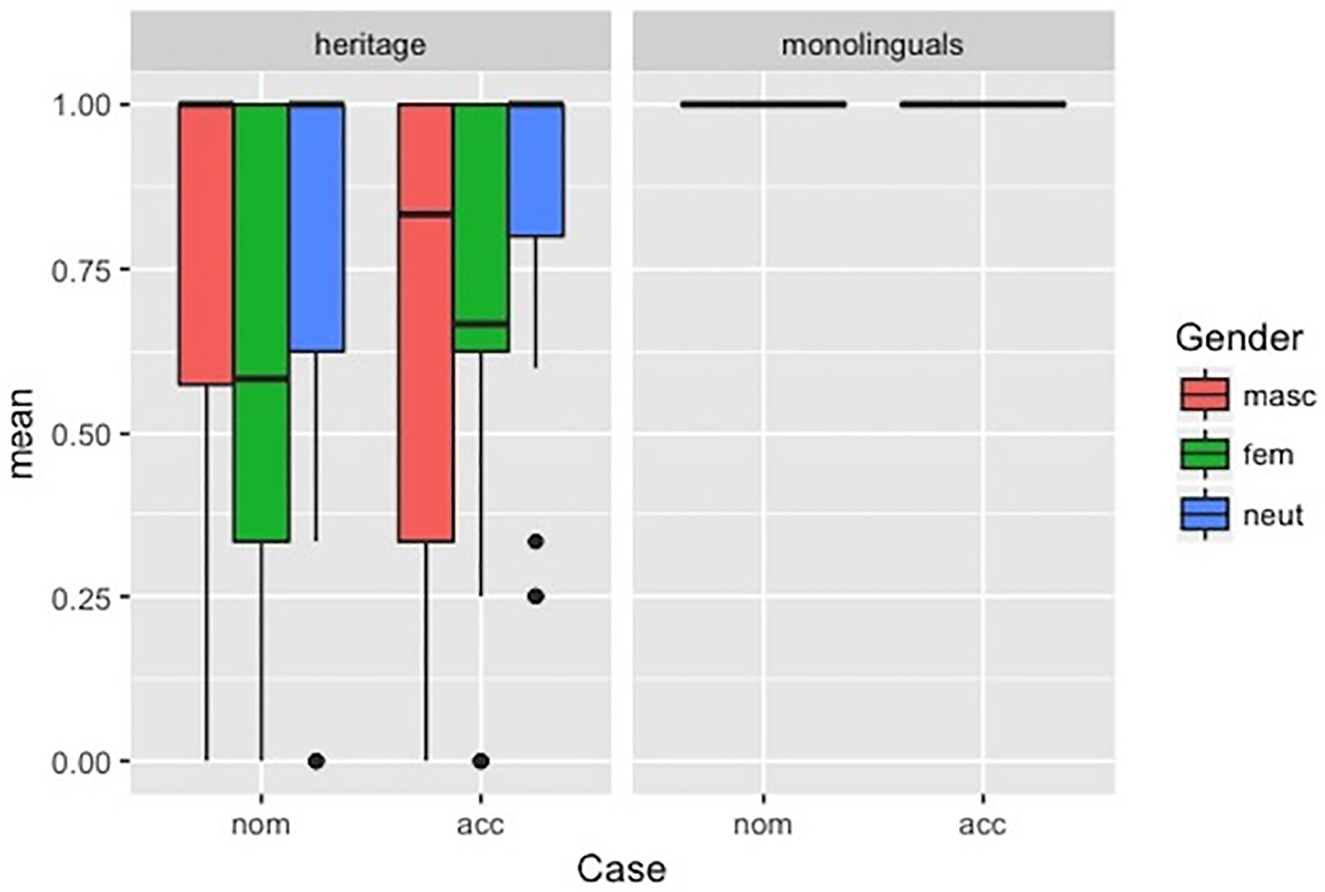
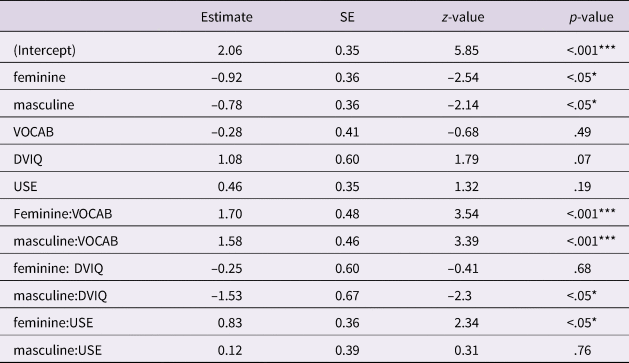
Figure 2 depicts the overall accuracy on the case production task across the three genders in the nominative and the accusative case for the L1 controls and the HL children. The L1 children in the present study performed at ceiling and were, therefore, not included in any further statistical analysis. L1 children's ceiling performance was not surprising as case marking (the nominative–accusative distinction in particular) is acquired by the age of four in Greek-speaking monolingual children (Marinis, Reference Marinis2003). For the HL children, we ran a mixed-effects logistic regression with CASE (nominative, accusative) and GENDER (masculine, feminine, neuter) as item-level fixed effects (the level in bold was the reference level). Children's chronological AGE, expressive vocabulary (VOCAB), and morphosyntactic abilities (DVIQ) in Greek as child-internal fixed effects, whereas early (eUSE) and current HL use (USE) of Greek were entered as child-external fixed effects into the model. The optimal model (C = .79, Dxy = .58) is presented in Table 3.
Proportion of accuracy in the production task for the monolingual and the heritage language children.

Optimal model for accuracy on the production task for the heritage language children

Notes. ***p < .001, **p < .01, *p < .05.
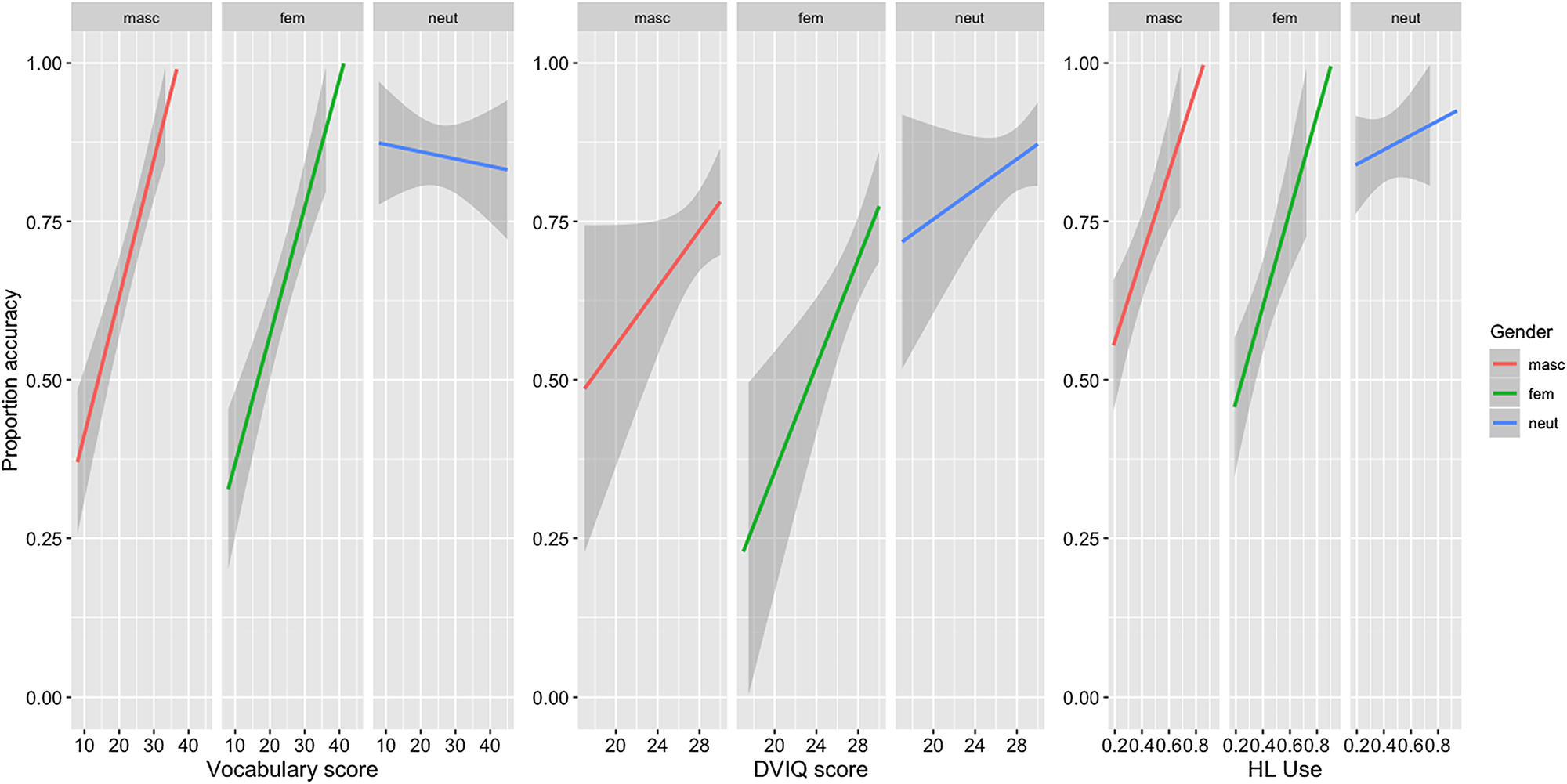
Overall, HL children had an overall accuracy of 74% across genders and cases. Results showed a main effect of Gender: feminine and masculine noun phrases did not differ in accuracy (E = –0.14, SE = 0.36, z = 0.39, p = .69) but were less accurate than neuter noun phrases (Table 3). Children's performance was influenced by their expressive vocabulary skills in Greek, and this affected primarily the masculine and the feminine, but not the highly accurate neuter, giving rise to an interaction. Performance also increased with higher accuracy on the DVIQ, but this effect was less prominent for masculine noun phrases. Increased HL use also led to significantly higher performance for feminine but not for masculine noun phrases. Figure 3 visualises the interactions reported in Table 3.
Interaction between accuracy on the case production task and vocabulary, comprehension of morphosyntax (DVIQ), and current heritage language (HL) use across the three genders (masculine, feminine, and neuter) for the HL children.

Error types
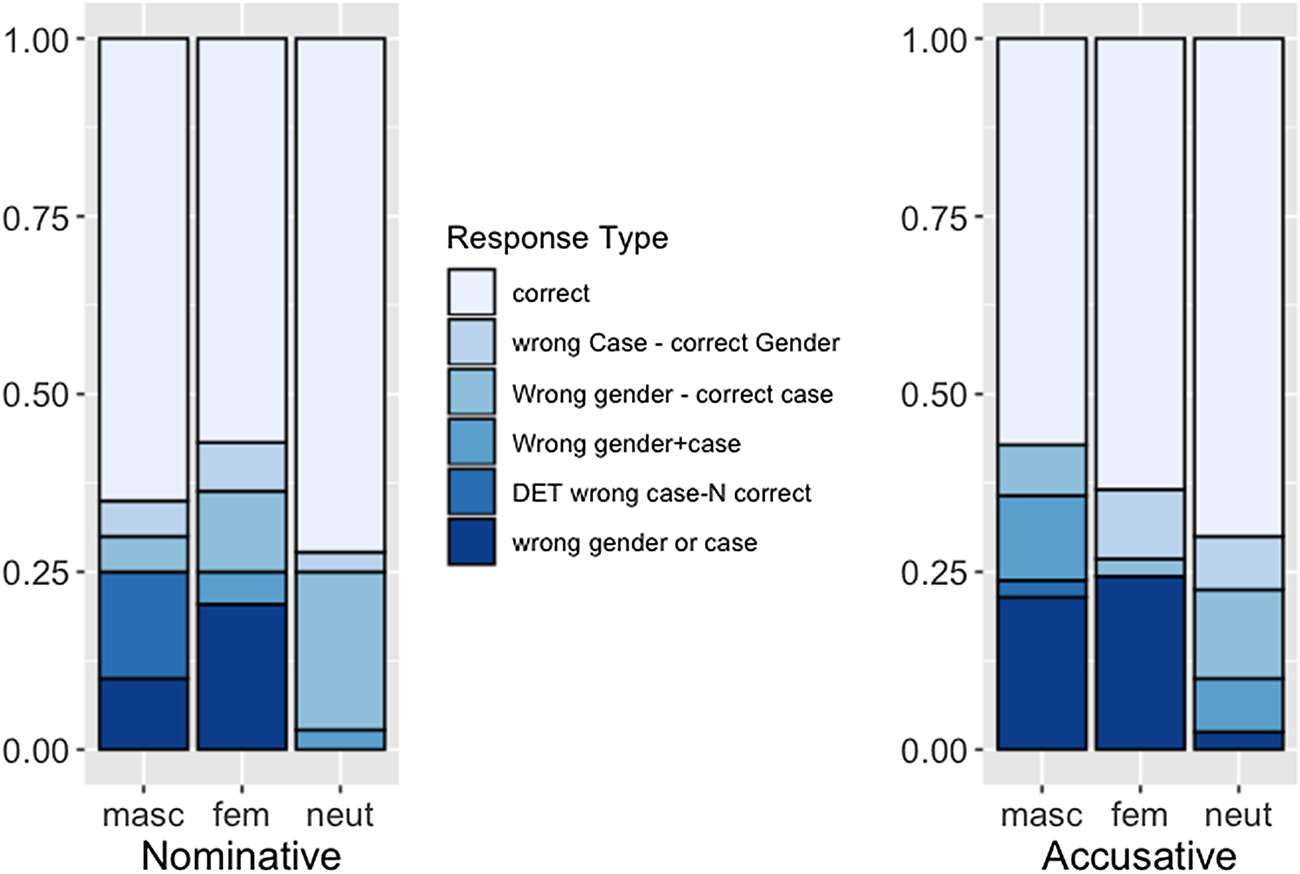
Figure 4 presents the types of responses that the children produced across nominative and accusative contexts. Overall, the HL children made approximately 25% of case-marking errors with masculine and feminine noun phrases. Visual inspection of the data, confirmed by a multivariate logistic regression, revealed that the predominant errors for the masculine in the nominative and in the accusative were ambiguous case/gender errors (p < .001 across all other case errors); for the feminine, there were more of these errors in the accusative (p < .001 across all other case errors) compared to the nominative, where errors involving both wrong case and gender were equally prominent. There were very few case errors in the neuter.
Response types in the nominative and accusative case contexts in the case production task for the HL children.

Case comprehension task
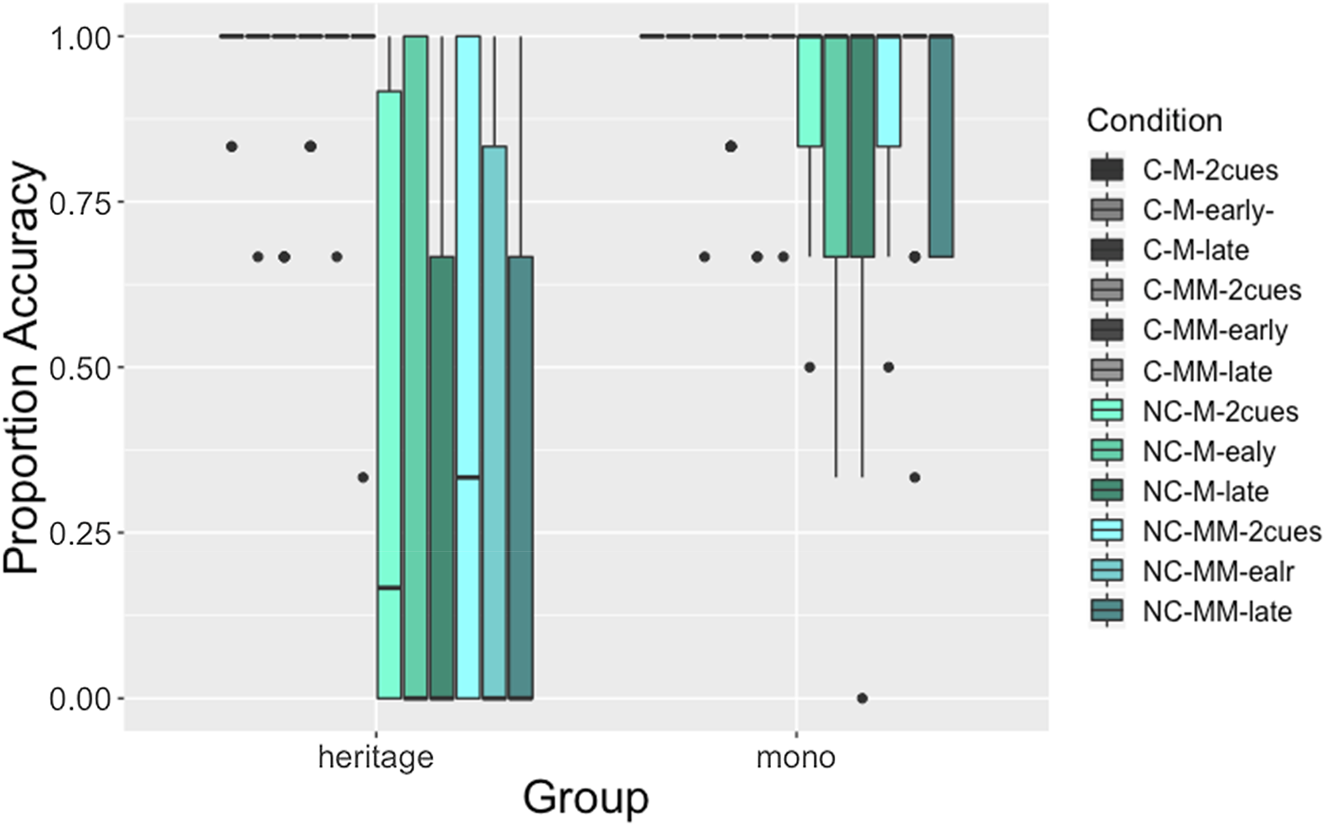
Figure 5 presents heritage and monolingual children's accuracy on the comprehension task as a function of CANONICITY, MATCH, and CUE POSITION. To investigate what affected performance in the two groups, we ran a mixed-effects logistic regression with GROUP (heritage, monolingual), CANONICITY (canonical, non-canonical), MATCH (match, mismatch), CUE POSITION (both, early, late) (values in bold were used as the reference level), and chronological AGE as fixed effects in the model. This gave rise to a three-way interaction between GROUP, CANONICITY, and AGE (E = 1.57, SE = 0.54, z = 2.91, p < .001). To unpack the interaction, we ran two mixed-effects models for each group separately.
Accuracy on the comprehension task for the monolingual and the heritage children.

For the monolinguals (Table 4), there was an effect of CANONICITY, as non-canonical sentences had lower accuracy than canonical sentences. Performance on the task improved with age. There were no effects of CUE POSITION or MATCH.
Predictors of monolingual children's comprehension of canonical and non-canonical conditions

Notes. ***p < .001, **p < .01, *p < .05.
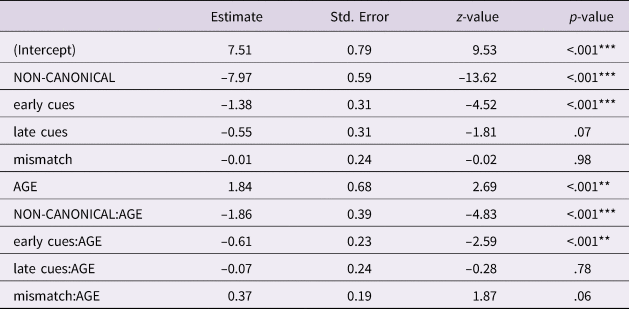
For the HL children (Table 5), canonical sentences had significantly higher accuracy than non-canonical sentences, and position played a role. Performance improved with age, and this was significant for the non-canonical condition, as the HL children had ceiling accuracy on the canonical condition.
Optimal model for accuracy on the comprehension task for the heritage language children

Notes. ***p < .001, **p < .01, *p < .05.
Pairwise comparisons revealed that sentences with early and late cues had lower accuracy than sentences with cues on both the subject and the object, and that the difference was larger for the early cue compared to the late cue condition. The late cue condition also had higher accuracy than the early cue condition (E = 0.76, SE = 0.38, z = 2.1, p < .05), suggesting that, in the non-canonical sentences, HL children relied more on the nominative subject at the end of the sentence rather than on the case-marked accusative object in a sentence-initial position in the OVS conditions.
Predictors for HL children's performance on case comprehension in Greek
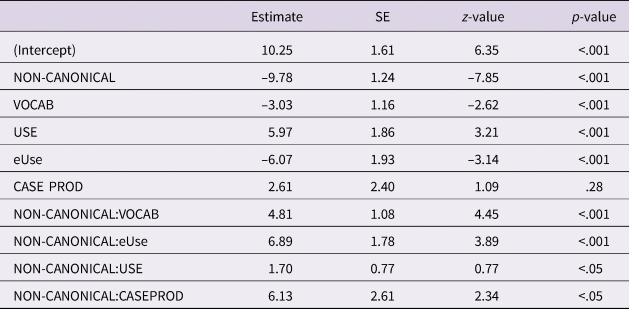
We further examined the factors that affect bilingual children's performance on case comprehension in Greek, and therefore we only included the HL children in the analysis. We focused primarily on the child-level variables and their interaction with CANONICITY. These were VOCAB, DVIQ, and their overall accuracy on the case production task (CASEPROD), as well as their current and early USE of Greek, and chronological AGE. The optimal model (Table 6) without AGE and DVIQ had an excellent fit to the data (C = .94, Dxy = .87).
Optimal model for accuracy on the comprehension task for the heritage children

Notes. eUse = early HL use; CASEPROD = accuracy on case in the production task.
Overall, canonicity interacted with the background variables. This was because the HL children had almost ceiling performance on the canonical conditions, which was less affected by individual factors compared to the non-canonical conditions. Individual factors affected children's performance differentially and to varying degrees. Figure 6 visualises the interactions reported in Table 6.
Interactions between vocabulary, case production, current, and early HL use and canonicity in the heritage language children.

Children with more HL use currently and early in life showed better comprehension of non-canonical sentences compared to canonical sentences (where a small drop from 99.8% to 95% was observed, hence the significant negative main effect of eUSE). Comprehension on non-canonical structures also improved with increased lexical knowledge. Finally, children's performance on case production strongly predicted their comprehension of non-canonical sentences.
Individual performance
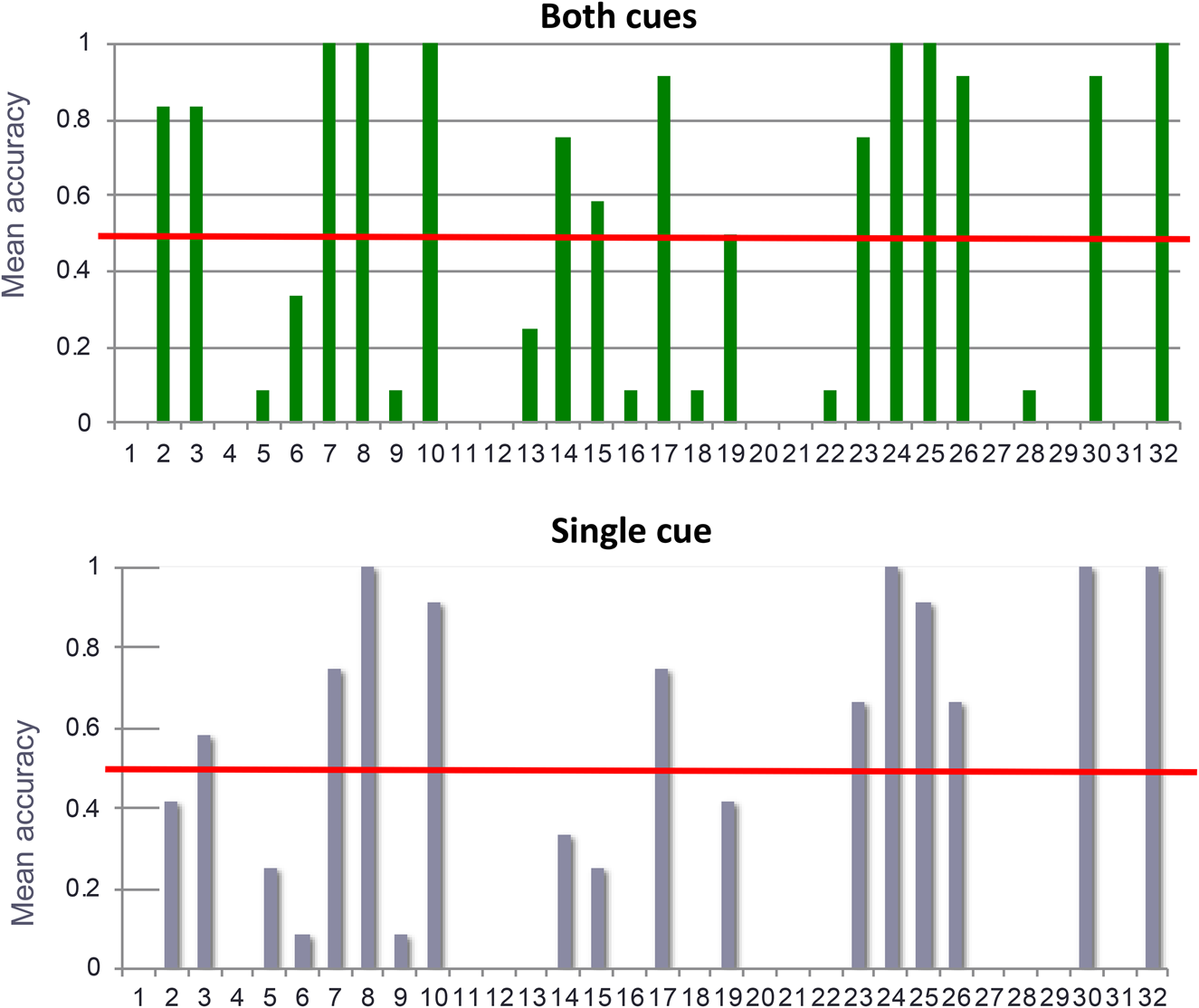
As a final analysis, we examined the heritage comprehension data in a more qualitative way to determine the optional performance within the group (Figure 7). Here we focus on the OVS conditions only and we have collapsed the sentences with early and late cues under a single condition of ‘single-cue’ for ease of exposition (horizontal line depicts the chance level).
Individual performance on the non-canonical conditions with two and single cues by the heritage children.

The individual analysis revealed an almost binomial distribution within the data. That is, even though as a group the HL children exhibited optional performance, the individual data revealed a more categorical pattern in terms of their judgements. In the two-cue condition, 13 and 18 out of the 32 children exhibited either above or below chance performance, respectively, with only two showing true chance performance. The same pattern was replicated for the single-cue condition, although overall accuracy dropped overall across participants. A closer inspection of the background variables in the HL children who performed above (N = 15) and below (N = 17) chance revealed that they differed in VOCAB (above: M = 30, SD = 8.2, below: M = 19.2, SD = 7.9, out of 50, p < .001), DVIQ (above: M = 28.8, SD = 1.2, below: M = 25.6, SD = 3.1, out of 32, p < .05), and proportion of early HL use (above: M = 0.86, SD = 0.14, below: M = 0.66, SD = 0.32, p < .05). The two groups did not differ in AGE (above: M = 119, SD = 20.7, below: M = 111, SD = 17, p > .2).Footnote 5
Discussion
The present study investigated the linguistic and child-level factors that influence case production and comprehension in Greek HL children. We hypothesised that the syncretism of the Greek case paradigm would modulate accuracy and error types in the production of child HSs. We also examined whether child HSs can use case marking as a cue to assign thematic role interpretation when case-marking cues are placed in a sentence-final position or are characterised by syncretism. Previous studies examining the acquisition of case in heritage populations have primarily focused on languages that allow for object marking drop (Kim et al., Reference Kim, O'Grady and Schwartz2017; Song et al., Reference Song, O'Grady, Cho, Lee and Kim1997) or on languages with a low degree of nominal syncretism (Janssen, Reference Janssen2017; Janssen et al., Reference Janssen, Meir, Baker and Armon-lotem2014). Given that morphological case marking varies cross-lingustically and interacts with other inflectional features such as gender, it is important to investigate whether case marking is vulnerable across different heritage communities and how this may be modulated by the nature of the nominal morphological paradigm. In the present study, we also examined the child-level factors that modulate performance on case production and comprehension, such as proficiency, chronological age, and early and current HL use.
Production
The present study revealed that the six- to twelve-year-old HL children show variable performance on case production. This contrasts with the performance of their age-matched monolingual peers, who exhibit ceiling performance at this age (six to twelve years old), as expected from previous studies with monolingual children (Marinis, Reference Marinis2003; Stephany, Reference Stephany and Slobin1997). Variable performance was shown in the accuracy and in the errors that the children made. The HL children made case-related errors that combined gender and case-marking errors, and overused a default form on nouns and articles. This is in line with previous studies with monolingual and sequential bilingual Greek-speaking children that report the use of a ‘default’ form rather than overuse of an incorrectly case-marked form (Marinis, Chondrogianni, Vasić, Weerman, & Blom, Reference Marinis, Chondrogianni, Vasić, Weerman and Blom2017; Tsimpli & Hulk, Reference Tsimpli and Hulk2013).
Whether or not Greek–English children move towards a reduced case system in heritage Greek, as has been suggested for Argentinian Spanish–Greek speakers (Zombolou, Reference Zombolou and Ihemere2011) is less clear. First, the majority of children's errors involved the use of the default form of the determiner to, a form that is ambiguous both in terms of gender and case. It is, therefore, impossible to disentangle case from gender errors in this context. What is clear, however, is that the Greek HL children in our study produced very few distinctly case-marked forms when they made case errors. This finding contrasts with Zombolou's report that HSs made overt case-marking errors. Given the lack of quantitative information in the Zombolou study, it is hard to ascertain whether or not Greek in a heritage context is indeed moving towards a no-case system. Our production results indicate that any shift towards a no-case system primarily involves the use of default forms on the article and the noun with conflated case- and gender-marking errors rather than distinct case-marking errors. However, given that this default form is also found in monolingual Greek-speaking children at a very young age, it may be the case that our child HSs exhibited more variation in the HL case system with a magnified and protracted use of default forms compared to monolingual acquisition (Łyskawa & Nagy, Reference Łyskawa and Nagy2019), rather than loss of case distinctions in the HL.
Comprehension
Problems with case also gave rise to difficulties with sentence interpretation contingent upon the canonicity of the sentence. The Greek heritage children exhibited almost ceiling performance on canonical SVO sentences but had difficulty interpreting non-canonical sentences. Thus, even under facilitatory prosodic conditions, they were unable to integrate case-marking cues into the sentence to successfully interpret it, when the sentential word order in the HL (Greek) contrasted with the word order in the children's dominant language (English). This performance was modulated by item-level factors, namely the number and position of cues. When the sentence carried disambiguating cues on both the subject and the object, children's performance improved compared to sentences with only subject or only object cues regardless of where they appeared (early or late) in the sentence. In the present study, the finding that late occurring cues did not lead to lower accuracy compared to early occurring cues contrasts with previous findings in the literature, where early occurring cues gave rise to greater accuracy compared to late occurring cues (Omaki et al., Reference Omaki, Davidson White, Goro, Lidz and Phillips2014; Roesch & Chondrogianni, Reference Roesch and Chondrogianni2016). We argue that the difference between the present study and previous studies is related to the degree of syncretism in the Greek morphophonological paradigm. Paradigmatic syncretism in Greek is not only found within the same gender but also across genders, and this holds for both definite articles and nouns. For example, the accusative forms of the masculine definite article and noun may overlap with that of the neuter definite article and noun. In the German nominal paradigm (Roesch & Chondrogianni, Reference Roesch and Chondrogianni2016), the masculine determiner is distinctly marked from the neuter and the feminine, and paradigmatic overlap is found across numbers (singular vs. plural) rather than within genders of the same number (singular). Although in the present study care was taken to make the two forms as distinct as possible, the paradigmatic overlap between the accusative masculine (ton) and neuter (to) definite article may have led to reduced facilitatory effects when the cue appeared early in the OVS condition. Conversely, when the cue appeared in a sentence-final position in the OVS condition again, it always involved a disambiguating noun phrase in the nominative, and the paradigmatic contrast there at least on the definite article (o for masculine vs. to for neuter) was much stronger, thus giving rise to improved performance compared to the early occurring cues with lower cue transparency. This pattern of performance was exacerbated in the HL children, who tended to produce the ambiguous default form to when making case-marking errors with the masculine. Therefore, cue ambiguity due to paradigmatic overlap overrode cue position, at least in this Greek study. Future studies would benefit from investigating how case interacts with gender in Greek by including conditions where case marking on the two nominal constituents is more clearly distinguished, at least on the definite determiner (e.g., Subject.fem vs. Object.masc or vice versa). Given that the HL children in our study produced ambiguous forms with feminine noun phrases as well, especially in the accusative, it remains to be established whether the proposed differential case marking facilitates comprehension.
The children in our study performed more poorly in the comprehension compared to the production task. This was the case for both the child HSs and the monolingual controls. This better performance on production compared to comprehension contrasts with the most commonly reported direction of the comprehension–production asymmetry, where comprehension outscores production (e.g., Hendriks & Koster, Reference Hendriks and Koster2010). The comprehension task in the OVS condition involved the integration of morphological cues while listening to a non-canonical sentence and visually processing a potentially competing picture. This gives rise to an increased processing load for two reasons: first, the listener must process a sentence that mismatches the canonical thematic role order in their dominant language (Agent–Patient) by integrating morphological cues and recognising the mismatch between the two; second, they need to reject the dominant, canonical interpretation and select the less prominent, non-canonical one to felicitously respond to this condition. This latter process has been argued to be more taxing than accepting canonical or grammatical structures (Blom & Unsworth, Reference Blom and Unsworth2010), and may explain the opposite-than-expected asymmetry in the study.
Individual differences
A striking finding in our study was the difference in performance when the HL children were considered as a group and when as individuals. As a group, the HL children exhibited chance or below chance performance on the comprehension task. When considered individually, however, a binomial distribution arose. Namely, children either displayed an accuracy rate of 75% and above or below chance accuracy, with only two children showing chance performance, at least in the two-cue condition. This finding has implications for the nature of the HL grammar, as it suggests that HL children have clear parsing strategies related either to their less (heritage Greek) or more dominant (English) language, rather than an optional grammar with strategies from both languages. The HL children in our study were either able to integrate case-marking cues to correctly interpret a simple transitive sentence or they adopted a dominant SVO strategy, thus being led to the reverse interpretation. This ability was contingent upon their knowledge of case, as the inclusion of the case production accuracy as a predictor for the case comprehension task showed. This finding highlights that the investigation of group versus individual variability is integral for understanding the nature of (HL) grammars (Reinhart, Reference Reinhart2006).
Individual variability brings us to the child-level factors that affected children's performance on case production and comprehension. For both modalities, single-word expressive vocabulary was a significant predictor. The higher productive accuracy of this variable compared to the comprehension of morphosyntax (DVIQ) points towards the lexical or item-based nature of acquisition of the morphological paradigm in this context, where input in the target language (Greek) is reduced. It is therefore not surprising that, for both production and comprehension, the degree of HL use (measured as the proportion of HL input and output) played an important role in performance. What seemed to differ for the two modalities is the timing of the HL use. For production, it seems that the current active use of the HL in the family improves performance. This was over and above any effects of age, a factor that did not emerge as a significant predictor in our study (Gagarina & Klassert, Reference Gagarina and Klassert2018; Janssen, Reference Janssen2017). For comprehension, it was a combination of HL use at an early age (before age five) and current HL use that predicted performance. It seems then that, for comprehension, the earlier the entrenchment of the HL parsing strategies, the better the performance at a later age. Our study showed that early language use was a necessary condition for children's comprehension of non-canonical structures (Meisel, Reference Meisel2007); HL children who received more HL input in early childhood performed better on non-canonical sentences compared to children who used the HL less in early childhood. However, early HL use was not a sufficient condition for successful performance, as it did not guarantee children's high accuracy on these structures. Increased current HL use also did not necessarily lead to improved performance. This may be because the English-dominant Greek HL children in our study may avoid using these low-frequency non-canonical structures and resort to canonical and unambiguous SVO sentences as they enter the English mainstream school system and become more dominant in English. Provided that input is a good proxy for dominance (Unsworth, Chondrogianni, & Skarabela, Reference Unsworth, Chondrogianni and Skarabela2018), the HL children in our sample were more dominant in Greek in early childhood than when we tested them at school age. For production, the opportunity to use the language on a daily basis gives rise to better case production, confirming previous findings in the bilingual literature that degree of current language use positively affects production skills (Bohman, Bedore, Peña, Mendez-Perez, & Gillam, Reference Bohman, Bedore, Peña, Mendez-Perez and Gillam2010). Future studies could further elucidate the differential contribution of child-level factors on the two modalities.
Importantly, in the present study, chronological age interacted with children's comprehension of canonical and non-canonical structures. Although HL children's performance improved with age, performance on non-canonical sentences did not improve to the same extend as on canonical sentences. Importantly, when chronological age was added into the model along with the other background variables it was no longer significant, and HL use explained more variance in the data. This finding is line with other recent studies with HL children that found that HL use can override chronological age effects in heritage contexts (Daskalaki et al., Reference Daskalaki, Chondrogianni, Blom, Argyri and Paradis2019; Gagarina & Klassert, Reference Gagarina and Klassert2018). Given that, in a HL context, the degree of HL use does not necessarily increase with age, HL use was a more reliable predictor than age.
Conclusions
The present study investigated whether English-dominant Greek HL children had problems acquiring case morphology in Greek, and what item-level and child-level factors modulate performance on case marking. Greek HL children of primary school age make case errors in production and have difficulties integrating case-marking cues when interpreting non-canonical sentences. HL children's performance was modulated by language-level properties such as the gender of the noun, child-internal abilities such as HL proficiency, and child-external characteristics such as the degree of early and current use of Greek. The study also revealed the importance of examining individual performance within learner groups. Although the HL children displayed chance-level performance at the group level on the comprehension task, a closer examination of the individual variability revealed an almost binomial distribution of their performance, with children either achieving 75% accuracy and above or exhibiting floor effects, and very few children exhibiting true chance performance. These results suggest that optionality on the individual level was rare; children were either able to integrate case-marking cues and reach the correct sentence interpretation, or relied on word order and failed to felicitously interpret the non-canonical OVS sentences.
Certain caveats apply in the present study. First, the OVS structure that we tested in our experimental design can be argued to be a rather challenging structure that lies at the syntax–pragmatics interface (Kapetangianni, Reference Kapetangianni, Anderssen, Bentzen and Westergaard2011). However, this is the word order that directly clashes with the dominant English SVO word order, and we wanted to examine whether participants could override the dominant English word order by making use of case-marking cues available in the HL. Future studies could shed further light on the interaction between word order and case in heritage Greek by investigating case integration in more canonical word orders: VSO and VOS contexts. Given that these structures have not received attention even in experimental studies with Greek monolingual children, their examination will be informative for other acquisition contexts as well. Furthermore, most studies to date have examined the interaction of word order and case in contexts where the HL uses case marking and the societal language uses strict word order cues to assign thematic roles. Future studies would benefit from investigating language pairs where both languages use case-marking cues to ascertain whether the prominence of SVO structures in HSs is an effect of influence from the societal language or a general preference of the human parser to linearly assign agent–patient roles to sentence constituents.
Second, the examination of the individual variability in the present study revealed that a group of HL children performed at the lower end and had a clear SVO preference in the comprehension task. Importantly, these were the children who had low case production scores and who also had lower proficiency and less exposure to Greek compared to the rest of the heritage group. Given that some of these children were quite old (e.g., ten years old), the questions that arise is why they have not yet acquired case, and when, if at all, they are likely to catch up to their other more successful heritage, or even their monolingual, peers. It has been observed in the literature that for bilingual children to reach monolingual norms a certain input threshold is required, and that this threshold may differ for production and comprehension and across language domains (Gathercole & Thomas, Reference Gathercole and Thomas2009; Hoff & Core, Reference Hoff and Core2013; Thordardottir, Reference Thordardottir2015). Reduced early input coupled with reduced current use of Greek highlights two factors contributing to a protracted developmental pattern of the acquisition of case in this heritage group. It merits further investigation whether and when these structures are acquired by Greek HL children, and what factors modulate their acquisition. It is also worth exploring in future studies whether heritage Greek indeed moves towards a reduced case system (Zombolou, Reference Zombolou and Ihemere2011), and if so, whether Greek HSs have developed any compensatory strategies to deal with this reduction, as has been suggested for adult HSs of German (Hopp & Putnam, Reference Hopp and Putnam2015; Yager et al., Reference Yager, Hellmold, Joo, Putnam, Rossi, Stafford and Salmons2015). This means that, if differential nominative–accusative case marking is indeed undergoing change in heritage Greek, this change will inevitably affect developing child grammars. Given that bilingual grammars are shaped by input quality as well as input quantity, future studies would benefit from exploring developing child heritage grammars in their own merit more closely, and highlighting the qualitative input factors that may contribute to their nature.
Acknowledgements
This research was made possible thanks to an Advanced Research Collaborative Fellowship (Graduate Center, City University of New York) awarded to the first author. We would like to thank the Academy of Hellenic Paideia & the Hellenic Education and Language Programme for making this study possible, and we are grateful to all the children and their parents for their participation and enthusiasm. Finally, many thanks to Katerina Katehis, Lito Alexaki, and Froso Argyri for assisting with the data collection.