Introduction
Tonsillectomy, with or without adenoidectomy, is one of the commonest surgical procedures performed by otolaryngologists in the United Kingdom, with around 50 000 procedures performed in England and Wales in 2005.1 Despite the large number of surgical cases, relatively few published studies have assessed the impact of tonsillectomy on health and quality of life. A review of the Cochrane database was not forthcoming with high-level evidence for the utility of tonsillectomy. There has been no consensus of opinion, nationally or internationally, on the indications for tonsillectomy or the best method of performing the surgical procedure. The most commonly accepted indications for this procedure are recurrent and chronic tonsillitis, obstructive sleep apnoea,Reference Tauman, Gulliver, Krishna and Montgomery-Downs2 and streptococci species colonisation.Reference Fujikawa, Hanawa, Ito, Ohkuni, Todome and Ohkuni3 Surgery is usually considered after conservative medical options have failed.
In 2000, the American Academy of Otolaryngology published a set of clinical indicators for patient selection for tonsillectomy. These specified three or more episodes of tonsillitis and/or adenoiditis per year, despite adequate medical therapy, as sufficient criteria for surgical intervention.4 The Scottish Intercollegiate Guidelines Network has suggested that patients should meet all of the following criteria: sore throats due to tonsillitis; five or more episodes of tonsillitis per year; symptoms for at least one year; and episodes of sore throat which disable normal function.5
Method
Data retrieval and selection
All patients who had undergone tonsillectomy at the Lister Hospital, Stevenage, between March 2004 and March 2005 were included in the study. Only patients (children and adults) who had undergone tonsillectomy for recurrent acute and chronic tonsillitis were included.
Patients (or, in the case of children under 16 years old, their parents) were informed and asked to compare the details of their (or their child's) health and symptoms for the year before and the year after tonsillectomy, as detailed in the tonsillectomy survey questionnaire (Appendix 1).
The results were plotted on a Microsoft Excel worksheet and analysed. Total scores were compared for: time off work or school due to tonsillitis and all other reasons; general practitioner visits due to tonsillitis and for all other causes; and overall quality of life, feeling of well-being and general energy levels.
Data from the questionnaire were plotted on a Microsoft Excel worksheet and analysed by comparison of means, using the Mann–Whitney U-test and the Statistical Package for the Social Sciences version 12 software.
Results
Of the 150 tonsillectomy patients identified, we were able to contact a total of 100, all of whom completed the questionnaire. There were 29 males and 71 females.
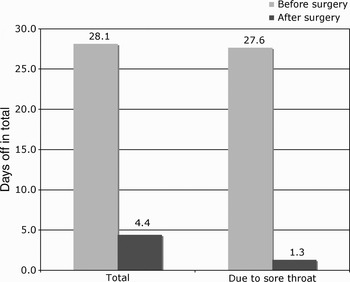
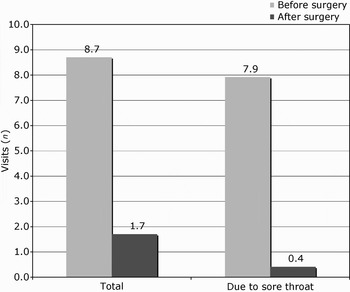
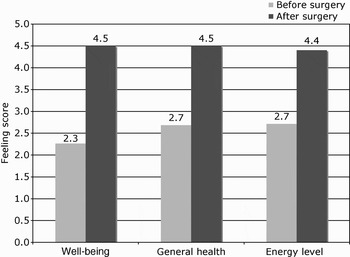
We found that patients' days off work/school due to sore throat reduced by 95.3% (from an average of 27.6 days to 1.3 days; 95% confidence interval (CI) for mean reduction, 89.7 and 99.6 per cent) (Figure 1). Patients' visits to their general practitioner due to sore throat reduced by 95.6 per cent (from an average of 7.9 to 0.4 visits; CI for mean reduction 93.8 to 95.1 per cent) (Figure 2). More than 93 per cent of patients reported an improvement in their feelings of well-being and general health and in their energy levels (Figure 3).
Patients' time off work or school in the 12 months before and after tonsillectomy.

Patients' general practitioner attendance in the 12 months before and after tonsillectomy.

Patients' reported feelings of well-being, general health and energy levels, in the 12 months before and after tonsillectomy. 1 = very poor; 2 = poor; 3 = moderate; 4 = good; 5 = very good.

Our results also revealed that, following tonsillectomy, patients' days off work (for children or university for students) or school (for adults and working patients) due to all other causes including tonsillitis reduced by 84.4 per cent (from an average of 28.1 to 4.4 days; CI for mean reduction 71.5 and 97.2 per cent) (Figure 1). Patients' general practitioner visits due to all causes including sore throats reduced by 80.6 per cent (from an average of 8.7 to 1.7; CI 72.1 and 87.8 per cent) (Figure 2).
Discussion
In the current climate of cost containment and limited health care funding, evidence of clinical and cost effectiveness is becoming increasingly necessary in order to justify funding for specific treatments by medical and non-medical members of priorities forums. Many clinicians feel that evidence-based practice is being used by medical purchasing bodies as a vehicle to withdraw funding for procedures that have little or no scientific evidence of effectiveness. This raises concerns that when cost savings are necessary, clinical priority group decisions may be swayed against procedures for which an evidence base cannot easily be demonstrated. Many otolaryngology procedures potentially fall within this category. In the case of tonsillectomy, level one and two evidence cannot easily be obtained, given the ethical objections that would be generated when considering a suitable surgical control group in a randomised, controlled trial. Unsurprisingly, tonsillectomy has recently been targeted for restriction funding by many primary care trusts in the UK.
Mui et al. have shown that tonsillectomy significantly reduces the number of physician visits and the need for antibiotics and also improves attendance at work and school.Reference Mui, Rasgon and Hilsinger6 These authors have also demonstrated that the mean number of physician visits and antibiotic prescriptions reduces significantly after the operation. Furthermore, 87 per cent of patients confirmed that they would recommend the procedure to anyone suffering from tonsillitis. Other studies on tonsillectomy have reported similar results.Reference Paradise, Bluestone, Bachman and Colborrn7, Reference Wolfensberger, Haury and Linder8
In an interesting US study, Bhattacharyya et al. proved that the financial ‘break-even point’ for tonsillectomy in adults is 2.3 years.Reference Bhattacharyya, Kepnes and Shapiro9 Recovery of tonsillectomy costs is achieved by savings in medication expenditure, physician visits and the cost of work-related expenses.Reference Bhattacharyya and Kepnes10 A recent meta-analysis of randomised and non-randomised studies of the efficacy of adenotonsillectomy, from 1963 to 2003, showed a reduction of frequency of sore throat episodes and upper respiratory tract infections with time, whether surgery had been performed or not. Tonsillectomy was shown only to result in a small reduction in frequency of sore throat episodes, days of sore throat associated school absence and upper respiratory tract infections, compared with ‘watchful waiting’. However, a major criticism of this meta-analysis is that several of the studies included were from the 1960s and 1970s, when selection criteria for surgery were likely to be significantly different. Furthermore, no attempt was made to categorise the cases by symptom severity.Reference van Staaij, van den Akker and van der Heijden11
• Tonsillectomy, with or without adenoidectomy, is one of the commonest surgical procedures performed by UK otolaryngologists
• This study assessed clinical improvement and quality of life measures in patients who had undergone tonsillectomy for recurrent acute and chronic tonsillitis
• Tonsillectomy significantly reduced general practitioner attendances and resulted in improved feelings of well-being and health
While recurrent, acute attacks of tonsillitis can be prevented by tonsillectomy, surgery will not prevent recurrent sore throats due to other reasons. Hence, before considering surgery, the diagnosis of recurrent tonsillitis should be confirmed by the history and clinical examination, and if possible differentiated from other causes of pharyngitis.
The present study was a retrospective survey without an effective control group, and information obtained from patients was anecdotal. The number of patients questioned was limited, and there was likely to have been a questioning bias. However, we feel that the overwhelming level of improvement demonstrated in all parameters assessed adds weight to the argument for tonsillectomy in appropriately selected individuals.
The natural history of tonsillitis is for episodes to become less frequent with time. However, there is insufficient epidemiological data in all age groups to enable prediction of this in individual patients. A future, prospective study of patients with recurrent acute and chronic tonsillitis would require two study groups (controls and patients undergoing tonsillectomy). Following the controls for a few years would determine the natural history of the disease, and would indicate at what stage the disease process spontaneously resolves. However, it may not be ethically acceptable to withhold surgical treatment which is known to be beneficial for a suffering individual.
Conclusion
We conclude that tonsillectomy is of benefit for patients with recurrent acute and chronic tonsillitis. In our patients, tonsillectomy resulted in significantly reduced general practitioner attendances and an improvement in reported well-being and health. This suggests that tonsillectomy is a cost-effective treatment.
Appendix 1. Questionnaire: impact of tonsillitis on patient's occupation or schooling
Patient name:
Hospital number:
Telephone number:
Age on date of surgery:
Date of surgery:
Occupation:
In 12 months before your operation
How many days off work or school did you miss in the 12 months before your tonsillectomy operation?
How many of these days were due to sore throat?
Were these episodes of sore throat associated with high temperature and painful swallowing?
How many times did you visit your general practitioner?
How many of these appointments were due to sore throat?
How would you rate your feeling of:
Well-being: very poor poor moderate good very good
General health: very poor poor moderate good very good
Energy levels: very poor poor moderate good very good
In 12 months after your operation
How many days off work or school did you miss in the 12 months after your tonsillectomy operation?
How many of these days were due to sore throat?
Were these episodes of sore throat associated with high temperature and painful swallowing?
How many times did you visit your general practitioner?
How many of these appointments were due to sore throat?
How would you rate your feeling of:
Well-being: very poor poor moderate good very good and compared with before the operation has this: improved stayed same worsened
General health: very poor poor moderate good very good and compared with before the operation has his: improved stayed same worsened
Energy levels: very poor poor moderategood very good and compared with before the operation has this: improved stayed same worsened