INTRODUCTION
It is well recognized that human immunodeficiency virus-1 (HIV-1) infection can lead to significant neurological complications. The acquired immunodeficiency syndrome (AIDS) dementia complex (ADC) is the most severe form of neurocognitive complication. Although the introduction of the highly active antiretroviral therapy (HAART) led to a reduction in incidence of ADC, this syndrome still occurs in 2 to 3% of HIV+ individuals, and this prevalence is rising due to longer survival rates (McArthur et al., 2003). Of importance to neuropsychologists is the evidence that the clinical presentation of the ADC has changed after the introduction of HAART (Brew, 2004) and the conceptualization of ADC as a subcortical dementia may no longer be accurate (Cysique et al., 2004a). To determine that the neuropsychological presentation of ADC is changing, it is crucial that there is a reliable model available of pre-HAART ADC. Although there is no debate that ADC is characterized by severe cognitive impairment, the precise nature and severity of these deficits are not well understood and surprisingly few studies have characterized ADC neuropsychologically. Another benefit of considering in detail the nature of ADC-related cognitive impairment in the pre-HAART era is that this information affords an opportunity to summarize relationships between biological disease markers and the nature and severity of cognitive impairments (Ellis et al., 1997). There is growing evidence that, after the introduction of HAART, known relationships between HIV-1 biological markers and the nature and severity of cognitive impairment (from the pre-HAART era) are no longer evident (Sevigny et al., 2004).
To our knowledge, there has been one meta-analysis of studies of cognitive impairment associated with HIV/AIDS (Reger et al., 2002). However, this meta-analysis provides no theoretical or quantitative information about ADC or about the interaction between HAART and ADC as it did not separate the few neuropsychological studies conducted on individuals receiving HAART from those conducted in the pre-HAART era. More seriously, the meta-analysis did not include any studies that assessed specifically cognitive function in ADC. Finally, for aspects of the disease other than ADC, this meta-analysis may have overestimated the severity of cognitive impairment as it included neuropsychological studies that investigated cognitive performance in HIV+ intravenous drug users (IVDU; Grassi et al., 1993).
We, therefore, conducted a meta-analysis of neuropsychological studies of HIV infection, including those related to ADC and excluded individuals with IVDU. Because we are interested in the question of whether the clinical presentation of ADC is changing with the introduction of HAART, we considered only studies conducted before the introduction of HAART. Such data should provide a firm quantitative basis against which the extent to which HAART-related changes in cognitive dysfunction in advanced HIV infection can be determined. To disentangle cognitive impairment associated with HIV-related neurodegeneration from that with general illness, neuropsychological data from individuals with ADC were summarized and compared to neuropsychological data from individuals with advanced disease who did not meet clinical criteria for ADC. We did not consider cognitive impairment in asymptomatic stages of the illness. Although neuropsychological impairment has been detected in a minority of individuals with asymptomatic HIV infection, and this has often been claimed to reflect the earliest manifestation of HIV-related central nervous system (CNS) change, methodological and statistical limitations (e.g., lack of an appropriate control group, strict criteria to define impairment) in these studies threaten the reliability of such interpretations (e.g., Newman et al., 1995; White et al., 1995). By contrast, the qualitative and quantitative nature of HIV-related CNS dysfunction can be determined reliably from the profile of neuropsychological impairment in advanced HIV infection (Maruff et al., 1994).
METHODS
Study Selection
The pre-HAART era was defined as the era preceding the introduction of triple combination therapy with antiretroviral (ART) drugs. Thus, data from studies that specified whether their sample of HIV+ individuals were currently untreated or treated with zidovudine monotherapy or dual-therapy of nucleoside analogues were included in the analysis.
We report a series of 13, 21, and 5 studies for groups of individuals with symptomatic AIDS and ADC that were conducted in the pre-HAART era and published between 1986 and 1999. These studies were identified through a search of the Medline and PsycINFO computer databases using the keywords: AIDS Dementia Complex; HIV-associated Dementia; cognitive; neuropsychological; AIDS and symptomatic HIV infection. In addition, we searched four reviews of the literature: Reger et al. (2002), White et al. (1995), Newman et al. (1995), and Skoraszewski et al. (1991). The total number of studies retained at this stage was 103. Studies exclusively addressing the neuropsychological impairment in IVDU HIV+ individuals were then excluded because IVDU is known to increase the neuropsychological impairment in certain cognitive domains (Grassi et al., 1993). One study of individuals with AIDS (Becker & Salthouse, 1999) was still included because only 11.9% of the HIV+ sample had acquired HIV through IVDU. A second study of individuals with ADC (Power et al., 1995) that included 27% of patients who acquired HIV through IVDU was also included as this study and defined encephalopathy due to substance abuse as an exclusion criterion.
A majority of studies (34 of 39) excluded substance users (e.g., current substance abuse dependence or history of substance abuse). Fourteen studies specified that they excluded IVDU, and all the others specified that they excluded substance users (10 studies clearly included alcohol abuse; 5 studies excluded only IVDU, and 9 studies allowed both substance use and IVDU). Finally, studies that included groups of patients with a treatment overlap between the pre-HAART and HAART era were also excluded (n = 5).
All of the remaining neuropsychological studies were then screened to determine the extent to which they met the following criteria: (1) Conducted before the advent of HAART as previously defined; (2) Included individuals with symptomatic HIV infection, AIDS, ADC, and matched healthy seronegative controls for age and education; (3) Used standard neuropsychological instruments (as described in standard neuropsychological test compendia, for example, Lezak et al., 2004; Spreen & Strauss, 1998) or studies that thoroughly referenced the neuropsychological tests used (see additional details in Table 1); (4) Provided statistical information sufficient to calculate effect sizes (ESs) between HIV+ individuals and seronegative controls (sample size; mean and standard deviation (SD); t test; F test, p value). In prospective studies, baseline scores were retained; (5) Contained clear definitions of Centers for Disease Control (CDC) stages (1987 and 1993 definitions) or in which HIV disease status could be re-classified according to the CDC 1993 definition; (6) Where patients with ADC were studied the diagnostic classification of these was made using the CDC definition of 1987 American Academy of Neurology (AAN, Janssen et al., 1991) and Price & Brew ADC scheme (1988).
Details of neuropsychological tests and cognitive domains and frequency of tests use collapsed for the three meta-analyses

Because we obtained access to unpublished data that had been collected in the pre-HAART era by Australian researchers (M. Perdices, N. Dunbar, P. Maruff), these data were also included in the meta-analysis as it conformed to the inclusion criteria detailed above. With patients from the three previously unpublished Australian samples and with consideration that one study presented data from different samples (Tross et al., 1988), the final group consisted of 89 different samples (6 with ADC, 25 with AIDS, 14 with symptomatic HIV infection, and 44 seronegative control groups). This yielded a total of sample size of 1420 HIV+ individuals and 1498 seronegative controls. For the meta-analysis, this total group was divided according to stage of HIV illness: 215 individuals with ADC (mean age = 38.5; SD = 2.4; mean educational level = 13.5; SD = 1.6; mean estimated IQ = 116; SD = 2.1), 851 individuals with AIDS (mean age = 37.3; SD = 1.8; mean educational level = 13.5; SD = 1.5; mean estimated IQ = 109; SD = 6.6), and 354 patients with symptomatic HIV infection (mean age = 34.9; SD = 2; mean educational level = 14.1; SD = 1; mean estimated IQ = 108; SD = 6.1).
Comparisons between these HIV disease status groups indicated that the group with symptomatic HIV infection was younger than both the AIDS and ADC groups (p < .01 in both cases), although there was no difference in age between the AIDS and ADC groups. Although estimated pre-morbid ability (Wechsler Adult Intelligence Scale-Revised (WAIS-R) vocabulary or IQ scales and National Adult Reading Test (NART) IQ) was slightly higher in the ADC group than the symptomatic HIV and AIDS groups, this group difference did not meet the criteria for statistical significance (p < .06) and estimated premorbid ability was equivalent in the symptomatic and AIDS groups. Eight studies did not assess pre-morbid abilities, and two of these had investigated ADC (e.g., two of five studies). Hence, the estimate of premorbid abilities in the total ADC group was less reliable than for other groups. Educational level was reported in all but two studies and did not differ significantly between any of the HIV disease groups.
Data Coding
The neuropsychological tests used in the different studies were classified into 1 of 15 cognitive domains on the basis of the classification used by Lezak et al. (2004) as well as classifications used previously by us in neuropsychological studies of HIV-1 infection (Cysique et al., 2004a; Maruff et al., 1994; Perdices & Cooper, 1990). The cognitive domains and the tests classified into each from the study sample are shown in Table 1. Tests that reflect similar cognitive functions, but for which neuropsychological procedures differ in terms of task difficulty, were distinguished (Perdices & Cooper, 1990). When a single study reported more than one test corresponding to one cognitive domain, the ESs were computed for all the distinct tests and an average ES was then computed for that cognitive domain. In cases where one neuropsychological construct such as Learning was represented by several submeasures of a same test, the performance measure reported most frequently was selected for meta-analysis. For tests from the Motor domain that reported performance for the dominant and nondominant hand, an average ES was calculated. From this total pool of 327 ESs, 32 were used in the meta-analysis of neuropsychological performance in ADC, 178 in AIDS and 117 in symptomatic HIV infection.
Effect Size Computation
Effect sizes were computed for all individual studies and a Mean ES (MES) was computed for each cognitive domain (see additional information in Lipsey & Wilson, 2001, as well in Appendix B). To simplify the calculations, all individual ESs were converted to a positive value. Therefore, a positive ES indicates impairment.
Homogeneity Analysis and Factors Influencing Neuropsychological Performance
The homogeneity of the distribution of ESs in each cognitive domain was explored with the Q statistic (Hedges & Olkin, 1985). In cases where a heterogeneous distribution was observed, two control analyses were performed. First, the effect of cognitive severity (for reports that included AIDS individuals who showed signs of early ADC or with memory complaints or suspected cognitive impairment) was determined. Second, the extent to which ART influenced the distribution of ESs was examined. Only reports that stated clearly the treatment status of patients were selected for this analysis (the definition of ART is detailed in Table A1). Studies including a portion of their group on ART were counted as “on-treatment” as it reached at least 60% of the group. The comparisons were made using the analog to the analysis of variance (ANOVA) method (Hedges & Olkin, 1985; Lipsey & Wilson, 2001).
Fixed Model and Random Effect Model
The computations conducted for these meta-analyses assume a fixed effect model (Figure 1; Hedges, 1994). Under this assumption, the ESs observed are assumed to be representative of the population from which they were derived. However, when the Q statistic is significant, this assumption is rejected (see additional information in Lispey & Wilson, 2001). In the analysis of data for symptomatic group, the Q statistic was significant for three cognitive domains, and for analysis of data from the AIDS group, the Q statistic was significant for six cognitive domains.

Fixed effect model mean effect size (MES) for the symptomatic acquired immune deficiency syndrome (AIDS) and AIDS dementia complex (ADC) groups. MESs and standard errors (SEs, one-sided to keep the illustration clear) for each group in each cognitive domains are illustrated. In the ADC group, six MES were derived from one single ES. These MESs have been highlighted with a black foreground and are attention, reasoning, simple reaction time, complex reaction time, visual memory-delayed, and visuospatial abilities.
This finding represents a 20%–40% significant variability among the cognitive domains explored. Thus, according to the Q statistic, a majority of the ESs observed were derived from a common population. Nevertheless, the Q statistic may lack statistical power in the case of small sample sizes (Lipsey & Wilson, 2001). Consequently, a random effect model was computed to increase the reliability of the magnitude of the neuropsychological impairment observed (Figure 2). A random model was not computed for the meta-analysis of data from studies of ADC as there were too few studies. However, we provided a descriptive analysis of the studies included when the Q statistic indicated that ESs differed significantly between studies within domains (Q statistic was significant in the domains of motor coordination, learning with a prose procedure (p < .0001), and verbal memory with a list procedure (p < .01)).

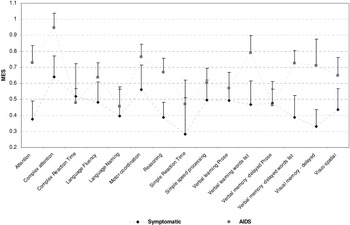
Random effect model mean effect size (MES) for the symptomatic and acquired immunodeficiency syndrome (AIDS). MESs and standard errors (SE, one-sided to keep the illustration clear) for each group in each cognitive domains are illustrated.
Analog to ANOVA for Between Group Comparisons
Analog to ANOVA allows group comparisons using the χ2 distribution (Lipsey & Wilson, 2001). This technique was applied as a planned contrast to compare the neuropsychological data between (1) the symptomatic HIV and AIDS groups and (2) the AIDS and to ADC groups for all of the cognitive domains in both the fixed and random model. However, when an MES was estimated on the basis of a single ES (as in the ADC group), no between group comparisons were made.
The interpretation of the magnitude of ES for the meta-analyses followed the classification offered by Cohen (1988), where ESs between .20 and .40 were classified as small, ESs between .40 and .80 classified as medium, and ESs greater than .80 considered large. The classification was also retained because it corresponds to the range of ES magnitude found in the meta-analysis of Reger et al. (2002) and, thus, offers a relevant scheme for interpretation (Zakzanis, 2001).
RESULTS
Symptomatic HIV Infection (See also Table B1)
In the fixed effect model, the magnitude of the MESs (relative to controls) varied between .28 and .51 (.50 representing half a standard deviation compared to controls). The MESs for each of the 15 cognitive domains represented meaningful trends (Z test = 1.96; p < .05), with the exception of simple reaction time under the random model. Fixed model MESs of medium magnitude were found first for complex attention (.51), verbal learning (.48), motor coordination (.47), complex reaction time (.42), simple speed processing (.41), and language fluency (.41) domains. The MES estimates for all other domains were classified as small. Complex attention and motor coordination domains remained the highest MESs under the random model, whereas visuospatial, verbal learning and memory delayed for the prose procedure were classified as being of a medium size (>.40).
Analog to ANOVA was applied to the three cognitive domains that showed a significant heterogeneity of ESs distribution. These domains were complex attention, motor coordination, and verbal learning prose. This analysis indicated that symptomatic HIV+ individuals receiving ART obtained better performances in these functions compared to untreated patients, specifically, complex attention (respectively, MES = .35; SD = .12 vs. MES = 1.55; SD = .32; p < .0001) and verbal learning prose (MES = .08; SD = .30 vs. MES = 1.10; SD = .30; p < .01).
AIDS (See also Table B1)
In both effect models, the magnitude of the MES (relative to controls) was moderate to large for all cognitive domains. In the fixed model, MESs ranged from .45 to .85 (representing at least half a standard deviation compared to controls). These trends were significant in each of the cognitive domains (e.g., Z test <1.96; p < .05). In the fixed model, the largest MES was observed for complex attention (.85) and motor coordination (.76) domains, followed by verbal learning word list and verbal memory word list (.73) domains. MESs of a medium magnitude (.50–.60) were found for the reasoning, attention, language fluency, visuospatial abilities, visual memory, delayed verbal learning prose, and simple speed processing domains. MESs of between .40 and .50 were observed for simple and complex reaction time domains: naming and verbal memory delayed prose domains. Under the random model, estimates of the magnitude MESs were similar, with the exception of the attention (.72) and visual memory (.71) domains, which were larger.
The inclusion or exclusion of individuals with early signs of ADC or the inclusion or exclusion of individuals with suspected cognitive impairment did not affect the variability of ESs distribution. However, a significant effect was found for ART in the domains of attention and simple processing speed. For both domains, patients with AIDS receiving ART (attention MES = .61; SD = .10, simple processing speed MES = .51; SD = .09) performed better than untreated patients (attention MES =1.27; SD = .27, simple processing speed MES = 1.24; SD = .31; p < .02 for both comparisons). Whether patients were receiving ART did not account significantly for variability in ESs in any other cognitive domain.
ADC (See also Table B1)
Due to the small number of studies, ESs from the ADC group were subjected to analysis using only the fixed model. The largest MES (>2.26) observed was for the verbal learning, motor coordination, and language fluency domains. The magnitude of impairment was large (>1) for all other cognitive domains except naming (.18). For six of the domains, the Q statistic could not be computed because the MES was estimated from a single ES.
Comparisons of MES Between the Three Groups
Detailed results are presented in Table 2. Individuals with symptomatic infection differed significantly from individuals with AIDS in the domains of attention, complex attention, motor coordination, verbal list learning, word list memory, visual memory, and reasoning. The random model indicated that homogeneity of variance was nonsignificant for all analyses and that the AIDS group performed worse than the symptomatic HIV+ group in the domains of attention, complex attention, memory word list, and reasoning. Compared to the AIDS group, the ADC group was significantly impaired in all cognitive domains except for naming, although within group variance was greater in the ADC.
Results for between meta-analytic groups planned comparisons

DISCUSSION
The meta-analysis indicated that, in HIV-1 infection and in individuals who have not received HAART, the severity of cognitive impairment increases with the clinical stage of the disease. In symptomatic HIV infection, the magnitude of impairment is mild (ESs from .28 to .51) compared to seronegative controls matched according to major demographic factors. In individuals with AIDS the magnitude of impairment is moderate (ESs from .42 to .85), whereas in individuals who meet clinical criteria for dementia, this magnitude increases to very large (ESs from .18 to 2.26).
Our meta-analysis offers new quantitative and qualitative insight into the neuropsychological profile of ADC in the pre-HAART era. First, surprisingly there have been only a few neuropsychological studies of clinical recognizable dementia in HIV-1 infection. This finding is important, because it indicates that neuropsychological models of dementia in HIV infection are derived predominantly from the study of nondemented individuals. This is quite different from neuropsychological models of dementia such as Alzheimer's disease, which first characterized the extreme form of the syndrome and then examined the neuropsychological prodrome in nondemented individuals who were at risk for Alzheimer's disease (Collie & Maruff, 2000). This is also important because the current data indicate that the neuropsychological profile of ADC is both qualitatively and quantitative different from that observed in AIDS and in symptomatic HIV infection. We have argued previously that ADC can be characterized neuropsychologically best by comparing the nature and magnitude of cognitive impairment to that observed in patients with AIDS (Cysique et al., 2006; Maruff et al., 1994). This comparison controls to some extent the general and indirect CNS effects of advanced HIV− infection on performance on neuropsychological tests (e.g., fatigue, HIV-related physical symptoms, and impaired immune functions). From this perspective, the current analysis indicated that, in ADC, the domains of learning, motor coordination, language fluency, and memory were the most severely impaired, whereas the domains of complex attention and simple processing speed were moderately to severely impaired. In contrast, the domains of naming and visuospatial abilities were relatively preserved. However, because there were considerably fewer neuropsychological studies of ADC, these results should be considered with some caution.
For the ADC group, the variability in the magnitude of impairment observed for some of the cognitive domains may have been due to the inclusion of patients with different stage of dementia severity. For example, the magnitude of deficits was constant, as assessed by the Q statistic, for the domains of list learning, memory, language fluency, complex attention, simple speed, and naming. However, there was significant variability in impairment for the domains of motor coordination, learning with a prose procedure and verbal memory recall with a list procedure. These data suggest that motor function, aspects of learning, and memory may be more sensitive to dementia severity in patients with ADC who have not received HAART. However, this hypothesis awaits further confirmation, especially given that, for some domains, the variability could not be explored as the estimates of impairment were based on a single study.
It is now widely accepted that CNS involvement also occurs in earlier stages of HIV infection, although it remains unclear if these earlier deficits are comparable in nature to the deficits found in ADC, as they may not be always predictive of further CNS involvement. Our meta-analysis showed that, when compared to seronegative controls, individuals with AIDS demonstrated a global moderate impairment that was of clinical significance (as assessed by the Z test) in all cognitive domains explored. The neuropsychological performance was dominated by deficits in complex attention and motor coordination. This result is unsurprising as many of the individual studies of cognitive function in HIV+ patients pre-HAART, upon which this meta-analysis was based, concluded that tests of complex attention and psychomotor function were most sensitive to the presence of CNS involvement and even to progression of CNS disease (e.g., Sacktor et al., 1996; Selnes et al., 1995). The other domain to be classified as having a large impairment in AIDS was verbal learning, using the word list procedure. Importantly here, we demonstrated that the difference in learning task complexity as well as in verbal memory (i.e., word list test vs. prose test) led to substantially different MESs in the AIDS group but also in the symptomatic and ADC groups (e.g., Perdices & Cooper, 1990). Other domains in AIDS that showed a mild to moderate degree of cognitive impairment were attention, verbal and visual memory, language fluency, simple speed processing, and visuospatial abilities. Least impaired domains were naming and memory with a prose procedure.
Individuals with symptomatic HIV infection showed a global mild degree of cognitive impairment. The deficits were characterized by moderate impairment in complex attention and motor coordination. Mild to moderate impairments were found for learning and simple speed processing. Mild impairment was observed for domains of memory, attention, naming, and visuospatial abilities. The overall pattern was similar to that found in individuals with AIDS but of a less severe magnitude.
Comparison of the nature and magnitude of cognitive impairment between the three HIV+ groups shows that individuals with ADC were more severely impaired on all domains, except naming, when compared with individuals with AIDS. Compared to individuals with symptomatic HIV infection, individuals with AIDS show greater impairment in complex attention, verbal memory recall, attention, and reasoning. Although attention and reasoning have been described previously as sensitive to the advancement of HIV-1 infection (Heaton et al., 1995), verbal memory deficits as evidenced in the word list procedure have been less well documented. As for learning, the magnitude of deficit appeared to be related to the type of task used (White et al., 1997). Compared to asymptomatic controls (e.g., in Reger et al., 2002), HIV+ patients with symptomatic disease and mostly advanced HIV+ individuals show robust and clinically relevant level of cognitive impairment.
It is possible that the small difference in age between the HIV disease severity groups contributed to the different patterns of cognitive impairment observed. We think this possibility unlikely because, when considered as a whole, the entire group was aged in their mid-thirties and the differences in age observed between groups were only of 2 or 3 years. Furthermore, correlational analyses showed no association between the magnitude of cognitive impairment and age within any of the disease severity groups. Differences between groups in the pattern of cognitive impairment could not be attributed to different estimated premorbid IQ or educational level, as these did not differ between groups.
Importantly, in individuals with symptomatic infection but not in AIDS, ART was found to have a beneficial effect on complex attention performance. This finding could indicate that, for complex attentional functions, monotherapy was beneficial only when impairment had reached a threshold of moderate impairment (Cysique et al., 2004b). It also suggests that, in individuals with AIDS, tests of complex attention are the most sensitive to the beneficial effects of monotherapy. However, the current analysis included only studies that indicated whether individuals were or were not receiving ART and this meant that some studies were omitted that would have reduced the power to determine whether ART use effected other aspects of cognitive function. Nevertheless, a monotherapy and dual-therapy benefit in the domains of complex attention, attention, and processing speed is in accord with the results of therapeutic trials (Brouwers et al., 1997; Sidtis et al., 1993) and a retrospective study (Baldeweg et al., 1995) in symptomatic and AIDS stages.
Considerations of the variability in ESs in the overall meta-analysis, using the Q statistic, revealed that 12 of 39 studies (30.76%) showed significant variability. Reger et al. (2002) noted that 20 of 30 studies provided significant variability, representing a large proportion of their MESs (66.66%). Differences between our study and Reger's meta-analysis are potentially due to our classification of neuropsychological tests that distinguishes between certain cognitive domains on the basis of on task difficulty. Our exclusion of studies including IVDU subjects also would have reduced variability in cognitive performance by both reducing variability in premorbid IQ and educational level and by also diminishing the number and type of social and demographic variables that could influence neuropsychological test performance.
Importantly, the finding that part of the variability in cognitive performance in HIV+ patients would be explained by the use of ART is new and also illustrates the power of quantitative summaries for reviewing the literature. This last finding also highlights the importance of distinguishing between pre- and post-HAART studies, as it is known that, in some cases, HAART can act to improve cognitive functioning in patients with AIDS and mild ADC (Tozzi et al., 1999). Finally, additional factors that were not explored in this meta-analysis could account for the remaining unexplained variability such as the diversity of neuropsychological tests used and strictness of criteria of exclusion.
The magnitude of cognitive deficits across the stages of HIV-1 infection (i.e., in symptomatic and AIDS) was similar to the findings of Reger et al. (2002) This finding is probably because there was some overlap between their study selection and ours for the pre-HAART studies. Nevertheless, important differences between this and the Reger et al. study exist. First, we did not find that motor coordination was the most affected domain in symptomatic and AIDS stages but, rather, that complex attention was most impaired. With the caution that the meta-analytical ADC group is small, we demonstrated that complex attention/psychomotor speed functions and simple speed processing are not the most severely affected (as opposed to motor coordination). Importantly, these results were observed in the dementia stage but not in symptomatic infection and AIDS, highlighting differences in the pattern of neuropsychological dysfunctions when dementia is actually present. Moreover, our meta-analysis also highlights the importance of impairment in learning and memory in ADC. Whereas learning deficits are one of the early signs of cognitive impairment, they are comparable in magnitude to impairments in complex attention. In ADC, the extent of memory disturbances is particularly severe and much greater than that observed for complex attention and speed processing functions. These findings are not consistent with the hypothesis that impairment in learning and memory in patients with advanced HIV infection is an indirect consequence of cognitive slowing and attentional impairment (e.g., Becker & Salthouse, 1999), at least in the case of ADC. The neuropsychological profile of ADC, therefore, appears to be both qualitatively and quantitatively different from that observed in earlier stages of HIV illness. This qualitative difference could reflect neuropathologic processes that operate when there is severe CNS tissue injury. It is conceivable, therefore, that the predominance of learning and memory deficits could reflect more extensive involvement of brain tissue beyond the striatofrontal circuits. This possibility is supported by the neuropathological studies of Petito et al. (2001), which show that the hippocampus is often involved in ADC and advanced HIV infection.
The increasing severity of motor incoordination with the occurrence of dementia is consistent with a subcortical model of the dementia (Brouwers et al., 1996) where basal ganglia are the primary target of HIV-related neuropathological processes (Navia et al., 1986). Increased disturbances in learning, fluency, and memory may be more interpretable in a frontostriatal model (Cummings, 1993; Dubois & Pillon, 1997) where increasing dysfunction of the fronto-subcortical loops alters the reciprocal functionality of the network. Interestingly, visuospatial abilities, despite being impaired, are not a predominant feature of HIV/AIDS-associated cognitive impairment in accordance with Maruff et al. (1994). This finding is in contrast with other subcortical dementia where visuospatial dysfunctions are a predominant sign as in Parkinson's disease (Stelmach et al., 1989) or Huntington's disease (Josiassen et al., 1983). This discrepancy suggests that distinctions may be needed between the so-called subcortical dementia and that ADC may represent a particular subtype where the cortical burden is greater. Hypothetically, it may mean that increasingly severe ADC is characterized by cortical involvement in addition to pathological changes in the basal ganglia (Dunbar, 1996).
The results of the current meta-analysis provide a quantitative foundation against which to compare the effect of HAART on cognitive function. This strategy is important as there are now new confounds and there is the unknown effect on cognition of increasing duration of HIV-1 infection with HAART. Quantitative comparisons of cognitive profile across treatment eras may allow the generation of new hypotheses regarding the neuropathogenesis of the disease. Future studies investigating neuropsychological aspects of HIV/AIDS cognitive impairment and ADC should include effect size. Because the demographics of the epidemic are changing in some parts of the world, appropriate controls groups may be a solution to correctly infer magnitude of impairment in the HAART era. More attention should now be given to the dementia stage of HIV infection.
ACKNOWLEDGMENTS
We thank Dr. Perdices and Dr. Dunbar for making the pre-HAART research data available to us.
APPENDIX A
Table A1: Details of reports/samples included in the three meta-analyses

APPENDIX B
Table B1: Details of the mean effect size (MES) in the symptomatic acquired immunodeficiency syndrome (AIDS) and AIDS dementia complex (ADC) groups