Iranian agriculture and rural society have undergone profound socioeconomic and political changes over the past four decades. While recognizing the significant impact of urbanization, economic development, and integration of the rural economy in the market, this paper contends that the land-reform program of the 1960s and the 1979 revolution represent the primary turning points in the rural transformation. Land reform, through intense state intervention, dramatically changed the traditional landlord-sharecropping system (nizam-i arbab-rayati).1
The current literature on Iran's 1960s land reform is highly controversial. For a review of different perspectives, see A. K. S. Lambton, The Persian Land Reform, 1962–1966 (Oxford: Clarendon Press, 1969); Eric J. Hooglund, Land and Revolution in Iran, 1960–68 (Austin: University of Texas Press, 1982); Khosrow Khosravi, Masalah-i dihqani va-masalah-i arzi dar Iran (The Peasant Question and Land Question in Iran) (Tehran: Payvand, 1980); Afsaneh Najmabadi, Land Reform and Social Change in Iran (Salt Lake City: University of Utah Press, 1987); Asghar Schirazi, Islamic Development Policy: The Agrarian Question in Iran (Boulder, Colo.: Lynne Rienner Publishers, 1993); Fatemeh E. Moghadam, From Land Reform to Revolution: The Political Economy of Agricultural Development in Iran, 1962–1979 (London: Tauris Academic Studies, 1996); Mohammad G. Majd, Resistance to the Shah: Landowners and Ulama in Iran (Gainesville: University Press of Florida, 2000); Hosein Azimi, “Tawzi-i zamin va-daramad dar astana-yi islahat-i arzi” (Distribution of Land and Income on the Eve of Land Reform), in Masail-i arzi va-dihqani (The Agrarian and Peasant Questions), Kitab-i Agah (Tehran: Muassisa-yi Intisharat-i Agah, 1982), 75–94; Ahmad Ashraf, “State and Agrarian Relations before and after the Iranian Revolution, 1960–1990,” in Peasant and Politics in the Modern Middle East, ed. Farhad Kazemi and John Waterbury (Miami: Florida International University Press, 1991), 277–311; and Ismail Ajami, “Islahat-i arzi va-tahavvul-i nizam-i zira
i-yi Iran” (Land Reform and Transformation of the Agricultural Production System in Iran), Majallah-i tahqiqat-i iqtisadi 8 (1972): 135–51.
Peasant uprisings, the forcible occupation of large estates, and the agrarian policies of the postrevolutionary regime have led to the demise of the urban agricultural bourgeoisie and the empowerment of the peasants. There has been a disintegration of large-scale public and private agricultural production systems, including agribusinesses, farm corporations, and the agricultural production cooperatives developed under the shah's regime.
2 For discussions of some of the revolutionary changes, see, among others, Bank Markazi Iran (hereafter, BMI), Barrisi-yi tahavvulat-i iqtisadi-yi kishvar bad az inqilab (A Survey of National Economic Changes after the Revolution) (Tehran, n.d. [ca. 1984]), esp. 28–68; Ahmad Ashraf, “Dihqanan, zamin va inqilab” (Peasants, Land and Revolution), in The Agrarian and Peasant Questions, 6–49; Adnan Mazarei, Jr., “The Iranian Economy under the Islamic Republic: Institutional Change and Macroeconomic Performance (1979–1990),” Cambridge Journal of Economics 20 (1996): 289–314; Schirazi, Islamic Development Policy; Sohrab Behdad, “Winners and Losers of the Iranian Revolution: A Study in Income Distributions,” International Journal of Middle East Studies 21 (1989): 327–58; Farhad Kazemi, Poverty and Revolution in Iran (New York: New York University Press, 1980); Mansoor Moaddel, “Class Struggle in Post-Revolutionary Iran,” International Journal of Middle East Studies 23 (1991): 317–43; Bahaal-din Najafi, Darbarah-i iqtisad-i kishavarzi-yi Iran (On the Agricultural Economics of Iran) (Tehran: Shirkat-i Intisharat-i Ilmi va-Farhangi, 1997). For an annotated bibliography on pre–post-revolutionary rural studies, see Mohamad J. S. Mazanderani, “Mururi tahlili bar sayr-i tahqiqat-i rustai va-ashayiri dar Iran” (An Analytical Review of Rural and Tribal Studies in Iran), Iqtisad-i kishavarzi va-tawsiah 6 (1994): 151–79.
This paper contextualizes these macrosocietal changes by tracing the patterns of socioeconomic transformation of one village community over a thirty-five–year period, providing a longitudinal study within the general conceptual framework of agrarian transition theory. In its classical model, first outlined by Lenin, this theory postulates that the penetration of capitalism into the countryside would result in the concentration of landholdings by rich peasants and absentee urban landlords, while poorer farmers would be dispossessed and converted into a class of landless rural proletarian wage laborers.3
V. Lenin, The Development of Capitalism in Russia, vol. 3 of Collected Works (London: Lawrence and Wishart, 1960); idem, The Agrarian Question and the “Critics of Marx” (Moscow: Progress Publishers, 1976).
An alternative model advanced by Y. Hayami and M. Kikuchi focuses on peasant stratification, not inevitable polarization, where there is increasing differentiation in a continuous spectrum ranging from landless laborers to noncultivating landlords.
4 Y. Hayami and M. Kikuchi, Asian Village Economy at the Crossroads (Tokyo: Tokyo University Press, 1981), 60–65.
Yet despite the debate on the agrarian transition theory and its applicability to rural transformation in developing countries,
5 See, among others, Teodore Shanin, “Polarization and Cyclical Mobility: The Russian Debate on the Differentiation of the Peasantry,” in Rural Development: Theories of Peasant Economy and Agrarian Change, ed. John Hariss (London: Hutchinson University Library, 1982), 223–45; Robert M. Netting, Smallholders, Householders: Farm Families and the Ecology of Intensive, Sustainable Agriculture (Stanford, Calif.: Stanford University Press, 1993): 214–21; and David Goodman and Michael Redclift, From Peasant to Proletarian: Capitalist Development and Agrarian Transition (New York: St. Martin's Press, 1982).
this conceptual framework provides a starting point to identify the relevant issues, processes, and tendencies in village agrarian transformation. Using a case study, I show that the structural changes in the pattern of land ownership, coupled with the integration of the village economy into the market, will propel its transition to capitalist agriculture and differentiation of its peasantry. Changes in the system of agricultural production, diversification of occupational structure, and shifts in social stratification are indicators of the village transition. This case study of agrarian transformation in a local context provides empirical evidence, illuminating some of the controversial aspects of agrarian transition theory, including the polarization paradigm. As significant, this in-depth focus on one village is a reflection of the broader socioeconomic trends occurring in rural Iran over the past four decades. Despite the emergence of a considerable body of literature on Iranian land reform and state policies on agriculture since 1960s, there is little analysis of the impact of these policies on rural transformation and the changing socioeconomic conditions of the Iranian peasantry.
The focus of this study is one village, Shishdangi (a pseudonym used for this settlement). I first investigated Shishdangi in 19676
Ismail Ajami, Shishdangi: pazhuhishi dar zaminah-yi jamahshinasi-yi rustai (Shishdangi: A Study in Rural Sociology) (Shiraz: Pahlavi University, 1969).
and restudied it in field work in 1999 and 2002. The village is located in Fars Province near the town of Marvdasht, about 45 kilometers northwest of Shiraz. At the time of the 1967 study, the village had a population of 784 individuals who lived in 140 households residing in 118 houses, all entirely enclosed within a high earthen wall, or
qalah. The villagers made their living mostly through farming and raising livestock; only 13 percent of the heads of households were employed in nonagricultural activities. Agricultural production depended heavily on irrigation, the water being supplied by both the Sivand River and twenty-seven irrigation pumps tapping groundwater. The cropping pattern, mainly wheat, barley, and sugar beets, had changed little over the previous decades, except that the cultivation of melons had increased considerably. The village arable lands consisted of approximately 1,215 hectares, more than 40 percent of which was laid fallow annually. All land in 1967 belonged to two absentee landowners who lived in Shiraz, each owning half of the village.
After more than thirty years, I returned to study Shishdangi to examine how the village had responded to the changing socioeconomic and political conditions over this period, particularly since the 1979 revolution. As will be described in this paper, far-reaching changes indeed have taken place over the past thirty years in the village's socioeconomic structure, especially in terms of land ownership, systems of agricultural production, and stratification of the peasants. The regional setting of the village has also seen dramatic changes in this period, particularly as a result of rapid urbanization. With the quadrupling of the population of the regional center, Marvdasht, from 25,498 in 1966 to 103,030 in 1996,7
Markaz-i Amar-i Iran (hereafter, MAI), Sarshumari-yi umumi-yi nufus va-maskan—shahristan-i marvdasht, 1345 (1966 Census) (Tehran: MAI, 1969); idem, Sarshumari-yi Umumi-yi Nufus va maskan—shahristan-i marvdasht, 1375 (1996 Census) (Tehran: MAI, 1997).
and the development of better transportation facilities, the village's population now has much more contact with that center, influencing economic diversification and change in the village.
METHODOLOGY
This study is a comparative analysis of data collected by my 1967 baseline study and a restudy of the village in 1999 and 2002.8
For studies that use similar methodologies, see, among others, Reinhold Loeffler, Islam in Practice: Religious Beliefs in a Persian Village (Albany: State University of New York Press, 1988); Morio Ono, Kheirabad Namah: bist-panj sal ba rustai yan-i Iran (Kheirabad Namah: Twenty-five Years with Iranian Villagers), trans. Hashem Rajab-Zadeh (Tehran: Intisharat-i Danishgah-i Tehran, 1998); and Hosein Mahdavi, “Tahavvulat-i si sala-yi yik dih dar dasht-i qazvin” (Thirty-Year Transformations in One Village in Qazvin), in The Agrarian and Peasant Questions, 50–74.
The design thus, provides a historical perspective in exploring the village's transformation within the conceptual framework of agrarian transition theory. Changes in the system of agricultural production, occupational structure, and social stratification reflect the extent of the village's transition to capitalist agriculture. A few other village and rural studies provide comparisons to help determine how the patterns described here represent the broader socioeconomic changes in rural Iran.
One principal reason for the selection of Shishdangi in 1967 for field research was its plural agrarian structure. This included the coexistence of four different types of agricultural-production systems in the village: (1) a peasant production system (nizam-i dihqani); (2) pump-owner tenant farmers (nizam-i tulumbah kari); (3) a large private capitalist farm (nizam-i sarmayi dari); and (4) the remnant of the landlord-sharecropping system (nizam-i arbabi). The 1967 baseline study provides a set of socioeconomic data on the village population, landownership, its four production systems, and social stratification. In the initial phase of the restudy in 1999, information was gathered on the village's land ownership, irrigation, agricultural and livestock production, and population characteristics. During summer 2002, a random sample of 39 households was selected for interviews from a listing of the total 176 landowning households. In addition, 39 landless households were randomly selected for interviews from a listing of 143 such households. In total, seventy-eight interviews were conducted by the author with the heads of the sample households. The information obtained from these interviews, the key informants, and personal observations constitute the bulk of data used in the restudy.
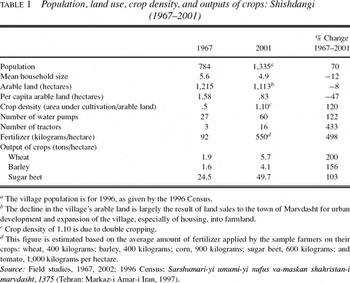
Between 1967 and 2001 major changes occurred in the village's population, per capita arable land, crop density, and agricultural productivity (Table 1). There was a substantial decline in per capita arable land (by 47%), resulting from the combination of a high population-growth rate and a slight decrease in the village's arable land. Substantial increases occurred in crop yields (wheat by 200%, barley by 156%, and sugar beet by 102%), which correspond to average annual growth rates of 3.2 percent, 2.8 percent, and 2.1 percent, respectively. The changes in Shishdangi reflect corresponding trends throughout Iran in the agricultural sector, as overall per capita arable land has declined by an estimated 24 percent,9
This is calculated on the basis of the data on the rural population provided in the 1956 and 1996 censuses and on the arable land area reported in the First National Census of Agriculture, 1961, and 1993 Agricultural Census.
and increased crop yields were reported of roughly 76 percent for wheat, 63 percent for barley, and 42 percent for sugar beet over the 1961–93 period.
10 The Food and Agriculture Organization of the United Nations (FAO) provides data on the yield (kilograms per hectare) of the major crops for 1961–78: 802 of wheat, 800 of barley, 2,914 of rice, 939 of cotton, and 19,202 of sugar beets in 1961–65; 896 of wheat, 891 of barley, 3,355 of rice, 1,198 of cotton, and 21,082 of sugar beets in 1966–70; 884 of wheat, 753 of barley, 3,455 of rice, 1,650 of cotton, and 24,243 of sugar beets in 1971–75; and 1,011 of wheat, 841 of barley, 3,315 of rice, 1,598 of cotton, and 25,314 for sugar beets in 1977–78 (Production Yearbook [Geneva: United Nations, 1971–79], Table 7:14); see also the 1961 First National Census of Agriculture and the 1993 National Census of Agriculture.
In light of changes in the pattern of land ownership, three distinct periods can be discerned in Shishdangi's transformation: (1) the village under landlord domination; (2) land reform, the rise of peasant proprietorship, and the development of capitalist farming; and (3) revolution, the demise of capitalist farming, and the transformation of the peasants. This paper will explore and analyze the dynamics and consequences of the socioeconomic changes in the village agrarian transition under each of the three periods, with a special focus on the postrevolutionary era.
THE VILLAGE UNDER LANDLORD DOMINATION
There is little information on the historical development of Shishdangi for the period under landlord domination, which roughly ended by the mid-1960s. In 1935, a sugar-beet refinery was founded in Marvdasht, and as far as the villagers recall, the entire village (Shish-dang)11
A dang is one-sixth of a real-estate property or a village. In traditional Iranian agriculture, a village would be divided into six dangs, and the ownership of an entire village was referred to as a shish-dang (six dangs).
was owned by one large absentee landowner, who lived in Shiraz. The land was leased out to a
mustajir, an intermediary between the landowner and the peasants in the management of crop production. The village land was divided into a number of fields, each of which was worked cooperatively by a team (
harasah) of some four to six sharecroppers. These
harasah, similar to what elsewhere has been called a
bunah,
sahra, or
bunku, function as a cooperative organization of farming whereby peasants are organized in working teams, each cultivating the fields jointly under a
sarbunah on a crop-sharing basis with the landlord.
12 For further discussion, see Javad Safi-Nezhad, Bunah: nizamha-i zira
ati sunnati dar Iran (Bunah: Traditional Farming Systems in Iran) (Tehran: Muassisa-yi Intisharat-i Amir Kabir, 1989); Hushang Elyasian, “Bunah bandi dar dasht-i qazvin: nimunah-yi az nizam-i kar kishavarzi-yi dastihjami dar Iran” (The Structure of Bunah in Qazvin: An Example of Agricultural Work Team in Iran), Iqtisad-i Kishavarzi va-Tawsiah 2 (1994): 143–50; and Eckart Ehlers, “The Iranian Village: A Socio-economic Microcosm,” in Agricultural Development in the Middle East, ed. P. Beaumont and K. McLachlan (New York: John Wiley and Sons, 1985), 151–70.
The
mustajir provided land, water, and seed to each
harasah while the peasants supplied labor and draft animals. The cultivation of crops was limited to wheat, barley, and rice, the peasants receiving one-third of the wheat and barley and one-half of the rice harvest as their annual share of the crops. Shortly after the initiation of sugar-beet cultivation in the village, the landlord sold the village to two landowners, each of whom bought one-half of the village land, along with the water rights from the Sivand River. The new landowners, hereafter referred to by the fictitious names Haj Arbab and Aqa Muhandis, also lived in Shiraz, and they continued leasing the land to the peasants. They dominated the village's agriculture and controlled its administration because they appointed the village headman (
kadkhuda). The peasants were physically tied to the village, as well, since their homes in the
qalah were owned by the landowners. Furthermore, because cultivation rights (
nasaq) were tied to membership in the
harasah, if a peasant left his
harasah, he would also lose his cultivation rights to the village farmland. The sharecroppers depended totally on the landowners for their livelihood.
With the development of pump irrigation by the late 1950s, a new system of agricultural production, locally known as tulumbah kari (pump-owner tenant farmer), emerged in the village. Tulumbah kari involves the transfer of land-use rights (usufruct) from the landowner to the peasant, who digs a well, installs water pumps to irrigate the land, and provides other production inputs for the cultivation of the land. This system of production spread very quickly in the village, and by 1967 some 340 hectares (28% of the total arable land) were cultivated by thirteen pump-owner tenant farmers. Furthermore, another new agricultural system, capitalist farming, began to develop in the village in the late 1950s when Aqa Muhandis's eldest son took over the management of his family estates from the mustajir. He proceeded to dig four wells and water-pump installations, introduced tractors, and dismissed the sharecroppers. Consequently, some forty-eight sharecroppers lost their cultivation rights to the capitalist farm and joined the ranks of the wage laborers (khwushnishin), a lower socioeconomic status than the sharecropper in the village's social hierarchy.
Before these changes, Shishdangi's social structure was nearly homogenous, largely dominated by absentee land ownership and sharecropping arrangements. Most households were sharecroppers at the same level in the village's social hierarchy and lacking any appreciable internal socio-economic differentiation. The village exemplifies the pre–land reform agrarian structure in Iran, characterized by (1) the predominance of an absentee landlord–sharecropping system; (2) low capital investment in agriculture, leading to low productivity and poverty of the peasants; and (3) a pattern of landlords' domination over the social and economic institutions of the countryside.13
For a discussion of urban landlord domination, see, among others, Paul Ward English, City, and Village in Iran: Settlement and Economy in the Kirman Basin (Madison: University of Wisconsin Press, 1966); Javad Safi-Nezhad, Talibabad: nimunih-i jami az barrisi-i yik dih (Talibabad: A Comprehensive Example of the Study of One Village) (Tehran: Muassisa-yi Mutaliat va Tahqiqat-i Ijtimai, 1967); Morio Ono and Mehdi Talib, Munugrafi-yi Ibrahim Abad (A Monograph of Ibrahim Abad) (Tehran: Muassisa-yi Mutaliat va-Tahqiqat-i Ijtimai, 1967); and Michael E. Bonine, Yazd and Its Hinterland: A Central Place System of Urban Dominance in the Central Iranian Plateau (Marburg: Geographischen Instituts der Universität Marburg), Marburger Geographische Schriften 82 (1980), chap. 3.
LAND REFORM, THE RISE OF PEASANT PROPRIETORSHIP, AND THE DEVELOPMENT OF CAPITALIST FARMING
Iran launched a sweeping land reform in 1962, which was implemented in three phases over a decade under the shah's “White Revolution.” While the shah's regime's interest in land reform is believed to have been primarily political14
For a survey of debates on 1960s land-reform politics, see Keith McLachlan, The Neglected Garden: The Politics and Ecology of Agriculture in Iran (London: I. B. Tauris, 1988), 105–52; Ashraf, “State and Agrarian Relations”; Majd, Resistance to the Shah, 88–163; and Hooglund, Land and Revolution in Iran, 123–37.
—dismantling the power base of the landowning class—the implementation of the reform contributed to a dramatic decline in absentee land ownership and the sharecropping system, leading to a substantial increase in peasant proprietorship.
15 See, among others, Azimi, “Distribution of Land and Income,” 88–89; Mohammad Javad Amid, Agriculture, Poverty and Reform in Iran (London: Routledge, 1990), 88–110; Cyrus Salmanzadeh and Gwyn E. Jones, “An Approach to the Micro Analysis of the Land Reform Program in Southwestern Iran,” Land Economics 55 (1979): 108–27; and Ismail Ajami, “Land Reform and Modernization of Farming Structure in Iran,” Oxford Agrarian Studies 2 (1973): 120–31.
All together, as a result of land reform, some 6 million to 7 million hectares of agricultural land (between 52% and 62% of the total) was transferred to the occupant sharecroppers and tenant farmers.
16 Ashraf, “State and Agrarian Relations,” 305–306.
However, not all rural households benefited from the land reform. Due mainly to the scarcity of agricultural land, some 35 percent of the households who did not hold cultivation rights (
nasaq) were mostly employed in agriculture as wage laborers (
khwushnishins) and were not included among the beneficiaries of the land-reform program.
In 1965, the half of the village that belonged to Haj Arbab was cultivated under sharecropping arrangements, subject to land redistribution under the second phase of the land-reform program. Consequently, one-third of this half, along with the water rights from the Sivand River, were transferred to the thirty-four occupying sharecroppers—on average, about 4.7 hectares each. The other half of the village (Aqa Muhandis' farm), which was worked by wage laborers, was exempt from redistribution.17
Under the provisions of Article 3, Part 2, of the Land Reform Law, mechanized lands—that is, those that were at least ploughed by mechanical means and cultivated by wage laborers—were exempt from redistribution.
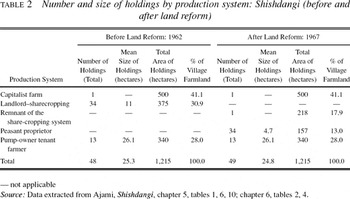
Implementation of the land reform gave rise to the development of the peasant production system,
18 For a discussion of peasant production system (nizam-i dihqani), see Gholam Reza Heydari, “Yikparchigi arazi tawsi
ah-yi kishavarzi dar Iran” (Land Consolidation and Agricultural Development in Iran), Iqtisad-i Kishavarzi va-Tawsi
ah 4 (1996): 145–203; and Ismail Ajami, “Naqsh-i nizam-i bahrih bardari-yi dihqani dar tawsi
ah-yi kishavarzi” (The Role of Peasant Production System in Agricultural Development], Namah-i Ulum-i Ijtimai 2 (1976): 189–99.
the decline of absentee land ownership and sharecropping arrangements, and further consolidation of capitalist farming in the village (
Table 2).
The implementation of land reform reinforced the trends toward development of capitalist agriculture. Haj Arbab redistributed more than 30 percent of his estates in 1965, discontinuing sharecropping arrangements and transforming his remaining land into capitalist farming by investing in water-pump irrigation and farm mechanization, and by hiring wage laborers and a farm supervisor. Aqa Muhandis further expanded his capitalist farming by adopting new agricultural technologies and increasing crop diversification, including leasing 30 hectares of the farm to a contractor for melon cultivation under a 50–50 profit-sharing arrangement (generally referred to as nisfah kari).19
This type of sharecropping, which advanced rapidly in the villages surrounding urban centers during the 1960s–70s, is also referred to as saifi kari, qumi kari, and muqasimah kari in different regions of Iran: see Safi-Nezhad, Talibabad, 123–24; Najmabadi, Land Reform, 112–14; and Mahdavi, “Thirty-year Transformations,” 55–56.
A substantial number of sharecroppers lost their cultivation rights as a result of further development in capitalist farming, joining the new majority landless
khwushnishin class. This transformation did not lead to rural polarization as postulated in the classical transition model, principally because of two tendencies in the village agrarian structure. First, the thirty-four newly emerged peasant proprietors organized themselves into three groups, each proceeding to dig a shallow well and install a water pump. The peasants initially began working the land cooperatively, forming new
harasah units. Second, most of the pump-owner tenant farmers acquired ownership of the land previously rented from the two landlords, expanding their farming operations by installing additional water pumps and diversifying into melon cultivation. Thus, the development of relatively large-scale capitalist agriculture alongside the emerging smallholders and pump-owner tenant farmers has given rise to contradictory tendencies in the village's transition to capitalist agriculture. These trends, corroborated by other case studies, continued to dominate the village agrarian structure until the 1979 revolution. For example, Hosein Mahdavi shows changes that occurred in two villages in the Qazvin area over a thirty-five–year period—one transforming into a modern commercial enterprise, and the other into a small-holding community.
20 Mahdavi, “Thirty-year Transformations,” 59–64.
Javad Safi-Nejad, on the basis of his field research on a sharecropping village near Tehran, demonstrates the development of a bimodal agrarian system after the implementation of the second phase of land reform in 1965. The landlord had to lease 210 hectares of his 318 hectares to sixty former sharecroppers under a fixed rent arrangement. He then set about farming his 108 hectares by employing wage laborers, introducing mechanization, digging a deep well, and installing pumping equipment. He now managed his farm as a commercial enterprise.
21 Safi-Nezhad, Talibabad, 203–206.
At the macro-level, Abdolali Lahsaeizadeh's study indicates that land reform contributed to the development of both peasant capitalist farming and large-scale agricultural enterprises, representing 6.5 percent and 15 percent of arable lands in Iran, respectively, by 1975.
22 Abdolali Lahsaeizadeh, Contemporary Rural Iran (Avebury, U.K.: Ashgate Publishing, 1993), 179, 183.
The Shishdangi data show the development of a dualistic agrarian structure, the demise of sharecropping, the disintegration of the bunah system, and deterioration in the socioeconomic conditions of the khwushnishins,23
For details, see Ajami, Shishdangi, 59–96.
which reflects the broader socioeconomic trends occurring in rural Iran at this time.
24 For further discussion of dualistic agrarian structure, see Amid, Agriculture, Poverty and Reform, 111–34. On the disintegration of the Bunah system, see Eric J. Hooglund, “Rural Socioeconomic Organization in Transition: The Case of Iran's Bonehs,” in Continuity and Change in Modern Iran, ed. Michael E. Bonine and Nikki Keddie (Albany: State University of New York Press, 1981); S. Amini, “The Origin, Function and Disappearance of Collective Production Units (Haraseh) in Rural Areas of Iran,” Der Tropenlandwrit 48 (1983): 47–61; and Amir Ismail Ajami, “Bunah dar sakht-i ijtimai rustai-yi Iran” (The Bunah System in Iran's Rural Society), Iran Namah 13 (1995): 503–22.
While there seems to be little disagreement on these changes, the positive effects of land distribution on agricultural production and the income of the peasant beneficiaries is controversial. Most studies contend that the land-reform program did not succeed in improving the living conditions of the majority of the peasants and, in fact, was a major contributing factor to Iran's agricultural stagnation.
25 See, among others, Majd, Resistance to the Shah, 344–46; and Hooglund, Land and Revolution, 81–98.
A careful scrutiny of the macroeconomic data on agriculture by Fatemeh Moghadam, however, does not support this contention.
26 Moghadam, From Land Reform to Revolution, 88–92.
Positive production growth rates of 3–4 percent annually were reported for the post–land-reform period.
27 Massoud Karshenas, Oil, State, and Industrialization in Iran (Cambridge: Cambridge University Press, 1990), 153.
Although estimates of Iranian agricultural production growth rates should be treated with some caution due to certain deficiencies in the data, these rates were largely maintained because more land was brought into cultivation and there continued to be increases in yields of major crops in the post-reform period.
28 The total area of agricultural land increased from 11.3 million hectares reported in the 1961 Agricultural Census to 16.1 million hectares in the 1971 Agricultural Census.
REVOLUTION, THE DEMISE OF CAPITALIST FARMING, AND TRANSFORMATION OF THE PEASANTRY
As the 1977–79 revolutionary upheavals gathered momentum in the urban centers, they eventually reached the rural areas, leading to peasant radicalization and land seizure in the countryside. Current scholarship suggests that the peasants' participation in pre-revolution antiregime demonstrations and political activities was by and large limited.29
See Ashraf, “State and Agrarian Relations,” 290–91; and Ervand Abrahamian and Farhad Kazemi, “The Non-Revolutionary Peasantry in Modern Iran,” Iranian Studies 11 (1978): 250–304.
However, villagers who commuted daily to city jobs and those who migrated and became part of the urban subproletariat were often willing participants in the urban uprisings as well as active agitators in the village.
30 See Eric Hooglund, “Rural Participation in the Revolution,” MERIP Reports 87 (1980): 3–6.
Therefore, what is apparent is that when the power of the central government was weakened, the peasantry gradually joined the protest movement, primarily for land takeovers.
31 For a survey of modes of revolutionary mobilization, see Ahmad Ashraf and Ali Banuazizi, “The State, Classes, and Modes of Mobilization in the Iranian Revolution,” State, Culture, and Society 1, 3 (1985): 3–41; and Gil Azar, “Mubarizat-i dihqani dar Iran” (Peasant Struggles in Iran), Dunya (October 1980): 74–77.
As an illustration of peasants' delayed participation, Morio Ono, who was in Kheirabad, a village in the Marvdasht region, in November 1978, observed: “when I am in Kheirabad, I don't feel the anti–Shah protest or the intense anti-government unrest which I witness in the city.”
32 Ono, Kheirabad Namah, 114; my translation.
However, some three months later, an eyewitness report by his friend who visited the village in mid-January 1979 informed him that “in Kheirabad the villagers used to support the Shah, but recently 60 percent of them have changed their position to pro–[Ayatollah] Khomeini.”
33 Ibid., 117; my translation.
In the case of Shishdangi, interviews with the two landlords and the village's key informants suggest that peasants were mostly in the “wait-and-see” mode during the revolutionary upheavals, except for a few activists who began agitating against the Aqa Muhandis capitalist farm about three months before the collapse of the regime in February 1979. In fact, peasants' protests against the village's two landlords occurred at different times, depending largely on the nature of their past relations with the landlords. Those who had been evicted by Aqa Muhandis in the early 1960s when he transformed his estate into capitalist farming were the ones who began their uprising prior to the revolution. In contrast, the peasant sharecroppers who were the beneficiaries of land redistribution by Haj Arbab under the 1962 land-reform program did not join the land-takeover movement until almost a year and a half later.
The earliest uprising was organized by two brothers whose father had been evicted by Aqa Muhandis when the capitalist farm was developed. They mobilized the former sharecroppers against the landowner by seizing the farm piece by piece. The peasants first took over about 14 hectares of land, then they moved to stop the landlord's delivery of sugar beets to the Marvdasht processing plant. Their next move was to occupy another 130 hectares of the capitalist farm's fallow land, which they collectively ploughed and planted with sugar beets. Finally, immediately after the revolution, the peasants seized the remaining fields, occupied the landlord's five water pumps, and expelled his farm's supervisor from the village. They then subdivided the farm among themselves and began working the fields by initially setting up the former harasah system. Despite the landowner's protest and frequent appeals to the local authorities, the peasants continued farming the occupied fields without paying any rent or a share of the crops to the landowner, except for the 1978–79 grain crops planted by the landowner. Almost a year and a half after the revolution, the peasants who were the beneficiaries of the land reform in the other half of the village began to agitate against Haj Arbab, the other landowner. They began by disrupting his farming operations, including the irrigation and fertilizing of the fields. Haj Arbab appealed to the Marvdasht governor's office, local gendarmes, and the Islamic Guards to prevent the peasants' aggressions on his estate. He argued that, since more than 30 percent of his estate had been distributed to the peasant sharecroppers in 1965 under the land-reform program, the peasants had no legitimate claim. His complaints were to no avail, however, and the peasants continued to disrupt his farming activities. Finally, in January 1981 they took over his land, two water pumps, a tractor, and other farm machinery.34
For a similar land expropriation in a village in the Marvdasht region, see Mary Hooglund, “One Village in the Revolution,” MERIP Reports 87 (1980): 7–12.
They subdivided the farm into six units and began to work the fields under the customary
harasah system. The landowner appealed to the
qadi-i shar in Marvdasht, requesting the eviction of the peasants. They refused to evacuate the land but agreed to the qadi's ruling, which stipulated the division of the 1980–81 crops between them and the landowner, as well as subsequent payments of annual rent to the landowner. Yet peasants continued to pay annual rent for the occupied land only until 1986, after which they refused to make any further rent payments.
The dispute over the occupied lands between different peasant groups and the two landowners has passed through various phases since the 1979 revolution. First, in addressing the petition of the landless agricultural workers for a portion of the village farmland, the local members of the “Sevener Commission”35
The Sevener Commissions were formed to carry out the post-revolutionary Land Reform Law. They were composed of two representatives from the Ministry of Agriculture, one from the Ministry of the Interior, one from Jihad-i Sazandigi, one from the Islamic Court, and one from the village council concerned: see Schirazi, Islamic Development Policy, 161–63.
(
hayat-i haft nafarah) visited Shishdangi in 1981. A decision was made by the commission to transfer 120 hectares of the capitalist farm (Aqa Muhandis) to twenty-three farmworkers (5.2 hectares per worker) and 30 hectares of the estate of the other landowner, Haj Arbab, to nine workers (3.3 hectares per worker). Since the legal status of these lands was in dispute, no land titles were issued; instead, the agricultural workers were granted temporary cultivation rights.
In the meantime, both the peasants and the two landowners remained unwilling to settle their disputes. The peasants hoped that the revolutionary government might eventually transfer the ownership of the occupied lands to them, while the landowners expected to gain the return of their estates through the courts. This climate of uncertainty drastically changed in October 1986 when the Islamic Parliament approved a land-reform law whose primary purpose was to legalize the transfer of the occupied lands to the peasant squatters.36
For details of the 1986 Land Reform Law, see ibid., 186–95.
Following the passage of the law, newly emerging political pressures forced the Sevener Commission, the landowners, and the squatters to seek a quick resolution to the legal status of the occupied lands. Thus, in 1988 the owners of the capitalist farm, Aqa Muhandis and his brother, agreed to transfer, free of charge, about 250 hectares to the fifty-five peasant squatters. The peasants agreed to return the remaining 140 hectares—70 hectares each—to the two brothers. Based on this agreement, land titles were accordingly issued to the landowners and the peasants. As for the legal status of some 120 hectares that were temporarily transferred to twenty-three agricultural workers in 1981, the two brothers also agreed to grant free ownership of the land to them. It took the other landowner, Haj Arbab, until 1999 to resolve his dispute with the peasants who had occupied his land, even though an appeals court had issued a verdict in 1989 for eviction of the squatters from the land. The settlement finally reached between the two parties involved a no-charge transfer of some 130 hectares out of Haj Arbab's total holding of 218 hectares to the forty-four peasant squatters. The remaining 88 hectares were to be returned by the peasants to the landowner, however, as the two parties failed to agree on the specifics regarding which tract of village land was to be returned to the landowner, the agreement still had not been implemented by summer 2002. Thus, the insecurity and disputes over landownership rights, coupled with intense hostility between the landlords and the peasants following the revolution, have continued to dominate economic life in Shishdangi to the present.
37 Despite the existing hostility, a few villagers told me in private conversations that the majority of the farmers are willing to return the 70–80 hectares of land to the landowner, Haj Arbab, and get their document “sanad.” They believed that, “since the land seizure, as the illicit ‘harām’ land has been mixed with our legitimate ‘halāl’ property, smoking, drug addiction, and fatal car accidents have been on the rise among our youth.”
The revolution's impact38
For an overall review of the revolution's impact on the villages, see Mansur Vosooghi, Jam
ahshinasi-yi rusta
i (Rural Sociology) (Tehran: Intisharat-i Kayhan, 1987), 229–89; and Mostafa Azkia, “Rural Society and Revolution in Iran,” in Twenty Years of Islamic Revolution, ed. Eric Hooglund (Syracuse, N.Y.: Syracuse University Press, 2002), 96–119.
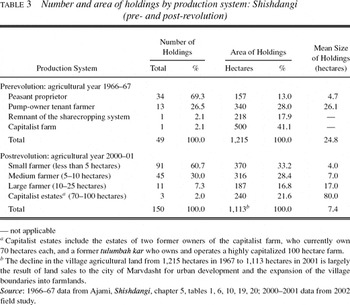
is clearly evident in the present pattern of land ownership in the village as contrasted to 1966-67 (
Table 3). As the data indicate, absentee land ownership has substantially declined, from a total of 59.1 percent of the village farmlands (41.2% capitalist farm plus 17.9%
arbabi estate) in 1967 to 20.6 percent in 2001. Parallelling this change is a significant increase in smallholdings, from 13 percent in 1967 to 33.2 percent of the cultivated land in 2001. Moreover, as some former smallholders occupied additional land during the land-takeover movement, a new category of landholders (medium farmers), who own 5–10 hectares, has emerged in the village. This radical redistribution of land has, however, resulted in a 70 percent decline in the average size of holdings, from 24.8 hectares in 1967 to 7.5 hectares in 2001. Even though it has led to a notable decrease in the scale of landlessness among village households, from 64.4 percent of the total households in 1967 to 49 percent in 2001, the absolute number of landless households has increased from 85 to 143 because of population growth. The substantial rise in the absolute number of landless households reinforces the fact that even radical land-redistribution measures under a revolutionary regime cannot by itself resolve the issue of landlessness in the countryside where land scarcity is coupled with a rapid population growth rate.
THE DEMISE OF CAPITALIST FARMING
The impact of revolutionary changes besides the peasants' land seizures and land redistribution includes the disintegration of capitalist farming in the village. As mentioned, the two capitalist farms were seized and parceled out among former sharecroppers, farm-workers, and its two landowners. In 1988, when Aqa Muhandis and his brother regained a portion of their farm, they contracted their total 140 hectares to three local farmers, who were each to work the land for a three-year period. Farming operations during the period consisted mainly of an annual cultivation of roughly 70 hectares of wheat and 35 hectares of corn, while the remaining 35 hectares were left fallow. This simple cropping pattern is in sharp contrast to the pre-revolution period, when this capitalist farm was characterized as a highly diversified and productive agricultural enterprise. The other large estate—that is, the remnant of the nizam-i arbabi, which was also developed into capitalist farming by its owner, Haj Arbab, after the 1965 land redistribution—has totally disintegrated and ceased to operate as an agricultural enterprise.
In 2002, continued land disputes, economic insecurity, and vacillating state agrarian policies were cited by the three urban landowners, Haj Arbab, Aqa Muhandis, and his brother, as primary reasons for their hesitation to commit capital investment and management to what has remained of their estates since the revolution. This insecurity of land tenure and government indecisiveness on the role of the private sector also are often postulated in the literature as the main causes in the deterioration of private capital formation in agriculture in post-revolutionary Iran.39
On the decline of domestic capital formation in agriculture, see Kambiz H. Kiyani and Mohamad R. Alizadeh, “Barrisi-yi
avamil mu
asir bar sarmayi guzari-yi bakhsh-i khususi dar kishavarzi-i Iran” (A Study on the Factors Affecting Private Sector Investment in Iranian Agriculture), Iqtisad-i Kishavarzi va-Tawsi
ah 8 (2000): 45–73; and Ahmad Mojtahed and Hadi S. Esfahani, “Agricultural Policy and Performance in Iran: The Post-Revolutionary Experience,” World Development 17 (1989): 839–60.
It seems clear that these socioeconomic changes have led to a dramatic interruption in the village agrarian transition to capitalism, as is evident in a quadrupling of the number of peasant smallholders, reinstatement of the sharecropping system by one of the former large landowners, and the fact that there was less investment in agriculture by urban merchants and former large landowners. The local-level changes were strongly reinforced by post-revolutionary political instability, social turmoil, and the new regime's antagonism toward large capitalist agricultural enterprises. Taken as a whole, the Shishdangi evidence suggests that agrarian transition to capitalism can follow a number of different paths, depending on the configuration of local-level conditions and on external sociopolitical forces. As Benjamin White argues, “[T]here is no universal or all-purpose ‘agrarian question’ awaiting investigation, nor is there any universal form of ‘agrarian differentiation’ (agrarian transition).”40
Benjamin White, “Problems in the Empirical Analysis of Agrarian Differentiation,” in Agrarian Transformation: Local Processes and the State in South East Asia, ed. Gillan Hart, Andrew Turton, and Benjamin White (Berkeley: University of California Press, 1989), 17.
TRANSFORMATION OF THE PEASANTRY
The increased access to land and water resources by a larger number of villagers coupled with the impact of rapid urbanization in the Marvdasht region and further integration of the village economy into the market (see later) have largely contributed to the acceleration of the socioeconomic transformation of the peasants in Shishdangi. This is mainly reflected in (1) changes in the agricultural production system; (2) diversification of occupational structure; and (3) shifts in social stratification. Each transformation will be discussed in detail.
Changes in the Agricultural Production System
An analysis of the production system in Shishdangi over the post-revolutionary period reveals a fundamental change: a transition from peasants whose livelihood depended largely on subsistence agriculture to farmers who practice intensive agriculture within a market economy.41
For a discussion of a similar trend in Egyptian agriculture, see Nicholas S. Hopkins and Kirsten Westergaard, “Introduction: Directions of Change in Rural Egypt,” in Directions of Change in Rural Egypt, ed. Nicholas S. Hopkins and Kirsten Westergaard (Cairo: American University in Cairo Press, 1998).
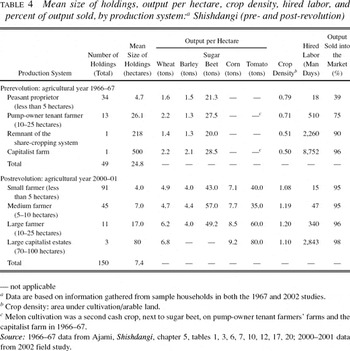
As part of this transition, we will see the emergence of a small number of petty capitalist farmers. The peasant production system, which depended heavily on family labor and farming for domestic consumption, has made a drastic shift to mainly mechanized and commercial agriculture. Plowing, planting, weeding, and harvesting of grains are now highly mechanized, even on small farms. The rapid expansion of farm mechanization has substantially reduced the need for household labor, except in tomato weeding and harvesting, as well as in managing the irrigation system, which have remained labor intensive. The peasant household that used to produce a significant part of its own subsistence (roughly 60% in 1967) now sells almost all of its output to the market (
Table 4). Even a family's daily bread is now acquired from bakeries in Marvdasht—in sharp contrast with 1967, when nearly all village households baked their own bread.
42 Since urban bread is highly subsidized by the government, it is to the village producers' economic advantage to sell their wheat harvest to the market and buy family bread from urban bakeries.
A comparison of 1967 and 2001 production-system data (
Table 4) indicates a substantial increase, due primarily to the 1979–81 land takeovers, in the number of smallholders (from 34 to 91), as well as the emergence of forty-five medium farmers by 2002.
The data also show a considerable rise in crop diversification, yields, and the increase in the percentage of output sold into the market by small and medium farmers. The dramatic rise in yields is primarily the result of the adoption of Green Revolution technologies, especially fertilizers and high-yielding seed varieties, and increased investment in irrigation pumps.43
As an illustration, the number of water pumps increased from twenty-seven in 1967 to sixty by 2002, and the average amount of fertilizer used per irrigated hectare increased from 92 to 550 kilograms over this period.
It should be stressed that the development of transportation and market networks in the Marvdasht region, as mentioned earlier, has brought the village more into the urban economy, which has contributed considerably to this transition.
Peasant agriculture has also changed with regard to animal husbandry. Most villagers have moved to new housing outside the old confinement of the qalah, and so they have largely given up the practice of raising a few sheep and goats. In 1967, each household had an average of twenty head of sheep and goats and one cow, but by 2002, sheep raising and milk production had been largely taken over by a few relatively specialized farmers. A further indicator of peasant transformation is reflected in new patterns of household consumption that have appeared gradually over the past thirty years, including the adoption of new types of housing, clothes, food items, televisions, refrigerators, and telephones.44
The 2002 sample household survey shows that all of the small and medium farm households except one now have a refrigerator, television, and telephone, whereas in 1967, 39 percent of peasant households had just a radio.
Considering the fundamental changes that have taken place in peasant production and consumption patterns since 1967, it can be argued that the concept of a peasant mode of production is no longer applicable to the village's small landholders.45
For a discussion of a similar trend in peasant transformation, see Caglar Keyder, “Paths of Rural Transformation in Turkey,” Journal of Peasant Studies 11 (1983): 34–50.
With this transformation in mind, the village households currently engaged in small-scale agriculture are more correctly referred to as farmers, not peasants or peasant farmers. The emerging production system in Shishdangi is a shift from peasant labor–intensive agriculture to mechanized commercial agriculture, and from large urban (absentee) landlord capitalist farming to small and petty capitalist farmers.
A striking feature of the transformation in the mode of production is the emergence of a small number of petty capitalist farmers in the village. The changes actually began in the 1960s when a few pump-owner tenant farmers increased the number of fields under sugar-beet cultivation and introduced melons into their cropping pattern. This trend has continued, particularly since the early 1990s, when some farmers began to diversify into milk production and increase tomato cultivation in their fields. The new developments, which required increased investment and hiring wage labor, have resulted in sharp distinctions between “ordinary” smallholders and the emerging petty capitalist farmers.46
For a discussion of theoretical perspectives, see, among others, John Hariss, Capitalism and Peasant Farming: Agrarian Structure and Ideology in Northern Tamil Nadu (Bombay: Oxford University Press, 1982); and Luis Llamli, “Small Modern Farmers: Neither Peasants nor Fully-Fledged Capitalists,” Journal of Peasant Studies 15 (1988): 350–72.
Reinhold Loeffler observed a similar development in Sisakht, a village in the Boir Ahmad region, where the farmers installed drip irrigation in their vineyards in 2002, drastically increasing their grape production and shipping to markets all over Iran.
47 Reinhold Loeffler, “Change and Continuity in Sisakht,” paper presented at the Fifth Biennial Conference on Iranian Studies, 28–30 May 2004, Bethesda, Md.
Also, the farmers in Kheirabad, in the Marvdasht region, abolished their cooperative arrangements for land and water use a year after the revolution and proceeded to build chicken farms, dig wells, install irrigation pumps, and expand cash crops in their fields.
48 Ono, Kheirabad Namah, 133–36.
The question of how these patterns of emerging capitalist farmers may be typical of rural Iran can be answered only in tentative terms because of the limited amount of comparable field research. We can reasonably argue that conditions conducive to the development of capitalist farmers are prevailing in most villages, especially those in proximity to urban centers. This argument can be supported by the fact that the number of rural entrepreneurs in agriculture—that is, capitalist farmers—increased by 255 percent between the 1976 census and the 1996 census.49
Sohrab Behdad and Farhad Nomani, “Workers, Peasants, and Peddlers: A Study of Labor Stratification in Post-Revolutionary Iran,” International Journal of Meddle East Studies 34 (2002): 667–90.
Furthermore, the size of holdings of about 50 percent of commercial farms enumerated in the 1993 Agricultural Census was less than 50 hectares, which can be assumed to be operated mostly by local capitalist farmers.
50 Sarshumari-yi umumi-yi kishavarzi kull-i kishvar, 1372 (National Census of Agriculture, 1993) (Tehran: MAI, 1998).
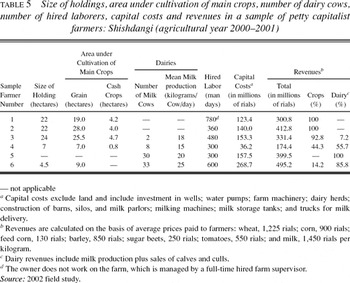
The development of petty capitalist farming in Shishdangi is primarily associated with two groups. The first consists mainly of a small number of relatively well-off pump-owner tenant farmers who have extended their farming into the production of high-value crops, primarily tomatoes. These farmers, whose tomato fields in 2000–2001 covered 2–5 hectares of their holdings, are referred to hereafter as “cultivators.” The second group is made up of those farmers who have diversified into milk production, holding some eight to thirty-three dairy cows; hereafter referred to as “cultivator/milk producers.”51
For an empirical study of integrated crop/dairy farming in Fars Province, see Javad Torkamani and Mahmood A. Borazjani, “Muqayisa-yi ulguha-yi bihinah-i vahidha-yi zira
i va-damdari-yi infiradi va-talfiqi” (A Comparative Study of Crop Farms with Integrated Crop/Dairy Farms), Iqtisad-i Kishavarzi va-Tawsi
ah 7 (1999): 61–76.
A total of seventeen farmers (11.6 %) can be identified as petty capitalist farmers—nine cultivators and eight cultivator/milk producers. The landholding size of cultivators ranges from 10 to 25 hectares, while among the “cultivator/milk producers” the landholding size is from 3 to 10 hectares.
Table 5 shows a sample of six petty capitalist farmers (three cultivators and three cultivator/milk producers). The three cultivators had diversified their cropping pattern by planting 4 to 4.7 hectares of tomatoes and sugar beets in 2000–2001. They used Green Revolution technologies, widespread farm mechanization, and wage labor, and sold nearly all of their output to the market in 2000–2001. The three farmers who have diversified into dairy come from the ranks of small and medium farmers. Although corn and barley were used for animal feed, almost all of the wheat crop and milk were sold to the market. The development of petty capitalist farming in Shishdangi has been influenced mainly by increased access to landholdings, a growing demand for commercial crops by agroindustries developed recently in the Marvdasht region, and state policies of highly subsidized inputs and favorable guaranteed prices, especially for milk.
This transformation has been reinforced by a rising number of land transactions in the village. Since the early 1990s, approximately 33 landholders (22% of the total) have sold all or part of their holdings, amounting to 156 hectares (12.8% of the total arable land). About two-thirds of the land was sold to the city of Marvdasht to construct housing, as well as to three small agricultural-processing plants. The remaining one-third, approximately 55 hectares, has changed hands among the farmers.
This rise of petty capitalist farmers does not mean the agrarian transition to capitalist agriculture accompanied by rural polarization—as postulated in the classical model—has taken root in the village. Rather, it should be interpreted as revealing an emerging tendency toward the development of farmer capitalism, which calls for further studies.
Diversification of Occupational Structure
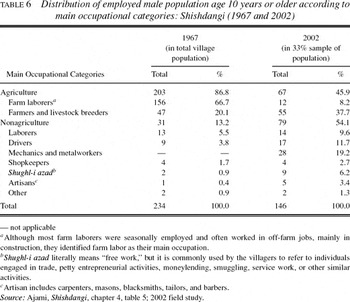
The peasant transformation is further manifested in the diversification of village occupational structure, primarily as a result of increased access to urban jobs. The proportion of the male population ten years or older engaged in agriculture has dramatically decreased, from 86.8 percent in 1967 to 45.9 percent by 2002,52
It is interesting to note that this trend is much stronger in Shishdangi when compared with the other rural areas in the Marvdasht region, where the share of male employment in agricultural and nonagricultural occupations were 55.6 percent and 44.4 percent, respectively, in 1996: see Sarshumari-yi umumi-yi nufus va-maskan shahristan-i marvdasht, 1375 (National Census of Population and Housing—Marvdasht Region, 1996) (Tehran: MAI, 1997), 29.
while the share of the nonagricultural occupations, especially in transportation, mechanics, and
shughl-i azad (petty trading, moneylending, and other similar activities) has sharply increased (
Table 6). The decline in agricultural occupation in Shishdangi is similar to the overall trend in rural Iran, as the percentage of the population age 10 and older engaged in agriculture has declined from 76.6 percent in 1956 to 49 percent in 1996.
53 Sarshumari-yi nufus va-maskan kull-i kishvar, 1335 (National Census of Population and Housing, 1956) (Tehran: Vizarat-i Kishvar, 1956); Sarshumari-yi umumi-yi nufus va-maskan kull-i kishvar, 1375 (National Census of Population and Housing, 1996) (Tehran: MAI, 1997).
The reduction in agricultural employment in Shishdangi has come about particularly as a result of a phenomenal drop in the percentage of farm laborers, from 66.7 percent in 1967 to 7 percent of the village labor force by 2002. This can be partly accounted for by the disintegration of the two large capitalist farms, which together employed some twenty-four permanent workers and a larger number of seasonally hired laborers before the 1979 revolution. Moreover, the rise in family-operated small holdings, widespread use of farm machinery, and increased access to urban jobs has contributed to this change. Similarly, Loeffler notes that, even for prerevolutionary Iran, “the occupational structure of Sisakht has become totally transformed. Whereas in 1966 virtually all Sisakhti gained their livelihood exclusively from the land, already ten years later only 44 percent of households did so any longer. Today the members of young generations are either students or have an income from salaries, business, craft, or wage labor…. Agriculture, which now largely means horticulture, has become a sideline, producing, however…substantial additional income.”
54 Loeffler, “Change and Continuity,” 7.
Accompanying the occupational changes, the primary source of income for the heads of households, which previously depended heavily on agriculture (78.8% in 1967), had declined to 50 percent by 2002—while the nonagricultural income increased from 21.2 percent to 50 percent during the same period. The analysis of farm-household data also suggests that even though most farmers have managed to keep their farms, a large number of household members (41.3%) now commute daily to jobs in nearby towns, mostly in Marvdasht (70%). These urban jobs have provided additional sources of household income, some of which has been spent on the family farm. It can therefore be postulated that occupational diversification and changes in the production system have acted through concurrent processes to accelerate peasant transformation in the village.
Shifts in Social Stratification
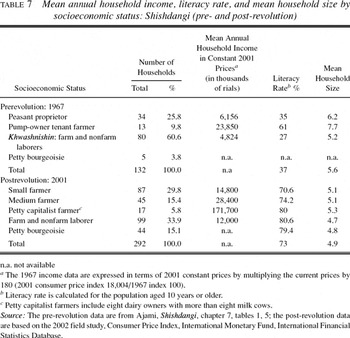
The changes in the production system, along with increased access to nonfarm occupations, resulted in relatively large-scale shifts in the village's social stratification by 2002. It contributed to a substantial increase of small holders and the rise of medium farmers. Among the latter are former peasant proprietors who enlarged their holdings by occupying additional land during the 1979–80 land takeovers. By 2002, small and medium farmers together constituted 45.2 percent of all the households and owned 61.6 percent of the cultivated area (Tables 4 and 7). This pattern is in sharp contrast to the 1967 situation, when peasant proprietors made up 25.8 percent of the households and owned about 13 percent of the farmland. It should, however, be pointed out that the peasants' upward movement in the village's stratification was not affected merely by an increased access to land. It was also significantly influenced by the adoption of improved agricultural technologies and expanded participation in the market economy. These changes, as discussed earlier, have contributed greatly to the peasants' transition to small farmers, with far-reaching implications in their mode of production, social status, and way of life.55
For a discussion of similar trends in a village northwest of Shiraz, see Eric Hooglund, “Letter from an Iranian Village,” Journal of Palestinian Studies 27 (1997): 76–84.
The changing village stratification is further characterized by the emergence of petty capitalist farmers. While only 11.6 percent of the landholding households fall into this category, they exert considerable influence in the village's socioeconomic structure by controlling larger landholdings or dairy herds, providing them with substantially higher incomes than other villagers. Yet the petty capitalist farmers who have invested heavily in tube-well irrigation, dairies, and farm machinery do not appear to have created or accelerated social polarization in Shishdangi. The limited land transactions, resistance of small farmers, and state policies supporting smallholders have so far prevented concentration of landownership by only a few individuals. A similar pattern was observed by Nicholas Hopkins, who investigated capitalist farmers in rural Egypt, where smallholders continue to function as petty commodity producers in a highly differentiated market economy.56
Nicholas S. Hopkins, “The Agrarian Transition and the Household in Rural Egypt,” in Household Economies and Their Transformations, Monographs in Economic Anthropology, no. 3, ed. Morgan D. Maclachlan (Lanham, Md.: University Press of America, 1987), 155–72.
The shift in village stratification is also seen in the sharp decline in the proportion of landless khwushnishin households and the increased diversification of their occupations. This stratum, as is the case in most villages in Iran, is composed of two distinct social categories: the agricultural and nonagricultural laborers and the village petty bourgeoisie.57
Azkia, “Rural Society and Revolution in Iran,” 101–103.
The latter includes shopkeepers, small traders, moneylenders, artisans, and peddlers. The
khwushnishin population, especially its laborer segment, has declined significantly, from 60.6 percent of all households in 1967 to 33.9 percent in 2002, whereas the petty bourgeoisie component had nearly quadrupled over the same period. The upward mobility of the
khwushnishin is clearly reflected in the higher literacy rate as well as in their adoption of new types of housing and consumer goods (
Table 7). The sample household survey indicates that by 2002, some 97 percent of
khwushnishin households had a refrigerator, and 85 percent had a television set, whereas in 1967 only 27 percent had just a radio. The
khwushnishin vision of their life conditions also appears to have changed, as revealed in personal interviews.
58 In the 1967 study, khwushnishins often expressed their overall life conditions as being destitute and powerless. They did not express such a negative outlook on life during interviews conducted in 2002.
Finally, a comparison of 1967 and 2001 data (
Table 7) points out two opposite trends in the village's stratification. First, there has been a pronounced increase in income inequalities, as indicated by the growing income gaps between various social strata over the past thirty-five years. For example, the ratio of rich-to-poor farmers' income, which in 1967 was 3.9 (pump-owner tenant farmers-to-peasant proprietors), had tripled to 11.6 (petty capitalist farmers-to-small farmers) by 2001. Second, however, the sharp differences in literacy rates and mean household sizes that existed in 1967 between various social strata has almost totally disappeared. This trend reflects the widespread diffusion of education and family planning across all socioeconomic classes in Shishdangi over the past thirty-five years. However, the widening income-inequality gap between rich and poor farmers, despite land redistribution and land takeovers by the latter, cannot readily be explained. One possible reason for this growing disparity might be that the adoption of Green Revolution technologies and better farm-management skills are more predominant among the petty capitalist farmers than the small and medium farmers.
CONCLUSION
This study has examined a village transformation in Iran within the conceptual framework of agrarian transition theory. It is postulated that structural changes in the pattern of the landownership system, coupled with the integration of the village economy into the market, would propel its transition to capitalist agriculture and differentiation of its peasantry. We maintain that changes in the system of agricultural production, diversification of occupational structure, and shifts in social stratification reflect this transition. Three distinct periods are discerned in Shishdangi's transition: (1) the village under urban domination; (2) land reform and the rise of peasant proprietorship; and (3) the post-revolutionary transformation. The data on the first two periods illustrate the dynamics and implications of landlord domination and land redistribution, including the dual development of the peasant production system and capitalist agriculture. They also provide the context necessary for understanding the post-revolutionary transformation. The evidence from this study shows significant differences in peasant responses to the 1978–79 revolutionary upheavals, as well as the persistence of hostility and disputes over landownership between peasants and landlords.
The most significant changes during the post-revolutionary period have been the transformation of the peasant, as perceived in its conventional sense, into a farmer, including the emergence of a small but significant number of petty capitalist farmers. These two interrelated changes have had far-reaching implications in the village's socioeconomic structure, which can be expected to contribute to the development of farmer capitalism in the future. Peasant transformation was further manifested by a sharp decline in the proportion of Shishdangi's active population engaged in agriculture and, hence, the substantial increase in the number of households whose primary source of income depended on nonagricultural occupations and who worked outside the village. Finally, changes culminated in relatively large-scale shifts in the village's social stratification. The substantial increase of small holders and the rise of medium farmers reflect the extent of this shift. Also, the declining khwushnishin population, coupled with the increased diversification in their occupations and higher literacy rates, is an indication of upward mobility for the khwushnishins.
The disruptions and changes in Shishdangi support the notion that the agrarian transition to capitalist agriculture does not proceed through a unilinear evolutionary process, as postulated in the classical model. Contradictory tendencies in the transition, particularly the 1979–80 revolutionary turmoil, led to disruptions in the development of capitalist agriculture. A sharp diversion from large-scale capitalist farming to mostly small and medium commercial agriculture developed, promoted by the post-revolutionary regime. The small holders and middle peasantry also have emerged as capitalist farmers in many villages in Iran. A similar pattern of agrarian transition in post–Nasser Egypt is examined by Hopkins, who calls the change a “blocked” transition: “now even if we agree that agrarian transition in something approaching its classic form has not happened—it has been ‘blocked’ by the continued importance of the household economy of the petty commodity producers—we still must recognize it has happened to some extent. The capitalist mode of production is present in rural Egypt.”59
Hopkins, “Agrarian Transition,” 157.
This study of Shishdangi also shows that the village's transformation, while increasing sharply the degree of differentiation among the peasantry, has not resulted in rural polarization. Rather, it has contributed to an increasing social stratification both among and between the landholding and khwushnishin population. The pattern of agrarian transition in other Iranian villages, as discussed earlier is similar to what has been found in Shishdangi. This suggests that we can reasonably argue that the underlying trends in Shishdangi would largely represent overall changes in rural Iran. A comparable transformation is observed by Robert Netting, who, on reviewing the results of village studies in Thailand, the Philippines, Indonesia, and Pakistan, concludes that there is “some evidence that stratification reflects the process of change in traditional, on-going communities of intensive cultivators more closely than does polarization.”60
Netting, Smallholders, Householders, 216.
The patterns and transformations that have been documented in this study of one village should provide insights for future developments in the rural sector and society of Iran. The khwushnishin population should continue to decline, perpetuating the current rapid urbanization, for unemployed farmworkers mostly migrate to urban centers to look for employment. The capitalist farmers should continue to expand their capital accumulation, mainly through land purchases and by renting land from smallholders. This may well lead to increased sociopolitical tensions within Iran's rural society, as well as with the agrarian policies of the post-revolutionary state, which is mostly committed to smallholders' patronage. Finally, rural society in Iran is continuing to urbanize as transportation and marketing networks improve. The Iranian peasant—now the Iranian farmer—is becoming more and more integrated into a wider (urban) society. The reduction of the divide between rural and urban society has far-reaching implications for the future of the Iranian economy and society—as well as for Iranian politics.
Author's note: Special thanks are due to Ahmad Behpoor for his valuable assistance in the field survey. I thank Sohrab Behdad, Michael E. Bonine, Mohsen A Fardi, Roger Fox, Mansoor Moaddel, Vahid Nowshirvani, Frank W. Young, and four anonymous referees for their constructive comments.