In the last several decades many studies emphasizing social interaction as a foundation for early language development have examined relations between parenting style and language acquisition in infants and toddlers, identifying parental styles that promote positive outcomes for children. Parenting styles characterized as sensitive and responsive have been shown to play an important role in positive developmental outcomes in child cognition and language (Landry, Smith, Miller-Loncar & Swank, Reference Landry, Smith, Miller-Loncar and Swank1997; Murray & Hornbaker, Reference Murray and Hornbaker1997; Tamis-LeMonda, Bornstein & Baumwell, Reference Tamis-LeMonda, Bornstein and Baumwell2001) as well as domains known to support language development such as social-emotional growth (Landry et al., Reference Landry, Smith, Miller-Loncar and Swank1997; Rocissano, Slade & Lynch, Reference Rocissano, Slade and Lynch1987). More specifically, studies have linked sensitive, responsive parenting with positive outcomes including global measures of receptive and/or expressive language (Landry et al., Reference Landry, Smith, Miller-Loncar and Swank1997; Murray & Hornbaker, Reference Murray and Hornbaker1997; Tamis-LeMonda et al., Reference Tamis-LeMonda, Bornstein and Baumwell2001) and vocabulary development (Hart & Risley, Reference Hart and Risley1995; Tomasello & Farrar, Reference Tomasello and Farrar1986). A sensitive, responsive parenting style has been shown to be optimal for children at risk for language delay (Hughes, Dote-Kwan & Dolendo, Reference Hughes, Dote-Kwan and Dolendo1999; Pressman, Pipp-Siegel, Yoshinaga-Itano & Deas, Reference Pressman, Pipp-Siegel, Yoshinaga-Itano and Deas1999) as well as for typically developing children.
With sensitive responding providing prompt, contingent and appropriate responses to children's exploration and communication (Bloom, Reference Bloom1993; Hughes et al., Reference Hughes, Dote-Kwan and Dolendo1999; Pressman et al., Reference Pressman, Pipp-Siegel, Yoshinaga-Itano and Deas1999; Tamis-LeMonda et al., Reference Tamis-LeMonda, Bornstein and Baumwell2001), it is argued that joint attention and attunement to the child's current state or focus of attention is an important dimension of sensitivity that contributes to language development (Murray & Hornbaker, Reference Murray and Hornbaker1997), including its semantic and syntactic level (Tamis-LeMonda et al., Reference Tamis-LeMonda, Bornstein and Baumwell2001). In contrast, parental behavior that requires children to turn away from their current focus of attention has been negatively correlated with children's expressive language development (Tomasello & Farrar, Reference Tomasello and Farrar1986). Furthermore, parental qualities related to sensitivity, such as non-intrusiveness and the expression of positive affect (e.g. emotional availability) have been associated with children's ability to focus and attend to the environment (Volling, McElwain, Notaro & Herrera, Reference Volling, McElwain, Notaro and Herrera2002), while intrusive behavior that incorporates anger has been associated with poorer physiological regulation in the child, reducing attention to salient aspects of the task at hand (Calkins, Smith, Gill & Johnson, Reference Calkins, Smith, Gill and Johnson1998). Other studies suggest that an optimally facilitative style is one which is reciprocal, supports the child's interests and recognizes the child's need for autonomy (Murray & Hornbaker, Reference Murray and Hornbaker1997; Landry et al., Reference Landry, Smith, Miller-Loncar and Swank1997); in contrast, restrictiveness and lack of direction during interaction tend to be related to slower cognitive–linguistic growth rates (Landry et al., Reference Landry, Smith, Miller-Loncar and Swank1997).
The goal of the present study was to determine whether these important differences in sensitive, responsive parenting that contribute to different language-learning experiences for the child might mediate the well-established relation between maternal and child language usage (e.g. Hart & Risley, Reference Hart and Risley1995). Numerous studies support the relation between maternal and child language usage. For example, frequency of parental speech relates to child language acquisition (Moerk, Reference Moerk1980); the amount of speech heard (Barnes, Gutfreund, Satterly & Wells, Reference Barnes, Gutfreund, Satterly and Wells1983) and volume of child-directed speech (Pine, Reference Pine, Gallaway and Richards1994) predicts children's language development; and linguistic input and overall amount of exposure to parental speech predicts language growth in toddlers (Huttenlocher, Haight, Bryk, Seltzer & Lyons, Reference Huttenlocher, Haight, Bryk, Seltzer and Lyons1991).
To test our hypothesis we examined spontaneous language data obtained during mother–child interaction at two years by evaluating measures of child grammar, semantics and pragmatics, as well as measures of mother linguistic input (i.e. grammar and semantics). A qualitative dimension of parental discourse including the use of prohibitions (Hart & Risley, Reference Hart and Risley1995) and other linguistic discourse features of adult language, such as questions and auxiliary-reversal (Hart & Risley, Reference Hart and Risley1995; Hoff-Ginsberg, Reference Hoff-Ginsberg1986; McCabe & Peterson, Reference McCabe, Peterson, McCabe and Peterson1991), is also related to children's language learning (see reviews in Gallaway & Richards, Reference Gallaway and Richards1994; Snow, Reference Snow, Fletcher and MacWhinney1995). The discourse features of commands, prohibitions and questions are instrumental components in the conceptualization of the parenting styles presented here, which center on control issues and vary in power-assertion. Hence to keep parenting style separate from the predictor variable of maternal language, the qualitative dimension of parental discourse was not included with the maternal measures of grammar and semantics as a component of maternal language. With the conceptual overlap between maternal discourse characteristics and parenting style, the more distal and global variable of parenting style is viewed as the mediating variable between maternal and child language usage.
In addition to the link between parent style and children's language usage, a relation between maternal language usage and parenting style must also be demonstrated to test the hypothesis that parenting style mediates the relation between maternal and child language usage. Although less well established, evidence supports this link. During toddlerhood, a period when important changes in children's language skill occur, the emergence of toddler autonomy presents a challenge to mothers as they attempt to modulate behavior in accordance with expectations for their toddlers. With this challenge, mothers' language usage may vary as they respond to their children's increasing autonomy by attempting to control their toddlers' behavior and/or to negotiate with them when mother and child intentions conflict. A compliance paradigm offers the possibility to explore differences in maternal child-directed speech as a function of parenting styles characterized by variation in mothers' willingness to assert their power as they attempt to control/influence their toddlers' behavior (i.e. control strategies). In the present study, we used the compliance paradigm developed by Crockenberg (Crockenberg & Litman, Reference Crockenberg and Litman1990) to investigate relations between mothers' control strategies, mothers' language usage and children's language usage at two years. Crockenberg identified maternal control behaviors as reflecting three coherent strategies – guidance, control and negative control – each of which displays a different level of power-assertion. The guidance strategy exerts the least power-assertion (e.g. ‘Where does the toy go?’), control exerts moderate power-assertion (e.g. ‘Put the blocks in the basket.’) and negative control exerts the most power-assertion (e.g. ‘Put that truck in the basket, now!’ said in an angry tone). Variations in how mothers combine their use of these three strategies have been associated with important developmental outcome, specifically compliant, self-assertive and defiant behavior in toddlers (e.g. Crockenberg & Litman, Reference Crockenberg and Litman1990; Donovan, Leavitt & Walsh, Reference Donovan, Leavitt and Walsh2000).
Of note, maternal behaviors which comprise these three control strategies have characteristics in common with parental behaviors considered more or less facilitative for language learning during interaction: the autonomy afforded and the encouragement of participation provided by the guidance strategy (e.g. suggests/asks, verbally assists and compromises), and the directive nature of the control strategy (e.g. commands or prohibits without negative affect). The negative affective component in the negative control strategy (e.g. commands or prohibits accompanied by anger or annoyance) is related to poorer functioning in general (e.g. Calkins et al., Reference Calkins, Smith, Gill and Johnson1998).
The hypothesis that parenting style would mediate the relation between maternal and child language usage yielded the following predictions. Initially, we expected to replicate the established finding that more advanced language usage of mothers would be associated with more advanced language usage of the children. Second, given the nature of the strategies, we expected that mothers who used the greatest amount of negative control would provide the most restrictive environment through a reduction in their linguistic input, grammatic and semantic. Third, we expected that at this pivotal stage of development children whose mothers used the greatest amount of negative control would be least advanced linguistically (grammatic, semantic and pragmatic) compared to other children, and that children whose mothers used minimal negative control would be most advanced linguistically. Lastly, in testing the mediation hypothesis, we expected that parenting style would mediate the relation between maternal and child language usage.
METHOD
Participants
Mothers and their toddlers were participants in a longitudinal study on maternal sensitivity and infant socio-emotional and cognitive development. Dyads participated in sessions at 0 ; 6, 0 ; 9, 1 ; 0 and 2 ; 0. Data reported here are from the 2 ; 0 session. Additional data were collected during each of these sessions; however, none of the data reported here have been reported elsewhere. Recruited through local public birth announcements, mothers were first sent a letter of introduction followed by a phone call requesting their participation in a study observing behaviors of mothers and infants during interaction. From an original 70 dyads at the 0 ; 6 session, 62 mothers, each with their two-year-old toddler (plus or minus 1 week) participated at the 2 ; 0 session. Mothers (age range=21 to 41 years, M=32·7 years) were white; 31 were primiparous. Sixty-one were married (the remaining one was unmarried but cohabitated with the infant's father). Fifty-eight were primary caregivers (the remaining four caregivers were the father). All mothers had completed high school and some college, 30 had completed an undergraduate degree and 22 had completed a master's level or other advanced degree. Thirty-eight mothers worked outside the home an average of 30 hours per week; median family income was $65,000 (range=$10,000 to over $80,000). All infants were typically developing; none was diagnosed with a high-risk condition; 36 were female and 26 were male. It was discovered when viewing the videotapes for the pragmatic analysis that two of the 62 mothers were bilingual. Data from the dyads with these two mothers were excluded from analyses. The remaining mothers were assumed to be monolingual.
Procedure
Demographics were completed at the 0 ; 6 session. When the children were two years old (plus or minus 1 week), mothers and children came to the laboratory and participated in a standard clean-up task (Crockenberg & Litman, Reference Crockenberg and Litman1990). Prior to the task, each mother completed computerized questionnaires for approximately 30 min (except for updating demographic information, questionnaire data were not part of the study reported here). A bin of standard toys appropriate for two-year-olds (e.g. doctor kit, building blocks and cars) was available to the child during this time. For the task, the mother was instructed to have the child put away all of the toys in a manner that she might typically do at home. No special instructions about how this should be done were given; however, if a mother asked if she could help, she was told she could assist but that it was the child's job to pick up the toys. The mother and child were then left alone in the room during the clean-up task, which lasted on average approximately 7 min (range=1·5 to 24 min). Mothers were informed that the session was being videotaped from an adjoining room. Interactions were videotaped by means of a split-screen technique; two small, inconspicuous cameras were attached on adjacent walls and positioned to optimize viewing the interaction. A microphone was attached to the ceiling and the adjoining observational room held the recording equipment.
Maternal and child behavior coding
Mothers used a variety of behaviors to direct their toddlers' behavior in completing the clean-up task. The behaviors of interest were those that comprised the mothers' control strategies (Crockenberg & Litman, Reference Crockenberg and Litman1990). An additional category of ‘other’ contained maternal behavior that did not meet any of the composite definitions (e.g. ‘mother walks toward’); therefore, behavioral codes were exhaustive and mutually exclusive. Affective codes of anger and annoyance were recorded and coupled with behavioral codes. For the child, while multiple behaviors had been coded for another study conducted by the authors, a single self-assertive behavior of ‘no’ uttered without anger was used in this study as a means to tap the transactional nature of the relationship to the degree that children's self-assertive behavior would differentially challenge the mothers. Thirty-two children produced one or more ‘no’ utterances (range=0 to 20).
The audio track of the videotapes was transcribed verbatim to provide an accurate record of the verbal interaction of the mother and her toddler. To establish the sequential pattern of mother–child interaction, the verbal transcripts were first read and coded for verbal directives. Then the videotapes were viewed in order to add the non-verbal behavior codes to the transcript. Two trained research assistants coded the tapes; reliability between the coders was established on sixteen transcripts (approximately 25%) selected at random. Percentage agreement reliability (agreements divided by total agreements plus disagreements) for individual maternal behavior and affect codes ranged from 88% to 97%, with a mean of 92%. Reliability for the single child behavior was 97%.
Maternal behavior data reduction
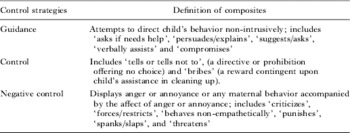
The three maternal strategies as defined by Crockenberg & Litman, (Reference Crockenberg and Litman1990) are presented in Table 1 together with behaviors defining each category. Frequencies of the specific maternal behaviors were summed to create the maternal control strategy composites that represent varying levels of parental power-assertion: guidance (low power-assertion), control (moderate power-assertion) and negative control (high power-assertion). Final composite values were transformed into proportions of control strategy behaviors exhibited by a mother relative to the total number of control strategy behaviors.
Definition of control strategy composites

As noted in Table 1, with the exception of the accompaniment of affect (anger or annoyance), the control strategies are constituted in large part by behaviors (e.g. tells, tells not, asks, asks if needs help) which overlap with the linguistic discourse features of commands, prohibitions and questions, respectively. Measured here, commands (i.e. ‘tells’) were the total number of mother utterances that were task-related directives implying no choice for the child; prohibitions (i.e. ‘tells not to’) were the total number of mother utterances that were task-related verbal directives telling the child not to do something; and questions were the total number of questions asked.
Maternal continuum-of-control groups
As in daily interaction, most mothers used a combination of strategies rather than relying on a single strategy to gain their child's cooperation and direct their child's behavior in the clean-up task. Mothers were placed into one of three groups based on their relative predominant use of the three composite measures and hence positioned on a continuum-of-control. All mothers, with the exception of one who used only guidance, used a combination of strategies; all used a substantial amount of guidance, all but one used some control and about half used some negative control. Mothers were similar in that they all used more guidance than the other two strategies, followed by control, with negative control being the least used strategy.
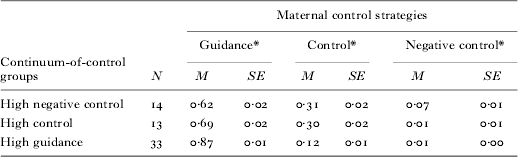
Because groups were differentiated by mothers' use of a particular strategy relative to mothers in the other two groups, groups were named for their predominant strategy. Those whose use of negative control was higher than that of other mothers were designated as high negative control (HNC) and were positioned at one end of the continuum. high control (HC) was positioned in the middle of the continuum, and mothers whose use of guidance was higher than that of other mothers were designated as high guidance (HG) and were positioned at the other end of the continuum. Maternal behavior data for the continuum-of-control groups are summarized in Table 2. Specifics of group designation are as follows:
Maternal control strategies as a function of continuum-of-control group: Means and standard errors

note: Values represent the proportion of guidance, control and negative control strategy behaviors for mothers in the three groups. Means reported are estimated marginal means. * Means in the column differ significantly in a linear contrast of the means, ps<0·05.
High negative control group (HNC)
This group was comprised of mothers who were in the upper quartile in the use of negative control (e.g. anger, annoyance) (n=14). They used relatively more negative control and less guidance than did mothers in the other two groups.
High control group (HC)
From the remaining 48 mothers, those in the upper quartile in the use of control behaviors (e.g. tells, tells not to) created the HC group (n=13). Their use of control was equal to that of mothers in the HNC group, but they used a minimal amount of negative control, with 54% not using any negative control. They used a substantial proportion of guidance but less than mothers in the HG group and more than mothers in the HNC group.
High guidance group (HG)
The remaining 33 mothers comprised the group which was characterized by an overwhelming predominance of guidance (e.g. suggests/asks). These mothers used substantially more guidance and less control than mothers in the other two groups, and they used minimal negative control, with 65% not using any negative control.
Language sampling
Transcripts of child and mother language were obtained from the clean-up task. Trained graduate students transcribed audiotapes into computer text files using conventions from the Systematic Analysis of Language Transcripts (SALT) software (Miller & Chapman, Reference Miller and Chapman2003). Following established protocol, after the first transcriber completed the tape, a second trained transcriber did a check, listening to the audio sample while reading over the transcript, making edits. The original transcriber then had the final say on whether or not he/she agreed with the edits. Each transcriber had received extensive training in the University of Wisconsin-Madison SALT Transcription Lab, where transcribers are considered trained when they achieve 95% agreement or above with a senior transcriber. SALT conventions for segmentation of speech into utterances capture thought completion based upon intonation contour and/or pauses. The SALT program marks grammatical bound morphemes as well as any utterances that are unintelligible. Language measures (i.e. grammar and semantics) were calculated from the SALT transcripts and unless otherwise noted are from complete and intelligible utterances. Calculation of the child pragmatics measure, that is, language functions (e.g. comments, vocatives and requests for information), is not automated in the SALT program, therefore the pragmatic measure was done as a separate calculation by the third author.
Mother language measures
Three grammatical measures were made:
Mean length of utterance in morphemes
Mean length of utterance (MLU), a measure of utterance length and complexity, is calculated in SALT according to rules developed by Brown (Reference Brown1973).
Number of grammatical word types
Another indicator of diversity of grammatical forms, types of grammatical words such as negatives (e.g. don't), conjunctions (before, because), pronouns (she, her) and auxiliary and modal verbs (can, have, is) was calculated.
Total number of bound morphemes
Total number of bound morphemes was calculated, indicating the number of grammatical markers, such as those for tense, possessives, plurals, and negative and auxiliary contractions.
A single semantics measure was made:
NDW
Number of different word roots (NDW) was calculated as a measure of diversity of expressive vocabulary.
Child language measures
Three grammatical measures were made:
MLU and number of grammatical word types
These measures were calculated in the same manner as for mother's language.
Number of bound morpheme types
With bound morpheme usage emerging at 2 ; 0, a count of bound morpheme types was calculated (instead of total number of bound morphemes as for the mother). This measure indicated the diversity of grammatical markers, such as those for tense, possessives, plurals, and negative and auxiliary contractions.
A single semantics measure was made:
NDW
As with the mother's measure, this was a measure of diversity of expressive vocabulary.
A single pragmatics measure was made:
Functions of language
Transcripts were scored for the presence of 17 different types of functions the children used. The types used were developed based on language functions reported in the literature for two-year-olds; in order to capture as much of the complexity and richness in children's pragmatic development as possible, communicative acts at different levels of analysis were selected (Ninio & Snow, Reference Ninio and Snow1996): utterance-level (requests for action, for object, for information, and for confirmation, comments, vocatives, rejects/protests, self-directives, verbal play, and the imaginative function), discourse level (answers question, clarification requests, acknowledgments, imitations, responses to clarification request) and the social level (politeness forms, verbal routines). Each category was mutually exclusive. No utterance was coded more than once.
Of the 17 functions, seven pragmatic functions were omitted from analysis because scores offered little or no variability among children. Ten categories remained for use in analyses: requests for action, for object, for information, and for confirmation, vocatives, rejects/protests, the imaginative function, answers question, imitations, and responses to clarification request. Scores from each category were summed yielding a single child pragmatic score.
RESULTS
Preliminary analyses
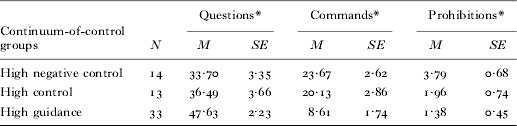
The categorization of mothers into three continuum-of-control groups was validated in a one-way multivariate analysis of covariance (MANCOVA) with length of session entered as the covariate. Using Wilks' lambda, mothers in the three continuum-of-control groups differed in their use of guidance, control and negative control (F(6, 108)=18·84, p<0·001, ηp2=0·51) (see Table 2). Reported means are estimated marginal means, with corresponding standard errors. Tests for orthogonal contrasts of the means were conducted (Kirk, Reference Kirk1995). Polynomial based orthogonal contrasts have been employed as a useful way to simultaneously analyze for mean differences (e.g. Anthony & Putman, Reference Anthony and Putman1985; Donovan et al., Reference Donovan, Leavitt and Walsh2000; Huntsinger & Luecken, Reference Huntsinger and Luecken2004). Table 3 shows that mothers' use of commands, prohibitions and questions, linguistically referred to as discourse features and central in our operational definition of parenting style, were also a function of the three continuum-of-control groups.
Mother discourse features as a function of continuum-of-control groups: Means and standard errors

note: Means reported are estimated marginal means. * Means in the column differ significantly in a linear contrast of the means, ps<0·05.
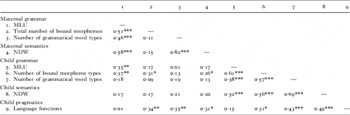
Univariate ANOVAs and chi-square analyses were conducted to determine whether mothers in the three continuum-of-control groups differed on demographic measures obtained at the 0 ; 6 session. No differences were found in maternal age, educational level, number of children, employment or marital status, household income, parity or infant gender (ps>0·10). To determine whether children differed on child self-assertion a one-way univariate ANCOVA was conducted on the total number of ‘no’ utterances for children of mothers in the three continuum-of-control groups, with length of session entered as the covariate (F(2, 56)=3·11, p=0·06, ηp2=0·10). Polynomial contrasts showed a significant linear effect for the means (p=0·02). Children of mothers in the HNC group (M=5·37, SE=0·98) were found to produce the most ‘no’ utterances, followed by children of mothers in the HC (M=3·88, SE=1·06) and HG (M=2·47, SE=0·65) groups. Partial correlations controlling for length of session were conducted to determine the intra-correlations for the mother and for the child measures (see Table 4).
Partial correlations between mother and child language variables

note: For the intra-correlations, length of session was entered as a control variable; for the inter-correlations, length of session and child self-assertion were entered as control variables. * p<0·05. ** p<0·01. *** p<0·001.
Analytic strategy
Four conditions must be met to demonstrate mediation (Baron & Kenny, Reference Baron and Kenny1986). In the present study: (a) the predictor variable (maternal language usage) must be significantly associated with the outcome variable (child language usage); (b) the predictor must be significantly associated with the hypothesized mediator (parenting style); (c) the hypothesized mediator must be significantly associated with the outcome variable; and (d) the strength of the association between the predictor and outcome must be reduced by removing the variance attributable to the mediator. These associations were tested with correlational and analysis of variance techniques. The analyses of the relations among variables are presented in four sections as they address the conditions necessary to demonstrate mediation. Two covariates were entered in the analyses. First, because of the transactional nature of the interaction, a measure of the child's self-assertion, saying ‘no’ without anger, was entered as a covariate in those analyses containing child language variables. Second, because all language measures were based on occurrence and because clean-up times in the sample varied for the dyads, we controlled for length of session by entering it as a covariate in all analyses.
Relation between mother and child language usage
To determine the relation between mother and child language measures, partial correlations were conducted, with length of session and child self-assertion entered as control variables, and are shown in Table 4. To summarize the seven significant relations, mother MLU was associated with child MLU. Mother MLU, total number of bound morphemes and NDW were associated with child number of bound morpheme types. Mother number of grammatical words types, total number of bound morphemes and NDW were related to child language functions.
Relation between mother language usage and parenting style
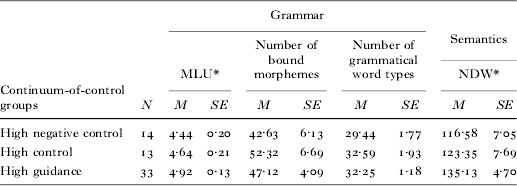
A one-way multivariate analysis of covariance (MANCOVA) was conducted using Wilks' lambda to determine whether mothers in the three continuum-of-control groups differed in their language usage measures. Reported means are estimated marginal means, with corresponding standard errors. Tests for orthogonal contrasts of the means were conducted (Kirk, Reference Kirk1995).
With mother language measures of grammar and semantics entered as the dependent variables (i.e. MLU, number of grammatical word types, total number of bound morphemes and NDW) and length of session entered as the covariate, a marginally significant multivariate effect was obtained for continuum-of-control (F(8, 106)=1·88, p=0·07, ηp2=0·12). On these grammar and semantic measures, polynomial contrasts showed that mothers in the three groups were differentiated on two of the measures (see Table 5). Polynomial contrasts showed a significant linear effect for MLU (p=0·05), indicating that mothers in the HG group had the greatest MLU and mothers in the HNC group the fewest, with mothers in the HC group falling in-between the other two groups. For NDW, a significant linear trend (p=0·04), indicated that mothers in the HG group had the greatest NDW and mothers in the HNC group the fewest NDW, with mothers in the HC group falling between the other two groups. These relations were considered sufficient to satisfy the condition that the predictor variable (maternal language usage) was associated with the hypothesized mediator (parenting style) of the maternal–child language usage relation.
Mother language input as a function of continuum-of-control groups: Means and standard errors

note: Means reported are estimated marginal means. * Means in the column differ significantly in a linear contrast of the means, p<0·05.
Relation between parenting style and child language usage
A one-way MANCOVA was conducted using Wilks' lambda to determine whether children of mothers in the three continuum-of-control groups differed on child language usage measures. Tests for orthogonal contrasts of the means were then conducted. Again, reported means are estimated marginal means, with corresponding standard errors.
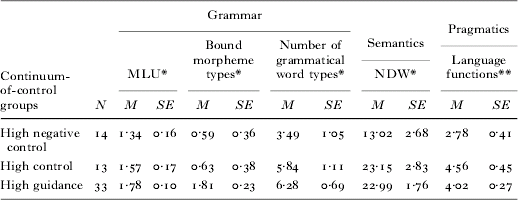
With the three continuum-of-control groups entered as the between-subjects variable, length of session and child self-assertion entered as the covariates, and child measures of grammar, semantics and pragmatics entered as the dependent variables (i.e. MLU, number of bound morpheme types, number of grammatical word types, NDW and language functions), a significant multivariate effect was obtained for continuum-of-control (F(10, 102)=2·72, p=0·01, ηp2=0·21). As shown in Table 6, for child MLU, polynomial contrast results showed a significant linear effect (p=0·03), indicating that children of mothers in the HG group had the highest MLU and children of mothers in the HNC group had the lowest, with children of mothers in the HC group falling between the two other groups. For number of bound morphemes types, a significant linear effect (p=0·01) indicated that children of mothers in the HG group had a higher production of bound morpheme types compared to children of mothers in the other two groups. For number of grammatical word types, a significant linear effect (p=0·04) indicated that children of mothers in the HNC group had fewer grammatical word types than did children of mothers in the other two groups. For child NDW, a significant linear effect (p=0·01) indicated that children of mothers in the HNC had fewer NDW than children of mothers in the other two groups. For child language functions, a significant quadratic effect (p=0·02) indicated that children of mothers in the HC group used a greater number of language functions than did children of mothers in the other two groups. These findings satisfied the condition that the hypothesized mediator was associated with the outcome measure.
Child language variables as a function of continuum-of-control groups: Means and standard errors

note: Means reported are estimated marginal means. * Means in the column differ significantly in a linear contrast of the means, p<0·05. ** Indicates means in the column differ significantly in a quadratic contrast of the means, p<0·05.
Relation between maternal and child language usage holding parenting style constant
Lastly, to test for mediation effects, partial correlations between mother and child language measures were conducted, holding the hypothesized mediator, parenting style, constant. Length of session and child self-assertion were also entered as covariates. The three maternal control composites which comprised the three categories and were continuous were entered as the potential mediators instead of the three parenting styles, HNC, HC and HG, which were categorical. Three correlations remained significant: child MLU remained related to mother MLU (pr=0·33, p=0·02); child number of bound morpheme types remained related to mother MLU (pr=0·30, p=0·03); and to mother total number of bound morphemes (pr=0·34, p=0·01). However, compared to the correlations shown in Table 4 before partialing out the mediator, the remaining four correlations were reduced, indicating that parenting style was a mediator. Child number of bound morpheme types was no longer related to mother NDW (pr=0·18, p=0·17), with a corresponding drop in r-squared for this relation from 0·07 to 0·03. Child language functions was no longer related to mother NDW (pr=0·22, p=0·10), with a corresponding drop in r-squared for this relation from 0·10 to 0·05; nor was child language function related to number of grammatical word types (pr=0·25, p=0·06), or to total number of bound morphemes (pr=0·24, p=0·08), with a corresponding drops in r-squared for these relations from 0·12 to 0·06.
DISCUSSION
Children's language development has been shown to be sensitive to a variety of environmental conditions including the availability and richness of linguistic and cognitive stimulation and exposure to parenting styles characterized as sensitive and responsive. This study examined the relations between mothers' language usage, children's language usage and mothers' strategies for control of and negotiation with their two-year-old toddlers in a clean-up task. Mothers were categorized into one of three continuum-of-control groups, with each group characterized by their relative use of the control strategy (i.e. guidance, control and negative control) that distinguished it from the combination of control strategies used by mothers in other groups. Because of the transactional nature of mother–child interactions, a measure of the child's self-assertion was obtained and controlled for in analyses. The findings provided support for the hypothesis that parenting style, that is, control strategies varying in power-assertion, in part mediates the well-documented relation between maternal and child language usage.
Relation between mother and child language usage
The established relation between maternal and child language usage was replicated in the present study: mother MLU was associated with child MLU; mother MLU, total number of bound morphemes and NDW were related to child number of bound morpheme types; mother number of grammatical word types, total number of bound morphemes and NDW were related to child language functions. These findings are consistent with those in the literature demonstrating a relation between maternal grammatical and semantic input and child language usage (e.g. Hart & Risley, Reference Hart and Risley1995).
Having replicated this relation, two additional relations needed to test the mediation hypothesis were established: (a) the predictor variable was associated with the potential mediator; and (b) the potential mediator was associated with the outcome variable.
Relation between maternal language usage and parenting style
The predictor variable, maternal language usage, was related to the potential mediator, parenting style used by a mother to enlist her two-year-old's cooperation in a clean-up task. Mothers in the three continuum-of-control groups differed in their grammatical input (i.e. MLU). Mothers in the HG group had the highest MLU and mothers in the HNC group had the lowest MLU. Also, a semantic measure of vocabulary diversity (i.e. NDW) differentiated mothers in the three groups, with mothers in the HG group having the highest and those in the HNC having the lowest NDW. In sum, mothers who systematically employed control strategies varying in power-assertion correspondingly differed in their use of grammar and semantics when interacting with their toddlers in a clean-up task.
Relation between parenting style and child language usage
The relation between the mediator and the outcome variable, child language usage, was also established for the present sample. As predicted, mothers in the HNC group who through their use of negative control (e.g. anger or annoyance) provided an environment that was less optimal for children's language learning were paired with children who performed relatively poorer overall on measures of language usage compared with children whose mothers used minimal negative control. Specifically, children of mothers who expressed relatively more anger and annoyance exhibited less advanced grammar (i.e. MLU) and were less diverse on the semantic measure (i.e. NDW) than children of mothers in the other two groups. Their performance was poorer on number of bound morpheme types compared to mothers in the HG group and was poorer on the pragmatics measure than children of mothers in the HC group. Thus, despite the fact that mothers in the HNC group exhibited a fair amount of guidance behaviors (i.e. 62%), these mothers who exhibited relatively higher amounts of negative control during the session were paired with children who were consistently less advanced in their language usage. The greater use of negative control may be disruptive for child language learning because child participation is less welcomed, in contrast to a parenting style with minimal negative control which makes the child's participation more welcome and less effortful, freeing up cognitive resources for learning (Bloom, Reference Bloom1993).
Children of mothers in the HG and HC groups exhibited more advanced language usage overall. Mothers in these two groups provided an environment more conducive to language learning through their minimal use of negative control and greater use of guidance, 87% and 69%, respectively. Children whose mothers' conversational style focused on asking, persuading and suggesting (HG) behaviors which entailed the extensive use of the discourse feature questions, had the highest MLU and greatest number of bound morpheme types. In contrast, mothers in the HNC group who asked the fewest number of questions were paired with children whose language usage was least advanced. Looking specifically at the behaviors of asking or questioning, these behaviors provide children with opportunities for learning because of the multifunctional nature of questions. Questions are a factor in the quality of interaction, in cognitive–linguistic scaffolding and in the quantity and quality of language a child uses (see review in Yoder, Davies, Bishop & Munson, Reference Yoder, Davies, Bishop and Munson1994); questions with auxiliary-reversal are associated with vocabulary (Hart & Risley, Reference Hart and Risley1995) and grammatical (Hoff-Ginsberg, Reference Hoff-Ginsberg1986) growth. In conversational interaction, adult questions assist the child in sustaining a specific topic (Pine, Reference Pine, Gallaway and Richards1994) and, unlike commands or comments, expand opportunities for participation by giving explicit openings for the child to respond (Ninio & Snow, Reference Ninio and Snow1996; Pine, Reference Pine, Gallaway and Richards1994). Because questions tend to suggest rather than tell the child what to do they are a factor in setting the tone of the interaction. Questions convey that the mother considers the child's participation to be important; they may also convey attentiveness, which has been shown to facilitate a speaker's competence (Pasupathi, Stallworth & Murdoch, Reference Pasupathi, Stallworth and Murdoch1998).
Wh-questions in particular are a means of cognitive–linguistic scaffolding and stimulation which may encourage cognitive–linguistic growth because, unlike yes/no questions, they do not have answers or choices embedded in them (e.g. compare ‘Where does that go?’ with ‘Doesn't that go in the blue bin?’). Cognitively stimulating wh-questions lead to the expression of more complex ideas, which in turn demand more complex language (Berman, Reference Berman1995) and are tied to later independent production of more advanced content (McCabe & Peterson, Reference McCabe, Peterson, McCabe and Peterson1991; Peterson & McCabe, Reference Peterson, McCabe, Gilbert and Johnson1996). Thus, in a predominantly mother-directed activity – a clean-up task – through their persuading/suggesting and more frequent questioning, mothers in the HG group provided opportunities for their children that were associated with more advanced grammatical and semantic language.
As with questions, the use of tells, the discourse feature of commands, was a component of the control strategy composites from which the continuum-of-control groups were created. Mothers in the HC and HNC groups used significantly more tells/commands than did mothers in the HG group, whose children exhibited the highest MLU and number of bound morpheme types. A parenting style which entails the use of tells differs from one which is more focused on suggesting/persuading and asking questions. For example, commands may provide less support for independent problem-solving, choice-making or verbal response as questions do, although in some contexts they are considered supportive in the sense of assisting task completion (Diaz, Neal & Vachio, Reference Diaz, Neal and Vachio1991; Gallaway & Woll, Reference Gallaway, Woll, Gallaway and Richards1994), albeit with a higher level of power-assertion than questions or suggestions (Crockenberg & Litman, Reference Crockenberg and Litman1990). Additionally, telling or commanding may lead to less conceptual learning because they refer to the immediate context and thus do not evoke mental representations (Diaz et al., Reference Diaz, Neal and Vachio1991).
However, we found that children of mothers who used tells/commands in the clean-up task but minimal negative control (i.e. mothers in the HC group) were more advanced on the pragmatics measure (used more language functions) than were children of mothers in the other two groups. Furthermore, their performance on NDW was equal to that of children of mothers in the HG group, with both being significantly better than that of children of mothers in the HNC group; and, their performance on MLU was intermediate between the other two groups. Thus, a maternal style containing tells/commands but minimal negative control (HC) contributes to an environment conducive to the use of a greater number of functions by the child (requests information, e.g. ‘What's that?’, requests confirmation, e.g. ‘In here?’), although it may be slightly less conducive to the advancement of grammatical language (MLU and number of bound morpheme types) compared with an environment that provides the cognitive–linguistic scaffolding offered by the greater use of questions (see Yoder et al., Reference Yoder, Davies, Bishop and Munson1994).
Use of tells not, the discourse feature of prohibitions, also differentiated the mothers. Mothers in the HNC group used significantly more prohibitions that did mothers in the other two groups. High proportions of prohibitions express explicit disapproval, contributing negatively to the affective tone or valence given to interaction, and have been associated with lower expressive vocabulary levels, rate of vocabulary growth and cognitive functioning in preschool (Hart & Risley, Reference Hart and Risley1995). Noting that while the control strategy (tells/tells not/bribes) was used by both mothers in the HNC and HC groups, the relatively higher use of prohibitions of mothers in the HNC group compared to mothers in the HC group indicated that mothers in the two groups distributed their use of tells/tells not differently. Recalling that mothers who differed in use of prohibitions were paired with children who differed in their language usage, these data expand our understanding of the role of maternal directiveness in predicting child language usage (see Murray & Hornbaker, Reference Murray and Hornbaker1997). A directive style which includes commands but fewer prohibitions and minimal expression of negative affect, characteristic of mothers in the HC group, is more facilitative for language learning than a directive style that includes commands but also prohibitions and expressions of negative affect.
Parenting style as a mediator between the maternal and child language usage relation
Differences in maternal strategies for control of and negotiation with their two-year-old toddlers in a clean-up task were predicted to mediate the relation between maternal and child language usage. Supporting the prediction, with parenting style controlled, the strength of the relation between maternal and child language usage was reduced for four of the seven initial relations. Elucidating the different interaction styles and language-learning environments offered by mothers in the three continuum-of-control groups, behaviors varying in power-assertion differentiated mothers. Our long-standing interest focusing on control issues in the mother–child relation (e.g. Donovan, Leavitt & Walsh, Reference Donovan, Leavitt and Walsh1997; Donovan et al., Reference Donovan, Leavitt and Walsh2000; Donovan, Leavitt & Taylor, Reference Donovan, Leavitt and Taylor2005; Donovan, Taylor & Leavitt, Reference Donovan, Taylor and Leavitt2007), specifically in the realm of child social-emotional development, has been extended here to include child language as the outcome variable. In the present study, variables which defined the parenting styles of interest (e.g. tells, tells not, asks) coincidentally overlapped with linguistic discourse features (i.e. use of commands, prohibitions and questions) that differentiated these parenting styles. In contrast to grammatical and semantic input, discourse features are stylistic in nature. During any interaction, choosing to question, command or prohibit reflects a person's interactional approach with another by setting the tone of the interaction and thus is qualitatively different from more cognitive measures, such as mothers' grammatical and semantic input.
Of the seven initial relations between maternal and child language usage, three of the four which were reduced when the mediator was entered in the equation were relations with child language functions (i.e. pragmatics measure). This indicated that parenting style mediated the relation between both maternal grammatical (number of grammatical word types and number of bound morphemes) and semantic (NDW) input and the outcome variable of child pragmatics. It may be noteworthy that the mediating role of parenting style had its greatest influence when the predictor variable related to the outcome variable of child pragmatics. The child pragmatics measure differs from the grammatical and semantic measures in significant ways. As with maternal discourse measures, the child pragmatics measure, such as the language functions of requests, answers question and politeness forms, reflects a tone or approach to interaction more so than do the child grammatical and semantic measures.
The mediator was not influential for the relation between maternal input and child semantics and only partially so for child grammar. For child grammar, the initial significant relation between number of child bound morpheme types and mother NDW was reduced when parenting style was controlled. Together with the findings for child pragmatics, the data support the argument that portions of the established relation between maternal and child language usage can be explained by children's exposure to the language-learning environments afforded by differences in their mothers' parenting style which vary in power-assertion.
This study focused on language performance in the second year, when language is fast emerging as the significant mode of communication (e.g. Bloom, Reference Bloom1993). With past studies linking sensitive, responsive parenting with positive outcomes in child language (e.g. Landry et al., Reference Landry, Smith, Miller-Loncar and Swank1997; Tamis-LeMonda et al., Reference Tamis-LeMonda, Bornstein and Baumwell2001), the present study described one aspect of sensitive, responsive parenting important for child language development – a linguistic style low in power-assertion in which a mother engages her child through suggesting and questioning and uses minimal anger/annoyance when power-assertion is increased. The data presented here assert that parenting style varying in power-assertion mediates portions of the established relation between maternal and child language usage.
Limitations and directions for future research
Our study has several limitations and our results point to several directions for future research. With researchers encouraging the use of varied sampling contexts to tap the broad range of children's experience (see Bornstein, Painter & Park, Reference Bornstein, Painter and Park2002; Pan, Perlmann & Snow, Reference Pan, Perlmann, Snow, Menn and Ratner2000), a goal-directed clean-up task was used here in contrast to play or narrative contexts, which are the most frequent sampling contexts for spontaneous early language. However, the goal-directed clean-up task may have been somewhat constraining for both mother and child language usage. In fact, the mean child MLU in this study (1·63) was lower than MLUs reported in other studies that sampled MLU of two-year-old toddlers during free play: 1·96 (Bornstein, Haynes, Painter & Genevro, Reference Bornstein, Haynes, Painter and Genevro2000); 1·93 (Ellis Weismer, Murray-Branch & Miller, Reference Ellis Weismer, Murray-Branch and Miller1994); 1·70–2·20 (Scarborough, Wyckoff & Davidson, Reference Scarborough, Wyckoff and Davidson1986). Therefore, it would have been advantageous had a comprehensive measure of expressive vocabulary, e.g. the MacArthur Communicative Development Inventory (Fenson et al., Reference Fenson, Resznick, Thal, Bates, Hartung, Pethick and Reilly1993) been collected to determine initial levels of child language ability. Future research is encouraged to assess both the contextual effects (e.g. different tasks) on mothers' and children's language as a function of control strategies and the relation between maternal control strategies and child language development over time. Data collection over time would also be advantageous when attempting to address direction of causality among the mother and child measures which were collected concurrently in the present study. For example, we are unable to determine the direction of effect for the current finding that child self-assertion was greatest for children of mothers in the HNC group. It is unclear whether a mother's negative control led to the child saying ‘no’ more frequently or whether more negative control was needed for those children who more frequently uttered ‘no’.
Negative maternal affect was a defining characteristic of mothers in the HNC group and its potential effect on language learning requires further investigation. Consistent with other findings (Donovan et al., Reference Donovan, Leavitt and Walsh2000), absolute amounts of negative control expressed through anger and annoyance in the clean-up task were small even in the HNC group, but research exploring the dynamics of dyadic relationships has demonstrated that expressions of negative affect are especially potent (Calkins et al., Reference Calkins, Smith, Gill and Johnson1998). Children's response to mothers' anger or annoyance may be a defensive ‘shutdown’, or in response they may become defiant (Crockenberg & Litman, Reference Crockenberg and Litman1990). Such responses may limit children's ability to process stimulation and may restrict their range of expression. As a component of the negative control strategy, negative affect (i.e. anger/annoyance) acted jointly with high amounts of control (i.e. commands and prohibitions) for mothers in the HNC group and we speculate that negative affect played a role in the less advanced language development of children in the HNC group. Others have suggested that prohibitions (even without anger/annoyance) express explicit disapproval and thus contribute negatively to the affective tone or valence given to interaction (Hart & Risley, Reference Hart and Risley1995).
In the present study a larger sample size would have allowed for the use of additional, informative statistical approaches, such as the use of a Structural Equation Model, to investigate the complex interrelations among the current study variables, including a test for mediation effects. Also, because mothers in our sample were married, white and middle-class, generalization to other populations may be limited. Future research is needed to determine the relation between maternal control strategies and child language usage in other demographic groups. For example, future research may address the issue of whether some populations are more responsive to questions than others, thus affecting their MLU measure, as has been reported for children with Down Syndrome (Miles, Chapman & Sindberg, Reference Miles, Chapman and Sindberg2006). In spite of these limitations, this study has applications for at-risk and clinical populations. These findings may contribute in assisting parents seeking more optimal parenting skills, providing support for children at risk for language difficulties, as well as assisting professionals in the development of intervention strategies for children with language disorders.