The Bund and the Shanghai International Settlements
European involvement in Shanghai began in 1842 with the Treaty of Nanking, which permitted foreign merchants to trade in the marshy land between Soochow Creek and the Walled City of Shanghai. The area was then a muddy, mosquito-infested foreshore on the banks of the Huangpu River (the Yellow River). After a series of diplomatic negotiations, Shanghai was divided into three parts: the International Settlement, the French Concession, and the old Chinese city. Foreign residents lived under the jurisdiction of their own courts. The International Settlement, dominated by British interests, was managed by the Municipal Council, whose members were elected by local ratepayers (landowners). The foreign enclaves became a political and economic safe haven for merchants both within and outside China. It soon developed the conditions conducive to the rise of a share market.Footnote 2 A market for securities trading began in late 1860s. The first share list appeared in June 1866 with a list of thirteen companies in The North-China Herald under the “Shares and Stocks” section. A regular system of dealing in shares sprang up. The market attracted sizeable private investments in China.Footnote 3 In the early days, banks dominated private shares. Shipping, insurance, and docks followed but from 1895 were overshadowed by industrial shares after the Treaty of Shiminoseki, which allowed Japan (and by extension other nations) to set up factories in Shanghai and other treaty ports. Shanghai had no shortage of speculators who were keen on investing in the financial market. A Shanghai Sharebrokers’ Association was formed in 1898 with the Shanghai Stock Exchange formally founded in 1904.Footnote 4
The Shanghai International Settlement attracted investors worldwide, but the British were the most influential, especially those who had relocated from India. Notable among them was the Sassoon family specializing in Indo-China trade. Though these Baghdadi Jews were few and marginal in Shanghai, they managed to secure a significant part of the trade with Bombay, especially cotton and opium. By 1895, with increasing wealth, the foreign community in the International Settlement decided to improve its sanitation with a barrier to keep the muddy water out, and drove ship's timbers into the mud to form an embankment on about twelve square miles of marshy land at the mouth of the river.Footnote 5 The site became known as the Bund, one of the most famous thoroughfares in the world and Shanghai's esplanade. In the early years of its development, construction on the Bund began with “a shabby mob of smaller buildings”. At that time “the harbour was in a very bad state; practically all building construction was in brickwork and timber; all roads were either water-bound macadam, chip-paving or plain mud.”Footnote 6 Before World War I, there were numerous foreign-style buildings there. In a style derived from the Anglo-Indian bungalow, these two to three storey buildings had hip roofs, arched verandahs, shuttered windows, and classical ornamentation. Their high ceilings and wide verandahs were tailored for maximum shade and free-flowing cool air. As such, they were more suited to the wet, tropical climate of Shanghai than European-style masonry buildings. Most of these colonial buildings showed their “face” to the street, while behind them lay the houses for the compradores and Chinese assistants, the godowns, and the stables. This style lasted for decades; the arch and column arrangement became known throughout the Treaty Ports as the “compradore” style.Footnote 7
Chinese contractors built most of these buildings using local materials and techniques. In nineteenth-century Shanghai, merchants had little use for architects, since dealing directly with Chinese contractors and artisans produced practical results for less money. Expense was a major consideration in building, and architects expected a seven per cent commission on the total cost. In 1890 there were only three professional architectural firms in Shanghai, and in 1900 only seven.Footnote 8 In 1907, a letter to the North China Daily News from the general public claimed that “The best built houses are built without the help of architects, using a Chinese contractor.” One-storey buildings were popular, since, as one foreign observer wrote: “Tall buildings are supposed to upset the Chinese spirit world. […] Where the land value is not to be considered […] one storey buildings are the most satisfactory […] simple, well-constructed buildings requiring the least possible amount of upkeep.”Footnote 9
Until the 1920s, then, merchants hired Chinese contractors who built using traditional methods, especially for the foundations. Most large buildings in nineteenth- and early twentieth-century Shanghai were built on foundations of a native form of “concrete”, made by a local method that involved digging a trench along the length of the wall, spreading layers of broken bricks into the trench, and adding a slush of lime, sand, and water. The mass was rammed down layer by layer, making the “concrete” quite heavy. The drawback to these foundations was that their weight was more than Shanghai's marshy soil could support, so they were only suitable for small buildings. For bigger buildings, artisans had to reinforce the ground with wood piling, using a method from the Han dynasty (206 BC–220 AD).Footnote 10 Workers raised huge hammers on pulleys to drive the wood piles from Fujian known as “Foochow poles” into the soil to establish the perimeter of a building. As Foochow poles were only a few metres long, early builders on the Bund had little trouble sinking them below the water table, where they were less likely to rot.Footnote 11
Increasing Wealth: from Bricks to Reinforced Concrete
Towards the end of the nineteenth century trade increased, and with it the demand for bigger and better buildings. Shanghai's architectural fraternity grew as merchants began to pay attention to a building's style, instead of just its practical function.Footnote 12 The Bund's architects came from a small community of foreign architects.Footnote 13 The appearance of the first significant architectural firms coincided with technological developments like better construction techniques, and the shift from using brick and stone to reinforced concrete and steel frame structures. In the early 1900s, reinforced concrete began to be widely used, following the birth of concrete manufacturing in Shanghai in the late 1890s. But despite the rapid development in materials and techniques, architectural styles and design philosophies remained entrenched in British conservatism.Footnote 14 As the famous architect George Leopold Wilson (1880–1967), who would work for Sassoon, observed: “Shanghai architects have been slaves of what may be termed ‘copybook architecture’. However, they are not entirely to blame, because building owners, when commissioning an architect, frequently call for a special style or refer to a given building, which, whether good or bad, is what they have in mind. The unfortunate architect is therefore tied to a given style or period.”Footnote 15
One of the first buildings in Shanghai to use reinforced concrete was the Russo-Chinese Bank building (1902). Although the Bank was set up with Russian capital to finance Russian railways in northern China, its architecture was strongly influenced by Western Europe, and became well known for its Renaissance style. The Shanghai Club (a three-storey neo-classical building) was another famous building that used reinforced concrete. The original Shanghai Club, built to house an exclusive British men's club in 1861, had been a three-storey red-brick building. In 1910 it was torn down and a new club built on the site in a neo-classical design, with a façade of artificial stone and columns of Suzhou granite, and a first-floor dining room floor of black and white marble. The new building weighed 17,000 tons, setting new records for cost and weight. A grand flight of granite steps rose from the street to the main entrance in the middle of the façade, but owing to Shanghai's alluvial soil, these steps gradually disappeared into the mud; the street is now higher than its front door. The Far-Eastern Review recorded the club's transformation in 1919, remarking (with exaggeration) that Shanghai had been “nothing but a swamp” until the British arrived, but that now this part of Shanghai set an example of “modernity seldom excelled either in Europe or America.”Footnote 16
A Display of British Power?
Situated at the Shanghai entrance to the sea, the Bund by then was regarded by many travellers as a window on British colonial power. By the early twentieth century its stately row of classical and Renaissance buildings projected an image of pride and prosperity. As the buildings grew larger (and heavier), builders needed new techniques to keep them from sinking into the mud. In the early twentieth century the Municipal Council conducted geotechnical studies to determine the depth of the silt under Shanghai. Samples from as deep as 800 feet showed no sign of bedrock (a layer of solid rock strong enough to support the building). Since heavier buildings needed to spread their loads onto the mud, builders began to adopt Western engineering techniques. These new techniques, such as using concrete piling, met with mixed success in Shanghai. The length of the concrete pile that could be used was determined by how deep the native pile driving crew could sink it; the method only worked for a piling 12 to 15 feet long, which meant they could not construct bigger, heavier buildings in a cost-effective way. Another new technique was to use reinforced concrete in a T-shaped footing under the walls to spread the weight, but this method failed due to the poor load-bearing capacity of Shanghai's marshy soil.Footnote 17
In the 1910s, as big earners like foreign banks could now afford to build larger buildings on prime real estate, some of the small, older buildings on the Bund were torn down and their original plots combined to make room for more imposing buildings. With mud for hundreds of feet below Shanghai, engineers proposed building on reinforced concrete “rafts”, which would allow the buildings to float and would distribute the weight of a building evenly over the site. One of the first buildings to use a raft was the Banque de L'Indo-Chine building (1914) designed by Atkinson & Dallas.Footnote 18 Thereafter, engineers played a more active role in Shanghai's construction scene.Footnote 19
As technologies improved, Shanghai buildings grew taller. Yet there was always a limit – Shanghai was built on silt, and the big buildings floating on rafts sank into the Bund's soil. The settling process could take several years; sometimes the footpaths in front of the buildings were raised, and often buildings were built one or two feet higher than their anticipated level, with temporary steps from the street to be removed one at a time as the building sank. Wilson remarked that “there are few other cities in the world […] which present such difficulties regarding the foundations for buildings of any magnitude […] even though the weight is spread over the whole site, it is usual for a building to sink about six inches, and sometimes more. So long as it settles evenly there is nothing to worry about, but when the settlement is uneven the architects and engineers have a few sleepless nights.”Footnote 20 In other words, even with raft technology, constructing tall buildings in Shanghai was risky.
The Economy of Tall Buildings
While architects in Shanghai were designing rafts and estimating the speed at which buildings sank, the world's first skyscraper went up in Chicago. Until the mid-nineteenth century the tallest buildings in Chicago had been five storeys. Then, in the late nineteenth century, with space at a premium, dozens of dazzling buildings shot skywards, first in Chicago and later in New York. In both cities land was so expensive that real estate developers could not make a profit from shorter buildings constructed with the then-current technology. With high rents from huge amounts of rentable space, skyscrapers were attractive investments. They also financed architects and engineers in exploring new technologies that could produce this “market-friendly” architecture.Footnote 21
As the cost of land in Shanghai escalated, developers there had the same market incentive to build taller buildings. But from an engineering perspective, architects could not conceive of a worse place for tall buildings than Shanghai. Skyscrapers like those in Chicago and New York had an exceedingly high centre of gravity, and needed a firm footing to keep from toppling over. In Manhattan, the bedrock was close to the surface, providing a strong foundation for skyscrapers. In Shanghai, boreholes 800 feet deep still failed to locate bedrock. Even worse, Shanghai soil was about 50 per cent water. Even with rafts, architects believed that six storeys was the tallest they could build. In 1920 architect Sidney Powell claimed: “Shanghai can only stand six floors, London sixty floors, New York and Hong Kong any numbers.”Footnote 22
Then in 1924 Karl von Terzaghi (1883–1963), an engineer of Italian descent born in Prague, published a pioneering study on “effective stress”. Known as the father of soil mechanics, Terzaghi studied soil as an engineering material whose properties could be measured in standardized ways. By “effective” stress, he meant the amount of calculated stress that it took to move or displace soil. Terzaghi's studies were recognized as an important scientific contribution, one that led to a breakthrough in understanding the interaction between building foundations and the surrounding soil. His work helped engineers cope with subsoil conditions, including those in Calcutta and Shanghai, places that soil mechanics experts ranked as the worst building conditions in the world. Contrary to popular belief, Terzaghi's studies suggested that skyscrapers did not need to stand on bedrock if there was enough friction between the pilings and the soil to counterbalance the weight put on them by the building. Inspired by Terzaghi's study, piles were tested under various soil conditions to determine the amount of friction between the pilings and the soil. Surveys by the Huangpu Conservancy Board in Shanghai, by French engineers in Tunis, and by Ackerman in England tested different types of piles. All these tests showed that in clays and silts the frictional resistance per unit of pile surface in contact with the soil remained the same despite its depth in the soil. (Although the Shanghai tests indicated somewhat smaller values of frictional resistance at greater depths, the difference was negligible.)Footnote 23 Once engineers knew friction values, they could estimate how many piles a building needed. In a friction pile foundation, a pile driver sank piles into the ground until they reached the point of maximum resistance, which meant the friction on the sides of the piles was greater than the pressure put on them by the weight of the building. This was the method adopted in Shanghai.Footnote 24
In China, Western-educated architects kept up-to-date with discoveries in soil mechanics. Throughout the 1920s and 1930s, they published articles debating how to combine the raft technique with soil mechanics knowledge. In general, engineers were divided into two camps regarding the best material for friction piling, with one camp preferring concrete and the other wood or timber. Concrete piles were strong and could be cast in place, but so heavy they added as much weight as an additional two storeys on a building, which meant losing precious rental space. There was also the risk of mud seeping into the mould, weakening the concrete.Footnote 25 Wood piles were much lighter than the surrounding soil and added little weight to the structure, but wood piles could only remain intact and undecayed as long as they were below the water line, and in Shanghai, the water table fluctuated.Footnote 26 Amidst these debates, the architectural firm of Palmer & Turner was appointed to test building height on the Bund. Which piling materials would they use?
New Building Technology, New Business Opportunity – the Raft Foundation with Friction Piling
By 1920, the physical shape of the Shanghai International Settlement was largely defined, and as such limited. This inspired speculation on its land, and the desire to build the first skyscrapers in Shanghai. Before building the Yokohama Specie Bank (1924), a partner at Palmer & Turner (P & T) by the name of John Archibald Ritchie had approached experts at MIT. Like traditional Chinese builders, the MIT experts went with timber piling; their idea was to saturate the site with driven-in timber piles and then cover them with a heavy reinforced concrete raft. To offset the weight of the raft, MIT advised using very long timbers. Foochow poles were only several feet long, so P & T imported Douglas fir from the Oregon coast, as it was the second-tallest conifer in the world (after coast redwood). The Oregon timber was sealed at both ends with concrete to prevent rot, then pounded deep into Shanghai soil. A giant concrete raft was built on top of the piles, and the building on top of the raft. To everyone's relief, the Yokohama Specie Bank did not sink into the ground, but stood tall, inspiring the hope that even higher buildings could be built on the Bund.Footnote 27
Immediately after this success, P & T used a similar friction piling method for the headquarters of the Hong Kong and Shanghai Banking Corporation (thereafter as HKSB). The chief manager of the Bank instructed P & T architects to “spare no expense, but dominate the Bund.” The massive HKSB building, which was completed in 1924, was a monument to British business and British dominance in Shanghai. A six-floor building of white marble, it was one of the most expensive office buildings per square foot in the world in terms of building cost. Despite its advanced engineering, its appearance was conservative – a neo-classical design with tripartite divisions, a central dome, and a ground floor decorated with a triangular structure with three arched doorways modelled on Greek temples. To build it, MIT experts had advised sinking over two thousand, six hundred fir piles 60 feet deep, then sealing the wood with concrete at both ends before constructing a raft on top of the piles.Footnote 28 The Shanghai Customs House presented P & T engineers with similar problems, which they solved by designing a foundation much like the one used for the HKSB building. When it was completed in 1926, the Customs House was the tallest, heaviest building on the Bund.Footnote 29 Thereafter, the raft foundation with friction piling was used for most tall buildings in Shanghai.Footnote 30
After overcoming technological restraints for building taller buildings, the next question was: how could real estate developers make these buildings profitable? Both the HKSB building and the Customs House had been constructed as symbols of British colonial and commercial power; neither one was intended to make money. It was not until Victor Sassoon began to build on the Bund that one of these landmarks began to generate rental profits.
Victor Sassoon – from Bombay to London and Shanghai
As one of the wealthiest men in Shanghai, Victor Sassoon could afford to gamble on the new building technology. CWR described him as being from “one of the most distinguished families in the British Empire, possessing a story-book past and a front-page present that add up to an unusual and colourful history.” A leading Baghdadi Jewish merchant family in Shanghai, the Sassoons traced their roots to the Middle East, where they had been one of the leading Jewish families in Baghdad. In 1832, the family settled in Bombay and partnered in business with the British community there. In 1833, David Sassoon set up David Sassoon & Company in Bombay and traded in commodities (wheat, spices, sugar, tea), garments (silk, cotton, yarn), and opium.
In China, the business interests of the Sassoon family were represented by the firm D. Sassoon & Company. By 1844, the company set up a branch in Hong Kong, and in 1845 he opened another one in Shanghai. Its operation was driven by a triangular business, based on the export of Indian cotton yarn and opium to China, the purchase of Chinese goods (tea, silk) and their export to Britain, and the export of Lancashire textile products to India. Under British protection, they acted as intermediaries in the Indo-China trade. In 1867, a son of David Sassoon set up E.D. Sassoon and Company Limited, with offices in Bombay and Shanghai, further cashing in on the Indo-China trade, especially the trade in opium. As the British colonial regime interacted with various longstanding trade diasporas, these coastal cities attracted an even greater mix of merchants from the Middle East, but due to their business acumen, networking strategies and connections with British elites, the Jewish traders won out in the competition over groups like the Parsee, and became the most powerful middlemen in the Indo-China trade. With the demise of the opium trade in the 1910s, the Sassoons began to diversify their investments into banking, finance and real estate. They ran cotton mills in India and bought property in the Far East. Most of the Sassoon offspring received elitist educations in England. Some of them chose to settle there, becoming naturalized citizens and regarding Britain as their home. Victor Sassoon (a fourth-generation Sassoon) was one of them.
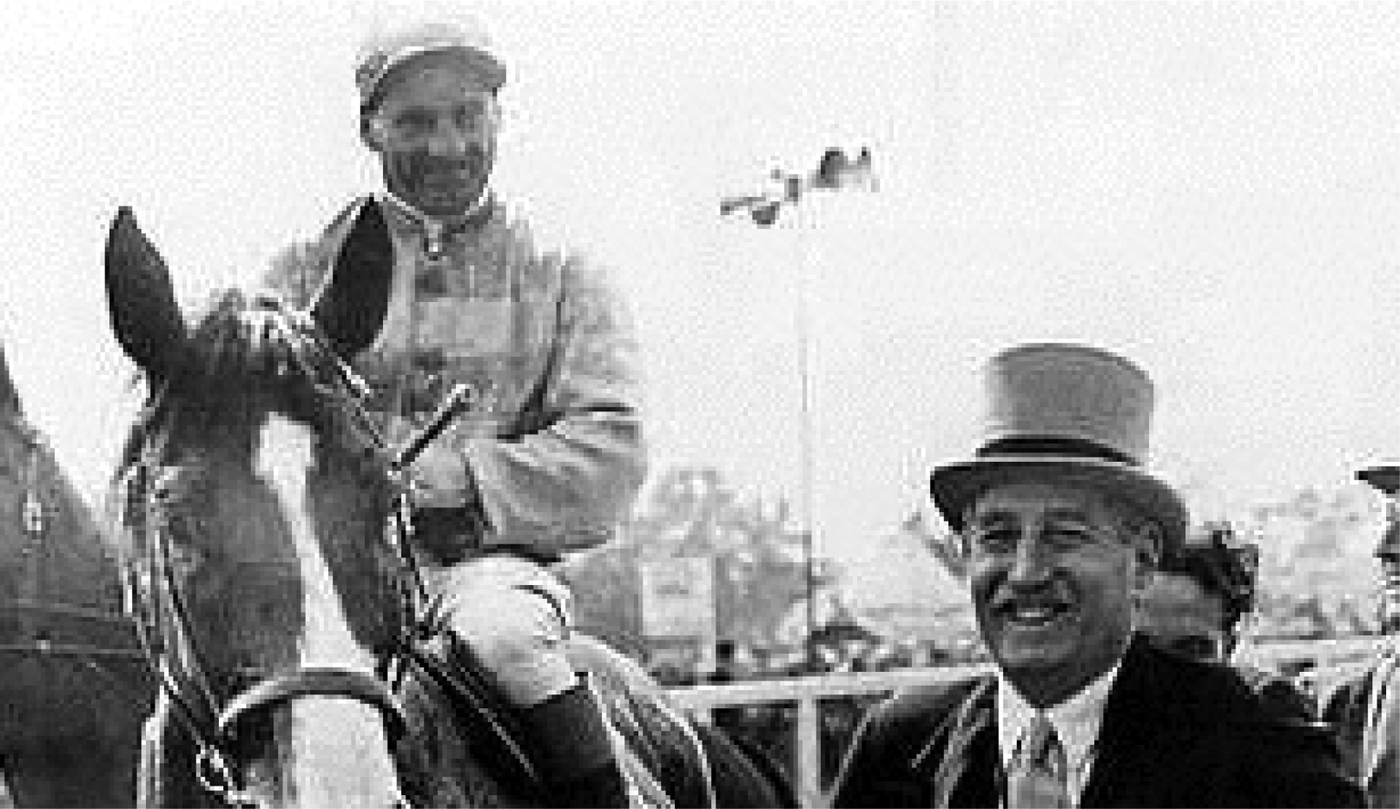
Raised in England, Victor Sassoon attended Harrow and Cambridge University. He was fond of horse racing and the new sport of aviation (Ill.1). He joined the Royal Flying Corps in World War I (hereafter WWI), and survived a plane crash in 1916, sustaining leg injuries. In 1917, he became the head of the family business. Fortune magazine observed that Victor Sassoon “ran head on … into the post-War British tax collector” and so sought a place to live in where he would not have to pay half of his income in taxes. Taxes were especially heavy after WWI, when higher taxes for wealthy British citizens financed post-war recovery, but according to British law, subjects who lived outside the Empire for more than six months of the year did not have to pay British income tax. Thus, Victor Sassoon relocated to Hong Kong and then Shanghai. Although both lay within the British sphere of influence, they were outside Britain's tax zone, so he travelled frequently, dividing his time between London, India and Shanghai.
Sir Victor Sassoon with one of his horses.

In Shanghai, Victor inherited an impressive amount of property from his family. In 1877, for instance, when Augustine Heard (an American firm) declared bankruptcy, Sassoon's family bought that company's property at the corner of the Bund and Nanjing roads – a prime location on the Bund – and the property was then leased for great profit. By 1921, when Victor Sassoon formally set foot in the Shanghai market, the Sassoon family had already become one of the biggest property owners in Shanghai.Footnote 31 In 1924 his father died and he inherited the family business. Thereafter, he formally decided to relocate more of his wealth to Shanghai where the real estate sector was booming.
Financial Turbulence – the Price of Silver
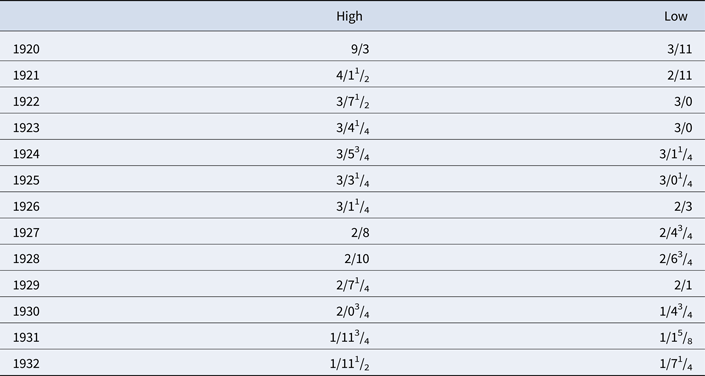
Shanghai was particularly attractive for British-based investors like Sassoon, as in the late 1920s British currency was overvalued and China's undervalued. This phenomenon could be traced back to WWI, when Britain first abandoned the gold standard so as to issue more currency to finance her war effort. In 1926, after a period of inflation, Britain re-established a gold standard pound sterling at its pre-war value. This led to overvaluation of the pound sterling and drove Britain into a deep recession. In Shanghai, this trend of overvaluation was well reflected in the movement of the exchange rate between the pound sterling and the Shanghai tael (see Table 1). In line with Britain, India also returned to the gold standard, so her currency became overvalued too. Sassoon took advantage of these currency fluctuations and converted assets denominated in overvalued British currency into undervalued Chinese money. He even relocated his assets from India to Shanghai, raising his purchasing power.Footnote 32
Meanwhile, with the establishment of the Kuomintang (KMT, the Nationalists) government in 1927, land in Shanghai's foreign concessions had become even more valuable. For many years foreign merchants had asked that the boundary of the Shanghai foreign concessions be redrawn to expand its size. In 1928, the KMT government categorically rejected these requests, making land in the foreign concessions even more valuable. In addition, some investors believed Shanghai would benefit from the KMT's choice of Nanjing as the nation's capital. Moving China's political headquarters nearer the lower Yangzi region made Shanghai the most important gateway city.Footnote 33
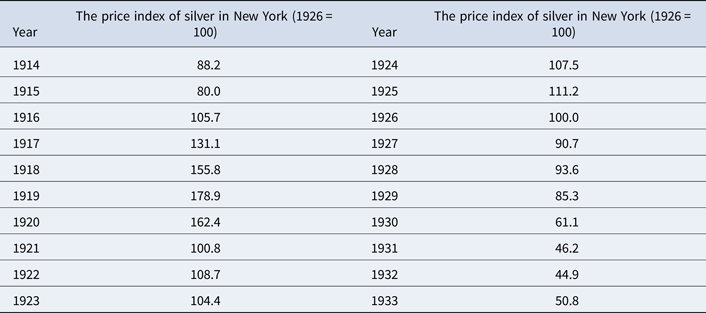
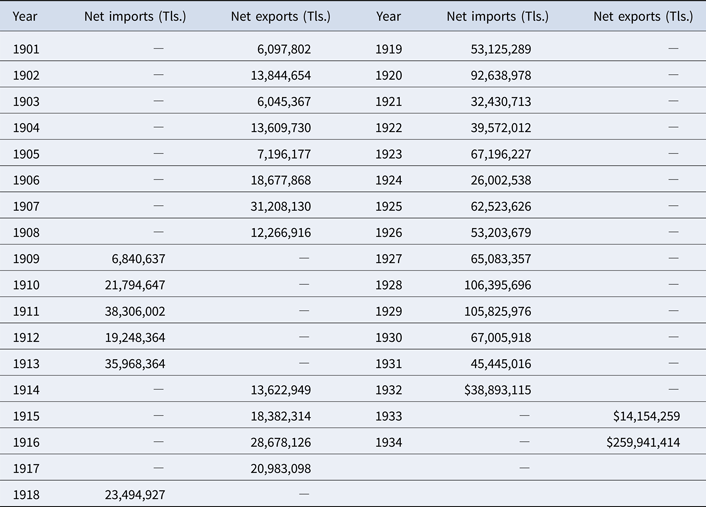
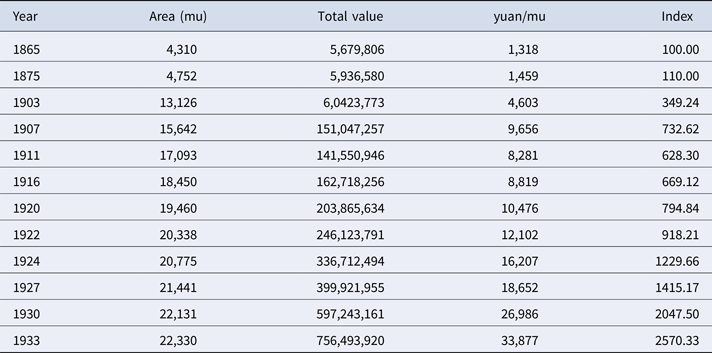
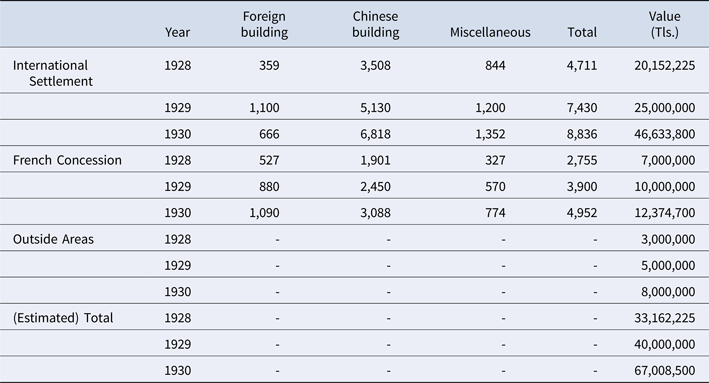
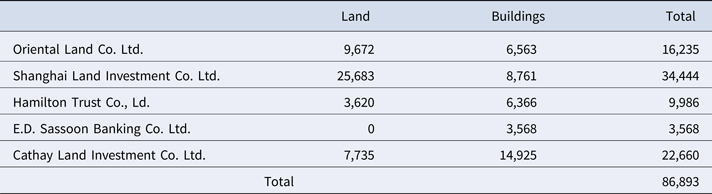
Victor Sassoon was hardly a lone speculator in coastal China. By 1928, so many foreign investors had moved their assets out of gold standard currencies to invest in China that Shanghai was inundated with investment capital. The low price of silver there stimulated real estate speculation; from 1928 onward, Shanghai real estate values started to spike (Tables 2, 3, and 4). Speculators were interested in real estate in the Shanghai International Settlement because property there could be measured accurately, protected legally, and because these title deeds for land were excellent collateral, widely accepted by both Chinese and foreign banks in Shanghai. Foreign banks, in particular, preferred land deeds as mortgage collateral.Footnote 34 This trust in real estate values in Shanghai's foreign settlements connected real estate and financial markets. This phenomenon was vividly recorded by Oxford-educated lawyer Richard Feetham (1874–1965), who visited Shanghai in 1930. He observed that:
The great piles of banks, offices … along the Bund, …, are at once recognized by the newcomer as evidence of the wealth and enterprise of Shanghai, … But they have a deeper economic significance than this, … [t]hat is, the fact that land is held on titles of unquestioned validity and is immune from the risk of illegal exaction – has not only given faith and courage to local investors, but has also had beneficial results in a much wider sphere. It has been one of the factors in enabling Shanghai to function as the financial center for a great part of China, which while it attracts large sums of money for investment from outside, also mobilizes credit by providing, in the shape of assets safely held within its borders, a basis of trading operations not only in Shanghai itself, and in adjacent areas, but also in distant parts of the country, where legal rights are often uncertain or held of small account, and conditions are often so disturbed as to admit of little or no security for either person or property.Footnote 35
Credit secured with real estate was crucial in the Shanghai market, especially in the early 1920s, when the issue of corporate bonds through the Shanghai stock exchange was not popular among most Chinese firms. Instead, mortgaging real estate was a popular channel for merchants to raise funds for their businesses. It was common for Chinese banks to accept real estate mortgages, which constituted half of their collateral-backed loans.
Sassoon as Financier of New Building Technology
When Sassoon arrived in Shanghai in the mid-1920s, it was a horizontal city. The harbour skyline of the Bund was dotted with Anglo-Indian style edifices like the British consulate, the Shanghai Club, the Customs House, and the HKSB building. Imposing and pompous in appearance, they were monuments to British commercial power. Even in the late 1920s, most architects doubted that skyscrapers could be built in Shanghai, claiming that its muddy soil could support no more than ten storeys.Footnote 36
But Sassoon envisioned Shanghai as the Manhattan of the East. He wanted to make a profit on his buildings. They had to be tall in order to provide the rental space, but he also wanted to build them profitably. Starting from 1920, he assembled a number of talented financial managers, architects, engineers and contractors. With them, he established a number of subsidiary companies in Hong Kong and Shanghai to coordinate his trading interests in China. Through these companies, his cash and credit flowed into Shanghai. Notable among them was the acquisition of Arnhold & Company in 1923. Its founders were the Arnholds, British Jews of German ancestry with deep economic roots in Shanghai; Harry E. Arnhold (1879–1950), for example, was chairman of the Shanghai Municipal Council. After WWI, they were in financial trouble. And, they were keen on diluting their German background, due to hostility to German companies as a consequence of the war. Thus, they teamed up with Victor Sassoon. By then, Sassoon's goal was to build a vertically integrated empire of properties, and Arnhold & Company was a leading distributor of building materials, engineering equipment, and construction materials (especially timber) in Shanghai. Sassoon shrewdly left its management team, headed by Harry E. Arnhold, intact. Collaborating with the Arnholds gave Sassoon established networks and a powerful voice in the foreign community in Shanghai.Footnote 37 Fortune magazine observed that “spreading out horizontally into the building industry, they [Sassoon enterprises] bought a hollow-brick factory, financed a firm of interior decorators, acquired Arnhold & Co., an important building-management firm.” With these subsidiary companies, Victor set out to finance new building technology and invest in Shanghai's property market.Footnote 38
An Expensive Business Experiment – a Mixed-use Design
One of Sassoon's groundbreaking projects was his flagship building in Shanghai, Sassoon House, begun in 1926. It was a bold experiment on the Shanghai Bund. The experiment was highly risky – both in terms of its engineering and financial arrangements. Fortune observed that “… it took a certain amount of courage and foresight to plunge into Shanghai real estate in 1927, after the city's prolonged boom. It was not unlike stepping in on top of the late great Manhattan bull market.”Footnote 39 A number of factors – a rapidly expanding population, the perceived scarcity of appropriate building sites, the depreciation of Chinese currency, engineering advances making vague promises that taller buildings could be built on the Bund – combined to create the conditions which encouraged Sassoon to build the first skyscrapers in Shanghai (and in the Eastern hemisphere).
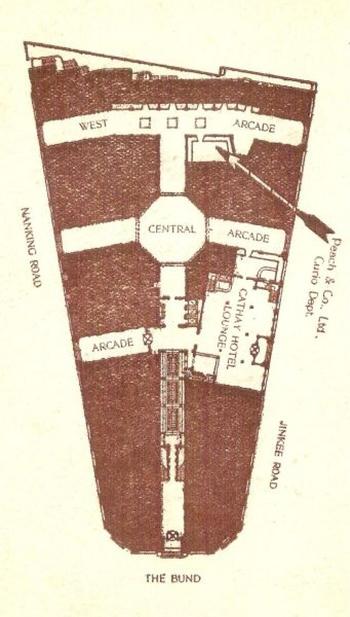
Built at No. 20, the Bund, Sassoon House created a sensation as the tallest building in China at the time. The Sassoon House building site at the corner of Nanking Road and the Bund was the best lot in Shanghai, located at the entrance to the International Settlement and facing the Huangpu River. As a condition of building, Sassoon lobbied the Municipal Council to allow him to straighten out the dog-legged Nanking Road. The building's southern perimeter tapered towards its northern edge, so that the two sides met in a near point at the hotel's Bund façade. To straighten the road, two houses that had occupied this site had to be demolished. The site was reconfigured allowing better access to Nanking Road (Illustration 2). The building had a peculiar ground plan as a result. Designed by George Wilson of P & T architects, its Nanking Road facade projected a sense of colossal horizontality, while its Bund façade suggested slender verticality. From the air, Sassoon House formed a flat-bottomed ‘V’ shape. (This was similar to how Victor Sassoon signed his correspondence.)Footnote 40
A floor plan drawing of Sassoon House.

Sassoon House was not only a bold experiment in terms of building technology, but also the earliest example of a mixed-use commercial building in China. It showcased an architectural style and business model that had originated in Chicago and New York to maximize rental profit and had become a successful real estate investment model by the 1920s. In Shanghai, the twelve-storey, pyramidal-towered Sassoon House was originally designed as office space, but halfway through construction Sassoon decided to include a modern hotel, to be a forerunner of Shanghai's glittering future. In 1928 Sassoon established his own company, Cathay Hotel Limited in Hong Kong, and had two floors added to the building plan so that Sassoon House could accommodate shops and a luxury hotel as well as office space.
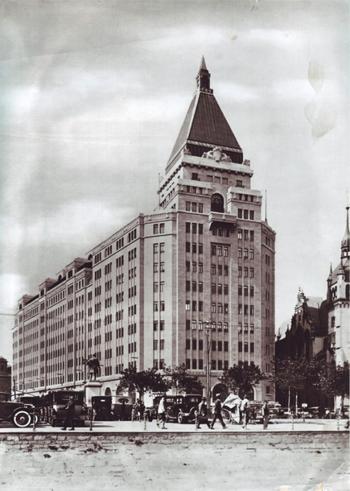
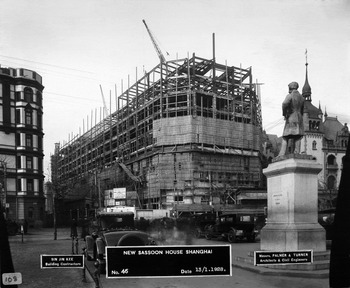
Sassoon House/Cathay Hotel became an icon on the Bund. The building was 240 feet tall; nine of its twelve storeys spanned the full width of the building, while the top three floors dwindled upward to the distinctive pyramidal roof, accentuating the height of the building and making Sassoon House the tallest building in Shanghai (Illustrations 3, 4 and 5). On the ground floor a grand rotunda, that also provided easy access to entrances, was the building's centrepiece, with a soaring ceiling of leaded glass bolstered by marble reliefs of stylized greyhounds. The colonnade of the hotel lobby and ground-floor shopping arcade ran to the end of Nanking Road. Two main walkways crossed in the centre at an octagonal hall (Illustration 6). A Chinese reporter who attended the hotel's opening recalled “the handsome ground floor lounge, which is 2 stories high, pillared in marble, with 2 balconies (one for each of the sexes) giving a measure of privacy if desired. The walls are of light grey and rose mottled marble, with dove grey marble strips marking the panels. Above the marble are paintings in soft colors of imaginary cities in various styles of architecture.” Nothing less than “fantasies”, he exclaimed.Footnote 41
The Sassoon House in the 1930s.

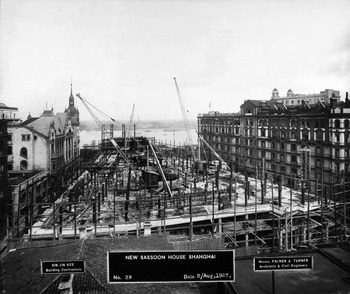
Sassoon House (The Cathay Hotel) under construction, Shanghai, August 1927. Reproduced with the permission of Teesside Archives, reference BS 1826.

Sassoon House (The Cathay Hotel) under construction, Shanghai, January 1928. Reproduced with the permission of Teesside Archives, reference BS 1829.

The octagonal hall, the Sassoon House.
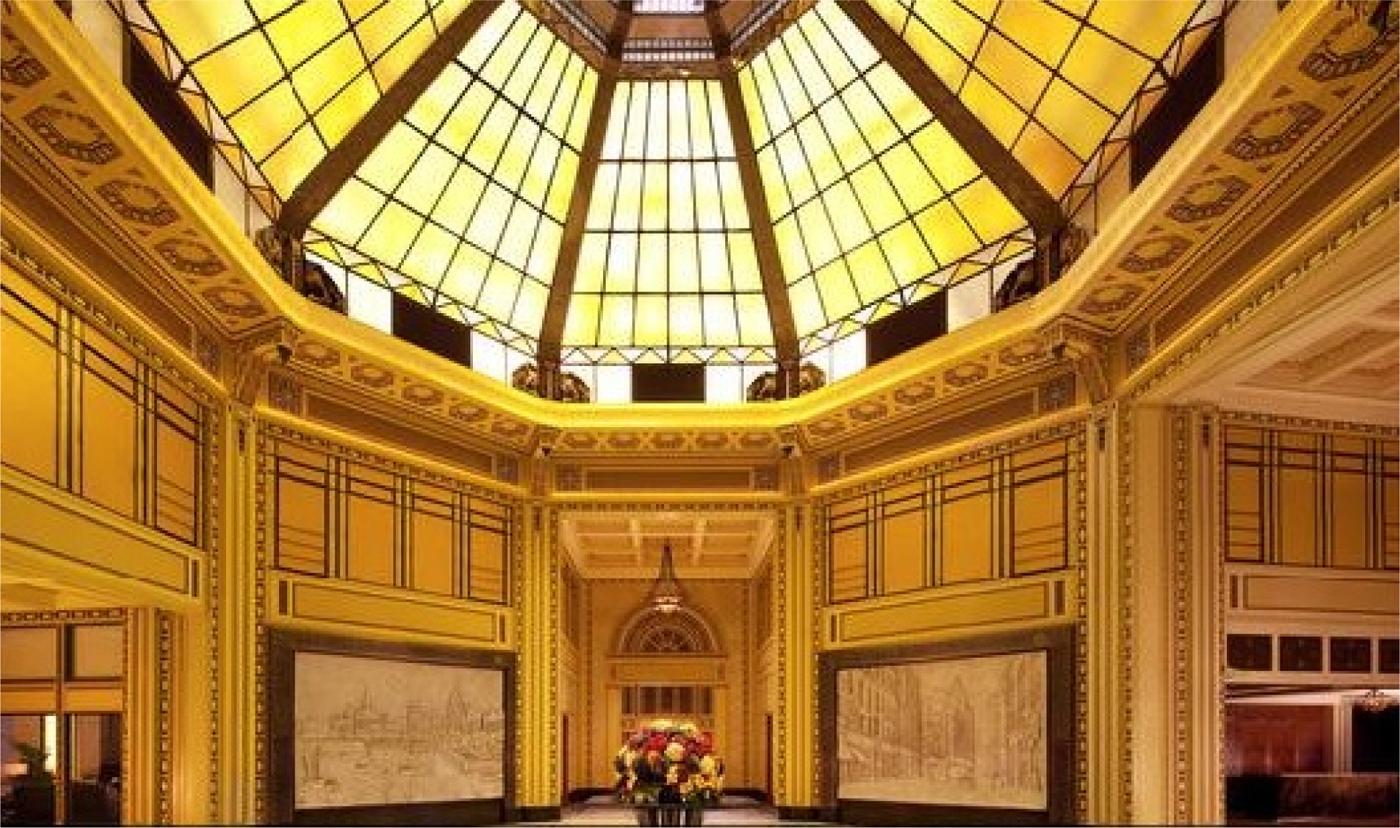
Above the ground floor, the next three storeys were leased as offices, while Sassoon's companies and subsidiaries had their offices on the fourth floor. The fifth to seventh floors housed the 215 rooms and suites of the Cathay Hotel. The rooms were decorated in exotic international themes, with suites facing the Bund in styles including Jacobean, Georgian, Indian, Chinese, Japanese and French. The eighth floor housed the hotel reception, the main bar, a ballroom, and a Chinese restaurant. At the front of the building, on the Bund, the first three tiers of the tower emerged from the roof, and gave a panoramic view of the waterfront. The ninth floor had a nightclub, a small dining hall, and a roof garden, the tenth floor an English banqueting hall with private dining rooms. Within the pyramidal roof was a large dining hall. On the top floor Victor Sassoon had his private apartments, along with the head office of the Sassoon Company.
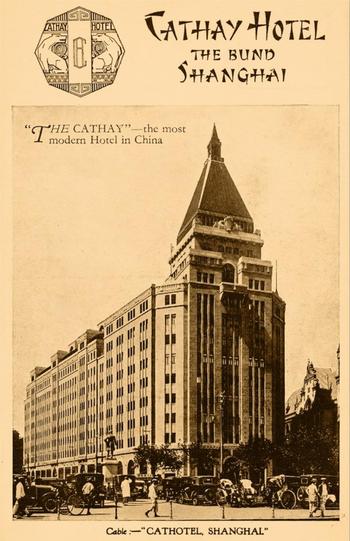
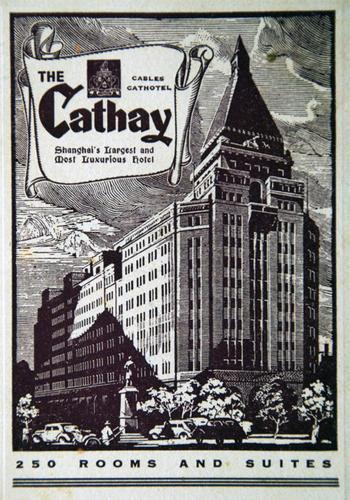
The mixed-use design of Sassoon House, modelled upon American commercial buildings, was made possible partly because Sassoon introduced residential air conditioning and electrical lifts to the building. From its opening, Sassoon House's shop and office space was fully leased by the most fashionable high-end retailers, while the Cathay Hotel won immediate worldwide fame for its service, grandeur and luxury. Its ballrooms and tower bedrooms eclipsed every hotel in Shanghai, and competed with the best hotels in Manhattan (see Illustration 7). It was a hotel with silk sheets, with silver-plated bathroom fixtures, and where employees ironed the wrinkles out of the daily newspapers before they were delivered to the guests. It became a famous nightspot for dancing, drinking and dining. People flocked to the ballroom where they danced the night away to American jazz bands. The Cathay Hotel helped make Shanghai a fashionable travel destination, attracting visitors from all over the world.
An advertisement for the Cathay Hotel, 1930s.

The First Skyscraper in Shanghai – a New Investment Model
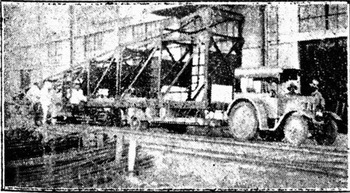
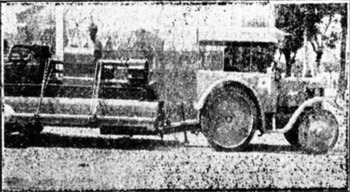
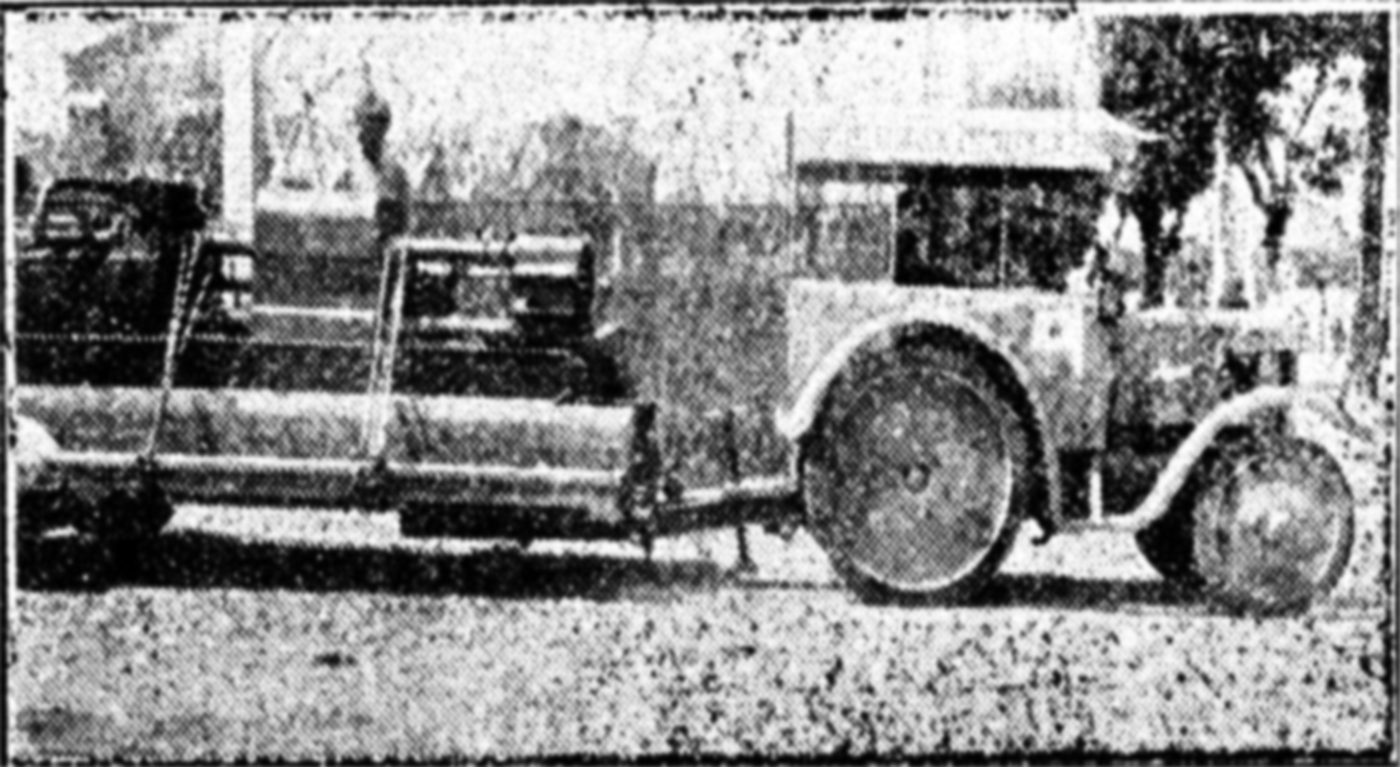
As well as being a famous attraction on the Bund, Sassoon House was pioneering in the history of Shanghai architecture in terms of its function, engineering and style. To build Sassoon House, George Wilson hired MIT engineers and designed what was then the most advanced foundation in China. Over sixteen hundred Douglas fir piles were driven 62 feet into the Shanghai soil to support a thick, reinforced concrete raft 325 by 188 feet, poured into a grid structure. When it was completed, the building sat atop this gigantic raft, floating in semi-liquid, alluvial mud. The North-China Herald recorded that to build Sassoon House, construction workers used a 70-ton pile driver (Illustrations 8 and 9), brought in from Hong Kong, which was “the largest piece of machinery ever to be employed in sinking the foundation piles.”Footnote 42
“The leader, or tower, for the 70-ton pile driver which is being erected on the corner of Jinkee and Nanking Roads and the Bund to be used in driving the concrete piles for the new Sassoon Building. The leader is 57 feet long and weighs 17,000 pounds.” (“Pile driving extraordinary, Big Machinery for preparing Foundations of Sassoon Arcade,” NCH, 28 August 1926, p. 403.

“The hammer of the big pile driver, which will be used in sinking the foundation piles for the new Sassoon Building. The piece of the driver weighs 11,000 pounds, but in spite of its weight it delivers 61 blows a minute.” “Pile driving extraordinary, Big Machinery for preparing Foundations of Sassoon Arcade,” NCH, 28 August 1926, p. 403.
The scale of the construction was as impressive as its engineering. Most of the building materials were from overseas. Wilson not only imported Douglas fir from Oregon, but also 16,000 blocks of white granite from Kowloon and Japan, tons of rare Italian marble, as well as pre-fabricated structural steel, pre-moulded ceilings, and Shanks bathroom fittings from England.Footnote 43 Sassoon's enterprises also transformed indigenous Shanghai businesses. Sassoon commissioned Chinese contractors to construct his buildings, and used local manufacturers to supply many of their luxurious accessories, which stimulated the growth of Shanghai's steel, terracotta and bronze manufacturing industries.Footnote 44 With the advent of steel frame construction, improved building materials, and the adoption of cranes for building, the Shanghai construction industry was booming.
The Skyscraper Sensation – “Magical Big Buildings That Reach the Skies”
Sassoon House became a Shanghai landmark not only for its cutting-edge engineering, but also for its refusal to emulate the British neoclassicism of other buildings on the Bund, favouring a style known as “Americanized Art Deco”. Designed by George Wilson of P & T, who was Sassoon's favourite collaborator, the building spoke for both men. Like Sassoon, Wilson had travelled widely, observing firsthand the new design styles like Parisian Art Deco and American skyscrapers. Originally, Art Deco referred to a French design style, popularized in the 1925 Exposition Internationale des Arts Décoratifs et Industriels Modernes in Paris.Footnote 45 Yet, the style found its most enthusiastic admirers in the USA, where architects were particularly successful in adapting the style to their high-rise buildings. Art Deco became the architectural language of the Jazz Age, a visual language whose optimism and energy matched the America's Roaring Twenties era of post-war economic boom. As New York overshadowed London as the world's financial powerhouse, the Roaring Twenties ushered in the widespread use of automobiles, telephones, electricity and air conditioning. It was a time of unprecedented industrial growth and consumer demand. Lacking a homegrown style to embody their new prosperity, Americans adopted the Paris designs and made them their own. As American influence grew, Art Deco became a popular style for commercial architecture all over the world in the 1920s and 1930s.
The new skyscrapers became cathedrals to the modern commercial age of American-led capitalism.Footnote 46 After WWI, Britain was no longer the unchallenged master of the Shanghai foreign concession. With the beginnings of US influence in the Pacific region, the look of Americanized skyscrapers in Shanghai became a visual cultural negotiation between the neoclassicism of British imperial power and the effervescence of American capitalism. As well as a mark of commercial success, skyscrapers were testaments to Shanghai's passage from old-fashioned tradition to sophisticated modernity.
The first skyscraper in Shanghai, then, was not only a breakthrough in building technology, but a sign of the triumph of American-style capitalism in the foreign concessions of Shanghai.Footnote 47 Its tall, narrow windows and surface detailing gave Sassoon House a sense of sleek verticality, a streamlined exterior that recalled those “aerodynamic” vehicles whose silhouettes suggested velocity, emphasizing Art Deco's Modernist influence and in fine contrast to the horizontal stodginess of its neighbouring buildings, whose stone quoins and Corinthian columns suggested immobility, conservation, and the glory of Empire. A comparison of the Sassoon House with another landmark, the HKSB building, vividly illustrates the trend away from the classical-European influence towards a more Americanized commercial model (Illustrations 10 and 11).
The Shanghai Bund in the late 1920s.

An advertisement for the Cathay Hotel, 1930s.

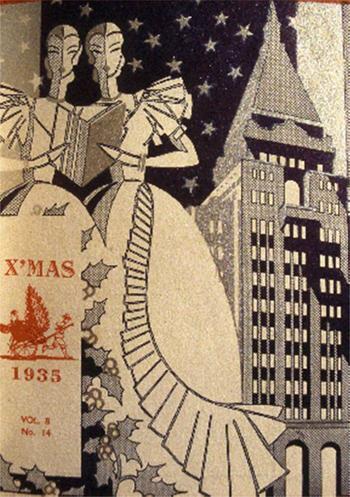
The Chinese were impressed by these tall buildings with their ornamental detailing of chevrons, sunbursts, arcs, geometric designs, and stylized floral patterns. They saw skyscrapers as exciting. Their shape, colour, height and decoration were perceived as charming and exotic, but above all, unreal. The Cathay Hotel, for instance, was viewed as a whimsical rendition of a Chinese skyrocket. The Chinese words for skyscrapers – motian dalou 摩天大樓 (literally, “magical big buildings that reach the skies”) spelled out their visual appeal. Chinese observers associated the skyscrapers’ bold architectural and decorative style with urban modernity, the spirit of a new Shanghai. Soon, the Chinese transferred the style to their daily lives, using it in clothing and graphic design (for instance, in local magazines (Illustration 12). As Art Deco put down local roots it took on Chinese motifs, with an aesthetic exuberance that characterized most new buildings along the Bund. From its outward façade to its interior décor Sassoon House had the Machine-Age, “futuristic” look of the 1920s and 1930s. Its vertical composition conformed to the style of the American skyscraper in a tripartite formula of base, shaft and capital. Wilson pointed out that its “modern note” was due to its “simplicity, a pleasing effect being produced by proportion, mass, concentration of ornament, if any, choice of colors and lighting.”Footnote 48 Wilson also incorporated Eastern motifs into his design of Sassoon House/the Cathay Hotel, giving rise to the East–West style that would become known as Shanghai Deco. This style was particularly impressive in the gilded chinoiserie bats of the ceiling of the Chinese restaurant, and the opulent tower dining room of the Cathay Hotel. In the article about its opening, the reporter was awed by the hotel design:
Passing up the main staircase to the base of the tower, one is transported to another fairy palace, this time in Chinese style. On the wall of the staircase landing there is a huge painting of a Chinese landscape, also by Lalique, dazzling in its brilliancy. […] Crossing the landing is the restaurant, also in Chinese style, and in the entrance doors are set circular panels of Lalique goldfish swimming in an opalescent sea. The color scheme in the restaurant is jade and gold, relieved by black and red lacquer, the coffered ceiling is a work of art painted by Chinese temple artists who had to lay on their backs on the scaffolding to carry it out, incorporating all the best known symbols of good augury for Buddhist and Chinese. Here again are carpets and curtains of jade green splashed with gold, all of the same pattern, specially made for this room. In a niche in one wall is another golden carp in all its glory.Footnote 49
The front page of a popular magazine published in Shanghai, 1935.

Oriental motifs also appeared throughout Sassoon House in the granite carvings and bronze work, along with other repeating patterns like the spirals on metal light fittings and in plasterwork throughout the building, and the stylized whippets in low-relief stonework on cornices and the plinth under the pyramidal roof. Sassoon House was a bold experiment, and later investors copied it. Thereafter, most high-rises in the international settlements were Americanized Art Deco spiced with China, in the hybrid style (eventually) known as Shanghai Deco.Footnote 50
Aesthetic Exuberance, Financial Exuberance
Sassoon's expensive business experiment paid off handsomely. Starting from 1929, after the opening of Sassoon House, he set off a “skyscraper sensation” in the real estate market. Land prices soared and construction works boomed. Fortune commented that on the eve of the stock market crash in New York, Sassoon had already transferred sixty lakhs of silver taels – the equivalent of $29 million – from Bombay to Shanghai.Footnote 51 Amidst the financial crisis in the West, the real estate sector in Shanghai expanded rapidly. From 1929 to 1932, Shanghai real estate values spiked. While the West was suffering from a deep deflation, Shanghai became a financial safe haven for investors. As silver was heavily depreciated in terms of the gold standard currencies, hot money rushed into the Shanghai market.
Victor Sassoon was quick to cash in on this extraordinary prosperity amidst the so-called “skyscraper craze”. As there was plenty of hot money pouring into Shanghai, Sassoon seized the opportunity to aggregate more capital through his companies by issuing a large quantity of debenture and corporate bonds through the Shanghai Stock Exchange. In 1930, remarkably, Sassoon announced his ambitious plans to set up two trust companies in Shanghai. They were the International Investment Trust Co. Ltd. (set up in April 1930 with an authorized capital of 2000,000 taels) and the Yangtze Finance Company (set up in early 1931 with an authorized capital of 2000,000 taels). He intended to use this new capital to purchase more properties and corporate bonds in China.Footnote 52 The financial circle in Shanghai was stunned by these bold moves and the North-China Herald records:
“Trust Company for Shanghai: Coming Important Flotation: Capital of Tls. 20,000,000”
Details of one of the most important company flotations undertaken in Shanghai are now available for the public. Its importance may best be gauged from the fact that the authorised capital is Tls. 20,000,000, and coming on the market at a time like the present, when a great deal of money is available for investment, and when more will shortly be available, it is of necessity a matter of the first interest to the investing public. The title of the company is the China Investment & Trust Co., Ltd., and as its name signifies it will carry on a business very much on the lines of what the numerous and powerful trust companies in Britain do.Footnote 53
Because of Sassoon's fame, the issues were immediately over-subscribed. With the money and credit, Sassoon acquired and set up more companies in Shanghai in the early 1930s. To coordinate all these companies under his wing, Victor Sassoon set up a Sassoon Banking Co. in Hong Kong in June 1931, registering it as a “private company” in British Hong Kong. By doing so, he kept most of his business documents strictly confidential.Footnote 54 Within a month, the Bank opened its office on the Shanghai Bund (Sassoon House).Footnote 55 Again, his move stunned the market and the media. Fortune observed that Sassoon “bit off big slices of Shanghai's two investment trusts. Through his private banking enterprises Sir Victor carried on his usual extensive operations in foreign exchange.”Footnote 56
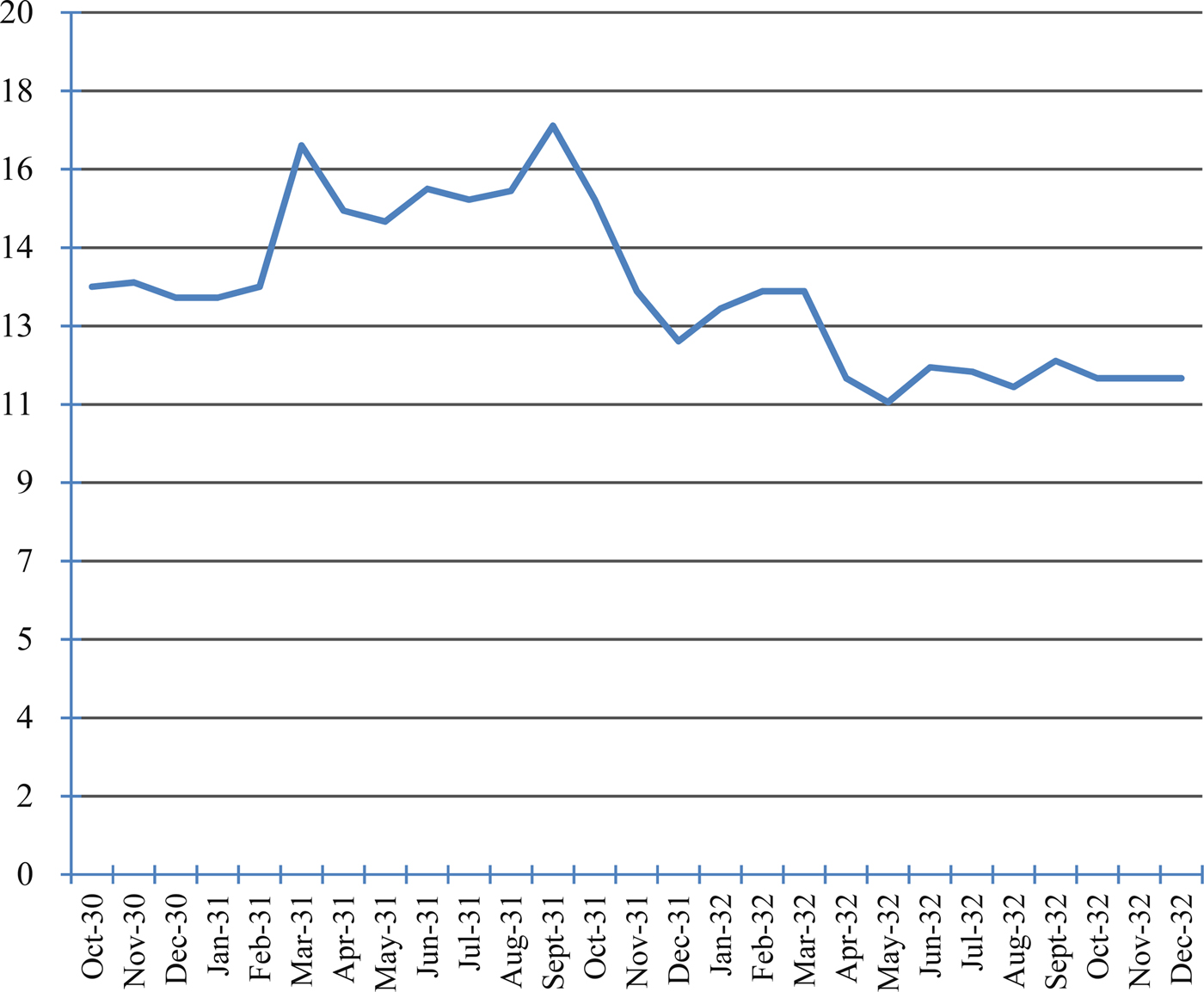
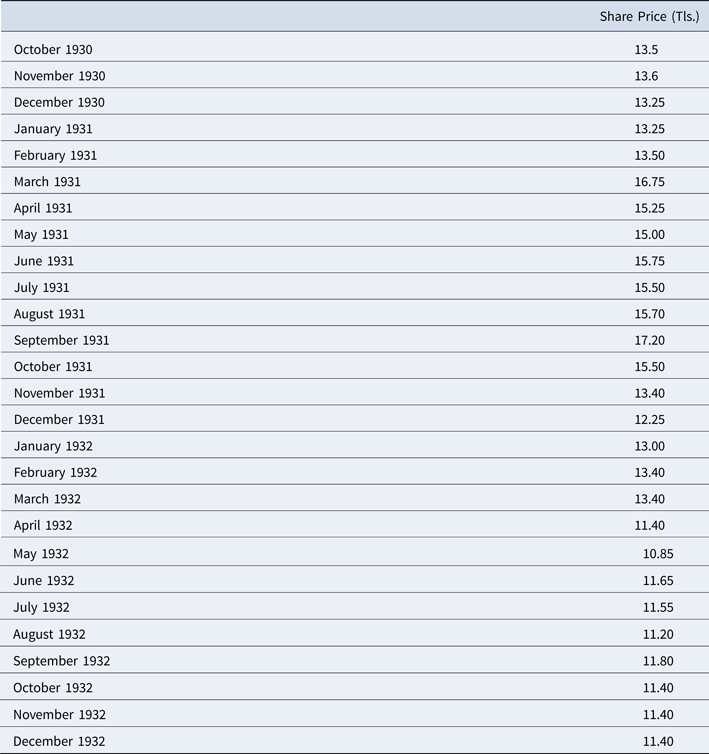
In 1931, speculators’ expectation was stimulated by Victor Sassoon's bold investment plans (building more skyscrapers and setting up his own private bank). Amidst the craze, company shares of Sassoon's enterprise were heavily speculated on in Shanghai. Sassoon seized the opportunity and announced his plan to issue corporate bonds (totalling 3 million taels with an annual interest of 6 per cent) for his Cathay Land Investment Company. Due to Sassoon's fame, the issues were immediately over-subscribed. The optimism fuelled overconfidence in the market and the share price of the Cathay Land Investment Company skyrocketed. As a result, the share price reached its record high (about 17.20 taels) in September 1931 (see Table 5 and Figure 1).
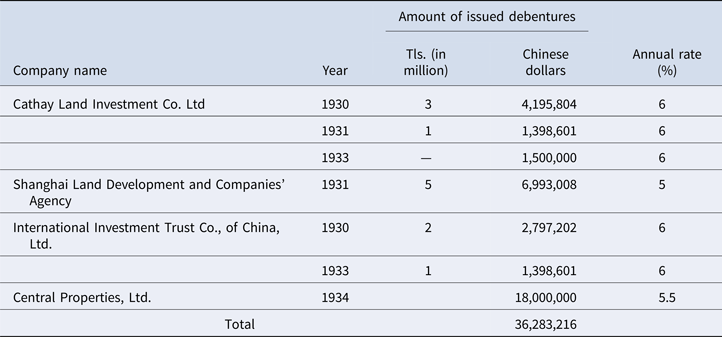
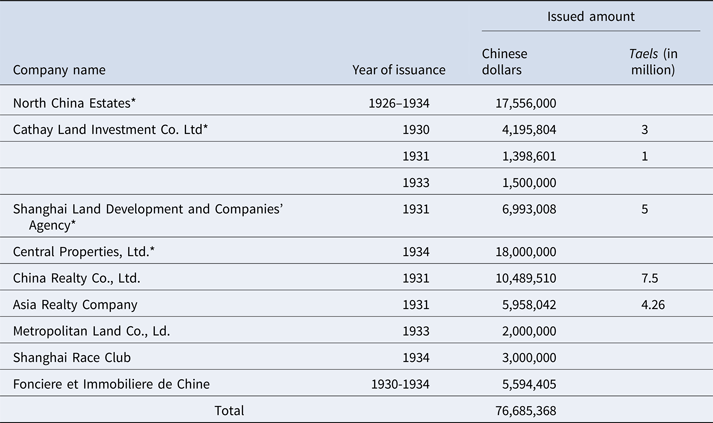
Between 1930 and 1934, Sassoon had floated at least seven lots of corporate debenture, tendering an amount of more than 12 million taels, through the companies under his wing (Table 6). In 1933, for instance, the Cathay Land Investment Company floated another bond issue totalling 1 million taels with an annual rate of 6 per cent; the bonds were backed by company-owned real estate. The optimism of rapid profit return fuelled overconfidence in the market and gave rise to a climate of financial exuberance; the result was an extraordinary construction boom (Tables 7, 8).
With plenty of hot money in hand, Sassoon made more plans to rebuild the Bund. After the great success of Sassoon House, his next project with P & T was the Cathay Mansions, an eighteen-storey apartment building located near Sassoon House. Reporters claimed the project would be a great success if the ground underneath managed to support it. Arnhold & Co. had begun the building, Sassoon finished it, and it then became a popular address for the wealthiest tenants in Shanghai. Once he had “taught Shanghai how to build skyscrapers” Sir Victor's companies began building in earnest. Fortune magazine reported that: “On Kiangse Road they built Hamilton House, a big apartment hotel. […] They laid the foundations for Grosvenor House […] and threw up rows of Chinese residences, shops, theatres, office buildings. Across Soochow Creek, they erected Embankment House, the biggest building on the China coast (it has a frontage of a quarter of a mile).”Footnote 57 At the height of his career, Sassoon was the largest single owner of real estate in the foreign concessions, with more than 1,800 properties in Shanghai including hotels, apartment houses, and office buildings in the best locations.
Sassoon was known as “Shanghai's No. 1 realtor”. He was also popular and famous for the “wild, luxurious, and astonishing parties” he gave in his tower apartment at the Cathay Hotel. For the most part he lived in Shanghai, visiting India and England “for no more than the few months the British income-tax laws permit him.”Footnote 58
More high-rise buildings went up as the Great Depression drove wealthy foreigners to Shanghai, where they invested in the booming real estate sector. From the late 1920s on, some thirty skyscrapers rose along the Bund, towering over the British colonial buildings. Visitors marvelled at their trademark vertical lines and bold geometry – even as the clouds of war gathered on the horizon.Footnote 59
Of all the new buildings on the Bund, Sassoon House with its Cathay Hotel had the most symbolic significance. A Chinese reporter saw the hotel as “a wonderful tribute to Shanghai, both as regards its present and future, for if such well-informed people [as Victor Sassoon] believe that Shanghai can now and will continue to support such a gorgeous place, then there should be small need to worry.”Footnote 60
Depression and War
The price of real estate in the International Settlement was still climbing when Japanese troops invaded Manchuria in September 1931. Despite economic depression and worldwide political instability, there was plenty of overseas money and the Shanghai building boom continued. Sassoon's hotels, office blocks, and apartment houses continued to yield vast revenues. His Shanghai properties had almost trebled in value by 1935.Footnote 61 But the tide was turning against him, and Sassoon knew it.
In 1934, the passage of the Silver Purchase Act in the USA drove up the price of silver, upsetting the trade advantages of China's currency.Footnote 62 Foreign investment in Shanghai dried up, as investors had no incentive to pay Shanghai's now-inflated prices. Worse still, many speculators in China moved their capital elsewhere, which led to deep deflation in the Chinese economy. Interest rates rose and the availability of credit dried up. When their silver reserves shrank, the KMT government issued a paper dollar note; but this failed to arrest the adverse trade balance since the price of silver abroad kept falling.Footnote 63
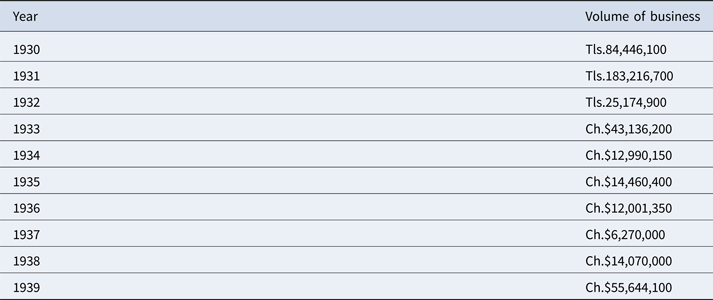
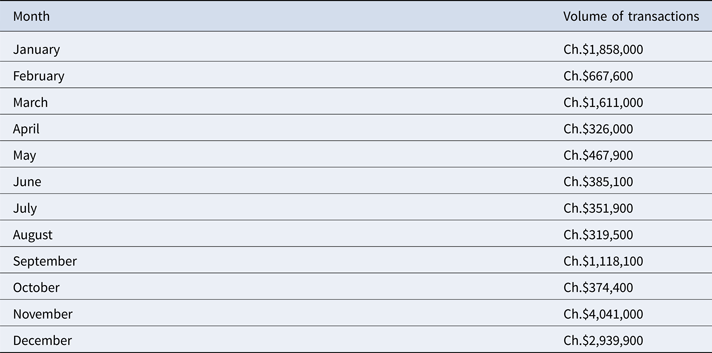
Starting from April 1934, property prices began to drop as investors lost their trust in landed properties. In September a silver drain ushered in a rush for liquidity. The uncertain future of the yuan led to a crisis in confidence. As the property market crashed, people lost their trust in land as secure collateral. Foreign banks refused to accept collateral loans signed against landed property. Chinese banks were driven to call in their outstanding credit. As the age of easy credit came to an end, Shanghai's real estate prosperity waned. Investors started to default on paying interest on mortgages. The volume of transactions in the property market had dropped 69 per cent in 1934, and a further 42 per cent in 1935 (see Tables 9, 10). The downward trend was temporarily arrested by the introduction of monetary reform in November 1935. According to the new measure, all silver in circulation in China was nationalized and a new legal tender, issued by the government banks with limited silver backing, was introduced. The new mixed monetary standard was based on a reserve of 25 per cent silver, 35 per cent foreign currency and 40 per cent government bonds. The reform, in principle, freed the note issue from its old link to the shrinking stock of available silver. Yet, the reform was not sufficient to arrest the eventual collapse of the real estate market in Shanghai.Footnote 64 In 1935 and 1936, a number of land companies went bankrupt. Sassoon's enterprise, heavily concentrated on real estate and corporate debenture, also suffered from the financial meltdown, as reflected by its falling annual profits and share prices (Table 11).
In the autumn of 1937, after a prolonged battle, Japanese forces took control of the Chinese-administered section of Shanghai and the Northern district of the International Settlement. Between 1938 and 1939, the Shanghai foreign settlements became a “solitary island” and enjoyed a very brief period of war-fuelled economic prosperity.
Yet Victor Sassoon remained in Shanghai. His property empire kept him there: he was able to sell some of his corporate shares at a discount, but could not move his “magical” buildings. He tried to conduct business as usual, and even continued to host elaborate parties. In September 1941, the International Investment Trust Company (Sassoon's financial flagship) had to declare liquidation, and transferred most of its assets to the Yangtze Finance Company. Within several months, the Sino-Japanese War finally forced him, reluctantly, to leave Shanghai.Footnote 65
Conclusion
The evolution of treaty port architecture in China owed much to Victor Sassoon. Its innovations – from the advent of skyscrapers, with their Art Deco style and mixed-use function, to the engineering methods and financial arrangements that built them – bore Sassoon's stamp. In the 1920s, while most investors believed that building profitable high-rise buildings in Shanghai was extremely risky, Sassoon envisioned the floating city as a Manhattan of the East – a glamorous skyscraper city of sleek, vertical lines and bold geometry. He possessed the resources to generate funding from private and public channels such as the Shanghai stock market to turn his vision into reality. His bold experiment paid off handsomely in financial terms. The skyscraper sensation set off by the opening of Sassoon House in 1929 helped him to aggregate more capital from the Shanghai Stock exchange through the issue of corporate bonds and company debentures.
Living a high-profile life in Shanghai, Sassoon was famous for his love of horse racing and his extravagant parties; he was well known as someone who was living the high life. But his personal journal, kept throughout those years, revealed that during the 1930s, in his Cathay penthouse, Sassoon frequently struggled with despair. With the advance of Japanese aggression, he began to suspect that his empire had been built on sand, and that he had gambled away a family fortune that could be traced back to the Middle East and had been amassed over a period of a thousand years.Footnote 66
His fears came to pass in July 1941. As the atmosphere of hostility in the Shanghai foreign settlement became more intense, Sassoon left the city, to live out the war years in Bombay. Immediately after the war, he sent his delegate to Shanghai, where his remaining properties were valued at £7.5 million – of which Sassoon House accounted for about one million.Footnote 67 As civil war approached Shanghai, Sassoon hoped to liquidate his real estate holdings but found few buyers. Then in 1949 China became a communist country. A year later, Sassoon relocated to Nassau in the Bahamas, which he chose largely because there was no personal or corporation tax there. In Shanghai, Sassoon House reopened in 1956 as the Peace Hotel, owned and operated by the government. In 1958, fifty-seven buildings belonging to the Sassoon enterprise were transferred to the state-owned China Enterprise Company. Sassoon died in Nassau three years later.
Sassoon's buildings are still standing in communist Shanghai. The former Sassoon House continues to be a visitor attraction on the Bund. As the Peace Hotel, it remains an Art Deco fantasy in concrete and steel floating on the once-muddy banks of the Huangpu River, a symbol of the vibrant entrepreneurial spirit (and the unusual period of financial exuberance) of old Shanghai.
Appendix
Share price of Cathay Land Investment Company, October 1930 to December 1932 (in Tls.).*

Official sterling quotations (to one Shanghai tael), 1920–1932

The price index of silver in New York, 1914–1933

Movement of silver in China, 1901–1934

Land values in Shanghai International Settlement

Share price of the Cathay Land Investment Company in Shanghai, Oct. 1930–Dec. 1932

Major corporate debentures issued by the Sassoon Groups, 1930–1934

The number of new buildings and their estimated cost, Shanghai 1928–1930

Corporate debentures issued by major real estate companies in Shanghai, 1926–1934

Volume of transactions in the real estate market in Shanghai, 1930–1939 (Ch.$1 = Tls.0.7143)

Volume of transactions in the real estate market in Shanghai, 1935

Book value of the properties held by the Sassoon Group in January 1941 (in thousand Yuan)