Introduction
Buried seeds can demonstrate repeating cycles of dormancy and non-dormancy linked to seasonal changes in environmental conditions – a well-known phenomenon among seeds showing physiological dormancy (Baskin and Baskin, Reference Baskin and Baskin1998). Seasonal cycles of dormancy help avoid germination during periods with unfavourable environmental conditions and allow seeds to be ready for germination immediately before periods favourable to plant growth (Vleeshouwers et al., Reference Vleeshouwers, Bouwmeester and Karssen1995). As such, seasonal dormancy favours the survival of species that are able to limit their germination to periods in which environmental conditions are most favourable to seedling survival and growth (Donohue, Reference Donohue2005).
Seasonal variations in the germination responses of buried seeds are common among annual species (Baskin et al., Reference Baskin, Baskin and Chester2003), and are especially well documented among species in temperate climates (Baskin and Baskin, Reference Baskin and Baskin1998; Handley and Davy, Reference Handley and Davy2005; Geissler and Gzik, Reference Geissler and Gzik2010) that are subject to very marked climatic variations. These seasonal variations in germination events, however, have been poorly examined among perennial species, especially those exclusive to tropical climates. A recent study of perennial Xyris (Xyridaceae) species endemic to campos rupestres (open, rocky, mountainous) vegetation in Brazil (Garcia et al., Reference Garcia, Giorni, Müller and Munné-Bosch2012) identified dormancy cycling during the year, which had not been reported previously for tropical species.
The Eriocaulaceae family has a tropical distribution, and its species are frequently encountered in the Cadeia do Espinhaço mountain range in south-eastern Brazil. This area is considered to be the centre of diversity for this family, and approximately 90% of the species found there are endemic (Giulietti et al., Reference Giulietti, Harley, Queiroz, Wanderley and van den Berg2005). The regional climate is mesothermic (due to its altitude), with humid summers and dry winters (Cheib and Garcia, Reference Cheib and Garcia2012). The genera Comanthera (recently re-established; Parra et al., Reference Parra, Giulietti, Gomes de Andrade and van den Berg2010) and Syngonanthus are typical of the campos rupestres vegetation in the Cadeia do Espinhaço Range and comprise perennial species with herbaceous habits that occur in rocky fields or high sandy plains and swampy sites. Their seeds are very small ( < 25 μg) and spherical, and most species have an absolute light requirement for germination (Oliveira and Garcia, Reference Oliveira and Garcia2005, Reference Oliveira and Garcia2011).
The endemism of many Eriocaulaceae species and the annual variations in regional climatic conditions (humid summers and dry winters) where they are found, as well as the indication that they can form persistent seed banks (Garcia and Oliveira, Reference Garcia and Oliveira2007), raise many important questions concerning their germination phenologies. Within this perspective, the present study sought to investigate the dynamics of the germination responses of four tropical perennial species of this family (two from the genus Comanthera and two from Syngonanthus) to determine: (1) the in-situ longevity of buried Eriocaulaceae seeds; (2) if the germination responses of these seeds are related to seasonal changes in the environmental conditions where they occur; and (3) if there are similarities between the germination phenologies of the species investigated.
Materials and methods
Study area and botanical material
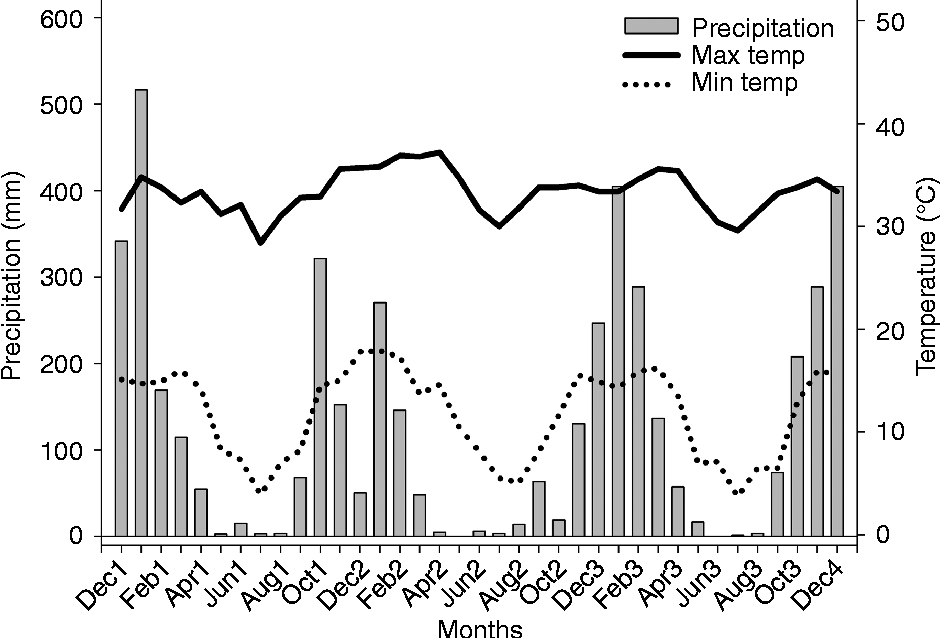
The seeds of four endemic species of Eriocaulaceae of the campos rupestres (rupestrian fields) vegetation of south-eastern Brazil were used. Capitula of Syngonanthus anthemidiflorus (Bong.) Ruhland, Syngonanthus verticillatus (Bong.) Ruhland and Comanthera bisulcata (Korn.) Ruhland ( = Syngonanthus bisulcatus) were collected in the Serra do Cipó Range in Minas Gerais State (MG), Brazil; the seeds of Comanthera elegans (Bong.) Ruhland ( = Syngonanthus elegans) were collected in the municipality of Diamantina, MG, Brazil. The regional climate where these plants are found is tropical and mesothermic due to the altitude (Cwb in the classification system of Köppen), with two well-defined seasons: a dry period that occurs in the austral autumn/winter; and a rainy period during the austral spring/summer (Garcia et al., Reference Garcia, Giorni, Müller and Munné-Bosch2012). The average precipitation and the minimum and maximum temperatures during the study period are presented in Fig. 1.
Climate data, monthly precipitation and maximum and minimum air temperature in Serra do Cipó, Brazil, during the period when the experiments were carried out. Environmental conditions were monitored by the weather station of Conceição do Mato Dentro, MG, Brazil.

In-situ longevity and seed germination
The collected seeds were placed in fine-mesh nylon bags and buried 5 cm below the soil surface for periods that varied from 24 to 34 months. The seeds of C. bisulcata (28 months) and S. verticillatus (34 months) were buried in a mesic environment where these species occur, which accumulates water during the rainy period, while the seeds of C. elegans (24) and S. anthemidiflorus (34) were buried in a seasonally dry environment (as described by Oliveira and Garcia, Reference Oliveira and Garcia2011). Seed samples were exhumed every 2 months and tested for their germination responses under a 12-h photoperiod (30 μmol m− 2 s− 1) at 30°C (C. elegans), 25°C (S. anthemidiflorus), and 20°C (C. bisulcata and S. verticillatus) – which were previously defined as optimal temperatures for seed germination by Oliveira and Garcia (Reference Oliveira and Garcia2005, Reference Oliveira and Garcia2011). The germination tests utilized samples of 200 seeds (four repetitions of 50 seeds each), with the seeds being maintained in Petri dishes lined with two layers of filter paper humidified with a nystatin solution (Oliveira and Garcia, Reference Oliveira and Garcia2005). The criterion adopted for determining germination was the emergence of the vegetative axis.
Statistical analysis
As the germination data did not demonstrate normality (according to the Shapiro–Wilk test) and/or homogeneity (according to the Brown–Forsythe test), they were submitted to non-parametric statistical tests (Kruskal–Wallis), followed by comparisons in pairs using the Conover test, considering a 5% level of significance (Conover, Reference Conover1999), utilizing Brightstat software (Stricker, Reference Stricker2008).
Results
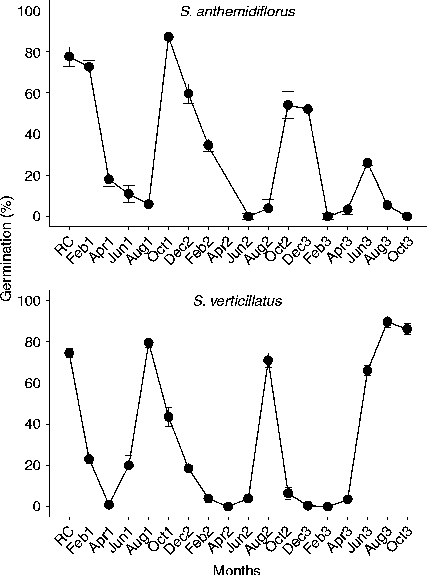
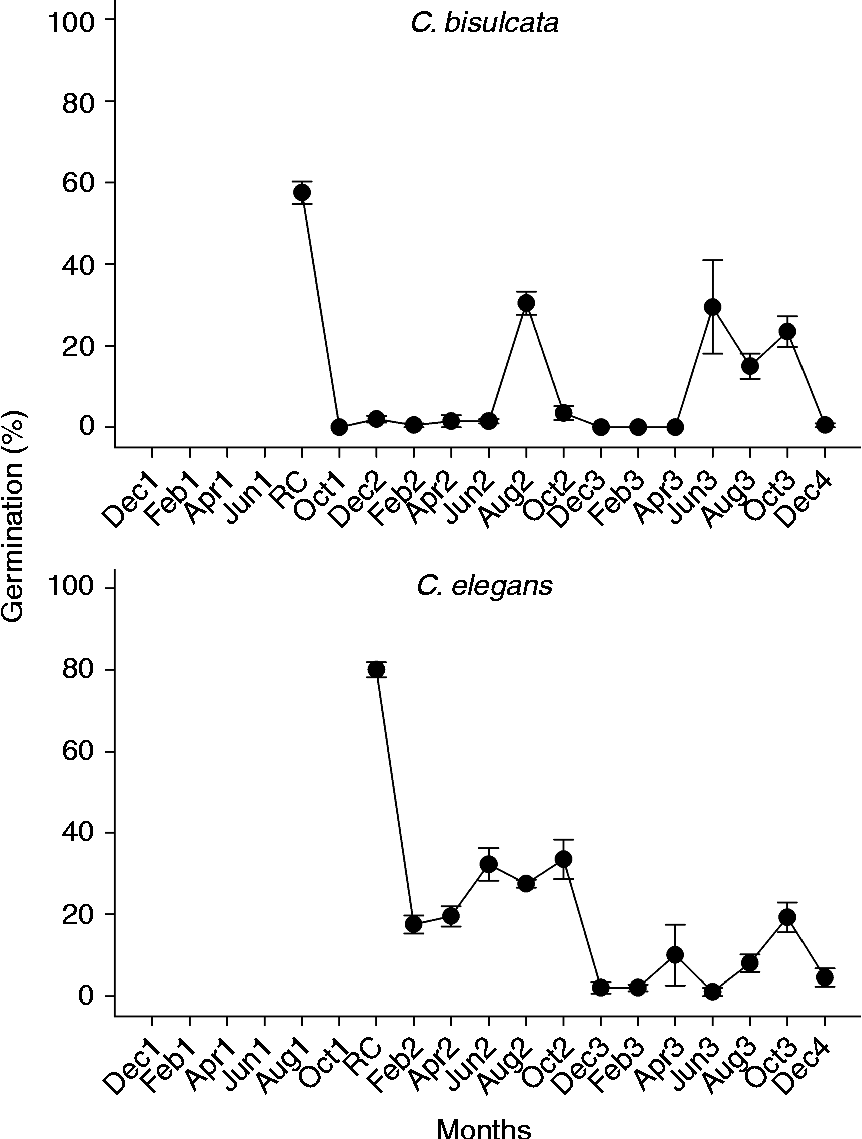
The germinability of the recently collected seeds of the four species varied from 58 to 80% (Figs 2 and 3). The buried seeds of C. bisulcata, S. anthemidiflorus and S. verticillatus remained viable for more than 24 months after dispersal, although the germinability of C. bisulcata seeds decreased by approximately 50% over that period of time. Approximately 80% of the seeds of C. elegans lost their germination capacity after being buried for 20 months (Fig. 3).
Germinability of Syngonanthus anthemidiflorus and S. verticillatus seeds during burial in the soil for 34 months under natural conditions in Serra do Cipó, Brazil. Data correspond to the mean ± SE of four replicates of 50 seeds per data point.

Germinability of Comanthera bisulcata and C. elegans seeds during burial in the soil for 28 and 24 months, respectively, under natural conditions in Serra do Cipó, Brazil. Data correspond to the mean ± SE of four replicates of 50 seeds per data point.

All four species demonstrated marked decreases in germinability shortly after burial (with the exception of S. anthemidiflorus, which demonstrated an accentuated decrease after 4 months) – but with subsequent returns to high germinability rates in the following months (Fig. 2). The dynamics of the germination responses tracked with seasonal variations, characterized seasonal cycles of germination/dormancy during the study period among the four species.
The buried seeds of C. bisulcata acquired dormancy throughout the rainy season (spring/summer, higher temperatures, see Fig. 1). Approximately 50% of the seeds re-acquired their germination capacity at the end of the winter (dry season, lower temperatures), a situation that was repeated in the following year (Fig. 3). Although the seeds of C. elegans did not demonstrate any characteristic cycle of dormancy, the seeds that remained viable in the first year overcame the dormancy acquired by burial (during the dry season) and became dormant once again at the beginning of the rainy season (Fig. 3).
The seeds of S. anthemidiflorus and S. verticillatus demonstrated seasonal cycles of germination and dormancy that repeated themselves for three consecutive years (Fig. 2). The seeds of both species acquired dormancy after burial and overcame that dormancy at the end of the dry season (S. verticillatus) or the beginning of the rainy season (S. anthemidiflorus). As the rainy season (accompanied by increase of temperature) became established, the seeds of these species gradually acquired dormancy and remained dormant until the end of the dry season (autumn/winter, lower temperatures) or the beginning of the wet season – when they once again overcame dormancy. The seeds of S. verticillatus maintained their viability even after 34 months of burial, while most S. anthemidiflorus seeds lost their capacity to germinate (Fig. 2).
Discussion
Soil seed banks provide diaspores for the recruitment of new individuals into plant populations and help maintain long-term ecosystem equilibrium (Doucet and Cavers, Reference Doucet and Cavers1996; Abella and Springer, Reference Abella and Springer2012). Seed banks therefore constitute an important survival strategy, especially for plants that are exposed to adverse environmental conditions during the course of the year (Moles et al., Reference Moles, Warton and Westoby2003). The formation of a seed bank is dependent on seed longevity in the soil, and will be influenced by environmental (Moles et al., Reference Moles, Warton and Westoby2003), physical (Mohamed-Yasseen et al., Reference Mohamed-Yasseen, Barringer, Splittstoesser and Costanza1994), eco-physiological and biochemical factors (Garcia et al., Reference Garcia, Giorni, Müller and Munné-Bosch2012).
The maintenance of the germination capacity of the seeds of C. bisulcata (50%), S. anthemidiflorus (70%) and S. verticillatus (100%) in the soil for periods greater than 24 months, as observed in the current study, confirms that at least some species of Eriocaulaceae can form seed banks of the persistent type (sensu Thompson, Reference Thompson, Hendry and Grime1993), as was suggested previously by Garcia and Oliveira (Reference Garcia and Oliveira2007). Considering the absolute requirement for light for germination of the seeds of the species investigated (observed by Oliveira and Garcia, Reference Oliveira and Garcia2005, Reference Oliveira and Garcia2011), the formation of a seed bank requires the relatively rapid burial of some of the seeds produced in a given year. According to Hölzel and Otte (Reference Hölzel and Otte2004), small, spherical seeds (like those of the Eriocaulaceae) tend to be more easily buried in the soil – thus increasing the probability of their incorporation into soil seed banks.
The seeds of Comanthera, especially C. elegans, showed high deterioration after the first year of burial, which reflects their incapacity to form viable soil seed banks. This seed mortality may be due to intrinsic factors, such as the chemical composition of the seed coat, the position of the embryo (Mohamed-Yasseen et al., Reference Mohamed-Yasseen, Barringer, Splittstoesser and Costanza1994) or the thickness of the seed coat (Gardarin et al., Reference Gardarin, Duerr, Mannino, Busset and Colbach2010), or to external factors such as their storage environments. The results of the present study suggest that soil conditions were not the primary determinants of seed deterioration among the species evaluated, as the seeds of S. anthemidiflorus (buried in the same environment as those of C. elegans) maintained their initial capacity to germinate for more than 24 months.
The results of the present work demonstrated the development of secondary dormancy after burial. Secondary dormancy can be induced, lost and re-induced repetitively in response to seasonal changes (Finch-Savage and Leubner-Metzger, Reference Finch-Savage and Leubner-Metzger2006), and is usually associated with annual cycles of dormancy (Baskin and Baskin, Reference Baskin and Baskin1998; Fenner and Thompson, Reference Fenner and Thompson2005). Dormant seeds wait for appropriate environmental information before breaking dormancy (Mohamed-Yasseen et al., Reference Mohamed-Yasseen, Barringer, Splittstoesser and Costanza1994) and adjust the seasonal emergence window to guarantee their reproductive success (Batlla and Benech-Arnold, Reference Batlla and Benech-Arnold2010).
The present study confirmed for the first time that the seeds of tropical perennial species demonstrate marked annual cycles of dormancy that can be repeated consecutively for at least 2 years. With the exception of C. elegans (seeds of which demonstrated irregular variations in their germinability over time and lost 80% of their germination capacity during the first year of burial), the buried seeds of the other species examined here (C. bisulcata, S. anthemidiflorus and S. verticillatus) acquired secondary dormancy during the rainy season (higher temperatures), which was alleviated during the subsequent dry season (lower temperatures). Additionally, our data indicated that seeds that did not germinate at the beginning of the rainy season (such as those that were not exposed to light) developed secondary dormancy and remained in that state until the end of the subsequent dry season. Cycles of germination/dormancy accompanying annual seasonal changes were recently observed in two Xyris species (Xyridaceae) endemic to the campos rupestres vegetation of Brazil (Garcia et al., Reference Garcia, Giorni, Müller and Munné-Bosch2012), which suggests a recurrent strategy among plants occurring in that environment.
The germination process must be highly responsive to environmental conditions (Donohue, Reference Donohue2002) and seeds have adapted to synchronize their germination/dormancy cycles with the different seasons of the year through environmental signalling (Footitt et al., Reference Footitt, Douterelo-Soler, Clay and Finch-Savage2011). Temperature is considered the principal factor regulating dormancy in temperate-climate species (Baskin and Baskin, Reference Baskin and Baskin1998; Benech-Arnold et al., Reference Benech-Arnold, Sánchez, Forcella, Kruk and Ghersa2000). The influence of wet–dry cycles on germination phenology is rarely discussed in the literature, although humidity levels (drought) can often be more important than temperature (cold) in terms of breaking dormancy (Wagmann et al., Reference Wagmann, Hautekèete, Piquoty, Meunier, Schimitt and Dijk2012). Species growing in tropical environments are subject to smaller temperature variations during the course of the year but can suffer from more extreme degrees of seasonal water restrictions, which, together with temperature, can modulate the degrees of seed dormancy (Adámoli et al., Reference Adámoli, Goldberg and Soriano1973; De Miguel and Soriano, Reference De Miguel and Soriano1974; Kruk and Benech-Arnold, Reference Kruk and Benech-Arnold1998). Studies under controlled conditions, isolating the factors soil temperature and soil humidity (with either constant or fluctuating levels, simulating rainy and dry seasons of the study region), will be needed to establish the influence of each factor on the induction and alleviation of the secondary dormancy and the dynamics of dormancy/germination in Eriocaulaceae species – which are typical (and exclusive) representatives of tropical regions.
Financial support
The authors thank Fundação de Amparo à Pesquisa do Estado de Minas Gerais (FAPEMIG) for providing a grant and financial support to P.G.O.; the Fundação o Boticário de Proteção à Natureza (FBPN) (Process 0662-20 051) and FAPEMIG (Process CRA APQ 4654-5.04-07) for financing the project. Q.S.G. receives a research productivity scholarship from Conselho Nacional de Desenvolvimento Científico e Tecnológico (CNPq).
Conflicts of interest
None.